
Real-Time Avatars, Speech Synthesis, and Conversational AI
Today's digest covers real-time conversational avatars with joint speech-facial motion, fast audio-driven portrait animation, feed-forward 4D head reconstruction, culturally-aware gesture generation, speech-to-speech LLMs, and unified voice attribute editing — eight papers pushing the frontier of expressive, interactive digital humans.
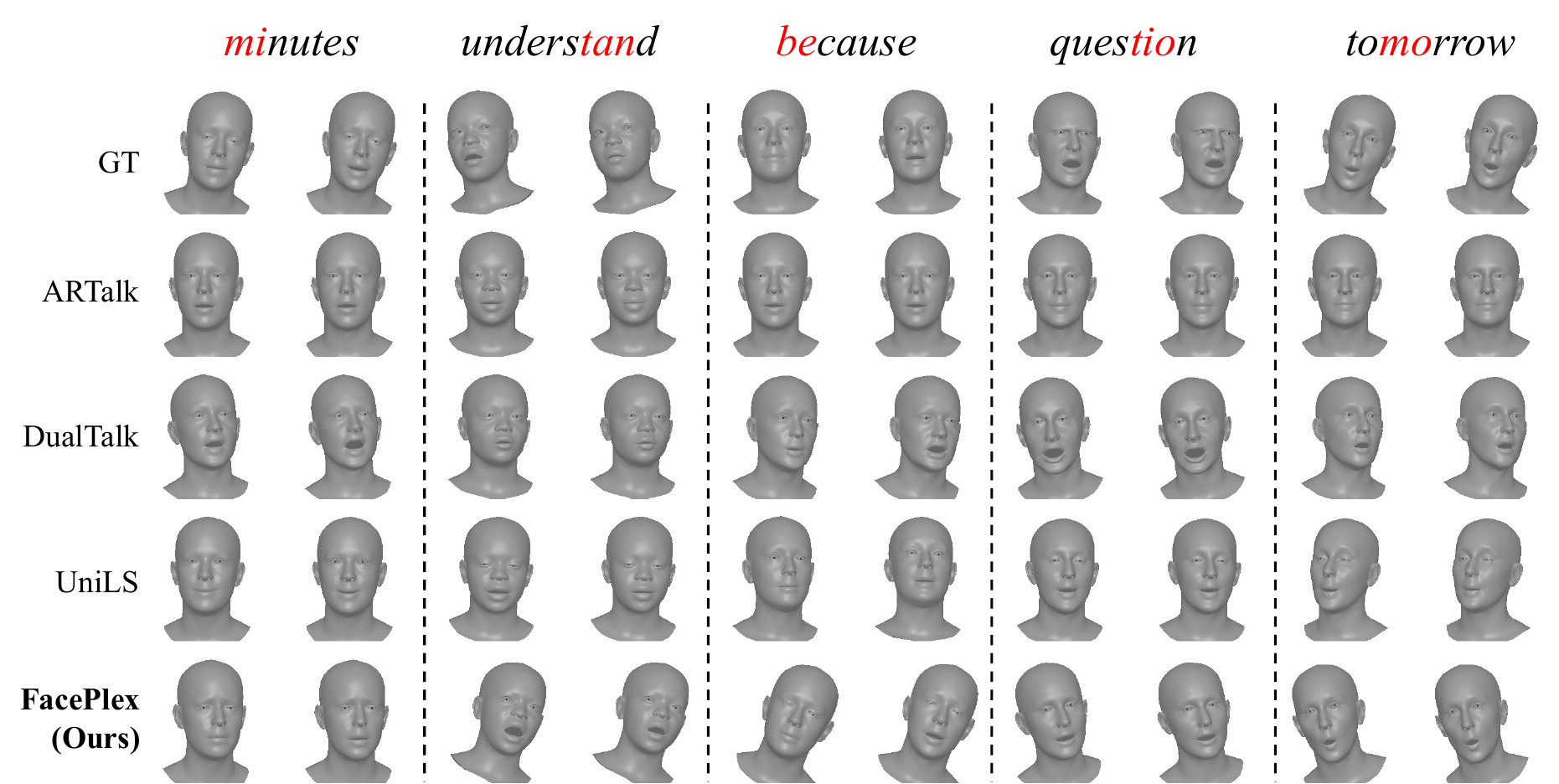
Qualitative comparisons. For each word, the two frames show the 80\,ms audio chunk around the highlighted phonetic segment. FacePlex produces more expressive and speech-consistent motions, with clearer mouth articulation and more natural head movements than prior methods. From FacePlex.
Today's papers converge on a single theme: making digital humans faster, more expressive, and genuinely conversational. From full-duplex avatar systems that speak and animate simultaneously to caching tricks that cut diffusion inference by 4×, from culturally-aware gestures to speech LLMs that generate audio without sacrificing text understanding — the field is moving hard toward real-time, identity-consistent, naturalistically interactive agents.
Talking Avatars, Lip-Sync & Portrait Animation
Generating synchronized speech and facial motion in real time remains a core bottleneck for live conversational avatars; this cluster attacks it from three angles.
Most avatar systems force a choice: generate speech first and animate to it, or animate offline. FacePlex breaks that dichotomy by generating speech audio and facial motion jointly in a streaming fashion. The key technical contribution is Rolling Flow Matching, a mechanism that enables causal, chunk-by-chunk generation while preserving tight speech–facial sync — making true full-duplex conversational avatars feasible for the first time.
FacePlex · 2026-06
FacePlex: Full-Duplex Joint Speech-Facial Motion Generation for Conversational Avatars
FacePlex generates speech and facial motion simultaneously in real-time for conversational avatars, overcoming the limitation of systems that choose between speech-only or pre-computed audio-driven animation. Rolling Flow Matching enables streaming motion generation while maintaining tight speech–facial sync.
Abstract
Natural face-to-face conversation requires real-time speech generation together with synchronized facial motion. Existing systems only partially address this problem: speech-only full-duplex models can generate speech in real time but do not produce facial motion, while audio-driven facial motion models animate a face from already available audio rather than jointly generating speech and motion online. To bridge this gap, we first formalize full-duplex joint speech-facial motion generation, where speech tokens and facial motion tokens are produced together every step. Building on this formulation, we propose FacePlex, a unified streaming framework with two key components. First, Rolling Flow Matching adapts flow matching to online motion generation by committing new motion frames at each streaming step. Second, Rolling Cross-Attention couples the streaming audio queue with the motion queue, allowing speech and facial motion to condition each other as generation progresses. Through extensive experiments, ablation studies, and a user study, we show that FacePlex enables full-duplex joint speech-facial motion generation under online streaming constraints, while achieving stronger lip-sync quality and motion fidelity than audio-driven facial motion baselines.
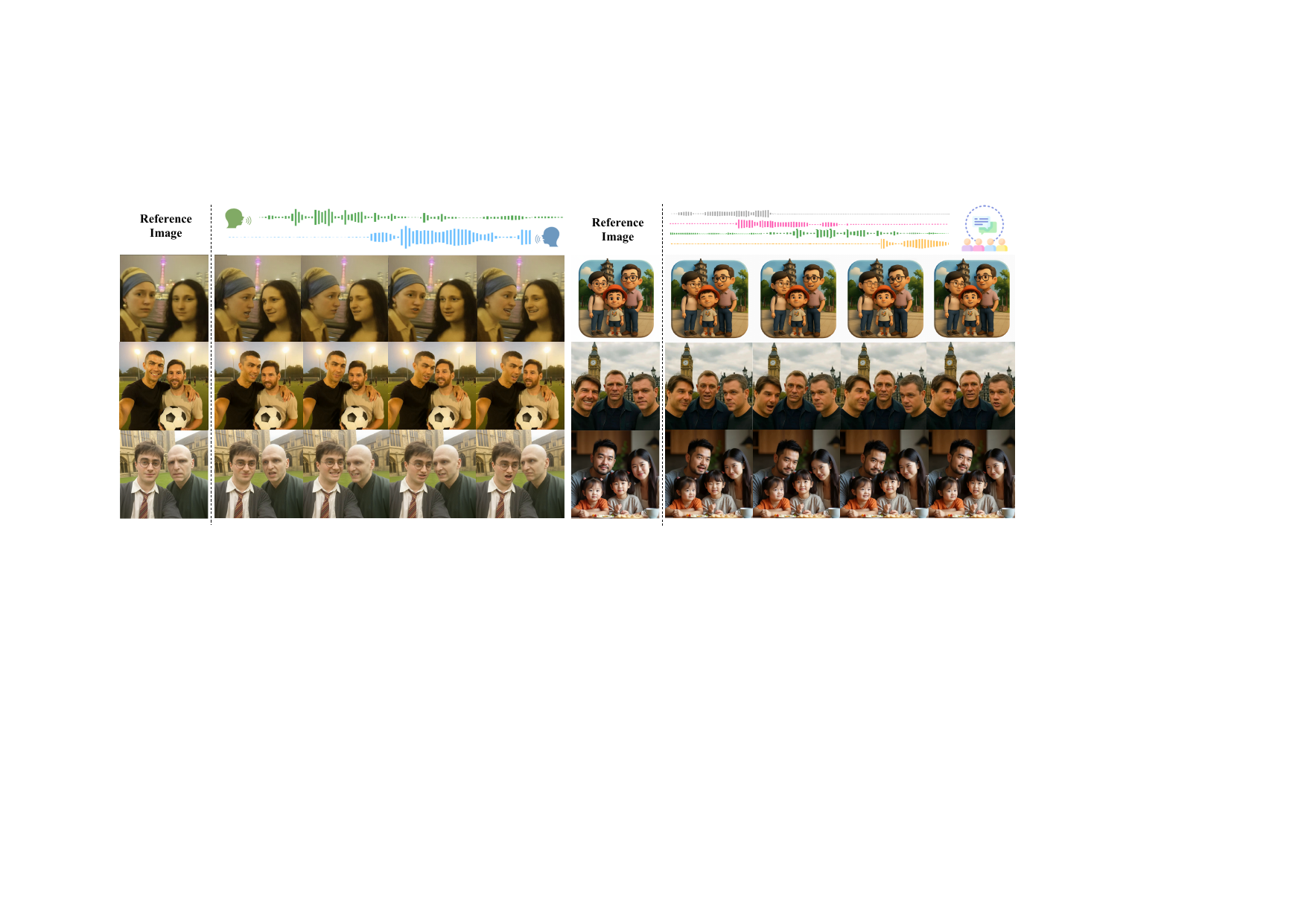
Multi-person conversation adds another layer of complexity: participants need to react to each other in real time without artificial constraints on who can speak or how many people are involved. InterTalk tackles this with motion disentanglement and an iterative generation strategy that progressively refines mutual feedback among participants, yielding flexible, natural, efficient multi-person talking face synthesis with no hard limit on participant count.
InterTalk · 2026-06
Towards Flexible, Natural, Efficient Interaction for Conversational Talking Face Generation
InterTalk enables real-time generation of multi-person conversational talking faces without participant constraints. It balances flexibility, naturalness, and efficiency through motion disentanglement and an iterative generation strategy that progressively refines mutual feedback among participants.
Abstract
Conversational talking face generation has recently attracted increasing attention, aiming to synthesize interactive talking videos where characters speak, listen, and respond dynamically to each other. This task presents three core challenges: 1) Flexibility: enabling multi-round dialogues with an arbitrary number of participants; 2) Naturalness: maintaining coherent motion and appropriate non-verbal feedback throughout the interaction; and 3) Efficiency: achieving real-time generation and low computation overhead for long-term continuous online conversation. Despite recent advances, existing methods still fall short in balancing all three requirements. To bridge this gap, we introduce InterTalk, a novel and efficient framework designed for highly interactive conversational talking face generation. Built upon a motion-based architecture, InterTalk supports real-time conversation synthesis. Our method achieves strong flexibility by explicitly modeling multi-round conversational dynamics among each participant, eliminating constraints on their numbers. To enhance interactivity, we incorporate motion feedback from multiple participants and introduce an iterative generation strategy for more natural behaviors. Besides, we disentangle motion into several facial components, enabling targeted refinements for natural response such as precise lip sync and realistic eye blinking. Finally, we construct a new multi-person conversational dataset and enrich it with 3D face-based data augmentation. Extensive experiments demonstrate that InterTalk achieves superior interaction quality while maintaining real-time performance at 30 FPS.
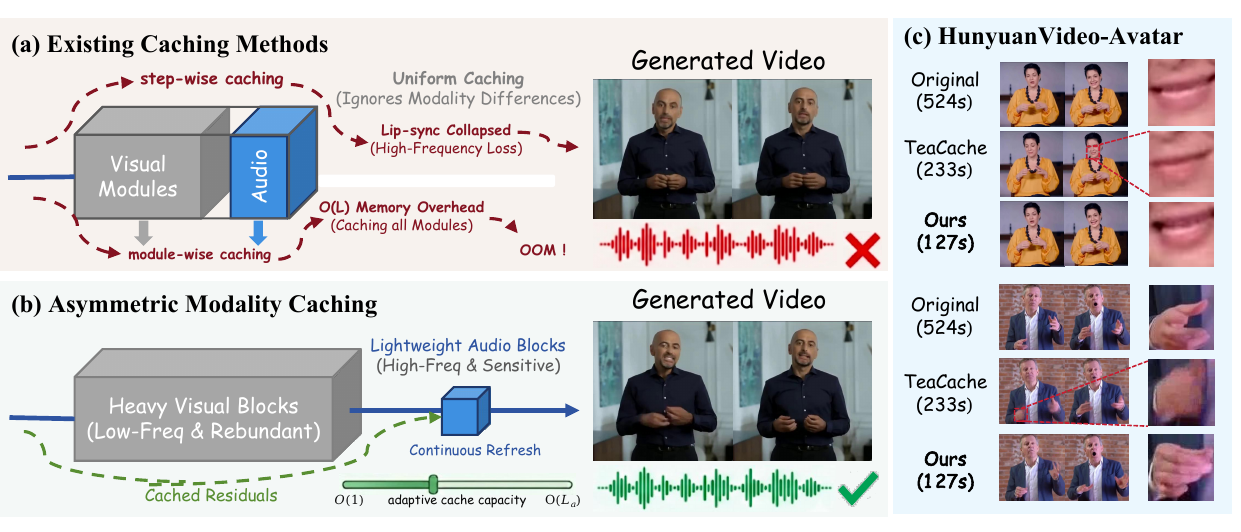
Even when a strong audio-driven portrait model exists, running diffusion transformers at inference is expensive. SyncCache offers a training-free remedy by exploiting an asymmetric dynamics observation: visual feature blocks in the DiT are far more temporally stable than audio-conditioned blocks. Caching the stable visual blocks while continuing to refresh audio blocks yields up to a 4.12× speedup with lip-sync fidelity intact — and it avoids the memory bloat and quality failures that plagued earlier uniform-caching approaches.
SyncCache · 2026-06
SyncCache: Exploiting Asymmetric Dynamics for Fast Audio-Driven Portrait Animation
Training-free caching for audio-driven portrait animation that exploits asymmetric dynamics in diffusion transformers. By caching stable visual blocks while refreshing audio blocks, it achieves up to 4.12× speedup while preserving precise lip sync—addressing memory and fidelity failures of prior caching methods.
Abstract
Diffusion Transformers (DiTs) have significantly advanced audio-driven portrait animation, but their high computational cost leads to substantial inference latency. Although training-free diffusion caching accelerates inference significant, existing methods are primarily developed for text-conditioned generation and overlook the spatial and modality imbalances inherent in audio-driven portrait animation. In this paper, we propose SyncCache, a training-free caching acceleration method tailored for DiT-based portrait animation that explicitly exploits asymmetric dynamics. Specifically, high-frequency dynamics driven by audio conditions and concentrated in human regions are more challenging and critical to cache and reuse than the low-frequency visual background in portrait animation. First, we introduce Spatially-Asymmetric Probing to prioritize error sensitivity in dynamic human region. Second, through Modality-Decoupled Caching, we bypass heavy DiT block by reusing stable inter-block residuals, while continuously recomputing lightweight audio blocks to preserve precise lip synchronization. Furthermore, we introduce a cache ratio to control cache capacity and formulate memory-adaptive cache selection as an offline dynamic programming problem without online overhead. Extensive experiments demonstrate that SyncCache achieves superior speed-quality trade-offs, delivering up to 4.12x acceleration on HunyuanVideo-Avatar and 3.75x on Wan-S2V with near-lossless visual fidelity and precise audio alignment.
Digital Humans & Head/Body Avatars
Reconstructing identity-consistent, animatable avatars from sparse or monocular inputs, with an excursion into culturally grounded gesture.
Reconstructing a high-quality animatable head avatar traditionally requires dense multi-view capture. FFAvatar shows that a feed-forward network operating on sparse portrait images can do it, using alternating attention to cleanly disentangle identity from expression and viewpoint. A sparse-to-dense learning stage followed by motion refinement delivers efficient, identity-consistent 4D head avatars from minimal input.

FFAvatar · 2026-06
FFAvatar: Feed-Forward 4D Head Avatar Reconstruction from Sparse Portrait Images
A feed-forward method for reconstructing animatable 4D head avatars from sparse portrait images with incremental refinement. It uses alternating attention to disentangle identity from expression/viewpoint and combines sparse-to-dense learning with motion refinement for efficient, identity-consistent avatar animation.
Abstract
We present FFAvatar, a Transformer-based 3D Gaussian framework for fast construction of high-quality and animatable 4D head avatars from one or more reference portrait images. Unlike existing feed-forward approaches that require a fixed number of input views, FFAvatar supports incremental reconstruction, progressively refining the avatar representation as additional reference images become available. At the core of our method is an alternating attention mechanism that disentangles identity appearance from expression and viewpoint variations, enabling the reconstruction of a canonical 3D appearance that remains consistent across poses and facial expressions. To balance visual fidelity and computational efficiency, we introduce a sparse-to-dense learning paradigm. Coarse appearance features are first learned using sparse primitives anchored to the FLAME vertex level and are subsequently densified in the UV domain to capture fine-grained geometric and texture details. We further propose a plug-and-play motion refinement module that enables subject-specific dynamic personalization by modeling residual motion beyond parametric deformation. Extensive experiments demonstrate that FFAvatar efficiently produces high-fidelity and controllable 4D head avatars, achieving superior flexibility, driving efficiency, and identity-consistent rendering across diverse expressions and viewpoints.
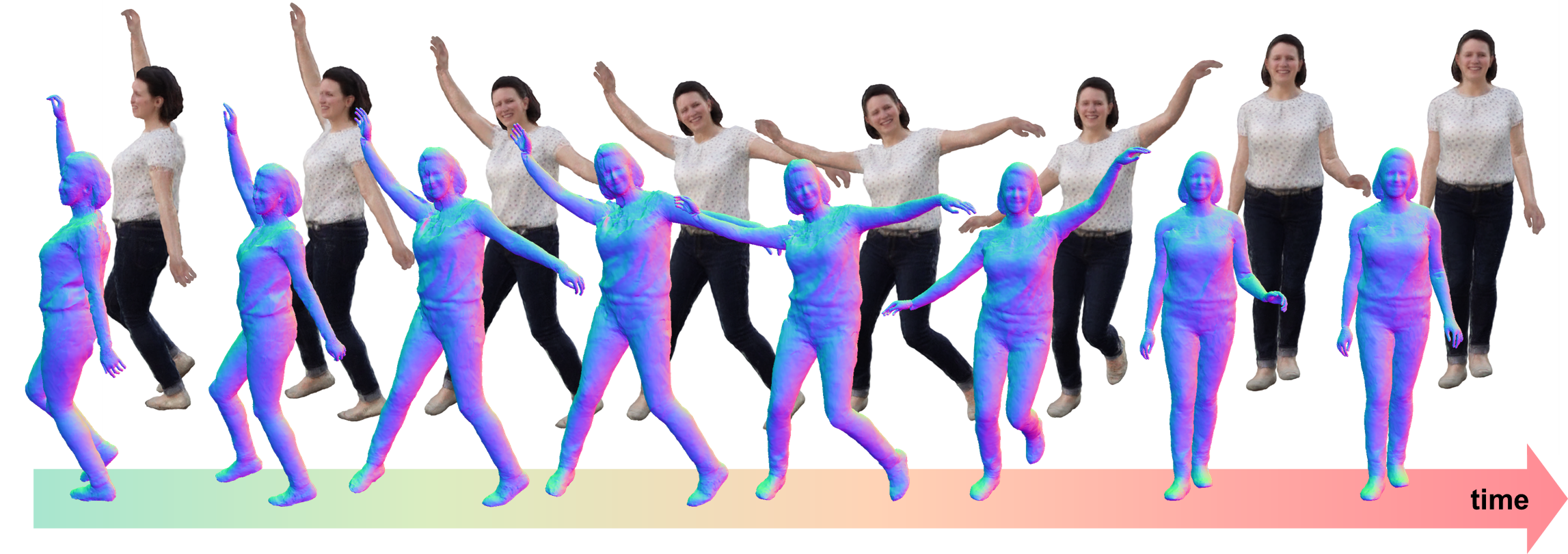
Full-body avatar reconstruction from monocular video is plagued by occlusions and the complex non-rigid dynamics of clothing. JacobianAvatar addresses this with neural Jacobian fields that model semi-rigid deformations, pairing a constrained Poisson solver with a deformation-guided temporal consistency loss to produce avatars that hold together across frames better than prior methods.
JacobianAvatar · 2026-06
JacobianAvatar: Temporally Consistent Semi-rigid Avatar Reconstruction from a Monocular Video
Reconstructs temporally consistent 3D human avatars from monocular video using neural Jacobian fields to model semi-rigid deformations. A constrained Poisson solver and deformation-guided temporal consistency loss address monocular occlusions and clothing dynamics better than prior work.
Abstract
Generating realistic human avatars in complex motions--such as clothing dynamics--requires modeling of global and local deformations which remains challenging in monocular settings. We address this problem by leveraging neural Jacobian fields (NJFs) for representing semi-rigid deformations. We train self-supervised neural networks for predicting Jacobian matrices that give the pose-dependent deformations, by solving a Poisson equation. However, monocular input presents several difficulties such as self-occluded regions and invisible surfaces. To address these issues, we introduce three key components: a constrained Poisson solver, signed distance-based Jacobian regularization, and a deformation-guided residual flow loss, which together suppress boundary artifacts, recover frequently occluded regions such as armpits and thighs, and enforce temporal consistency during motion. Experiments on benchmark and in-the-wild videos demonstrate that our method generates temporally stable and geometrically coherent avatars, outperforming state-of-the-art approaches.
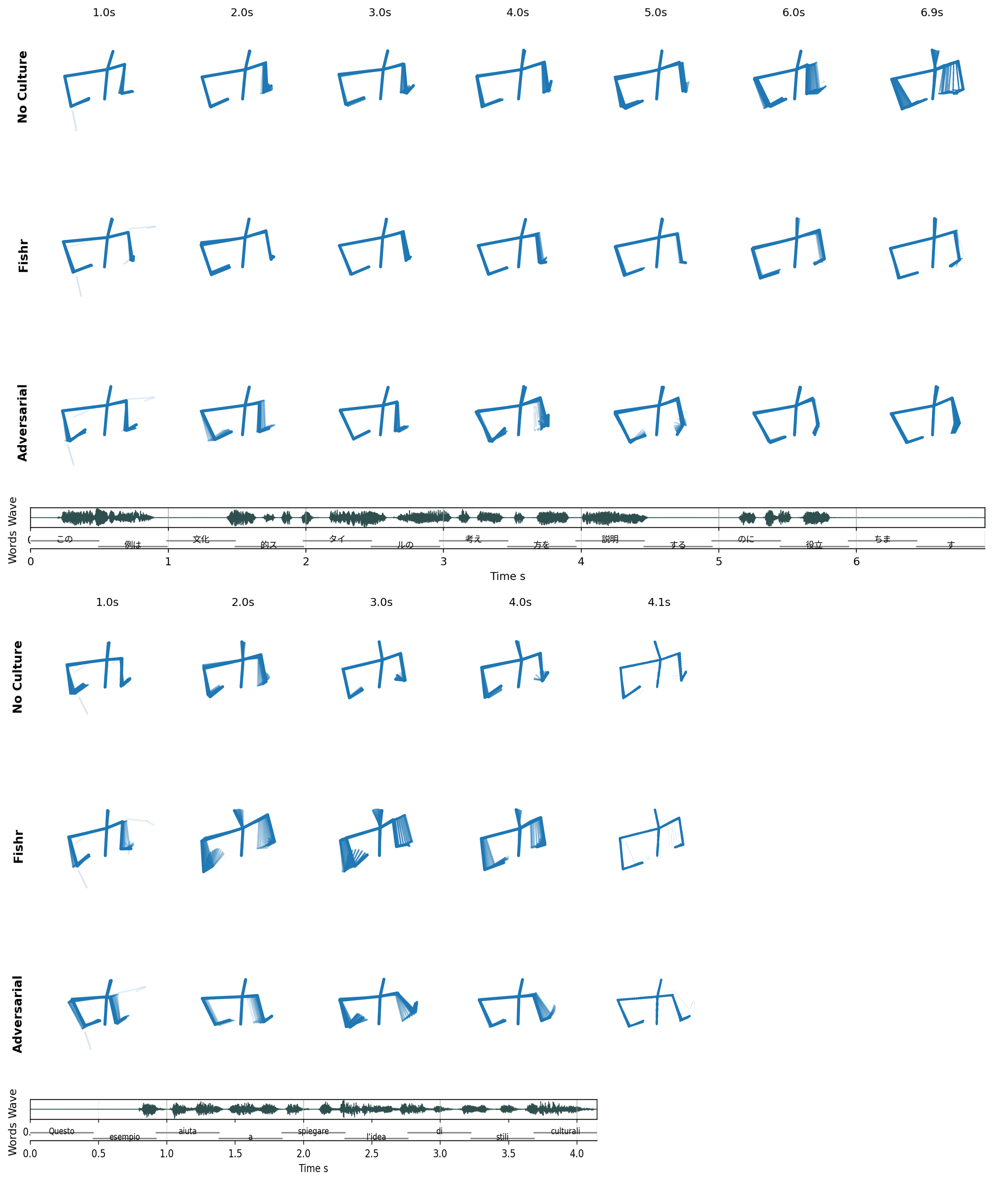
Co-speech gestures carry cultural meaning that most generation systems ignore entirely, or conflate with speaker identity. SICAGE disentangles the two: it learns speaker-independent cultural representations via domain generalization, pairs them with a real-time diffusion generator, and introduces TED4C-L — a new 106-hour multimodal dataset spanning four cultures — to train and evaluate culturally appropriate gesture synthesis.
SICAGE · 2026-06
SICAGE: Speaker-Independent Culture-Aware Gesture Generation using TED4C-L Dataset
SICAGE generates culturally appropriate co-speech gestures by learning speaker-independent cultural representations through domain generalization. It avoids confounding speaker identity with culture and pairs a real-time diffusion generator with TED4C-L, a new 106-hour multimodal dataset spanning four cultures.
Abstract
Recent co-speech gesture generation methods often overlook cultural differences, limiting their effectiveness in human-agent interaction. Moreover, culture-conditioned models are rarely evaluated under speaker-disjoint splits, so apparent "cultural" behavior may be confounded with speaker-specific gesturing style. We introduce SICAGE, a modular framework for culture-aware co-speech gesture generation that conditions motion synthesis models on speaker-independent cultural representations. SICAGE learns these representations from audio and text by treating each speaker as a separate domain while imposing invariance across speakers. This encourages representations to remain culture-discriminative while reducing dependence on speaker identity. The resulting cultural embeddings condition a multimodal generator to produce culturally appropriate gestures. We instantiate this idea with two domain generalization approaches: adversarial learning and Fishr regularization. We further introduce ALaDiT, a real-time diffusion-based gesture generator designed to efficiently incorporate the learned cultural embeddings. To validate our method, we built TED4C-L, a 106-hour multimodal dataset of 764 TED speakers from four cultural groups. Experiments show that SICAGE improves motion realism, diversity, beat synchronization, semantic relevance, and cultural consistency.
other
SpeechLLMs & Spoken Dialogue
Extending text-centric LLMs to spoken interaction without sacrificing their existing capabilities.
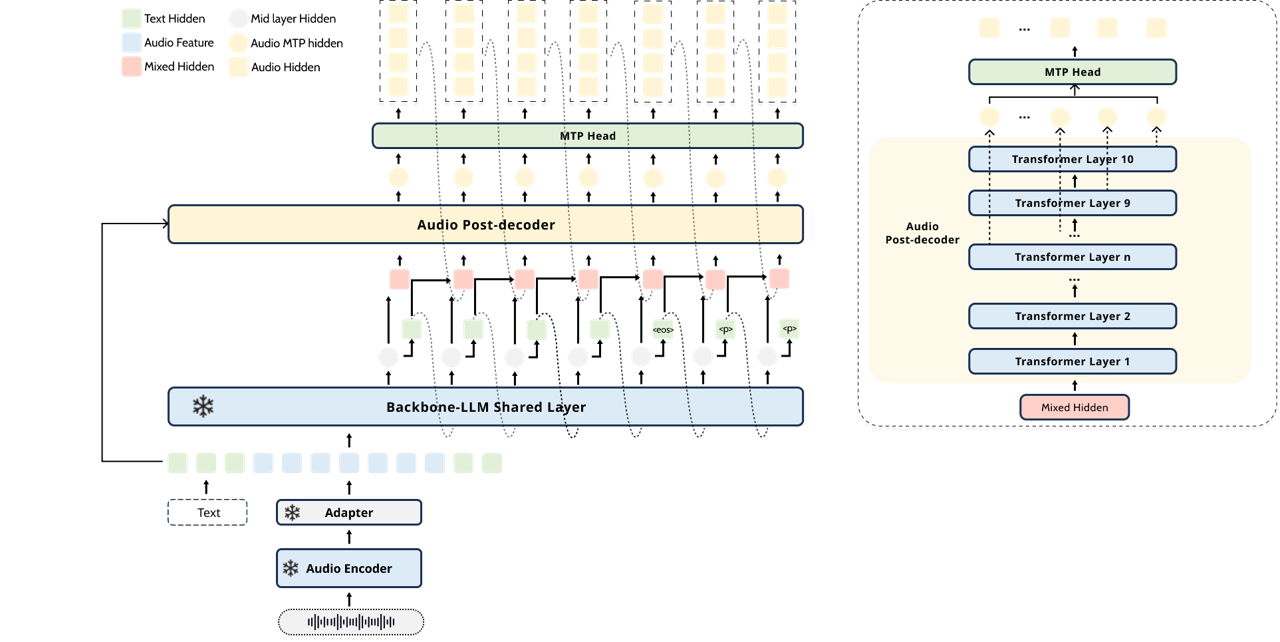
The standard recipe for speech-to-speech LLMs retrofits a TTS module after a frozen text backbone, introducing serial latency and potentially degrading S2T performance. PRIME-Speech takes a different path: it freezes the backbone entirely and attaches a trainable audio post-decoder that synchronizes to intermediate hidden states, enabling concurrent speech generation alongside text decoding. The result preserves the original speech-to-text capabilities while eliminating the serial TTS bottleneck.
PRIME-Speech · 2026-06
Preserving Speech-to-Text LLM Capabilities in Speech-to-Speech Generation
PRIME-Speech converts speech-to-text LLMs into speech-to-speech systems by freezing the backbone and attaching a trainable audio post-decoder synchronized to intermediate hidden states. This enables concurrent speech generation while preserving original S2T capabilities and avoiding serial TTS bottlenecks.
Abstract
Strong speech-to-text (S2T) LLMs already provide robust speech perception and text reasoning, but adding speech-to-speech (S2S) output is challenging: fine-tuning the backbone can degrade the original S2T performance, while attaching a downstream talker reintroduces a serial text-to-speech bottleneck. We present PRIME-Speech, a frozen-backbone S2S conversion framework that trains only speech-generation modules. PRIME-Speech synchronizes a causal audio post-decoder with intermediate hidden states of the frozen backbone, so codec tokens are generated from the model's evolving reasoning trajectory rather than from completed text chunks. The post-decoder uses mixed hidden-state, text, and audio-history conditioning, and a training-time packing strategy with turn-level audio KV-cache and position reset stabilizes multi-turn spoken interaction without additional multi-turn S2S training data. Multi-token prediction further reduces the effective codec prediction rate and improves first-audio latency without modifying the reasoning path. Across speech translation, spoken QA, speech understanding, and multi-turn dialogue, PRIME-Speech preserves the S2T behavior of the frozen backbone while producing accurate, low-WER spoken responses.
TTS & Voice Synthesis
Fine-grained, multi-attribute control over synthesized and edited speech.
Most TTS editing frameworks treat speaker identity, emotion, and phonetic content as separate problems with separate models. UniSAE unifies all three in a single framework by introducing Discrete Phonetic PosteriorGrams (DPPGs) — a factorized discrete token representation that makes phonetic structure directly manipulable. This enables control ranging from sub-phoneme to word level, covering speaker, emotion, and low-level content in one coherent system.

UniSAE · 2026-06
UniSAE: Unified Speech Attribute Editing on Speaker, Emotion and Low-Level Content via Discrete Phonetic Posteriorgram Modelling
UniSAE unifies speaker, emotion, and content editing in one framework with control from sub-phoneme to word level. It introduces Discrete Phonetic PosteriorGrams that factorize speech into discrete tokens, enabling direct phonetic manipulation—a capability absent in prior work treating these attributes separately.
Abstract
Speech editing aims to modify specific portions of an utterance while preserving the remaining speech. Existing approaches primarily focus on word-level content modification and typically treat content, speaker, and emotion editing as separate tasks, limiting both editing granularity and flexibility. We propose UniSAE, a unified speech attribute editing framework which supports composable speaker, emotion and content editing from sub-phoneme to word level within a single architecture. UniSAE introduces a Discrete Phonetic PosteriorGram (DPPG) representation that factorizes speech content into discrete tokens encoding phoneme identity, pronunciation variants, and duration, enabling direct phoneme- and sub-phoneme-level editing. For higher-level modifications, an autoregressive content transformer predicts edited DPPG sequences for word-level content editing. The edited sequences are rendered into speech by a diffusion-based acoustic decoder, conditioned on disentangled speaker and emotion representations. Experimental results demonstrate that the proposed unified framework supports precise speaker and emotion control, content editing at multiple granularities, and joint modification of all three attributes within a single framework.