
Dyadic Avatars, Efficient SpeechLLMs, and Fine-grained TTS Pronunciation
Today's digest covers end-to-end dyadic conversation generation, real-time 3D facial expression synthesis, parameter-space composition for instruction-following speech LLMs, high-throughput audio inference pipelines, and per-word pronunciation control in zero-shot TTS.
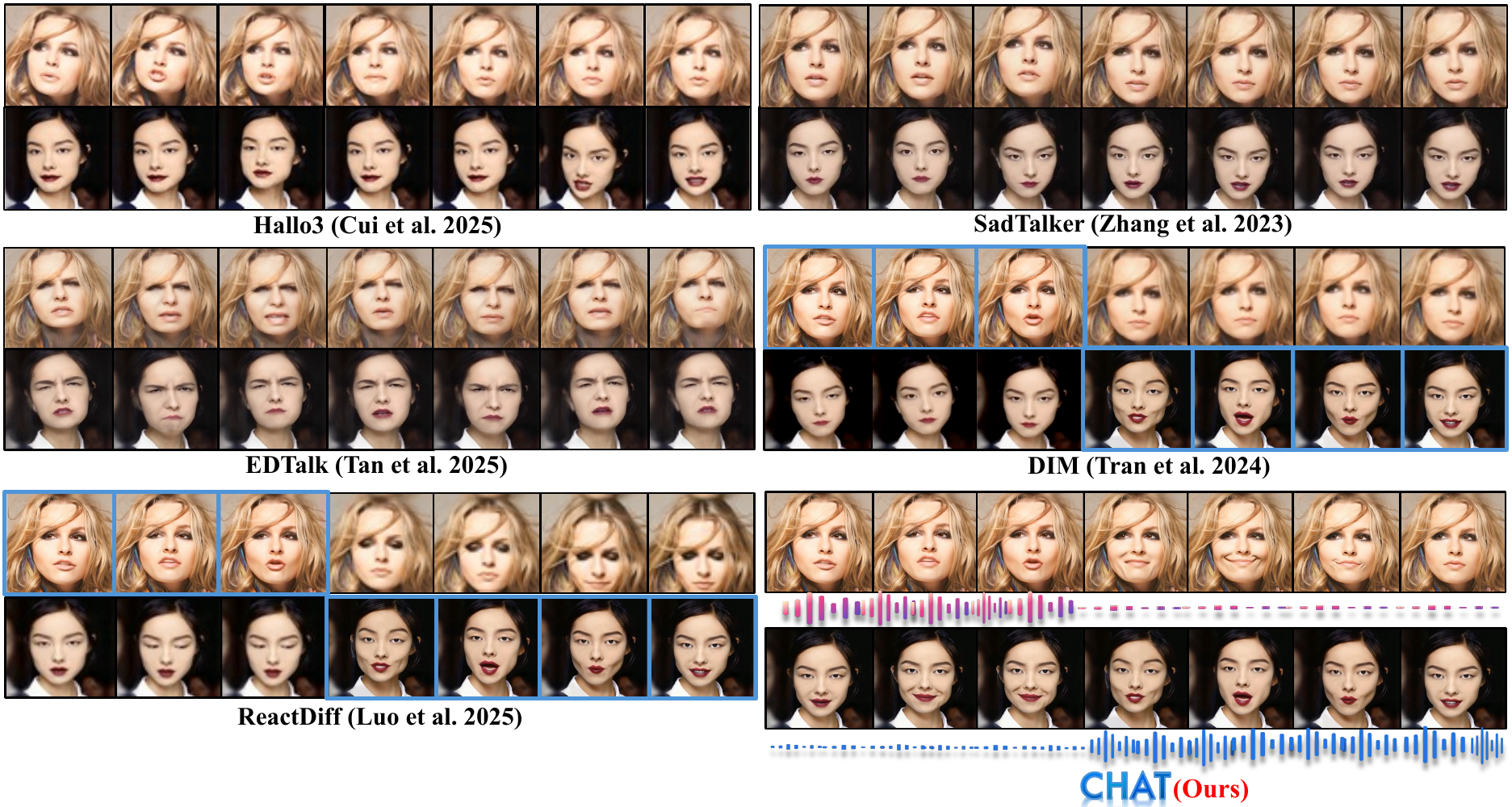
Qualitative comparison. Talking-face methods (Hallo3, EDTalk, SadTalker) used twice yield non-responsive pairs; FRG methods (DIM, ReactDiff) take user-provided speaker video (blue frames). CHAT generates mutually responsive audio-visual dialogue pairs. From CHAT.
Today's five papers push across the full conversational AI stack — from generating entire two-person video conversations out of a text prompt, to real-time expressive face synthesis, to making speech LLMs dramatically cheaper to train and serve, to fine-grained pronunciation control in zero-shot TTS. A productive day across all three layers of the voice-and-avatar pipeline.
Talking Avatars & Audio-Driven Faces
From full dyadic conversations to parametric facial expressions — language-conditioned avatar generation is growing more expressive and interactive.
Generating a realistic two-person video conversation has historically required pre-recorded footage or carefully scripted dialogue. CHAT takes a different route: given only a text prompt describing a scenario, it orchestrates an LLM to produce the dialogue and then feeds each turn into an interactive talking-face generator, so both speakers react to each other's verbal and non-verbal cues in a closed loop.
CHAT · 2026-07
Conversational Human Audio-visual Talking Dialogue Generation
Imperial College London, Department of Computing
CHAT generates mutually responsive dyadic audio-visual conversations from text prompts by combining LLMs with interactive talking-face generation. It produces realistic dialogue pairs where both speakers respond to each other's verbal and non-verbal cues, without requiring pre-scripted dialogues or speaker videos.
Abstract
Large-scale dyadic interactive audio-visual dialogue (DIAD) datasets provide fundamental data resources for developing humanoid interactive virtual agents and digital humans. However, collecting such data is time-consuming, expensive, and ethically sensitive. To address this, we propose CHAT, a new dyadic interactive audio-visual dialogue generation (DIADG) framework that generates diverse, paired, and mutually responsive speech-face dialogue clips from a single textual prompt. CHAT unifies large language models and talking face models with interactive audio and facial behaviour refinement modules, enabling the generation of aligned dyadic dialogue clips with diverse contents and facial identities. Experiments show that CHAT outperforms existing related methods designed for similar tasks under both objective and subjective evaluations. Moreover, our synthesised CHAT-AVD-50k dataset serves as effective pre-training data for downstream interactive head generation, consistently improving PerFRDiff and ReactDiff on REACT 2024. CHAT offers a scalable alternative to the costly and ethically sensitive collection of real dyadic interaction data.
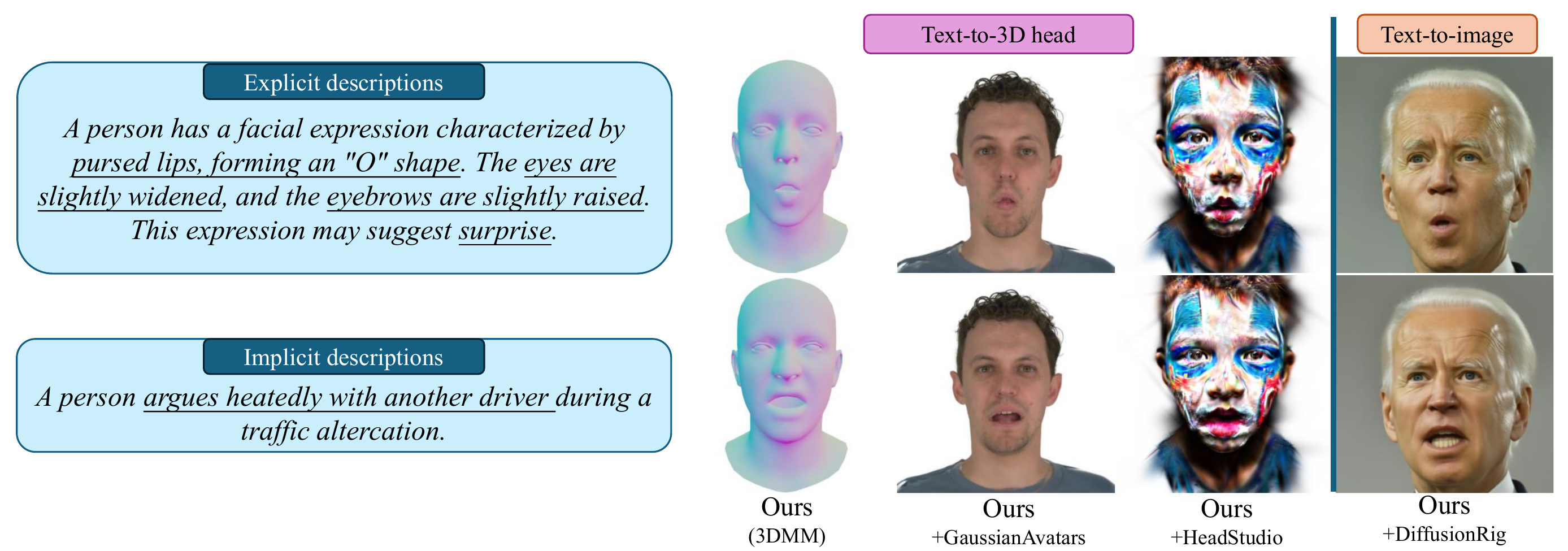
Controlling the expressiveness of a 3D face is a separate hard problem. EmoteGPT tackles it by training a multimodal LLM to directly regress disentangled FLAME parameters from natural language descriptions — both explicit ("raise left eyebrow") and implicit ("she looks surprised"). Unlike diffusion-based approaches, it runs in real time and doesn't need phonetic annotations. The authors also release Txt2Emote, a 30 K-sample benchmark with fine-grained expression annotations to support future work in this space.
EmoteGPT · 2026-07
EmoteGPT: 3D Human Facial Expressions from Natural Language Descriptions
Max Planck Institute for Informatics
EmoteGPT generates 3D facial expressions from text via an MLLM that regresses disentangled FLAME parameters. Unlike diffusion-based methods, it enables real-time control from explicit and implicit descriptions. The work also introduces Txt2Emote, a 30K benchmark with fine-grained expression annotations.
Abstract
Precise control of 3D facial expressions from text is crucial for virtual avatars, animation, and human-computer interaction, yet existing text-to-3D methods jointly generate identity, expression, and texture, making fine-grained expression control difficult. We instead formulate text-driven expression synthesis as a regression problem in the disentangled parameter space of a 3D Morphable Model (3DMM). This setting, however, requires paired data linking detailed language to precise expression parameters, which are missing from existing resources. To fill this gap, we introduce Txt2Emote, a benchmark of diverse 3D facial expressions with fine-grained textual annotations obtained from GPT-4o and a high-fidelity face tracker, providing both explicit descriptions detailing facial features and implicit descriptions referencing the situational context behind the expression. Leveraging this dataset, we present EmoteGPT, a text-to-3D expression framework based on a Multimodal Large Language Model (MLLM) with a dedicated <Expr> token to semantically ground expression representations, which are then decoded into 3DMM parameters. We further improve EmoteGPT by augmenting training with large-scale image-to-3DMM data, enabling it to surpass state-of-the-art text-to-3D face synthesis methods on emotion recognition metrics and in perceived expressiveness. Integrated into avatar pipelines, our method enables photorealistic and stylized 3D avatars, as well as expressive 3D-consistent 2D face synthesis from textual input.
SpeechLLMs & Voice Inference
Two complementary angles on making speech language models practical: cheaper training and faster serving.
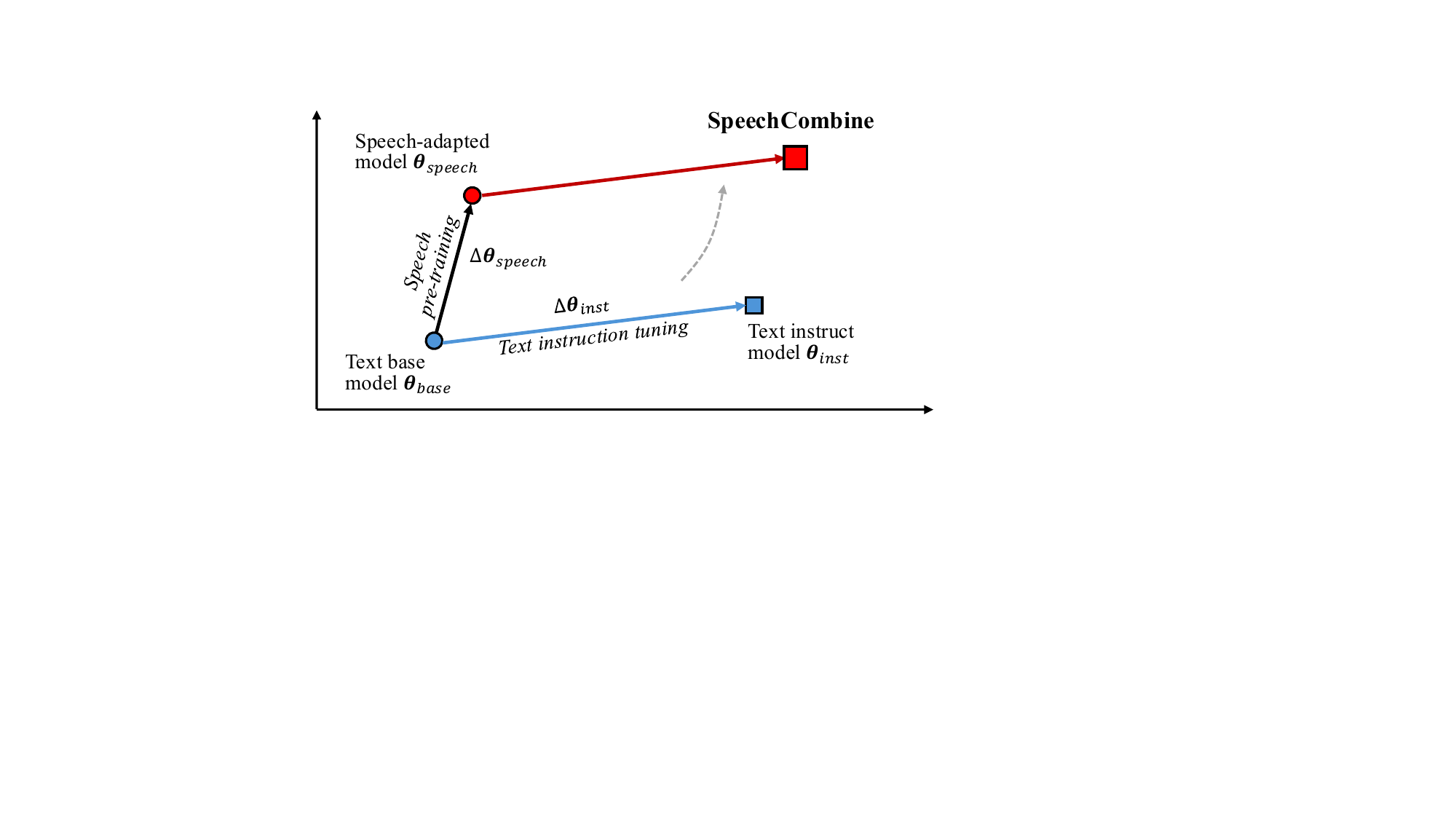
Instruction-following speech LLMs typically require large curated datasets and expensive fine-tuning runs. SpeechCombine sidesteps this entirely by working in parameter space: it computes weight deltas from separately trained text-instruction and speech-domain models, then composes them arithmetically to produce a model that can follow instructions over speech — with 100× less data than conventional instruction-tuning approaches and competitive benchmark results.
SpeechCombine · 2026-07
Unlocking Speech-Text Compositional Powers: Instruction-Following Speech Language Models without Instruction Tuning
University of California, Santa Barbara
An instruction-following speech language model that avoids expensive instruction-tuning by composing weight deltas in parameter space. It transfers instruction-following capability from text LLMs to speech domain, achieving competitive results with 100× less data than existing approaches.
Abstract
Instruction tuning for speech language models (SLMs) is substantially more challenging than for text-based large language models (LLMs), as it requires learning a new modality and a wide range of speech-specific instructions in addition to those supported by text LLMs. Existing SLM training approaches largely replicate the text LLM training paradigm by synthesizing large-scale speech pre-training and instruction-tuning datasets. However, this strategy is difficult to scale, since speech sequences are significantly longer than text sequences. In this paper, we propose SpeechCombine, an instruction-following speech language model trained without any instruction tuning, using only a single round of speech pre-training on 30k hours of data. Starting from a text LLM base model, we perform continuous pre-training on speech utterances to obtain a speech-adapted model, and then directly combine its weights with the weight difference between the instruction-tuned and base versions of the text LLM. Our results show that this simple combination strategy not only preserves the knowledge and capabilities of the original text LLM, but also effectively transfers them to the speech domain. These findings suggest a new direction for SLM training that avoids reliance on massive speech data.
cc-by-nc-4.0
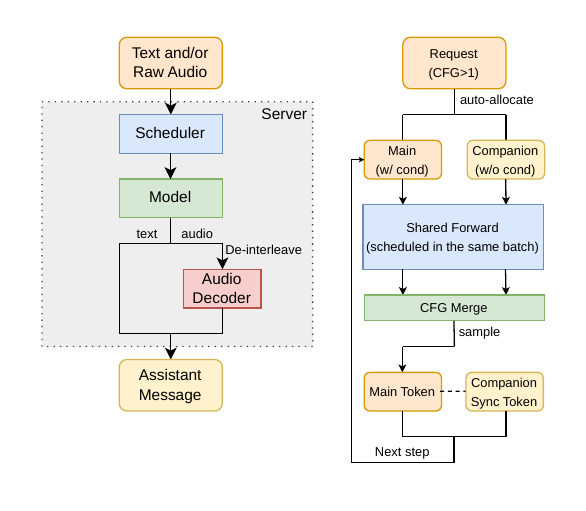
Even after training, unified audio LLMs face a serving bottleneck: classifier-free guidance (CFG) roughly doubles inference cost, and codec decoding adds more GPU pressure. This vLLM-based pipeline addresses both. It introduces multi-stream token generation with delay-pattern de-interleaving for audio codec streams, and a paired co-scheduling strategy that batches conditional and unconditional CFG requests together — sustaining 80 % of non-CFG throughput while keeping on-GPU acoustic decoding end-to-end.
SpeechLM Serving · 2026-07
An Efficient vLLM-Based Inference Pipeline for Unified Audio Understanding and Generation
Carnegie Mellon University
A vLLM-based inference pipeline for unified audio understanding and generation supporting multi-stream token generation with delay-pattern de-interleaving. Paired co-scheduling of conditional and unconditional requests sustains 80% of non-CFG throughput while enabling on-GPU acoustic decoding for end-to-end synthesis.
Abstract
While Large Multimodal Models excel in comprehension, high-throughput inference engines lack native support for multimodal generation. This is severe in Speech Language Models, where generating multi-layered audio tokens via decoupled AR+NAR or synchronous Multi-Token Prediction (MTP) with delay-pattern interleaving conflicts with standard single-stream loops. We present a vLLM-based inference pipeline for unified speech understanding and generation. We extend autoregressive decoding to natively execute delay-pattern de-interleaving and coordinated multi-stream sampling, integrating an on-GPU acoustic decoder for end-to-end waveform synthesis. Crucially, we overcome the shared intuition that Classifier-Free Guidance (CFG) halves throughput. By co-scheduling paired conditional and unconditional requests within a continuous batch, our CFG implementation sustains 80% of non-CFG throughput, absorbing dual-request and logit merging overheads. We open-source our framework.
Apache-2.0
TTS & Voice Synthesis
Fine-grained pronunciation control without phonetic transcriptions — just a short audio clip.
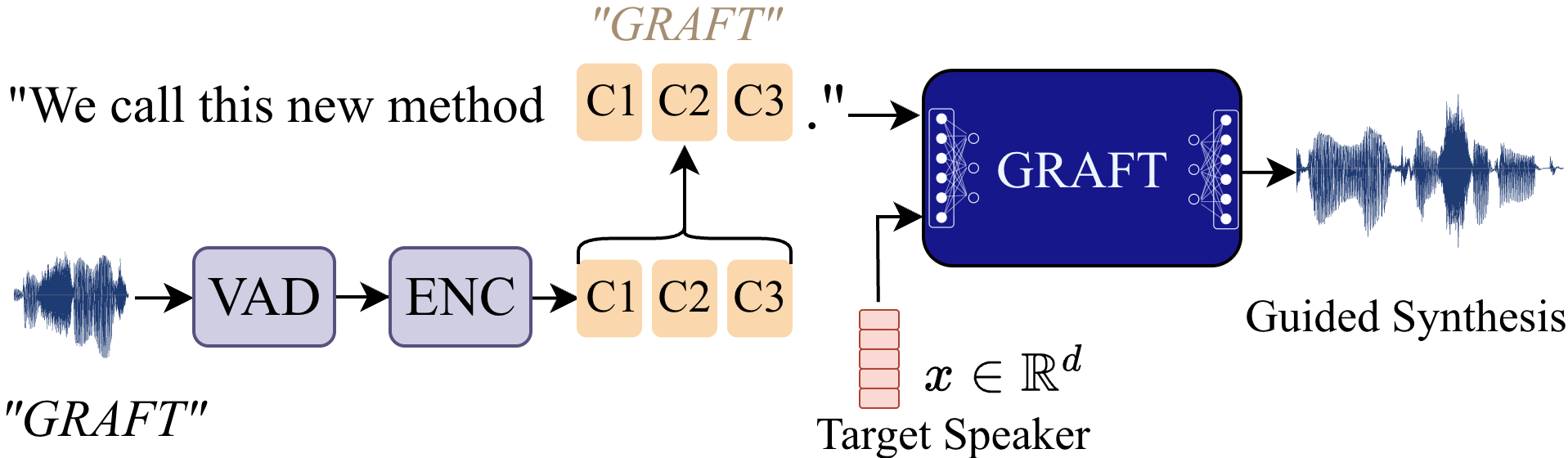
Zero-shot TTS systems handle common words well but struggle with rare proper nouns, technical jargon, or non-native pronunciations that the model has never seen rendered in the target voice. GRAFT solves this with a clean architectural idea: encode a short reference audio clip (from any voice) as acoustic tokens and inject them as a per-word conditioning prompt. A voice-conversion-based training scheme ensures the model learns to copy the pronunciation from the hint while rendering it in the target speaker's voice, with no phonetic transcriptions required at inference time.
GRAFT · 2026-07
GRAFT: Grafted Reference Audio for Fine-grained Pronunciation in Zero-shot Text-to-Speech
AGIGO
GRAFT enables per-word pronunciation control in TTS by conditioning on short audio samples, encoded as acoustic tokens in the prompt. Voice-conversion-based training decouples pronunciation from speaker identity, allowing hints from any voice to render in the target voice without phonetic transcriptions.
Abstract
We present GRAFT, a per-word pronunciation conditioning mechanism for text-to-speech neural codec language modeling. Existing systems reach high intelligibility and naturalness but inherit the ambiguity of text and mispronounce rare proper nouns, loanwords and technical terms. Even phoneme-conditioned models offer no direct acoustic handle for per-word pronunciation. GRAFT controls the pronunciation of a chosen word from a short spoken sample of it, encoded with the model's own speech tokenizer and bound to the word's position in the prompt. Voice conversion during training-data construction disentangles the hint speaker from the target speaker, so the hint may come from any voice while the output stays in the target voice. In a blind English listening study, human raters rank GRAFT first by a clear margin, judging its rendering of the difficult word closest to a reference recording of that word. On a five-language objective benchmark, GRAFT reduces target-word phoneme error rate by 22-39% over the identical text-only backbone and outperforms competitive open-source zero-shot systems, both phoneme- and text-conditioned, on target-word pronunciation, while preserving speaker similarity and naturalness.
Trending on Hugging Face

Qinglin Zhang et al.
OmniFlatten: An End-to-end GPT Model for Seamless Voice Conversation
A novel GPT-based model, OmniFlatten, enables real-time natural full-duplex spoken dialogue through a multi-stage post-training technique that integrates speech and text without altering the original model's architecture.
Abstract
Full-duplex spoken dialogue systems significantly advance over traditional turn-based dialogue systems, as they allow simultaneous bidirectional communication, closely mirroring human-human interactions. However, achieving low latency and natural interactions in full-duplex dialogue systems remains a significant challenge, especially considering human conversation dynamics such as interruptions, backchannels, and overlapping speech. In this paper, we introduce a novel End-to-End GPT-based model OmniFlatten for full-duplex conversation, capable of effectively modeling the complex behaviors inherent to natural conversations with low latency. To achieve full-duplex communication capabilities, we propose a multi-stage post-training scheme that progressively adapts a text-based large language model (LLM) backbone into a speech-text dialogue LLM, capable of generating text and speech in real time, without modifying the architecture of the backbone LLM. The training process comprises three stages: modality alignment, half-duplex dialogue learning, and full-duplex dialogue learning. Throughout all training stages, we standardize the data using a flattening operation, which allows us to unify the training methods and the model architecture across different modalities and tasks. Our approach offers a straightforward modeling technique and a promising research direction for developing efficient and natural end-to-end full-duplex spoken dialogue systems. Audio samples of dialogues generated by OmniFlatten can be found at this web site (https://omniflatten.github.io/).
↑16 · 1 comment · ★ 61,007

Qwen
Qwen3-TTS Technical Report
Qwen
The Qwen3-TTS series presents advanced multilingual text-to-speech models with voice cloning and controllable speech generation capabilities, utilizing dual-track LM architecture and specialized speech tokenizers for efficient streaming synthesis.
Abstract
In this report, we present the Qwen3-TTS series, a family of advanced multilingual, controllable, robust, and streaming text-to-speech models. Qwen3-TTS supports state-of-the-art 3-second voice cloning and description-based control, allowing both the creation of entirely novel voices and fine-grained manipulation over the output speech. Trained on over 5 million hours of speech data spanning 10 languages, Qwen3-TTS adopts a dual-track LM architecture for real-time synthesis, coupled with two speech tokenizers: 1) Qwen-TTS-Tokenizer-25Hz is a single-codebook codec emphasizing semantic content, which offers seamlessly integration with Qwen-Audio and enables streaming waveform reconstruction via a block-wise DiT. 2) Qwen-TTS-Tokenizer-12Hz achieves extreme bitrate reduction and ultra-low-latency streaming, enabling immediate first-packet emission (97,ms) through its 12.5 Hz, 16-layer multi-codebook design and a lightweight causal ConvNet. Extensive experiments indicate state-of-the-art performance across diverse objective and subjective benchmark (e.g., TTS multilingual test set, InstructTTSEval, and our long speech test set). To facilitate community research and development, we release both tokenizers and models under the Apache 2.0 license.
↑77 · 5 comments · ★ 12,349

Fish Audio
Fish Audio S2 Technical Report
Fish Audio
Fish Audio S2 is an open-source text-to-speech system with multi-speaker capabilities, multi-turn generation, and instruction-following control through natural-language descriptions, utilizing a multi-stage training approach and production-ready inference engine.
Abstract
We introduce Fish Audio S2, an open-sourced text-to-speech system featuring multi-speaker, multi-turn generation, and, most importantly, instruction-following control via natural-language descriptions. To scale training, we develop a multi-stage training recipe together with a staged data pipeline covering video captioning and speech captioning, voice-quality assessment, and reward modeling. To push the frontier of open-source TTS, we release our model weights, fine-tuning code, and an SGLang-based inference engine. The inference engine is production-ready for streaming, achieving an RTF of 0.195 and a time-to-first-audio below 100 ms.Our code and weights are available on GitHub (https://github.com/fishaudio/fish-speech) and Hugging Face (https://huggingface.co/fishaudio/s2-pro). We highly encourage readers to visit https://fish.audio to try custom voices.
↑38 · 2 comments · ★ 31,200

Wei Deng et al.
IndexTTS: An Industrial-Level Controllable and Efficient Zero-Shot Text-To-Speech System
IndexTTS, an enhanced text-to-speech system combining XTTS and Tortoise models, offers improved naturalness, enhanced voice cloning, and controllable usage through hybrid character-pinyin modeling and optimized vector quantization.
Abstract
Recently, large language model (LLM) based text-to-speech (TTS) systems have gradually become the mainstream in the industry due to their high naturalness and powerful zero-shot voice cloning capabilities.Here, we introduce the IndexTTS system, which is mainly based on the XTTS and Tortoise model. We add some novel improvements. Specifically, in Chinese scenarios, we adopt a hybrid modeling method that combines characters and pinyin, making the pronunciations of polyphonic characters and long-tail characters controllable. We also performed a comparative analysis of the Vector Quantization (VQ) with Finite-Scalar Quantization (FSQ) for codebook utilization of acoustic speech tokens. To further enhance the effect and stability of voice cloning, we introduce a conformer-based speech conditional encoder and replace the speechcode decoder with BigVGAN2. Compared with XTTS, it has achieved significant improvements in naturalness, content consistency, and zero-shot voice cloning. As for the popular TTS systems in the open-source, such as Fish-Speech, CosyVoice2, FireRedTTS and F5-TTS, IndexTTS has a relatively simple training process, more controllable usage, and faster inference speed. Moreover, its performance surpasses that of these systems. Our demos are available at https://index-tts.github.io.
↑7 · ★ 21,760

Microsoft Research
VibeVoice Technical Report
Microsoft Research
VibeVoice synthesizes long-form multi-speaker speech using next-token diffusion and a highly efficient continuous speech tokenizer, achieving superior performance and fidelity.
Abstract
This report presents VibeVoice, a novel model designed to synthesize long-form speech with multiple speakers by employing next-token diffusion, which is a unified method for modeling continuous data by autoregressively generating latent vectors via diffusion. To enable this, we introduce a novel continuous speech tokenizer that, when compared to the popular Encodec model, improves data compression by 80 times while maintaining comparable performance. The tokenizer effectively preserves audio fidelity while significantly boosting computational efficiency for processing long sequences. Thus, VibeVoice can synthesize long-form speech for up to 90 minutes (in a 64K context window length) with a maximum of 4 speakers, capturing the authentic conversational ``vibe'' and surpassing open-source and proprietary dialogue models.
↑174 · 10 comments · ★ 50,010