
Real-Time Avatars, Emotional Voice Control, and Proactive Dialogue
Today's digest covers speech-driven real-time avatar generation at 42 FPS, zero-shot emotional voice conversion via natural-language instructions, and a proactive thinking framework that cuts LLM response latency without extra training.
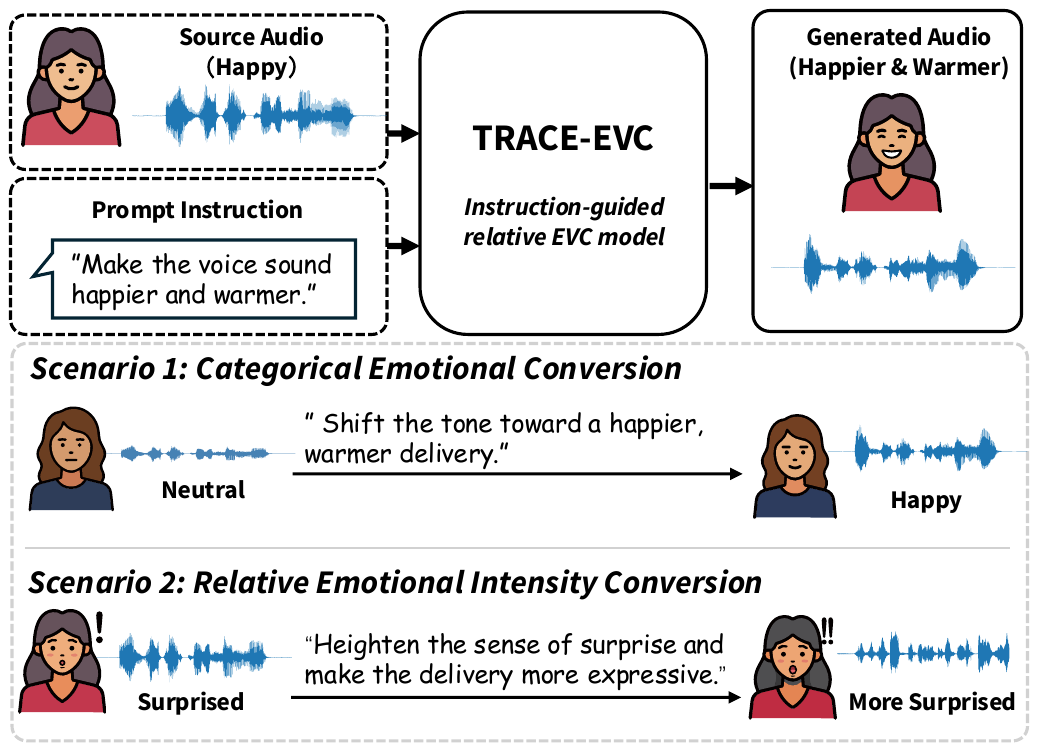
Illustration of the instruction-guided relative EVC task. The instruction specifies how the source emotion should change rather than a fixed target. From TRACE-EVC.
Today's papers push the frontier of interactive, expressive AI communication — from animating digital characters with your voice in real time, to reshaping the emotion of a spoken utterance with a text prompt, to making dialogue agents think ahead so they're ready to reply the instant you stop talking.
Talking Avatars & Real-Time Digital Humans
When video generation meets voice control at consumer GPU speeds.
Real-time interactive avatar systems have long required a painful trade-off between visual quality and latency. Vidu S1 demolishes that trade-off, delivering infinite-length, speech-driven animation of real people, anime characters, and custom avatars at 42 FPS on consumer-grade GPUs — with no temporal drift or visual artifacts. Coming from today's Hugging Face Daily tab (97 upvotes), it's one of the more striking demos to land this week: the model couples efficient real-time inference directly with speech-driven character control, a combination that has largely eluded prior work.

Vidu S1: A Real-Time Interactive Video Generation Model
Vidu S1 is a real-time interactive video generation model that supports voice-controlled digital character animation with infinite-length output and high frame rate on consumer hardware.
Abstract
We introduce Vidu S1, a real-time interactive video generation model supporting voice control of digital characters. Users can control video generation content at any moment through voice instructions. Vidu S1 supports infinite-length real-time video generation without blurring, drift, or visual distortion. Built with TurboDiffusion and TurboServe, Vidu S1 outputs 540p real-time videos at up to 42 FPS on regular consumer GPUs. Users can upload custom images of real people, anime, and pets, and choose different voice tones for personalized experiences. Experiments show that Vidu S1 achieves the best performance across all test metrics while fully meeting real-time inference requirements. A playable online demo is available at https://vidu.com/vidu-stream.
Voice Conversion & Emotional Speech
Natural-language descriptions as a dial for emotional expression.
Most emotional voice conversion systems ask you to pick a fixed target emotion — "angry," "happy," "sad." TRACE-EVC takes a more intuitive route: you describe the relative affective transformation you want in plain text ("sound a bit warmer and less tense"), and the zero-shot framework handles the rest. By grounding emotional control in natural-language instructions rather than discrete labels, TRACE-EVC enables fine-grained, compositional adjustments while preserving the original speaker's identity and overall speech quality — no reference audio of the target emotion required.
TRACE-EVC: Text-Guided Relative Affective Control for Zero-Shot Emotional Voice Conversion
A zero-shot emotional voice conversion framework guided by natural-language instructions that specify relative affective transformations rather than fixed targets. This enables intuitive control over emotional modifications while preserving speaker identity and speech quality.
Abstract
Traditional emotional voice conversion (EVC) conditions generation on explicit target emotions like labels or references, defining the target affective state but omitting the direction or nature of the transition. We introduce instruction-guided relative emotional voice conversion, a task where natural-language instructions specify source-conditioned affective transformations (e.g., "make the speech slightly calmer" or "sound noticeably more confident") instead of fixed targets. To support this task, we construct TRACE-Instruct, a dataset of relative emotion instructions covering categorical transitions, intensity modifications, and open-ended affective changes. We propose TRACE-EVC, a zero-shot framework built around Emo-Compass, a module that models each conversion as a source-anchored rectified flow. Rather than conditioning on an explicit target, it predicts the direction and degree of the affective change. Experiments demonstrate that TRACE-EVC accurately follows relative emotion instructions while preserving speaker identity, linguistic content, and speech quality, and remains competitive with conventional EVC systems on standard categorical emotion conversion.
Real-Time Spoken Dialogue & Voice Agents
Shifting LLMs from reactive responders to anticipatory thinkers.
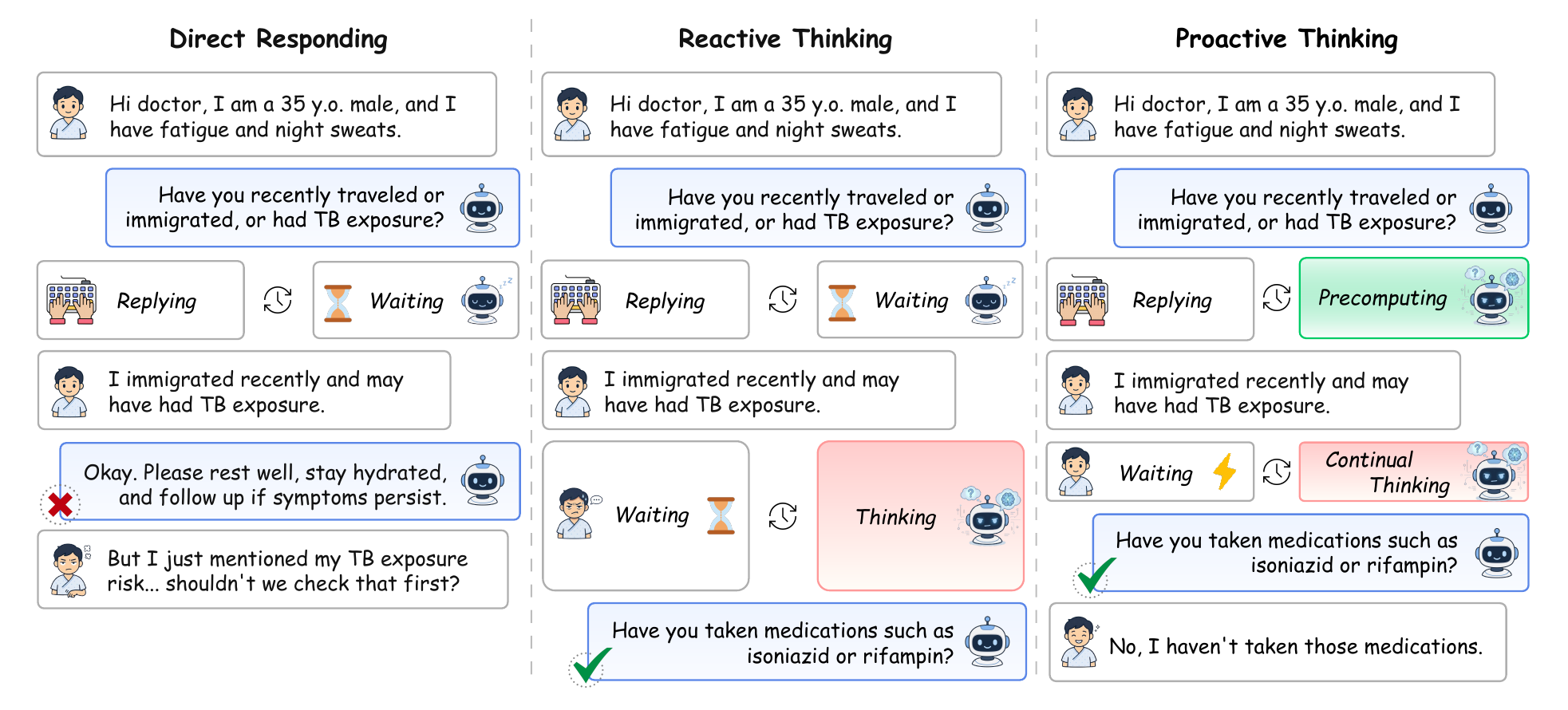
Even the fastest streaming LLM still waits until you finish speaking before it starts reasoning. The Proactive Thinking framework flips that assumption: it lets the model pre-compute response elements during conversational downtime — the pauses, turn-taking gaps, and listening periods inherent in natural dialogue. The approach mimics human anticipatory cognition, reducing end-to-end latency while maintaining the quality of thoughtful, coherent replies. Crucially, it requires no additional training, making it a drop-in strategy for existing dialogue LLMs.
Don't Wait to Reply: Towards Responsive yet Thoughtful Dialogue through Proactive Thinking
This framework enables LLMs to pre-compute response elements during conversational downtime, mimicking human anticipation patterns. By shifting from reactive to proactive reasoning, it reduces latency while maintaining thoughtful dialogue quality without requiring additional training.
Abstract
Thinking has emerged as a critical capability for Large Language Models (LLMs) tackling complex tasks. However, its reactive nature, where reasoning is passively triggered only upon receiving a user response, inevitably introduces latency that compromises conversational fluidity. This stands in sharp contrast to human dialogue, where speakers proactively anticipate and plan future content during natural pauses to ensure seamless interaction. To bridge this gap, we propose Proactive Thinking, a framework that empowers models to pre-compute potential response elements during conversational downtime instead of waiting idly for the next input. We then introduce a training-free baseline that can think ahead by anticipating future states, balancing efficiency and quality through speculative continual thinking. To evaluate this approach in practice, we adapt three benchmarks of varying complexity into time-aware environments that simulate real-time conversational flow. We demonstrate that proactive thinking effectively improves interaction efficiency without compromising performance. Ultimately, this work advocates for a fundamental shift toward more intelligent, anticipatory, and real-time conversational AI.
Trending on Hugging Face

OmniFlatten: An End-to-end GPT Model for Seamless Voice Conversation
A novel GPT-based model, OmniFlatten, enables real-time natural full-duplex spoken dialogue through a multi-stage post-training technique that integrates speech and text without altering the original model's architecture.
FunAudioLLM: Voice Understanding and Generation Foundation Models for Natural Interaction Between Humans and LLMs
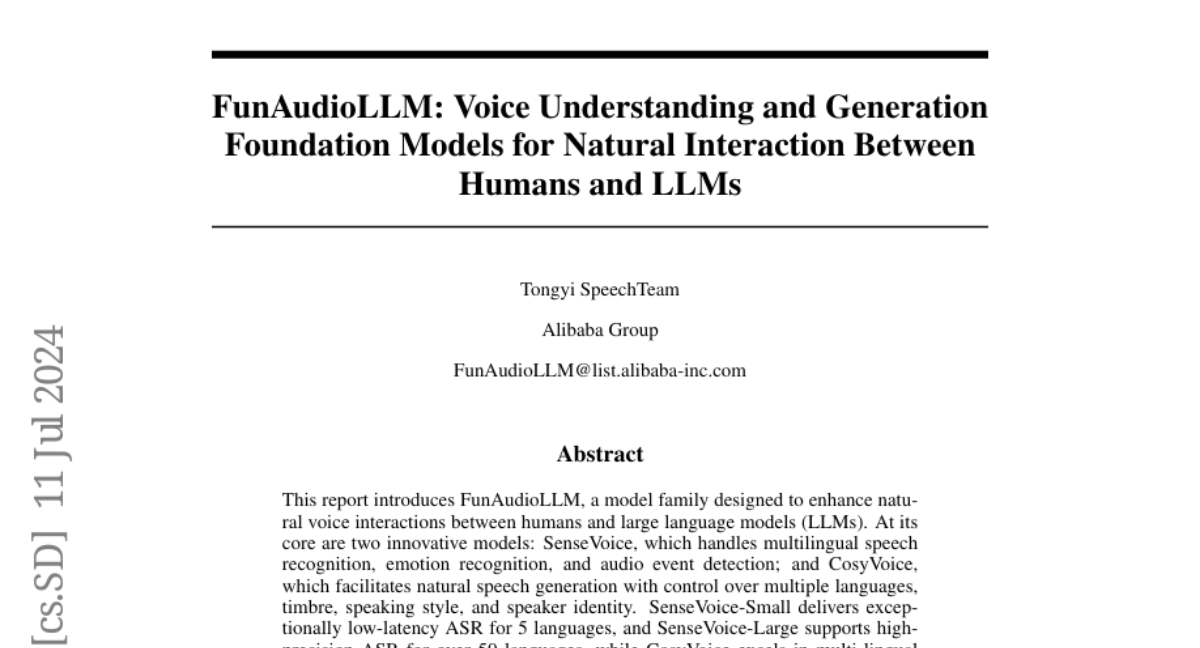
FunAudioLLM enhances voice interactions by integrating SenseVoice for multilingual speech recognition, emotion detection, and audio event detection with CosyVoice for natural speech generation across languages, timbres, and styles.

Qwen3-TTS Technical Report
The Qwen3-TTS series presents advanced multilingual text-to-speech models with voice cloning and controllable speech generation capabilities, utilizing dual-track LM architecture and specialized speech tokenizers for efficient streaming synthesis.

Fish Audio S2 Technical Report
Fish Audio S2 is an open-source text-to-speech system with multi-speaker capabilities, multi-turn generation, and instruction-following control through natural-language descriptions, utilizing a multi-stage training approach and production-ready inference engine.