
Unified Audio LLMs, Full-Duplex Dialogue Data, and Test-Time Scaling for ASR
Today's digest covers unified audio-text LLMs, benchmarks for streaming conversational naturalness, large-scale full-duplex dialogue data construction, controllable speaker synthesis from text profiles, and test-time scaling for ASR — a broad sweep across the speech AI stack.

Figure from From NVIDIA.
Today's papers push on several fronts at once: making audio LLMs smarter without sacrificing text reasoning, measuring whether streaming voice models actually feel natural in conversation, mining podcasts for full-duplex training data, and scaling ASR at test time with almost no extra parameters. Here's the full rundown.
SpeechLLMs & Spoken Dialogue
From unified audio-text models to full-duplex data pipelines and instruction-following benchmarks — the spoken dialogue stack is maturing fast.
A persistent tension in audio LLMs is that routing audio through a separate pathway tends to erode the backbone's text capabilities. NVIDIA's Audex attacks this head-on by projecting audio directly into the text embedding space, enabling seamless multimodal generation without a hard modality boundary. The result is state-of-the-art performance on audio understanding, ASR, and TTS while fully preserving the backbone LLM's reasoning and knowledge — a rare trifecta.
Unified Audio Intelligence Without Regressing on Text Intelligence
Audex is a unified audio-text LLM that projects audio into the text embedding space for seamless multimodal generation without degrading text intelligence. It achieves state-of-the-art audio understanding, speech recognition, and TTS while fully preserving the backbone LLM's reasoning and knowledge capabilities.
Abstract
Audio intelligence involves understanding, reasoning about, and generating both audio and speech. In this work, we introduce Nemotron-Labs-Audex-30B-A3B (Audex), a unified audio-text LLM built on Nemotron-Cascade-2-30B-A3B, a strong text-only MoE LLM. Audex adopts a simple unified design with a single Transformer decoder: audio inputs are encoded and projected into the text embedding space, while text tokens and quantized audio output tokens are treated uniformly during generation. This architecture enables strong audio-text fusion, seamless multimodal generation, and compatibility with standard LLM training and inference infrastructure. For training, we meticulously curate audio-text datasets comprising 157.4B audio tokens and 320.5B text tokens. We apply multi-stage supervised training on these datasets, followed by text-only Cascade RL and multi-domain on-policy distillation. Audex delivers state-of-the-art audio understanding, speech recognition and translation, text-to-speech, audio generation, and speech-to-speech generation, while preserving very compelling reasoning, alignment, knowledge, long-context, and agentic capabilities of its text-only LLM backbone with marginal or no regression. We release the model checkpoints to facilitate open research.
High speech quality scores don't tell you whether a voice model actually behaves like a human in conversation. Meta AI's SPEARBench fills this gap with a naturalness benchmark for streaming speech-to-speech LMs that evaluates turn-taking timing, overlap handling, emotion, dialect, and relational stance — dimensions that standard benchmarks completely miss. Their findings are sobering: models can score well on speech quality while diverging substantially from human conversational behavior.
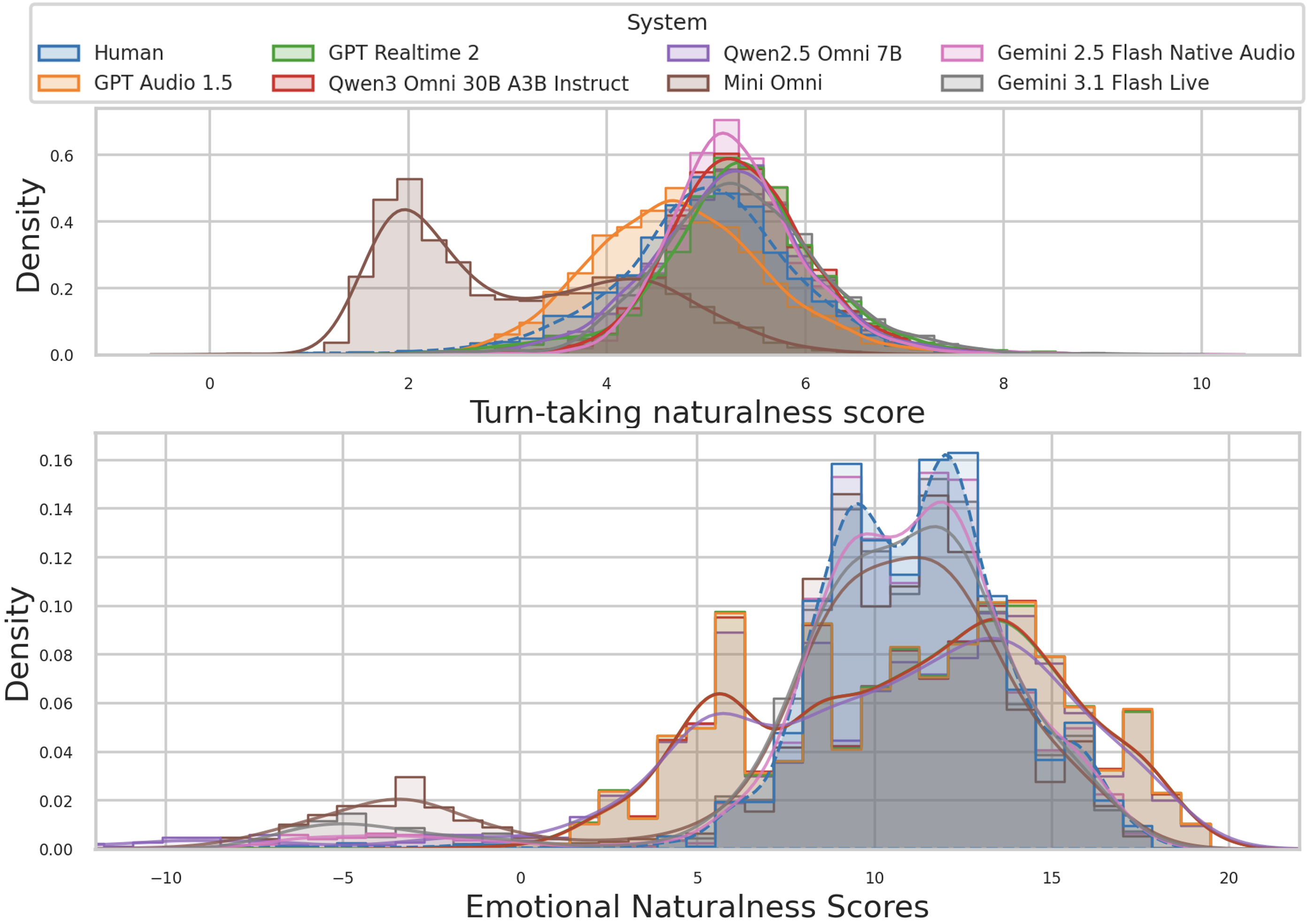
SPEARBench: A Benchmark for Naturalness Evaluation in Streaming Speech-to-Speech Language Models
SPEARBench evaluates naturalness in streaming speech-to-speech models across conversational dimensions—turn-taking, emotion, dialect, and stance—that standard benchmarks overlook. It reveals models can achieve high speech quality while diverging from human behavior in timing, overlap, and relational appropriateness.
Abstract
Streaming speech-to-speech language models aim to answer spoken queries directly with synthetic speech. However, standard speech and text benchmarks do not capture whether these systems behave naturally in conversations, where timing, turn-taking, prosody, interpersonal stance, language and dialect consistency, and relationship-aware appropriateness jointly shape perceived quality. We introduce SPEARBench, a benchmark for evaluating naturalness in speech-to-speech language models from question-answer interactions. SPEARBench constructs controlled dialogue prompts from the Seamless Interaction corpus, runs inference across multiple models, and evaluates generated answers using a multidimensional protocol that covers response latency, interruptions, speech quality, ASR robustness, language and dialect consistency, emotional naturalness, interpersonal stance, and explainable distributional baselines. The benchmark includes original human answers as a reference condition and reports results for several contemporary models. Results show that current models can achieve high signal-level quality and low ASR error while still differing from human conversational behavior in latency, overlap, dialect preservation, emotional adaptation, and interpersonal stance dynamics.
Training full-duplex spoken dialogue models requires speaker-separated, monaural two-channel recordings — data that is extremely scarce. The University of Tokyo's DuplexChat addresses this by building a scalable pipeline that harvests two-speaker clips from podcasts using speech separation and diarization, producing realistic dialogue with natural turn-taking dynamics at scale. This is the kind of infrastructure paper that quietly enables a generation of follow-on research.

DuplexChat: Constructing Speaker-Separated Full-Duplex Dialogue Speech at Scale for Spoken Dialogue Language Modeling
DuplexChat constructs speaker-separated full-duplex dialogue speech from podcasts at scale, addressing the lack of monaural training data. The pipeline extracts two-speaker clips with speech separation and diarization to enable training realistic spoken dialogue models with natural turn-taking dynamics.
Abstract
Full-duplex spoken dialogue models are trained on conversational speech in which each speaker is represented as a separate stream, but existing large-scale public speech corpora are mostly monaural, making them unsuited for SDLM training. We present DuplexChat, an open-source corpus for full-duplex spoken dialogue models, and DuplexChat-Pipe, a pipeline for constructing speaker-separated full-duplex dialogue speech from public podcast feeds. DuplexChat-Pipe filters language-specific podcast feeds, retrieves and cleans episode audio, extracts diarization-guided two-speaker dialogue clips, and applies speech separation and restoration to produce one channel per speaker. Running this pipeline yields a speaker-separated spoken dialogue corpus covering 282,634 hours of English and 132,723 hours of Japanese. Analysis results on DuplexChat show that it contains turn-taking dynamics present in human dialogues.
On the instruction-following side, NAVER LABS describes their system re-implementation for the IWSLT 2026 Instruction-Following Task, adapting a staged alignment + LoRA fine-tuning protocol to a new backbone pairing: a SeamlessM4T-v2 encoder with a Qwen3 LLM. They also synthesize 100k instruction examples spanning ten speech-centric task types, demonstrating how training recipes can be efficiently ported across architectural generations.
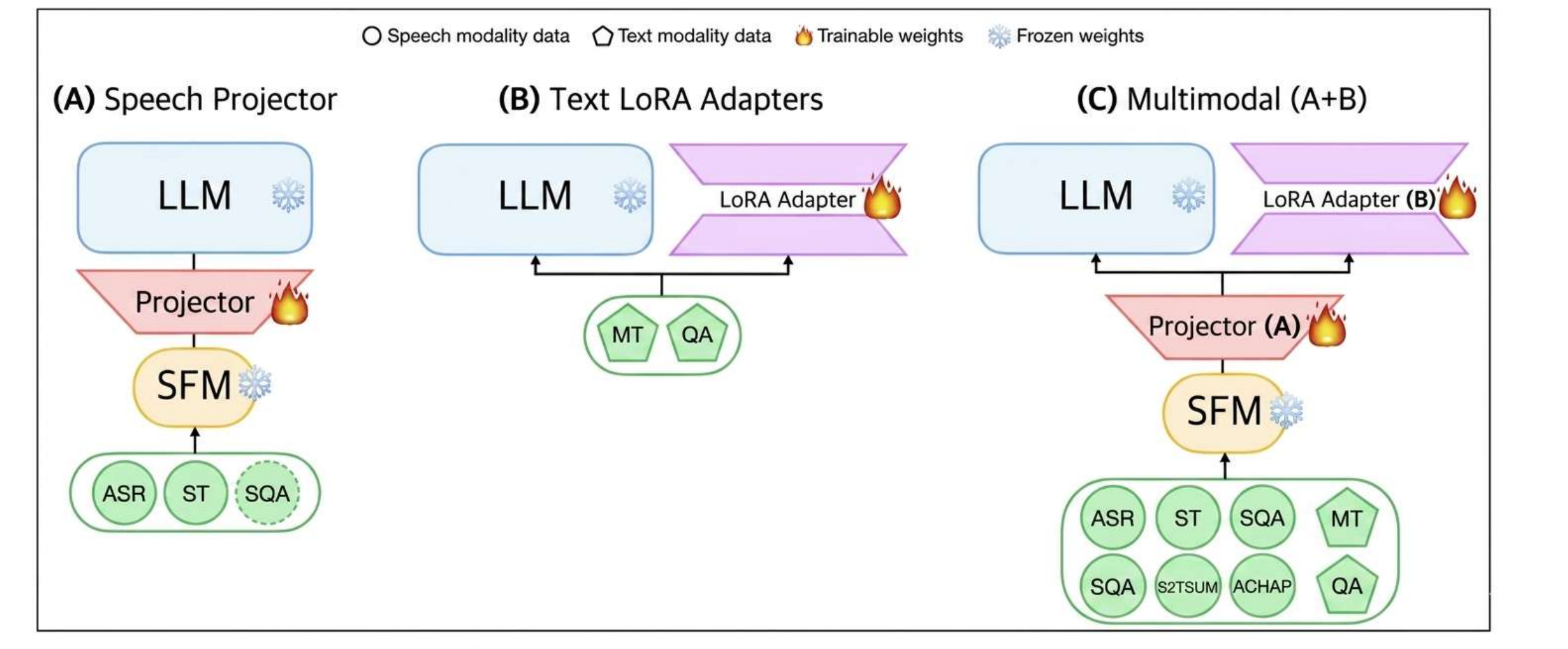
NAVER LABS System Re-implementation for the IWSLT 2026 Instruction-Following Task
This work adapts a speech-to-text instruction pipeline using staged alignment and LoRA fine-tuning to new architectural components (SeamlessM4T-v2 encoder + Qwen3 LLM). It demonstrates efficient porting of training protocols while building 100k synthetic instruction examples across ten speech-centric task types.
Abstract
We re-implement the NAVER LABS IWSLT 2025 instruction-following pipeline for the IWSLT 2026 Shared Task (constrained condition, short audio track), adapting it to the mandated components: SeamlessM4T-v2-large as the speech encoder and Qwen3-4B-Instruct as the LLM backbone. The three-stage approach projector alignment, text-only LoRA pre-training, and multimodal merging is preserved from the original design. We additionally construct 100k synthetic instruction-following examples across ten speech-centric task types (10k per task) from the provided corpora, suitable for further Stage 3 fine-tuning. Our primary model achieves COMET 0.781 on EN-ZH speech translation and BERTScore-F1 0.346 on English SQA on the MCIF benchmark.
TTS & Voice Synthesis
Describing a voice in plain English and getting the right speaker embedding out — no reference audio needed.
Speaker conditioning for TTS typically requires a reference audio clip, which limits flexibility. Johns Hopkins' ProPS (Prompted Profile Synthesis) sidesteps this entirely by learning to synthesize speaker embedding distributions directly from natural language descriptions like "a thirties male speaker with an Indian accent." Unlike prior extractive approaches that retrieve embeddings from a fixed pool, ProPS is fully generative, enabling fine-grained, controllable speaker-profile conditioning for both TTS and voice conversion.
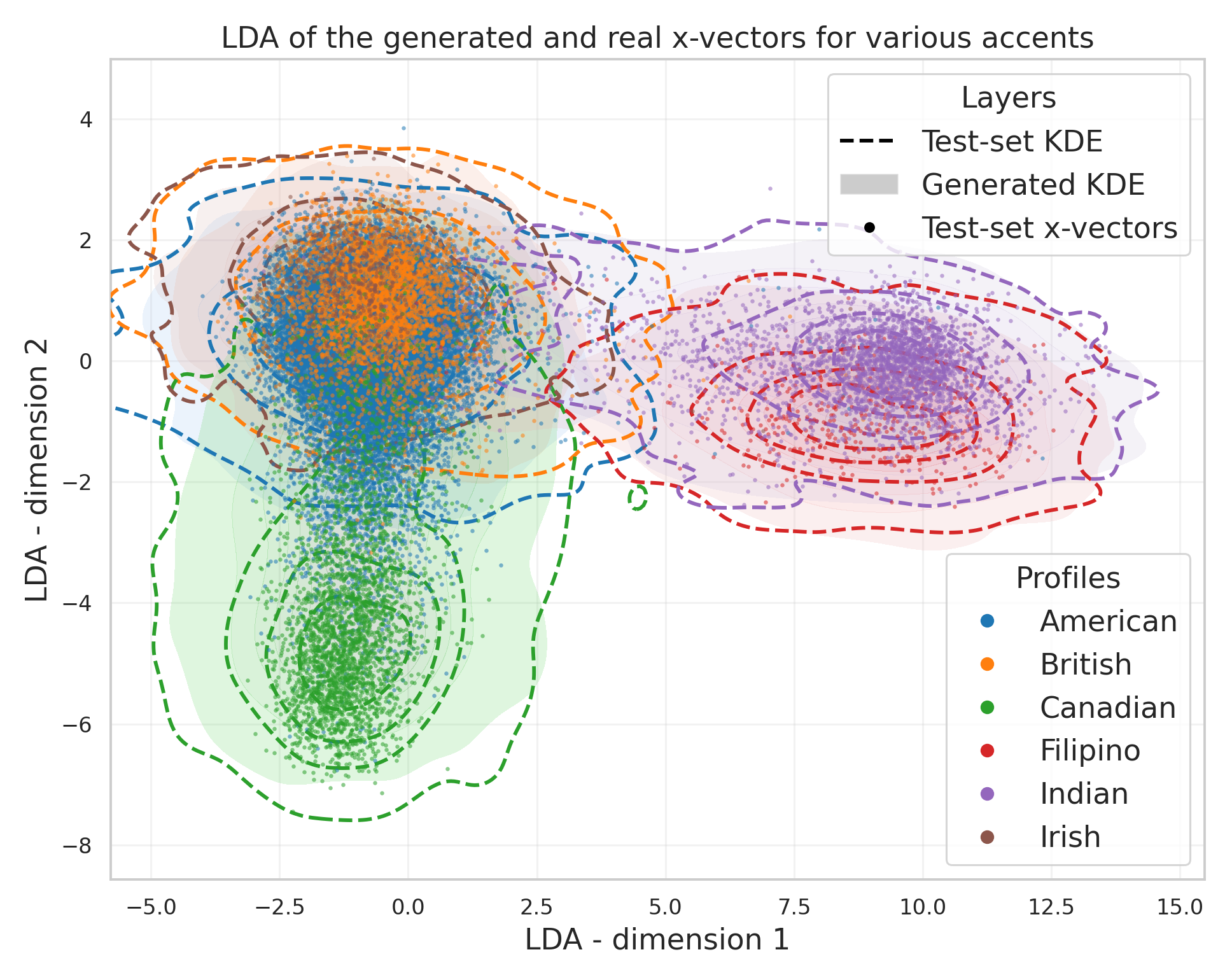
ProPS: Prompted Profile Synthesis for Natural Language-Conditioned Speaker Embedding Distributions
ProPS synthesizes speaker embedding distributions directly from natural language profiles like "a thirties male speaker with an Indian accent." Unlike prior extractive approaches, this generative method enables controllable speaker-profile conditioning for TTS and voice conversion while preserving speaker attributes.
Abstract
Speaker embeddings, or x-vectors, are widely used to represent speaker identity and speaker-related attributes, but existing embedding extractors are typically descriptive rather than generative: they map an observed speech segment to an x-vector, which is then used for downstream applications. We introduce ProPS, Prompted Profile Synthesis, a framework for generating distributions of speaker embeddings conditioned on natural language prompts such as "a thirties male speaker with an Indian accent". ProPS converts human-written profile descriptions into sentence embeddings and uses a mixture density network trained on a large-scale dataset to predict a Gaussian mixture model in the x-vector space. The model is trained by maximizing the likelihood that real speaker embeddings match the requested profile, and its generated distributions are evaluated by negative log-likelihood on held-out x-vectors and by attribute classification accuracies on sampled synthetic x-vectors. Experiments show that ProPS produces profile-conditioned distributions and generates x-vectors that preserve requested speaker attributes such as age, gender, accent, and prosodic characteristics. This design enables controllable speaker-profile synthesis for speech generation systems like Text-To-Speech (TTS) or Voice Conversion (VC) while anchoring generated distributions in observed speaker-embedding structure.
ASR Architectures
Spending more compute at inference time — with almost no training data.
Test-time compute scaling has transformed text LLMs; can it work for ASR? National Taiwan University's Listen, Think, Transcribe answers yes, introducing a parameter-efficient method that adds iterative latent refinement and a learned halting mechanism on top of a frozen ASR model. Remarkably, it improves WER with as few as 500 utterances of fine-tuning data — a regime where standard adaptation fails entirely — and generalizes across 30 languages, concentrating its gains on the hardest inputs.
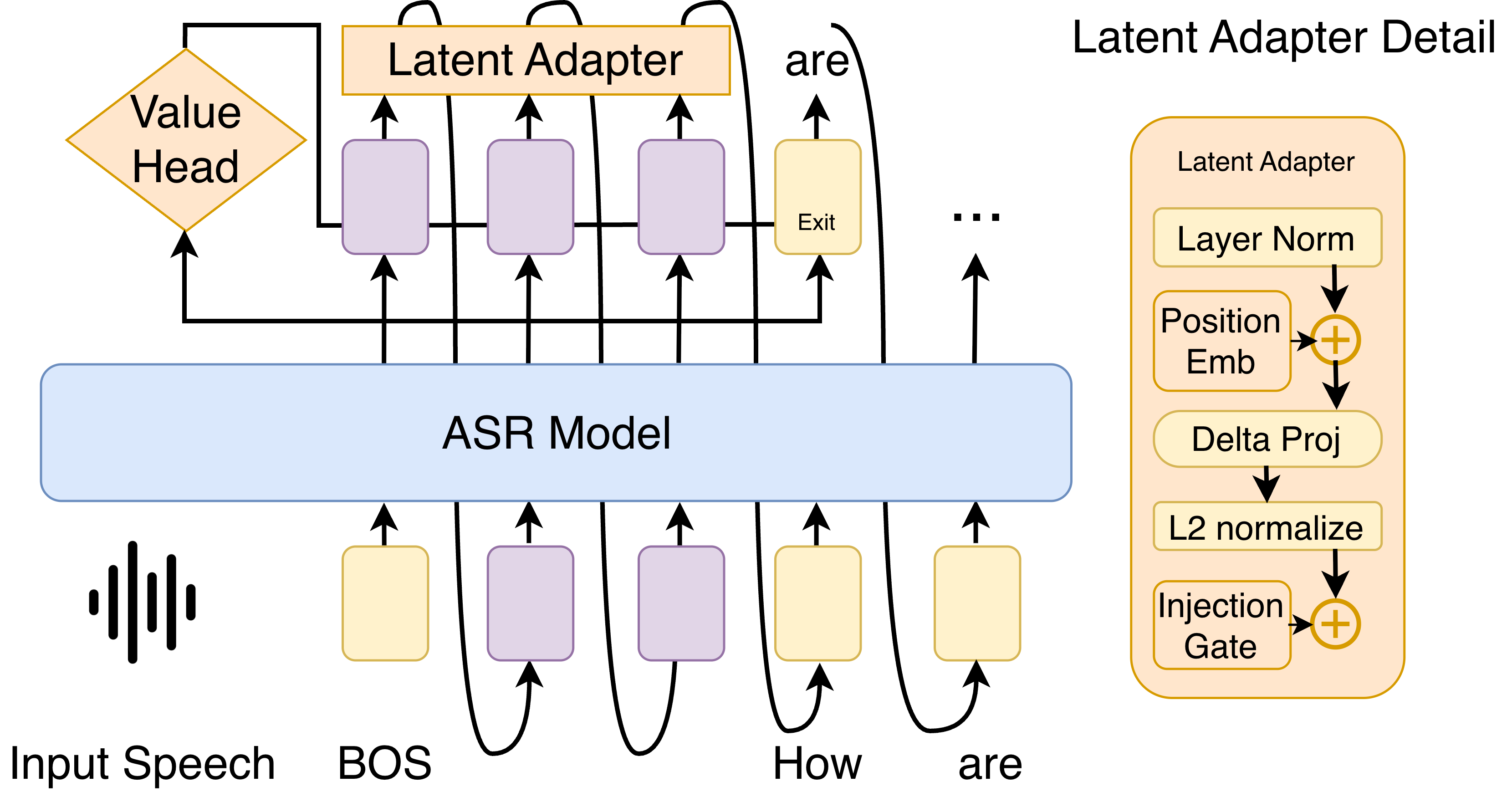
Listen, Think, Transcribe: Continuous Latent Test-Time Scaling for ASR
A parameter-efficient method that enables test-time scaling in frozen ASR models through iterative latent refinement and learned halting. It uniquely improves WER with minimal training data (500 utterances) where standard adaptation fails, concentrating gains on hard inputs while generalizing across 30 languages.
Abstract
End-to-end ASR models transcribe in a single pass, leaving no room for the decoder to revisit hard inputs. We propose LatentASR, a parameter-efficient method that adds continuous latent test-time scaling to a frozen ASR backbone. Two small trainable modules drive it: a Latent Adapter that iteratively refines a few latent prefix positions through bounded, stabilized updates, and a Value Head that predicts whether extra computation will help and halts the loop early. The Qwen3-ASR-0.6B backbone stays fully frozen, and we train only ~4M extra parameters. We activate this loop with a deliberately small, diverse 500-utterance training set. Under this minimal-data regime, standard adaptation methods all regress: full fine-tuning, LoRA, and prompt tuning each increase WER. LatentASR is the only tested method that reduces WER on both clean benchmarks (FLEURS -2.54% and VoxPopuli -0.47% relative). The reductions are concentrated on intrinsically hard inputs. On accented and code-switched speech (ASCEND), LatentASR achieves a 16.0% relative CER reduction. Across 30 FLEURS languages (23,049 utterances), the multilingual WER decreases uniformly across resource tiers, confirming that the adapter generalizes without overfitting. Dynamic halting preserves most of the clean-set reduction at a fraction of the compute, skipping roughly half of all utterances at the entry gate. Our results show that a small, carefully chosen activation set can switch on test-time scaling inside a frozen ASR model without corrupting the model itself, converting fixed per-utterance compute into input-dependent compute where it is most needed.
Trending on Hugging Face

Vidu S1: A Real-Time Interactive Video Generation Model
Vidu S1 is a real-time interactive video generation model that supports voice-controlled digital character animation with infinite-length output and high frame rate on consumer hardware.

OmniFlatten: An End-to-end GPT Model for Seamless Voice Conversation
A novel GPT-based model, OmniFlatten, enables real-time natural full-duplex spoken dialogue through a multi-stage post-training technique that integrates speech and text without altering the original model's architecture.
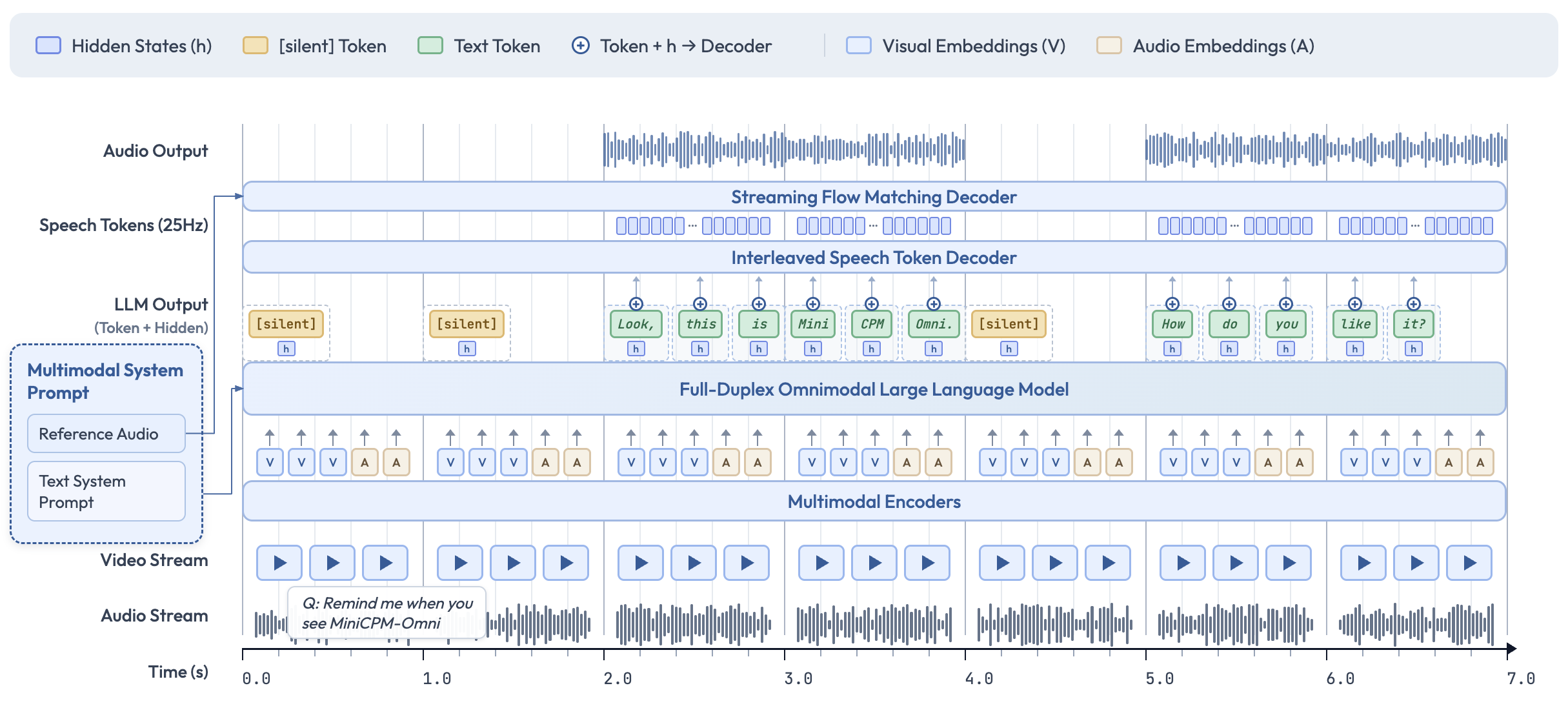
MiniCPM-o 4.5: Towards Real-Time Full-Duplex Omni-Modal Interaction
MiniCPM-o 4.5 enables real-time full-duplex interaction where perception and response happen simultaneously across vision, audio, and speech. Its Omni-Flow framework aligns multimodal signals on a shared timeline, supporting both reactive and proactive behaviors in continuous, streaming conversation.

Qwen3-TTS Technical Report
The Qwen3-TTS series presents advanced multilingual text-to-speech models with voice cloning and controllable speech generation capabilities, utilizing dual-track LM architecture and specialized speech tokenizers for efficient streaming synthesis.

Fish Audio S2 Technical Report
Fish Audio S2 is an open-source text-to-speech system with multi-speaker capabilities, multi-turn generation, and instruction-following control through natural-language descriptions, utilizing a multi-stage training approach and production-ready inference engine.