
Word-Level TTS Control, KV Cache Compression, and Universal ASR Alignment
Today's digest covers fine-grained prosodic control in LLM-based TTS, distributional training objectives, a Taiwanese code-switching system, KV cache compression for speech LLMs, orthogonal audio-language connectors, and a gradient-based alignment method that works across every ASR family.
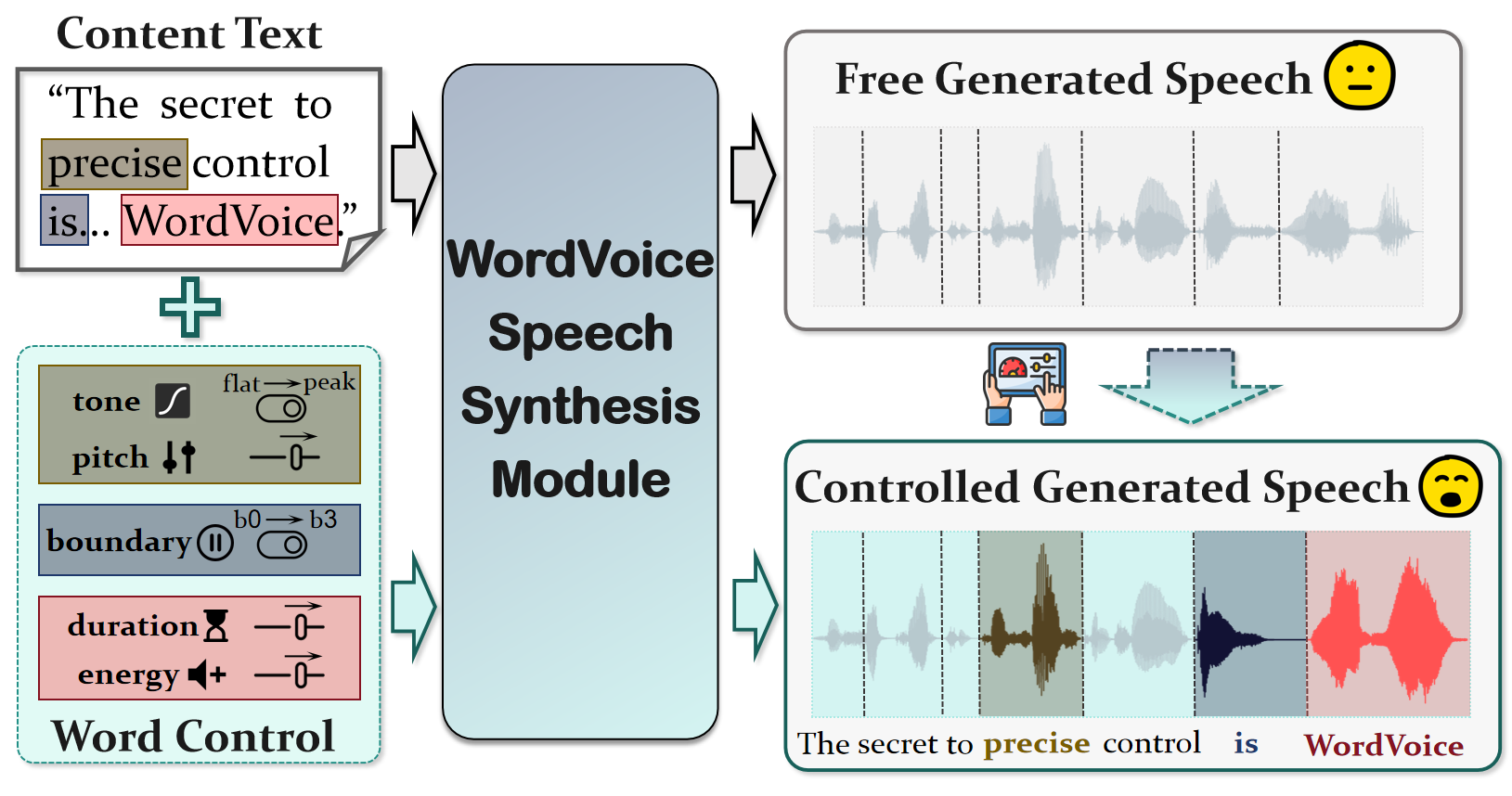
WordVoice framework. By introducing explicit word-level control, WordVoice supports a dual-mode synthesis paradigm. Users can either rely on the model's autonomous prosodic planning or explicitly manipulate five-dimensional acoustic attributes for specific words to achieve highly expressive and precise stylistic interventions. From Harbin Institute of Technology.
Today's papers push on two fronts simultaneously: making TTS systems more controllable and linguistically aware, and making speech LLMs faster and richer in the representations they preserve. From word-level prosodic planning to KV cache surgery, there's a lot of practical engineering here alongside some elegant theoretical contributions.
TTS & Voice Syntax
Controllability, distributional training, and low-resource language coverage in speech synthesis.
LLM-based TTS systems have traded explicit control for naturalness — a bargain that breaks down in professional dubbing and audiobook production where precise prosodic intent matters. WordVoice from Harbin Institute of Technology reclaims that control by decomposing synthesis into two decoupled stages: acoustic planning and modulation. The system exposes five prosodic dimensions at the word level, replacing implicit generation with an interpretable pipeline that can be steered manually without retraining.
WordVoice: Explicit and Decoupled Multi-Dimensional Word-Level Control for LLM-Based TTS
WordVoice adds explicit word-level control to LLM-based TTS by decomposing synthesis into acoustic planning and modulation. It enables precise manipulation of five prosodic dimensions for professional applications like dubbing, replacing implicit generation with an interpretable, manually-controllable design.
Abstract
While recent Large Language Model (LLM)-based Text-to-Speech (TTS) systems have achieved remarkable naturalness, they predominantly rely on implicit end-to-end generation paradigms, resulting in coarse-grained control. In scenarios demanding precise stylistic interventions and strict temporal alignment, such as audiobook narration and video dubbing, the inability to explicitly manipulate word-level acoustic attributes remains a critical bottleneck. This limitation is primarily amplified by the severe scarcity of fine-grained annotated datasets and the architectural challenge of integrating multi-dimensional control signals into discrete autoregressive generation. To address this, we propose a unified framework for highly precise word-level control. First, we construct WordVoice-5A, a massive 4.7k-hour bilingual dataset featuring five-dimensional word-level annotations (duration, boundary, energy, pitch and tone) developed through a rigorous linguistically-guided pipeline. Second, we introduce WordVoice to transform the implicit generation process into an explicit, highly controllable paradigm. Specifically, we introduce a bound-token mechanism within the LLM to formulate an explicit ``acoustic planning'' process, enabling adaptive multi-task prosodic planning and flexible manual intervention. Furthermore, we augment the token-to-waveform stage with a fine-grained acoustic modulation module, bridging the resolution gap to strictly align word-level attributes between highly compressed discrete tokens and continuous waveforms. Extensive experiments demonstrate that WordVoice achieves superior, decoupled control over multiple acoustic dimensions while maintaining competitive zero-shot synthesis stability. The code and audio samples are publicly available at https://xxh333.github.io/wordvoice-demo/.
Few-step diffusion TTS models train fast but can drift away from the statistics of natural speech — especially when the training signal is purely local (per-frame or per-sample). National Taiwan University's SR-FD addresses this with a distributional regularizer inspired by the Fréchet distance: it matches the statistics of generated speech embeddings to a high-quality reference set, nudging the model toward the natural manifold without adding discriminators or any inference overhead.

Fréchet Distance Loss on Speech Representations for Text-to-Speech Synthesis
This paper proposes SR-FD, a distributional regularizer that improves few-step TTS by matching generated speech statistics to high-quality references. Unlike local training objectives, it ensures synthesized speech follows natural distributions without requiring discriminators or inference overhead.
Abstract
Few-step diffusion and flow-matching text-to-speech (TTS) models are usually trained with local objectives, such as conditional flow matching, reconstruction, and stop prediction. These losses provide stable optimization, but they never ask whether sampled speech follows the distribution of high-quality speech. We propose Speech Representation Fr'echet Distance loss (SR-FD), a training-time distributional regularizer for tokenizer-free flow-matching autoregressive TTS. During fine-tuning, the model synthesizes speech with the same few-step sampler used at deployment, and SR-FD matches the mean and covariance of frozen Whisper and CTC features of this speech to reference statistics computed offline from three complementary content targets. The loss requires no discriminator and no inference-time computation. On Seed-TTS English, four-step SR-FD fine-tuning reduces WER from the original four-step VoxCPM2 baseline's 2.2279% to 1.4147%, a 36.5% relative reduction, and also surpasses the original ten-step baseline at 1.7366%; both gains are significant under an utterance-level paired bootstrap. Speaker similarity and objective quality proxies are preserved at the ten-step level, and an error analysis shows the gain comes from content substitutions across all prompt lengths. SR-FD is thus an intelligibility-improving distributional regularizer for few-step TTS.
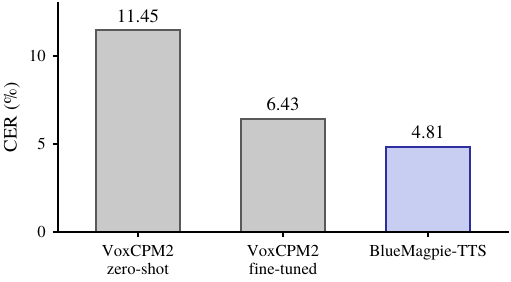
Code-switching and tonal language quirks are a notoriously hard target for general-purpose TTS. BlueMagpie-TTS, also from National Taiwan University, attacks the problem from the text side: a byte-level tokenizer for Taiwanese text, a Traditional Chinese language model trained to handle code-switching, and a learned bridge to a pretrained acoustic model. The result is a 58% CER reduction over baseline — a significant jump for a dialect with limited resources.
BlueMagpie-TTS: A Token-Efficient Tokenizer, Language Model, and TTS for Taiwanese-Accent Code-Switching Speech
A specialized Taiwanese Mandarin TTS system built from the text side up: a byte-level tokenizer for Taiwanese text, a Traditional Chinese language model, and a bridge to a pretrained acoustic model. It uniquely handles code-switching and Taiwanese-specific pronunciation, achieving 58% CER reduction over baseline.
Abstract
Off-the-shelf TTS systems are poorly adapted to Taiwanese Mandarin. Their accent defaults to other Mandarin variants, their tokenizers over-segment common Taiwanese text, and their pronunciation degrades at code-switching boundaries where Chinese and English alternate within one utterance. These problems share one root: the text side lacks adaptation to the Taiwanese context. We address the text side from the bottom up. PangolinTokenizer, a byte-level BPE tokenizer trained on Taiwan-context data, reaches the lowest token rate (0.485 tokens/character) with the smallest vocabulary among nine tokenizers. Barbet, a billion-parameter Traditional-Chinese language model trained on PangolinTokenizer, serves as the text-semantic frontend and ranks first among comparable public models on a 14-task evaluation. BlueMagpie-TTS attaches Barbet to the pretrained acoustic stack of VoxCPM2 through a learned bridge, keeping the acoustic stack fixed. On a 1000-sentence Taiwan-localized test set, it lowers CER from 11.45% to 4.81% and WER from 14.83% to 5.36%, relative reductions of 58.0% and 63.9%. In a blind listening study on 500 of these sentences with ten listeners, 65.6% of majority votes prefer BlueMagpie-TTS.
SpeechLLMs & Audio-Language Models
Efficiency, representation fidelity, and universal alignment across ASR architectures.
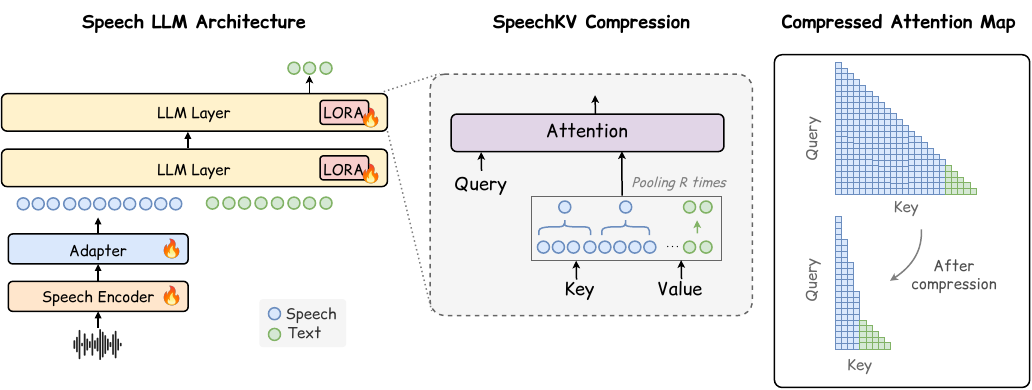
One of the persistent costs of speech LLMs is the sheer length of encoded audio sequences — a single utterance can balloon into hundreds of tokens that the LLM must attend over at every decoding step. Microsoft's SpeechKV sidesteps the usual approach of compressing the speech embedding before the LLM by instead applying learned pooling inside the KV cache. This preserves fine-grained information during encoding while cutting the cache footprint that the decoder sees, delivering at least 1.49× decoding speedup without measurable performance degradation.
Compress the Cache, Not the Speech Embedding: KV Compression for Efficient Speech LLMs
Speech LLMs struggle with long encoded speech sequences during decoding. SpeechKV applies learned pooling to the KV cache within the LLM to compress speech tokens while preserving performance, delivering at least 1.49× decoding speedup without sacrificing fine-grained information.
Abstract
Speech large language models (Speech LLMs) typically encode speech into sequences far longer than text, creating a major efficiency bottleneck during autoregressive decoding. A common remedy is to compress the speech sequence at the adapter level to remove temporal redundancy before it enters the LLM; however, such early downsampling risks discarding fine-grained information that cannot be recovered. We propose SpeechKV, which applies a learned pooling to the KV cache of speech tokens inside the LLM. This design allows the LLM to fuse speech and text internally while directly accelerating decoding. Trained on 71K hours of speech data, SpeechKV compresses the speech to approximately text-level granularity yet maintains performance on par with or even slightly better than the uncompressed baseline, with relative gains of 6.6% on out-of-domain entity recognition and 2.3% on OpenASR, while delivering at least 1.49 times decoding speedup that scales with audio length.
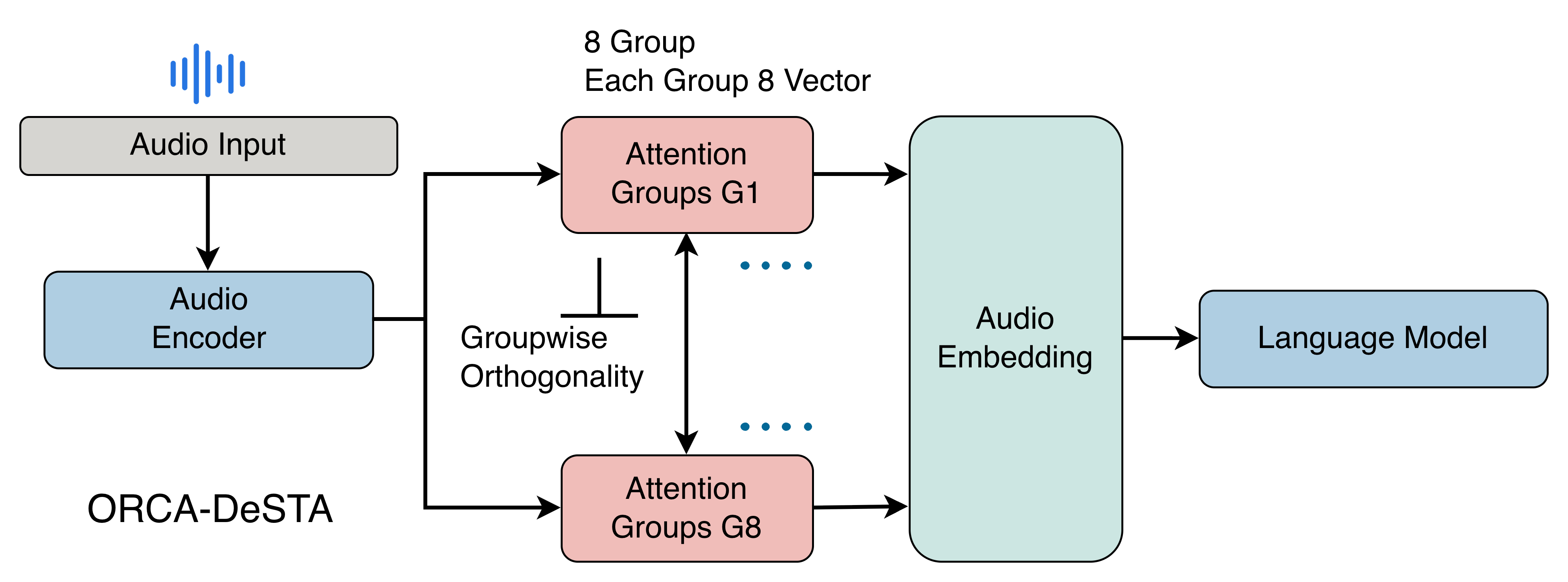
Cross-modal connectors between audio encoders and language models routinely collapse paralinguistic information — speaker identity, emotion, prosody — into a single homogenized query representation, a phenomenon the authors colorfully dub the "Procrustean Bed." National Taiwan University's ORCA breaks out of this by partitioning queries into groups and enforcing orthogonality constraints between them, forcing each group to capture distinct aspects of the speech signal. The result is measurably better preservation of speaker and prosodic cues, with significantly improved reasoning performance on audio-language benchmarks.
Escaping the Procrustean Bed: Groupwise Orthogonal Connectors for Audio-Language Models
Audio-language connectors compress speech into collapsed representations that lose speaker identity and prosodic information. ORCA fixes this by partitioning queries into orthogonally constrained groups, preserving paralinguistic cues and achieving significantly better reasoning performance.
Abstract
Audio-language models compress a speech encoder's output through a Querying Transformer (Q-Former) connector before feeding it to a large language model. We identify two failures in this compression. The connector's output vectors collapse to a single direction, and different speakers produce nearly indistinguishable outputs, with paralinguistic cues such as speaker identity, gender, and prosody lost along the way. Our method, ORCA, reverses this collapse by splitting the queries into groups whose outputs are constrained to point in different directions. On SAKURA multi-hop reasoning, ORCA gains 26.4 points over an identically trained 4B baseline, reaching 75.2% (vs. 49.0% for the 8B Audio Flamingo-3). At the connector level, the same change cuts query redundancy by 12x and raises cross-speaker variance by 75x.
Word-level speech-to-text alignment is a capability that almost every downstream application needs — forced alignment for subtitling, keyword spotting, and training data curation — but it has historically required model-specific solutions. RWTH Aachen University's gradient-based method is a welcome universalist: it computes alignments by backpropagating through the input frame grid and works unmodified across CTC models, transducers, attention-encoder-decoder systems, and speech LLMs. Crucially, it requires no additional training and produces usable alignments even for streaming models.
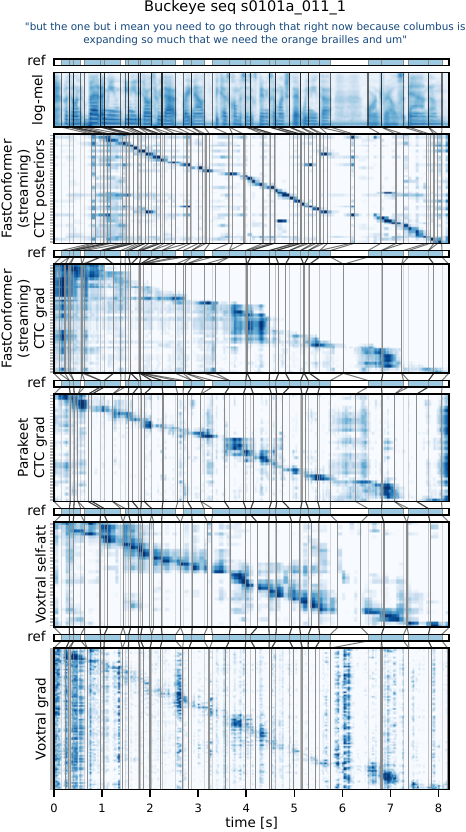
Gradient-Based Speech-to-Text Alignment for Any ASR Model: From CTC to Speech LLMs
A universal gradient-based method for computing word-level speech-to-text alignment that works across all ASR model families—CTC, transducers, attention-encoders, and speech LLMs—without training or modification. It operates on the input frame grid and delivers usable alignments even for streaming models.
Abstract
Speech-to-text alignment means finding the temporal boundaries of each word in the audio. Some models provide such an alignment directly and others do not. Connectionist temporal classification (CTC) and transducer models have an alignment by construction, whereas attention-based encoder-decoders (AED) and speech large language models (LLMs) do not, and their word timings are usually read off the attention weights instead. All of these signals live on the encoder frame grid, which bounds their temporal precision. We study a generic gradient-based alignment that applies to any differentiable ASR model. We take the gradient of each teacher-forced token log probability with respect to the input, reduce it to a per-frame saliency, and decode the resulting matrix into word boundaries with a single dynamic-programming pass. The method needs no training, no model modification and no alignment heads, works across all model families including the speech LLMs, and aligns on the input grid rather than on the coarser encoder grid. We evaluate it on sixteen models from four families, on read (TIMIT) and spontaneous (Buckeye) speech, each against the model's own native or attention-based alignment. We find that the gradient yields a usable alignment for every model, that it is usually somewhat behind a strong native aligner but better where the native alignment is weak, as for the streaming models, and that its main disadvantage is the cost of one backward pass per token.
Trending on Hugging Face

Vidu S1: A Real-Time Interactive Video Generation Model
Vidu S1 is a real-time interactive video generation model that supports voice-controlled digital character animation with infinite-length output and high frame rate on consumer hardware.

OmniFlatten: An End-to-end GPT Model for Seamless Voice Conversation
A novel GPT-based model, OmniFlatten, enables real-time natural full-duplex spoken dialogue through a multi-stage post-training technique that integrates speech and text without altering the original model's architecture.
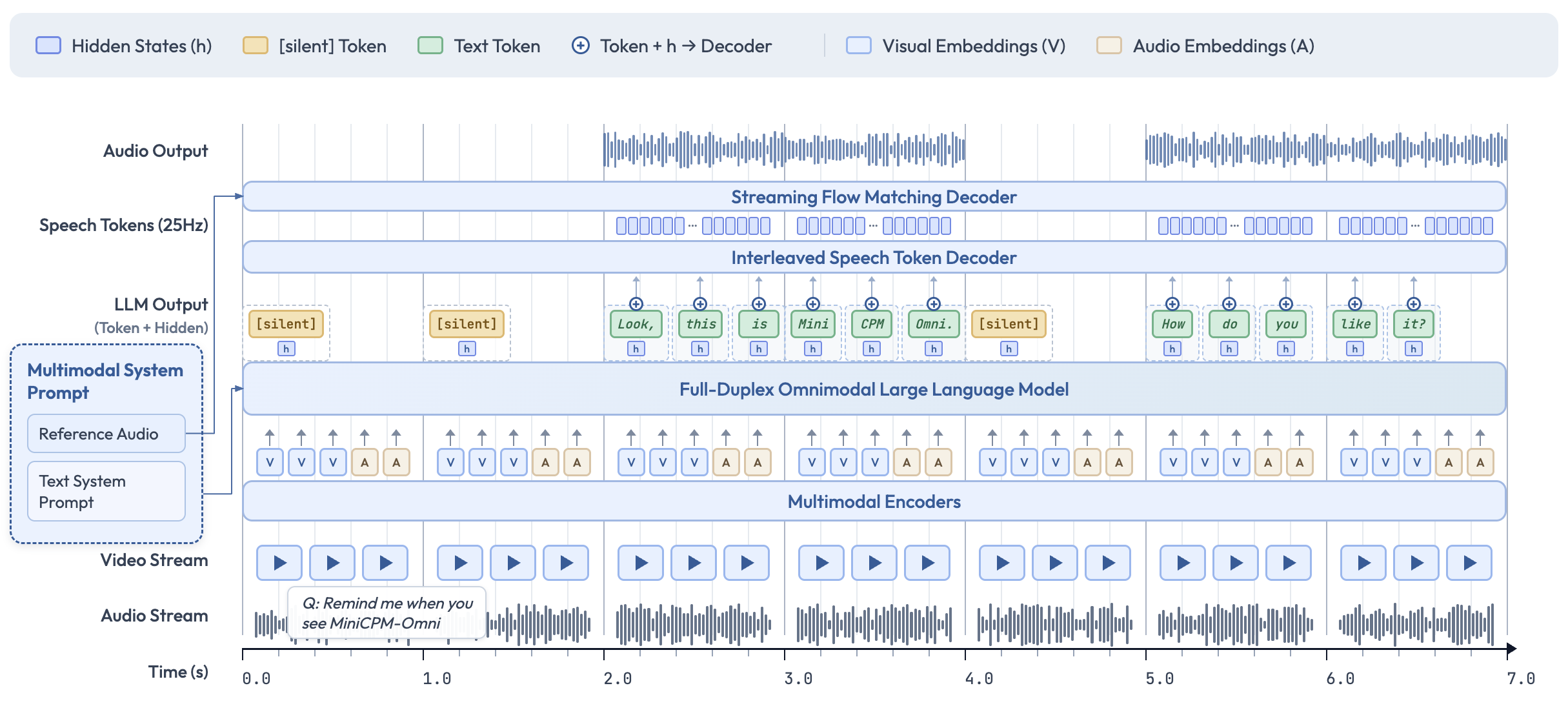
MiniCPM-o 4.5: Towards Real-Time Full-Duplex Omni-Modal Interaction
MiniCPM-o 4.5 enables real-time full-duplex interaction where perception and response happen simultaneously across vision, audio, and speech. Its Omni-Flow framework aligns multimodal signals on a shared timeline, supporting both reactive and proactive behaviors in continuous, streaming conversation.

Qwen3-TTS Technical Report
The Qwen3-TTS series presents advanced multilingual text-to-speech models with voice cloning and controllable speech generation capabilities, utilizing dual-track LM architecture and specialized speech tokenizers for efficient streaming synthesis.

Fish Audio S2 Technical Report
Fish Audio S2 is an open-source text-to-speech system with multi-speaker capabilities, multi-turn generation, and instruction-following control through natural-language descriptions, utilizing a multi-stage training approach and production-ready inference engine.