
Visual Speech, Multimodal Alignment, and RL-Driven ASR Adaptation
Today's digest covers viseme-guided event-based lip reading, optimal-transport alignment for audio-visual LLM-based ASR, and reinforcement learning as a superior alternative to supervised fine-tuning when only synthetic speech is available.
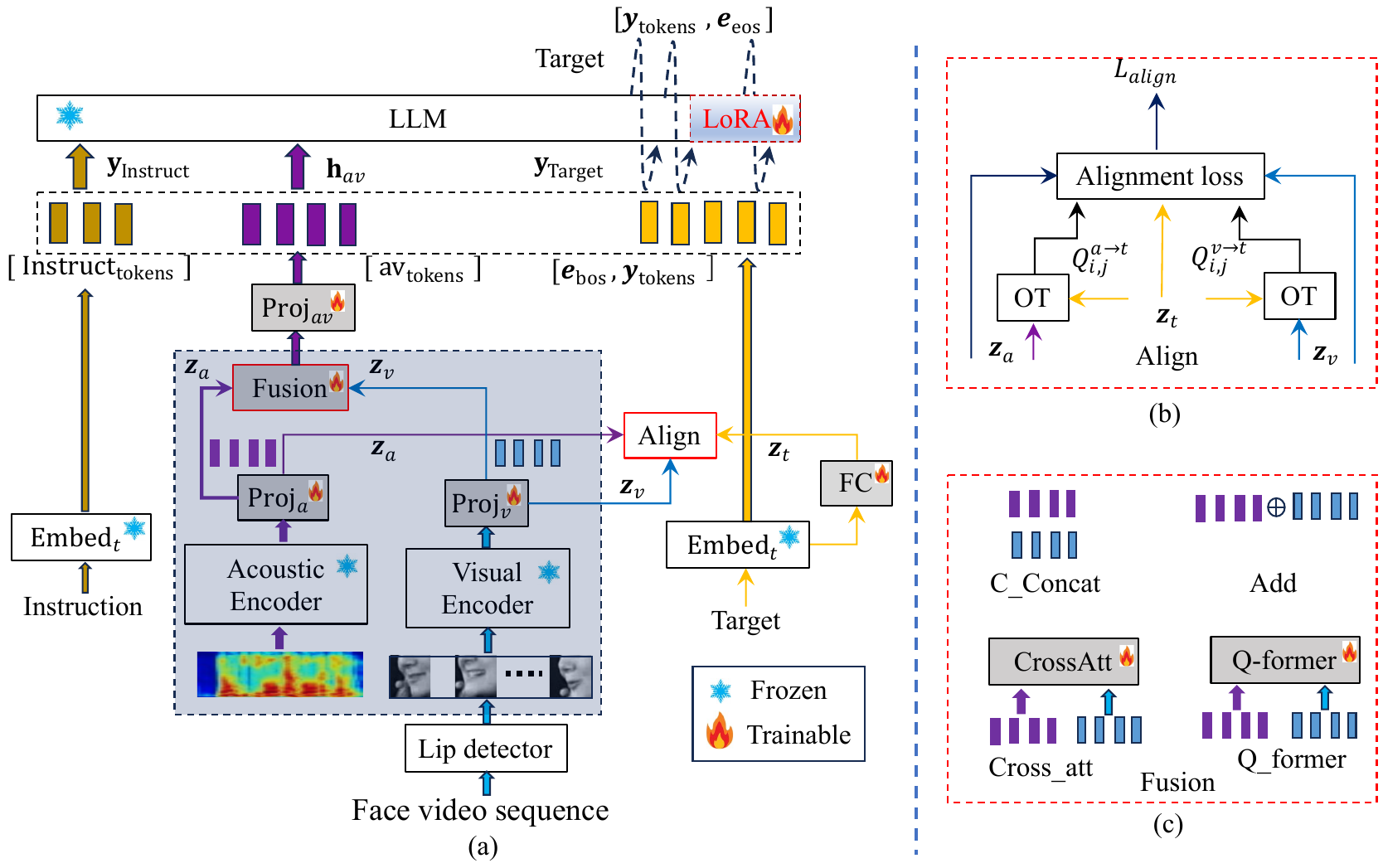
The proposed LLM-based audio-visual ASR (LLM-AVSR) model framework: (a) Model architecture, (b) OT-based alignment module, (c) Modules for several alternative fusion methods. From National Institute of Informatics.
Today's three papers all grapple with a shared challenge: making speech recognition systems smarter about what they see and hear. From novel event-camera lip reading to optimal-transport-based multimodal fusion and RL-driven ASR adaptation under data-privacy constraints, the throughline is richer signal representation and better cross-modal understanding.
Lip Reading & Viseme Modeling
Moving beyond frame-level features toward trajectory-aware, phonetically-structured visual speech.
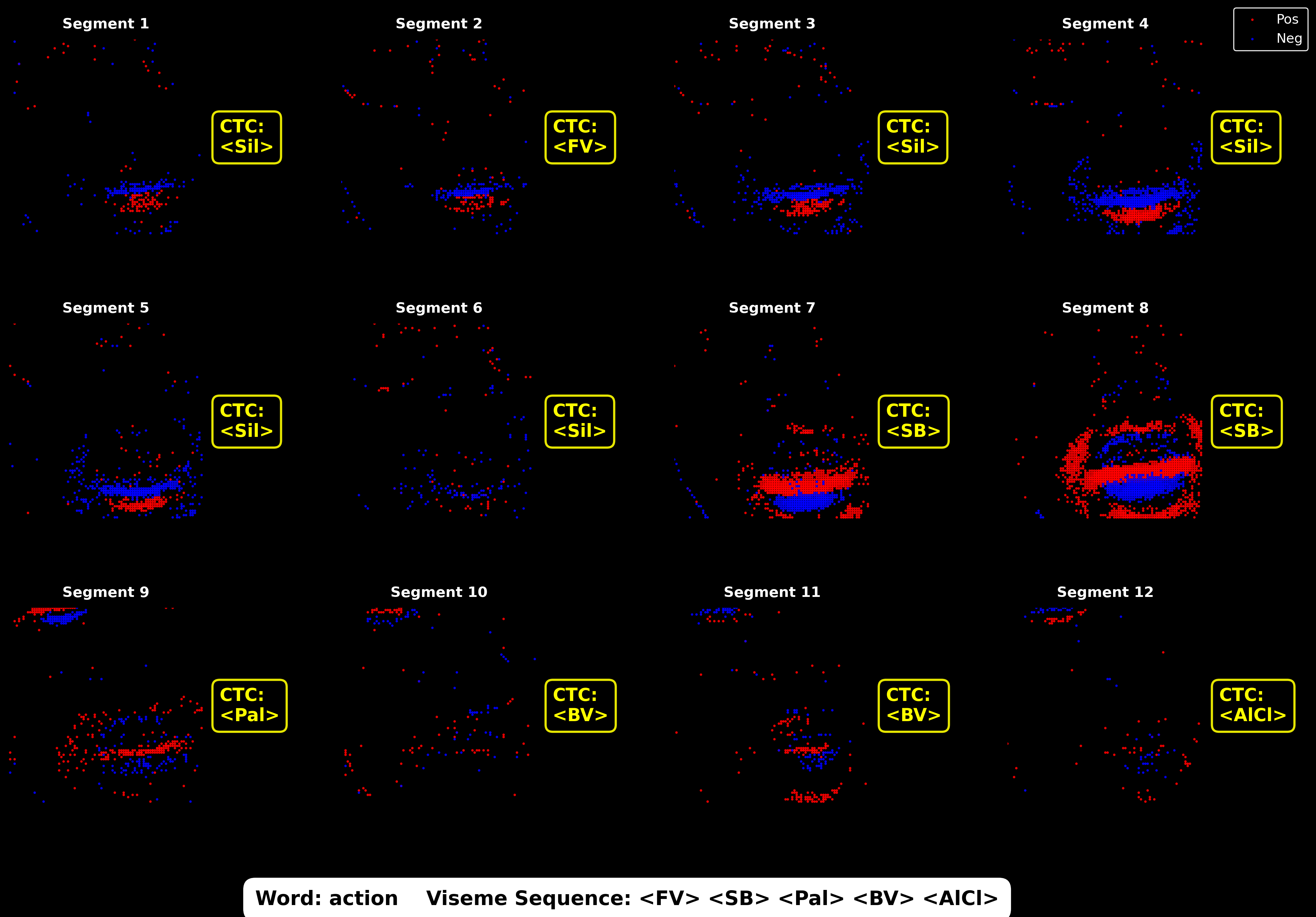
Event cameras capture asynchronous brightness changes at microsecond resolution — a natural fit for the fast, subtle dynamics of lip motion. Prior event-based lip reading methods typically compress spatial information early, discarding the precise temporal trajectories that distinguish visually similar phonemes. TVTA (Trajectory-Aware Viseme-Guided Temporal Aggregation) from Harbin Institute of Technology attacks this directly: it preserves motion trajectories before spatial compression, and adds viseme-level supervision to inject articulatory structure into the learned representations. Crucially, it replaces word-level decoding with CTC-based decoding to enforce phonetic constraints and sharpen temporal understanding of visual speech sequences.
TVTA: Trajectory-Aware Viseme-Guided Temporal Aggregation for Event-Based Lip Reading
This paper advances event-based lip reading by preserving motion trajectories before spatial compression and adding viseme-level supervision for articulatory structure. Unlike prior word-level methods, it uses CTC-based decoding to inject phonetic constraints and improve temporal understanding of visual speech.
Abstract
Event-based lip reading has recently emerged as a promising direction for visual speech recognition, benefiting from the high temporal resolution and motion sensitivity of event cameras. However, existing methods typically perform spatial compression before sufficient temporal modeling, which may suppress sparse and localized motion trajectories that are crucial for distinguishing similar lip movements. Moreover, most current approaches optimize temporal representations mainly at the word-classification level, leaving the underlying articulatory structure weakly constrained. To address these limitations, we propose a temporally enhanced framework for event-based lip reading. First, we introduce Trajectory-Aware Differential Aggregation (TDA), which performs local temporal modeling at each spatial location before adaptive spatial aggregation. Second, we propose Viseme-Guided Aggregation (VGA), a unified temporal module composed of a CTC decoder and a viseme-guided gated aggregation branch, which injects viseme-aware sequence supervision and improves final temporal aggregation for word recognition. Third, we incorporate an EMA teacher--student training strategy to enhance robustness under strong event perturbations. Experiments on the DVS-Lip benchmark verify the effectiveness of the proposed design, and extensive ablation studies further validate the contributions of TDA, VGA, and teacher--student consistency. Qualitative decoding results also demonstrate that the proposed CTC-based temporal modeling learns meaningful viseme-aware structure from event streams.
Audio-Visual Speech Recognition & LLM Integration
Bridging modality gaps with principled alignment and smarter fine-tuning strategies.
Optimal Transport for Audio-Visual LLM Alignment
Fusing audio and visual streams inside a large language model is harder than it looks — raw encoder outputs live in very different representational spaces, and naïvely concatenating them before LLM fusion leads to coherence losses, especially under noise. The National Institute of Informatics proposes using optimal transport (OT) to explicitly align audio and visual representations with the LLM's own linguistic embedding space before fusion. By framing cross-modal alignment as a transport problem — minimizing the distributional distance between modality representations and the target linguistic space — the method achieves stronger cross-modal coherence and meaningfully improved robustness in noisy acoustic environments.
Optimal Transport-based Semantic Alignment for LLM-based Audio-Visual Speech Recognition
This paper uses optimal transport to align audio and visual representations with an LLM's linguistic space for multimodal speech recognition. By explicitly bridging modality gaps before fusion, it achieves stronger cross-modal coherence and improved robustness in noisy acoustic environments.
Abstract
Large language model (LLM)-based audio-visual speech recognition (LLM-AVSR) has recently demonstrated strong robustness in adverse acoustic environments by leveraging complementary audio and visual information. Existing approaches typically employ independently pretrained acoustic and visual encoders, whose outputs are projected and fused as soft prompts to condition an LLM for speech recognition. However, most methods perform multimodal fusion without explicitly addressing the representational discrepancy between audio, visual and text modalities, potentially limiting the effectiveness of cross-modal integration. In this paper, we propose an optimal transport (OT)-based semantic alignment framework for LLM-AVSR. The proposed method explicitly bridges the modality gap by aligning the acoustic and visual representations with reference to the linguistic embedding space of the LLM before multimodal fusion. Specifically, OT is used to estimate probabilistic coupling matrices that characterize structured correspondences between modality-specific features and linguistic embeddings. The resulting OT couplings are further utilized as soft pseudo-labels to supervise contrastive learning, encouraging the extraction of semantically coherent and cross-modal consistent audio-visual representations. By anchoring multimodal features to the linguistic space of the LLM, the proposed framework facilitates more effective multimodal fusion and decoding. We implement the proposed framework using a Whisper-based acoustic encoder, an AV-HuBERT-based visual encoder, and a LLaMA3.2-3B decoder. Experiments conducted on the LRS3-TED benchmark demonstrate consistent improvements over strong baselines and achieve state-of-the-art performance under both clean and noisy evaluation conditions across a wide range of signal-to-noise ratios (SNRs).
RL over SFT When Real Data Is Off-Limits
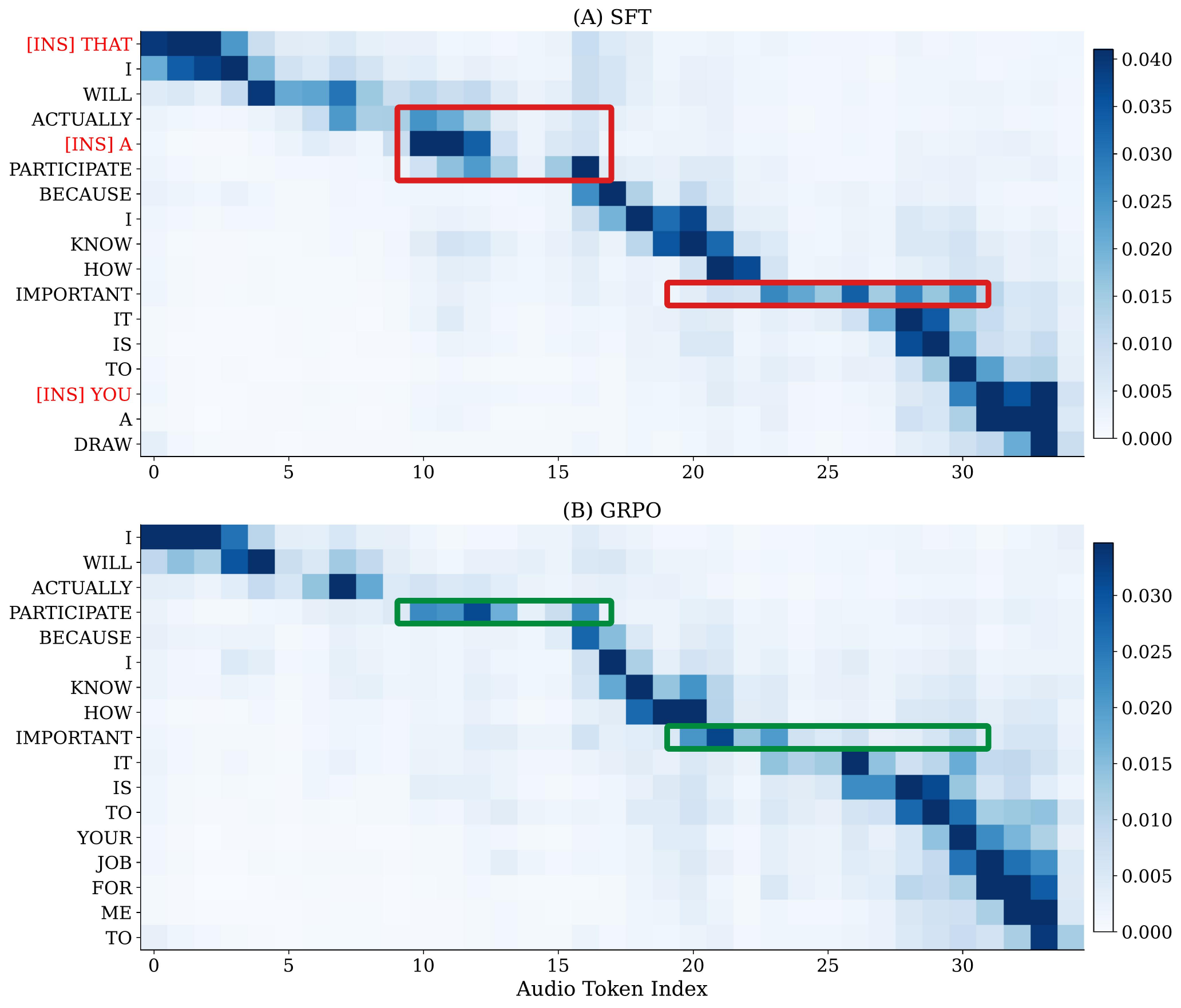
In regulated domains such as healthcare or finance, real speech recordings are often locked behind privacy restrictions, leaving synthetic TTS data as the only adaptation signal. Idiap Research Institute asks: given only synthetic speech, is supervised fine-tuning (SFT) the right tool? Their answer is a clear no. GRPO (Group Relative Policy Optimization) — a reinforcement learning approach — significantly outperforms SFT for domain-adaptive ASR in this setting. The gains are behavioral: GRPO measurably sharpens the model's attention focus onto the audio stream and improves decoding calibration, rather than simply memorizing the synthetic corpus's surface patterns.
"Better Call GRPO" is a catchy title, but the finding is serious: when your training data is synthetic, RL alignment may matter more than the data volume.
When Synthetic Speech Is All You Have: Better Call GRPO
This paper shows that reinforcement learning (GRPO) significantly outperforms supervised fine-tuning when adapting ASR to regulated domains using only synthetic speech. The key gain is behavioral: GRPO sharpens attention focus on audio and improves decoding calibration without accessing privacy-restricted real data.
Abstract
LLM-based ASR adapted to regulated domains such as banking is bottlenecked by privacy: real speech is costly and legally constrained to collect, making synthetic text-to-speech (TTS) an attractive substitute. Yet synthetic speech stays acoustically mismatched with real recordings, and work on this gap has stayed within supervised fine-tuning (SFT). We instead turn to reinforcement learning, and show that Group Relative Policy Optimization (GRPO) extracts far more from the same synthetic speech than SFT. Synthetic-only adaptation of the model with GRPO, a critic-free method rewarding low-WER hypotheses, reduces WER by 40\% relative to SFT (36.71\%$\to$22.09\%), and an SFT-then-GRPO combination pushes this further to 45\%. We trace the gain to behavior rather than representation: GRPO reduces insertion errors by improving stopping calibration and speech-to-text alignment by better anchoring attention to audio, leaving early-layer representations intact. When synthetic speech is the main resource, reinforcement learning should be preferred over supervised fine-tuning.
Trending on Hugging Face

Vidu S1: A Real-Time Interactive Video Generation Model
Vidu S1 is a real-time interactive video generation model that supports voice-controlled digital character animation with infinite-length output and high frame rate on consumer hardware.
MiniCPM-o 4.5: Towards Real-Time Full-Duplex Omni-Modal Interaction
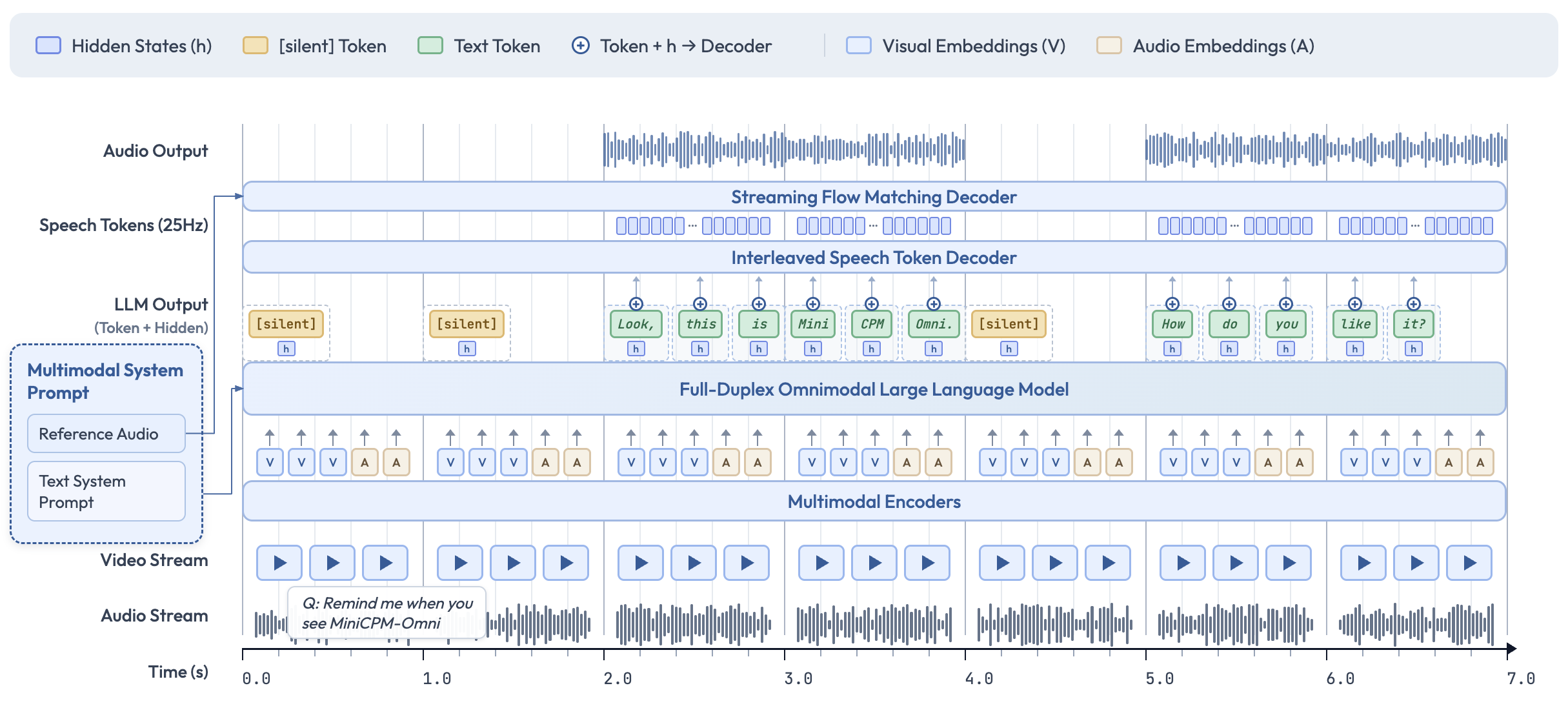
MiniCPM-o 4.5 enables real-time full-duplex interaction where perception and response happen simultaneously across vision, audio, and speech. Its Omni-Flow framework aligns multimodal signals on a shared timeline, supporting both reactive and proactive behaviors in continuous, streaming conversation.

OmniFlatten: An End-to-end GPT Model for Seamless Voice Conversation
A novel GPT-based model, OmniFlatten, enables real-time natural full-duplex spoken dialogue through a multi-stage post-training technique that integrates speech and text without altering the original model's architecture.

Fish Audio S2 Technical Report
Fish Audio S2 is an open-source text-to-speech system with multi-speaker capabilities, multi-turn generation, and instruction-following control through natural-language descriptions, utilizing a multi-stage training approach and production-ready inference engine.

IndexTTS: An Industrial-Level Controllable and Efficient Zero-Shot Text-To-Speech System
IndexTTS, an enhanced text-to-speech system combining XTTS and Tortoise models, offers improved naturalness, enhanced voice cloning, and controllable usage through hybrid character-pinyin modeling and optimized vector quantization.