
Tokenizer-Free Turkish TTS and Video as World Models
Today's digest covers FreyaTTS, a production-ready Turkish speech synthesis system that ditches phonemizers for direct character-level Diffusion Transformers, alongside a Hugging Face trending paper reconceptualizing video as a joint world-state and event stream.
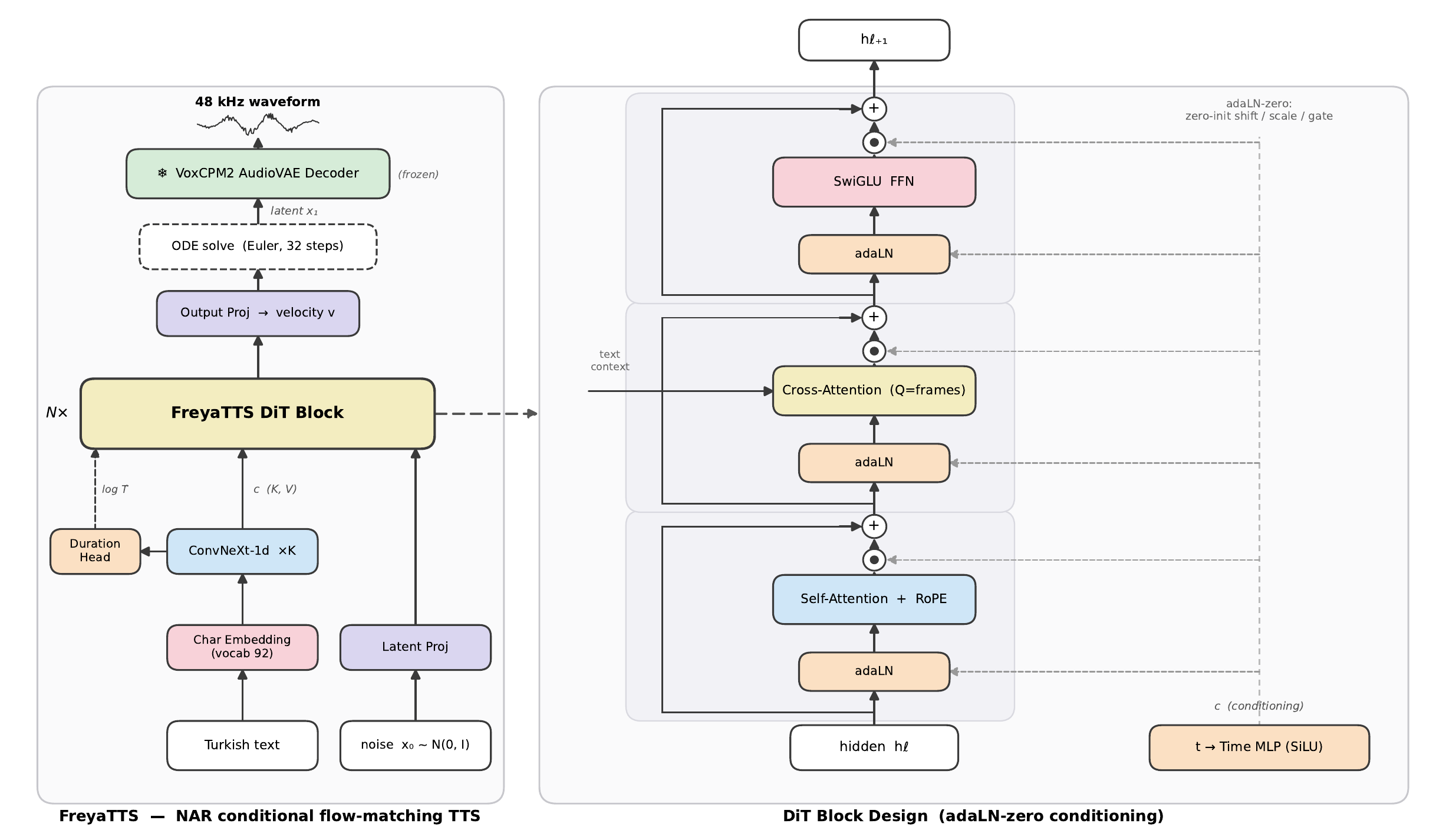
Overall architecture of . Character-level Turkish text (a $92$-symbol vocabulary; no byte-pair encoding, phonemizer, or grapheme-to-phoneme frontend) is embedded and refined by a ConvNeXt-1d encoder into a character-feature sequence $c$, which (i)~drives a duration head that predicts the total latent length $ T$ and (ii)~serves as the key/value memory for the cross-attention layers of a non-autoregressive Diffusion Transformer (DiT). Conditioned on the flow-matching timestep $t$ through adaLN-zero modulation, the DiT denoises a length-$ T$ sequence of $64$-dimensional latent frames drawn from Gaussian noise; the resulting clean latents are rendered to $48$\,kHz audio by the frozen AudioVAE2 decoder. The autoregressive TSLM/FSQ/RALM backbone is discarded; only AudioVAE2 is reused. From Freya TTS Research Team.
Today's compact digest spans two quite different corners of generative modeling: a lean, production-grade Turkish TTS system that strips away the usual text-processing pipeline, and a conceptual reframing of video generation from Wan-AI that arrived on the Hugging Face Daily tab.
TTS & Voice Synthesis
Direct-character synthesis meets production constraints
Most neural TTS pipelines lean heavily on language-specific phonemizers and subword tokenizers — components that are brittle, hard to maintain, and a real barrier for lower-resource languages. FreyaTTS from the Freya TTS Research Team takes a clean-slate approach for Turkish, feeding raw Unicode characters straight into a non-autoregressive Diffusion Transformer that operates in a frozen latent space. By sidestepping phoneme look-ups entirely, the system avoids the typical failure modes around out-of-vocabulary words and grapheme-to-phoneme errors. A dedicated production post-training stage locks in speaker consistency, and the resulting model runs in real time on consumer CPUs — a practical requirement for on-device deployment. The paper reports state-of-the-art results on Turkish TTS benchmarks.
FreyaTTS Technical Report
Freya-TTS eliminates phonemizers and tokenizers, operating directly on Turkish characters via non-autoregressive Diffusion Transformers in a frozen latent space. Production post-training ensures speaker consistency while achieving state-of-the-art Turkish TTS with real-time inference on consumer CPUs.
Abstract
We introduce Freya-TTS, a compact, tokenizer-free, Turkish-first text-to-speech model designed for highly reliable and efficient conversational synthesis. Freya-TTS is a 183.2M-parameter non-autoregressive conditional flow-matching Diffusion Transformer (DiT) that operates in the frozen continuous latent space of AudioVAE2 (16 kHz encode, 48 kHz decode), allowing the model to focus its capacity on text-to-latent mapping while inheriting high-quality 48 kHz reconstruction. We advance the framework along three key dimensions: (1) rule-free end-to-end modeling from a 92-symbol Turkish character vocabulary without a phonemizer, grapheme-to-phoneme frontend, or discrete speech tokenizer; (2) non-autoregressive parallel denoising, which predicts the entire latent sequence simultaneously over a predicted duration; and (3) a production-oriented two-stage post-training recipe consisting of single-speaker voice locking and short-utterance coverage, improving speaker consistency and robustness on short inputs. On the Freya-TR-Eval benchmark, Freya-TTS achieves a band-matched word error rate (WER) of 8.0% and character error rate (CER) of 3.0%, outperforming substantially larger open-source systems while using a fraction of their parameters. The model achieves a real-time factor of 0.11 on consumer GPUs and runs faster than real time on a laptop CPU, making it well suited for resource-constrained edge deployment. We release the model weights, training and inference code, and evaluation benchmark under the Apache-2.0 license.
Video Understanding & Generation
Rethinking what a video actually represents
From today's Hugging Face Daily picks, Wan-AI proposes a provocative decomposition: Video = World + Event Stream. Rather than treating video as a dense sequence of pixels, the framework separates the underlying static world state from the dynamic event stream that drives change over time. This dual-stream view has implications for both video generation and understanding, suggesting models can reason more explicitly about what persists versus what changes across frames.

Video = World + Event Stream
Abstract
We present Wan-Streamer v0.3, which reframes our native-streaming interaction model under a single organizing view: a video is a world plus an event stream. The world is the persistent context in which a video unfolds, including the environment, scene, subjects, ambient acoustic conditions, voice characteristics, and other relatively stable conditions. The event stream is everything that changes over time within that world, including scene or environmental changes, subject behavior, speech, and other sounds. This yields a general-purpose pretraining task over large amounts of real video: given a world and incoming input, predict how the world moves, changes, and responds in real time. The resulting competence can be specialized to a broad family of real-time downstream tasks. We instantiate it on real-time full-duplex audio-visual interaction, where the event stream is the agent's speech together with free-form behavior. Functionally, the model's multimodal understanding process is vision-language-action-like: it maps multimodal user input to language-form speech and behavior actions. Wan-Streamer v0.3 preserves the v0.2 operating point: 640x368 video at 25 FPS, a 160 ms streaming unit, approximately 200 ms model-side response latency, and approximately 550 ms total interaction latency under a 350 ms bidirectional network budget.
Trending on Hugging Face

Vidu S1: A Real-Time Interactive Video Generation Model
Vidu S1 is a real-time interactive video generation model that supports voice-controlled digital character animation with infinite-length output and high frame rate on consumer hardware.

OmniFlatten: An End-to-end GPT Model for Seamless Voice Conversation
A novel GPT-based model, OmniFlatten, enables real-time natural full-duplex spoken dialogue through a multi-stage post-training technique that integrates speech and text without altering the original model's architecture.

Qwen3-TTS Technical Report
The Qwen3-TTS series presents advanced multilingual text-to-speech models with voice cloning and controllable speech generation capabilities, utilizing dual-track LM architecture and specialized speech tokenizers for efficient streaming synthesis.

VibeVoice Technical Report
VibeVoice synthesizes long-form multi-speaker speech using next-token diffusion and a highly efficient continuous speech tokenizer, achieving superior performance and fidelity.