
Animating Avatars: Nodding, Vocal-Tract Motion, and Non-Humanoid Blendshapes
Today's digest covers three papers pushing the boundaries of avatar animation — from real-time listener nodding and synchronized 3D vocal-tract articulation, to feed-forward blendshape registration for non-humanoid heads.
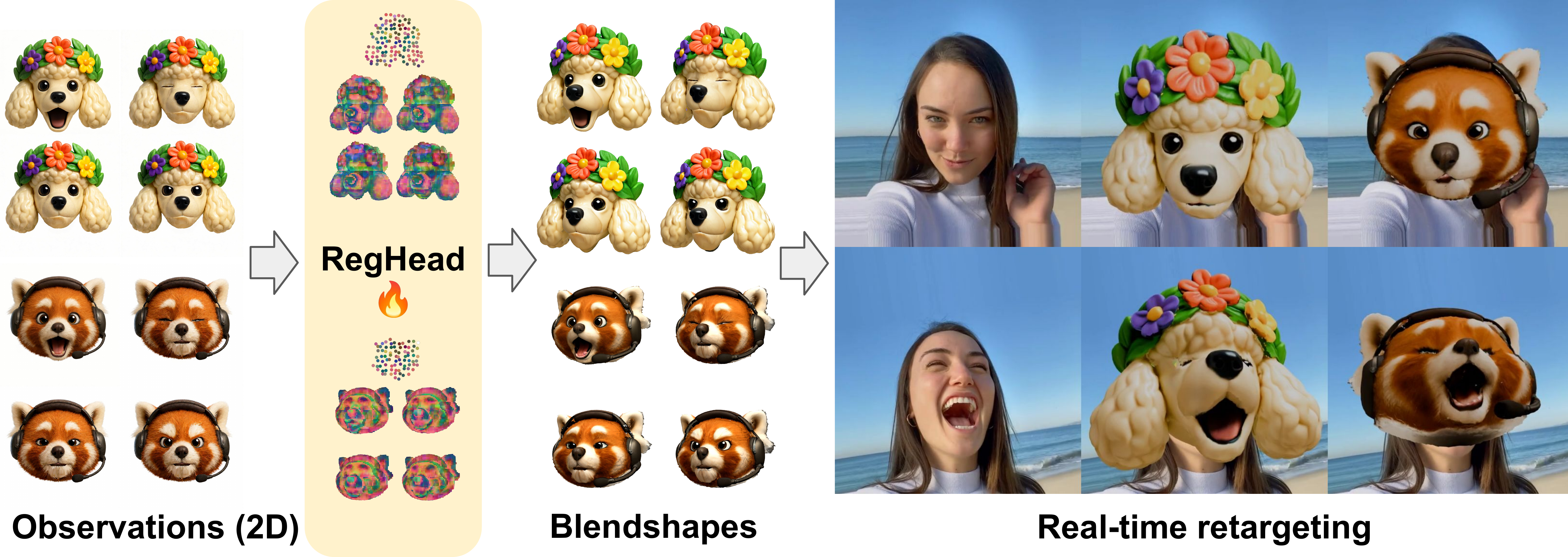
RegHead converts semantically labeled expression observations into a corresponded semantic blendshape set for non-humanoid heads in a single feed-forward pass. The resulting blendshapes support real-time animation and retargeting via a fixed expression vocabulary. From Snap Research.
Today's papers share a common thread: making virtual characters more physically plausible, expressively responsive, and efficiently animatable. From the subtle head nod of a conversational agent to the biomechanics of the vocal tract and the blendshape rigs of fantastical creatures, researchers are closing the gap between real and rendered.
Talking Avatars & Gesture Animation
Getting conversational avatars to move and speak in ways that feel natural and interpretable.
Real-Time Listener Nodding
One of the persistent challenges in dialogue avatar systems is generating listener back-channel behavior — those small head nods that signal engagement — without it looking robotic or mistimed. Most prior approaches either rely on stochastic timing models or play back fixed motion clips, neither of which adapts well to live conversation dynamics. Kyoto University's new work addresses this directly by predicting both the timing and kinematic parameters (amplitude, velocity, duration) of nodding in real time using dyadic attention networks that model the interplay between speaker and listener context.

Real-time Generation of Listener Nodding via Prediction of Kinematic Parameters for Avatar Dialogue Systems
This paper predicts both timing and kinematic parameters of listener nodding in real time for conversational avatars. Unlike prior work using stochastic timing or fixed motions, it uses dyadic attention networks to generate context-aware nodding that naturally adapts to dialogue flow.
Abstract
In human dialogue, we achieve smooth communication by expressing nonverbal cues such as eye contact, nodding, and facial expressions with precise timing. It is expected for conversational avatars to express these cues appropriately to realize natural and human-like interactions. This study focuses on nodding, which is crucial for demonstrating active listening and encouraging further user utterances. We propose a model that predicts both timing and kinematic parameters representing the motion features of listener nodding in real time. The proposed model consists of a timing prediction module and a kinematic parameter prediction module. Each implements a dyadic attention network over the speaker and listener channels based on the technique of Voice Activity Projection (VAP). Unlike conventional models, this approach enables real-time prediction of kinematic parameters based on the specific context of the dialogue rather than just predicting the timing. Furthermore, we demonstrate the effectiveness of fine-tuning the kinematic parameter prediction module initialized from the trained timing prediction module. The proposed model is lightweight and capable of real-time operation, and it has been integrated into an avatar dialogue system. Subjective evaluation experiments shows that our proposed method significantly outperforms both a baseline with stochastic timing and another with fixed-motion nodding. The code and trained models are available at https://github.com/MaAI-Kyoto/MaAI.
Synchronized 3D Vocal-Tract Motion
Going deeper into the speech production pipeline, Tokyo Institute of Technology presents a system that couples neural speech synthesis with biomechanical vocal-tract modeling. Rather than treating acoustics and articulation as separate problems, they use a Joint-Embedding Predictive Architecture (JEPA) alignment to synchronize a neural acoustic carrier with a physically constrained 3D vocal-tract model. The result is speech output that is both high-quality and grounded in interpretable, physically plausible articulatory motion — a significant step toward visually faithful talking-head systems that can render the full vocal apparatus.

Synchronized Three-Dimensional Vocal-Tract Motion for Speech Synchronization via Joint-Embedding Predictive Architecture Alignment
This work merges neural speech synthesis with biomechanical vocal-tract modeling to generate synchronized 3D articulatory motion. By aligning a neural acoustic carrier with a physically constrained 3D vocal-tract model, it achieves robust speech while maintaining interpretable, physically plausible articulation.
Abstract
Modern neural speech systems can generate intelligible waveforms, but they usually hide the physical speech-production state that produced the sound. Conversely, biomechanical vocal-tract models expose articulatory structure, contact behavior, airflow routing, and geometric constraints, but direct physical waveform synthesis remains less robust than modern neural vocoders. A duration-preserving acoustic carrier supplies the listening waveform, while a corrected three-dimensional vocal-tract model supplies synchronized jaw, lip, tongue, velum, laryngeal, oral-airflow, and nasal-airflow motion. A joint-embedding predictive architecture (JEPA)-style representation and a reinforcement learning/cross-entropy method (RL/CEM) trajectory-selection loop align articulatory actions to the acoustic carrier and to physical-plausibility constraints. The evaluation contains 12 3D recordings covering 24 minimal-pair stimuli. On the 24-word set, the carrier obtains good automatic speech recognition (ASR) results (an 8.33\% WER, a 4.17\% CER), a UTMOS score of 3.174, a mean JEPA score of 0.864, and a mean timbre-guard score of 0.947.
Digital Humans & Blendshape Avatars
Fast, scalable rigging for characters that don't look human.
Non-Humanoid Blendshapes at Feed-Forward Speed
Blendshape rigs are the industry standard for facial animation, but constructing them for non-humanoid characters (think stylized creatures, fantasy races, or cartoon heads) is laborious and typically requires expensive per-identity optimization. Snap Research's RegHead tackles this with a feed-forward registration approach that builds semantic blendshapes for arbitrary non-humanoid head geometries. By combining a curated dataset of non-humanoid heads with stochastic anchor representations, RegHead enables high-fidelity animation and real-time cross-identity retargeting that is orders of magnitude faster than optimization-based baselines — making production-scale non-humanoid avatar pipelines far more tractable.
RegHead: Non-Humanoid Head Blendshapes via Feed-Forward Registration
RegHead constructs semantic blendshapes for non-humanoid head avatars via fast feed-forward registration. It combines a curated dataset with stochastic anchor representations to enable high-fidelity animation and real-time cross-identity retargeting—orders of magnitude faster than optimization-based methods.
Abstract
We present RegHead, a framework for constructing semantic blendshape sets for animatable non-humanoid head avatars. With a fixed expression vocabulary, semantic blendshapes provide a low-dimensional and interpretable animation interface and support cross-identity retargeting. Building such blendshape sets remains expensive because (i) expression-consistent supervision is scarce, (ii) generated 4D assets typically lack correspondence, and (iii) facial motion is highly localized. We propose (1) a large-scale dataset of non-humanoid identities paired with a shared expression vocabulary, obtained by expanding a small artist-rigged library via fine-tuned image editing; (2) a dense stochastic anchor motion representation tailored to localized facial deformations; and (3) a fast feed-forward registration model that converts unregistered expression meshes into a corresponded blendshape basis by predicting anchor-based deformations from the neutral shape. Experiments show that our approach produces higher-fidelity expression meshes than baselines, while running orders of magnitude faster than optimization. We further demonstrate real-time retargeting from human face tracking signals to non-humanoid characters, capturing both head pose and localized facial motions. Our project page is available at https://snap-research.github.io/RegHead/.
Trending on Hugging Face

Vidu S1: A Real-Time Interactive Video Generation Model
Vidu S1 is a real-time interactive video generation model that supports voice-controlled digital character animation with infinite-length output and high frame rate on consumer hardware.

OmniFlatten: An End-to-end GPT Model for Seamless Voice Conversation
A novel GPT-based model, OmniFlatten, enables real-time natural full-duplex spoken dialogue through a multi-stage post-training technique that integrates speech and text without altering the original model's architecture.

Qwen3-TTS Technical Report
The Qwen3-TTS series presents advanced multilingual text-to-speech models with voice cloning and controllable speech generation capabilities, utilizing dual-track LM architecture and specialized speech tokenizers for efficient streaming synthesis.

IndexTTS: An Industrial-Level Controllable and Efficient Zero-Shot Text-To-Speech System
IndexTTS, an enhanced text-to-speech system combining XTTS and Tortoise models, offers improved naturalness, enhanced voice cloning, and controllable usage through hybrid character-pinyin modeling and optimized vector quantization.

Qwen3-ASR Technical Report
The Qwen3-ASR family introduces speech recognition models with language identification capabilities and a non-autoregressive forced alignment model, achieving state-of-the-art performance and efficient processing.