
Controllable TTS, Efficient Dialog Synthesis, and Streaming Speech Translation
Today's digest covers fine-grained style control in TTS, memory-efficient dialog speech synthesis via latent flow matching, cross-domain voice conversion from music models, and data-driven simultaneous speech translation with unmodified LLMs.
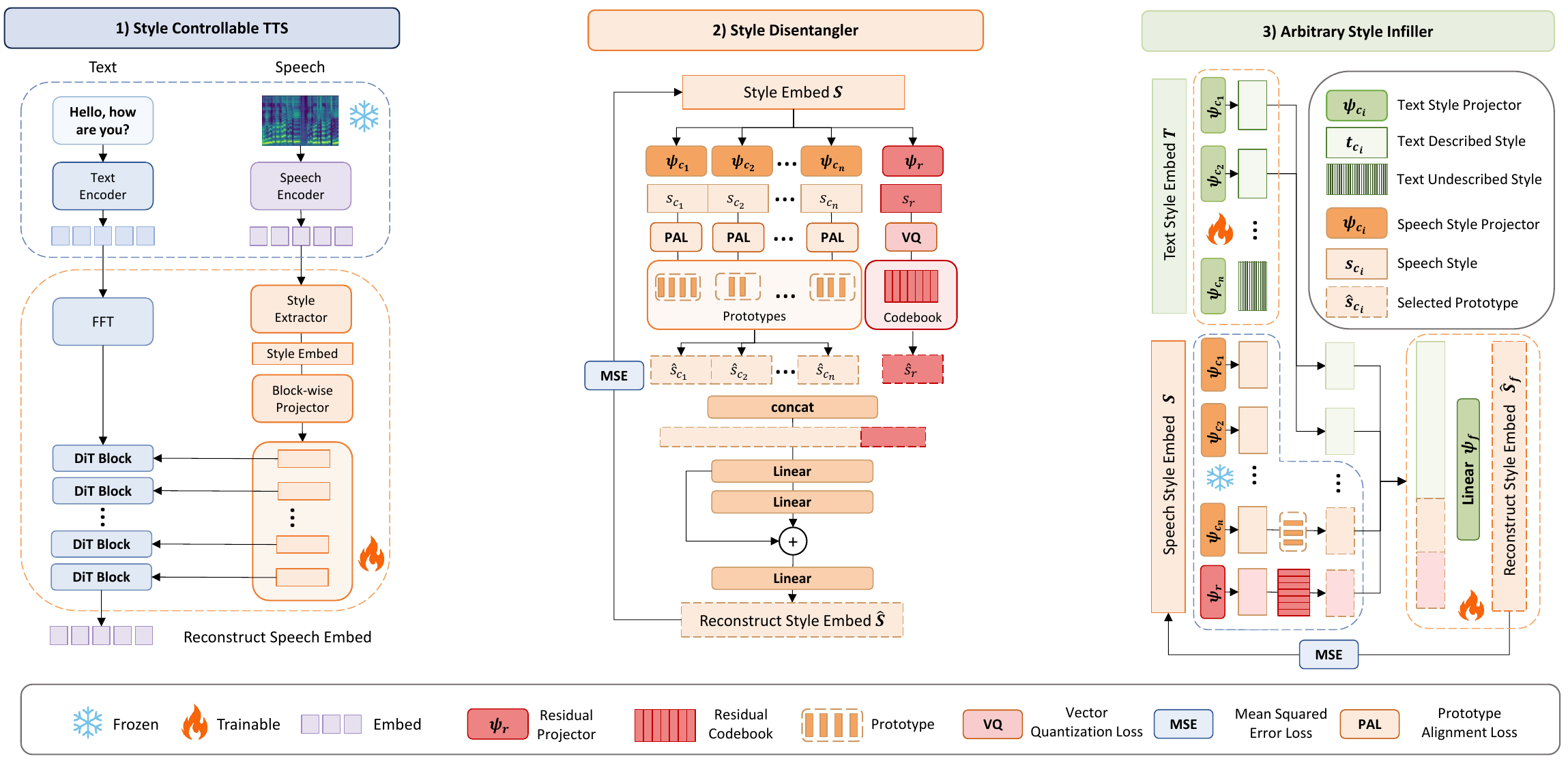
Overview of AutoSIFT. 1) A FM-DiT-based SC-TTS extracts a style embedding from speech. 2) A Style Disentangler decomposes style embedding $S$ into category-specific and residual style embeddings. 3) An Arbitrary Style Infiller performs the ASI task by following text-specified categories and preserving text-undescribed and residual styles from $S$. From UNSW Sydney.
Today's papers span the full arc of spoken AI — from sculpting the emotion and age of a synthesized voice to streaming translations in real time without touching an LLM's architecture. Four focused contributions push controllability, efficiency, and cross-domain transfer in complementary directions.
TTS & Voice Synthesis
Fine-grained style control and radical memory efficiency come to the foreground in today's synthesis work.
Style transfer in TTS has long struggled with a fundamental tension: you want to change some attributes of a reference utterance (say, the emotion) while leaving everything else — the speaker's idiosyncratic timbre, pacing, residual nuances — untouched. AutoSIFT from UNSW Sydney tackles this head-on by explicitly disentangling controllable categories (emotion, age, gender) from the residual speaker representation. Rather than collapsing all style into a single embedding, it selectively infills only the specified axes, preserving unspecified details from the reference speech and balancing explicit control with natural prosody.
AutoSIFT: Automatic Style Sifting for Controllable Speech Generation with Arbitrary Style Infilling
AutoSIFT enables fine-grained style control in speech generation by disentangling controllable categories (emotion, age, gender) from residual speaker nuances. It selectively modifies specified styles while preserving unspecified details from reference speech, balancing explicit control with natural prosody.
Abstract
State-of-the-art text-to-speech (TTS) models achieve impressive naturalness and expressiveness, yet fine-grained, disentangled control over speaking styles remains challenging. In professional scenarios such as film dubbing, game voice acting, and video content generation, users often need to modify a specific style category, such as emotion, age, or gender, while preserving all others. Existing style-controllable TTS methods typically rely on either text-described styles or speech-reference style transfer, making it difficult to jointly control explicit semantic attributes and preserve subtle, text-undescribed prosodic details. We propose AutoSIFT, a controllable speech generation framework for category-level style editing. AutoSIFT decomposes speaking style into known text-describable categories and unknown residual styles that capture non-verbal prosody and speaker-specific nuances. It consists of a generalized Style Disentangler, which extracts category-aware style prototypes from reference speech, and an Arbitrary Style Infiller, which selectively infills unspecified style categories from the reference. By replacing only text-specified style categories while preserving residual speech-derived styles, AutoSIFT enables natural, expressive, and highly customizable speech generation.
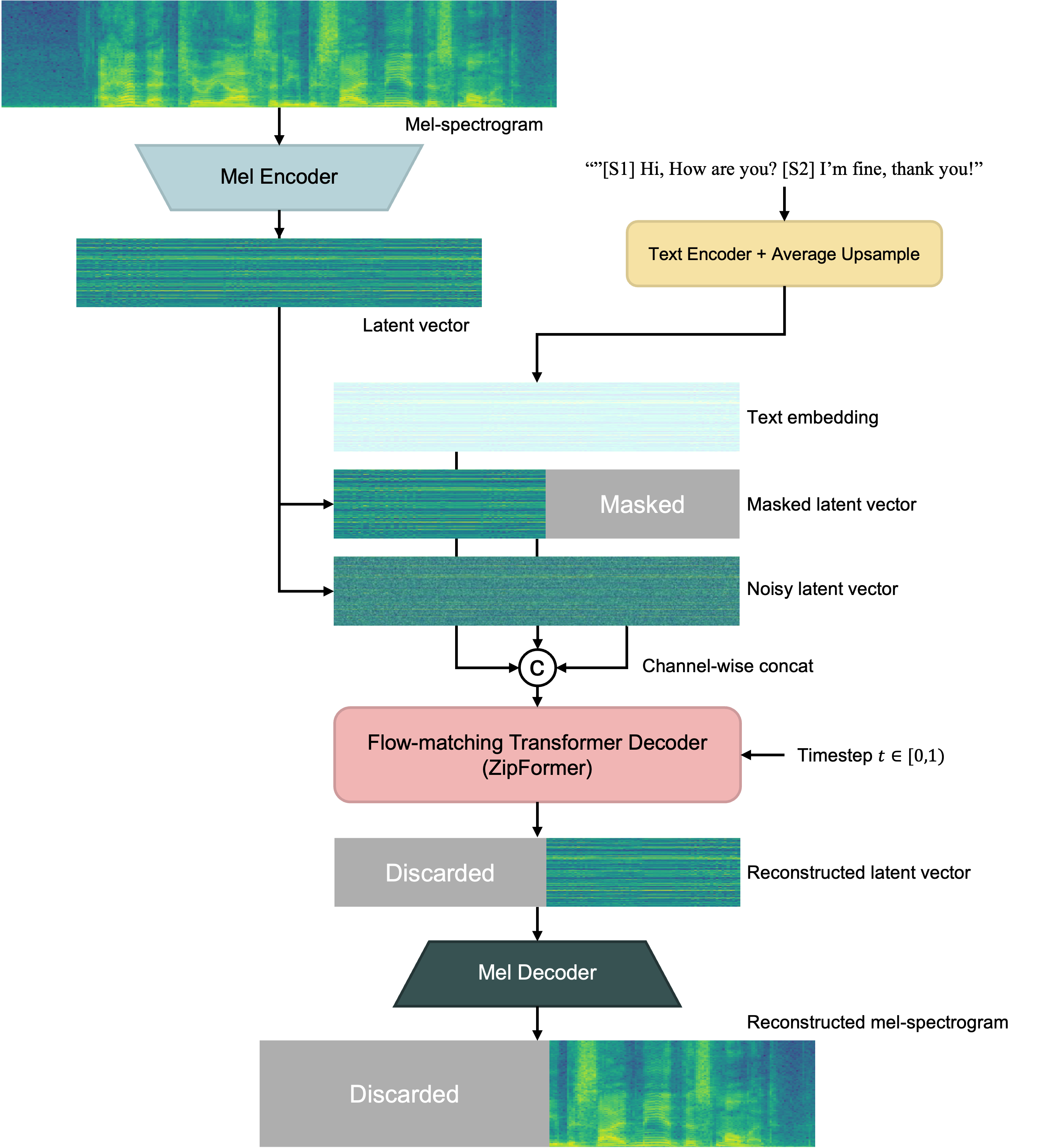
Long-form spoken dialog synthesis carries a different burden: dense mel-spectrogram generation at scale is punishingly expensive. ZipL-Dialog from Seoul National University sidesteps this by performing flow matching in a 4× compressed latent space produced by a deterministic autoencoder with auxiliary acoustic supervision. The payoff is dramatic — 11× reduction in peak GPU memory and 2.23× faster inference with no meaningful loss in acoustic quality. It's a clean demonstration that the right latent bottleneck can decouple generation quality from compute cost.
ZipL-Dialog: Memory-Efficient Long-Form Spoken Dialog Synthesis via Latent Flow Matching
This paper enables efficient dialog TTS by performing flow-matching in a 4x compressed latent space rather than on dense mel-spectrograms. The approach reduces peak GPU memory 11× and inference time 2.23× while maintaining acoustic quality through deterministic autoencoders and auxiliary supervision.
Abstract
Zero-shot dialog TTS benefits from flow-matching, but minute-scale generation on dense mel-spectrograms causes severe memory bottlenecks, often forcing unnatural chunked synthesis. We propose ZipL-Dialog, which shifts conditional flow-matching into a 4x time-compressed (25 Hz) latent space. To preserve acoustic fidelity under compression, we employ a deterministic mel autoencoder with auxiliary mel-domain supervision and optimize the ZipFormer's hierarchical downsampling schedule. Experiments show that ZipL-Dialog reduces maximum peak GPU memory by 11.22x and accelerates inference by 2.23x over the baseline, substantially lowering the memory footprint of single-pass multi-minute dialog synthesis while maintaining perceptual naturalness.
Voice Conversion
Cross-domain transfer lets a music diffusion model speak — and sing.
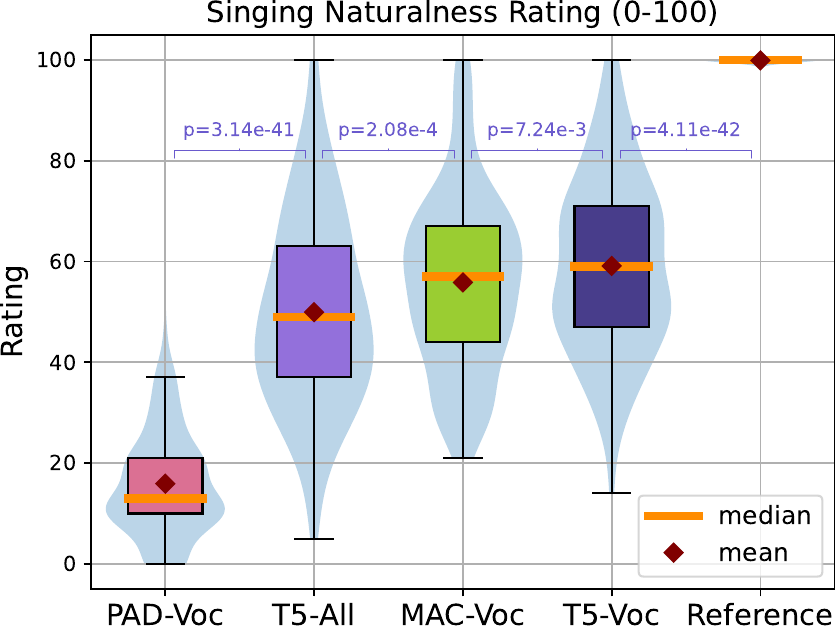
Voice conversion typically demands task-specific architectures for speech or singing, but rarely handles both in a unified way. Fraunhofer IDMT's work adapts a diffusion-based music synthesis model to both speech and singing voice conversion by extending it with phonetic and pitch conditioning extracted from off-the-shelf front-ends. Because the backbone was pre-trained on music, cross-domain transfer handles the acoustic richness of singing naturally, yielding a single model that spans speech, singing, and music without bespoke architectural choices for each domain.
Adapting Diffusion-Based Music Synthesis to Speech and Singing Voice Conversion
This work adapts a diffusion-based music model to voice conversion for speech and singing using extended phonetic and pitch conditioning. By leveraging off-the-shelf extractors and cross-domain transfer, it enables unified handling of speech, singing, and music in a single model without task-specific architectures.
Abstract
Recent diffusion-based generative models have achieved strong results in domain-specific audio generation tasks such as speech, singing, and instrumental music synthesis. However, these models are typically specialized and do not generalize well to mixed or intermediate audio types. In this work, we adapt a diffusion-based model originally designed for multi-instrument music synthesis to voice conversion, covering both speech and singing within a unified framework. Specifically, we extend musical note-based conditioning to include phonetic posteriorgrams (PPGs) and pitch contours, and reinterpret timbre conditioning as speaker or singer identity via feature-wise linear modulation. Experiments show that the adapted model matches or surpasses a dedicated voice conversion system in terms of naturalness and performer similarity, while maintaining accurate pitch control across speech and singing. At the same time, we observe limitations in phonetic fidelity and a degradation in vocal quality when incorporating instrumental training data. Furthermore, we demonstrate that off-the-shelf feature extractors provide effective conditioning signals, enabling large-scale self-supervised training without manual annotations. These results highlight the potential of cross-domain model transfer towards unified audio generation systems capable of handling speech, singing, and music. Qualitative samples can be found on our project page: https://benadar293.github.io/voice-conversion
SpeechLLMs & Spoken Dialogue
A data-driven supervision scheme gives decoder-only LLMs simultaneous translation without a single architectural change.
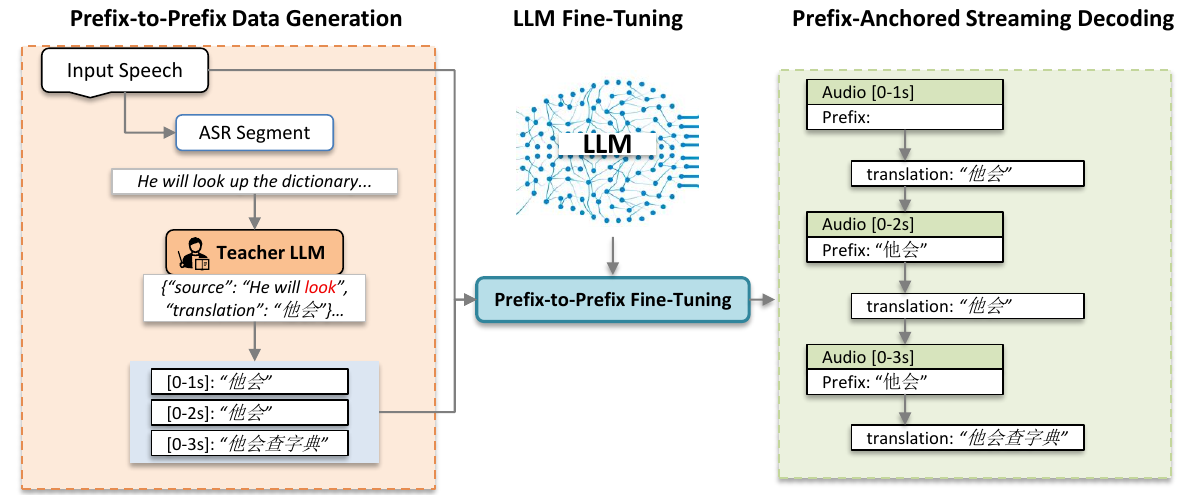
Simultaneous speech translation — producing target-language text incrementally as source audio streams in — is typically solved with specialized encoder-decoder designs or custom latency-control modules. Microsoft Research Asia asks a sharper question: do LLMs actually need any of that? Their prefix-to-prefix approach generates incremental translation targets from streaming audio chunks using a teacher LLM, then uses those targets as supervision for a student decoder-only model. The result is low-latency streaming decoding under realistic latency budgets with no modifications to the underlying LLM architecture — just smarter training data construction.
Do LLMs Need Architectural Changes for Simultaneous Speech Translation? A Prefix-to-Prefix Data Driven Approach
This work enables decoder-only LLMs to perform simultaneous speech translation under latency constraints without architectural changes, using prefix-to-prefix supervision. A teacher LLM generates incremental translation targets from streaming audio chunks to train the student model for low-latency streaming decoding.
Abstract
Simultaneous speech translation (SimulST) requires incremental translation under strict latency constraints, yet remains challenging for decoder-only LLM systems due to limited context and cross-lingual reordering. Recent approaches often introduce architectural changes or explicit read/write policies to control output timing, which can be brittle in conversational speech where segmentation boundaries are ambiguous. We present a simple data-driven alternative: fixed-length chunks for cumulative streaming decoding with a rewind-based committed prefix, and teacher-labeled prefix-to-prefix (P2P) targets with bounded waiting for fine-tuning, yielding CSSEL-P2P, where CSSEL is our proposed chunked streaming speech encoder LLM. In our in-house conversational speech evaluation, CSSEL-P2P improves streaming quality by +1.54 COMETKiwi over the CSSEL streaming baseline at comparable latency (+0.15s Average Lagging), suggesting effective SimulST without architectural changes via P2P supervision.
Trending on Hugging Face
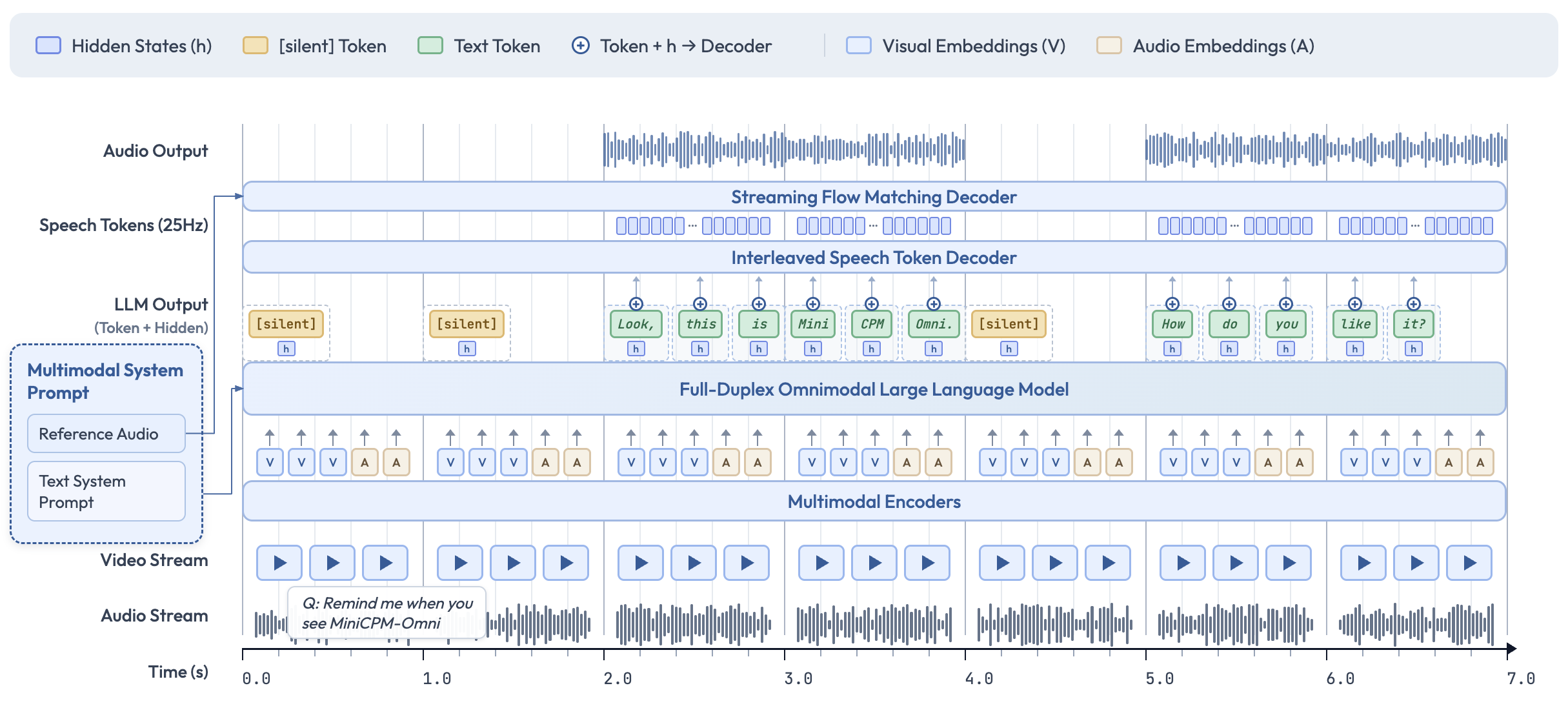
MiniCPM-o 4.5: Towards Real-Time Full-Duplex Omni-Modal Interaction
MiniCPM-o 4.5 enables real-time full-duplex interaction where perception and response happen simultaneously across vision, audio, and speech. Its Omni-Flow framework aligns multimodal signals on a shared timeline, supporting both reactive and proactive behaviors in continuous, streaming conversation.

OmniFlatten: An End-to-end GPT Model for Seamless Voice Conversation
A novel GPT-based model, OmniFlatten, enables real-time natural full-duplex spoken dialogue through a multi-stage post-training technique that integrates speech and text without altering the original model's architecture.

Qwen3-TTS Technical Report
The Qwen3-TTS series presents advanced multilingual text-to-speech models with voice cloning and controllable speech generation capabilities, utilizing dual-track LM architecture and specialized speech tokenizers for efficient streaming synthesis.

VibeVoice Technical Report
VibeVoice synthesizes long-form multi-speaker speech using next-token diffusion and a highly efficient continuous speech tokenizer, achieving superior performance and fidelity.

IndexTTS: An Industrial-Level Controllable and Efficient Zero-Shot Text-To-Speech System
IndexTTS, an enhanced text-to-speech system combining XTTS and Tortoise models, offers improved naturalness, enhanced voice cloning, and controllable usage through hybrid character-pinyin modeling and optimized vector quantization.