
Authentic Emotion in Conversational Speech Synthesis
Today's digest focuses on emotionally expressive conversational TTS, featuring AuEmoChat from NUS — a system that moves beyond discrete emotion categories to learn continuous emotion tokens from large-scale speech data.
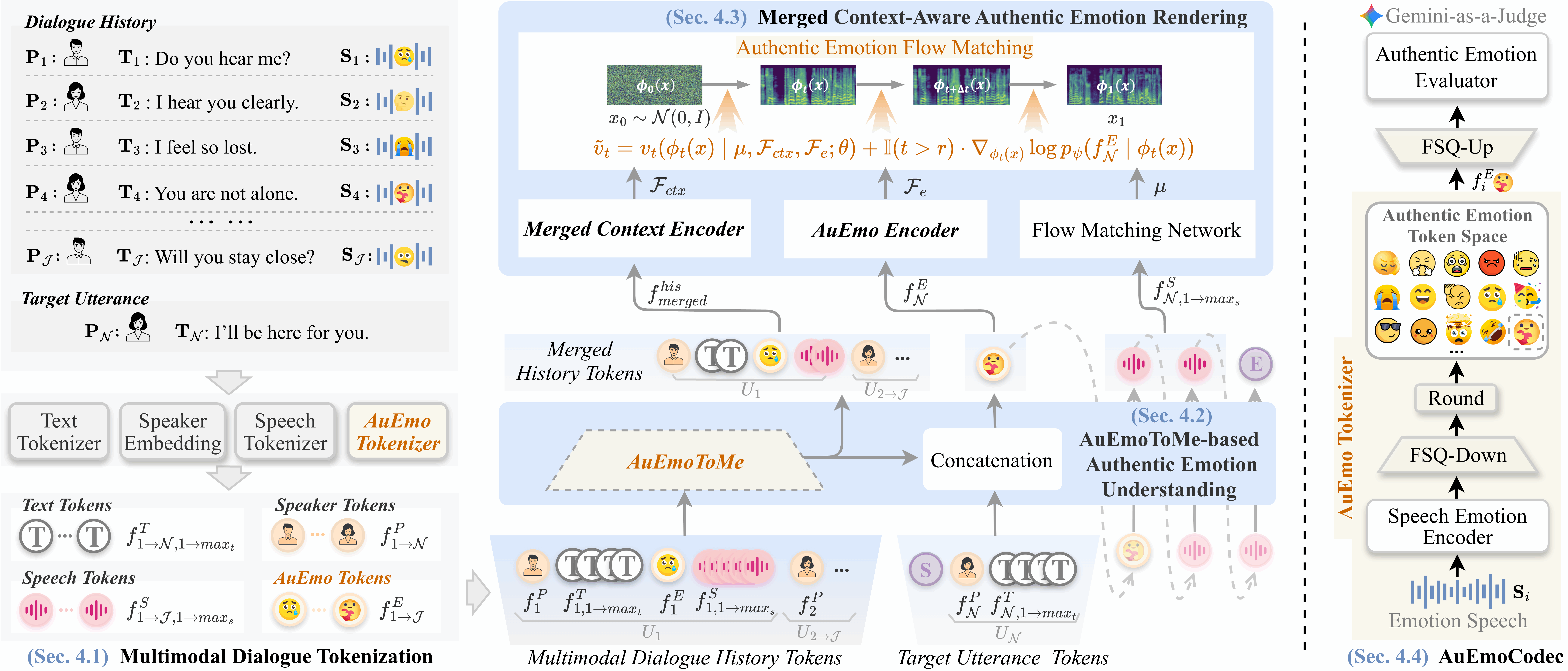
The left side illustrates the overall framework of the proposed AuEmoChat, which includes: Multimodal Dialogue Tokenization, AuEmoToMe-based Authentic Emotion Understanding, and Merged Context-Aware Authentic Emotion Rendering. The right side illustrates the overall framework of the proposed AuEmoCodec. From National University of Singapore.
Today's digest is a focused look at one of the harder unsolved problems in conversational AI: making synthesized speech that doesn't just sound emotional, but actually reflects the nuanced, continuous nature of human emotion in dialogue. A single paper from the National University of Singapore takes a compelling step forward.
TTS & Voice Synthesis
Beyond discrete labels — learning emotion the way humans feel it
Categorical emotion labels (happy, sad, angry…) have long been the dominant paradigm for emotional TTS, but they're a crude approximation of how affect actually works in conversation. The real challenge is capturing emotion as a continuous, context-dependent signal that shifts across a dialogue — and then rendering it naturally in synthesized speech.
AuEmoChat tackles exactly this problem. Rather than relying on a fixed emotion taxonomy, it learns continuous emotion tokens directly from large-scale emotional speech data, letting the model capture fine-grained affective nuance that discrete categories simply cannot express. On the dialogue-context side, it applies a smart merging strategy that compresses redundant conversational history while preserving the emotion-relevant information that actually drives prosody. The result is a system capable of generating expressive, contextually appropriate emotional speech across multi-turn conversations.
AuEmoChat: Authentic Emotion Understanding and Rendering for Conversational Speech Synthesis
AuEmoChat proposes conversational speech synthesis with authentic emotion understanding by learning continuous emotion tokens from large-scale emotional speech rather than discrete categories. It merges redundant dialogue context while preserving emotion-relevant information, generating expressive emotional speech.
Abstract
Conversational Speech Synthesis (CSS) aims to synthesize speech with human-like emotional expression and contextual consistency in user-agent interactions. Existing CSS methods struggle to render authentic human emotions due to limited predefined emotion label spaces (e.g., seven emotion categories), while redundant multimodal tokens in multi-turn dialogue history interfere with context understanding. To address these issues, we propose AuEmoChat, a CSS framework for authentic emotion understanding and rendering. First, we develop AuEmoCodec, which learns a discrete authentic emotion token space from large-scale emotional speech via finite scalar quantization, enabling a more authentic emotion representation than limited basic emotion categories. We further propose AuEmoToMe, an authentic-emotion-guided token merging algorithm that merges redundant tokens in multimodal dialogue history while preserving emotion-relevant context. We integrate it into an autoregressive text-speech model to predict the target authentic emotion token and speech tokens. Finally, we propose Authentic Emotion Flow Matching, which renders speech by jointly conditioning on merged dialogue context, target authentic emotion, and acoustic priors. Extensive experiments on the NCSSD-EmCap dataset demonstrate that AuEmoChat outperforms state-of-the-art CSS baselines and generates more expressive and authentic emotional speech.
Key design choices worth noting:
- Continuous emotion representation trained from data rather than imposed from a label set — more robust to the messy, overlapping nature of real emotion
- Context compression with emotion preservation — reduces the noise of long dialogue histories without discarding the affective cues that matter for synthesis
- End-to-end conversational framing — the system is designed from the ground up for multi-turn dialogue, not retrofitted from single-utterance TTS
This is a meaningful shift in how the field thinks about grounding emotional TTS in authentic human affect, and the continuous-token approach in particular feels like a direction worth watching as conversational AI systems become more expressive.
Trending on Hugging Face

OmniFlatten: An End-to-end GPT Model for Seamless Voice Conversation
A novel GPT-based model, OmniFlatten, enables real-time natural full-duplex spoken dialogue through a multi-stage post-training technique that integrates speech and text without altering the original model's architecture.
FunAudioLLM: Voice Understanding and Generation Foundation Models for Natural Interaction Between Humans and LLMs
FunAudioLLM enhances voice interactions by integrating SenseVoice for multilingual speech recognition, emotion detection, and audio event detection with CosyVoice for natural speech generation across languages, timbres, and styles.

Qwen3-TTS Technical Report
The Qwen3-TTS series presents advanced multilingual text-to-speech models with voice cloning and controllable speech generation capabilities, utilizing dual-track LM architecture and specialized speech tokenizers for efficient streaming synthesis.

IndexTTS: An Industrial-Level Controllable and Efficient Zero-Shot Text-To-Speech System
IndexTTS, an enhanced text-to-speech system combining XTTS and Tortoise models, offers improved naturalness, enhanced voice cloning, and controllable usage through hybrid character-pinyin modeling and optimized vector quantization.

VibeVoice Technical Report
VibeVoice synthesizes long-form multi-speaker speech using next-token diffusion and a highly efficient continuous speech tokenizer, achieving superior performance and fidelity.