
Talking Avatars, Dynamic Hair, and On-Device TTS
Today's digest covers fast audio-driven avatar generation, steerable conversational avatars, physics-based hair reconstruction, unified portrait mesh estimation, and two new speech synthesis systems from Alibaba and Apple targeting controllability and mobile efficiency.
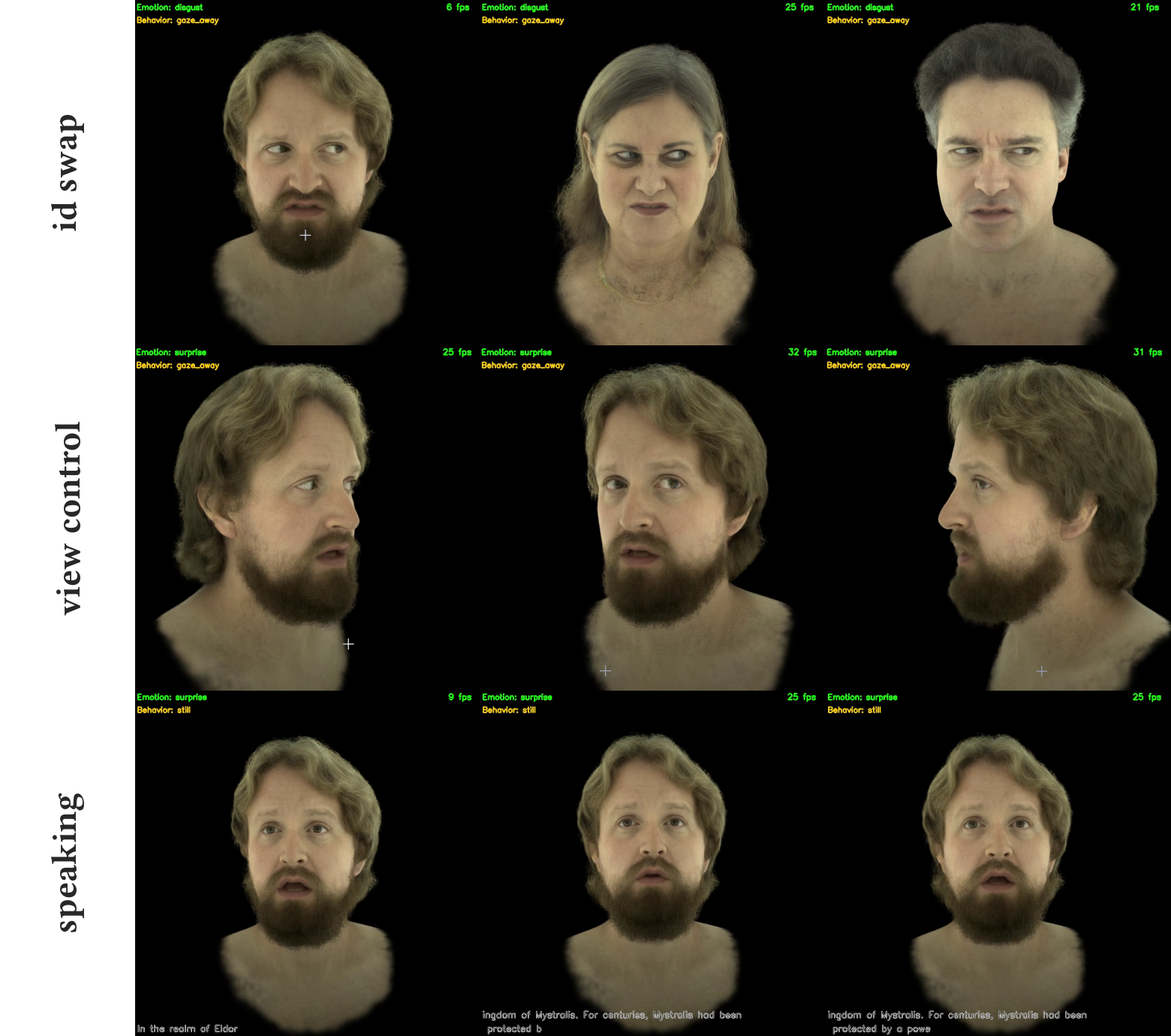
STEER deployed in a real-time setting at $25$\,fps. Row 1 (id swap): same pose driving three different identities through UHAP. Row 2 (view control): free-viewpoint rendering of the same identity. Row 3 (speaking): live audio-driven speaking with semantic-control overlays (emotion, behavior). From Max Planck Institute for Informatics.
Today's papers push the frontier on three converging fronts: making audio-driven avatars faster and more controllable, reconstructing digital humans with richer geometric fidelity, and shipping speech synthesis that is both highly expressive and light enough to run on mobile hardware. Here's the full rundown.
Talking Avatars & Audio-Driven Animation
From 60× speedups to fine-grained behavioral control, this section covers the latest in animating digital humans from audio.
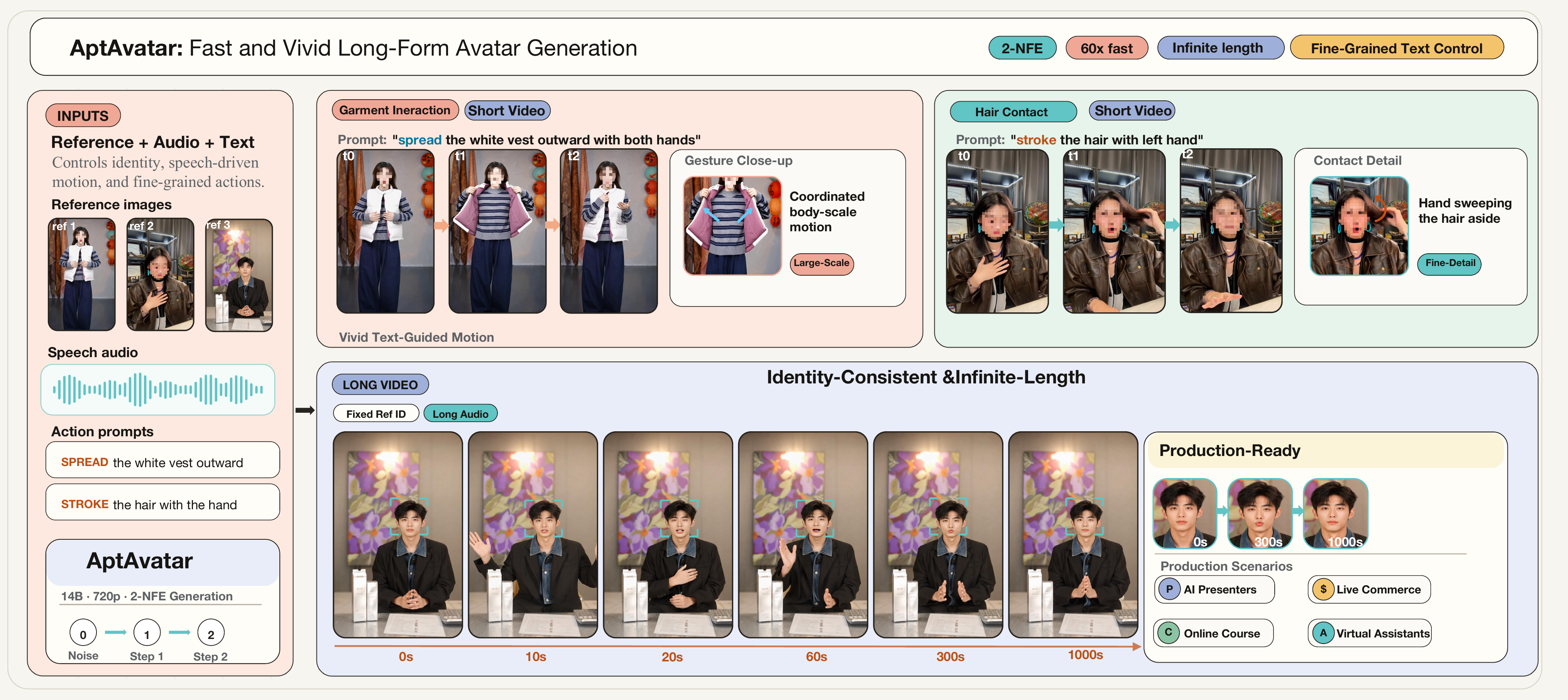
Production-grade avatar video generation has historically meant long inference queues. AptAvatar from TaoLiveAIGC attacks this directly with a distillation strategy that compresses the generation process to just 2 inference steps — a claimed 60× speedup — while maintaining visual fidelity and expressiveness over long video horizons. The key enablers are novel distillation techniques combined with a history-replay mechanism that prevents the temporal drift common when aggressively compressing diffusion models.
AptAvatar: Fast and Vivid Long-Form Audio-Driven Video Generation for Production-Ready Avatars
AptAvatar generates vivid, long-form audio-driven avatar videos with only 2 inference steps, achieving 60x speedup while preserving visual fidelity and expressiveness. Novel distillation and history-replay techniques enable efficient compression without sacrificing model capacity or long-horizon consistency.
Abstract
Production-ready audio-driven avatar generation requires efficient inference without sacrificing fidelity or motion expressiveness. However, existing acceleration methods often compromise quality through restrictive architectural choices, such as causal attention and short temporal horizons, or by reducing model capacity and resolution. Without such compromises, we propose AptAvatar, a 14B-parameter long-form audio-driven avatar generation framework that delivers fast and expressive inference. For efficiency in production-level applications, AptAvatar addresses the extreme two-step generation challenge. To bridge the gap between the multi-step teacher model and the two-step student model, we introduce Endpoint-Anchored Distribution Distillation. It augments vanilla distribution matching with a dedicated Anchor Score Estimator trained on the trajectory-endpoint distribution defined from a frozen pretrained 4-step bridge generator. This provides an attainable endpoint-level anchor for the evolving two-step student. To improve long-horizon consistency, we further introduce Self-Generated History Replay, which reuses cached outputs from earlier generator checkpoints as history conditions during chunk-wise training. This approximates inference-time conditioning on self-generated histories without costly online rollouts, mitigating quality degradation from accumulated history errors. Extensive experiments demonstrate that AptAvatar generates vivid 720p long-form avatar videos with only 2 NFEs, achieving a 60x speedup while preserving visual fidelity and long-horizon identity. Code is available at https://github.com/TaoLiveAIGC/AptAvatar
Expressiveness without controllability is only half the story. STEER from the Max Planck Institute for Informatics takes aim at the harder problem: giving developers explicit handles on gaze direction, head rhythm, and emotional tone in dyadic (two-person) conversational avatars, rather than letting these behaviors emerge implicitly from audio. A flow-matching transformer conditioned on partner context drives a frozen 3D Gaussian avatar prior, enabling real-time interactive control and fine-grained behavioral editing at inference time — a significant step toward avatars that feel intentional rather than just reactive.
STEER: Steerable Dyadic Head Avatars
STEER provides explicit control over gaze, head rhythm, and emotion in conversational avatars rather than emergent audio effects. A flow-matching transformer with partner context drives a frozen Gaussian avatar prior, enabling real-time interactive control and fine-grained behavioral editing.
Abstract
Facial movement and expression are central to face-to-face communication, conveying turn-taking, attention, agreement, and engagement alongside speech. While speech-driven facial animation has made strong progress in lip synchronization and audio-conditioned motion generation, most methods treat conversational behavior as an emergent byproduct of audio, or expose only coarse sequence-level affect control. As a result, key non-verbal channels such as gaze contact and aversion, rhythmic head motion, and emotion remain difficult to explicitly control. We present STEER, a controllable 3D dyadic motion prior for reactive conversational head avatars. STEER factorizes conversational behavior into explicit controls for gaze, head rhythm, and emotion, allowing users to steer how an avatar listens, reacts, and engages with a conversation partner. Since temporally aligned annotations for these behaviors are not available in public dyadic corpora, we introduce a tracking and annotation pipeline that recovers behavioral pseudo-labels from in-the-wild dyadic video. A causal flow-matching transformer then learns partner-aware target motion conditioned on audio, partner motion, emotion and the proposed behavioral controls. We further embed STEER in a photorealistic avatar pipeline by extending a Universal Gaussian Head-Avatar Prior with a learned mapping from tracked parametric motion into its avatar-driving space. This enables controllable animation of high-fidelity Gaussian head avatars without re-training the underlying avatar model. STEER outperforms recent dyadic motion baselines on motion quality, dynamics, and diversity, remains competitive on partner coupling, and enables gaze, head-rhythm, and emotion edits together with an interactive live deployment. We make our code and dataset annotations available at our webpage.
Digital Humans & 3D Face Reconstruction
Two papers tackle the geometry of digital humans — one going strand-deep into hair, the other grounding the whole head on a body.
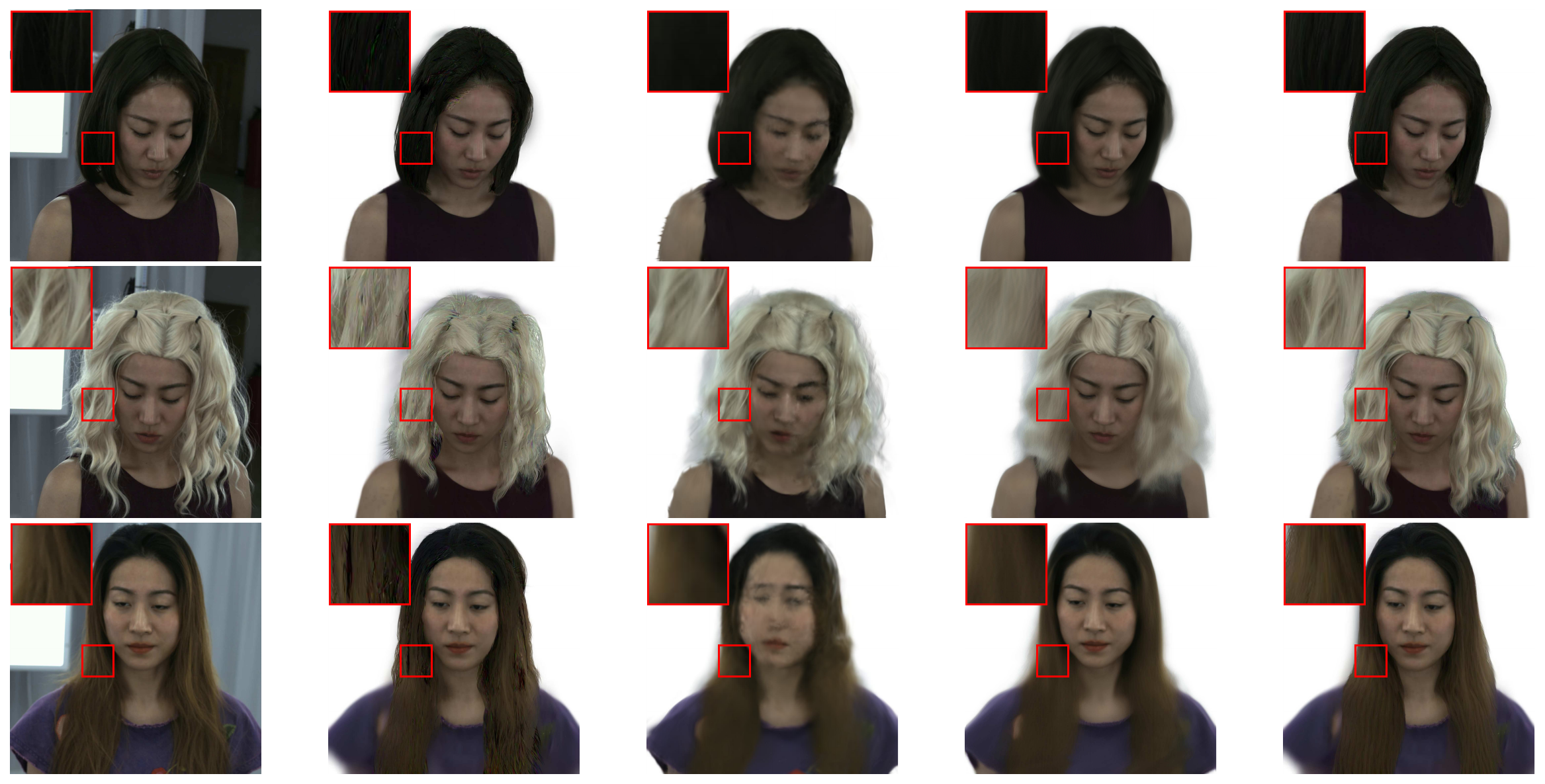
Realistic head avatars have long glossed over hair, typically relying on volume-based approximations. The Max Planck Institute for Intelligent Systems changes this with a reconstruction pipeline that recovers explicit strand-based hair using 3D Gaussian splatting. What makes it distinctive is how hair dynamics are handled: physics-conditioned temporal networks respond to head motion and gravity to produce deformations that are temporally consistent and generalize across subjects — not a per-identity bake.
Head Avatars with Dynamic Explicit Hair
This work reconstructs dynamic head avatars with explicit strand-based hair using 3D Gaussian splatting. It uniquely models hair deformations through physics-conditioned temporal networks responding to head motion and gravity, enabling temporally consistent, animatable hairstyles that generalize across subjects.
Abstract
We present DynHair, a novel method for tracking and modeling dynamic hair for human head avatars. From video input, we reconstruct a dynamic head avatar with an explicit strand-based hair representation using structured 3D Gaussian Splatting. In contrast to the face region of human head avatars, which can be modeled with 3D Gaussians that are attached or generated with respect to some expressive 3D head model, hair is particularly challenging as it exhibits dynamic motion effects. Therefore, we present a novel method that models the dynamic deformations of the hair strands using a temporal network that is conditioned on angular velocity and acceleration of the head, as well as relative gravity. Specifically, an LSTM encodes the motion history and modulates per-point strand features via FiLM conditioning which further used by MLP to produce physically plausible displacements to canonical hairstyle. We jointly optimize this motion and appearance representation of the hair, with a 3DGS-based representation of the face-region, via differentiable Gaussian splatting with photometric, geometric, and physics-based supervision. As a result of our method, we retrieve hair tracking of the training video data and an animatable head avatar with controllable hair dynamics. In our experiments, we demonstrate state-of-the-art performance in terms of hair dynamics, temporal consistency, and generalization across subjects.
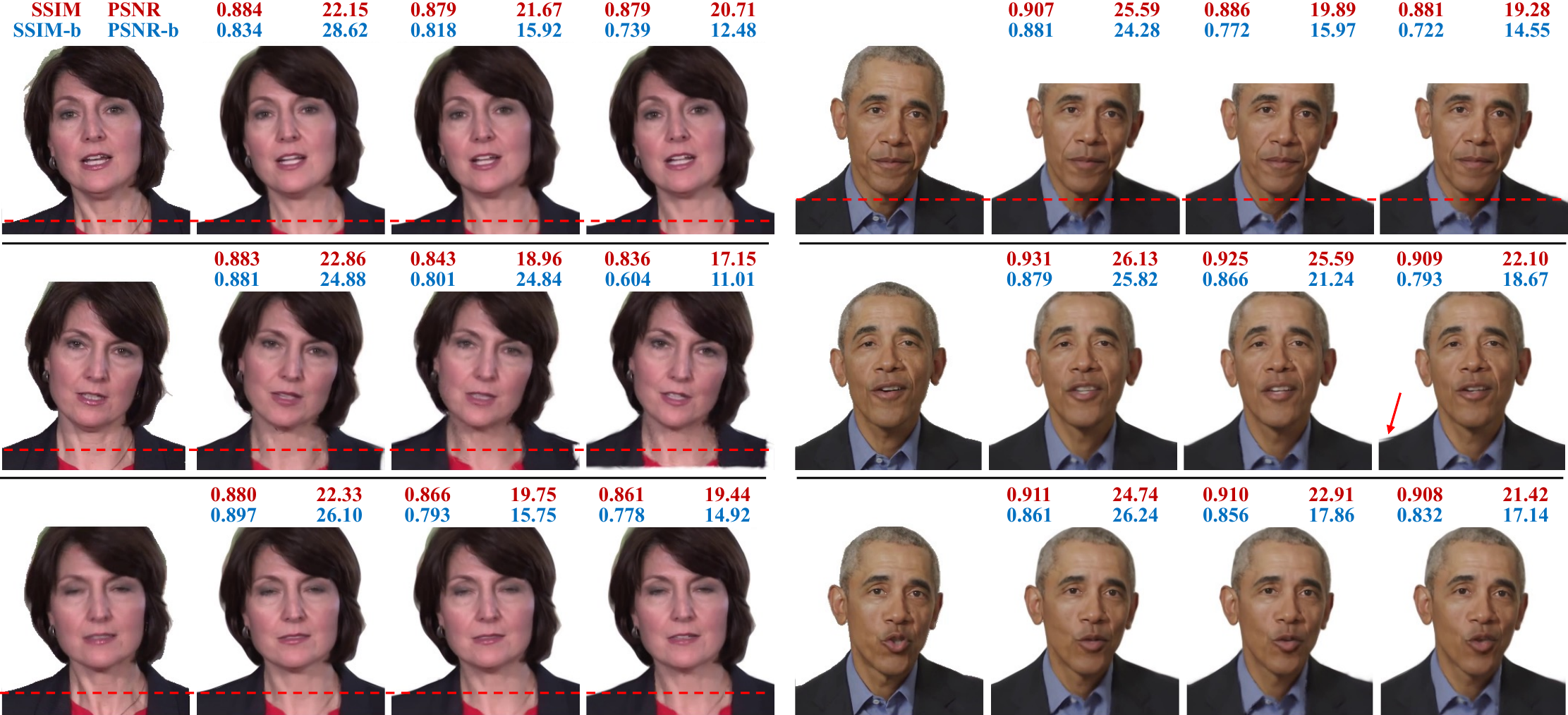
A persistent annoyance in portrait-to-3D pipelines is the "floating head" — a face reconstructed without a body anchor, causing kinematic inconsistencies. GRAPE from Tsinghua University resolves this with explicit torso-to-head kinematics and a canonical mesh fusion strategy that jointly models face and body. It also properly disentangles jaw motion from facial expression, which matters enormously for downstream talking-head and avatar generation tasks that rely on clean expression coefficients.
GRAPE: Graduated Routing for Articulated Portrait mesh Estimation
GRAPE unifies face and body modeling through explicit torso-to-head kinematics and canonical mesh fusion, eliminating "floating head" artifacts while properly disentangling jaw from expression. This enables high-fidelity 3D portrait recovery for talking-head and avatar generation tasks.
Abstract
Articulated portrait mesh estimation is fundamental to 3D understanding, avatar generation, and immersive interaction. Existing approaches primarily rely on 3D Morphable Models (3DMMs). However, face-centric models suffer from the "floating head" assumption, conflating head pose with global rotation due to the lack of neck kinematics. Conversely, body-centric models lack high-fidelity facial expression capabilities. Furthermore, current methods struggle to disentangle jaw articulation from expression blendshapes, often over-relying on expressions for mouth opening. These limitations make monocular portrait recovery difficult across representation, supervision, and anatomical parameter estimation. To address these limitations, we introduce GRAPE(Graduated Routing for Articulated Portrait mesh Estimation). We build a Portrait Parametric Model (PPM) with an explicit torso-to-head kinematic chain and a canonical injection step to merge FLAME and the SMPL-X torso. We propose a Progressive Anatomical Alignment (PAA) network, which is composed of a pretrained portrait encoder, a Graduated-Mask Router, and coarse-to-fine experts that follow the portrait anatomical prior. We then train this network with multi-source supervision that combines sparse anatomical keypoints, feature distillation, foreground mask constraints, and relative geometry constraints. Experiments show that GRAPE improves portrait mesh recovery quality, pose alignment, and jaw--expression disentanglement over prior methods. We also demonstrate that our method can benefit the downstream tasks of audio-driven talking-head generation and 3D portrait generation.
TTS & Voice Synthesis
Alibaba ships a multilingual production TTS system; Apple proposes a memory-efficient diffusion architecture for on-device streaming.
Alibaba's Qwen-Audio-3.0-TTS is a full production TTS system built around a lightweight tokenizer and a multi-stage training paradigm designed to unify three properties that typically trade off against each other: controllability, robustness, and multilingual coverage. Natural-language instruction control lets users specify speaking style in plain text; the system handles noisy reference speech gracefully, supports 16 languages, and extends to long-form synthesis — a practical set of capabilities for real-world deployment.
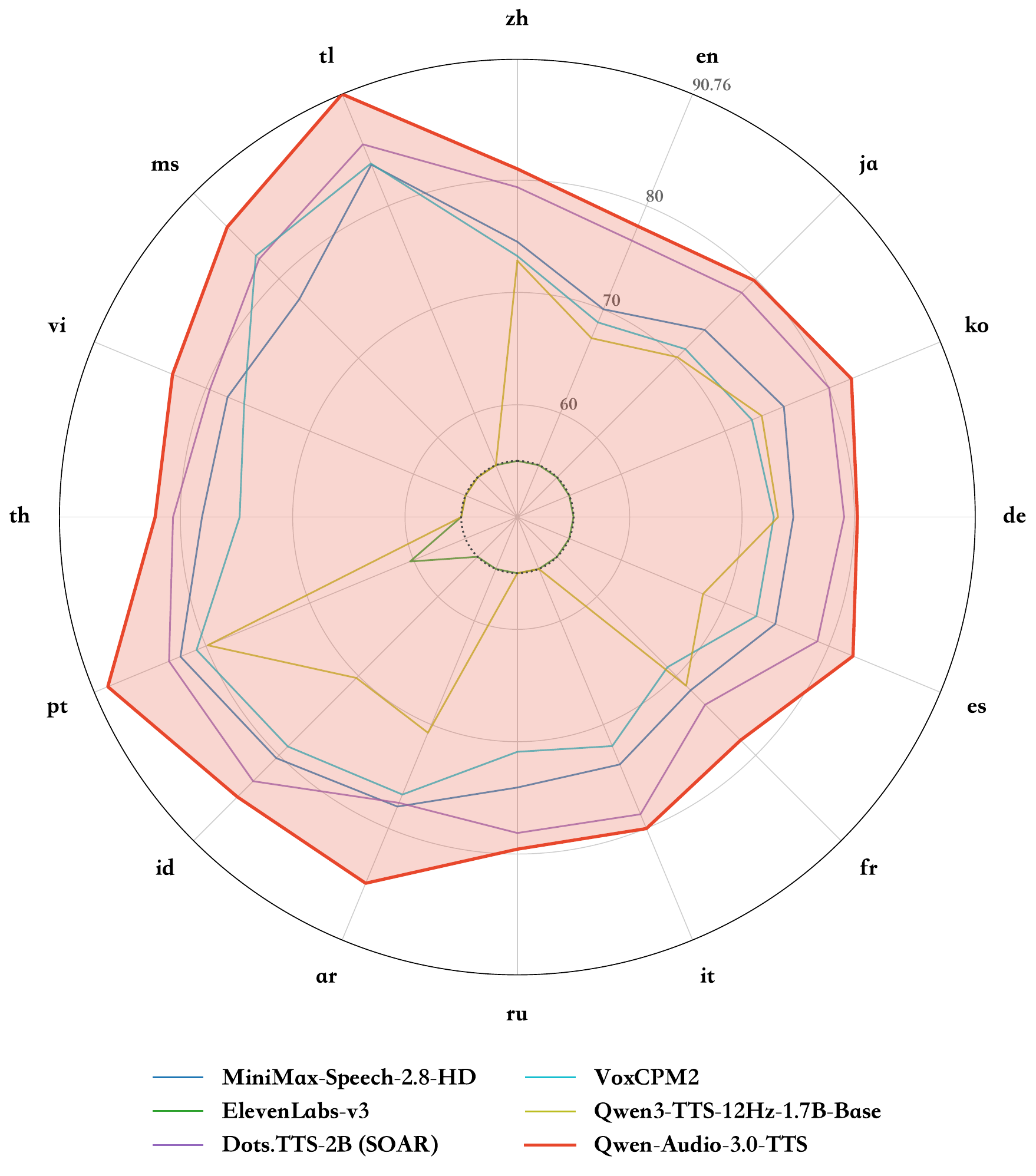
Qwen-Audio-3.0-TTS: Freely Controllable and Highly Robust Speech Synthesis with Multi-Stage Training Paradigm
A production TTS system using a lightweight tokenizer and multi-stage training to unify controllability, robustness, and multilingual support. It enables natural-language instruction control, handles noisy reference speech, supports 16 languages and long-form synthesis—addressing core trade-offs in prior systems.
Abstract
In this report, we present Qwen-Audio-3.0-TTS, a production-oriented speech synthesis system that jointly advances content consistency, speaker similarity, prosodic naturalness, audio quality, controllability, multilingual coverage, efficiency, and robustness. It combines a 12.5~Hz low-frame-rate speech tokenizer for reduced inference latency with a five-stage progressive training paradigm for coordinated language model (LM) and flow-matching model (FM) optimization. The model provides production-level control through free-style natural-language instructions and fine-grained inline tags, while supporting 16 languages, 20 Chinese dialect regions, one-pass long-form synthesis up to 3 minutes, and robust generation from noisy, reverberant, or unclear reference speech. Across SEED-TTS-Eval, CV3-Eval, instruction-following, long-form, and acoustic-robustness evaluations, Qwen-Audio-3.0-TTS achieves state-of-the-art performance on many reported dimensions or the strongest aggregate results. It also ranks first on the independent Artificial Analysis Text-to-Speech Leaderboard. These results establish Qwen-Audio-3.0-TTS as a strong foundation for production-level speech synthesis.
Apple's contribution addresses a different bottleneck: memory footprint during audio synthesis. Their Decoupled Temporal Depth Diffusion Transformer separates temporal and depth processing so that the decoder can be reused across time steps, achieving constant memory complexity via causal attention. The result is a semantic-token-to-speech system capable of real-time streaming on mobile hardware with a smaller footprint than comparable transformer or GAN baselines — a meaningful step toward on-device voice generation.
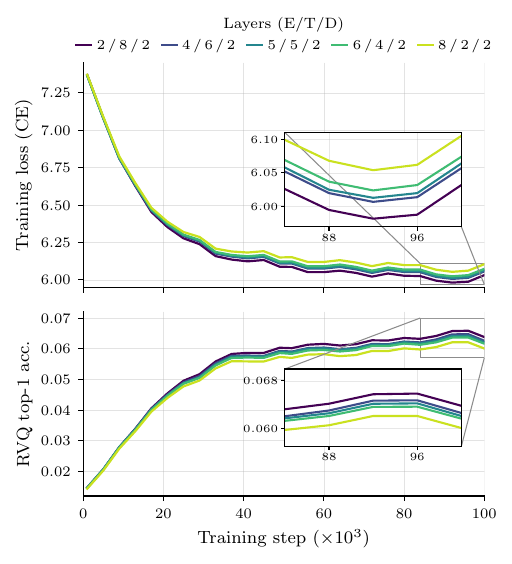
Memory Efficient Audio Synthesis with Decoupled Temporal Depth Diffusion Transformers
A memory-efficient audio synthesis architecture that converts semantic tokens to speech through decoupled temporal-depth processing. It achieves constant memory complexity via causal attention and reusable decoding, enabling real-time streaming on mobile hardware with lower footprint than transformers or GANs.
Abstract
Siri Expressive Voices synthesize rich, configurable speech in real time and entirely on device, powered by AFM 3 Core Advanced, Apple's most powerful on-device foundation model. This work presents the memory-efficient audio synthesis architecture behind that capability: a detokenizer that converts the semantic audio tokens emitted by the foundation model into high-fidelity audio within the tight compute and memory budget of the Apple Matrix Coprocessor (AMX). We convert semantic audio tokens to a residual vector quantization (RVQ) representation with a three-component design, a streaming encoder, a temporal decoder, and a depth decoder, that systematically decouples temporal and depth processing. A single reusable depth decoder with Diffusion Transformer (DiT)-style stage conditioning generates all RVQ levels autoregressively, replacing the dedicated per-level decoders of prior multi-decoder architectures, while causal sliding window attention with fixed-window key-value caching yields constant memory complexity independent of sequence length. Deployed on the AMX, the detokenizer sustains roughly 10 ms per generation step, about 16x faster than real time, with a peak runtime memory of only 21 MB and 329 MB of on-device assets, enabling continuous streaming synthesis of 20-320 seconds of audio. This constant, small footprint replaces the linear and quadratic memory scaling of conventional transformer- and GAN-based approaches. Ablation studies validate the key architectural components, and audio quality assessment confirms that the architecture maintains synthesis fidelity while achieving efficiency gains over existing methods. Operating at a 1-billion-parameter activation size within AFM 3 Core Advanced, it improves Mean Opinion Score by +0.28 overall (4.15 vs. 3.87) and by +0.42 on conversational speech (4.24 vs. 3.82) over the prior on-device text-to-speech system.
Trending on Hugging Face


Qwen3-TTS Technical Report
The Qwen3-TTS series presents advanced multilingual text-to-speech models with voice cloning and controllable speech generation capabilities, utilizing dual-track LM architecture and specialized speech tokenizers for efficient streaming synthesis.

VibeVoice Technical Report
VibeVoice synthesizes long-form multi-speaker speech using next-token diffusion and a highly efficient continuous speech tokenizer, achieving superior performance and fidelity.

OmniFlatten: An End-to-end GPT Model for Seamless Voice Conversation
A novel GPT-based model, OmniFlatten, enables real-time natural full-duplex spoken dialogue through a multi-stage post-training technique that integrates speech and text without altering the original model's architecture.