
Real-Time Digital Humans, Expression-Aware TTS, and the Phase Problem in Neural Vocoders
Today's digest covers real-time audio-video digital human generation, video diffusion-based portrait animation, facial-expression-driven conversational TTS, and a deep-dive into why phase reconstruction bottlenecks time-frequency neural vocoders.
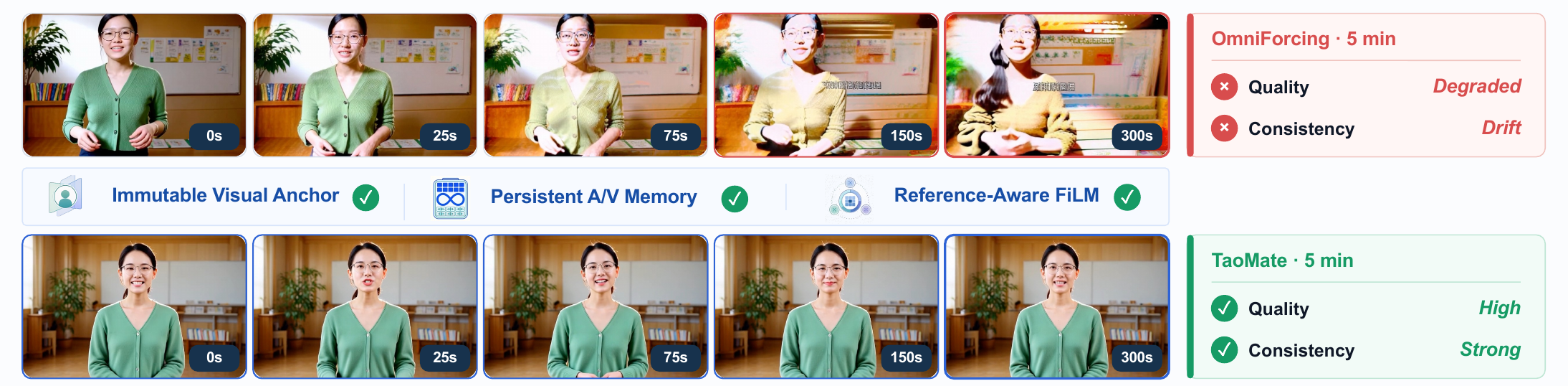
remains stable over 1,000 seconds. Unlike OmniForcing's visual degradation, identity drift, and color shift, preserves consistency through visual anchoring, persistent A/V memory, and reference-aware FiLM. From Alibaba.
Today's four papers span the full stack of lifelike conversational AI: keeping a digital human's identity stable across long streams, animating portraits with dense 3D face geometry, teaching a TTS system to read the listener's face, and diagnosing a persistent artifact in one of the most popular neural vocoder architectures. It's a tight thematic arc from pixels to waveforms.
Talking Avatars & Portrait Animation
Building convincing, real-time digital humans requires solving both identity consistency over time and fine-grained geometric control — two papers tackle each side.
Long-form digital human generation has a fundamental tension: attending over a full history of frames is expensive and causes identity drift, but discarding context kills temporal coherence. Alibaba's TaoMate resolves this with an immutable visual anchor — a fixed reference state — combined with compressed memory states that bridge the anchor to the current evolving frame. The result is stable appearance and lip-sync across long sequences with parallel inference designed for low-latency streaming.
TaoMate: Anchor-Guided Memory Bridging Evolving and Reference States for Real-Time Audio-Video Digital Human Generation
TaoMate generates long-form audio-video digital humans in real-time using an immutable visual anchor and compressed memory states. This avoids expensive full-history attention while preventing identity drift, enabling stable appearance and lip-sync across long sequences with parallel inference for low-latency stream.
Abstract
Real-time long-form digital-human generation relies on causal models to extend audio-visual content while preserving subject appearance and audio-video synchronization across successive segments. A bounded cache retains local motion and phonetic context but discards older evidence, whereas attending to the complete generated history is computationally expensive and can propagate accumulated errors. We present \method, an anchor-guided persistent-memory framework for few-step joint audio-video generation. The framework preserves an immutable visual anchor, compresses completed video and audio blocks into fixed-capacity dynamic states, and retrieves those states through modality-specific residual attention without extending the active cache. A reference-aware modulation method additionally conditions video features on dynamic and anchor appearance statistics. Anchor-preserving causal-context distillation varies rollout horizon, prefix provenance, and cache-history reliability while keeping the immutable visual anchor unperturbed. By separating persistent memory from stage-local denoising dependencies, \method further admits stage-parallel execution across blocks, accelerating autoregressive inference without pipeline-specific retraining. We evaluate long-form video continuations with appearance, temporal, synchronization, facial, and speech diagnostics. Results show that \method preserves stable appearance across prompt-conditioned segments and strong audio-visual synchronization under autoregressive generation. Our project page is https://taoliveaigc.github.io/TaoMate.
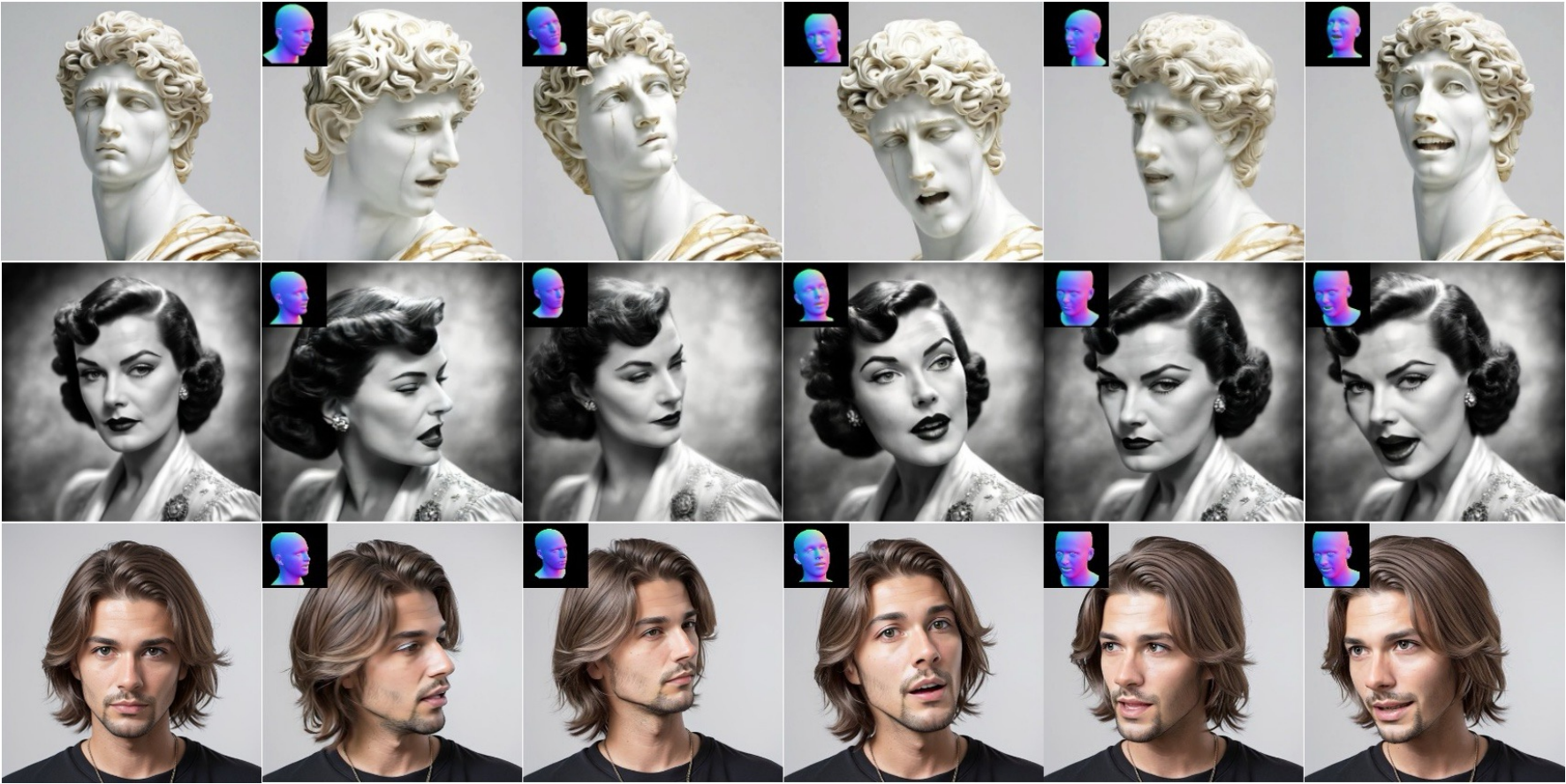
Where TaoMate focuses on temporal memory, ViDS from Woven by Toyota tackles the spatial control problem in portrait animation. Rather than relying on sparse landmarks or implicit motion flows, ViDS conditions a video diffusion model on dense 3DMM normal maps derived from 3D face tracking, effectively using diffusion as a neural shader. This geometry-grounded conditioning delivers finer expression control and stronger identity preservation than prior landmark-based or warping-based approaches.
ViDS: Video Diffusion Shader using 3D Face Tracking
ViDS uses video diffusion as a neural shader for portrait animation, leveraging 3D face tracking for identity-preserving expression control. By conditioning on dense 3DMM normal maps rather than landmarks or implicit motion, it achieves finer-grained control and superior appearance preservation.
Abstract
We introduce ViDS, a Video Diffusion Shader that leverages 3D face tracking for expressive and identity-preserving portrait animation. We first reconstruct the identity-specific 3DMM mesh from the reference image, and then animate it using expression and pose parameters from a driving video. Leveraging dense geometric cues from 3DMM normal maps, we employ a video diffusion model as a neural shader to synthesize lifelike portrait animations while preserving the appearance and identity of the reference image. We find that more accurate 3DMM tracking enables finer-grained expression control. We also introduce an autoregressive diffusion sampling process that extends generation beyond the model's native window while reducing discontinuities between adjacent clips. Compared with prior diffusion-based approaches for portrait animation that rely on landmark-based conditioning or implicit motion latents, our method achieves more detailed and consistent expression and pose control while faithfully preserving identity and appearance. Detailed ablation studies validate the effectiveness of our design choices. Project page: https://fusheng-ji.github.io/ViDS/
Speech Synthesis & Conversational TTS
Making synthesized speech truly conversational means perceiving the interlocutor — not just the text — and producing acoustics that are artifact-free down to the phase.
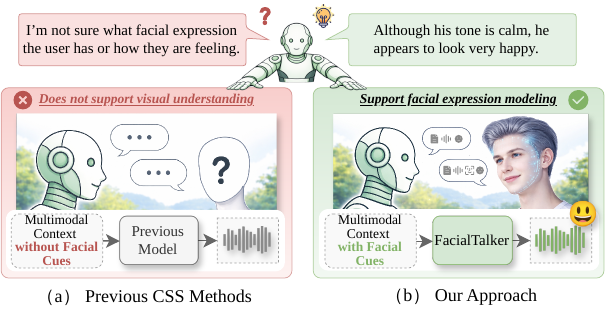
Most conversational TTS systems are effectively blind to the person they're speaking with. NUS's "Let Me Look at You" changes that by enabling a speech synthesis model to perceive and respond to the listener's facial expressions. The system jointly tokenizes facial action units (AUs) and speech into a compact discrete representation and applies dual preference optimization to align the synthesized prosody with observed visual affect. A new large-scale multimodal dialogue dataset supports training. This is a meaningful step toward genuinely face-aware spoken dialogue systems.
Let Me Look at You: Advanced Facial Expression Modeling for Conversational Speech Synthesis
This work enables conversational speech synthesis to perceive and respond to facial expressions, unlike prior methods that ignore visual affect. It jointly models facial action units and speech via compact tokenization and dual preference optimization, supported by a new large-scale multimodal dialogue dataset.
Abstract
Conversational Speech Synthesis is a fundamental component of human-computer interaction, aiming to generate contextually appropriate, expressive, and empathetic speech. However, facial expressions encode subtle and rich affective cues that are crucial for empathetic speech interaction, whereas existing approaches often overlook this important modality. In addition, the lack of large-scale natural conversational datasets with both speech and visual modalities also limits the development of visual affect understanding in conversational settings.To address these limitations, we propose FacialTalker, a facial-expression-aware CSS framework built upon a large language model backbone. To efficiently encode facial expressions, we propose AUTokenizer, a single-codebook visual tokenizer that discretizes each frame-level facial expression into a compact token, trained with supervision from combinations of facial Action Units. We further introduce a dual direct preference optimization (DualDPO) strategy, which extends the DPO by jointly imposing preference constraints on both visual and speech token sequences, to enhance the model's understanding of facial expressions and speech semantics in multimodal conversational contexts. Moreover, we construct VSDD-1K, a large-scale multimodal dialogue dataset collected through a fully automated pipeline from real-world Internet conversations, comprising over 1,033 hours of synchronized speaker videos and speech, with more than 85\% of frames containing valid faces. Extensive objective and subjective experiments demonstrate that FacialTalker consistently outperforms strong baselines in facial-expression perception and speech synthesis quality, generating speech that is more natural, expressive, and better aligned with the conversational context. The results also validate the effectiveness of our training strategy and dataset construction pipeline.
On the vocoder side, Fraunhofer IDMT takes a forensic look at why Vocos — one of the most widely used time-frequency neural vocoders — still lags behind time-domain vocoders in perceptual quality. The culprit is phase reconstruction: while Vocos models magnitude spectra well, standard 1D convolutions lack the right inductive biases to model the time-frequency structure of speech phase. The paper systematically isolates this bottleneck and points toward architectural changes that could close the gap.

Revisiting Vocos: That Phasiness Business in Time-Frequency Neural Vocoding
This work analyzes why Vocos underperforms versus time-domain vocoders through phase reconstruction. While excelling at magnitude modeling, phase prediction is the critical bottleneck—standard 1D convolutions poorly capture speech's time-frequency structure, pointing toward better architectural inductive biases.
Abstract
Recently, time-frequency neural vocoders have been approaching the state-of-the-art quality of time-domain neural vocoders. Vocos is a notable example due to its efficiency, but its audio quality lags behind the time-domain vocoders and the reasons remain debated. Thus, in this study, we revisit Vocos from a phase reconstruction perspective. First, we quantify the gap between time-domain and time-frequency domain vocoders using bandlimited mel spectrograms as inputs. Later, via an ablation study, we verify the Vocos architecture is effective for magnitude modeling, but less so for phase. We then adapt the Vocos backbone to predict phase differences, a precursor for phase reconstruction, and identify 1D convolutional layers are hindering their accurate prediction. Our findings indicate that future research needs to focus on inductive biases that allow the architecture to better model the time-frequency structure of speech signals, without sacrificing the support for arbitrary input representations.
Trending on Hugging Face

Fish Audio S2 Technical Report
Fish Audio S2 is an open-source text-to-speech system with multi-speaker capabilities, multi-turn generation, and instruction-following control through natural-language descriptions, utilizing a multi-stage training approach and production-ready inference engine.

Qwen3-TTS Technical Report
The Qwen3-TTS series presents advanced multilingual text-to-speech models with voice cloning and controllable speech generation capabilities, utilizing dual-track LM architecture and specialized speech tokenizers for efficient streaming synthesis.

IndexTTS: An Industrial-Level Controllable and Efficient Zero-Shot Text-To-Speech System
IndexTTS, an enhanced text-to-speech system combining XTTS and Tortoise models, offers improved naturalness, enhanced voice cloning, and controllable usage through hybrid character-pinyin modeling and optimized vector quantization.

VibeVoice Technical Report
VibeVoice synthesizes long-form multi-speaker speech using next-token diffusion and a highly efficient continuous speech tokenizer, achieving superior performance and fidelity.

OmniFlatten: An End-to-end GPT Model for Seamless Voice Conversation
A novel GPT-based model, OmniFlatten, enables real-time natural full-duplex spoken dialogue through a multi-stage post-training technique that integrates speech and text without altering the original model's architecture.