
Turn-Taking, Memory-Augmented ASR, Federated SpeechLLMs, and Unified Audio Generation
Today's digest covers human-calibrated dialogue turn-taking, agentic ASR with editable voice memory, federated learning for SpeechLLMs, a latency-busting talking head model, and ByteDance's unified multi-speaker audio generation system.
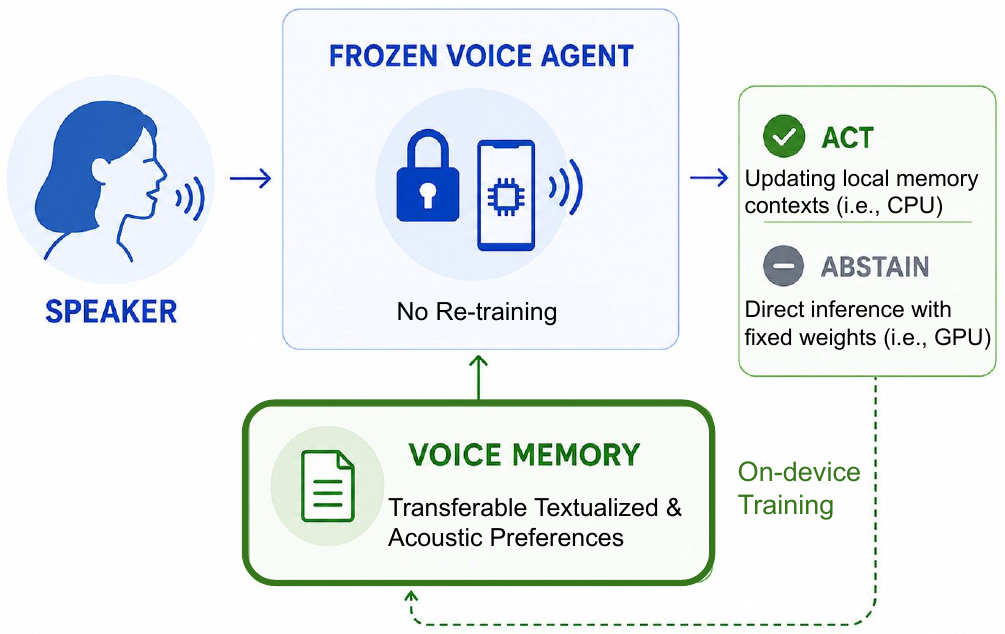
Overview of . At inference, a frozen corrector reads a learnable, human-readable text memory and decides per utterance whether to act on the ASR hypothesis or abstain. Offline, an optimizer distills this instructional memory from training corpora using forward passes only, with no weight updates, so that the learned skill (i) generalizes within an acoustic domain and (ii) transfers across domains and correctors. From NVIDIA.
Today's roundup spans the full conversational AI stack — from how systems decide when to speak, to how they recognize and generate speech more accurately, efficiently, and expressively. We have three arXiv papers and two picks fresh from the Hugging Face Daily tab, covering turn-taking dialogue synthesis, agentic ASR correction, federated SpeechLLM training, real-time talking head generation, and unified multi-speaker audio.
SpeechLLMs & Voice Agents
Smarter turn-taking, more robust recognition, and privacy-preserving distributed training.
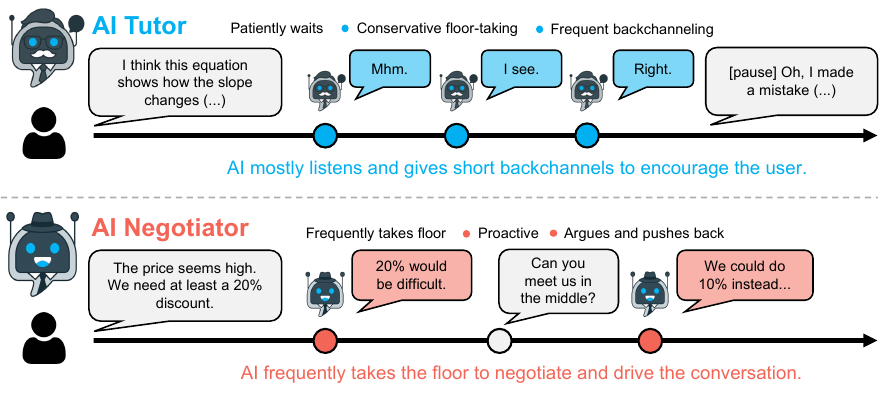
Natural turn-taking is one of the last remaining gaps between AI voice assistants and human conversation. DuplexGen from Seoul National University attacks this directly by generating scenario-adaptive dialogues calibrated against human preference annotations — rather than relying on generic corpora or hand-crafted heuristics. The core insight is that LLM predictions alone are insufficient; aligning them with human judgments is what unlocks context-specific, preferred turn-taking behavior.
DuplexGen: Adaptive Synthesis of Human-AI Turn-Taking Dialogues
DuplexGen generates dialogues with scenario-adaptive turn-taking by calibrating LLM predictions against human preference annotations. Unlike prior work relying on generic corpora or heuristics alone, this approach shows that human calibration is key to achieving context-specific, human-preferred turn-taking behaviors.
Abstract
Turn-taking is a central component of full-duplex interaction. Which turn-taking behaviors are appropriate varies with the scenario, yet current models apply a single norm regardless of context. This limitation originates in their training data: human-human speech corpora capture natural timing phenomena but provide little role grounding or scenario-specific norms, while heuristic or prompted synthesis methods inject turn-taking behaviors without basing them on human preferences. We introduce DuplexGen, a framework for generating dialogues with scenario-adaptive turn-taking by calibrating LLM predictions against a small set of slot-level human preference annotations. In six cooperative and competitive tasks, human turn-taking preferences differ systematically, and DuplexGen aligns substantially more closely with those preferences than uncalibrated prompting or training solely on generic human-human data; a full-duplex model trained on DuplexGen-generated data exhibits distinctive, human-preferred turn-taking behaviors. These results show that human calibration, not corpus scale or prompt design alone, is what allows turn-taking synthesis to be scenario-specific.
Correcting ASR errors post-hoc is notoriously brittle — overcorrecting proper nouns and domain-specific terms is a common failure mode. NVIDIA's Voice Memory sidesteps this by decoupling correction entirely: a shared, editable text memory store is read by a frozen corrector at inference time, with an explicit abstention mechanism so the model knows when not to apply a correction. The result is auditable, parameter-free domain adaptation that transfers across domains without retraining.
Voice Memory for Agentic Speech Recognition
Voice Memory decouples ASR correction through a shared, editable text memory that a frozen corrector reads at inference time. By learning when to abstain rather than applying unconstrained corrections, it eliminates over-correction while enabling auditable, parameter-free corrections that transfer across domains.
Abstract
We present Voice Memory, a inference-only scheme for agentic speech recognition: at stream time, a frozen corrector reads a single per-domain memory.md and decides per utterance whether to act on the hypothesis or abstain and keep the 1-best. Asynchronously, a score-gated optimizer revises that file through bounded edits, accepting an edit only when it strictly improves a held-out score. Extended from classical ASR-LM framework, we refer this split the listener-thinker architecture; the two roles are coupled only through the memory, so no weights change and the learned skill stays auditable and portable. Restraint turns out to be the operative skill this loop discovers: unconstrained generative error correction (GER) over-corrects, breaking correct tokens on up to 64% of its edits on financial news, and Voice Memory, reduces this rate to 35%. Across ten HyPoradise domains with an open corrector, Voice Memory, lowers weighted word error rate from 8.36% to 7.52% (7.47% with three added in-context examples) without regressing any dataset below its 1-best baseline; gains concentrate where recoverable headroom is largest, including air-travel commands (8.40% to 3.40%) and noisy far-field speech (CHiME-4, 12.69% to 10.46%). The memory transfers across corrector families and adds zero parameters to the inference path. A demo and example code are provided for future studies.
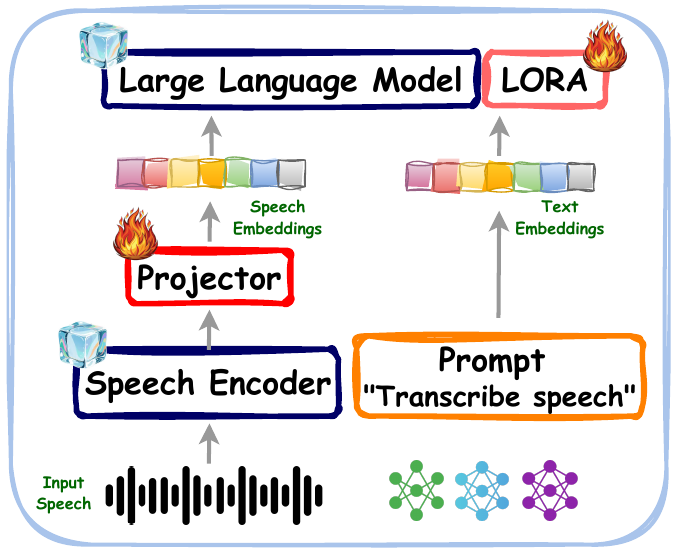
Deploying SpeechLLMs in privacy-sensitive or data-silo'd environments calls for federated training, yet almost no systematic work existed on this for end-to-end ASR. Fondazione Bruno Kessler fills that gap with the first systematic study of federated learning for SpeechLLMs, introducing communication-efficient strategies validated on both English and Italian datasets. They demonstrate competitive ASR performance with significantly reduced communication overhead — a meaningful step toward practical, privacy-preserving voice AI.
SpeechLLM Meets Federated Learning for End-to-End ASR: English and Italian Case Studies
First systematic study of federated learning for speech language models in end-to-end ASR, introducing communication-efficient strategies for distributed SpeechLLM training. Validated on English and Italian datasets with competitive performance and significantly reduced communication overhead.
Abstract
Federated learning (FL) enables privacy-preserving training of automatic speech recognition (ASR) systems across distributed data sources, yet its application to large-scale speech language models (SpeechLLMs) remains unexplored. This paper presents the first systematic study of federated training for SpeechLLM-based end-to-end ASR systems. We design a communication-efficient federated optimization strategy tailored to the unique challenges of SpeechLLM architectures, addressing high-dimensional parameter spaces, gradient communication overhead, and computational constraints in distributed settings. Through extensive empirical evaluation on monolingual ASR tasks in English and Italian, we demonstrate the effectiveness and stability of our federated approach compared to centralized training baselines across diverse acoustic conditions and speaking styles. Additionally, we conduct a comprehensive ablation study analyzing the impact of different speech encoder architectures on monolingual English ASR performance within the federated framework, providing insights into optimal model configurations for decentralized training. Our results achieve competitive word error rates while reducing communication costs, establishing practical foundations for federated SpeechLLM deployment in real-world multilingual scenarios.
Talking Heads & Audio Generation
From today's Hugging Face Daily tab — high-upvote community picks on visual speech and unified audio synthesis.
Talking head generation faces a persistent tension: faster models produce jerkier, lower-quality video, while high-quality models introduce unacceptable latency. LeapTalk from Shanghai Jiao Tong University SAI claims to break this trade-off, targeting real-time, high-fidelity talking head generation. It's an early HF community favorite with 13 upvotes.

LeapTalk: Breaking the Latency-Quality Trade-off in Talking Head Generation
Abstract
Long-form and real-time talking-head generation remains challenging due to a latency-quality trade-off: inefficient multi-step diffusion prohibits streaming generation, whereas real-time autoregressive approaches suffer from error accumulation and identity drift. To address this drawback, we propose LeapTalk, a novel framework that achieves stable and real-time talking-head generation with a single forward step, scaling to arbitrarily long videos. At the heart of our approach lies a single-step bridge distillation scheme. On the one hand, departing from the conventional noise-to-data paradigm, we introduce a data-to-data transport formulation based on a Brownian bridge. Anchored by a persistent reference, this strategy effectively mitigates identity drift and enhances long-term temporal stability. On the other hand, to enable smooth knowledge transfer from a pre-trained diffusion teacher to the student bridge model, we explore a heterogeneous distillation framework with an SNR-aligned time transformation Φ(τ), which bridges the functional discrepancy between the two models. Moreover, we propose an audio-driven classifier-free guidance mechanism to maintain fine-grained lip synchronization under extreme step reduction. Extensive experiments demonstrate that our method achieves high-fidelity and temporally consistent video generation with only 1 step at up to 200 FPS, significantly outperforming existing approaches in both efficiency and stability. Project Page: https://zhangrongxiang.github.io/leaptalk-page/
ByteDance's SwanTale is today's most upvoted HF paper by a wide margin (99 upvotes), and for good reason: it proposes a unified framework for multi-speaker speech and audio generation that handles both instruction-following and zero-shot tasks under a single model. Consolidating instruct and zero-shot paradigms into one system — across speaker identities and audio types — represents a significant architectural ambition in the TTS and audio generation space.

SwanTale: Unified Multi-Speaker Speech and Audio Generation for Instruct and Zero-Shot Tasks
Abstract
Speech and audio generation is often needed in animation dubbing, audio drama, movies, advertising, games, podcasts, and short-video production. In these scenarios, creators may need to design voices without reference recordings, control speaker styles with natural language, support acoustic scenes with environments and audio effects, and later reuse the designed voices. Therefore, it is important to support multi-speaker speech and audio generation for both instruct and zero-shot tasks. The instruct task requires a caption of the environment, speaker styles, and fine-grained content, while the zero-shot task uses reference audio together with the same fine-grained content. We address these tasks from both the data and model sides. First, we propose SwanData-Caption, which cleans raw speech and audio data, adds targeted synthetic coverage, and annotates diverse and accurate multi-level captions. Then, we propose SwanTale, a multi-speaker expressive speech and audio generation model that supports both zero-shot and instruct tasks. We introduce SwanVAE to support high-quality multi-audio-modality generation. Then, we adopt reward-conditioned quality control and Engram conditioning, along with Unified MoE for multi-task and multi-audio-modality modeling. In addition, we use curriculum learning and GRPO post-training to let the model progressively learn and strengthen its capabilities. Experimental results show that SwanTale leads on multiple key zero-shot and instruct metrics, achieves the best expressiveness scores in both tasks, and supports complex instruct generation involving multi-speaker speech and audio. Demos can be found at https://swanaigc.github.io/\#swantale.
Trending on Hugging Face


Qwen3-TTS Technical Report
The Qwen3-TTS series presents advanced multilingual text-to-speech models with voice cloning and controllable speech generation capabilities, utilizing dual-track LM architecture and specialized speech tokenizers for efficient streaming synthesis.

OmniFlatten: An End-to-end GPT Model for Seamless Voice Conversation
A novel GPT-based model, OmniFlatten, enables real-time natural full-duplex spoken dialogue through a multi-stage post-training technique that integrates speech and text without altering the original model's architecture.