
Stable Speech Synthesis, Ultra-Fast ASR, and Single-Image 3D Avatars
Today's digest covers stable long-horizon autoregressive TTS with co-designed codecs, a parallelized LLM-based ASR system hitting real-time factors below 0.01, a new full-duplex dialogue benchmark from Sony, and two Gaussian Splatting methods for reconstructing detailed 3D avatars — hands and garments included — from a single image.
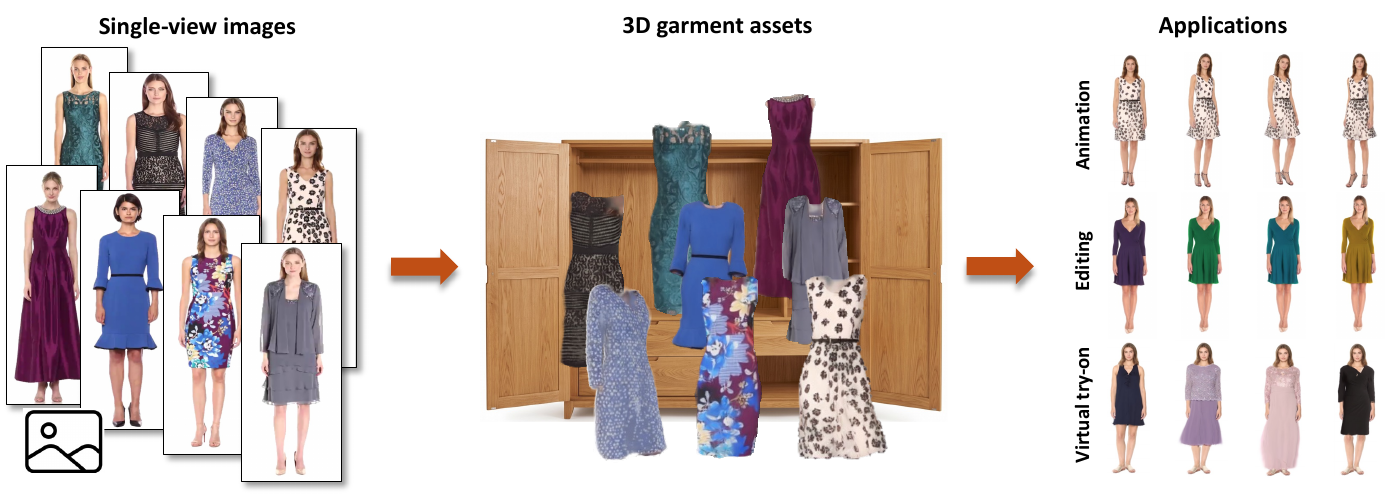
Forwardrobe reconstructs garment-aware Gaussian avatars from single-view images, improving the continuity and animation of loose garments. The explicitly separated garment layer forms an independently controllable 3D asset, supporting animation, appearance editing, and 3D virtual try-on across different avatars. From Nanyang Technological University.
Today's papers push the boundaries of what's possible from minimal input: stable speech from continuous tokens, near-instantaneous transcription, rigorous full-duplex evaluation, and richly detailed 3D avatars reconstructed from just one photo. Across speech and vision, the theme is robustness — handling accumulation errors, long contexts, simultaneous turn-taking, self-occlusion, and loose clothing — all at once.
TTS & Autoregressive Speech Synthesis
Taming error accumulation in long-form autoregressive speech generation.
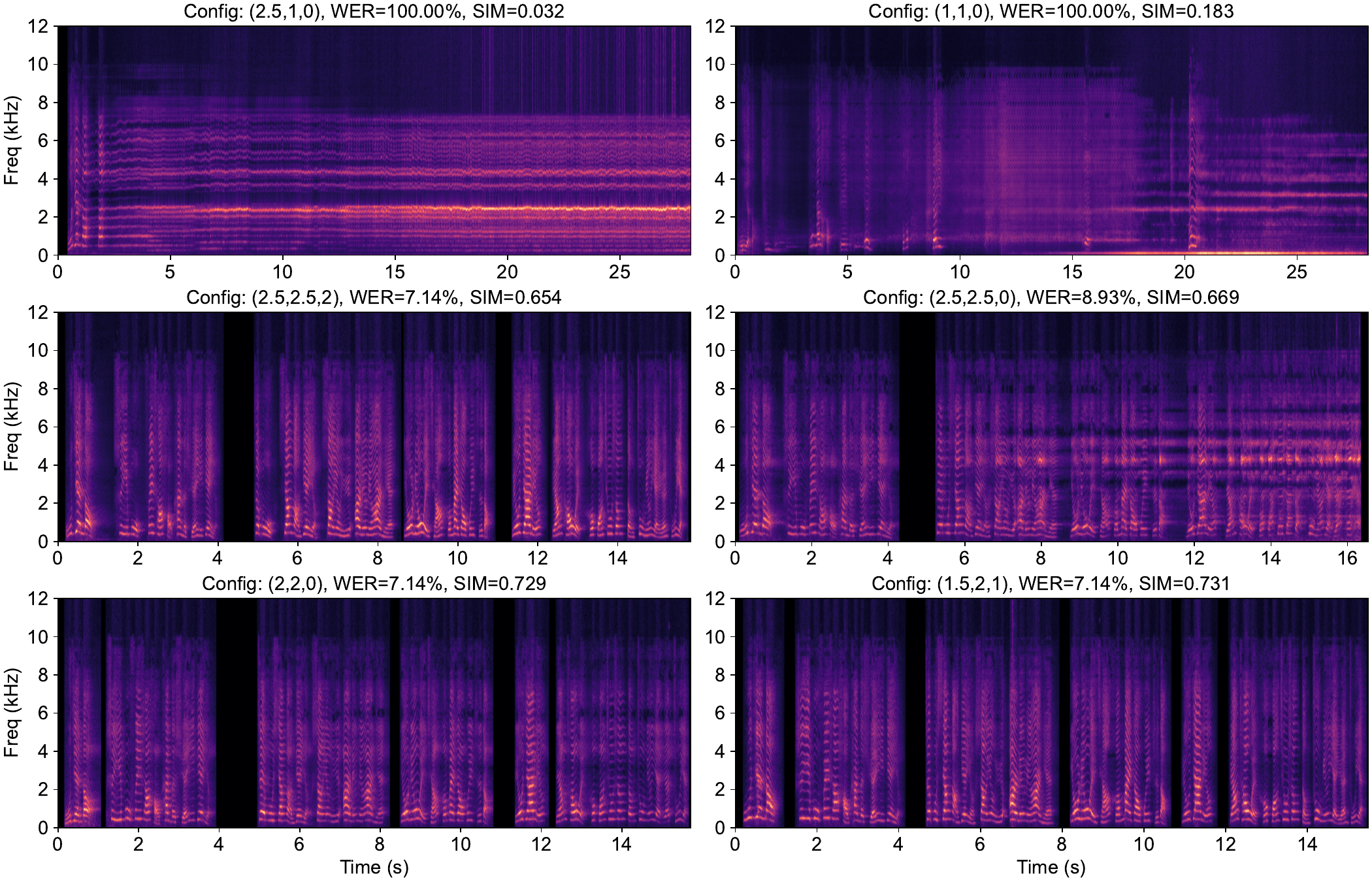
Long-horizon autoregressive TTS has historically struggled with instability — small prediction errors compound across thousands of steps. This work tackles the problem head-on with a co-designed codec and flow-matching generator. The key insight is that token predictability can be improved through representation geometry: by shaping the latent space so that consecutive tokens are more predictable, the autoregressive LM has an easier job. On top of that, multi-path guidance during generation actively mitigates error accumulation, enabling high-fidelity synthesis without leaning on external vocoder or enhancement models.
Stable Autoregressive Speech Generation with Low-Frame-Rate High-Dimensional Continuous Tokens
Co-designed codec and flow-matching generator for stable long-horizon autoregressive speech synthesis. Improves token predictability through representation geometry and mitigates error accumulation via multi-path guidance, enabling high-fidelity generation without external models.
Abstract
Balancing sequence length, representational capacity, and long-horizon stability is a central problem in autoregressive (AR) speech and audio generation. Representations with higher frame rates or greater capacity can preserve more signal detail, but they also make streaming generation more vulnerable to distribution drift and AR error accumulation. Conversely, shorter and more compressed representations simplify AR modeling, but their limited bandwidth may discard important components and constrain the upper bound of reconstruction fidelity and generation quality. We ask whether a low-frame-rate, high-dimensional, high-bandwidth continuous representation can be co-designed with a streaming generation framework to support robust high-fidelity reconstruction, strong single-token predictability, and superior long-horizon stability. We decompose this goal into two coupled problems: what geometric and statistical properties a high-dimensional representation space should have, and how an AR continuous-token generator should be structured to resist error accumulation. Accordingly, we propose Locodec, a locally encoded codec that shapes its representation space to improve the interpolatability of a lower-dimensional core manifold and the identifiability of the native high-dimensional coordinates, thereby improving the predictability of high-dimensional high-bandwidth tokens. We also propose MP-ELD, a single-token AR flow-matching framework that uses multi-path information routing and residual classifier-free guidance to mitigate error accumulation. Experiments with 8-Hz, 768-dimensional tokens show that our design preserves reconstruction quality, improves single-token predictability, achieves competitive WER, and maintains stable long-form synthesis, without using external SSL/ASR models, pretrained text language models, or post-training stages.
SpeechLLMs, ASR & Full-Duplex Dialogue
Faster transcription, richer evaluation — the two sides of real-time spoken language understanding.
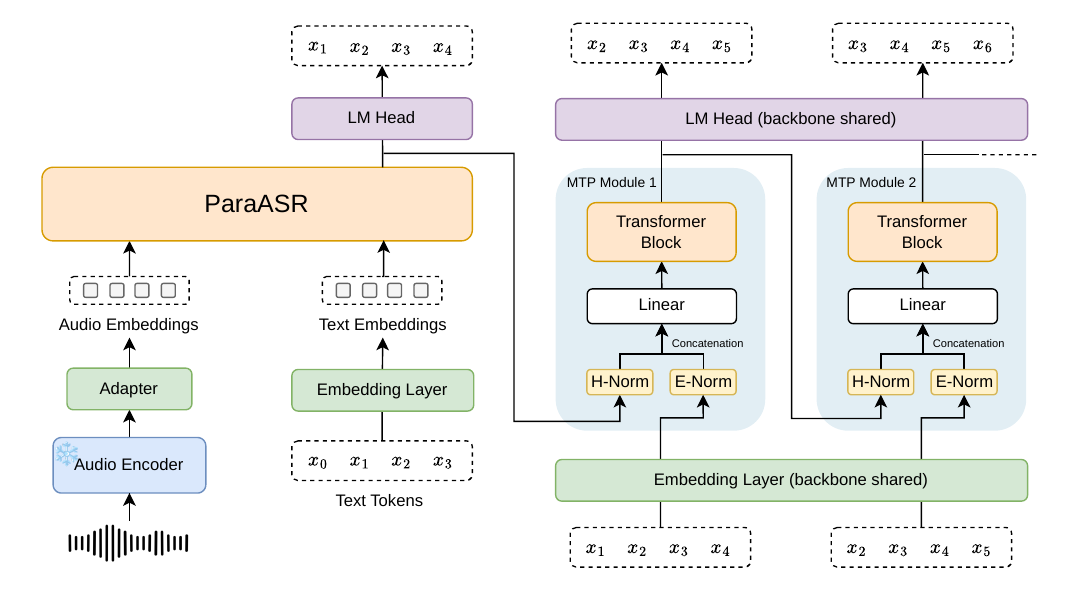
LLM-based ASR delivers strong quality but pays a steep latency price: one output token per decoder step means transcription time scales linearly with transcript length. ParaASR from Alibaba breaks this bottleneck with multi-token prediction: the model emits multiple transcript tokens per step using audio-grounded proposals, then verifies them with a lightweight autoregressive pass. The result is a real-time factor below 0.01 — a dramatic improvement without sacrificing recognition quality, and with support for long-context utterances that trip up conventional approaches.
ParaASR: Multi-Token Prediction for Fast and Long-Context LLM-Based Speech Recognition
ParaASR uses multi-token prediction to parallelize LLM-based speech recognition, emitting multiple transcript tokens per decoder step while maintaining quality through audio-grounded proposals and autoregressive verification. This breaks the latency-quality trade-off with real-time factors below 0.01.
Abstract
Audio-encoder-LLM-decoder architectures have become the dominant paradigm for modern automatic speech recognition (ASR), improving transcription quality through large-scale language modeling. However, the cost of autoregressive decoding scales with decoder size, creating a fundamental trade-off between recognition quality and serving latency. We argue this trade-off is not inherent: unlike open-ended text generation, ASR outputs are strongly anchored to the input speech signal, providing a natural inductive bias toward high-parallelism decoding. Building on this, we introduce ParaASR, an ASR system that leverages Multi-Token Prediction (MTP) to let a 4B LLM decoder emit multiple tokens per forward step. Starting from a publicly available audio-language foundation, the model first establishes a robust autoregressive recognizer and then aligns five future-token branches through a staged optimization recipe. At inference, it proposes a six-token continuation per step and admits only the verified prefix into the transcript, preserving the safety of standard autoregressive decoding. The average accepted length reaches 5.0 out of 6 proposed tokens, confirming that the deterministic structure of speech makes ASR an especially natural setting for multi-token decoding. ParaASR further retains a native 32K-context window and transcribes up to 30 minutes of audio in a single pass. Across diverse benchmarks, it attains average error rates of 2.97%, 3.68%, and 3.70% on Chinese, English, and long-form evaluations, respectively, while reaching a real-time factor (RTF) as low as 0.0053. These results show that decoder scaling, low-latency inference, and long-context transcription need not be competing goals when future-token proposals are anchored by the acoustic signal and guarded by autoregressive verification.
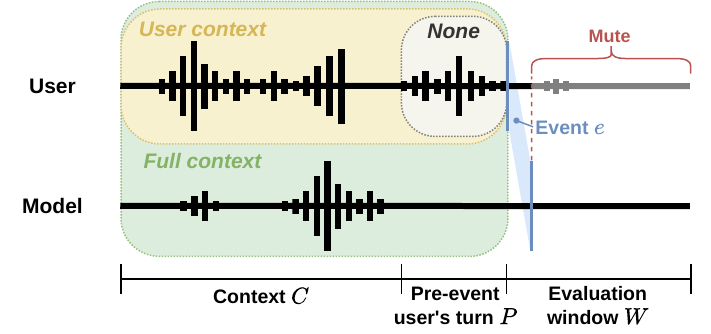
Evaluating full-duplex dialogue systems — those that listen and speak simultaneously — is notoriously hard because standard turn-based benchmarks don't capture the nuances of overlap, backchanneling, and interruption. M3-DuplexBench from Sony fills this gap with a multi-turn benchmark spanning English and Japanese, casual conversation and QA domains. It systematically probes how dialogue history affects turn-taking, backchannel generation, and barge-in behavior, giving researchers a principled way to compare full-duplex models across all three phenomena at once.
M3-DuplexBench: A Multi-Turn, Multilingual, Multidomain Benchmark for Full-Duplex Spoken Dialogue Models
M3-DuplexBench is a benchmark for full-duplex dialogue systems that listen and speak simultaneously. It provides multi-turn evaluation in English and Japanese across casual and QA domains, systematically examining how dialogue context affects turn-taking, backchannel, and barge-in behavior.
Abstract
Full-duplex spoken dialogue systems (FDSDSs) can listen while speaking, enabling natural behaviors such as smooth turn-taking, backchannel handling, and user barge-in handling. However, fair comparisons in multi-turn conversations remain a challenge. In addition, existing benchmarks provide limited coverage of languages and dialogue domains. We propose M3-DuplexBench, a multi-turn, multilingual, multidomain benchmark for FDSDSs. M3-DuplexBench supports English and Japanese and covers both casual conversation and multi-turn question answering. In addition, we evaluate models under multiple dialogue context settings, including single-turn, user-only, and teacher-forced full-context settings, to analyze how dialogue history affects model behavior. Experiments with recent FDSDSs reveal model-specific turn-taking characteristics, clear performance gaps across languages and domains, and mixed effects of dialogue context.
Digital Humans & 3D Avatars
From a single snapshot to a fully animatable, occlusion-aware, garment-separated 3D human.
Reconstructing hands in 3D is notoriously difficult: they're small, heavily self-occluding, and highly articulated. OASIS from Zhejiang University tackles single-image hand avatar reconstruction with 3D Gaussian Splatting, pairing it with visibility-conditioned attention to reason explicitly about which parts of the hand are hidden from view. A Feature-on-Mesh representation guides non-rigid deformation, preserving surface detail through articulation changes — a combination that delivers both efficiency and fidelity.
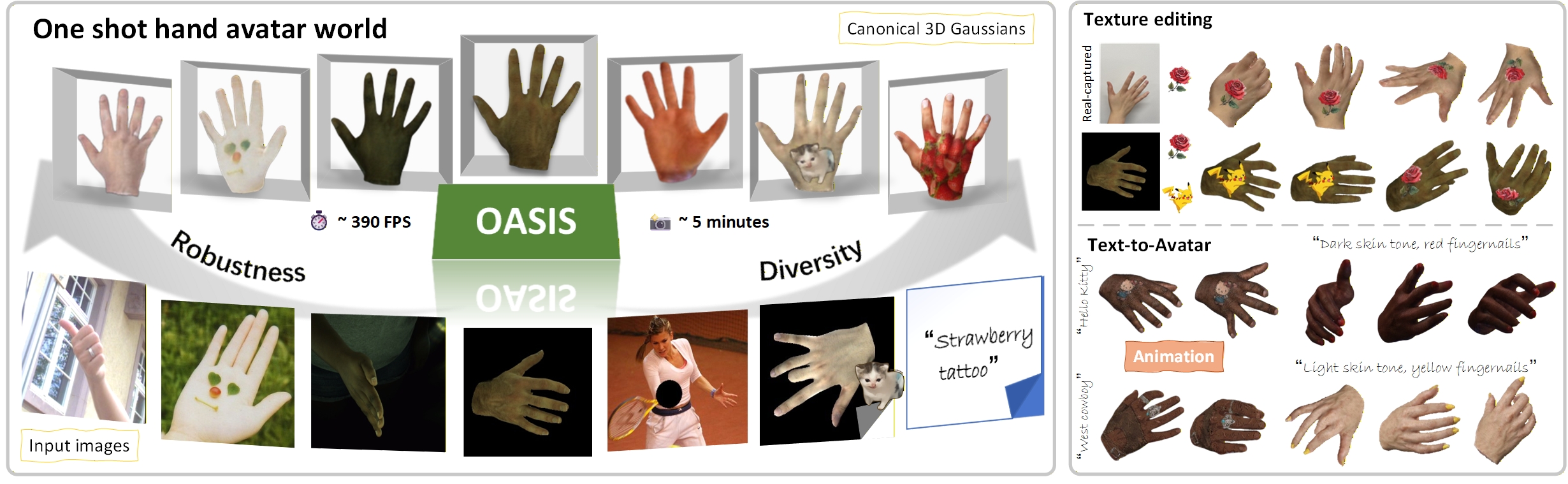
OASIS: Occlusion-aware Single-image Hand Avatar Reconstruction via 3D Gaussian Splatting
OASIS reconstructs detailed 3D hand avatars from a single image using Gaussian Splatting for efficiency and detail preservation. The method uses visibility-conditioned attention to handle self-occlusion and a Feature-on-Mesh representation to guide non-rigid deformation of articulated hands.
Abstract
Single-image 3D hand avatar reconstruction is fundamentally ill-posed and particularly challenging due to limited visual evidence under severe self-occlusion and the complex pose-dependent deformation of highly articulated hands. Existing methods predominantly rely on implicit NeRF-style representations, whose volumetric fitting is computationally expensive and often struggles to preserve fine-grained hand details. In this work, we present OASIS, a tailored 3D Gaussian Splatting framework for single-image hand avatar reconstruction. To faithfully encode sparse image-specific appearance cues in single-view reconstruction, we construct geometry-aligned visual evidence tokens by explicitly aligning input image observations with 3D hand geometry and context-adaptively tokenizing the resulting visual evidence. Since severe self-occlusion makes the reliability of image evidence inherently visibility-dependent, we introduce a visibility-conditioned point-image attention to reliably transfer visual evidence to geometric tokens, yielding occlusion-aware Gaussian features for faithful and robust reconstruction. To further capture non-rigid deformation of articulated hands, we introduce a Feature-on-Mesh representation to enable Gaussian deformation to be guided by local surface stretching. Under this framework, we adopt a one-shot adaptation scheme that learns a shared hand prior from multi-identity training data and then fits it to a target image for target-specific reconstruction. Extensive experiments show that OASIS outperforms existing baselines in both visual fidelity and efficiency across challenging poses and in-the-wild scenarios, and further demonstrates strong versatility in downstream applications such as text-to-avatar generation and texture editing.
Bodies are easier to reconstruct than hands, but loose clothing has long been the Achilles' heel of avatar methods — garments don't follow body skinning, and prior work typically bakes clothing into the body mesh. Forwardrobe from Nanyang Technological University explicitly separates garments from the body when reconstructing animatable Gaussian avatars from a single image. The decoupled garment layer isn't just a rendering trick: it directly enables garment editing, garment transfer, and 3D virtual try-on as downstream applications, opening a practical path toward interactive digital wardrobe systems.
Forwardrobe: Garment-Aware Gaussian Avatars from a Single Image
Forwardrobe reconstructs animatable 3D avatars from single images by explicitly separating garments from the body, handling loose clothing better than prior work. The separated garment layer enables downstream applications including garment editing, transfer, and 3D virtual try-on.
Abstract
Reconstructing animatable 3D human avatars from a single image remains particularly challenging for loose garments, whose geometry and motion cannot be adequately represented by body-aligned topology and skinning. We present Forwardrobe, a feed-forward framework for reconstructing garment-aware Gaussian avatars from a single image. Forwardrobe explicitly separates clothing from the body in canonical Gaussian space and equips the garment layer with continuity-aware geometry and skinning initialization, pose-conditioned non-rigid deformation, and appearance adaptation. These designs improve garment reconstruction and visual quality during animation, particularly for skirts and dresses. The separated garment layer additionally forms an independently controllable 3D asset, enabling garment editing, transfer, and 3D virtual try-on. Experiments demonstrate improved garment reconstruction quality and greater flexibility in garment manipulation compared with existing single-image avatar reconstruction methods.
Trending on Hugging Face


VibeVoice Technical Report
VibeVoice synthesizes long-form multi-speaker speech using next-token diffusion and a highly efficient continuous speech tokenizer, achieving superior performance and fidelity.

Fish Audio S2 Technical Report
Fish Audio S2 is an open-source text-to-speech system with multi-speaker capabilities, multi-turn generation, and instruction-following control through natural-language descriptions, utilizing a multi-stage training approach and production-ready inference engine.

Qwen3-TTS Technical Report
The Qwen3-TTS series presents advanced multilingual text-to-speech models with voice cloning and controllable speech generation capabilities, utilizing dual-track LM architecture and specialized speech tokenizers for efficient streaming synthesis.

OmniFlatten: An End-to-end GPT Model for Seamless Voice Conversation
A novel GPT-based model, OmniFlatten, enables real-time natural full-duplex spoken dialogue through a multi-stage post-training technique that integrates speech and text without altering the original model's architecture.