
Emotion at the Center: Expressive TTS and Talking Faces Get Personal
Today's digest focuses on emotion in speech and video synthesis — from geometry-guided talking face generation and hallucination-free TTS decoding, to personalized emotional speech adapted to individual cultural perception.
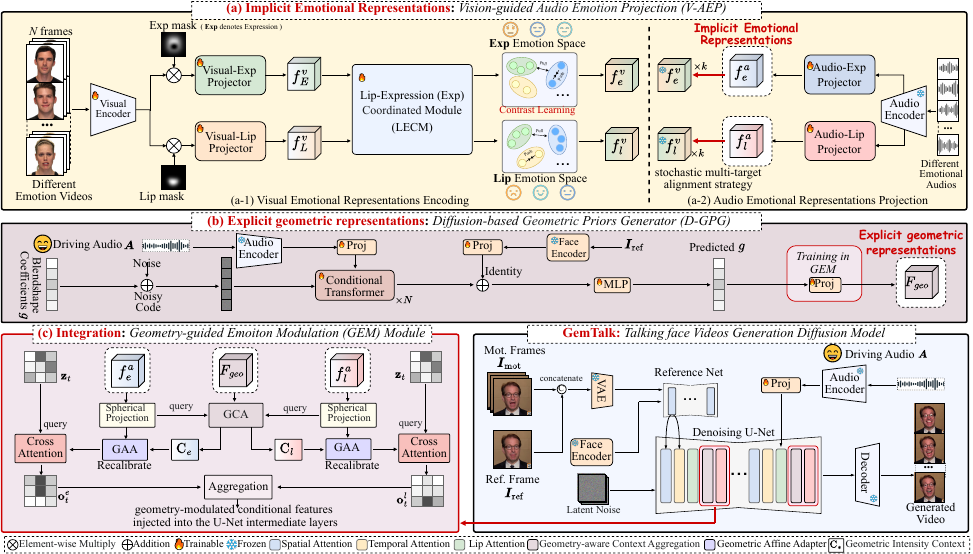
Given a reference face and driving audio, our GemTalk generates high-fidelity and controllable emotional videos. We first establish a emotion-agnostic lip sync backbone. Then we employ the V-AEP framework to extract robust implicit emotional representations, and D-GPG to synthesize explicit geometric representations. Finally, the GEM utilizes explicit geometric representations as structural priors to recalibrate the implicit feature magnitude, enabling continuous control over facial dynamics without losing visual quality. Details of the baseline framework are provided in the Section . From Zhejiang University.
A common thread runs through today's three papers: emotion is hard to get right, and the field is attacking it from multiple angles — geometric priors for faces, contrastive decoding for speech reliability, and listener-adaptive arousal-valence spaces for personalization. Here's what's new.
Talking Avatars & Lip Sync
Fusing geometry and semantics for expressive, controllable video portraits.
Prior emotional talking-face methods have long faced a frustrating tradeoff: models that are highly controllable tend to sacrifice photorealism, while photorealistic approaches often lack fine-grained expression control. Zhejiang University's new work attacks this directly by combining implicit semantic representations with explicit geometric priors — specifically, a geometry-guided emotion modulation module that enables precise tuning of expression intensity without degrading visual fidelity.
Geometry-guided Emotion Modulation for Controllable and Photorealistic Emotional Talking Face Generation
This work fuses implicit semantic representations with explicit geometric priors to generate emotional talking faces with precise control over expression intensity. The geometry-guided emotion modulation module resolves the tradeoff between controllability and photorealism that limits prior methods.
Abstract
Audio-driven emotional talking face generation aims to synthesize realistic videos with expressive facial dynamics. However, existing methods struggle to balance controllability and visual fidelity. Although implicit representations capture rich semantics, they lack structural guidance, often resulting in averaged emotional expressions. In contrast, explicit geometric methods offer better control over facial expressions but tend to sacrifice high-frequency texture details. To address it, we propose GemTalk, a diffusion-based framework that combines the semantic richness of implicit representations with the structural precision of explicit geometric priors. We introduce a Vision-guided Audio Emotion Projection (V-AEP) module to extract implicit emotional lip and expression features. At the same time, a Diffusion-based Geometric Priors Generator (D-GPG) generates identity-aware blendshape coefficients as explicit structural priors. Crucially, our Geometry-guided Emotion Modulation (GEM) module leverages these geometric priors to recalibrate the magnitude of implicit features, enabling precise, continuous control over emotional expressions, especially emotion intensity, without sacrificing visual quality. Extensive experiments show GemTalk achieves superior performance in photo-realism, and facial emotional dynamics.
TTS & Voice Synthesis
Tackling hallucinations and personal perception in language-model-based speech synthesis.
Hallucination-Free Decoding for LM-Based TTS
Language-model-based TTS systems are powerful but prone to speech hallucinations — dropped words, repetitions, or misaligned phonemes that have nothing to do with the input text. Harbin Institute of Technology proposes Experience-Calibrated Contrastive Decoding (ECCD), a training-free inference-time method that steers token generation to strengthen text alignment while still preserving useful learned acoustic patterns. The key appeal: substantial WER/CER reductions with zero architectural changes or retraining required.
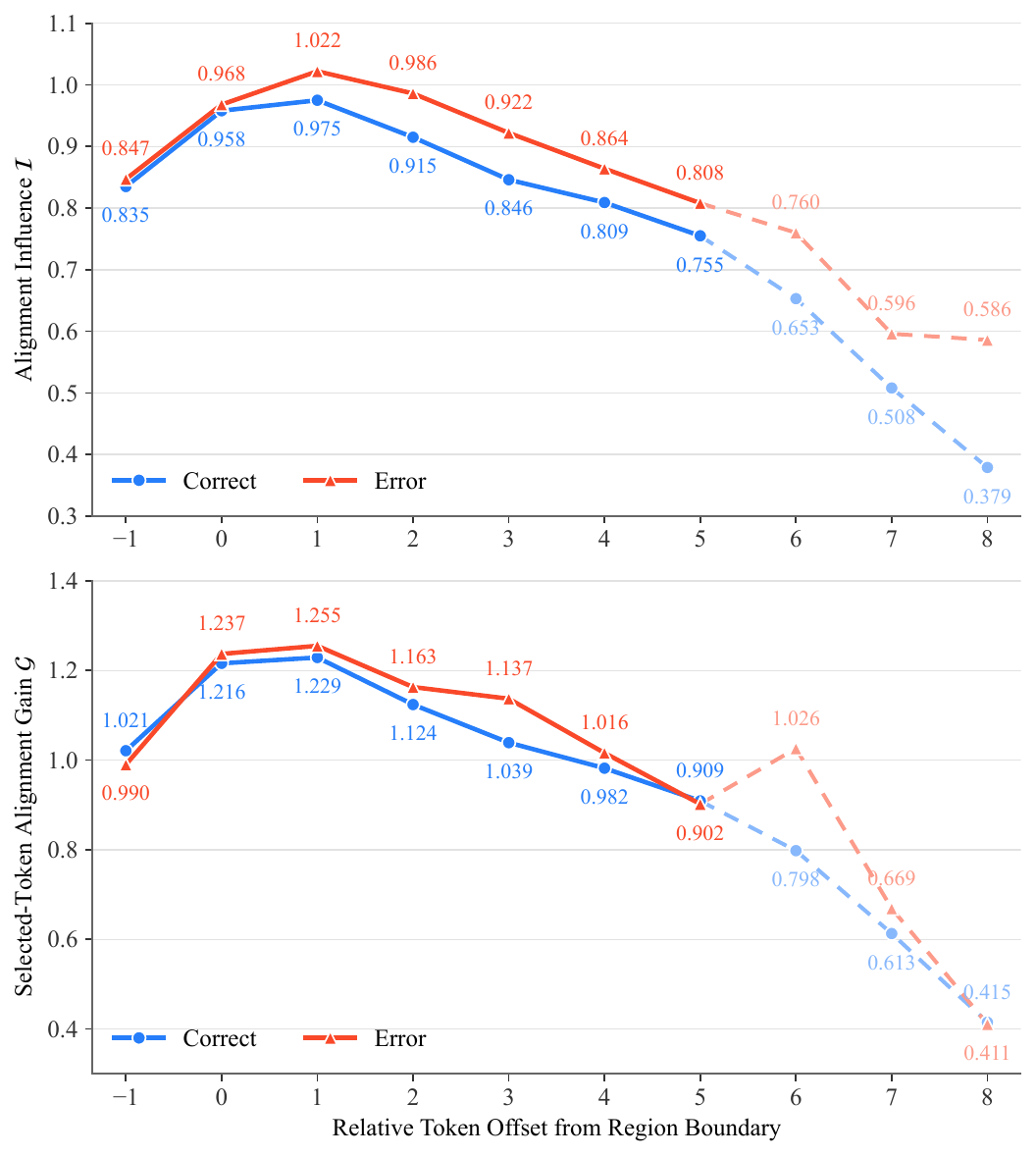
Experience-Calibrated Contrastive Decoding for Mitigating Hallucinations in LM-Based Text-to-Speech
Mitigates speech hallucinations in LM-based TTS through Experience-Calibrated Contrastive Decoding, a training-free inference method that strengthens text alignment while preserving useful acoustic patterns. Achieves substantial WER/CER reductions without architectural changes or retraining.
Abstract
Language model-based text-to-speech (LM-based TTS) remains vulnerable to speech hallucinations that deviate from the target text. Existing mitigation mainly relies on architectural changes or additional training, while decoding-time control remains underexplored. We present a conditional information view that distinguishes text-derived alignment information from experience information supplied by acoustic context and learned speech regularities. We hypothesize that an important class of hallucinations begins when alignment support is insufficiently reflected in the selected token at a vulnerable transition. Using predictions from the same speech LM with and without text conditions, we propose Experience-Calibrated Contrastive Decoding (ECCD), a training-free method that strengthens alignment support while preserving useful experience information. ECCD preserves the original expert distribution, applies only positive alignment enhancement, and calibrates its strength using set-level experience compatibility. Across four models, ECCD reduces WER/CER by up to 55.6% in all SeedTTS-Eval settings and 24 of 25 multilingual CV3-Eval settings. A listening test yields a CMOS gain of $+0.644$ while retaining strong speaker similarity. Further analysis shows that alignment influence and decision-level gain vary within linguistic units and are lower at first-error boundaries than at matched correct boundaries. Overall, these extensive experiments and analyses identify conditional information control as a promising decoding-time direction for mitigating speech hallucination.
Personalized Emotional TTS via Interactive Genetic Optimization
Most emotional TTS systems map categories like "happy" or "sad" to a single averaged representation — ignoring the well-documented fact that emotion perception varies significantly across individuals and cultures. Nara Institute of Science and Technology's paper personalizes the arousal-valence space for each listener using an Interactive Genetic Algorithm (IGA), iteratively optimizing the representation based on subjective feedback. The result is speech that feels emotionally aligned to you, not to a population mean.
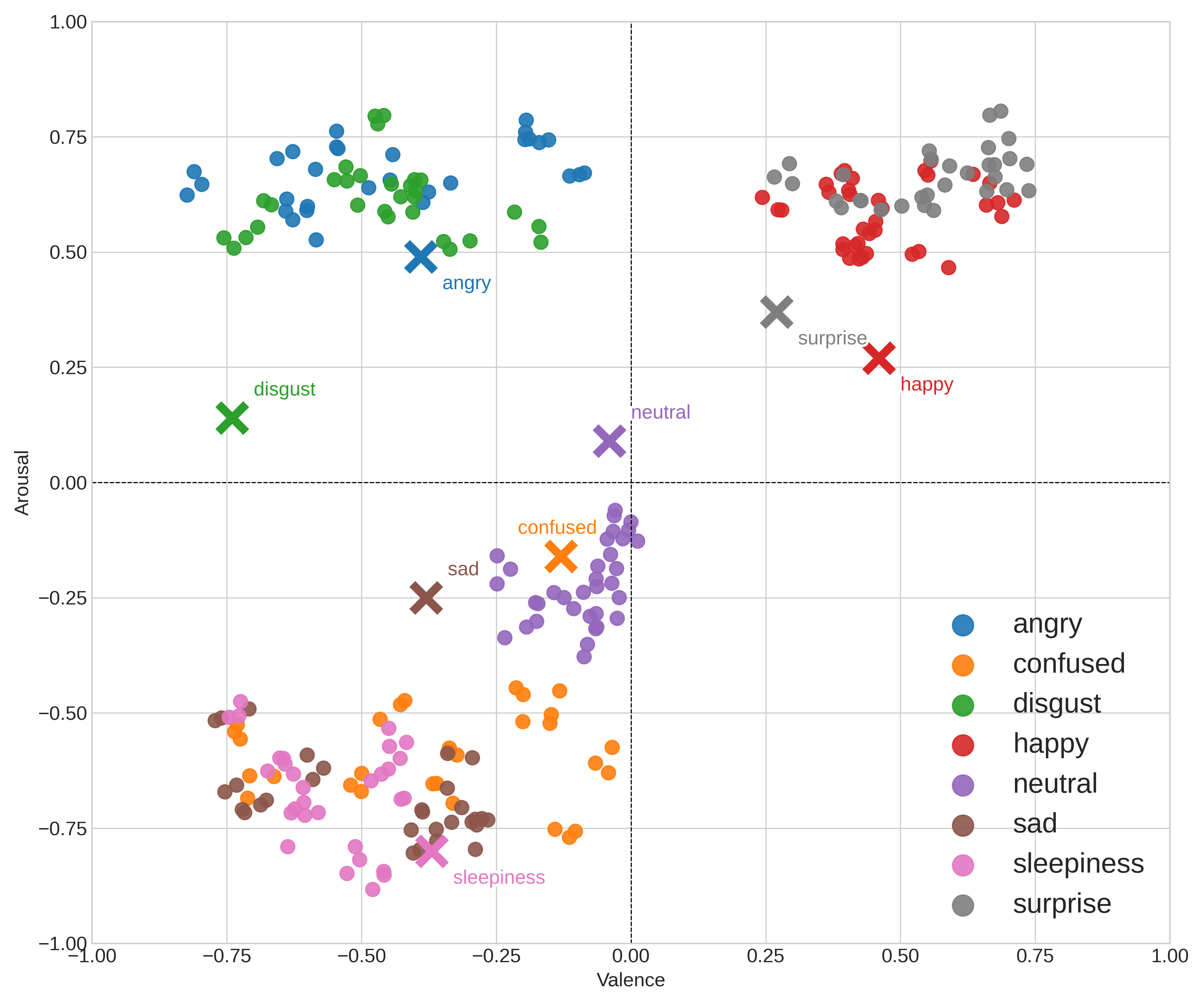
Beyond One-Size-Fits-All: Personalized and Culturally Adaptive Emotional TTS via Interactive Optimization of Individual Emotion Perception Spaces
This paper personalizes emotional text-to-speech by optimizing arousal-valence representations for individual listeners using an Interactive Genetic Algorithm. By adapting to cultural and personal emotion perception differences, it produces more emotionally aligned speech than models using averaged values.
Abstract
The rise of conversational AI has increased interest in emotional Text-to-Speech (TTS). Most systems rely on discrete emotion labels, which fail to capture the nuanced nature of human affect. Recent models employ dimensional representations such as Russell's arousal-valence (A-V) model, offering finer control. However, emotional perception varies across individuals and cultures, which may cause mismatches between modeled and perceived emotions. We propose a personalized and culturally adaptive emotional TTS framework that performs interactive optimization of individualized A-V perception spaces using an Interactive Genetic Algorithm. By adapting emotion representations to each listener, the system produces speech with more perceptually aligned emotional expression than models using averaged A-V values. Evaluations with Japanese, Chinese, and Indonesian participants highlight the importance of personalization and cultural adaptation for moving beyond one-size-fits-all emotional TTS.
Trending on Hugging Face


Qwen3-TTS Technical Report
The Qwen3-TTS series presents advanced multilingual text-to-speech models with voice cloning and controllable speech generation capabilities, utilizing dual-track LM architecture and specialized speech tokenizers for efficient streaming synthesis.

Fish Audio S2 Technical Report
Fish Audio S2 is an open-source text-to-speech system with multi-speaker capabilities, multi-turn generation, and instruction-following control through natural-language descriptions, utilizing a multi-stage training approach and production-ready inference engine.

OmniFlatten: An End-to-end GPT Model for Seamless Voice Conversation
A novel GPT-based model, OmniFlatten, enables real-time natural full-duplex spoken dialogue through a multi-stage post-training technique that integrates speech and text without altering the original model's architecture.