
Empathetic Voice Agents, Precise Speech Editing, and Real-Time Gestures
Today's digest covers full-duplex empathetic dialogue from ByteDance, XML-driven speech editing with fine-grained prosody control, streaming co-speech gesture generation with drift-free anchoring, and a novel Latent Softmax output layer for multilingual ASR across tonal and non-tonal languages.
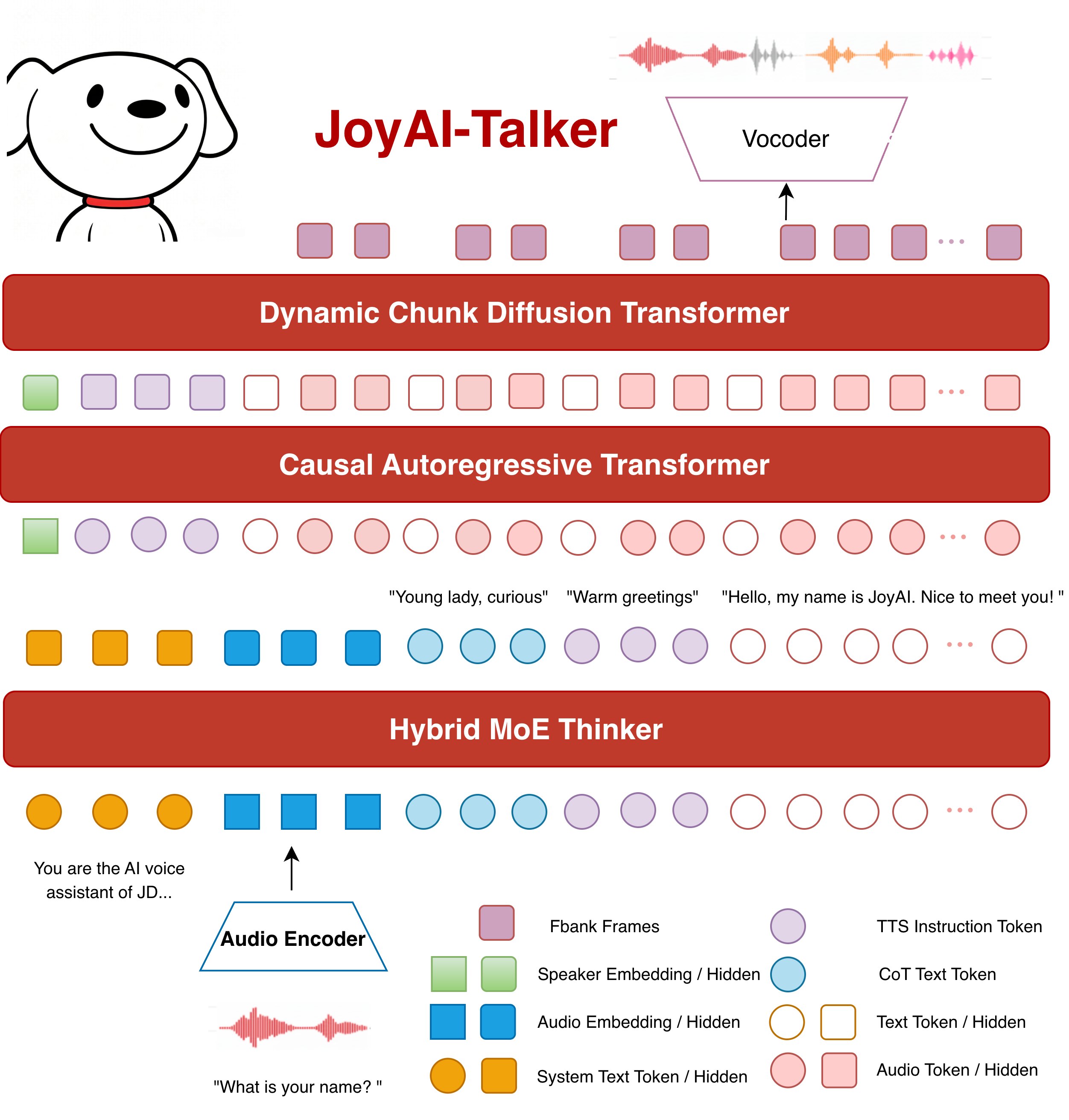
An overview of Thinker-Talker pipeline in JoyAI-Talker. It consists of several key components: 1) Audio Encoder: This module processes the input speech query and extracts continuous audio embeddings. 2) Hybrid MoE Thinker: Ingesting multimodal inputs, this cognitive core performs reasoning to predict the target text tokens and TTS instruction tokens. 3) Causal Autoregressive Transformer: This module takes the speaker embeddings, predicted TTS instruction tokens, and target text tokens as input, and predicts the discrete audio tokens. 4) Dynamic Chunk Diffusion Transformer: Using the hidden representations from the Causal Autoregressive Transformer as input, this component predicts the mel-spectrogram output. 5) Vocoder: This module is responsible for reconstructing the predicted mel-spectrogram back to continuous waveform audio. From Bytedance.
Today's papers push the frontier of conversational AI across the full stack — from how voice agents listen and respond in real time, to how speech is edited with surgical precision, to how virtual bodies move in sync with speech, and how ASR systems can share phonetic knowledge across vastly different language families.
SpeechLLMs & Voice Agents
Making LLMs genuinely conversational: full-duplex, emotionally aware, and persona-driven.
Real-time voice interaction demands more than just fast inference — it requires a system that can manage turn-taking, express empathy, and maintain a coherent persona without sacrificing the reasoning depth of the underlying LLM. ByteDance addresses all of this in a single unified architecture.
JoyAI-Talker is a full-duplex speech dialogue system that unifies speech and text training to preserve LLM reasoning while enabling empathetic, persona-adaptive voice responses. It supports fine-grained paralinguistic control — covering emotion, speaking style, and prosody — alongside real-time turn management for natural conversational flow. The system's design explicitly avoids the degradation of LLM capabilities that often accompanies speech-native training, making it a compelling step toward truly intelligent voice agents.
JoyAI-Talker: Full-Duplex Speech Interactive Large Model Built for Empathetic Voice Agents
JoyAI-Talker is a full-duplex speech dialogue system that preserves LLM reasoning while delivering empathetic voice interaction through unified speech-text training and persona-adaptive responses. It enables fine-grained paralinguistic control and real-time turn management with natural conversational flow.
Abstract
We present JoyAI-Talker, a full-duplex speech dialogue system that delivers robust foundation model capabilities while empowering empathetic interaction and voice agent intelligence. JoyAI-Talker adopts a modular Thinker-Talker architecture and further implements a unified speech-text joint training pipeline to mitigate the common "cognitive degradation" bottleneck, thereby largely preserving the model's core textual reasoning, STEM, and logical capabilities while extending them to speech-based interaction. For expressive speech synthesis, the Talker module employs a text-controllable generation paradigm that enables natural-language instructions to flexibly control vocal attributes and localized paralinguistic events, such as laughter and sighs, supporting more expressive and fine-grained speech responses. To enhance conversational empathy, we introduce the Persona-Adaptive Empathetic Response (PAER) framework. PAER employs a hierarchical cognitive pipeline to extract non-verbal speaker cues, such as gender, age, and emotional state, from raw input audio, incorporate them into the Thinker's CoT reasoning, and generate context-adaptive responses that align semantically appropriate text with fine-grained control over utterance-level expressiveness and localized paralinguistic events, including sighs, speaking rate, and volume. We further integrate Joy-Duplex, a state-driven, plug-and-play full-duplex framework that functions as an efficient gating engine for real-time turn control. Extensive evaluations show that JoyAI-Talker achieves highly competitive performance on foundational T2T and S2T benchmarks. In full-duplex evaluation, the system reaches a high response rate of 0.88 under user interruptions while maintaining an extremely low false-trigger rate under background speech, demonstrating its readiness for fluid and natural speech dialogue.
TTS & Speech Editing
Structured, timestamp-free editing that gives authors surgical control over every spoken detail.
Post-production speech editing typically requires either re-recording or brittle timestamp alignment. ByteDance AI Lab sidesteps both with a transcript-grounded approach that uses structured markup instead of time codes.
dots.tts.edit introduces XML-style structural instructions layered over a semantic timeline to enable precise, compositional edits — covering content replacement, emotion, prosody, and phrasing — without requiring explicit timestamp alignment. Because edits are grounded in the transcript's structure rather than audio positions, the system avoids common ambiguities while faithfully preserving unedited regions. The backbone is a continuous autoregressive model, which provides the fine temporal resolution needed for these kinds of localized interventions.
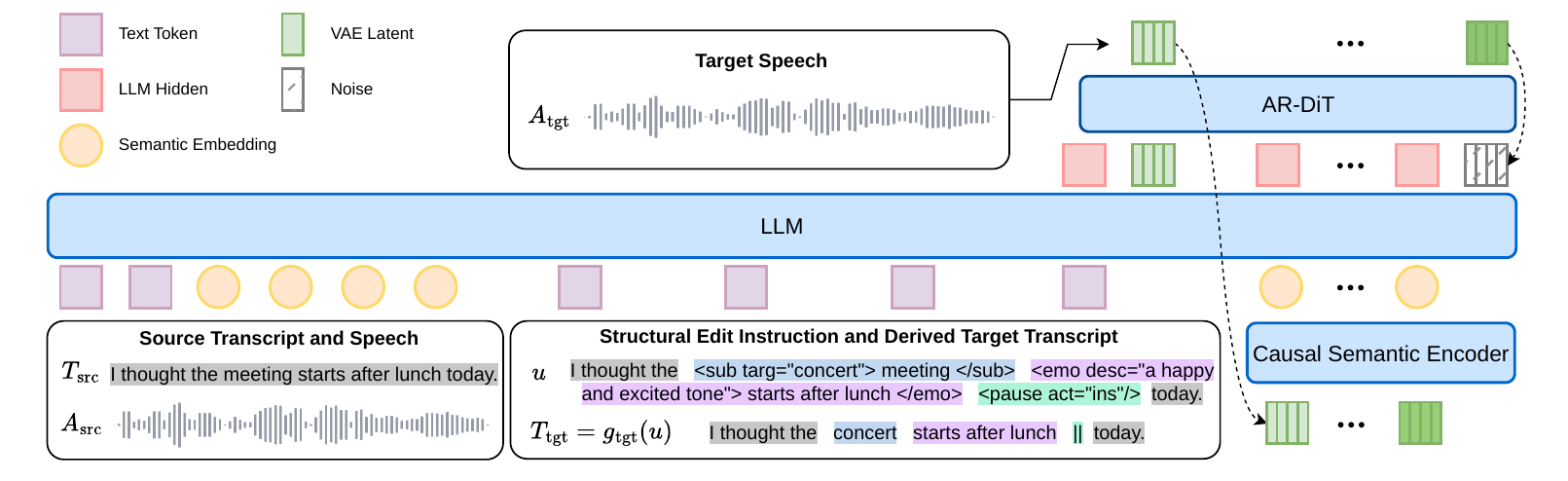
dots.tts.edit: Precisely Controlled Speech Editing with a Continuous Autoregressive Model
A transcript-grounded speech editing system using XML-style structural instructions for precise control over content, emotion, prosody, and phrasing without explicit timestamp alignment. The semantic timeline approach avoids ambiguity while enabling compositional edits and preserving unedited regions.
Abstract
Speech editing for content creation requires precise control over both what an edit should do and where it should apply. Free-form natural language provides a flexible interface for expressing edit requests, but its ambiguity may leave the intended operation, parameters, or target region underspecified. We study a precise and explicit interface for speech editing: a transcript-grounded structural edit instruction with XML-style tags explicitly specifies typed operations and localizes them to transcript spans or boundaries. This semantic timeline avoids explicit timestamp alignment and provides an externally inspectable contract for compositional edits. We instantiate the interface in dots.tts.edit, an editor adapted from the continuous autoregressive dots.tts foundation model. Four representative speech-creation controls cover lexical content, affective expression, pitch and speaking-rate delivery, and temporal phrasing through text, emotion, prosody, and pause editing. Task-specific data pipelines construct operation- and scope-controlled pairs while retaining source-derived context outside each target region. We further introduce doteBench, a bilingual evaluation suite that measures precise instruction following, local preservation, and audio quality across the four controls and their composition. Experiments show leading overall instruction following and local preservation across its five editing categories, while audio quality remains comparable to existing open-source systems. Across three Seed-TTS-Eval shards, the model shows negligible differences from the base model in zero-shot TTS recognition error rate and speaker similarity. The code and model will be released soon.
Co-Speech Gesture & Animation
Closing the loop on streaming gesture generation to eliminate long-horizon drift.
Generating convincing co-speech gestures in real time is hard enough; keeping them stable over long utterances is harder still. Open-loop streaming approaches accumulate errors as motion clips are chained together, leading to unnatural drift. NTU's solution is a closed-loop correction mechanism anchored to plausible poses.
StreamTalk introduces periodic key-pose anchoring — at regular intervals, the system retrieves a plausible anchor pose from a motion database and uses it to refine the current motion clip, resetting any accumulated trajectory error. This closed-loop framework enables stable, real-time co-speech gesture generation that remains coherent over extended speech sequences, without sacrificing the low latency required for streaming applications.
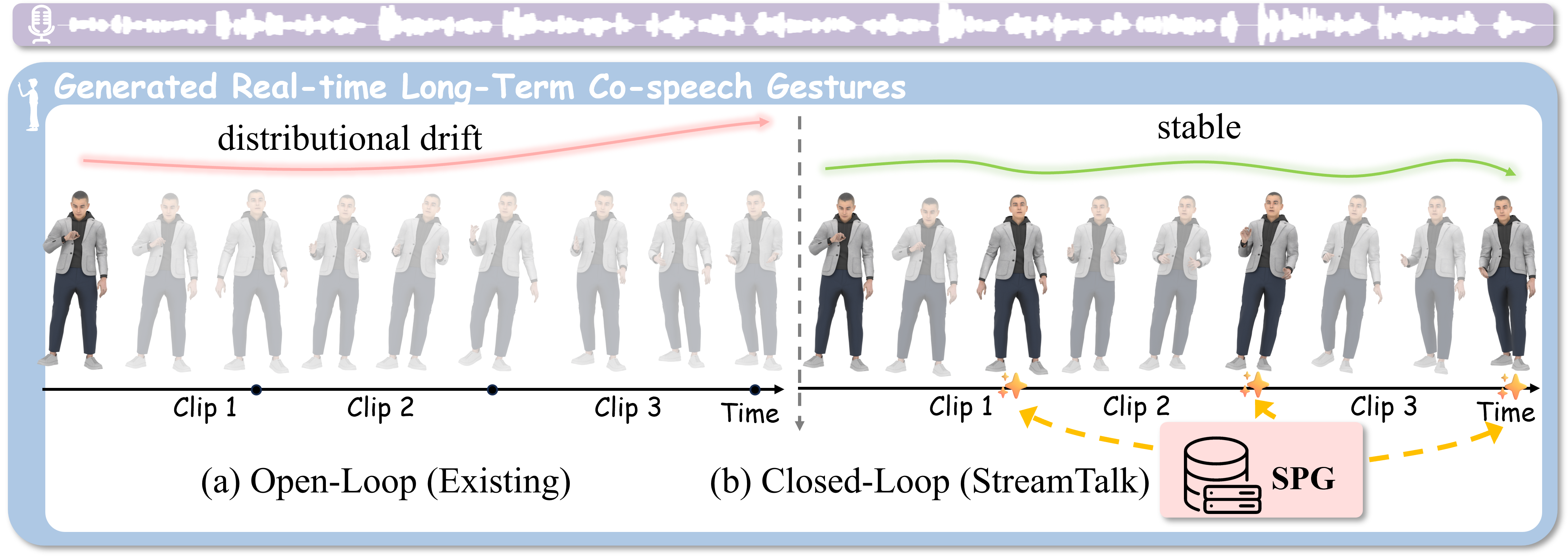
StreamTalk: Streaming Co-Speech Gesture Generation with Key-Pose Anchoring
StreamTalk enables stable real-time co-speech gesture generation using periodic key-pose anchoring to prevent trajectory drift. Unlike open-loop streaming methods that accumulate errors over time, this closed-loop framework retrieves plausible poses from a motion database to refine each motion clip.
Abstract
Real-time co-speech gesture generation must produce 3D motion clip by clip as speech arrives. Existing streaming methods are open-loop: each clip depends on past context, but the model cannot check or correct its trajectory. Small errors therefore accumulate and cause drift over long sequences. We observe that this failure is mainly caused by the lack of a forward constraint rather than poor short-clip quality. A plausible key pose at the end of each clip provides a destination anchor that limits drift. Based on this observation, we propose StreamTalk, a closed-loop framework with a periodic generate-retrieve-refine cycle. Streaming Pose-Guided Generation first predicts a coarse clip, retrieves a plausible tail pose from a speaker-specific motion database, and refines the clip using this pose before continuing to the next window. During training, Stochastic Anchor Masking randomly masks pose and translation frames, teaching the model to recover complete motion from sparse boundary conditions. A part-aware DiT separates hand, body, and translation streams to reduce interference between global displacement and local articulation. On BEAT2, StreamTalk achieves state-of-the-art FGD, reduces long-horizon drift relative to open-loop baselines, and runs in real time at 76 FPS. Project page: https://xiangyue-zhang.github.io/StreamTalk/.
ASR Architectures
A smarter output layer that lets tonal and non-tonal languages share phonetic knowledge gracefully.
Multilingual ASR faces a structural challenge when mixing tonal languages (like Mandarin) with non-tonal ones: tone-marked vowels and bare vowels occupy incompatible label spaces, making cross-lingual phoneme sharing difficult. Tsinghua University proposes an elegant output-layer fix.
Latent Softmax reframes tone-marked vowels as latent subclasses of their base vowels. When only a base-vowel label is available (as in non-tonal supervision), the model marginalizes over the tone subclasses, ensuring no information is discarded and no artificial conflict is introduced. This allows a single multilingual ASR model to share phonetic representations across language families in a data-efficient way, with the benefit being especially pronounced in low-resource tonal language settings.
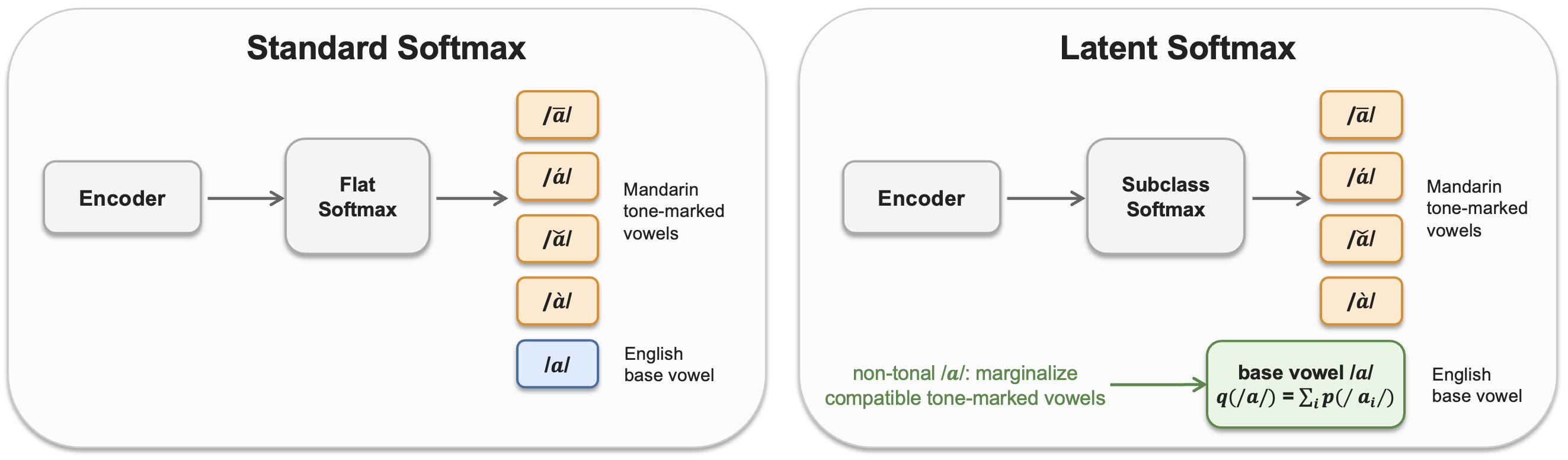
Latent Softmax for Data-Efficient Phoneme-Based Multilingual ASR Across Tonal and Non-Tonal Languages
Latent Softmax is an output layer for multilingual ASR that handles supervision mismatches between tonal and non-tonal languages by treating tone-marked vowels as subclasses that marginalize when only base-vowel labels are available, enabling better cross-lingual phonetic sharing.
Abstract
Phoneme-based multilingual automatic speech recognition (ASR) can share acoustic evidence across languages more directly than language-specific subword modeling. When tonal and non-tonal languages are jointly trained, however, their supervision granularity does not match: tonal languages annotate tone-marked vowels, whereas non-tonal languages typically provide only base-vowel labels. A standard softmax either treats the two as unrelated classes, weakening cross-lingual sharing, or collapses tones, losing distinctions required by tonal languages. We propose Latent Softmax, a connectionist temporal classification (CTC)-compatible output layer that models tone-marked vowels as subclasses and base vowels as major classes, while consonants and the CTC blank remain singleton labels. When only a base-vowel major-class label is observed, the tone-marked vowel subclass is treated as latent and marginalized out. Multilingual experiments on AISHELL-1 Mandarin and LibriSpeech English show that Latent Softmax reduces speech-to-phoneme (S2P) phoneme error rates over a standard softmax multilingual baseline by 8.4% on AISHELL-1, 17.5% on LibriSpeech test-clean, and 12.6% on test-other. The improved speech-to-phoneme encoders also yield consistent word error rate gains for both large-language-model phoneme-to-grapheme conversion and projector-based interfaces. After code-switching adaptation, Latent Softmax further reduces projector-based mixed error rate by 2.6% on ASRU2019 and 9.5% on CS-Dialogue datasets.
Trending on Hugging Face


OmniFlatten: An End-to-end GPT Model for Seamless Voice Conversation
A novel GPT-based model, OmniFlatten, enables real-time natural full-duplex spoken dialogue through a multi-stage post-training technique that integrates speech and text without altering the original model's architecture.

VibeVoice Technical Report
VibeVoice synthesizes long-form multi-speaker speech using next-token diffusion and a highly efficient continuous speech tokenizer, achieving superior performance and fidelity.

Qwen3-TTS Technical Report
The Qwen3-TTS series presents advanced multilingual text-to-speech models with voice cloning and controllable speech generation capabilities, utilizing dual-track LM architecture and specialized speech tokenizers for efficient streaming synthesis.

Fish Audio S2 Technical Report
Fish Audio S2 is an open-source text-to-speech system with multi-speaker capabilities, multi-turn generation, and instruction-following control through natural-language descriptions, utilizing a multi-stage training approach and production-ready inference engine.