
Emotion-Aware Avatars, Smarter TTS, and Tool-Calling Speech Agents
Today's digest spans real-time emotion-controllable portrait animation, reinforcement-learned TTS, environment-aware voice synthesis, and spoken LLMs that reason with external tools — a broad sweep across talking avatars, voice generation, and speech intelligence.
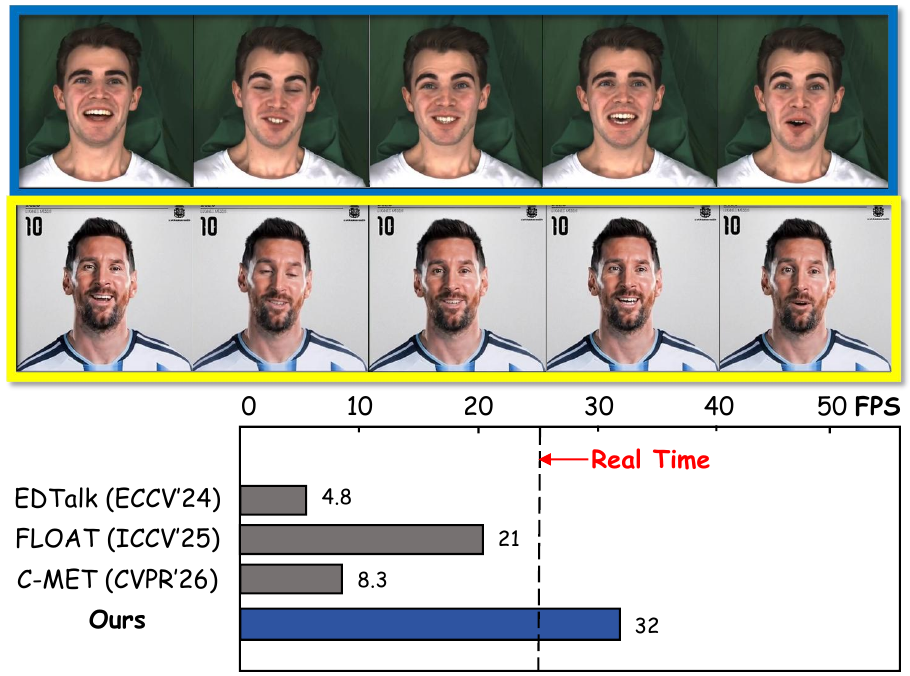
Given a source portrait, an audio clip, and an emotion category, our method can generate emotional talking-head videos in real time on a consumer-grade GPU, specifically the RTX 4090. The blue box indicates the driving videos, and the yellow box indicates the driving results. From Nanjing University of Science and Technology.
Today's papers push hard on three interconnected fronts: making talking avatars more expressive and real-time capable, teaching TTS systems to understand acoustic context and optimize with RL, and equipping spoken language models with better reasoning and tool-use. ByteDance's SwanTale also lands as today's top Hugging Face Daily pick, unifying speech and audio generation in a single model.
---
Talking Avatars & Portrait Animation
From Gaussian proxy avatars to subtle blink dynamics — two papers tackle the full expressiveness stack for audio-driven faces.
One long-standing tension in portrait animation is separating what emotion to express from whose face expresses it. Researchers at Nanjing University of Science and Technology tackle this with a cascaded two-stage design: a Gaussian-based proxy avatar first generates expressive, emotion-aware motion directly from audio, then a one-shot retargeting module transfers that motion onto an arbitrary target portrait. Crucially, low-rank caching is applied to diffusion attention to make the whole pipeline run in real time — without sacrificing emotion control or identity fidelity.
Proxy Avatar Meets Low-Rank Caching: Real-Time One-Shot Emotion-Controllable Portrait Animation
A cascaded framework decoupling emotion-aware motion from appearance: a Gaussian proxy avatar generates expressive emotional driving from audio, then one-shot retargeting adapts motion to arbitrary portraits. Low-rank caching enables real-time inference with emotion control and identity preservation.
Abstract
Audio-driven portrait animation has advanced rapidly with diffusion-based generative models, yet real-time one-shot generation with expressive emotion control remains challenging. Existing methods often suffer from insufficient emotion-aware motion priors and expensive appearance computation during multi-step denoising. To address these issues, we propose Proxy Avatar Meets Low-Rank Caching, a cascaded framework for real-time one-shot emotion-controllable portrait animation. Instead of directly generating the target portrait from audio, our method uses a Gaussian-based emotion proxy avatar as a reusable motion generator, which is trained once on a single identity to produce expressive driving videos from audio and emotion labels. Since the proxy avatar only provides motion rather than target appearance or geometry, a large-scale one-shot retargeting model further extracts identity-independent motion from the proxy performance and adapts it to arbitrary target portraits. To improve inference efficiency, we introduce zero-shot appearance reuse with low-rank caching, which caches reference appearance features at the initial denoising step and models subsequent feature variations using lightweight low-rank adapters. Extensive experiments demonstrate that our method achieves stronger emotional expressiveness, better identity-preserving animation, and substantially reduced inference cost, enabling real-time one-shot portrait animation.
Even when lip sync is perfect, a talking head can look robotic if the eyebrows never move and the eyes never blink. SubtleTalk from Zhejiang University directly targets these weakly-correlated facial dynamics — motions that are statistically related to speech but not deterministically predictable from it. The system combines explicit multimodal control signals with residual flow matching, which models the residual distribution of subtle motions beyond what a deterministic predictor would produce. A large-scale dataset is introduced alongside to address the data scarcity that has historically bottlenecked this sub-problem.
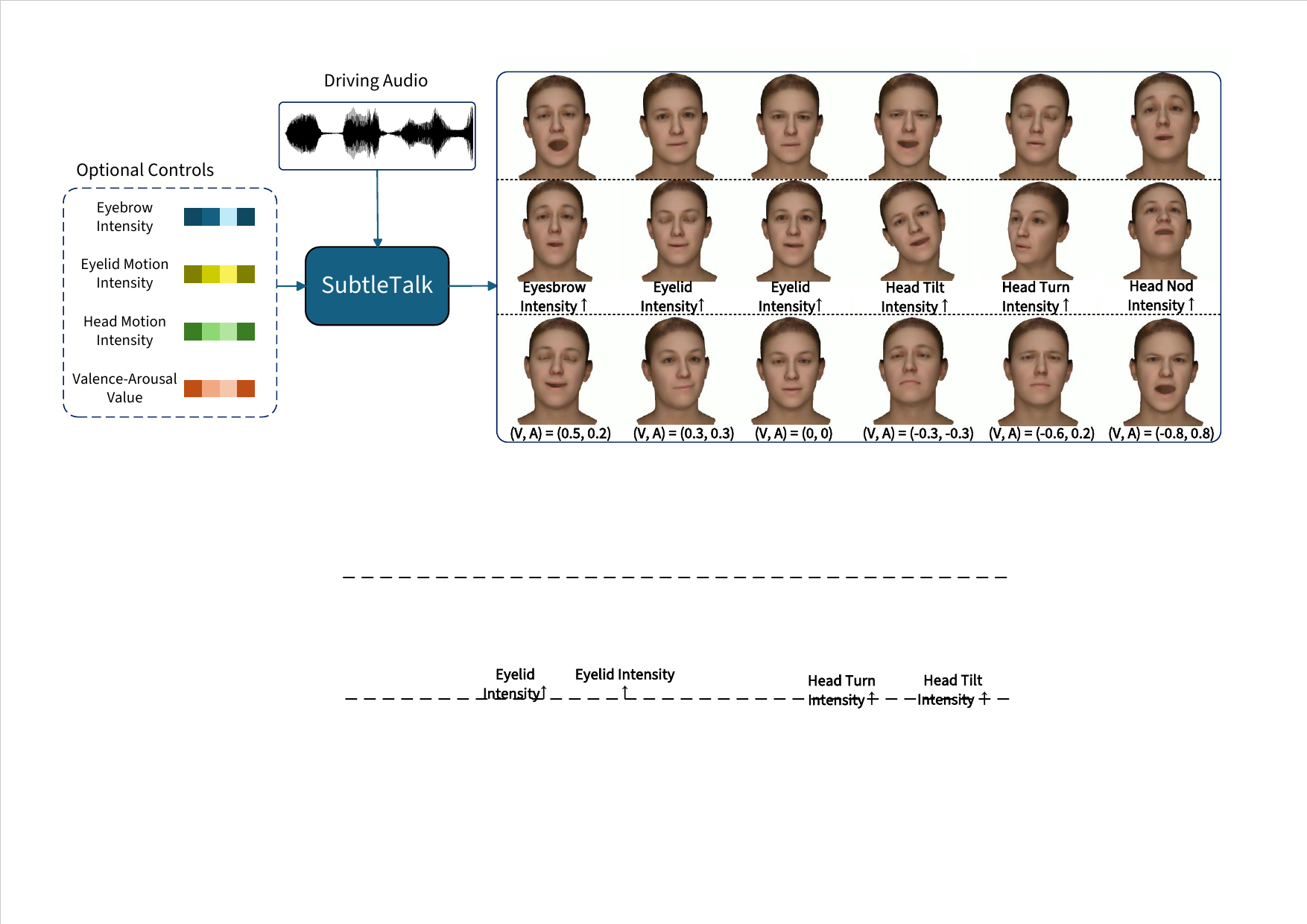
SubtleTalk: Generating Controllable Weakly-correlated Facial Dynamics for 3D Talking Heads via Residual Flow Matching
Generates natural weakly-correlated facial dynamics (eyebrows, blinks, head motion) in audio-driven 3D talking heads. Combines explicit multimodal controls with residual flow matching to capture diverse variations beyond deterministic prediction, paired with a large-scale dataset to overcome data bottlenecks.
Abstract
Audio-driven 3D facial animation aims to synthesize realistic and temporally coherent motions from speech. Despite notable progress in lip synchronization, weakly correlated dynamics, including eyebrow movements, eye blinks, and head motion, which are essential to photorealistic facial animation, remain difficult to model faithfully and often appear static or unnaturally repetitive. We attribute this limitation to three factors: (a) insufficient conditioning for weakly correlated dynamics; (b) the limited ability of deterministic regression to capture diverse motion patterns; (c) data bottlenecks from unreliable upper-face pseudo-labels and limited dataset diversity. To address these issues, we propose SubtleTalk, a framework for generating natural and controllable weakly correlated facial dynamics via multi-condition modeling and residual flow matching. First, to compensate for the limited guidance of speech alone, we introduce interpretable controls, including prosody, regional intensity, and Valence-Arousal signals, to explicitly capture the timing, magnitude, and affective variation of weakly correlated dynamics. Second, to overcome the limited expressiveness of deterministic regression, we build residual flow matching based on a stable speech-driven motion prior, allowing the model to capture stochastic deviations beyond deterministic prediction. Third, to alleviate the data bottleneck, we construct SubtleTalk-Face, a large-scale 3D facial animation dataset comprising about 3,900 identities and 74 hours of data, built via a simple and scalable pseudo-labeling pipeline and featuring improved upper-face tracking and frame-level VA annotations. Extensive experiments demonstrate that our method significantly improves the realism and diversity of weakly correlated facial dynamics while preserving accurate lip synchronization.
---
TTS & Voice Synthesis
RL-tuned flow matching, acoustic environment disentanglement, and unified multi-speaker generation mark a busy day for voice synthesis.
Reinforcement learning for TTS has proven effective but expensive. GROW from Tencent proposes a more efficient path: on-policy RL with group-relative advantage weighting applied to a flow-matching TTS backbone. By scoring groups of generated samples relative to each other rather than against an absolute baseline, GROW improves both speech intelligibility and speaker similarity — and does so 2.9× faster than prior RL-based TTS methods.

GROW: Group-Relative Advantage-Weighted On-Policy Reinforcement Learning of Autoregressive-Diffusion Text-to-Speech model
GROW proposes an efficient on-policy RL method for flow-matching text-to-speech using group-relative advantage weighting, improving speech intelligibility and speaker similarity while training 2.9× faster than prior RL-based TTS approaches.
Abstract
Reinforcement learning for flow-matching text-to-speech is complicated by deterministic ODE sampling: trajectory-level policy-gradient methods typically convert the ODE into an SDE and track per-step likelihood ratios, introducing stochastic perturbations and substantial overhead. We propose GROW, a group-relative advantage-weighted on-policy RL method that acts directly on the standard flow-matching objective. For each prompt, GROW samples a group of on-policy utterances, separately standardizes intelligibility and speaker-similarity rewards within the group, and combines them to reweight flow-matching regression. A Wasserstein-2 velocity penalty anchors the updated model to a frozen pretrained reference. A group-mean reward baseline is introduced to convert reward weighting into advantage weighting. For strong pretrained TTS models with concentrated rewards, positive exponential weighting is dominated by reward-agnostic self-imitation, whereas a zero-mean signed advantage preserves effective within-group credit assignment. Instantiated on DiTAR and evaluated on LibriSpeech and Seed-TTS EN/ZH, GROW reduces average WER from 2.016 to 1.558 and raises speaker similarity from 0.676 to 0.715 while keeping UTMOS. With 10-NFE training rollouts and 32-NFE evaluation, GROW retains comparable performance while training 2.9x faster than 32-NFE DiTAR-GRPO. We will open-source complete GROW codes, faithful DiTAR reproduction, and all model checkpoints.
Zero-shot TTS systems typically clone a speaker's voice, but they largely ignore the acoustic environment that voice was recorded in — leaving synthesized speech sounding out of place in noisy or reverberant scenes. USTC's new system addresses this via disentangled audio infilling: separate prompts are used for speaker timbre and for acoustic environment (noise, reverberation), enabling independent control over both dimensions simultaneously.
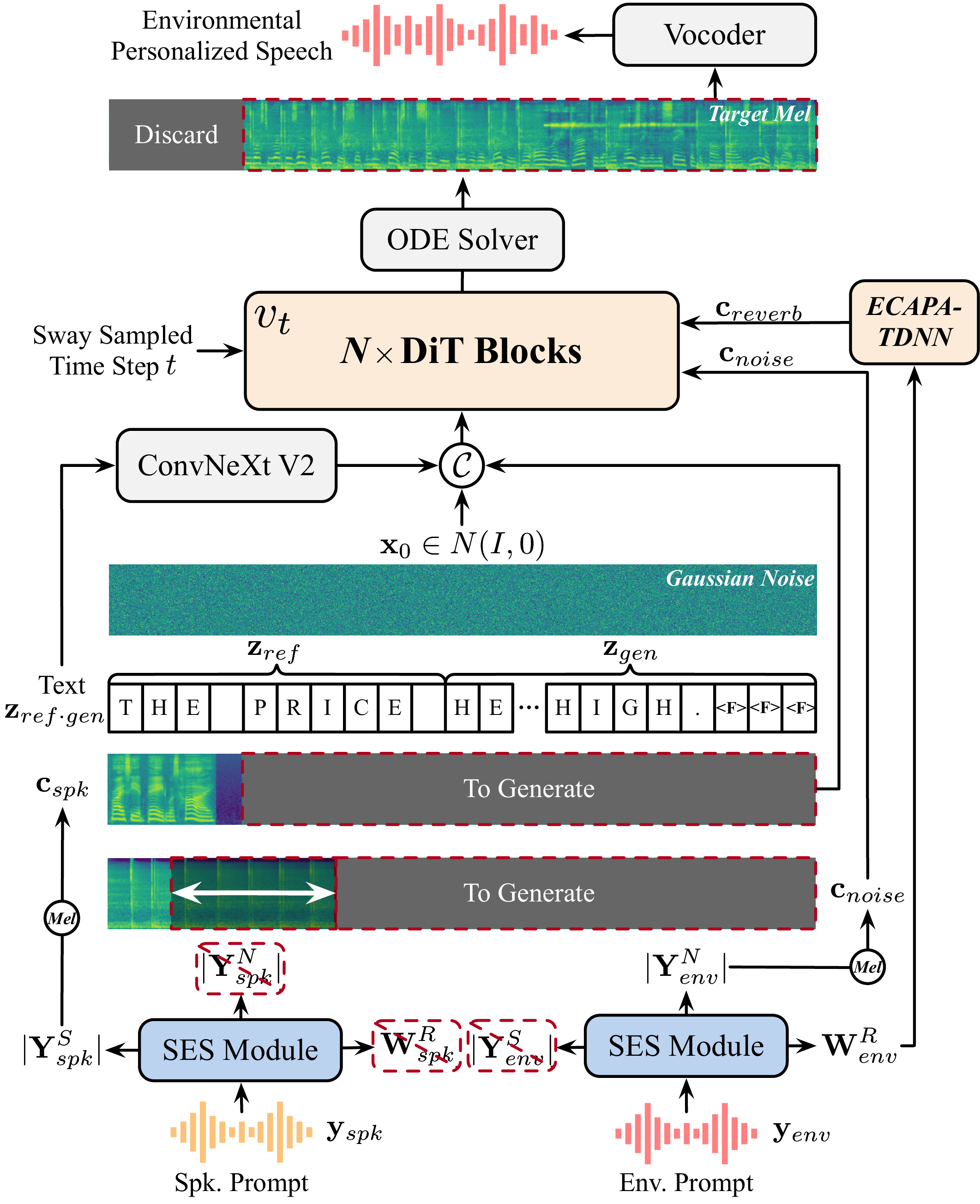
Towards Real-world Environment-aware Zero-shot Text-to-speech Synthesis via Disentangled Audio Infilling
An environment-aware zero-shot TTS system that disentangles speaker timbre from acoustic environment through separate prompts, enabling independent control over noise and reverberation. This addresses prior systems' inability to handle both speaker similarity and realistic environmental factors simultaneously.
Abstract
Recent zero-shot text-to-speech (TTS) systems achieve remarkable naturalness and speaker similarity but typically require high-quality speaker prompts and either strip away or entangle the acoustic environment with speaker characteristics, limiting their real-world applicability. We present an extended DAIEN-TTS, an environment-aware zero-shot TTS framework that disentangles and jointly models speech, background noise, and reverberation, enabling independent control over timbre and acoustic environment through separate speaker and environment prompts. Built upon the flow-matching-based F5-TTS, it uses a speech-environment separation module to decompose environmental speech into speech, noise, and reverberation components, which are injected into the Diffusion Transformer for environment-aware generation. Training uses simulated data constructed by mixing clean speech with noise and room impulse responses, together with a cross-speaker conditioning strategy that suppresses speaker information leakage from the environment branch. When real-world data are available, the system can be further fine-tuned to bridge the simulated-to-real domain gap.At inference, a triple classifier-free guidance mechanism enables fine-grained control over speech, noise, and reverberation, and a signal-to-noise-ratio adaptation strategy aligns the synthesized speech with the environment prompt. Experiments on simulated and real-world test sets show that DAIEN-TTS generates environmental personalized speech with high naturalness, strong speaker similarity, and faithful noise and reverberation reproduction, while offering controllability beyond prior environment-aware TTS systems.
From today's Hugging Face Daily tab, ByteDance's SwanTale proposes a single unified model for multi-speaker speech and general audio generation, handling both instruction-based and zero-shot tasks. The architecture pairs a specialized VAE for multi-modal generation with a Unified MoE routing mechanism to flexibly handle complex tasks like style-controlled dubbing and reference-audio-driven synthesis — all within one model rather than a pipeline of specialist systems.
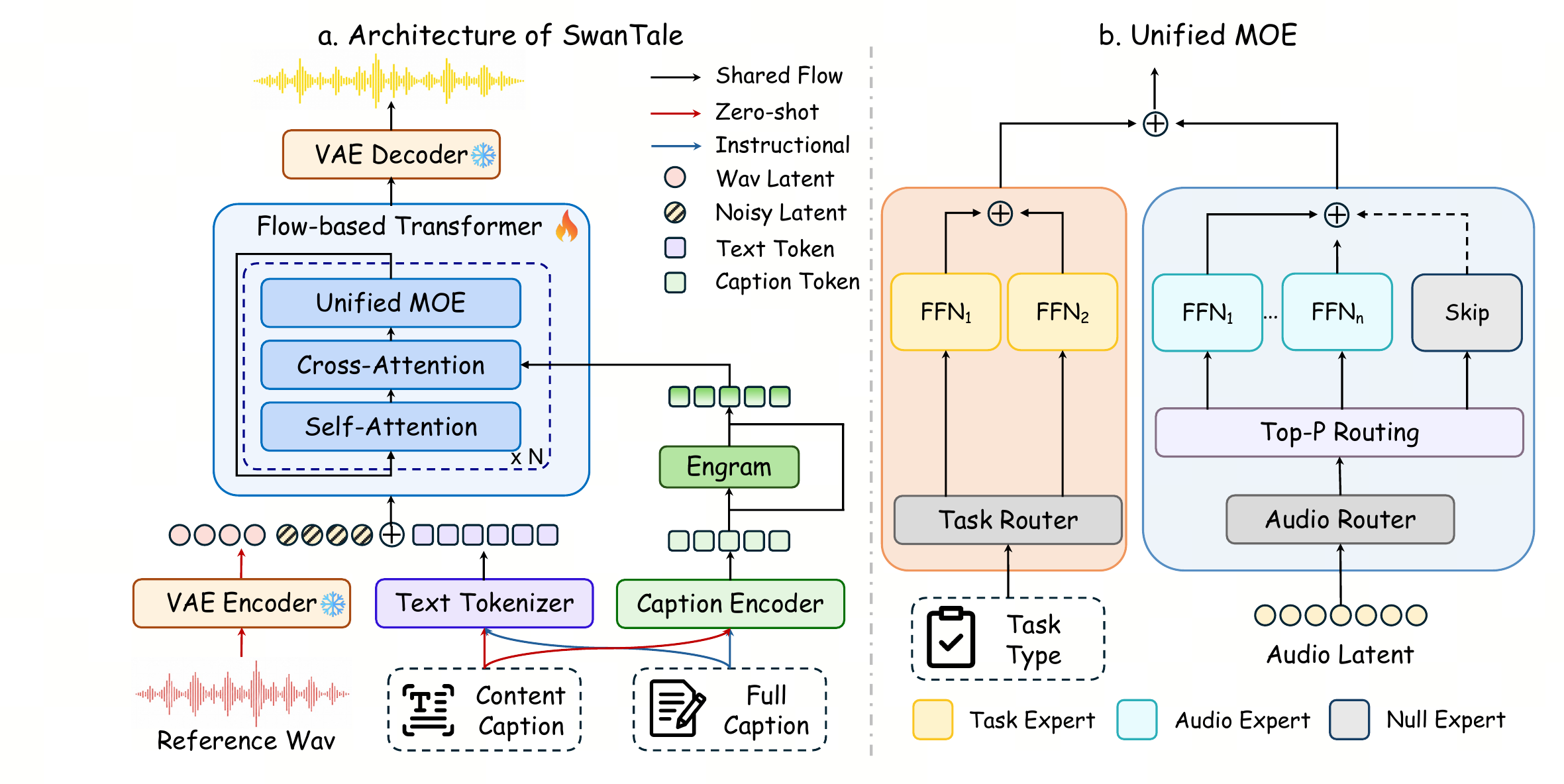
SwanTale: Unified Multi-Speaker Speech and Audio Generation for Instruct and Zero-Shot Tasks
SwanTale unifies multi-speaker speech and audio generation for both instruction-based and zero-shot scenarios in a single model. It combines a specialized VAE for multi-modal generation with Unified MoE routing to support complex tasks like style-controlled dubbing and reference-audio-driven synthesis.
Abstract
Speech and audio generation is often needed in animation dubbing, audio drama, movies, advertising, games, podcasts, and short-video production. In these scenarios, creators may need to design voices without reference recordings, control speaker styles with natural language, support acoustic scenes with environments and audio effects, and later reuse the designed voices. Therefore, it is important to support multi-speaker speech and audio generation for both instruct and zero-shot tasks. The instruct task requires a caption of the environment, speaker styles, and fine-grained content, while the zero-shot task uses reference audio together with the same fine-grained content. We address these tasks from both the data and model sides. First, we propose SwanData-Caption, which cleans raw speech and audio data, adds targeted synthetic coverage, and annotates diverse and accurate multi-level captions. Then, we propose SwanTale, a multi-speaker expressive speech and audio generation model that supports both zero-shot and instruct tasks. We introduce SwanVAE to support high-quality multi-audio-modality generation. Then, we adopt reward-conditioned quality control and Engram conditioning, along with Unified MoE for multi-task and multi-audio-modality modeling. In addition, we use curriculum learning and GRPO post-training to let the model progressively learn and strengthen its capabilities. Experimental results show that SwanTale leads on multiple key zero-shot and instruct metrics, achieves the best expressiveness scores in both tasks, and supports complex instruct generation involving multi-speaker speech and audio. Demos can be found at https://swanaigc.github.io/#swantale.
---
SpeechLLMs & Voice Agents
Intent benchmarking, decoupled policy optimization, and tool-calling audio agents — spoken LLMs are growing in capability and rigor.
Spoken LLMs are increasingly expected to capture not just what is said but how it's meant — the paralinguistic layer that carries sarcasm, emphasis, and emotional subtext. Tsinghua's ParaIntent benchmark formalizes this challenge by distinguishing explicit and implicit communicative intents in spoken dialogue. To close the gap, the team introduces ALPO (Acoustic-Lexical Decoupled Policy Optimization), which separates text-based and acoustic learning signals during optimization so that semantic quality and emotional expressiveness can be jointly improved without one interfering with the other.
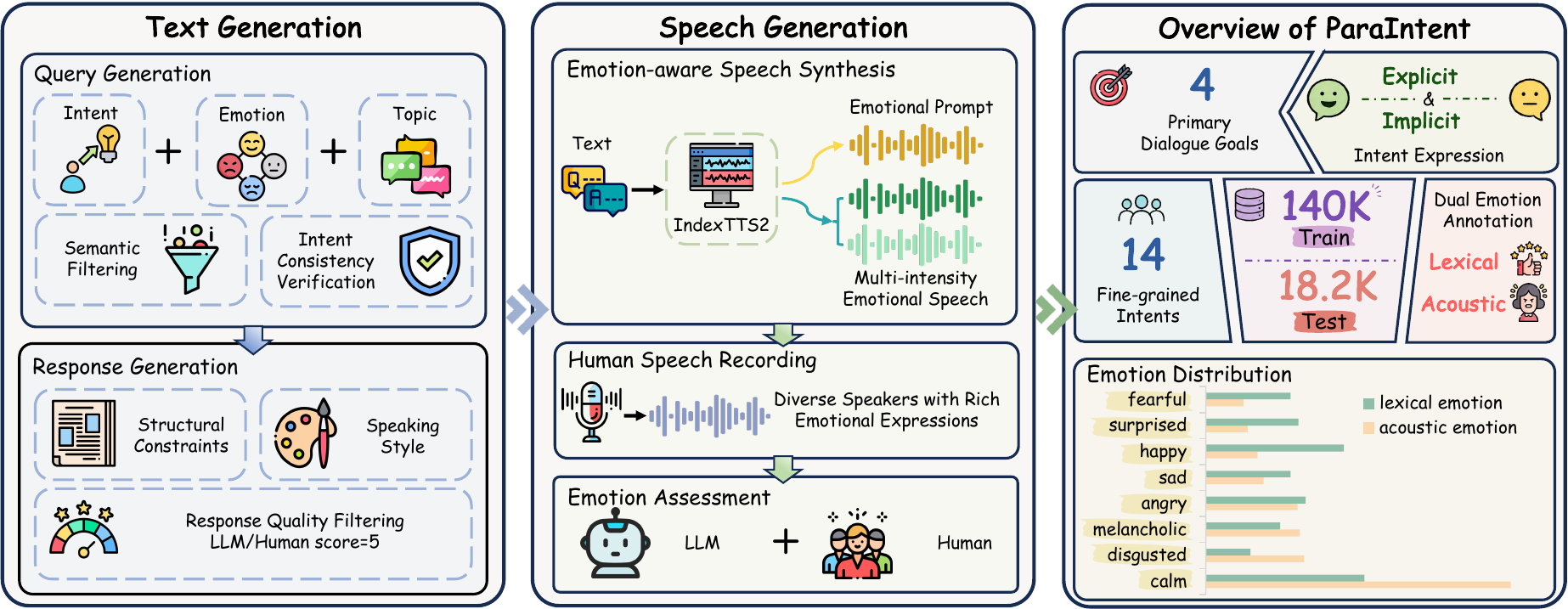
Towards More Expressive Spoken LLMs: Fine-Grained Intent Benchmarking and Acoustic-Lexical Decoupled Policy Optimization
Introduces ParaIntent, a benchmark for distinguishing explicit and implicit communicative intents in spoken dialogue, paired with ALPO—a policy optimization method that decouples text and acoustic learning signals to jointly optimize semantic quality and emotional expressiveness.
Abstract
Spoken emotional dialogue requires a model to understand a user's spoken input and generate a response that is both semantically appropriate and emotionally expressive. This is challenging because communicative intent may be stated explicitly in lexical content or conveyed more implicitly through paralinguistic cues, which can complement or diverge from the words themselves. However, two limitations constrain progress in this area: the scarcity of benchmarks that distinguish these intent expressions, and the lack of reinforcement learning objectives that jointly account for response quality and emotional expression. To address the lack of suitable benchmarks, we introduce ParaIntent, a Chinese benchmark comprising 14 intent categories with balanced explicit and implicit samples, together with a multidimensional evaluation protocol covering intent fulfillment, response quality, and emotional expression. For policy optimization, existing approaches either use a shared objective for text and speech or apply reinforcement learning to only one modality, leaving modality-specific learning signals entangled within policy optimization. Motivated by this, we propose Acoustic-Lexical Decoupled Policy Optimization (ALPO), which computes independent textual and acoustic advantages and routes them to the corresponding text and speech tokens within a unified rollout. Under identical reward functions and training budgets, ALPO improves over standard GRPO on most automatic metrics and achieves the best subjective results among the fine-tuned variants, with particularly clear gains in emotional expressiveness on both the synthetic and human-recorded test sets.
Audio reasoning tasks — identifying events, tracking speakers, understanding acoustic context — often require capabilities beyond what a single model can provide. SpeechAgent-R from Tsinghua reframes this as an interactive, tool-augmented process: the agent learns to strategically invoke external skills at the right moment to solve complex acoustic problems. Training combines trajectory-based fine-tuning with reinforcement learning, teaching the agent to coordinate its own audio understanding with the outputs of called tools in a coherent reasoning chain.
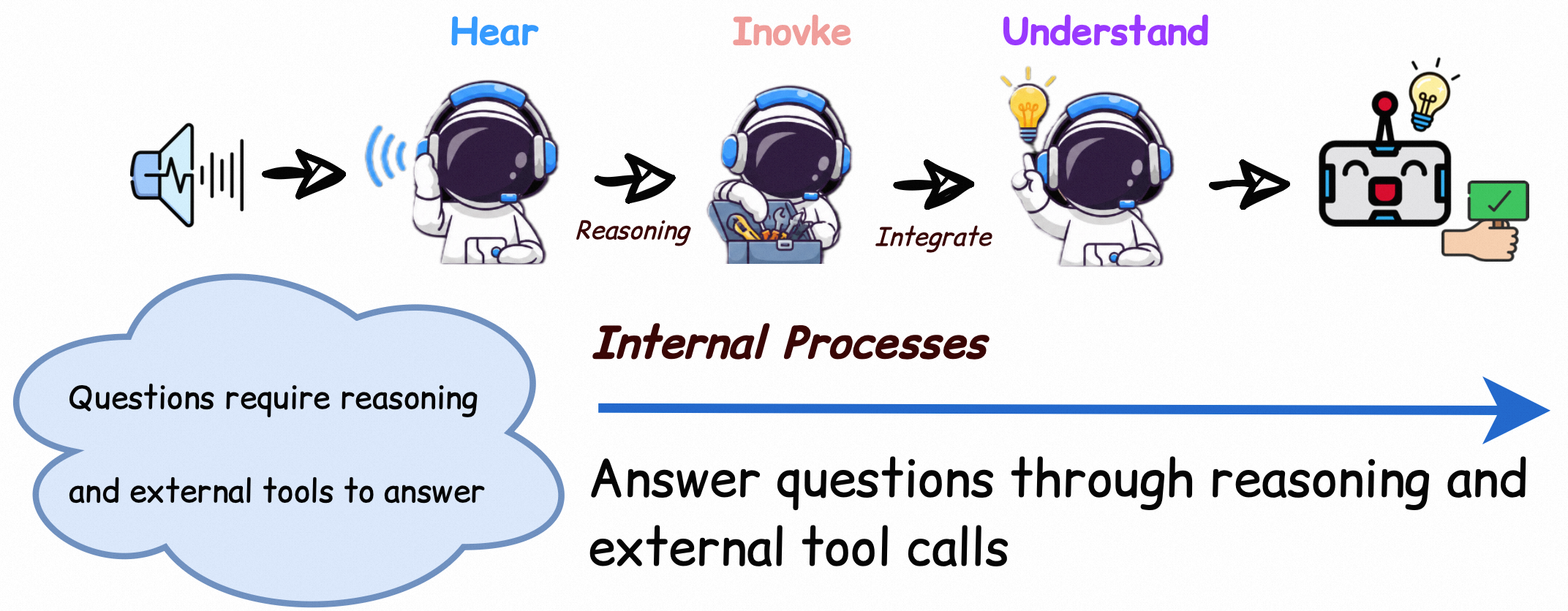
Hear, Invoke, and Understand: A Skill-Calling Multimodal Agent for Large Audio Language Models
SpeechAgent-R treats audio reasoning as an interactive process where the agent strategically invokes external tools and skills to solve complex acoustic problems. It learns through trajectory-based fine-tuning and reinforcement learning to coordinate audio understanding with tool interactions.
Abstract
Complex acoustic problems may require models to perform acoustic operations, interact with external tools and reason over the resulting textual or processed-audio observations rather than answer directly from a fixed audio input. We study such problems as tool-interactive audio reasoning and develop SpeechAgent-R, an audio agent that coordinates its intrinsic multimodal understanding with external skills and tools. To support this capability, we construct HIU-Corpus, comprising 65,492 interaction trajectories and 507.6 hours of audio across 24 tasks, 8 skills and 9 tools. SpeechAgent-R first learns structured interaction behaviors through trajectory-based supervised fine-tuning and then improves its decisions through multi-turn reinforcement learning. We further introduce HIU-Bench to jointly evaluate task performance, interaction quality and generalization to diverse task settings. It contains 1,395 samples across 56 tasks, including in-distribution (ID) and out-of-distribution (OOD) splits with substantial shifts in tool usage and workflow composition. SpeechAgent-R achieves 84.17 on ID tasks and 70.94 on OOD tasks, improving over the base model under the same agent harness by 15.40 and 14.23 points. These results demonstrate that learning skill and tool coordination improves audio agents' ability to handle diverse task settings and adaptive tool interactions.
Trending on Hugging Face


PersonaLive! Expressive Portrait Image Animation for Live Streaming
PersonaLive is a diffusion-based portrait animation framework that improves real-time performance through hybrid implicit signals, appearance distillation, and autoregressive streaming generation.

Qwen3-TTS Technical Report
The Qwen3-TTS series presents advanced multilingual text-to-speech models with voice cloning and controllable speech generation capabilities, utilizing dual-track LM architecture and specialized speech tokenizers for efficient streaming synthesis.

Fish Audio S2 Technical Report
Fish Audio S2 is an open-source text-to-speech system with multi-speaker capabilities, multi-turn generation, and instruction-following control through natural-language descriptions, utilizing a multi-stage training approach and production-ready inference engine.

OmniFlatten: An End-to-end GPT Model for Seamless Voice Conversation
A novel GPT-based model, OmniFlatten, enables real-time natural full-duplex spoken dialogue through a multi-stage post-training technique that integrates speech and text without altering the original model's architecture.