
3D Avatars, Phoneme-Precise Lip Sync, and Spoken Function Calling
Today's digest covers phoneme-driven talking heads, empathetic 3D avatar chatbots, multi-view upper-body animation, discrete diffusion for speech editing, spoken function calling for audio LLMs, and an omni-modal dialogue model that generates coordinated text, speech, and video.
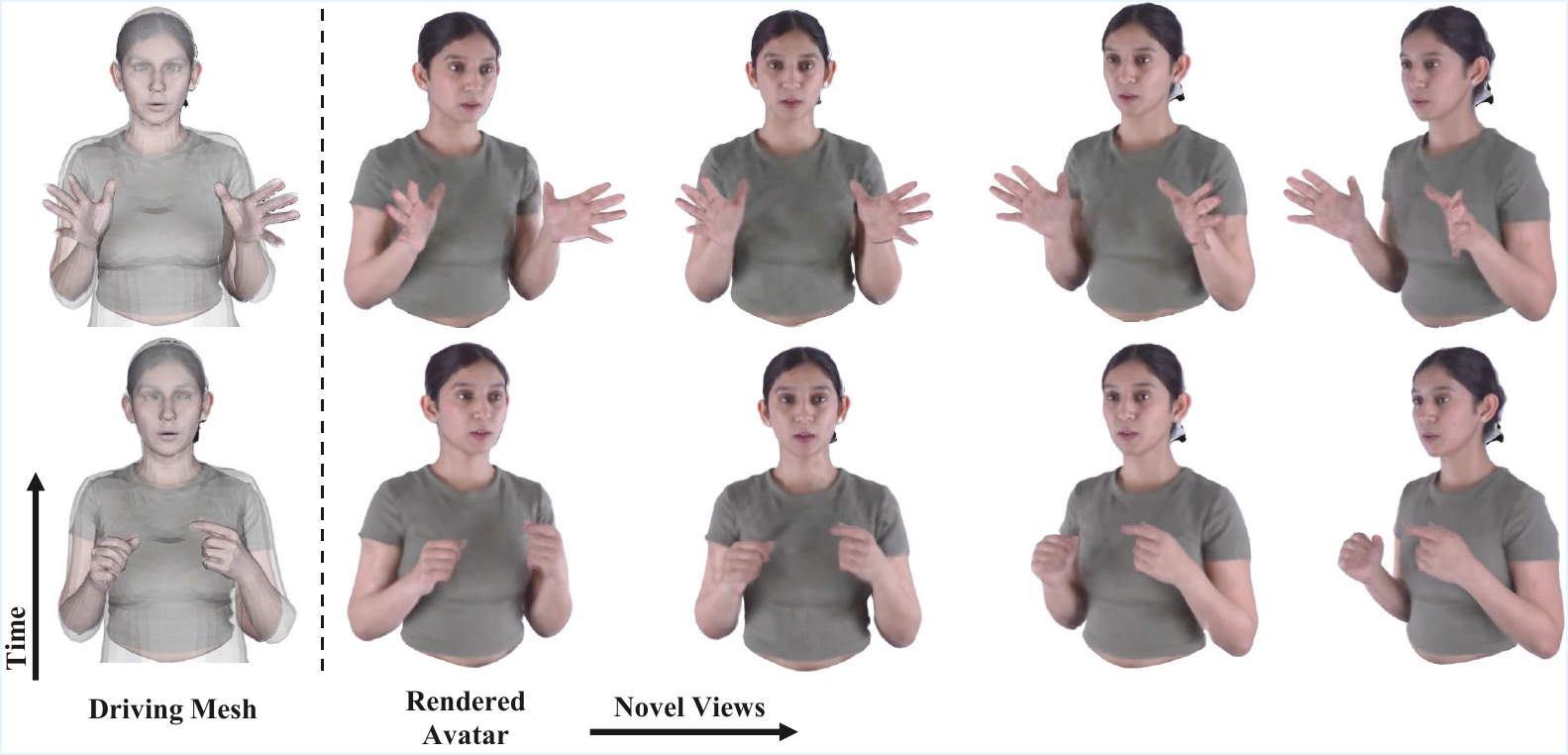
Figure from From DFKI.
Today's papers push hard on two converging frontiers: making 3D avatars more physically convincing and more emotionally present, while simultaneously expanding what spoken-language models can understand and generate. From fixing the dreaded "leaky mouth" artifact to recasting SLU as a function-calling problem, there's a lot of precision work here — alongside one HuggingFace Daily pick that ties it all together with omni-modal video dialogue.
Talking Avatars & Lip Sync
Taming articulation artifacts and injecting empathy into face-to-face avatar interactions.
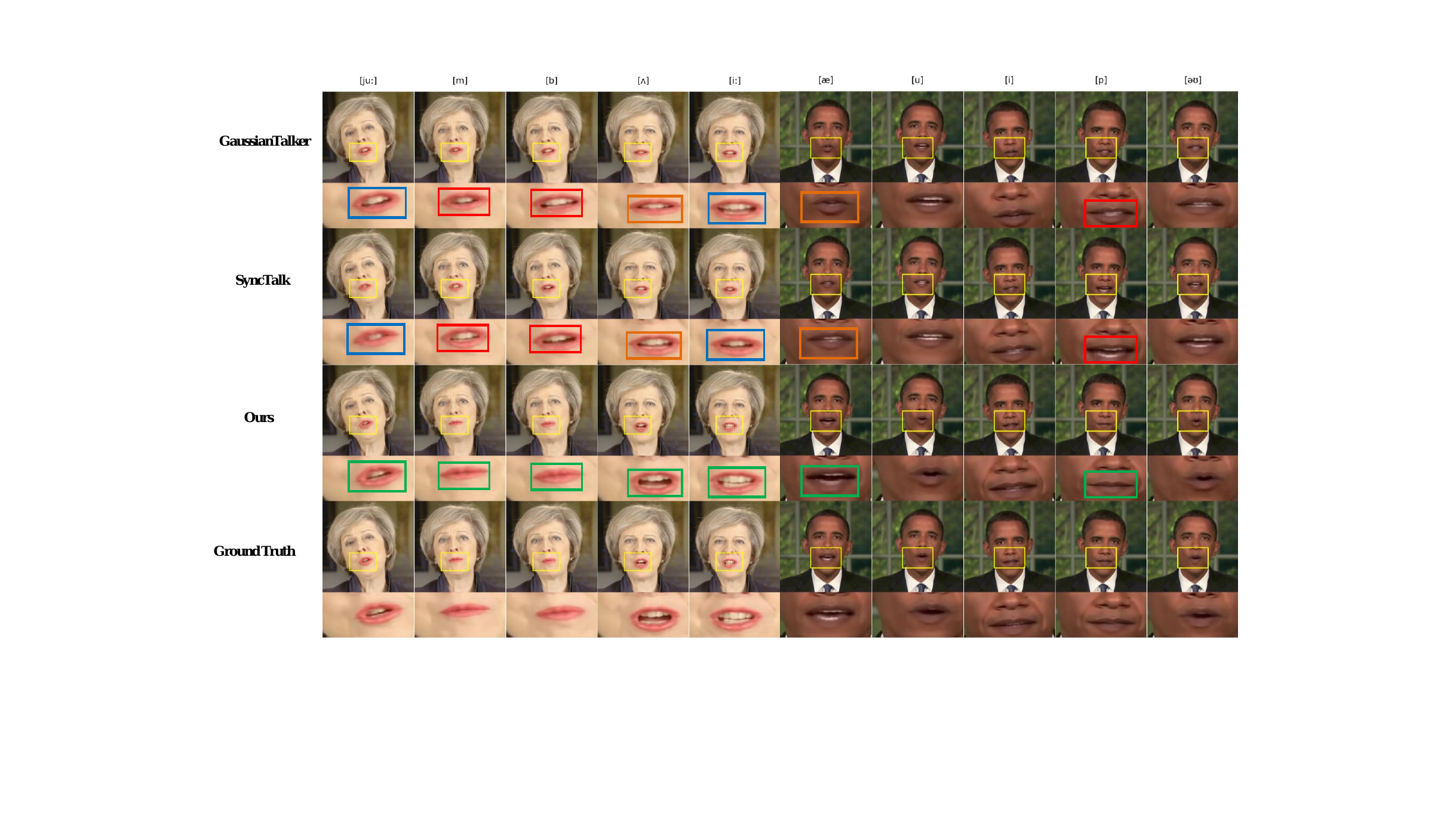
Audio-driven talking-head synthesis has long struggled with a subtle but visible flaw: mouths that never quite close cleanly during bilabials and fricatives. PD-GS from USTC tackles this directly by fusing explicit phoneme guidance with continuous audio features through a learned gating module rendered in 3D Gaussian Splatting, achieving physically plausible lip closure that pure audio-regression models miss.
PD-GS: Phoneme-Driven 3DGS for Audio-Driven Talking Heads
This paper fixes the "leaky mouth" artifact in audio-driven talking heads by fusing explicit phoneme guidance with continuous audio through a learned gating module. The approach enables physically plausible lip articulation and closure precision that standard audio-only regression methods cannot achieve.
Abstract
3D Gaussian Splatting (3DGS) enables fast, photorealistic talking-head rendering, yet accurate lip articulation remains elusive: mouth motion is often over-smoothed and may violate hard articulatory constraints such as bilabial closures, producing the notorious ``leaky mouth'' artifact. A key difficulty is that brief, discrete articulatory events are inferred from a continuous acoustic embedding under a regression objective, which biases predictions toward averaged mouth configurations. While modern self-supervised speech encoders provide rich prosodic and phonetic cues, they do not provide an explicit, frame-aligned linguistic target that reliably disambiguates closure-level events. We propose \textbf{Phoneme-Driven Gaussian Splatting (PD-GS)}, which augments a 3DGS talker with time-aligned phoneme tokens obtained from an automatic ASR and forced-alignment pipeline. Our core component, the \textbf{Linguistic Fusion Module (LFM)}, adaptively fuses continuous audio context with discrete phoneme embeddings through a learned gate, allowing the model to preserve smooth audio-driven dynamics while strengthening phoneme guidance on articulation-critical segments. PD-GS is trained purely from monocular video using image reconstruction and lip landmark supervision. On HDTF, PD-GS achieves the best lip geometry among the compared baselines (LMD 2.66) and qualitatively reduces closure violations in challenging phoneme sequences, yielding more linguistically faithful neural avatars.
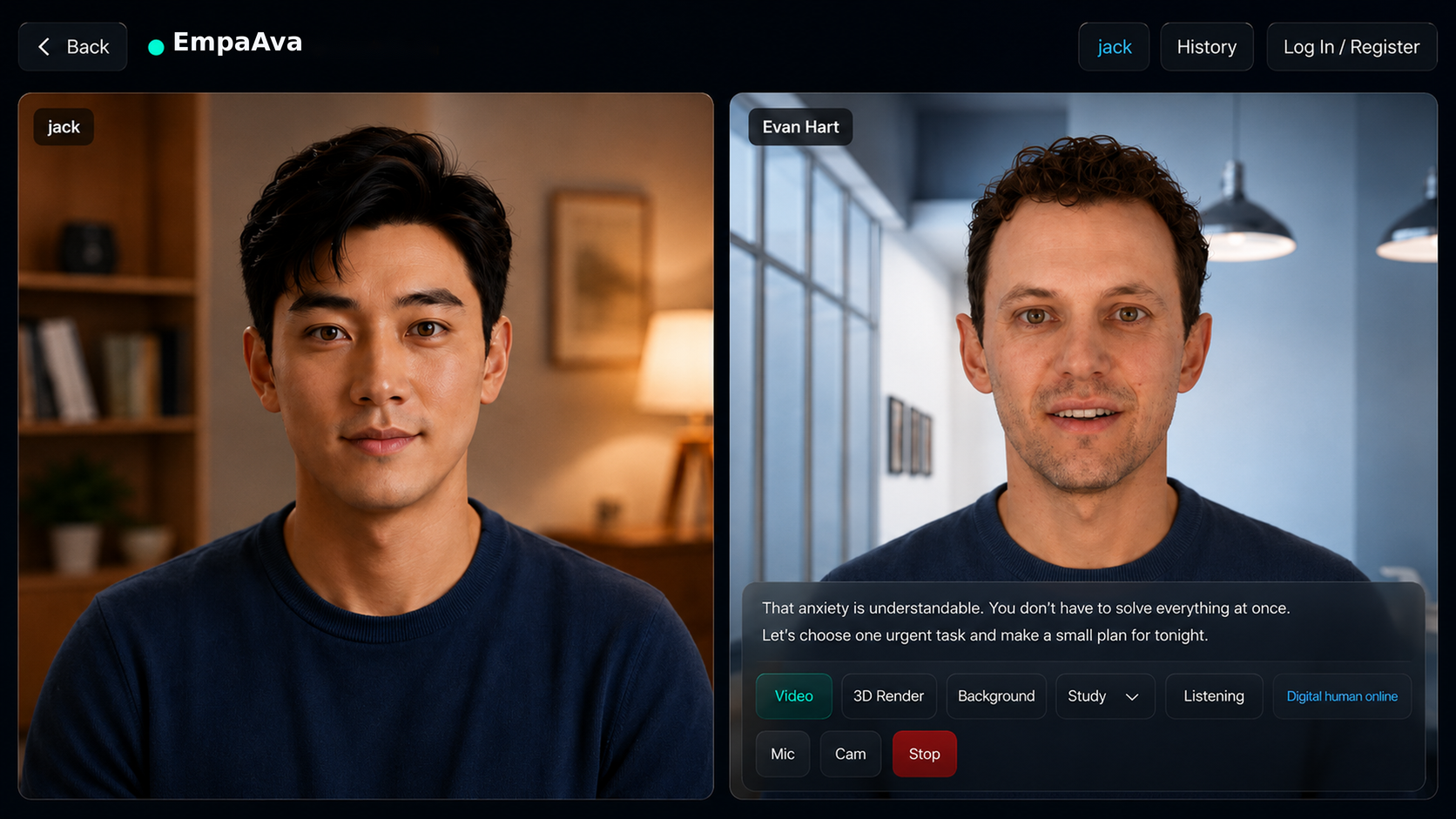
Lip accuracy is only half the battle — if the avatar feels emotionally flat, users disengage. EmpaAva (Open Source AI Research) takes a different angle, building an LLM-driven multi-agent system that maintains emotional consistency across speech, facial animation, and photorealistic 3D rendering in a live chatbot loop. It's fully open-source and positions itself as a face-to-face empathetic companion rather than a disembodied voice.
EmpaAva: An Open-source Agentic 3D-Avatar Empathetic Live Chatbot
EmpaAva brings empathetic chatbot interaction into face-to-face 3D-avatar conversations via an LLM-driven multi-agent system. Unlike text-only or 2D baselines, it maintains emotional consistency across speech, facial animation, and photorealistic 3D rendering.
Abstract
This paper presents EmpaAva, to our knowledge the first open-source, agentic 3D-avatar empathetic chatbot, which carries empathetic response generation (ERG) from text-only exchanges into live, face-to-face interaction. Through a video-call-like interface, a user speaks to a 3D digital human that reads their affect from speech and optional vision, and replies with emotional speech, lip-synced facial motion, and photorealistic 3D Gaussian rendering. At its core, an LLM coordinates a Tri-Agent Architecture, in which perception, empathetic response planning, and embodied rendering form a closed loop, paired with a Response Planning layer that compiles each reply into an executable multimodal plan, keeping voice, expression, and rendering on one empathetic intent. Building on strong open-source modules, EmpaAva supplies the intelligence that binds them into one controllable, inspectable experience. In automatic and human evaluations, EmpaAva surpasses text-only, 2D talking-face, and multimodal avatar baselines in emotion understanding, response quality, and audio-visual consistency. We open-source EmpaAva with an online live demo.
Digital Humans & 3D Avatars
Full upper-body fidelity through disentangled face and gesture modeling.
Facial animation and hand gesture articulation are usually solved separately — and combining them in a single photorealistic render is notoriously difficult. DFKI's multi-view pipeline addresses this by explicitly disentangling facial expressions from hand gestures, fusing both with parametric body meshes, and rendering the result via dynamic 3D Gaussians. The multi-view capture setup lets it recover fine-grained hand articulation alongside high-fidelity facial detail, an area where prior single-stream methods consistently lose resolution.
Multi-View Face and Gesture Animation with Dynamic Gaussians
A multi-view pipeline for photorealistic upper-body avatars that separately models facial expressions and hand gestures, then fuses them with parametric body meshes and renders via 3D Gaussians. It achieves high-fidelity facial animation and precise hand articulation—balancing details prior methods struggle with.
Abstract
Creating photorealistic 3D human avatars with realistic upper-body motion remains challenging. Existing approaches either focus on the head and overlook hand gestures, or reconstruct the full body but fail to preserve fine-grained facial fidelity and hand pose accuracy. As a result, current methods struggle to capture the subtle dynamics of facial expressions and hand gestures that are crucial for natural human communication. While methods based on full-body parametric models enable avatar reconstruction from monocular or multi-view inputs, they often lack accurate facial animation and detailed hand articulation. To address these limitations, we propose MVFGA, a novel multi-view-consistent pipeline for generating realistic upper-body avatars. Our approach models the face and hands separately and fuses them with a parametric upper-body mesh model, enabling the capture of fine-grained facial expressions and hand poses for accurate upper-body avatar reconstruction. We then splat 3D Gaussians onto the obtained mesh, enabling high-quality rendering of dynamic avatars from novel viewpoints. Furthermore, we introduce MVFGA-MoCap, a multi-view upper-body motion capture dataset featuring controlled facial expression sequences, diverse hand gestures, and free-form communication. Experiments show that MVFGA generates visually realistic avatars with high-fidelity facial expressions and hand motions, outperforming baselines for upper-body avatar animation. Project page: https://dfki-av.github.io/MVFGA/
TTS & Voice Synthesis
Discrete diffusion over codec hierarchies for context-aware speech editing.
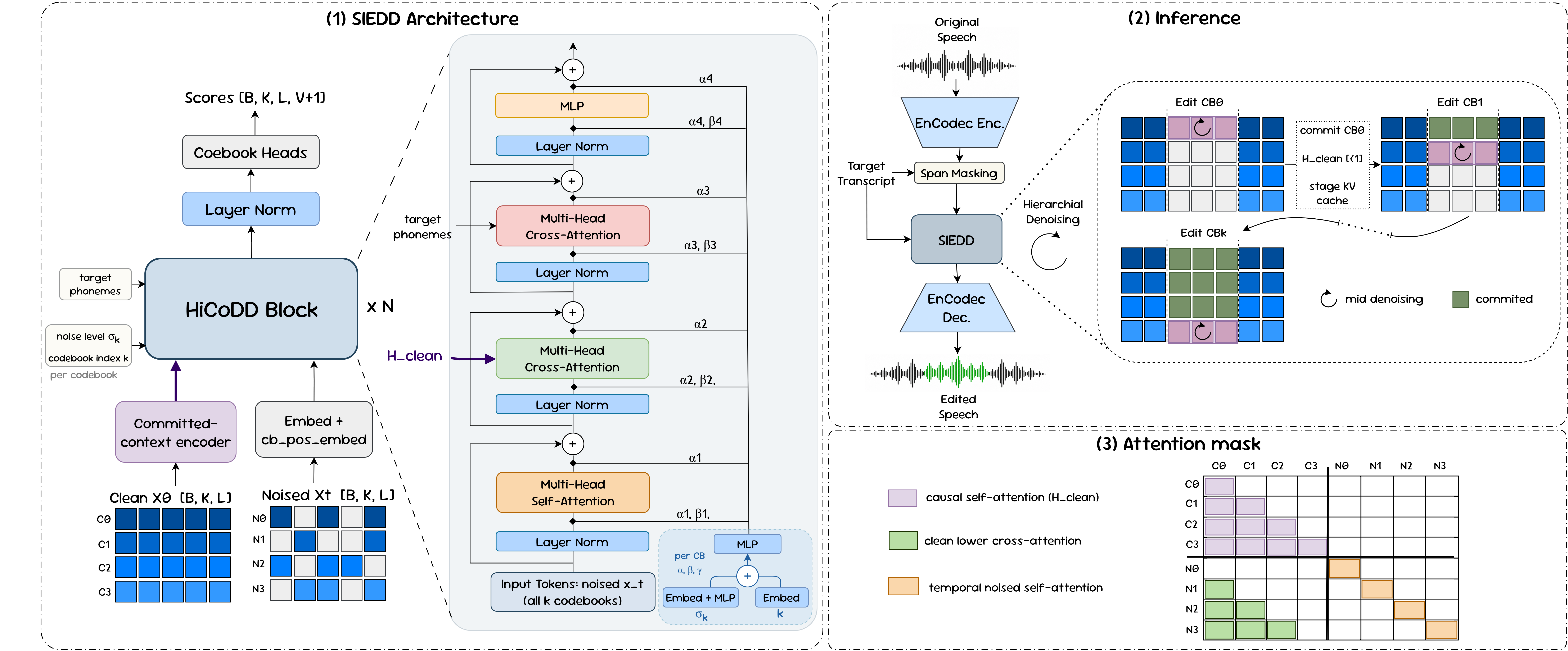
Text-guided speech editing — inserting, replacing, or correcting segments while preserving surrounding prosody and speaker identity — is one of the harder generative audio tasks. SIEDD (Bar-Ilan University) approaches this with discrete diffusion over hierarchical codec token sequences, explicitly modeling inter-codec dependencies rather than treating each codebook independently. The result is better context preservation than autoregressive baselines on both reconstruction and editing benchmarks, making it a compelling alternative to mask-then-predict approaches.
Multi Codec Discrete Diffusion Model for Text Guided Speech Inpainting and Editing
SIEDD applies discrete diffusion over hierarchical codec tokens for speech inpainting and editing while preserving speaker identity and prosody. By explicitly modeling codec dependencies, it achieves better context preservation than autoregressive baselines on both reconstruction and editing tasks.
Abstract
Speech recordings often contain missing, corrupted, or incorrect regions that must be reconstructed or modified without re-synthesizing the entire utterance. Speech inpainting restores missing segments, whereas speech editing replaces spoken content according to an edited transcript. Both tasks require the generated speech to express the intended words while remaining consistent with the surrounding speaker identity, prosody, timing, and recording conditions. Discrete diffusion is particularly well suited to these tasks because it can iteratively refine masked tokens while jointly conditioning on both left and right acoustic context. We introduce SIEDD, a discrete diffusion framework for text-guided speech inpainting and editing over hierarchical codec tokens. Its core architecture, HiCoDD, follows the RVQ generation order by representing previously generated codebooks as clean, committed acoustic context and applying diffusion only to the current refinement codebook. This separation enables leakage-free joint training while matching sequential coarse-to-fine inference. The model further combines phoneme-level conditioning, span-localized classifier-free guidance, and duration prediction to support both fixed-duration inpainting and variable-duration text edits. On the RealEdit benchmark, SIEDD achieves the best overall speech-editing performance among the evaluated methods. It also outperforms the evaluated autoregressive baselines across all speech-inpainting settings, on both single and multiple gaps. These results demonstrate that explicitly modeling the codec hierarchy substantially improves context-preserving speech reconstruction and editing. See our full code at https://github.com/iftachShoham/SIEDD.
SpeechLLMs & Voice Agents
Rethinking spoken understanding as function calls, and generating video alongside speech.
Traditional Spoken Language Understanding operates over closed label sets — intent taxonomies and slot schemas defined at train time. Alibaba DAMO Academy proposes reframing SLU entirely as spoken function calling: large audio language models receive precise function specifications and perform open-domain semantic extraction through in-context learning, sidestepping the closed-set ceiling that limits classic SLU systems.
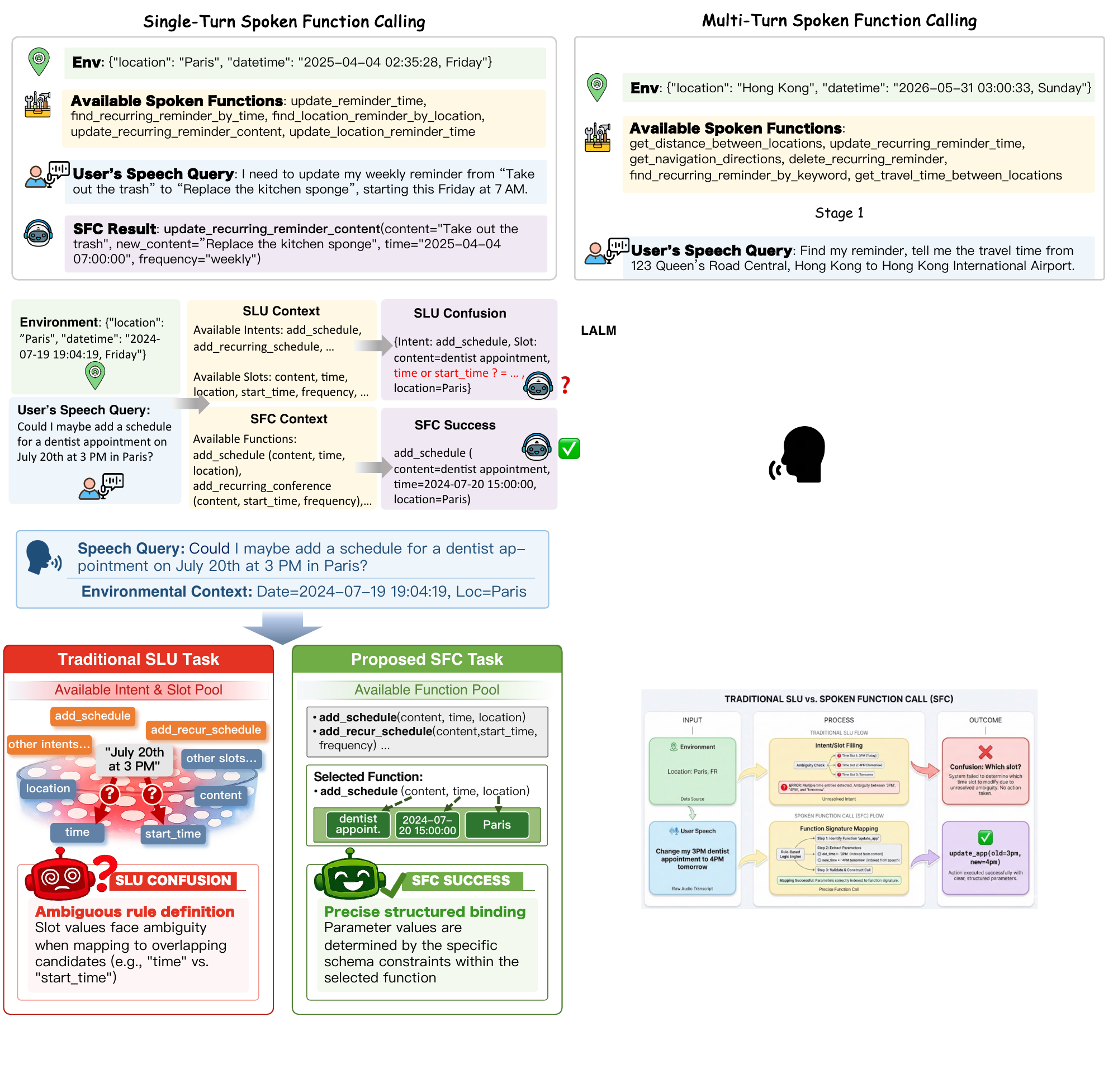
Spoken Function Calling: A New Perspective on Spoken Language Understanding for Large Audio Language Models
This work recasts Spoken Language Understanding as function calling to enable large audio language models to perform open-domain semantic extraction through in-context learning. By defining precise function specifications, it bridges traditional SLU's closed-set limitations with modern LLM generalization.
Abstract
Spoken Language Understanding (SLU) is the core component of task-oriented dialogue systems and a pivotal link in achieving seamless human-agent interaction. While traditional SLU can effectively extract user semantics for closed-set tasks after in-domain supervised fine-tuning, it faces significant challenges in leveraging in-context learning for open-domain tasks due to its ambiguous rule definitions. This work proposes Spoken Function Calling (SFC), a novel semantic understanding perspective that optimizes semantic understanding with structured rule definitions, to evolve beyond traditional closed-set SLU. Specifically, we curate and extend a suite of spoken functions based on traditional SLU datasets, construct a multi-agent system to synthesize the SFC-Bench dataset, evaluate the performance of Large Language Models (LLMs) and Large Audio Language Models (LALMs), and enhance the SFC capabilities of LALMs through post-training. Experiments demonstrate that SFC outperforms traditional SLU, substantially enhancing the semantic extraction accuracy for LLMs and LALMs.
From today's Hugging Face Daily tab, Ex-Omni-2D extends the omni-modal dialogue paradigm by producing coordinated text, speech, and video responses in a single framework. A visual thought plan guides a distilled streaming video generator, giving the model native visual presence rather than bolting video generation on as an afterthought — a meaningful step toward truly multimodal conversational agents.

Ex-Omni-2D: Expressive Omni-Modal Dialogue Models with Native Visual Presence
Ex-Omni-2D is an omni-modal dialogue framework that produces coordinated text, speech, and video responses via a visual thought plan and a distilled streaming video generator.
Abstract
Omni-modal dialogue models can understand multimodal inputs and synthesize spoken replies, yet their responses remain visually disembodied. We introduce Ex-Omni-2D, an omni-modal dialogue framework that generates a coordinated response comprising text, personalized speech, and reference-conditioned video. Given a multimodal query, reference image, and reference audio, the model predicts a structured Visual Thought Plan (VTP) describing scene, emotion, and motion, followed by response text and native multi-codebook speech units. These units form a shared acoustic-temporal interface: they are decoded into speech and aligned online with video frames. This interface enables the response and avatar pathways to be learned from heterogeneous speech, dialogue, and avatar-video data, avoiding the need for large-scale query--text--speech--video supervision. A full-sequence Video Generator serves as the primary Teacher. For efficient incremental generation, we further distill it into a few-step block-causal Streaming Student whose Prefix Streaming mechanism carries a clean latent across consecutive chunks to reduce cumulative late-chunk degradation. With four-step inference, the complete four-GPU pipeline achieves an end-to-end RTF of 1.293 at 400times720/720times400, providing a practical quality--efficiency operating point.
Trending on Hugging Face

LeapTalk: Breaking the Latency-Quality Trade-off in Talking Head Generation
LeapTalk enables real-time, long-form talking-head generation via single-step bridge distillation with Brownian-bridge transport, heterogeneous SNR-aligned distillation, and audio-driven guidance.

OmniFlatten: An End-to-end GPT Model for Seamless Voice Conversation
A novel GPT-based model, OmniFlatten, enables real-time natural full-duplex spoken dialogue through a multi-stage post-training technique that integrates speech and text without altering the original model's architecture.

Qwen3-TTS Technical Report
The Qwen3-TTS series presents advanced multilingual text-to-speech models with voice cloning and controllable speech generation capabilities, utilizing dual-track LM architecture and specialized speech tokenizers for efficient streaming synthesis.

Fish Audio S2 Technical Report
Fish Audio S2 is an open-source text-to-speech system with multi-speaker capabilities, multi-turn generation, and instruction-following control through natural-language descriptions, utilizing a multi-stage training approach and production-ready inference engine.