
Real-Time Talking Avatars, Unified Audio-Visual Models & ASR Evaluation
Today's digest is dominated by a wave of audio-visual generation systems pushing toward real-time, long-form, and multi-task synthesis — plus a sharp empirical look at rare-word ASR and a counterfactual audit of audio language model judges.
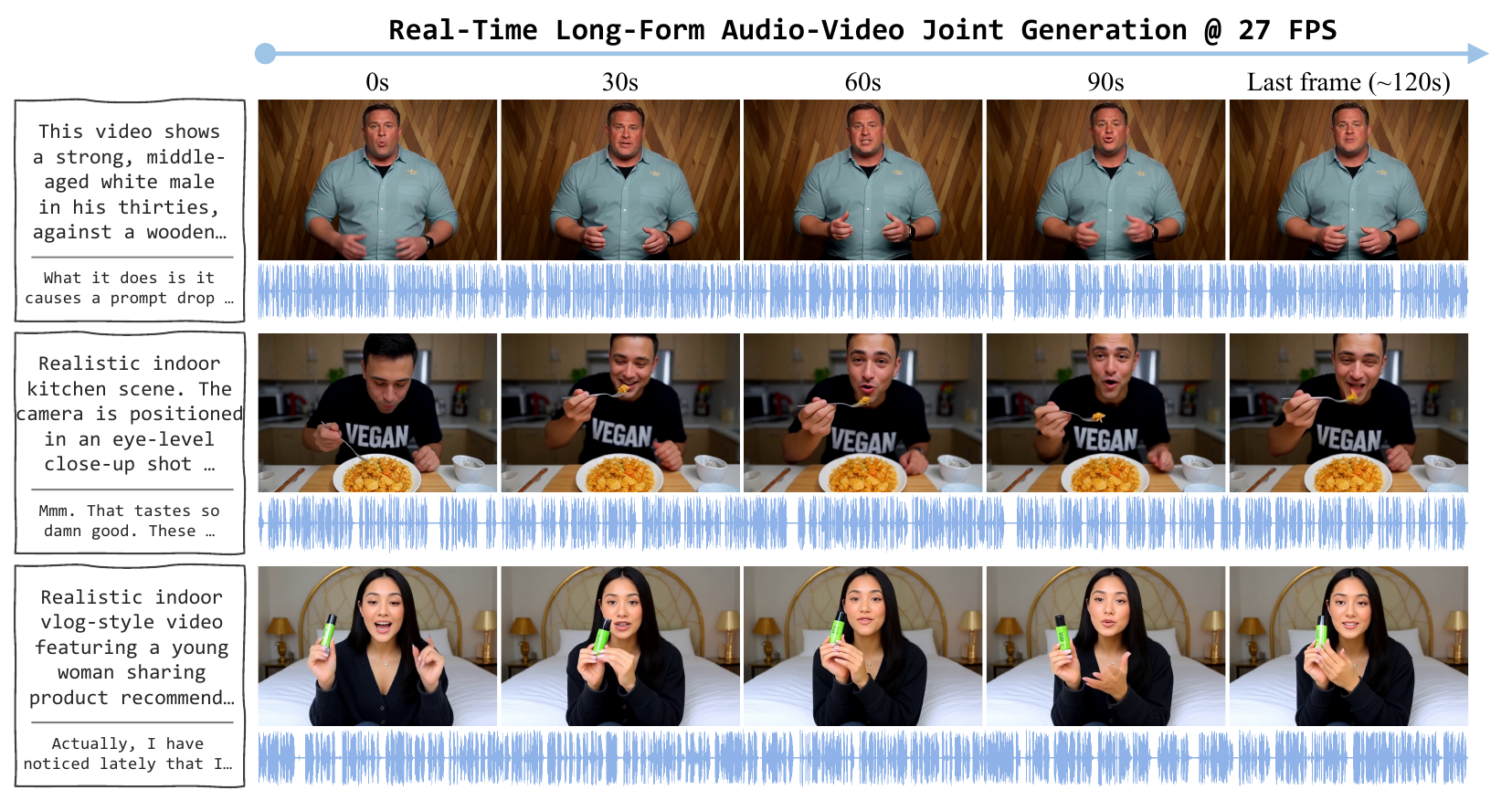
Real-time long-form text-to-audio-video generation with Vorch-Streamer. Conditioned on a global caption and long speech (left), our model causally and jointly streams video and synchronized speech at 27 FPS, without externally supplied audio or a reference first frame. Frames sampled at 0, 30, 60, and 90 seconds and near the end of three approximately two-minute rollouts demonstrate sustained identity and scene consistency together with expressive facial, gestural, and object motion; the blue waveforms visualize the continuously generated audio. From Tsinghua University.
Today's papers reflect two converging pressures in conversational AI research: the drive to make audio-visual avatar generation faster, longer, and more controllable in a single unified model, and the need to rigorously stress-test the speech and audio language models we already deploy. Four papers tackle the first challenge — several from the emerging Vorch family — while two carefully probe what current speech LLMs and audio-language model judges actually get right (and wrong).
Talking Avatars, Character Animation & Streaming
From real-time streaming to multi-shot storytelling, today's avatar and animation papers push the boundaries of how long, how fast, and how flexibly we can generate synchronized audio-visual content.
Real-time deployment of talking-head avatars has long been blocked by two problems: autoregressive exposure bias (training/inference mismatch) and the non-causal structure of speech generation. Vorch-Streamer from Tsinghua attacks both head-on, using Self Forcing to close the exposure-bias gap and planning tokens to impose causal structure on speech, achieving synchronized audio-video output at 27+ FPS while sustaining consistent identity across multi-minute sequences — far longer than prior streaming methods.
Vorch-Streamer: Extending Human Audio-Visual Generation to Real-Time Long-Form Streaming
This work enables real-time text-to-audio-video streaming for talking avatars by addressing exposure bias through Self Forcing and speech causality via planning tokens. It generates synchronized audio and video at 27+ FPS while maintaining identity over multi-minute sequences—substantially longer than prior methods.
Abstract
Real-time long-form avatar audio-video generation requires causal, continuous synthesis while maintaining audiovisual synchronization and visual consistency. Adapting a pretrained bidirectional model to this setting presents two key dilemmas. First, autoregressively reusing generated blocks as context creates exposure bias, causing errors and visual drift to accumulate over long rollouts. Second, a global speech utterance does not indicates a causal generator which portion should be spoken next when only limited local audio-video context is available. We present Vorch-Streamer, a post-training framework that addresses these challenges and enables real-time long-form Text-to-Audio-Video (T2AV) streaming. We construct a synthetic corpus of 80K avatar clips spanning 12-21 seconds and first train a causal generator with mixed Teacher Forcing and Diffusion Forcing. We then apply long-horizon Self Forcing with DMD distillation, exposing the model to its own rollout distribution while preserving the quality of the pretrained bidirectional teacher. To explicitly control speech progression, an external language model predicts discrete 25-Hz speech-planning tokens, whose continuous features condition the audio diffusion branch and align each causal block with the content it should speak. With bounded causal context and four-step denoising, Vorch-Streamer jointly generates audio and video from text at 27.12 FPS, exceeding the 24-FPS real-time playback rate while maintaining competitive audio-lip synchronization and strong identity preservation over long-form generation.
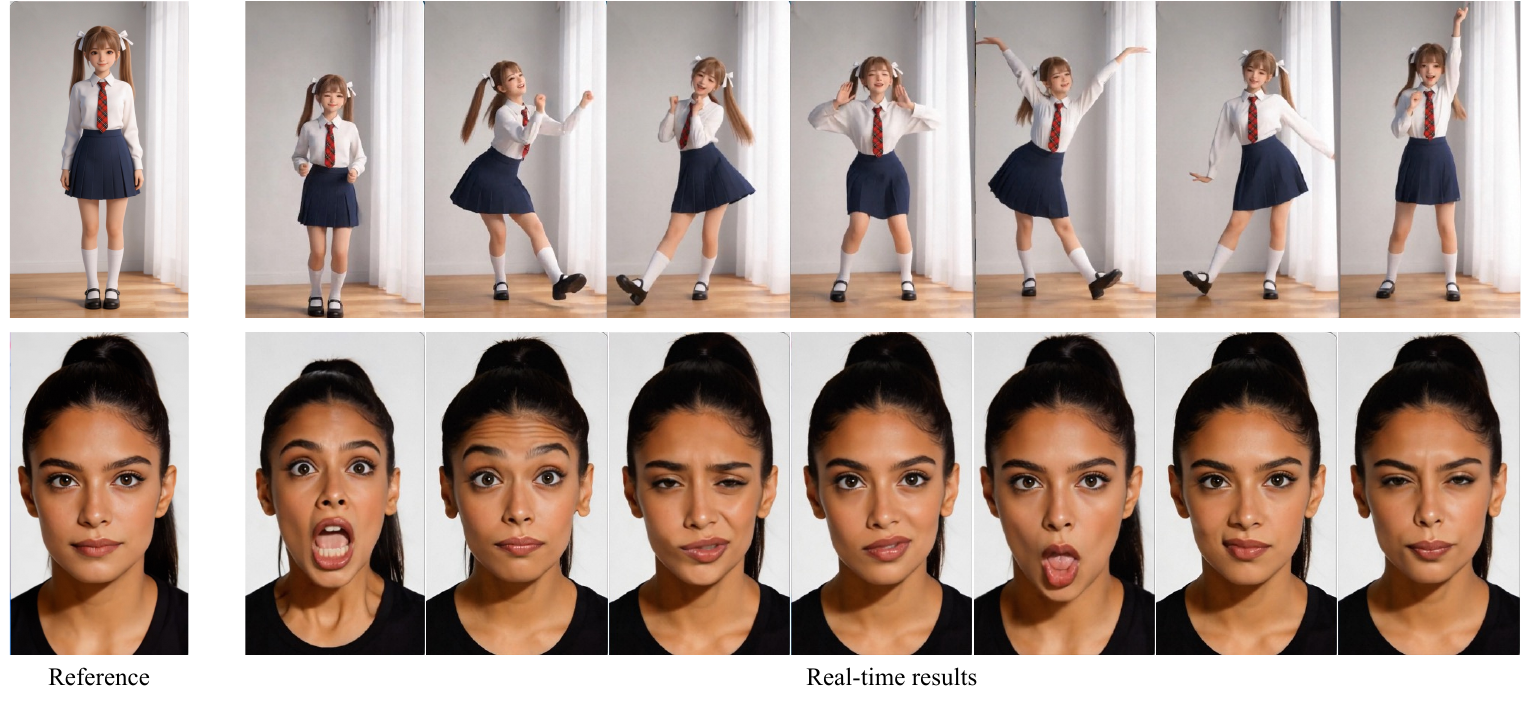
Character animation from driving video traditionally requires an intermediate motion-extraction step — skeleton, optical flow, or keypoints — that introduces error and limits flexibility. Wan-Animate-2, also from Tsinghua, sidesteps this entirely by processing driving video directly through Diffusion Transformers, and adds a distinctive capability: text-controlled viewpoint manipulation so that the animated character can be re-angled without re-shooting the reference. A real-time streaming variant is also included, making this a practical option for interactive digital avatars.
Wan-Animate-2: Pushing the Application Boundaries of Character Animation
A video-driven character animation system using Diffusion Transformers that directly processes driving videos without intermediate motion extraction. Uniquely enables text-controlled viewpoint manipulation and includes a real-time streaming variant for interactive applications like digital avatars.
Abstract
Character image animation remains a foundational yet challenging task in computer vision. Existing approaches can be broadly categorized into three paradigms: methods based on explicit motion representations suffer from extraction errors and identity drift; methods based on implicit motion features lose fine-grained dynamics through compression; and in-context learning approaches avoid intermediate representations but incur prohibitive computational costs. Furthermore, all current systems are designed for offline synthesis, unable to meet the real-time requirements of interactive applications such as digital avatars and live-streaming hosts. To address these limitations, we present Wan-Animate-2, an end-to-end character animation framework that directly consumes the driving video within a redesigned Diffusion Transformer. Our architecture achieves superior motion fidelity and identity preservation by eliminating intermediate motion extractors entirely. We further introduce text driven viewpoint control that decouples the output camera perspective from the driving video--a capability rarely supported by prior character animation methods that rely on explicit motion representations. Beyond generation quality, we present Wan-Animate-2-Lite, an efficient variant that reduces inference latency to real-time thresholds through a three-stage training paradigm: teacher forcing pretraining with error buffer mechanism, and Self-Forcing distillation with chunk-wise backpropagation. This enables streaming character animation for interactive applications, opening new deployment scenarios that were previously infeasible. Qualitative evaluations and user studies demonstrate that Wan-Animate-2 achieves high-fidelity animation results across diverse characters and motion patterns. To foster further research and community development, we will release the Wan-Animate-2-Base model weights to the public.
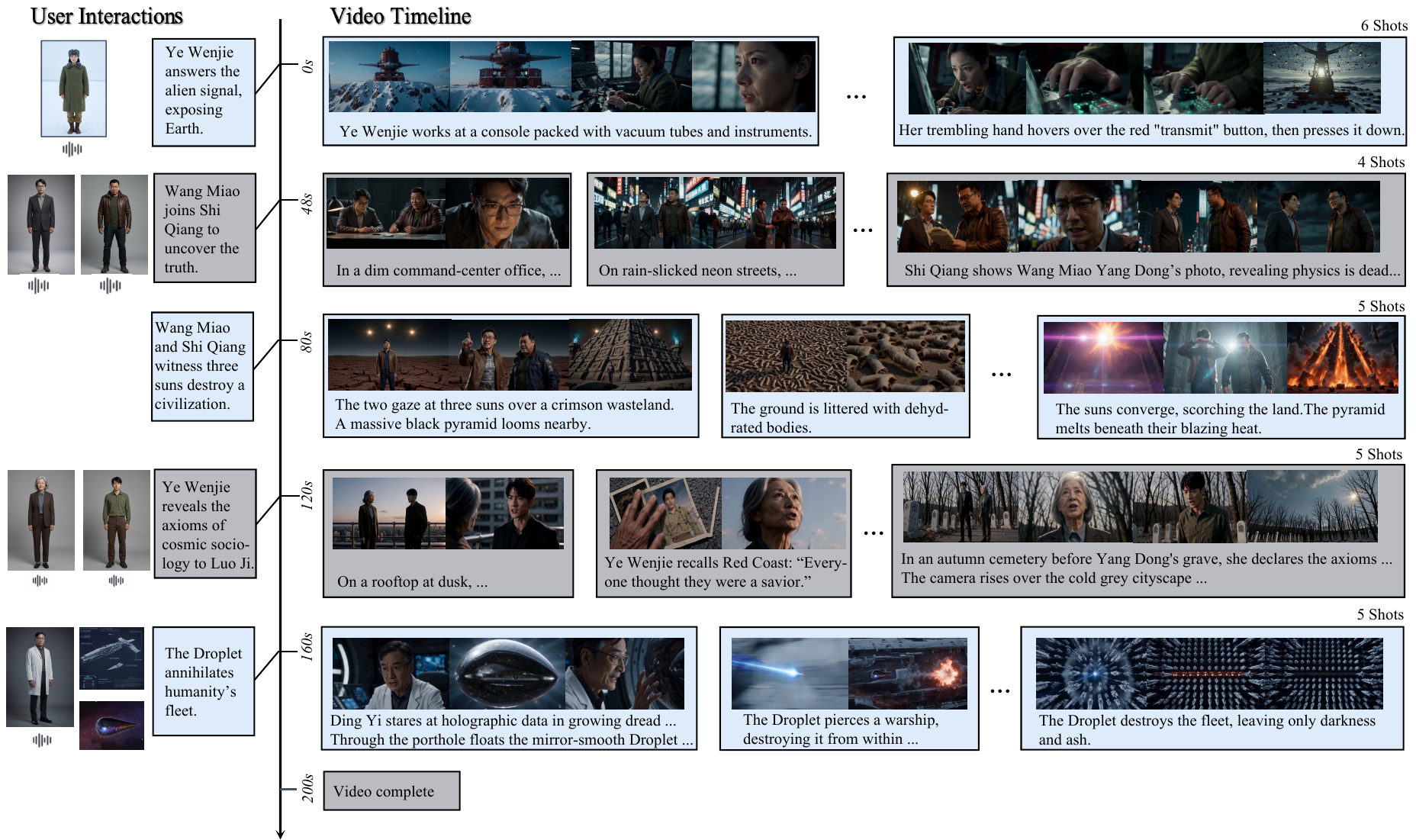
Generating coherent audio-visual content at minute scale — across multiple shots — is a hard consistency problem, since autoregressive continuation accumulates errors that can snowball quickly. Vorch-Director from Alibaba addresses this with noise-level-aware residual correction: rather than applying a single correction strategy, it explicitly matches the residual correction to the denoising noise level at inference time, keeping the error regime aligned with what the model saw during training and enabling stable long-horizon multi-shot generation.
Vorch-Director: Interactive World Story Model via Noise-Aware Error Rectification
Vorch-Director generates minute-scale audio-visual video with multi-shot consistency via autoregressive continuation. It uses noise-level-aware residual correction to prevent error accumulation during inference, matching training errors to actual denoising regimes for stable long-horizon generation.
Abstract
Autoregressive continuation provides a natural path toward minute-scale audio-visual generation by repeatedly extending a short-window generator conditioned on previously generated video and audio. However, models are trained on clean ground-truth histories, while inference relies on their own generated histories, where accumulated errors cause identity drift, over-smoothing, and audio-visual desynchronization. Recent methods reduce this mismatch by reusing prediction residuals as synthetic corruption, but we observe that the effectiveness of residual correction critically depends on the flow-matching noise level at which residuals are produced. We propose Vorch-Director, a noise-level-aware residual correction strategy that associates each residual with its originating noise level and injects residuals from matched noise regimes during training. By aligning injected errors with the denoising process, Vorch-Director produces more realistic autoregressive histories while retaining efficient teacher-forcing training. Built on the audio-visual LTX-2 diffusion transformer, Vorch-Director further introduces task embeddings to distinguish historical video, reference images, and target video, enabling unified conditioning for long-horizon generation. Together with a clean conditioning sink and mixed-task training, Vorch-Director supports multi-shot, multi-subject, reference-guided audio-visual long-video generation. We evaluate Vorch-Director on ST-Bench and introduce a new long-horizon audio-visual benchmark with metrics for quality drift and long-range consistency. Extensive experiments demonstrate improved stability and audio-visual fidelity over strong baselines.
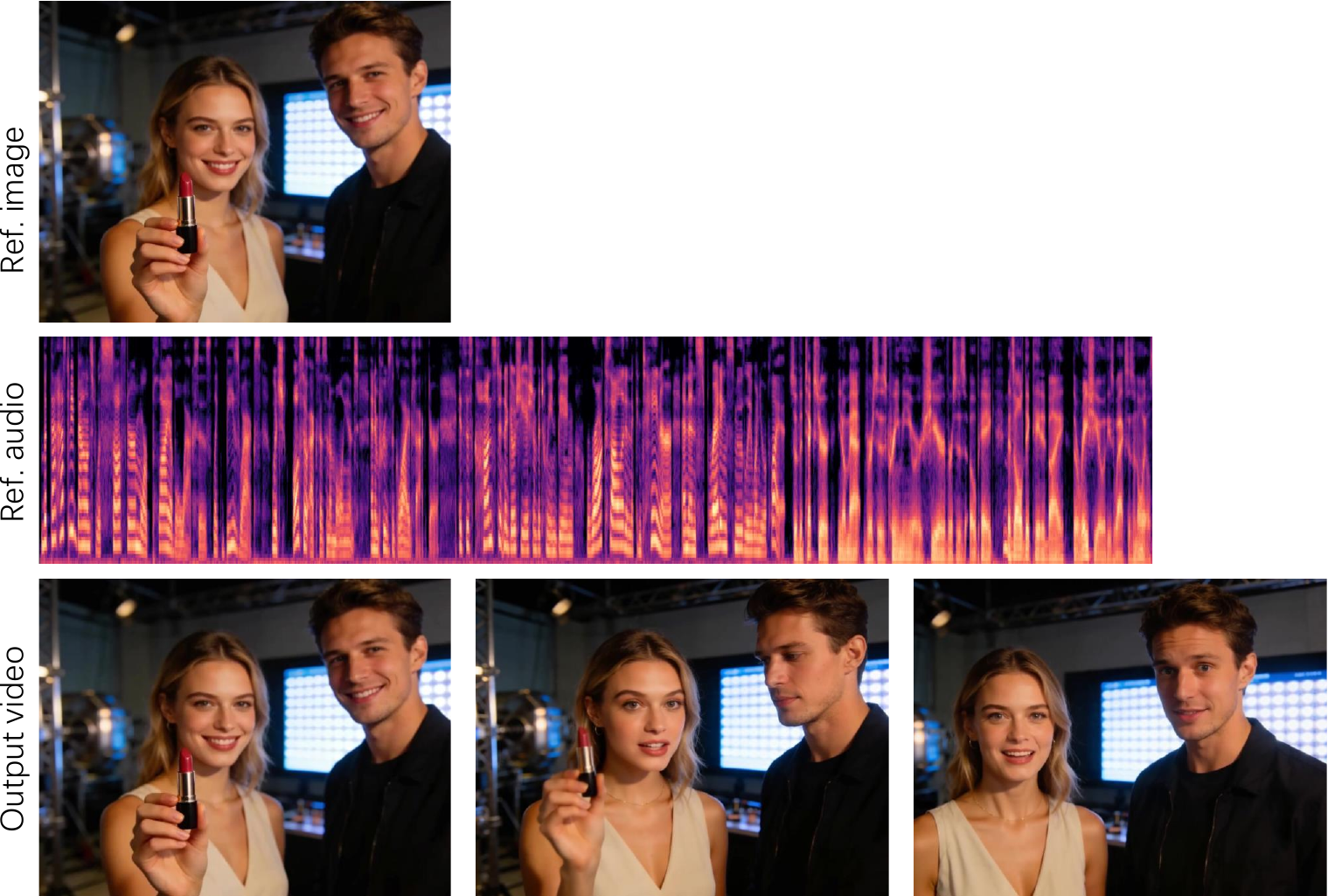
Rather than building separate models for each audio-visual task, the Vorch-Omni framework from the Vorch Team proposes a single diffusion model that covers 10+ tasks — audio-driven talking-head generation, video editing, text-to-video, and more — through token-level conditioning masks that encode arbitrary input-output configurations. The elegance is that no task-specific architecture is needed: the same model learns to handle whatever combination of conditions is presented at inference time.
Vorch-Omni: Multi-Task Orchestration of Sight and Sound
A unified framework for audio-visual synthesis supporting 10+ tasks including audio-driven talking-head generation, video editing, and text-to-video—all from a single diffusion model using token-level conditioning masks to handle arbitrary input-output configurations without task-specific architectures.
Abstract
Recent advances in generative video modeling have enabled diverse generation, reference-based synthesis, extension, and editing, but existing approaches often rely on fragmented task-specific models. A general model must distinguish heterogeneous target, source, and reference signals to determine what to generate, preserve, or use as guidance, while reducing interference among tasks. Joint audio-visual generation further increases this challenge by introducing diverse conditioning and output configurations across modalities. We present Vorch-Omni, a unified multi-task framework for audio-visual synthesis based on an arbitrary-condition-to-arbitrary-output formulation. It flexibly treats video and audio signals as either conditioning inputs or generation targets. Token-level conditioning masks and task identifiers distinguish targets, source content, and references, while position types separate temporal context from independent conditions. To capture semantic and structural information, Vorch-Omni employs complementary visual conditioning pathways: a vision-language model interprets sampled frames with text instructions, and a video VAE encodes conditions into latent tokens for direct guidance. We further build a distributed data pipeline to curate diverse temporally aligned audio-visual clips, generate structured captions and metadata, and balance heterogeneous task distributions. Built on a single flow-matching diffusion transformer without task-specific architectural changes, Vorch-Omni supports over 10 tasks, including text-to-video, text-to-audio-video, image- and reference-conditioned generation, temporal extension, audio-driven generation, video transformation, and audio-visual editing. This unified framework provides a scalable foundation for general-purpose audio-visual generation and manipulation.
SpeechLLMs, ASR & Voice Agent Evaluation
As speech LLMs take on more real-world ASR tasks, two papers ask pointed questions: when should you reach for a language model versus a classical biasing approach, and can audio-language model judges actually hear what they claim to?
Recognizing rare or out-of-vocabulary words is one of the most practical pain points in production ASR. Carnegie Mellon's study directly compares context biasing (injecting a lexical bias list into a conventional ASR system) against speech LLM prompting on the same rare-word recognition task. The finding is nuanced: context biasing delivers consistent WER improvements while preserving accuracy on non-target words, whereas speech LLMs excel specifically on read speech but generalize poorly to spontaneous or non-read speech and are notably sensitive to prompt design choices.

How to Recognize New Words: A Comparison Between Context Biasing Methods and Speech LLMs
This paper compares context biasing and speech LLM prompting for recognizing rare words in ASR. Context biasing achieves consistent WER gains while preserving other words, whereas speech LLMs excel on read speech but generalize poorly to non-read speech and are sensitive to prompt design.
Abstract
Recognizing new and rare words - named entities, acronyms, domain specific special words, and other items scarce in training data - remains a key challenge for automatic speech recognition (ASR). We compare two strategies for this: context biasing methods, where an ASR model is extended such that during inference a word list can be supplied, and speech large language models (LLMs) prompted with context directly. We evaluate two context biasing methods based on Whisper against three speech LLMs across read and non-read speech, reporting biased, unbiased, and overall word error rate (WER). The context biasing methods cut biased WER by up to 88% relative while leaving other words largely unaffected. Speech LLMs excel on read speech but generalize less well to non-read speech, and prove sensitive to distractor count and prompt word order. We characterize the resulting trade-offs to guide method selection.
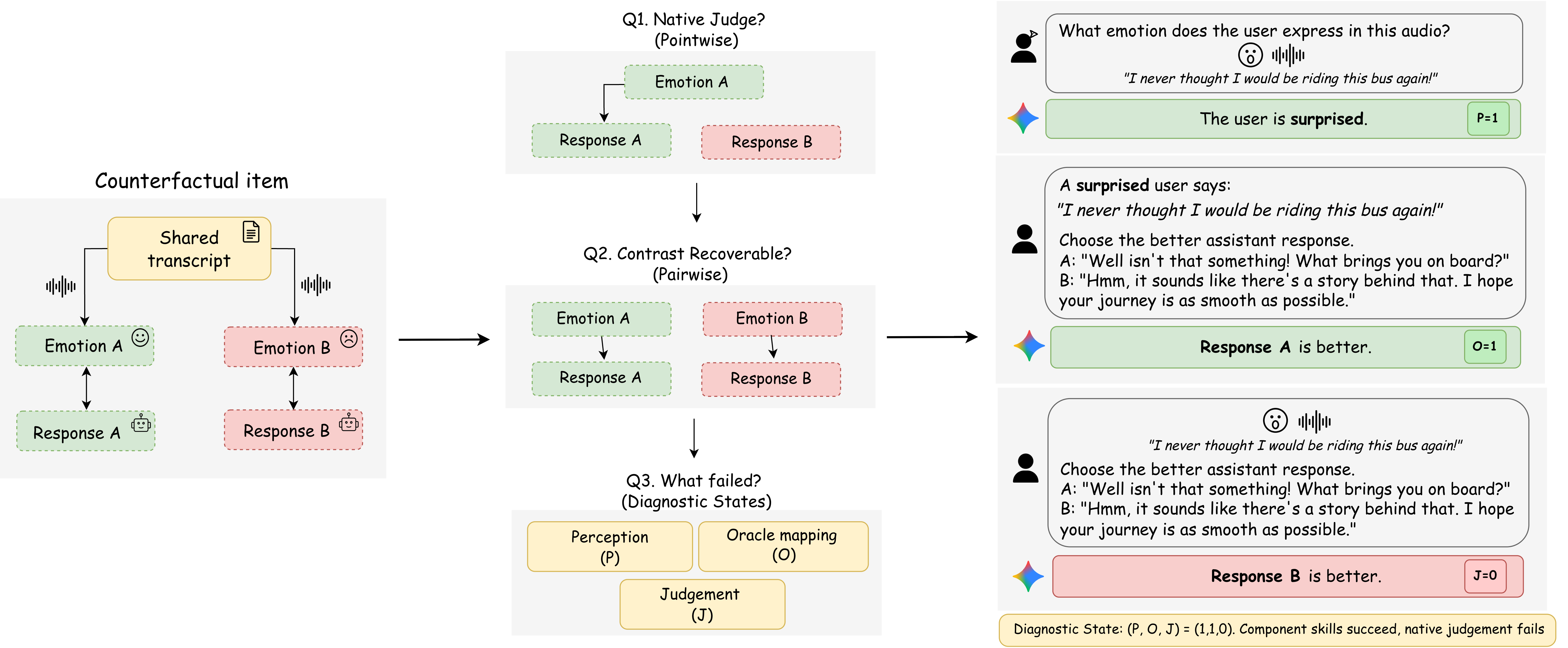
A growing trend is using audio-language models (ALMs) as automatic judges for speech system evaluation — effectively replacing human listeners. Boston University's counterfactual audit challenges this practice by systematically varying audio while holding transcripts fixed, then decomposing where ALM judgments break down. The key finding: models with similar aggregate accuracies can exhibit very different failure modes, meaning headline numbers hide whether a model is actually using paralinguistic cues (prosody, speaking rate, voice quality) or just reading the transcript. The authors argue that behavioral audits of this kind should be a prerequisite before deploying any ALM as an evaluation judge.
Do Audio Language Models Use Paralinguistic Evidence? Counterfactual Audits for Response Evaluation
Counterfactual audits test whether audio-language models use paralinguistic cues when judging speech systems. By varying audio while fixing transcripts and decomposing failures, the work shows that similar accuracies hide different failure modes—arguing for behavioral audits before deploying ALM judges.
Abstract
Audio-language models (ALMs) are increasingly used as judges for speech-to-speech systems, but a judge that receives audio may not actually use paralinguistic evidence. We introduce counterfactual audits for paralinguistic response evaluation. Each audit item holds the transcript fixed while varying affect, prosody, or the timing of an affective shift, forcing a valid judge to track the audio cue rather than lexical content or response style. We evaluate ALM judges using a native one-context judgment protocol and a contrastive recoverability control, then further decompose each item into its constituent perception and response-mapping skills. This yields useful diagnostic states that identify different sources of judge failures. Across Gemini, GPT, and open audio models, we find that contrastive success often overstates native judge reliability, and that similar aggregate accuracies can hide different failure modes. These results suggest that ALM judges should not be evaluated by accuracy alone, instead requiring thorough behavioral audits before deployment.
Trending on Hugging Face

LeapTalk: Breaking the Latency-Quality Trade-off in Talking Head Generation
LeapTalk enables real-time, long-form talking-head generation via single-step bridge distillation with Brownian-bridge transport, heterogeneous SNR-aligned distillation, and audio-driven guidance.

Ex-Omni-2D: Expressive Omni-Modal Dialogue Models with Native Visual Presence
Ex-Omni-2D is an omni-modal dialogue framework that produces coordinated text, speech, and video responses via a visual thought plan and a distilled streaming video generator.
dots.tts Technical Report
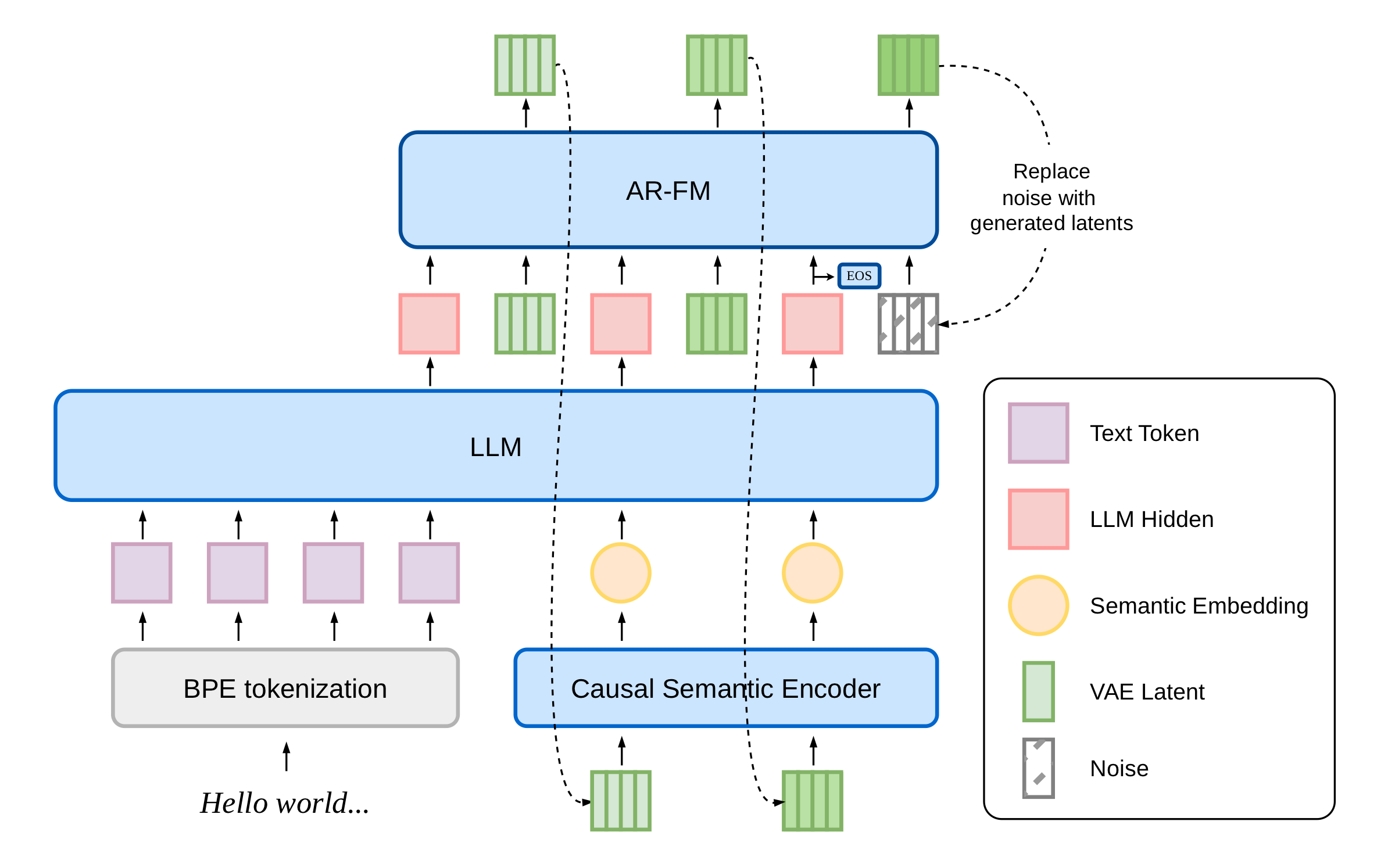
dots.tts is a 2B-parameter continuous autoregressive text-to-speech model that generates speech in a semantically structured continuous latent space. Innovations include full-history conditioning and self-corrective post-training for robust, expressive, and low-latency multilingual speech.

Qwen3-TTS Technical Report
The Qwen3-TTS series presents advanced multilingual text-to-speech models with voice cloning and controllable speech generation capabilities, utilizing dual-track LM architecture and specialized speech tokenizers for efficient streaming synthesis.

VibeVoice Technical Report
VibeVoice synthesizes long-form multi-speaker speech using next-token diffusion and a highly efficient continuous speech tokenizer, achieving superior performance and fidelity.