
Smarter Voice Dialogue, Cleaner Speech Synthesis, and Streaming Avatars
Today's digest covers a middleware fix for full-duplex LLM voice agents, a hybrid semantic-continuous TTS architecture, and two Qwen streaming avatar systems for real-time identity swapping and human animation.
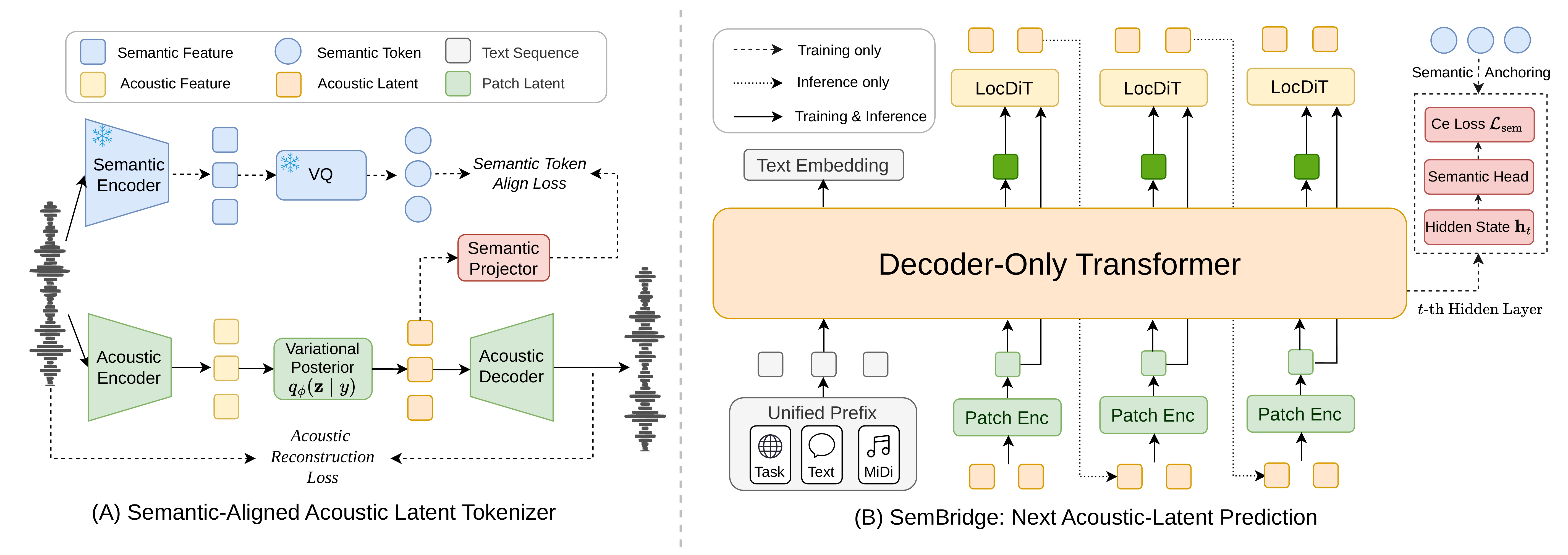
Overview of the two-stage framework. (A) Stage I trains SA-VAE to reconstruct waveforms while aligning continuous acoustic patches with embeddings from a frozen semantic tokenizer; their token IDs are retained as Stage-II targets. (B) Stage II trains a continuous-latent autoregressive generator: a causal LM encodes symbolic conditions and preceding acoustic patches, LocDiT predicts the next patch, and a semantic head supervises a LM hidden layer under the same causal shift. From Audio, Speech and Language Processing Lab.
Today's papers span the full conversational AI stack — from keeping an LLM's mouth and ears in sync during live voice calls, to supervising continuous speech generation with semantic structure, to Qwen's pair of streaming avatar systems that swap faces and voices or animate human poses in real time. A compact but technically dense set of contributions.
SpeechLLMs & Voice Agents
Getting full-duplex voice right requires more than fast generation — the LLM needs to know what the user has actually heard.
Full-duplex voice systems face a subtle but critical timing problem: LLMs generate tokens far faster than audio plays back on the client, so when a user interrupts mid-sentence, the model's context window doesn't reflect what the user actually heard. Independent researchers name this Generative Context Mis-anchoring (GCM) and propose a provider-agnostic middleware layer to correct it. PACE tracks real client playback state and anchors the LLM's dialogue context to the audio that has genuinely reached the user's ears — eliminating GCM without sacrificing low-latency generation.

PACE: A Playback-Aligned Context Engine for LLM-Based Full-Duplex Voice Dialogue
PACE solves Generative Context Mis-anchoring in full-duplex voice systems, where LLMs generate faster than playback, causing misinterpretation of user speech. This provider-agnostic middleware anchors dialogue context to actual client playback, maintaining consistency while preserving low-latency generation.
Abstract
LLM-based full-duplex voice services allow users to speak while the assistant is responding. Because servers can generate output and advance dialogue state faster than clients can play it, subsequent user speech may be interpreted based on content the user never heard. We call this failure Generative Context Mis-anchoring (GCM). To address GCM issues, we present PACE, a provider-independent middleware layer that anchors model-facing context to the client playback boundary, a system-observable proxy for what the user could have heard. After an interruption, PACE repairs this context to exclude assistant content that never reached playback, while preserving low-latency generation across heterogeneous voice runtimes. We implement PACE's audio-only projection path end to end in a browser-based realtime voice assistant using a black-box speech model, without modifying the model service. We also construct GCM-Bench, a new controlled benchmark dataset of 108 playback-relative referent-anchoring cases. On GCM-Bench, PACE raises Referent Anchoring Accuracy from 25.0% to 96.3% over a cancellation-only baseline. On 200 Full-Duplex-Bench v1 interruption samples, it preserves interruption response quality. These results show that grounding model-facing context in actual playback is a practical way to maintain consistency in full-duplex voice dialogue.
TTS & Voice Synthesis
Continuous latent generation avoids quantization artifacts, but risks losing linguistic grounding — this section covers methods that bridge that gap, and avatar systems that put synthesized voice and appearance together.
Autoregressive speech models increasingly operate in continuous latent spaces to avoid the quality ceiling of discrete codebooks, but this means the LLM backbone loses the phonetic and linguistic supervision that discrete tokens provide. SemBridge, from the Audio, Speech and Language Processing Lab, addresses this directly: it uses discrete semantic tokens as auxiliary supervision signals during training, guiding the model to capture linguistic structure, while inference remains fully continuous. The result is improved content fidelity on zero-shot TTS and singing synthesis benchmarks — the best of both worlds without quantization loss at test time.
SemBridge: Semantic Token Anchoring for Continuous-Latent Autoregressive Speech Generation
SemBridge supervises continuous autoregressive speech generation with discrete semantic tokens, enabling the language model to capture linguistic structure without quantization loss. This hybrid approach improves content fidelity in zero-shot TTS and singing synthesis while maintaining fully continuous inference.
Abstract
Continuous-latent autoregressive speech generation has emerged as a promising alternative to discrete-token modeling by avoiding quantization loss and preserving richer acoustic information. However, continuous acoustic targets do not ex- pose linguistic structure as explicit token-level prediction tar- gets. Consequently, the autoregressive language model (LM) must acquire linguistic structure indirectly through acous- tic prediction, which can compromise the content fidelity of generated speech. We propose SemBridge, a training-only semantic-token anchoring framework for continuous-latent autoregressive speech generation. SemBridge uses discrete se- mantic tokens to directly supervise autoregressive LM states and employs a Semantic-Aligned Acoustic VAE to organize the continuous target space under the same semantic refer- ence. The semantic supervision is used only during train- ing, while inference remains entirely continuous. We evalu- ate SemBridge on zero-shot text-to-speech (TTS) and score- conditioned singing voice synthesis (SVS). Across multi- ple benchmarks, SemBridge improves content accuracy, as measured by word and character error rates (WER/CER), while maintaining competitive speaker similarity and percep- tual quality. Experimental results demonstrate that explicit semantic-token supervision for autoregressive state learning is an effective and general direction for continuous speech generation. Speech samples are available.1 The model code and checkpoints will be available at https://github.com/ASLP- lab/SemBridge
From the Qwen Business Unit (featured on today's Hugging Face Daily), UniSwap tackles a different synthesis challenge: replacing both the face and voice of a person in a talking video simultaneously, in a temporally consistent streaming fashion. A unified audio-visual diffusion transformer handles the joint identity swap with specialized training and inference adaptations to keep audio and visual streams locked together.

UniSwap: Streaming Audio-Visual Identity Swapping for Talking Videos
UniSwap enables synchronized appearance and voice replacement in talking videos through a unified streaming audio-visual diffusion transformer with specialized training and inference adaptations.
Abstract
Talking-video character replacement requires coordinated transfer of appearance and voice while preserving the source motion, scene, linguistic content, and audio-video timing. Existing methods use separately optimized models for the two modalities, making audio-visual consistency difficult to enforce. We present UniSwap, the first framework for streaming joint audio-visual identity replacement in talking videos. Given a source video, a reference image, and a reference voice clip, UniSwap transfers the reference appearance and vocal timbre within a single audio-visual diffusion transformer while preserving the source content and dynamics. To address the scarcity of aligned cross-identity training pairs, we introduce a swap-and-reconstruct pipeline that removes visual and vocal identity from real clips and uses the original clips as reconstruction targets. Starting from a bidirectional backbone, we progressively adapt the model through In-context Pretraining for joint replacement, Conditional Streaming Adaptation for block-causal KV-cached generation, and Efficient Self-forcing DMD for mitigating exposure bias and reducing sampling from 30 to 3 denoising steps per block. Efficient Multi-LoRA Switching enables the three DMD roles to share a single frozen backbone. Feature-RoPE Decomposition keeps cached positions within the training range, supporting stable long-form inference. Experiments demonstrate strong audio-visual synchronization, competitive identity preservation, efficient streaming, and stable long-form generation.
Also from Qwen's team on Hugging Face Daily, LiveAnimate pushes pose-driven human animation to real-time, long-form streaming. Powered by a 14B-parameter video diffusion transformer, it combines bounded attention caching and sequence parallelism to sustain stable generation across extended sequences — a significant engineering feat for production-grade avatar animation.

LiveAnimate: Stable Long-Form Streaming Human Animation in Real-Time
LiveAnimate enables real-time, long-form pose-driven human animation via a 14B-parameter video diffusion transformer with specialized training, bounded attention caching, and sequence parallelism.
Abstract
Pose-driven human animation synthesizes a video of a target person from a single reference image and a driving pose stream. Real-time generation is essential for interactive applications such as live streaming, telepresence, and virtual avatars, yet diffusion-based systems require minutes to hours per clip, precluding responsive interaction. We present LiveAnimate, to our knowledge the first animation system to combine real-time streaming with stable long-form generation at billion scale, built on a 14B-parameter video Diffusion Transformer (DiT). A two-stage training pipeline first adapts a pretrained bidirectional DiT into a block-causal autoregressive generator through Reference-Anchored Teacher-Forcing Adaptation, and then reduces the sampling budget to three steps through Block-wise Self-Forcing Distillation. To preserve appearance over extended streams, we introduce Pose-Retrieval Sink Attention (PR-Sink), a bounded KV-cache mechanism combining a Static Sink that permanently anchors the first generated block, a Dynamic Sink that holds a pose-retrieved historical block, and a three-slot Rolling Window. When a pose recurs, PR-Sink restores the relevant appearance context without retaining the entire sequence, so memory and per-block latency remain constant regardless of stream duration. Together with Ulysses sequence parallelism and operator fusion, these designs enable 19.63\,FPS streaming inference on two NVIDIA H100 GPUs. On a three-minute benchmark, LiveAnimate maintains nearly constant perceptual quality and identity from the first 30 seconds to the final minute, while prior systems degrade substantially or require hours of offline computation for the same rollout. These results establish a new operating point in quality, latency, and duration for interactive full-body animation.
Trending on Hugging Face

Ex-Omni-2D: Expressive Omni-Modal Dialogue Models with Native Visual Presence
Ex-Omni-2D is an omni-modal dialogue framework that produces coordinated text, speech, and video responses via a visual thought plan and a distilled streaming video generator.

MuseTalk: Real-Time High Quality Lip Synchronization with Latent Space Inpainting
MuseTalk generates high-fidelity lip-synced face videos in real-time by encoding face images and audio features in a latent space with a Variational Autoencoder and U-Net.
dots.tts Technical Report
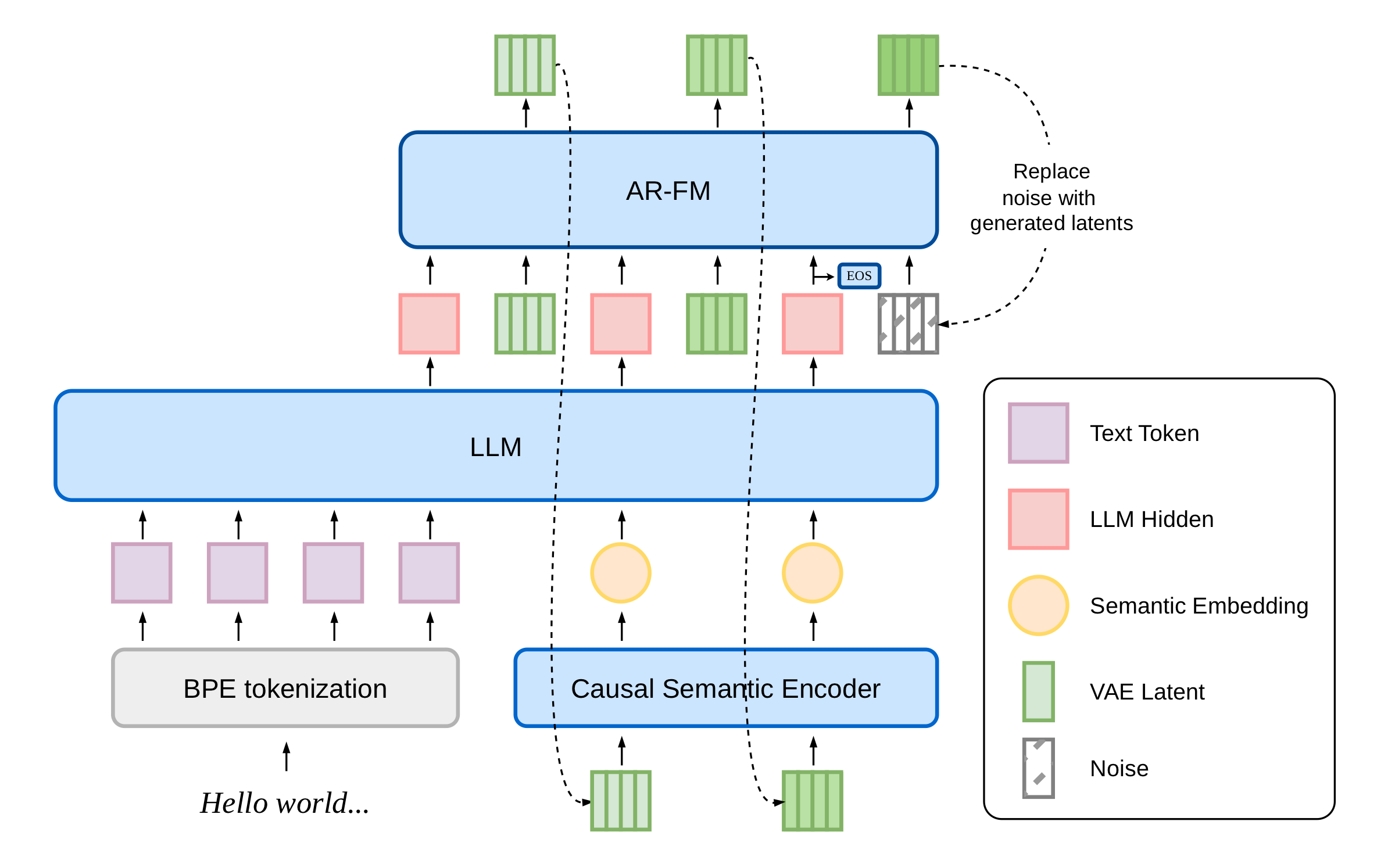
dots.tts is a 2B-parameter continuous autoregressive text-to-speech model that generates speech in a semantically structured continuous latent space. Innovations include full-history conditioning and self-corrective post-training for robust, expressive, and low-latency multilingual speech.