
Unified Audio Scene Generation and Temporally-Aware Animatable Avatars
Today's digest covers two papers pushing the boundaries of synthesis: SonicWeave unifies speech, music, and sound effects into coherent audio scenes via chunk-routed mixture-of-experts, while DSAR models cloth dynamics autoregressively for photorealistic animatable avatars that generalize to novel motions.
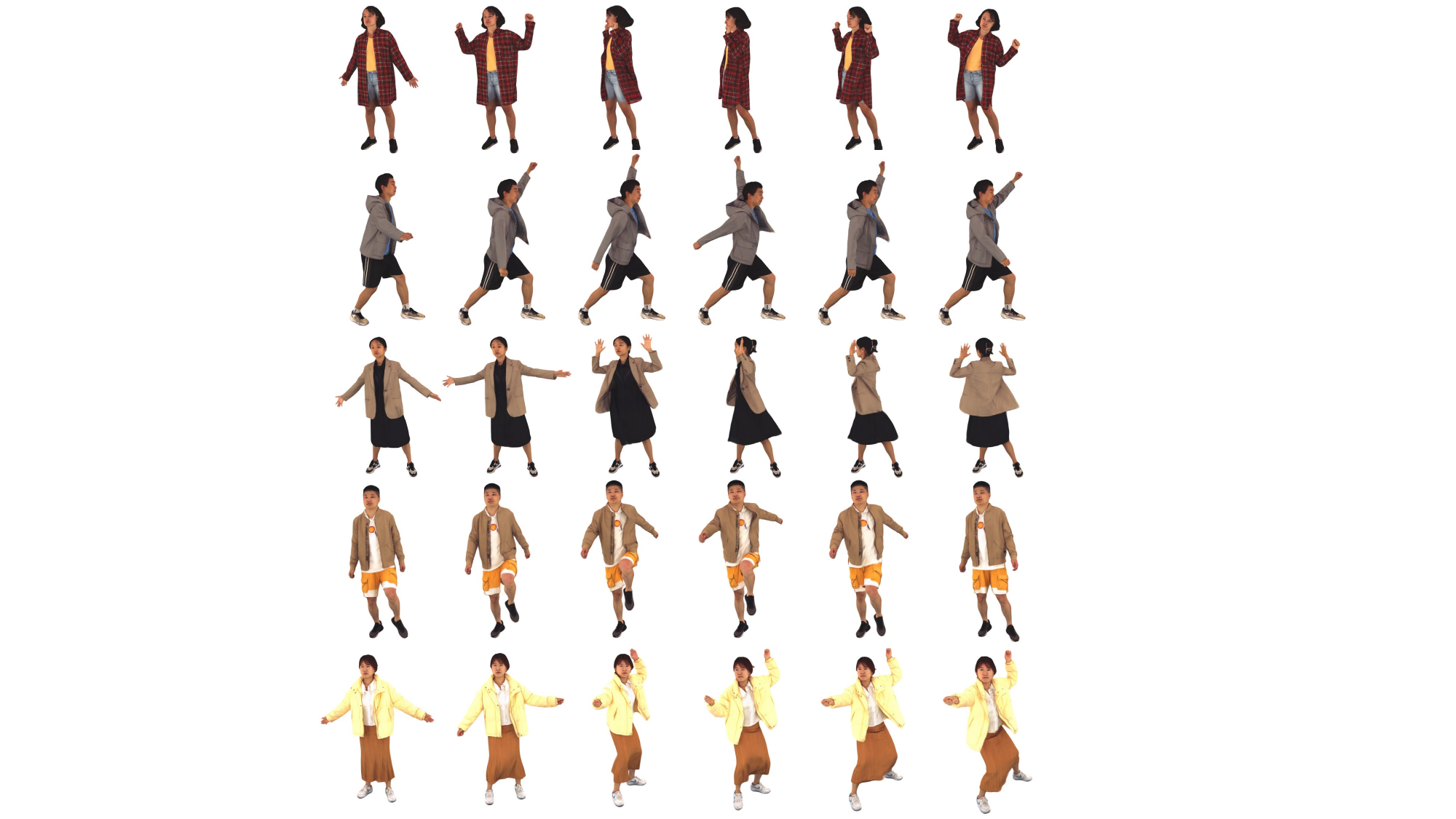
Avatar gallery. Additional results demonstrating our method's capability to reconstruct diverse avatars with different clothing styles and motion patterns. Our dual-stream architecture captures realistic cloth dynamics including momentum-driven motion and natural settling behaviors. From Zhejiang University.
Today's two papers share a common ambition — replacing fragmented, modality-siloed pipelines with architectures that reason about temporal and structural coherence holistically. One tackles the full audio scene generation problem by unifying speech, music, and effects under one roof; the other rethinks cloth dynamics for digital humans as a temporal causality problem rather than a pose-lookup problem.
TTS & Voice Synthesis
From speech to soundscapes — a single model for the whole audio canvas
Audio scene generation has traditionally been carved up into separate systems for speech, music, and sound effects, leaving the compositional glue to post-production. SonicWeave from Tsinghua University attacks this fragmentation head-on, proposing a unified architecture that synthesizes all three modality types from text descriptions while keeping the result acoustically coherent.
The technical centrepiece is a chunk-routed mixture-of-experts (MoE) design. Rather than applying a monolithic decoder uniformly across an audio sequence, SonicWeave routes different temporal chunks to specialised experts — balancing global structural guidance (overall scene layout, genre, speaker identity) with local acoustic evidence (fine-grained timbre, transient events). This lets a single model adapt across heterogeneous content without forcing a single set of parameters to simultaneously solve perceptually very different generation sub-tasks.
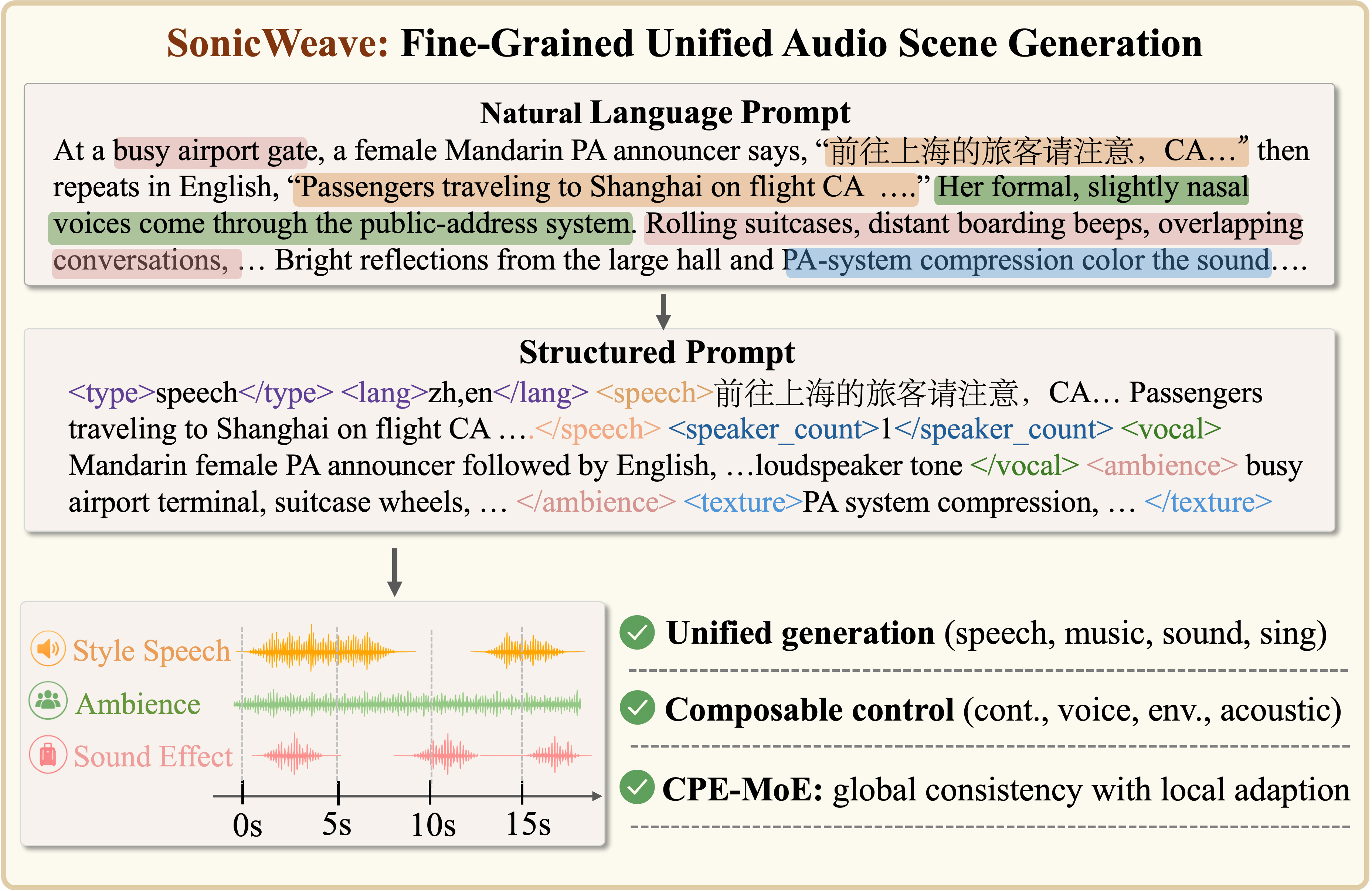
SonicWeave: Chunk-Routed Mixture-of-Experts for Unified Audio Scene Generation
SonicWeave unifies speech, music, and sound-effect synthesis into a single model for composing coherent audio scenes from text. Its chunk-routed mixture-of-experts balances global structural guidance with local acoustic evidence, enabling fine-grained adaptation across heterogeneous content.
Abstract
Text-conditioned general audio generation is moving beyond isolated speech, music, and sound-effect synthesis toward a single model that can compose them into controllable, coherent audio scenes. This unified setting is particularly challenging: heterogeneous components impose conflicting structural requirements on a shared backbone, while a complex mixed scene may contain locally distinct or overlapping content that demands fine-grained adaptation within the same clip. Existing audio mixture-of-experts (MoEs) mainly route at the domain level, while token-wise routing overlooks the local continuity inherent to acoustic signals. We propose SonicWeave, a flow-matching model for unified audio scene generation. At its core is a chunk-routed MoE with a conflict-gated prior-evidence routing mechanism (CPE-MoE). CPE-MoE routes contiguous acoustic chunks by combining a global prior that encodes the structured text condition and diffusion phase with local evidence from the evolving acoustic state. A learned conflict gate favors the prior when local states are unreliable, while allowing local evidence to influence routing when a region departs from the global scene context. SonicWeave supports speech, music, sound effects, singing, and their fine-grained mixtures with a single set of weights. Across TTS, TTA, and TTM benchmarks, SonicWeave consistently improves over controlled Dense and Base-MoE baselines. Complex-scene evaluation further demonstrates improved compositional quality, while routing analyses reveal content-dependent expert specialization across diffusion phases. These results suggest that temporally coherent, prior-evidence routing is an effective conditional-computation strategy for unified audio generation. Project page: https://caiyunrui.github.io/SonicWeave.
Digital Humans & Animatable Avatars
Cloth that remembers — modeling garment dynamics through time, not pose alone
Photorealistic animatable avatars have made enormous strides, but clothing remains a stubborn problem: most methods condition garment appearance on the current body pose, which collapses the rich temporal history that determines how fabric actually behaves (momentum, inertia, wrinkle propagation). DSAR from Zhejiang University reframes the problem as dual-stream autoregressive modeling, explicitly capturing temporal causality — how the cloth state at frame t emerges from prior frames — rather than treating each timestep independently.
The dual-stream design separates coarse dynamics from fine appearance detail, with each stream operating autoregressively so that generalization to novel motions and out-of-distribution poses improves substantially over pose-conditioned baselines. This is a meaningful architectural shift: instead of memorizing a pose-to-appearance mapping, the model learns the physics-like causal chain that underlies real garment motion.
DSAR: Dual-Stream Autoregressive Modeling of Temporal Cloth Dynamics for Photorealistic Animatable Avatars
A dual-stream autoregressive framework that models cloth dynamics by explicitly capturing temporal causality—how current states emerge from previous frames—rather than treating appearance as pose-dependent. This approach significantly improves generalization to novel motions and out-of-distribution poses.
Abstract
Creating photorealistic and temporally coherent animatable human avatars from RGB videos remains challenging. Current methods struggle to capture realistic cloth dynamics, producing over-smoothed appearance or severe artifacts on out-of-distribution poses. This limitation stems from a fundamental oversight: existing approaches neglect the temporal causality inherent in cloth physics, where current states emerge from previous states through temporal evolution rather than instantaneous skeletal configurations alone. Without explicit modeling of this causal structure, networks learn pose-appearance correlations instead of motion evolution, leading to poor generalization. We introduce a dual-stream autoregressive framework that explicitly models both observable geometric information and implicit internal state. The geometric stream propagates surface displacement from the previous frame, while the state stream fuses current features with historical states retrieved from a memory bank. Motion-adaptive aggregation handles spatially-varying dynamics, and adaptive regularization balances smoothness with flexibility. Experiments on challenging datasets demonstrate significant improvements in rendering quality, temporal consistency, and generalization to motion patterns beyond training distributions, validating that dual-stream temporal modeling enables realistic cloth dynamics.
Trending on Hugging Face

MuseTalk: Real-Time High Quality Lip Synchronization with Latent Space Inpainting
MuseTalk generates high-fidelity lip-synced face videos in real-time by encoding face images and audio features in a latent space with a Variational Autoencoder and U-Net.

OmniFlatten: An End-to-end GPT Model for Seamless Voice Conversation
A novel GPT-based model, OmniFlatten, enables real-time natural full-duplex spoken dialogue through a multi-stage post-training technique that integrates speech and text without altering the original model's architecture.
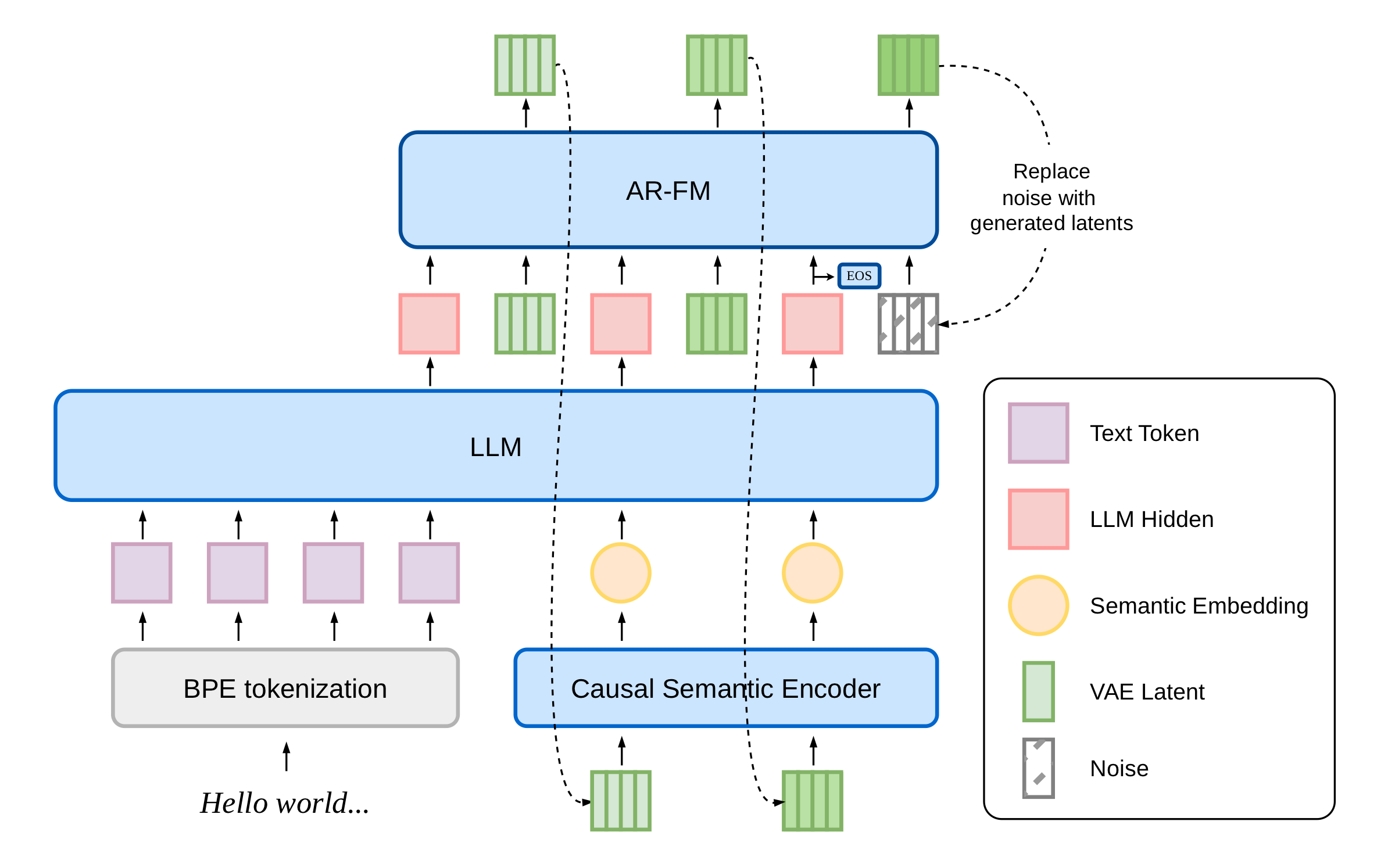
dots.tts Technical Report
dots.tts is a 2B-parameter continuous autoregressive text-to-speech model that generates speech in a semantically structured continuous latent space. Innovations include full-history conditioning and self-corrective post-training for robust, expressive, and low-latency multilingual speech.

Qwen3-TTS Technical Report
The Qwen3-TTS series presents advanced multilingual text-to-speech models with voice cloning and controllable speech generation capabilities, utilizing dual-track LM architecture and specialized speech tokenizers for efficient streaming synthesis.

Fish Audio S2 Technical Report
Fish Audio S2 is an open-source text-to-speech system with multi-speaker capabilities, multi-turn generation, and instruction-following control through natural-language descriptions, utilizing a multi-stage training approach and production-ready inference engine.