
Voice Agents, Parallel TTS, and Gesture Benchmarks
Today's digest covers parallel diffusion-based TTS, transcript-free cross-lingual voice cloning, a unified speech+singing model, a new voice agent benchmark, frame-synchronous turn-taking, 3D speech animation, and the GENEA 2026 gesture generation challenge.
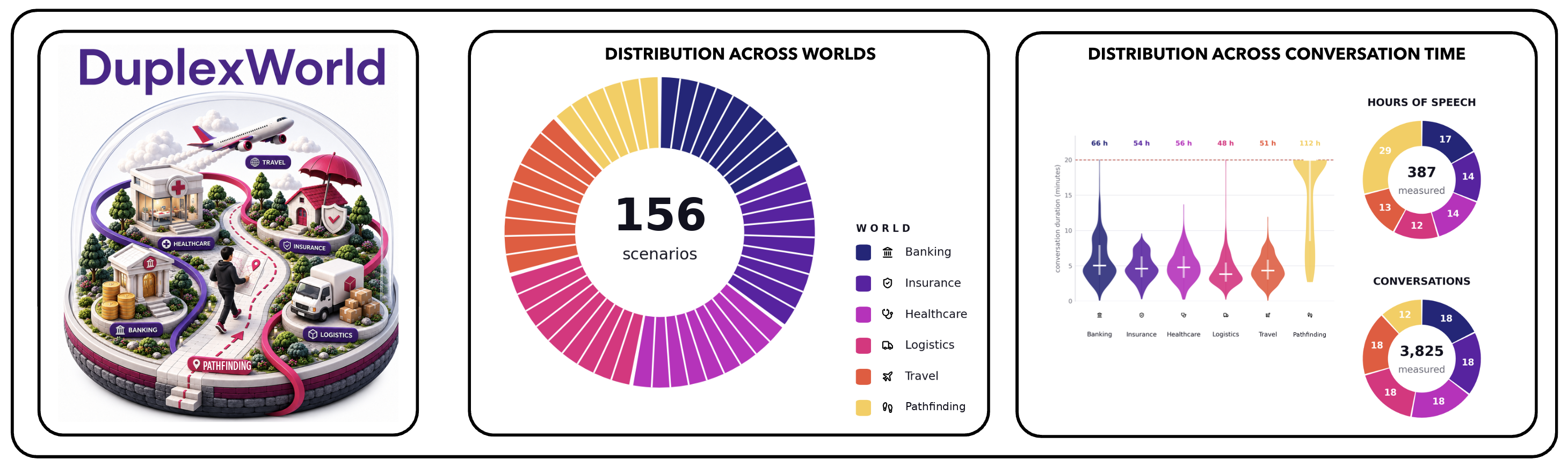
(a) The worlds of an ordinary day, the authored scenarios (one wedge per world), and conversation-time densities with hours of speech per world. (b) Six of the conversation types (Section~), each with a verbatim passing excerpt from the scored corpus; far right, the two -only types with the walked route against the ideal routes. Failing analogues of all eight tiles are in Figure~ (appendix). From University of Maryland.
Today's papers push on several fronts at once: TTS systems are shedding autoregressive constraints and transcript dependencies, voice agents are being stress-tested against real daily tasks, turn-taking is moving down to the frame level, and gesture/animation generation is getting rigorous disentangled benchmarks. A broad and dense day — let's dig in.
TTS & Voice Synthesis
From parallel diffusion to transcript-free cross-lingual cloning and a unified speech+singing model, TTS is having a productive week.
Alibaba DAMO Academy's Luna-TTS takes aim at the fundamental latency problem of autoregressive TTS: generation time scales with utterance length. By generating entire speech representations in parallel via diffusion, Luna-TTS sidesteps that bottleneck entirely. It natively supports zero-shot voice cloning and speech editing, and its streaming variant achieves real-time synthesis through block-parallel denoising — a compelling engineering story alongside the modeling contribution.

Luna-TTS Family Technical Report
Luna-TTS is a diffusion-based non-autoregressive TTS system that generates entire speech representations in parallel, eliminating latency scaling with utterance length. It natively supports zero-shot voice cloning and speech editing, with a streaming variant achieving real-time synthesis via block-parallel denoising.
Abstract
Modern text-to-speech (TTS) is dominated by autoregressive (AR) codec language models, whose left-to-right decoding brings latency that grows with utterance length, error accumulation along the committed prefix, and an artificial generation order imposed on the Residual Vector Quantization (RVQ) token grid. We propose Luna-TTS Family, diffusion-language-model-based TTS systems pretrained on 1 million hours of speech across Chinese, English, Japanese, and Korean. The family is built by progressive adaptation of a pretrained AR text LLM, from causal to bidirectional and finally to block-causal attention, and comprises two variants sharing a single tokenizer, data pipeline, and 0.6B backbone lineage. Luna-TTS is fully non-autoregressive: it generates the entire RVQ token grid in a fixed number of parallel refinement steps, with zero-shot voice cloning and speech editing arising natively as infilling. Luna-TTS Realtime, derived by continual training, is autoregressive over blocks of 32 codec frames (1.28s) while denoising each block in parallel; it supports KV-cached blockwise generation and incremental audio delivery, achieving an end-to-end RTF of 0.0240 and 41.6 ms local first-block latency under the warmed serving protocol. An annealed fine-tuning stage adds explicit control over emotion and non-verbal vocalizations (NVVs), and a reinforcement-learning stage applies GRPO with policy ratios computed over the realized denoising trajectory. On Seed-TTS-Eval, Luna-TTS achieves the best results on all four metrics among compared open-source and commercial systems (0.73 CER / 79.7 SIM on test-zh, 1.49 WER / 76.8 SIM on test-en); on the harder in-the-wild CV3-Eval, it posts the lowest Mandarin and English error rates in our comparison. Against leading commercial systems, it achieves the best results on most objective, model-based, and human-rated metrics for NVV and emotion control.
Most cross-lingual voice cloning systems quietly require you to provide a transcript of the reference audio — a hard constraint in practice. Confucius4-TTS from NetEase Youdao removes that requirement entirely, accepting untranscribed audio prompts and using a learnable speaker encoder to extract identity. An LLM-based semantic prediction stage drives a flow-matching acoustic decoder, enabling multilingual zero-shot cloning without any text annotation of the prompt.
Confucius4-TTS: Transcript-Free Cross-Lingual Zero-Shot TTS with a Learnable Speaker Encoder
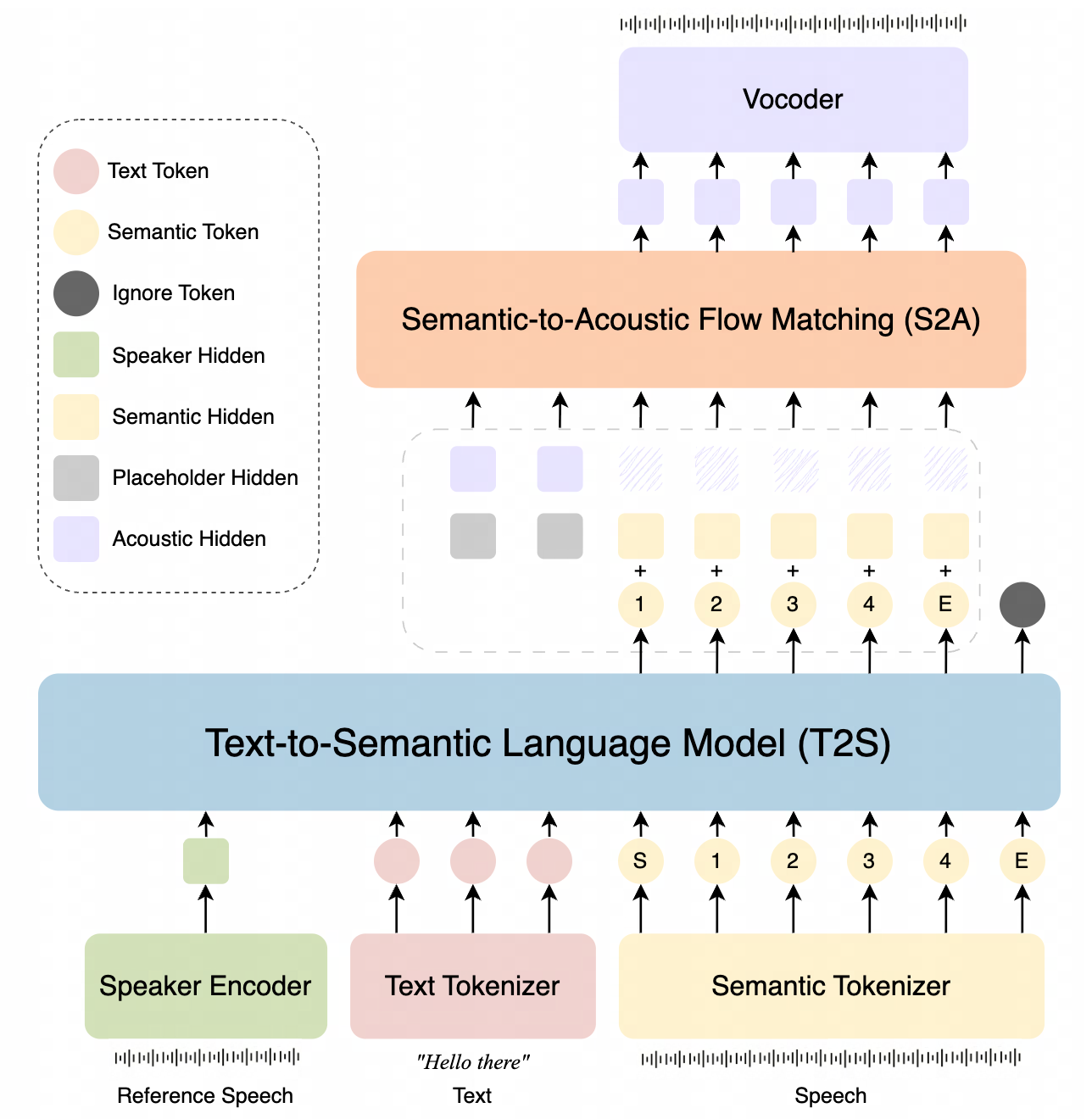
A multilingual zero-shot TTS system that enables cross-lingual voice cloning from untranscribed audio prompts, removing the transcript dependency that limits most prior systems. It uses a learnable speaker encoder and LLM-based semantic prediction combined with flow-matching acoustic generation.
Abstract
Recent advances in zero-shot text-to-speech (TTS) have substantially improved speech quality and voice cloning fidelity. However, many zero-shot TTS systems still depend on audio prompt transcripts at inference time. This dependency limits cross-lingual voice cloning, since in-the-wild reference audio is often untranscribed. In this technical report, we present Confucius4-TTS, a multilingual zero-shot TTS system that supports 14 languages and performs both intra-lingual and cross-lingual reference cloning without requiring transcripts of audio prompts. Confucius4-TTS follows a two-stage architecture, consisting of text-to-semantic (T2S) and semantic-to-acoustic (S2A) modules. The LLM-based T2S module uses a learnable speaker encoder to extract timbre features from self-supervised speech representations, and the conditional flow-matching S2A module converts the predicted semantic tokens into mel-spectrograms. The same model also supports continuation cloning when a reference transcript is available. Confucius4-TTS is trained on large-scale multilingual speech data. It achieves high intelligibility and speaker similarity on public benchmarks. On the CV3-Eval cross-lingual benchmark, Confucius4-TTS obtains an average WER of 3.73% across six directions. On our internal cross-lingual set, it achieves the best average overall rank in human evaluation among recent open-source and commercial systems. We release code, model checkpoints, and demos at https://github.com/netease-youdao/Confucius4-TTS.
UNSW Sydney's CookVoice tackles a different kind of unification: why should speech synthesis and singing voice generation be separate models? By decomposing voice into content, prosody, and style components, CookVoice handles TTS, text-to-singing, voice conversion, and voice editing within a single 43M-parameter framework — achieving quality comparable to larger specialist baselines while remaining far more parameter-efficient.
CookVoice: Unified Framework for Style Controllable Multi-Modal Human Voice Generation
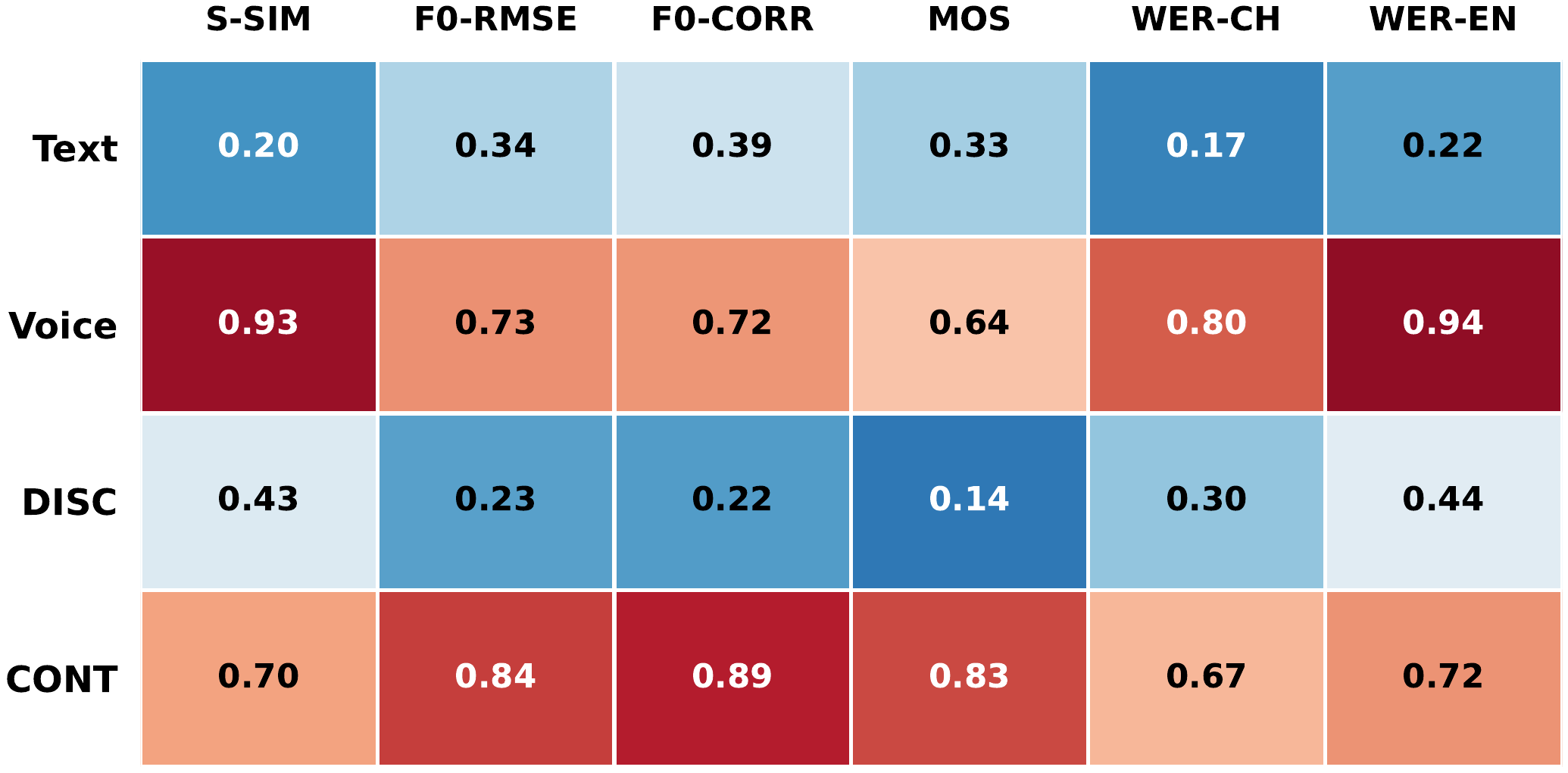
CookVoice unifies speech and singing voice generation by decomposing voice into content, prosody, and style, enabling flexible control over multiple tasks in one model. It achieves comparable quality to larger baselines while supporting TTS, text-to-singing, voice conversion, and editing with only 43M parameters.
Abstract
Human voice generation has made rapid progress in speech generation, singing voice generation, voice cloning, and voice editing. However, most existing systems are designed for specific tasks and often rely on task-dependent architectures, control signals, or autoregressive decoding, limiting fine-grained controllability and inference efficiency. In this paper, we propose CookVoice, a unified framework for multimodal, multi-style, and multi-task human voice generation. CookVoice decomposes the human voice into three key factors: content, prosody, and style, enabling both speech and singing voice generation within a unified model. To achieve precise and flexible controllability, we design a flexible alignment strategy that maps text, style, and prosody control signals onto the frame-level of spectrogram. This design allows CookVoice to support a wide range of tasks, including text-to-speech, text-to-singing voice, style-controllable generation, voice mimicry, voice conversion, and voice editing. Experimental results show that CookVoice achieves generation quality comparable to existing Text-to-Speech and text-to-singing voice baselines, while providing stronger style and prosody controllability. Moreover, CookVoice achieves comparable performance to large-scale baselines with only 43.51 million parameters and efficient inference using as few as 4 ODE steps, making it a practical solution for real-world human voice generation applications. Demo page is available at https://haoweilou.github.io/CookVoice/.
SpeechLLMs, Voice Agents & Spoken Dialogue
Benchmarking voice agents in the real world, tightening turn-taking latency, and animating arbitrary 3D characters from speech.
How well can today's voice agents actually help you navigate daily life? The DuplexWorld benchmark from the University of Maryland operationalizes that question across six real-world domains and 156 scenarios, jointly evaluating conversational quality, analytical reasoning, and speech naturalness. Crucially, it moves beyond the narrow database-query paradigm that dominates prior benchmarks, demanding that agents reason and respond naturally about practical tasks — a much harder and more realistic bar.
DuplexWorld: Can voice agents help you get through the day?
DuplexWorld introduces a comprehensive benchmark for evaluating voice agents across six real-world domains with 156 scenarios, testing conversational quality, analytical reasoning, and speech naturalness together—moving beyond database-centric evaluation to measure agents on practical daily tasks.
Abstract
Speech-to-speech (S2S) voice agents are increasingly being incorporated into enterprise for customer care and as daily companions for consumers owing to the ease of the conversational modality over text. However, existing benchmarks fail to holistically evaluate voice agents along axes that really matter and are shaped as tests of agentic tool calling against a database. We believe they fail to adequately account for the diversity of conversational dialogue that mundane activities introduce and further, never test how faithfully an agent can assist on tasks that move beyond database manipulation. To tackle this DuplexWorld introduces six worlds where voice agents are especially useful: banking, insurance, travel, healthcare and logistics, and Pathfinding. Agents are evaluated on eleven different types of conversations across 156 scenarios (350+ hours of conversation), each testing conversational and analytical capability to varying degrees. Through extensive evaluation comprising agentic, conversational and speech-naturalness metrics, we show that even the best voice agents leave substantial room for improvement on all 3 axes (Pass@1: 0.490, turn-taking: 0.653, DNSMOS: 3.378). We perform extensive analysis on agentic v conversational performance, world- and conversation type-wise performance, failure modes exploring the explore v exploit lens for Pathfinding conversations and voice agent reliability over all six worlds.
Google's X2-Turn rethinks the architecture of streaming spoken dialogue systems. Rather than treating ASR and turn-state prediction as separate pipeline stages, it introduces a single frame-synchronous dual-head model that jointly emits speech tokens and dialogue-state predictions at every frame. Operating at frame boundaries rather than utterance boundaries directly reduces end-of-turn detection latency and collapses system complexity, making it a practically significant result for real-time voice agents.
X2-Turn: Frame-Synchronous Dual-Head Modeling for Joint Streaming ASR and Turn State Prediction
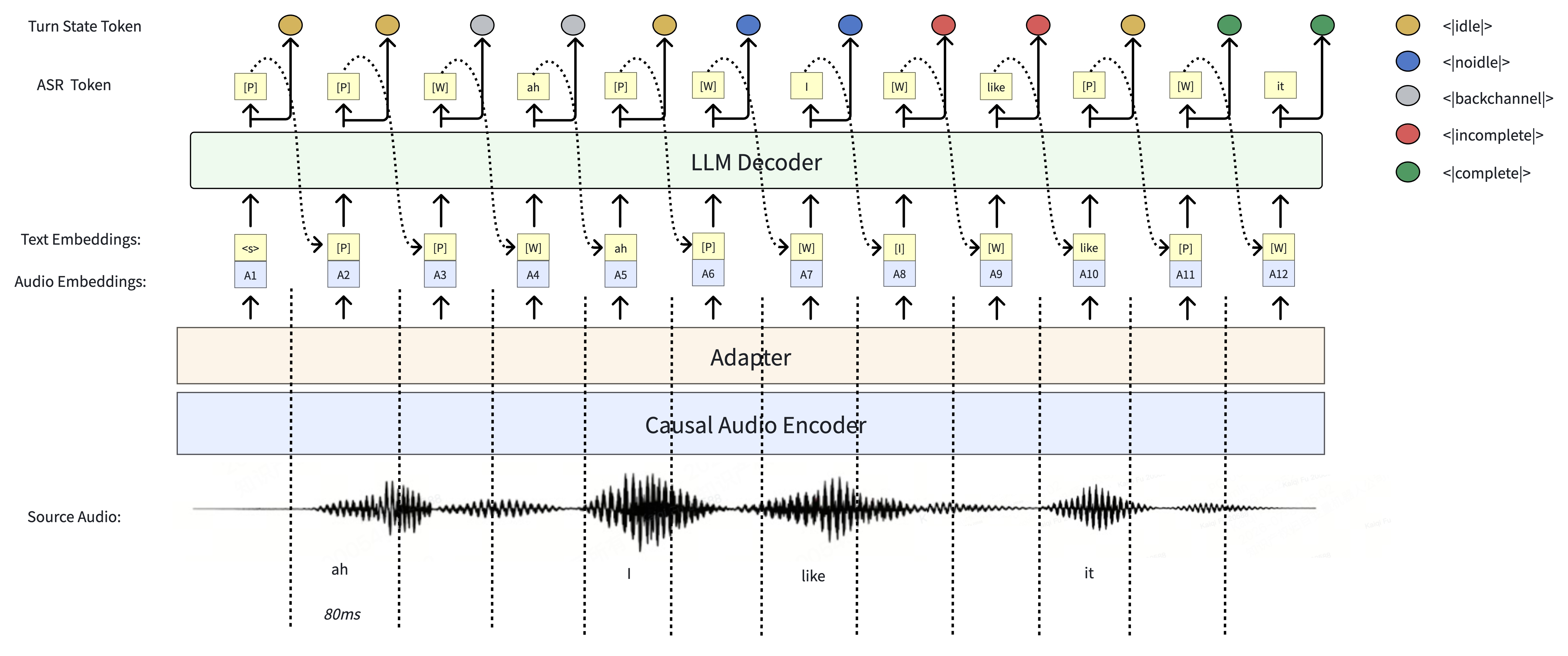
This work unifies ASR and turn-state prediction into a single frame-synchronous dual-head model that jointly predicts speech tokens and dialogue states in real time. By operating at the frame level rather than utterance boundaries, it reduces latency and system complexity compared to modular approaches.
Abstract
Accurate and responsive turn-taking is essential for spoken dialogue systems, which must distinguish in real time between user interruptions, backchannels that should be ignored, and the completion of an utterance. Prior modular approaches typically optimize turn state prediction at the utterance or fixed-chunk level, creating a mismatch with the continuous turn state estimate, and often depend on an auxiliary ASR model, which limits responsiveness and increases overall system complexity. Therefore, we present X2-Turn, a frame-synchronous turn state prediction method via delayed-stream modeling. Specifically, building on the pretrained Voxtral Realtime model, we introduce a frame-synchronous turn state head that operates in parallel with the ASR head on shared streaming representations, jointly predicting ASR tokens and fine-grained turn states at the frame level. We evaluate our method on the bilingual Chinese-English Easy-Turn test sets, and the results demonstrate its effectiveness in achieving accurate turn-taking detection while maintaining low latency.
From today's Hugging Face Daily tab, KAIST's AnyTalk addresses a stubborn gap in speech animation: most talking-head systems are locked to specific characters or require character-specific animation data. AnyTalk sidesteps this by fine-tuning video diffusion models per character and then optimizing blendshape parameters from the synthesized talking-head videos — recovering 3D animation without any direct animation supervision. A distilled real-time variant makes deployment practical.

AnyTalk: Speech Animation for Arbitrary Characters Leveraging a Video Generation Model
AnyTalk generates 3D speech animations for arbitrary characters without animation data by adapting video diffusion models via character-specific fine-tuning and optimizing blendshape parameters from synthesized talking-head videos, with a distilled real-time variant.
Abstract
We present AnyTalk, a novel method for generating 3D speech animations for arbitrary characters without requiring any animation data. While existing audio-driven 3D speech animation methods rely on character-specific training data or laborious rigging/re-meshing, AnyTalk circumvents these limitations by leveraging recent video diffusion models trained on extensive video datasets. We first adapt a pre-trained video diffusion model to a target character through our Character-specific Fine-tuning (CsF) technique. By fine-tuning on rendered images of the 3D character paired with zeroed-out audio embeddings (representing "no motion"), we eliminate the need for animation data while preserving the motion prior of large-scale video diffusion model. We then uplift the resulting talking-head video into a 3D speech animation by estimating blendshape parameters through a proposed optimization process. AnyTalk enables lip-synced animations across diverse face meshes and blendshape configurations, significantly reducing manual effort and data requirements. We further enhance usability by distilling AnyTalk into a streamlined network, AnyTalk_{RT}, thereby enabling real-time performance. By leveraging talking-head video generation, our method broadens access to audio-driven speech animation technology for arbitrary characters. The code is publicly available at https://serin-yoon.github.io/projects/anytalk/.
Co-Speech Gesture Generation
The GENEA community raises the bar on how gesture generation systems are evaluated.
Evaluating co-speech gesture generation has long been plagued by conflating motion quality, speech alignment, and semantic expressiveness into single opaque scores. The GENEA Challenge 2026 addresses this head-on with a disentangled evaluation protocol that scores each dimension independently. It also extends to dyadic interaction analysis and semantic expressiveness tasks on natural conversation data, collecting over 23,000 human votes to produce a rigorous benchmark for participating systems — setting a new methodological standard for the field.
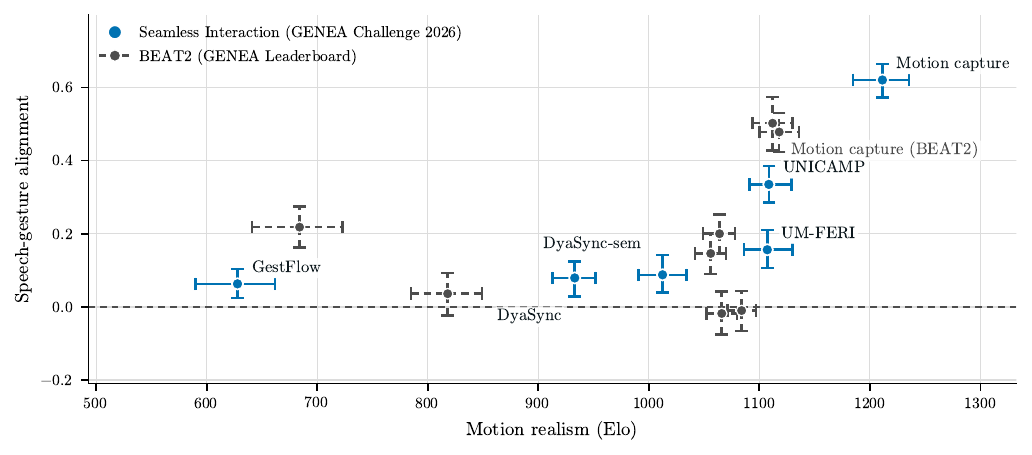
The GENEA Challenge 2026: A Large-Scale Disentangled Evaluation of Speech-Driven Gesture Generation on the Seamless Interaction Dataset
The GENEA Challenge 2026 evaluates speech-driven gesture generation using disentangled metrics for motion quality, speech alignment, and semantic expressiveness. It introduces dyadic interaction analysis and semantic tasks on conversation data, collecting 23k+ votes to benchmark participating systems.
Abstract
This preprint presents the results of the fourth GENEA Challenge, a large-scale human evaluation of five speech-driven gesture-generation systems trained by participating teams on the Seamless Interaction dataset of dyadic conversations. As in the 2023 GENEA Challenge, we used a disentangled evaluation methodology to assess motion quality and speech alignment without confounding between the two, and performed a dyadic mismatching study to isolate the effect of listening and reacting to the interlocutor. We additionally introduce a new semantic gesture-generation task and a text-mismatching evaluation methodology using the Grounded Gestures subset of the data. In total, we ran four large-scale user studies, collecting over 23,000 votes from 869 test-takers. In the motion-realism study, the dataset's filtered segments had substantially higher motion quality than all challenge submissions (68-95% pairwise winrate). In the speech-alignment study, the motion-capture segments provided a conceptual ceiling at 62% alignment score, with the top submission significantly behind at 32% and the rest only slightly above the 0% expected of an input-independent system. In the dyadic study, motion capture again set the ceiling at 65% appropriateness score, but no submission scored substantially above chance, indicating that the systems could not yet respond to the interlocutor. Finally, the semantic mismatching evaluation found highly expressive gestures in the dataset (test-takers identified the matching transcript 79% of the time), yet almost all submissions failed to generate semantically expressive motion, with the best achieving only an 8% appropriateness score. The collected votes and outputs will be made publicly available at https://genea-workshop.github.io/2026/challenge/ to facilitate reproducibility and further research.
Trending on Hugging Face
dots.tts Technical Report
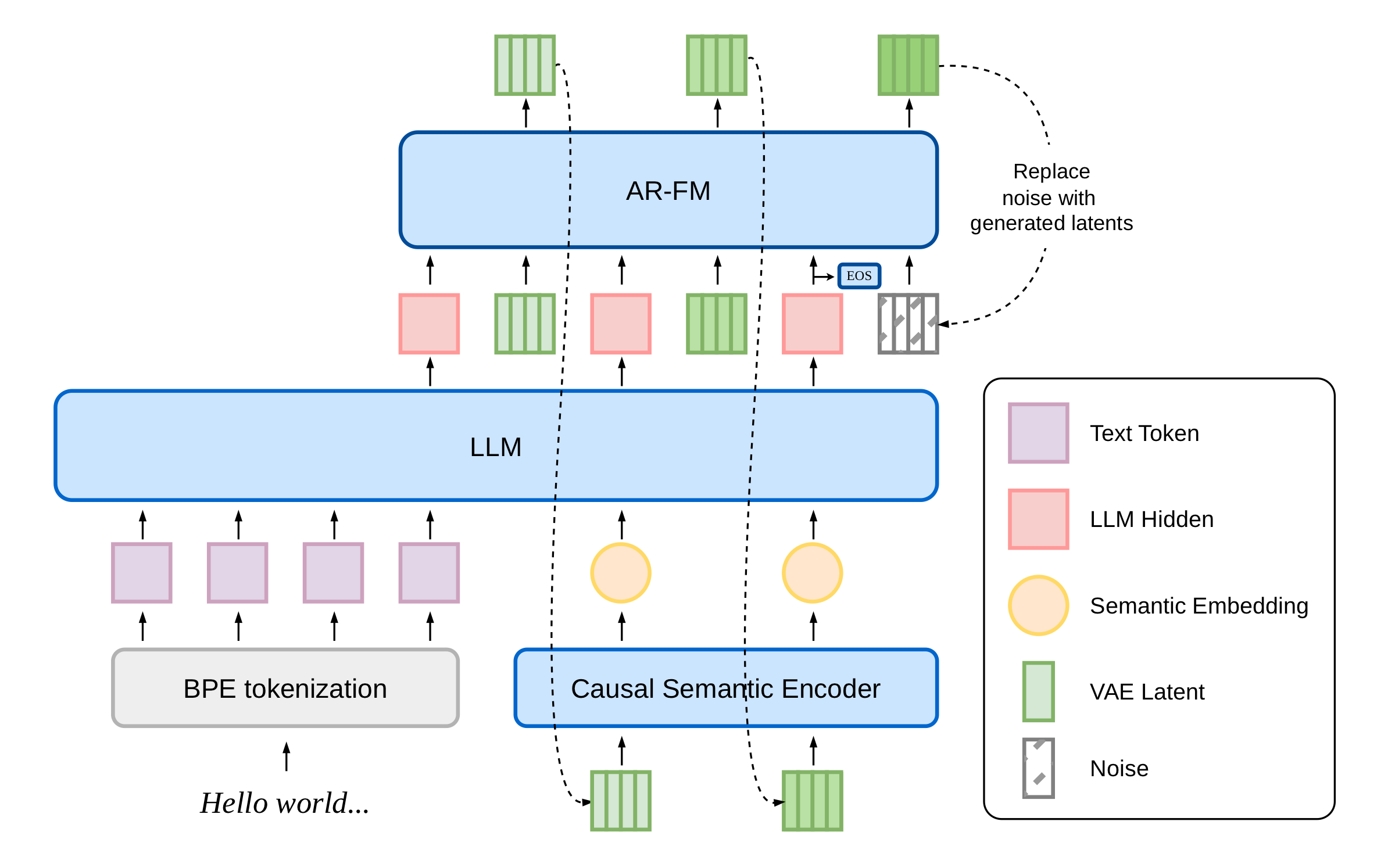
dots.tts is a 2B-parameter continuous autoregressive text-to-speech model that generates speech in a semantically structured continuous latent space. Innovations include full-history conditioning and self-corrective post-training for robust, expressive, and low-latency multilingual speech.

Qwen3-TTS Technical Report
The Qwen3-TTS series presents advanced multilingual text-to-speech models with voice cloning and controllable speech generation capabilities, utilizing dual-track LM architecture and specialized speech tokenizers for efficient streaming synthesis.

Fish Audio S2 Technical Report
Fish Audio S2 is an open-source text-to-speech system with multi-speaker capabilities, multi-turn generation, and instruction-following control through natural-language descriptions, utilizing a multi-stage training approach and production-ready inference engine.

OmniFlatten: An End-to-end GPT Model for Seamless Voice Conversation
A novel GPT-based model, OmniFlatten, enables real-time natural full-duplex spoken dialogue through a multi-stage post-training technique that integrates speech and text without altering the original model's architecture.