
Flow Matching, Diffusion, and Real-Time Avatars: August 19 Roundup
Today's digest covers four papers pushing the frontiers of real-time avatar generation, zero-shot TTS, controllable voice design, and unified audio scene generation — with Flow Matching emerging as a common thread across labs at ByteDance, Alibaba, Google, and Xiaomi.
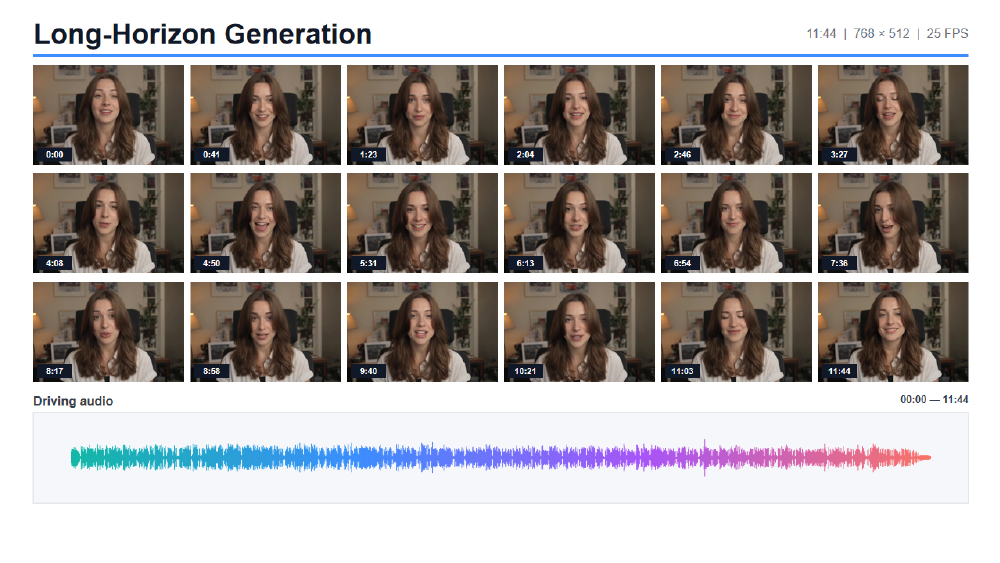
Visual results of extended-duration generation. We uniformly sample frames from a continuous video generated for more than 11 minutes. Avatar-Forever maintains stable identity, facial structure, and scene content while producing natural expressions, coherent head and body motion, and accurate audio--visual synchronization throughout the extended autoregressive rollout. The bottom row shows the corresponding driving-audio waveform. From ByteDance.
Today's papers share a common ambition: eliminating the architectural compromises that force researchers to trade quality for speed, or semantic fidelity for acoustic richness. Whether it's decoupled training branches for infinite avatars or joint Flow Matching for speech tokenization, August 19 is a day of unified pipelines and end-to-end thinking.
Talking Avatars & Streaming Digital Humans
When sequential generation pipelines fight themselves — optimizing efficiency at the cost of long-horizon coherence — the result is avatars that degrade over time. ByteDance's new work tackles this head-on.
Maintaining identity and motion consistency across an unbounded generation horizon is one of the hardest open problems in digital human synthesis. Most sequential pipelines suffer from competing objectives: short-term frame quality vs. long-term temporal stability. Avatar-Forever from ByteDance resolves this by decoupling these goals into parallel training branches, each responsible for its own objective without interfering with the other. The result is stable real-time infinite avatar generation at a compelling 27.2 FPS, with consistent identity and coherent motion across arbitrarily long sequences.
Avatar-Forever: Decoupled Parallel Training for High-Quality Real-Time Infinite Avatars
Avatar-Forever decouples generation efficiency and long-horizon robustness into parallel training branches, eliminating the competing objectives that plague sequential pipelines. It enables stable real-time infinite avatar generation with consistent identity and coherent motion at 27.2 FPS.
Abstract
Existing streaming video systems often rely on sequential, distillation-centered training pipelines to enable few-step long-video generation. However, this paradigm suffers from two limitations. First, failures or distribution shifts introduced in earlier stages affect later optimization, complicating the training process to converge. Second, the distillation-centric objective favours short-term generation but is prone to quality degradation when autoregressive errors accumulate over long rollouts. We propose Avatar-Forever, a decoupled parallel training framework for high-quality real-time infinite interactive avatars. Instead of coupling generation efficiency and long-horizon robustness under a sequential distillation pipeline, we treat them as two independent capabilities that can be trained in parallel. One branch performs full-parameter distillation to train an efficient generator with high visual quality, while another trains a lightweight long-horizon adapter via Recovery-oriented Rollout Training (RRT), which improves generation robustness under long-horizon inference conditions. Our decoupled parallel training design simplifies the overall training process and avoids unnecessary objective conflicts between few-step generation and long-horizon adaptation. We further introduce ForeverCache, a chunk-wise feature caching mechanism to substantially reduce redundant history computation during streaming inference. Built upon a 22B video foundation model, Avatar-Forever supports unbounded audio-driven avatar generation while maintaining identity consistency, motion coherence, and visual fidelity, enabling an end-to-end throughput of high-resolution 768x512 videos at 27.2 FPS on a single H100 GPU and providing a practical path toward stable digital humans.
TTS & Voice Synthesis
Flow Matching and diffusion modeling are rapidly becoming the backbone of high-fidelity speech synthesis — three papers today demonstrate just how far these approaches can be pushed.
Coupled Tokenization and Synthesis
A persistent tension in neural TTS is that speech tokenizers are typically trained independently from acoustic models, creating a mismatch: tokens optimized for compression or reconstruction don't necessarily align with the downstream synthesis objective. Phoenix TTS from Alibaba DAMO Academy attacks this directly by jointly training the speech tokenizer and the acoustic model via Flow Matching, so that the tokenizer learns to preserve exactly the semantic and acoustic details the synthesizer needs. The payoff is high-fidelity zero-shot synthesis and voice conversion without any task-specific fine-tuning.
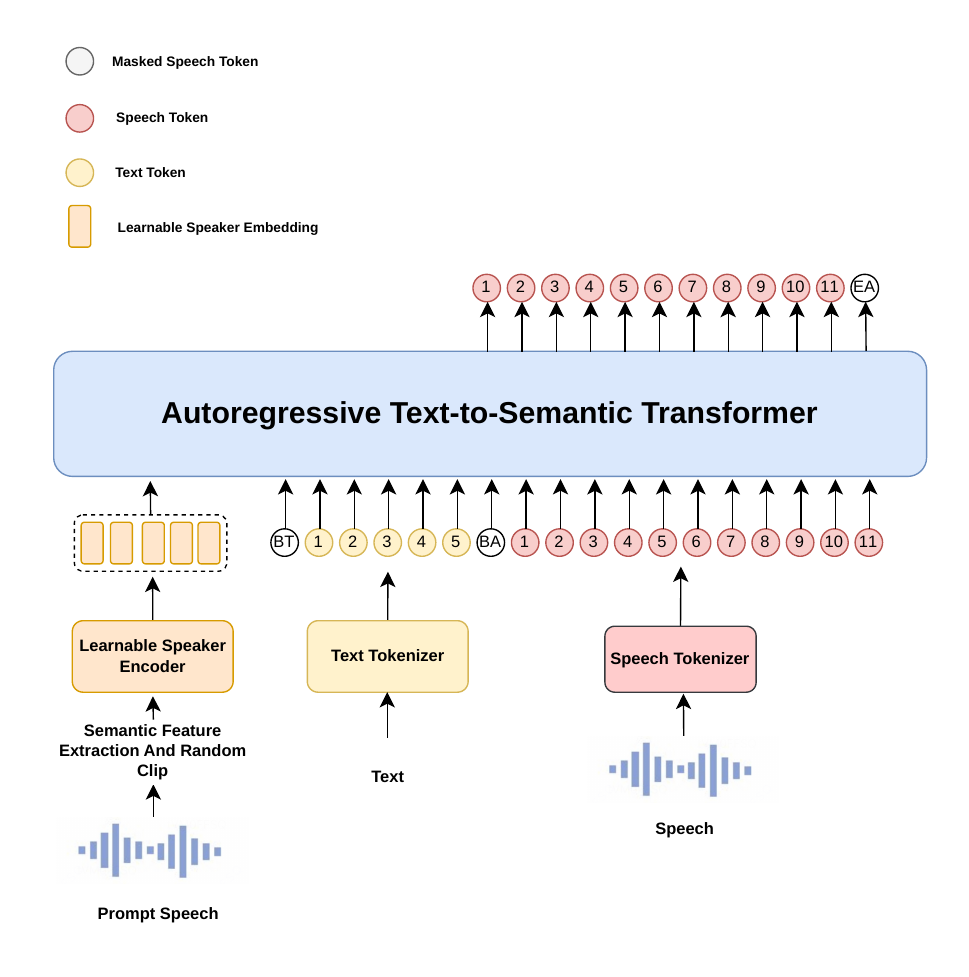
Phoenix TTS: High-Fidelity Synthesis and Voice Conversion via Flow-Matching-Driven Speech Tokenization
Phoenix TTS couples speech tokenization with acoustic modeling via joint Flow Matching training, enabling tokenizers to preserve semantic and acoustic details while aligning with synthesis. This unified approach achieves high-fidelity zero-shot synthesis and voice conversion without task-specific tuning.
Abstract
In current zero-shot text-to-speech systems, conventional semantic tokenizers are typically optimized using supervised automatic speech recognition or self-supervised learning objectives. However, due to the inherent nature of speech, semantic and acoustic information cannot be completely decoupled, and ASR-based tokenizers discard acoustic details to focus on linguistic content; models relying on them usually struggle to achieve optimal speaker similarity. Furthermore, these tokenizers are optimized independently and lack direct supervision from downstream acoustic generation tasks. This isolated training creates a feature gap between the extracted discrete tokens and the continuous space required by acoustic models, fundamentally bottlenecking the upper bound of synthesis quality. To bridge this gap, we propose Phoenix TTS, a unified framework that tightly couples representation learning with generative acoustic modeling. Specifically, our speech tokenizer is optimized to reconstruct self-supervised features to maintain semantic richness, while simultaneously receiving direct supervision from a Flow Matching training loss. Through this joint training paradigm, the extracted discrete tokens successfully preserve essential semantic information and natively align with the feature space of the downstream Flow Matching model. Comprehensive evaluations highlight the efficiency and effectiveness of Phoenix TTS. Trained on 110K hours of data, the system achieves excellent speech intelligibility, yielding WER that consistently falls below that of ground-truth recordings. Simultaneously, it maintains robust zero-shot speaker similarity, rivaling or outperforming several prominent large-scale baselines. Furthermore, as an advantageous byproduct of this unified training, the learned tokenizer can be seamlessly adapted to zero-shot voice conversion tasks without requiring task-specific fine-tuning.
Controllable Voice Design via Diffusion
Moving beyond vanilla TTS toward true voice design — where a user can specify emotion, tone, or clone a target voice — requires both a more expressive model and richer training data. VoiceDesigner from Google Research unifies text-to-voice generation and editing under a single diffusion modeling framework, pairing it with synthetic data augmentation to cover the long tail of voice characteristics. Fine-grained control over emotion, tone, and voice identity becomes possible without separate task-specific modules.
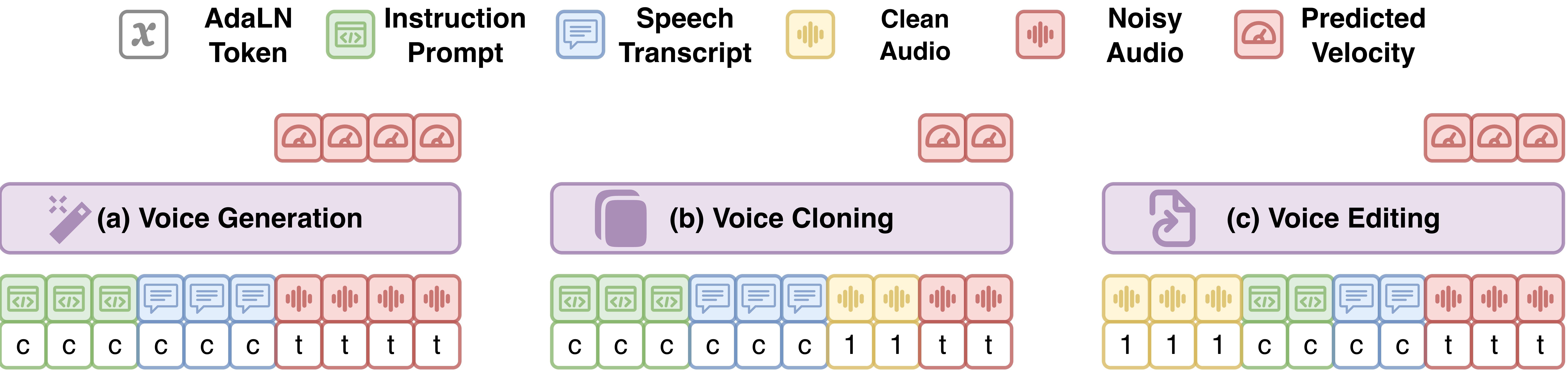
VoiceDesigner: Text-to-Voice Generation and Editing via Unified Diffusion Modeling and Data Augmentation
VoiceDesigner unifies text-to-voice generation and editing via diffusion modeling, enabling diverse voice synthesis and fine-grained control over emotion, tone, and voice cloning. It combines synthetic data augmentation with improved architecture to move beyond basic TTS toward controllable voice design.
Abstract
Recent breakthroughs in generative models have made text-to-voice generation (TTV) possible, enabling the synthesis of speech directly from textual voice descriptions. However, existing systems face two key challenges. First, they struggle to generate a diverse range of voices, spanning real-world human speakers and fictional characters. Second, they lack robust and flexible voice editing capabilities, such as voice cloning and the ability to modify attributes like emotion and tone. In this paper, we propose VoiceDesigner, a unified framework for text-to-voice generation and editing that supports diverse and controllable voice design. To tackle the above challenges, we propose solutions from two perspectives. First, we develop a hybrid data pipeline that leverages digital signal processing techniques and speech generation models to construct a diverse voice dataset covering both real-world and fictional voices. Second, we introduce a diffusion transformer with architectural improvements to better handle complex conditioning and enhance multi-task performance, enabling unified voice generation and editing. Through subjective and objective evaluations, VoiceDesigner achieves superior prompt alignment with both voice descriptions and editing instructions, while maintaining competitive perceptual quality and voice usability compared to state-of-the-art TTV models.
Unified Audio Scene Generation
Most audio generation systems treat speech, music, and sound effects as separate problems, relying on frozen encoders and modular pipelines that leave performance on the table. MiDashengLM-Gen from Xiaomi Inc. takes an end-to-end approach, coupling a pre-trained LLM directly with autoregressive Flow Matching for unified text-to-audio generation across all three audio modalities. Eliminating the frozen-encoder bottleneck yields a dramatic improvement in speech intelligibility — just 2.79% WER — while maintaining competitive quality on mixed-audio scenes.

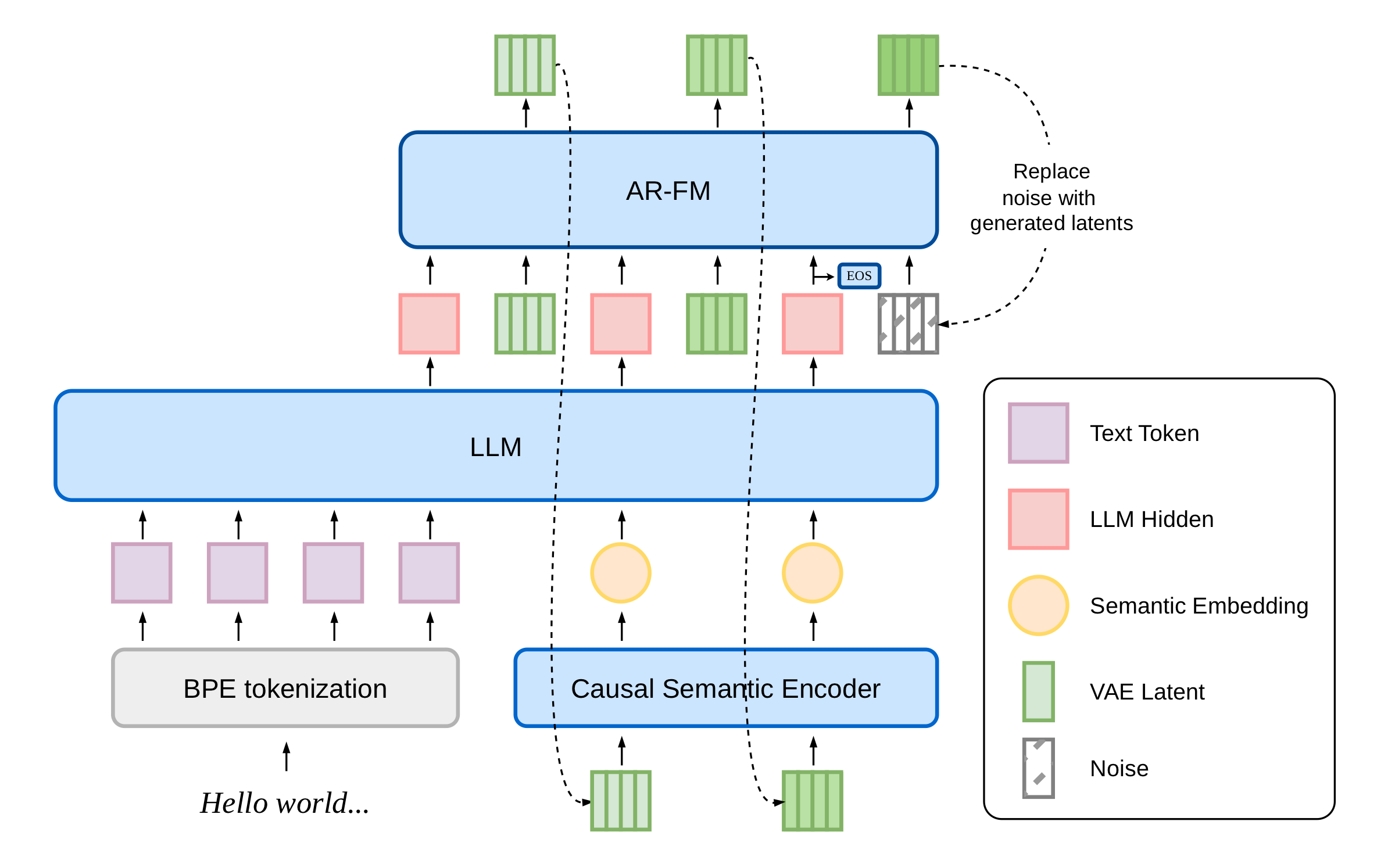
MiDashengLM-Gen: Unified Audio Scene Generation via LLM-Driven Autoregressive Flow Matching
An end-to-end framework coupling a pre-trained LLM with flow matching for unified text-to-audio generation of speech, music, and sound effects. By eliminating frozen-encoder pipelines, it achieves dramatically improved speech intelligibility (2.79% WER) while maintaining competitive mixed-audio quality.
Abstract
Generating coherent audio scenes that simultaneously blend speech, music, and sound effects remains a significant challenge. Current approaches typically rely on a disjointed pipeline where a frozen, decoupled text encoder feeds a separate audio decoder, limiting cross-modal optimization and leading to poor speech intelligibility. To overcome these limitations, we introduce MiDashengLM-Gen, an end-to-end framework that couples a pre-trained Large Language Model (LLM) with per-token conditional flow matching for autoregressive, variable-length mixed-audio scene generation. MiDashengLM-Gen represents a first approach for general text-to-audio generation with one end-to-end trained model. Empirical evaluations demonstrate that MiDashengLM-Gen drastically improves speech intelligibility over existing unified models. On the Seed-TTS benchmark, English Word Error Rate (WER) drops from 12.15% to 2.79%, approaching the performance of dedicated Text-to-Speech (TTS) systems (1.24%). Furthermore, the framework extends effectively to multilingual settings, yielding highly competitive multilingual WERs compared to existing baselines. Lastly, the model maintains competitive mixed-audio generation quality on the MECAT benchmark. Code and checkpoints are available at https://github.com/xiaomi-research/midashenglm-gen and https://huggingface.co/mispeech/midashenglm-gen, and the demo page is available at https://xingws.github.io/midashenglm-gen-demo/.
Trending on Hugging Face
dots.tts Technical Report
dots.tts is a 2B-parameter continuous autoregressive text-to-speech model that generates speech in a semantically structured continuous latent space. Innovations include full-history conditioning and self-corrective post-training for robust, expressive, and low-latency multilingual speech.

Qwen3-TTS Technical Report
The Qwen3-TTS series presents advanced multilingual text-to-speech models with voice cloning and controllable speech generation capabilities, utilizing dual-track LM architecture and specialized speech tokenizers for efficient streaming synthesis.

Fish Audio S2 Technical Report
Fish Audio S2 is an open-source text-to-speech system with multi-speaker capabilities, multi-turn generation, and instruction-following control through natural-language descriptions, utilizing a multi-stage training approach and production-ready inference engine.

VibeVoice Technical Report
VibeVoice synthesizes long-form multi-speaker speech using next-token diffusion and a highly efficient continuous speech tokenizer, achieving superior performance and fidelity.

OmniFlatten: An End-to-end GPT Model for Seamless Voice Conversation
A novel GPT-based model, OmniFlatten, enables real-time natural full-duplex spoken dialogue through a multi-stage post-training technique that integrates speech and text without altering the original model's architecture.