
Dubbing, Cloning, and Dialogue: Speech Synthesis Goes End-to-End
Today's digest covers end-to-end video dubbing, zero-shot voice cloning, expressive TTS via iterative self-learning, realistic dialogue speech synthesis, and animation-free 3D lip sync for arbitrary characters.
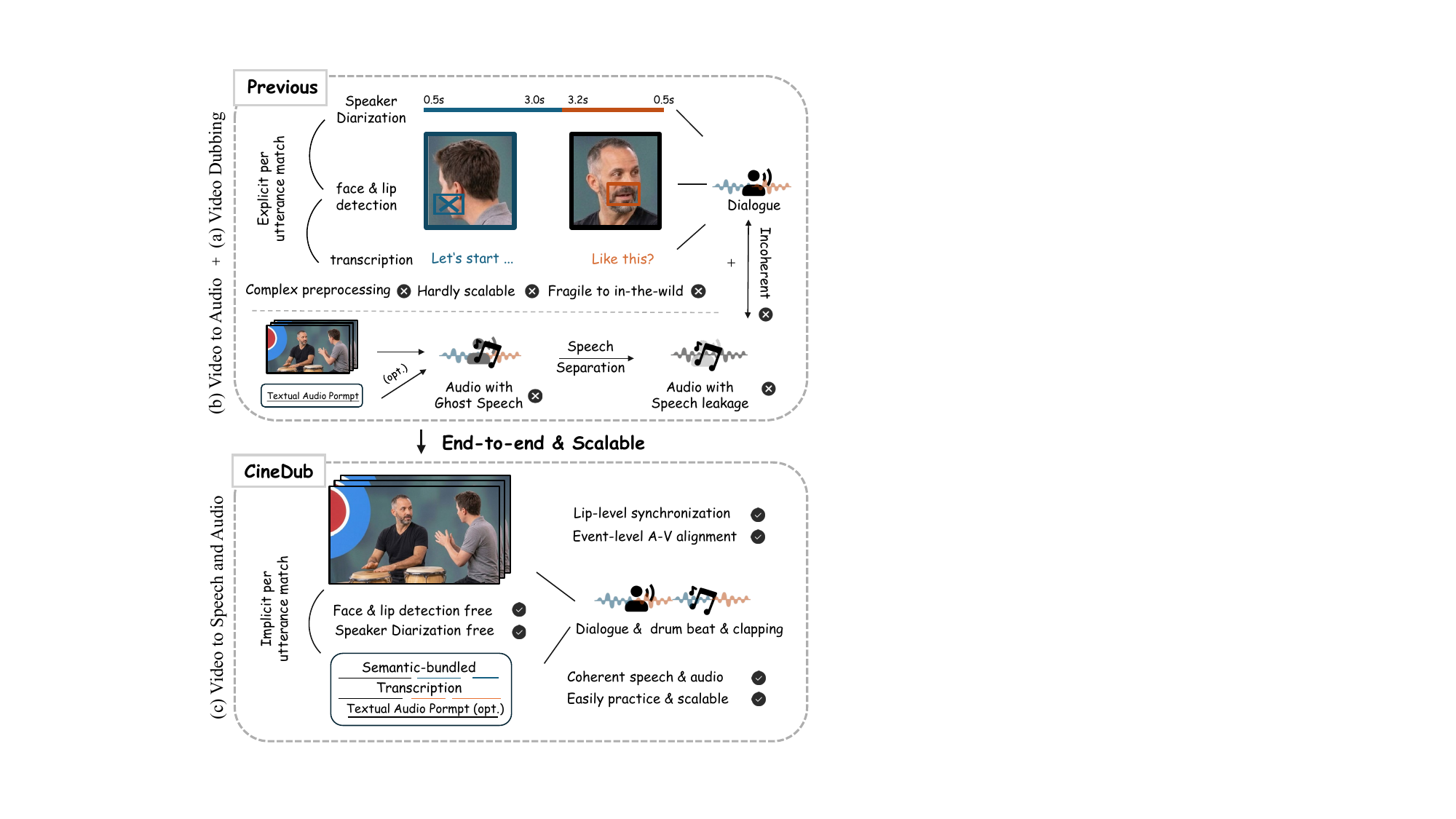
(a)~Existing dialogue dubbing methods rely on complex preprocessing to provide active cropped speaker regions with corresponding timestamps and transcripts, limiting scalability and practicality. (b)~Generating accompanying sound effects requires a separate V2A model, which inevitably introduces ghost speech and acoustic incoherence with the dubbed speech. (c)~CineDub jointly generates multi-speaker dialogue with coherent audio through a unified end-to-end model, requiring only an uncropped video and an MLLM-generated semantic-bundled transcription. From Tsinghua University.
A strong theme runs through today's papers: the push to eliminate brittle, modular pipelines in favor of unified, end-to-end systems. Whether it's dubbing a full scene with sound effects, cloning a voice with a single extra layer, or generating realistic conversational overlaps, the field is converging on models that handle complexity implicitly rather than by hand-engineering every step.
Talking Avatars & Lip Sync
From character-agnostic 3D animation to full-scene multi-speaker dubbing — new approaches that skip the preprocessing and go straight to results.
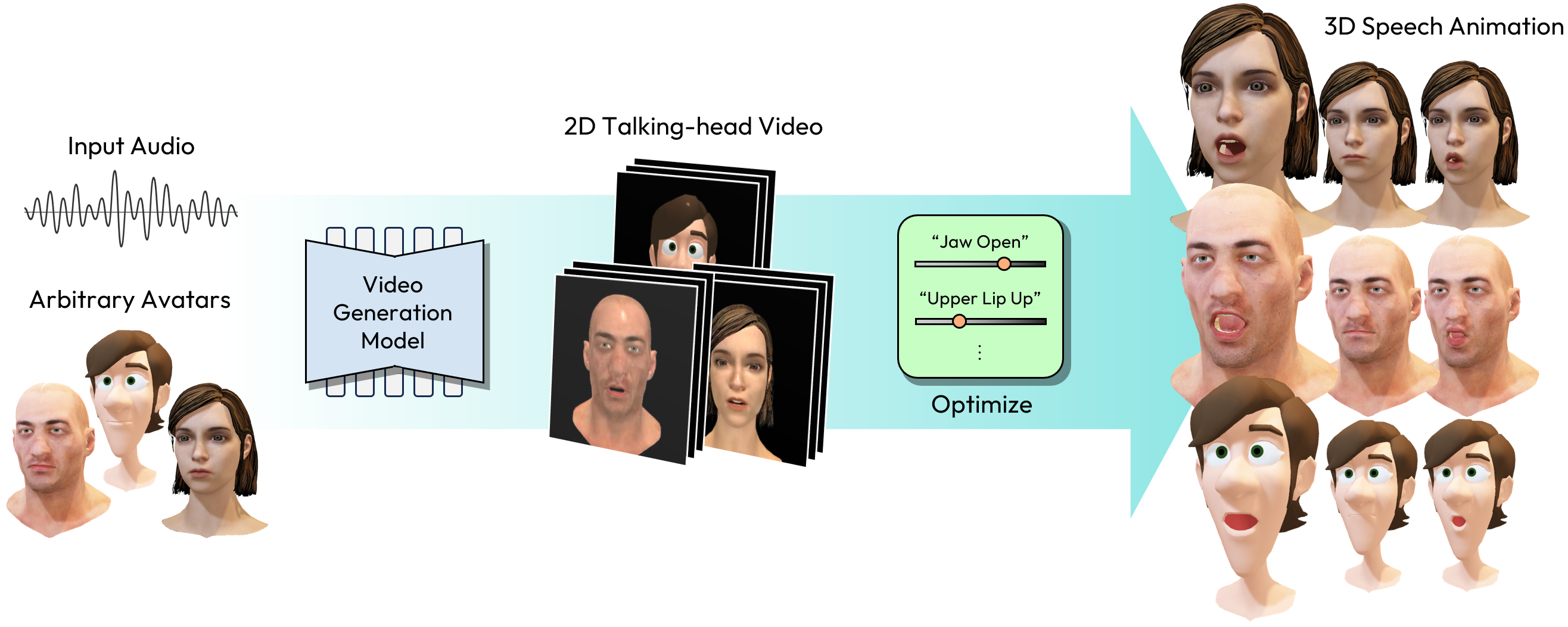
Training a lip-sync model traditionally means collecting paired audio-animation data for every character you care about — a laborious and brittle process. AnyTalk from KAIST sidesteps this entirely by fine-tuning a video diffusion model (no animation data required) and then back-solving blendshape parameters from the generated video frames. The result is character-agnostic 3D speech animation that works across diverse face meshes without manual rigging or character-specific retraining. This paper is also featured on today's Hugging Face Daily tab.
AnyTalk: Speech Animation for Arbitrary Characters Leveraging a Video Generation Model
AnyTalk generates 3D speech animations for arbitrary characters by fine-tuning a video diffusion model without animation data, then optimizing blendshape parameters from the generated video. This eliminates character-specific training and manual rigging while enabling lip-synced animations across diverse face meshes.
Abstract
We present AnyTalk, a novel method for generating 3D speech animations for arbitrary characters without requiring any animation data. While existing audio-driven 3D speech animation methods rely on character-specific training data or laborious rigging/re-meshing, AnyTalk circumvents these limitations by leveraging recent video diffusion models trained on extensive video datasets. We first adapt a pre-trained video diffusion model to a target character through our Character-specific Fine-tuning (\textit{CsF}) technique. By fine-tuning on rendered images of the 3D character paired with zeroed-out audio embeddings (representing "no motion"), we eliminate the need for animation data while preserving the motion prior of large-scale video diffusion model. We then uplift the resulting talking-head video into a 3D speech animation by estimating blendshape parameters through a proposed optimization process. AnyTalk enables lip-synced animations across diverse face meshes and blendshape configurations, significantly reducing manual effort and data requirements. We further enhance usability by distilling AnyTalk into a streamlined network, $\text{AnyTalk}_{RT}$, thereby enabling real-time performance. By leveraging talking-head video generation, our method broadens access to audio-driven speech animation technology for arbitrary characters. The code is publicly available at https://serin-yoon.github.io/projects/anytalk/.
Scaling video dubbing to multi-speaker dialogues is a notoriously hard problem: you need to resolve who's speaking, keep background sound effects acoustically coherent, and avoid the cascading errors of multi-stage pipelines. CineDub from Tsinghua University tackles all of this in a single diffusion model that operates on uncropped video. By coupling speaker disambiguation and sound effect generation through implicit cross-modal signals, it eliminates the need for face-cropping, separate audio synthesis models, and explicit preprocessing — a significant architectural simplification for real-world dubbing at scale.
CineDub: Scaling End-to-End Video Dubbing to Multi-Speaker Dialogues with Coherent Sound Effects
CineDub unifies multi-speaker video dubbing with coherent sound effect generation in a single diffusion model operating on uncropped video. It resolves speaker ambiguity and acoustic incoherence through implicit cross-modal coupling, eliminating preprocessing pipelines and separate audio synthesis models.
Abstract
Automatic video dubbing in the wild remains fundamentally limited by two competing constraints: hierarchical methods depend on brittle, multi-stage preprocessing pipelines that severely restrict data scalability and practical deployment, while holistic approaches operating on uncropped video suffer from weak temporal alignment and speaker-utterance ambiguity in multi-speaker settings. To overcome these limitations, we propose CineDub, a unified diffusion-based model that achieves precise multi-speaker dialogue dubbing directly from uncropped videos, without face cropping or speaker diarization. Central to our approach is the Implicitly-Coupled Holistic Conditioning (ICHC) paradigm, where holistic visual representations and a semantic-bundled transcription format are encoded independently, yet implicitly coupled through cross-modal training to resolve speaker ambiguity and enable precise multi-speaker multi-turn dialogue dubbing. Building on the unified temporal cues captured by holistic visual features, we further extend CineDub to joint speech and audio generation. We introduce an Ambient-to-Linguistic Curriculum Learning (ALC) to mitigate sub-task degradation, and a decoupled textual branch control mechanism to resolve cross-prompt interference during simultaneous generation. We also release two in-the-wild benchmarks, CineDub-Multi for multi-speaker dialogue dubbing and CineDub-SA for video-to-speech-and-audio (V2SA) generation, to enable evaluation under realistic conditions. Experiments show that CineDub achieves state-of-the-art results on established single-speaker dubbing and video-to-audio benchmarks while excelling in multi-speaker dialogue dubbing and acoustically coherent joint generation.
TTS & Voice Synthesis
Minimal architectural surgery for voice cloning, and a semi-supervised path to expressive control with scarce labels.
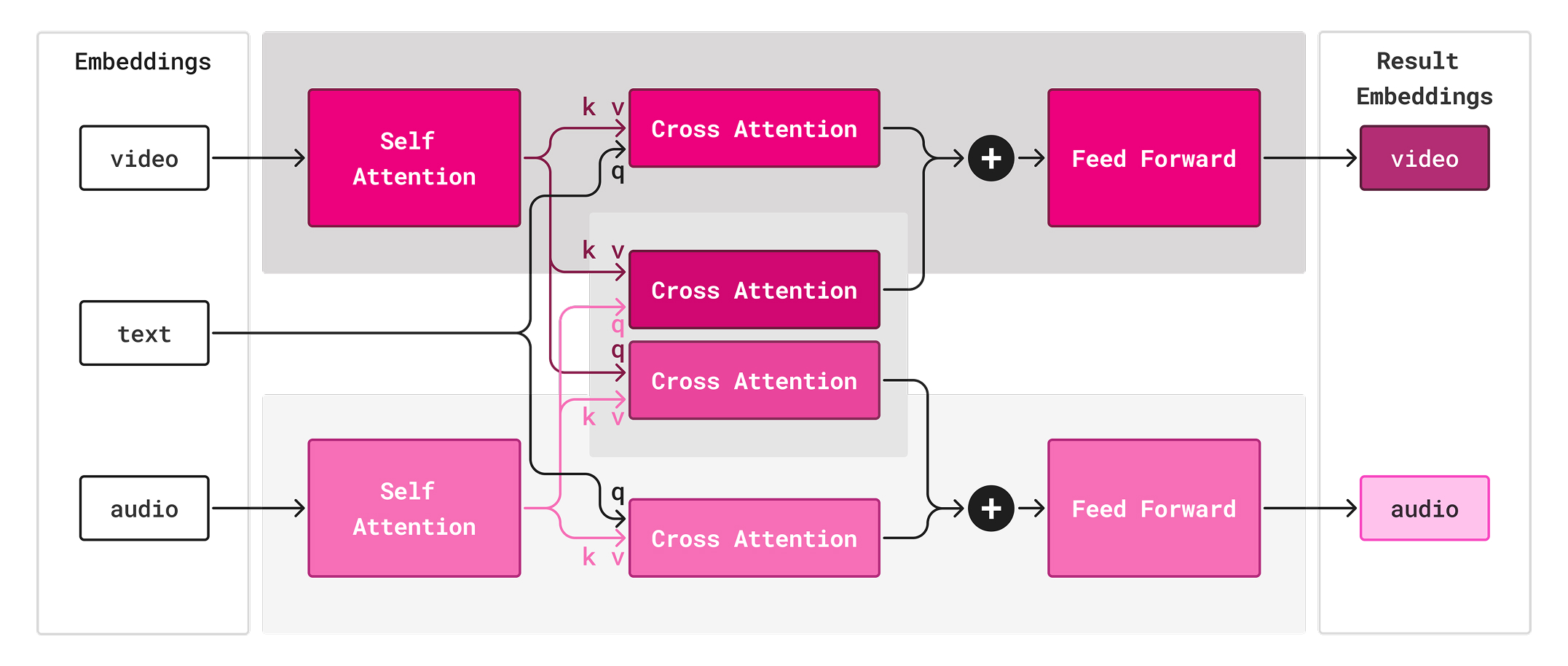
Voice cloning usually demands deep architectural changes to an existing audio-video generation model. Yandex's approach challenges that assumption: they add speaker control to text-to-audio-video models using a single zero-initialized layer plus dual conditioning signals. The method outperforms specialized voice-cloning baselines while preserving the original model's weights, and the zero-init design means the base model's behavior is unchanged at the start of fine-tuning. A bonus: audio-only inference runs 30× faster than the full audio-video model.
Adding Voice Cloning to Text-to-Audio-Video Models with a Single Zero-Initialised Layer
This work adds voice-cloning to text-to-audio-video models through a single zero-initialized layer and dual conditioning signals, enabling speaker control without redesigning the architecture. It outperforms specialized voice-cloning baselines and enables 30x faster audio-only inference.
Abstract
Text-to-audio-video (T2AV) generation models produce a video and its soundtrack from a textual description, but offer no control over whose voice speaks in the output. We show that a base T2AV model can be turned into a voice-cloning model by adding a single zero-initialized linear layer on top of its audio backbone, fine-tuning for a comparatively short training schedule, and conditioning on a short reference recording at inference time. The reference is injected through two complementary signals: its diffusion latents are prepended to the audio stream, and a global speaker embedding modulates token of the target audio. On a benchmark of 674 speaker-text pairs spanning 30 speakers we compare against five strong voice-cloning text-to-speech baselines: our enhanced 5B model attains the highest speaker-encoder cosine similarity (SECS) across three independent verification networks (ECAPA-TDNN, WavLM-SV, Resemblyzer), statistically significantly outperforming every baseline. A side product of the architecture is that the audio path can be evaluated without the video path at inference time, yielding a ~30x speed-up over the full audio-video diffusion loop while preserving the voice-cloning behaviour.
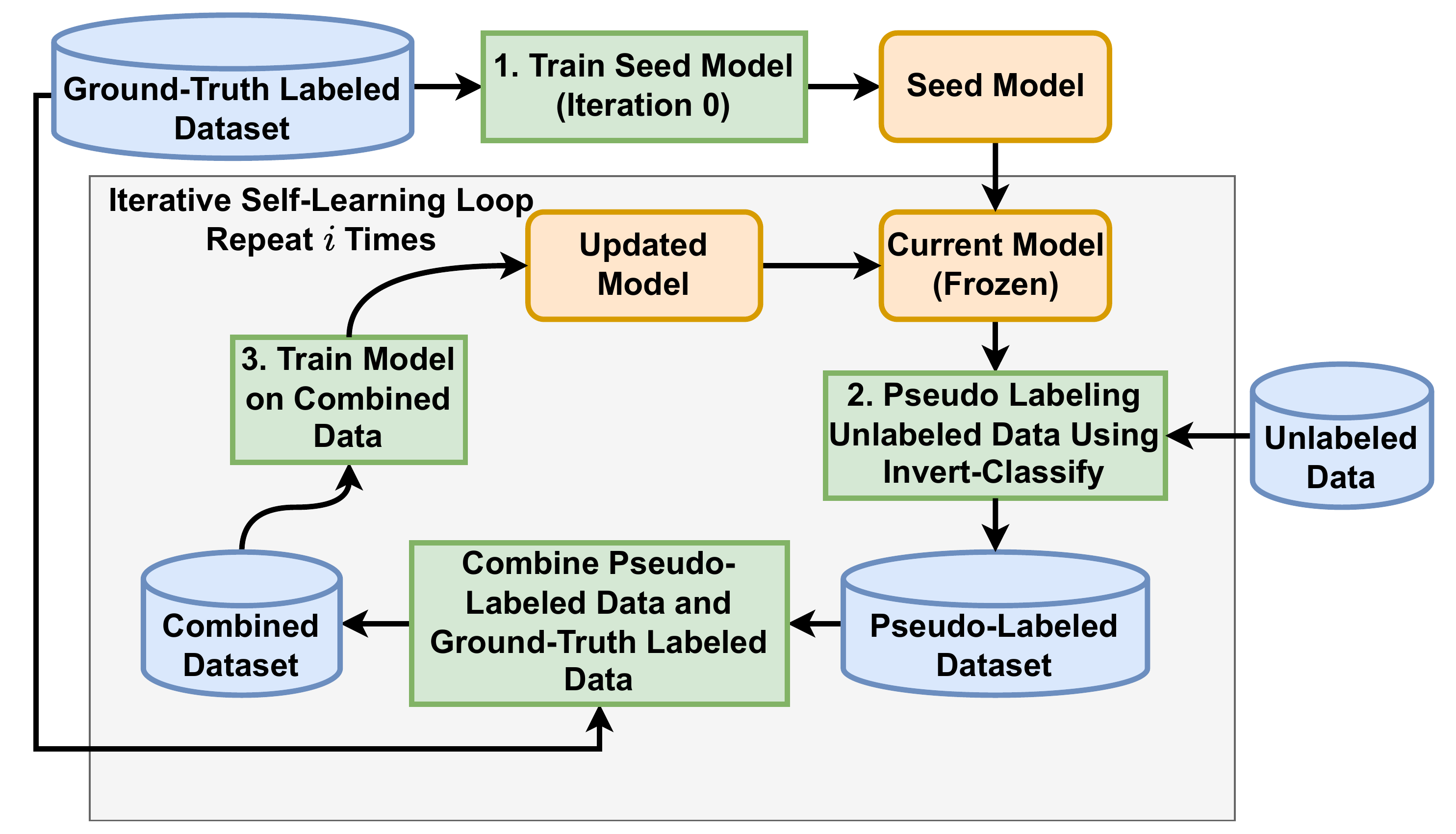
Expressivity in TTS is bottlenecked by labeled data — annotating prosody, emotion, and style at scale is expensive. The University of Edinburgh's Iterative Self-Learning framework addresses this with a semi-supervised loop: pseudo-label unlabeled speech with a model trained on a small labeled seed set, retrain, and iterate. This yields explicit, interpretable expressivity control and substantially closes the gap to fully supervised models in low-resource conditions — a practically important result for any language or domain where rich expressive corpora don't exist.
Iterative Self-Learning for Expressive Text-to-Speech Synthesis
A semi-supervised framework that addresses expressive label scarcity in text-to-speech through Iterative Self-Learning, pseudo-labeling unlabeled speech and refining iteratively. It provides explicit, interpretable control over expressivity while narrowing the gap to fully supervised models in low-resource settings.
Abstract
Expressive text-to-speech (TTS) systems that use explicit conditioning labels provide direct and interpretable control over expressive attributes, in contrast to reference-based or prompting-based approaches, but require labeled data. Obtaining these labels at scale is costly and time-consuming, yet no prior semi-supervised framework addresses this specific bottleneck. Existing semi-supervised TTS methods instead target scarcity of paired speech-text data or transcriptions. To address the scarcity of expressive labels, we propose an Iterative Self-Learning (ISL) framework for expressive TTS, built on Invert-Classify, a classifier-free method that recovers discrete expressive labels by inverting a frozen generative model. The framework iteratively pseudo-labels unlabeled speech using the current model, retrains on the combined labeled and pseudo-labeled data, and repeats, progressively refining label quality and synthesis. We validate on two expressive tasks, word-level prominence and utterance-level emotion, across multiple low-resource data splits. We find that iterative refinement can improve pseudo-label accuracy over single-pass baselines. Furthermore, we observe that these improvements in pseudo-labeling of expressivity translate to gains in expressive label adherence and synthesis quality, confirmed by objective metrics and human listening tests. In the most data-scarce conditions, ISL-trained models outperform single-pass pseudo-labeling and further approach fully supervised performance, demonstrating that gradient-based ISL is an effective solution to expressive label scarcity in low-resource TTS.
SpeechLLMs & Spoken Dialogue
Rethinking how to synthesize scripted dialogue so that natural overlaps and interruptions emerge on their own.
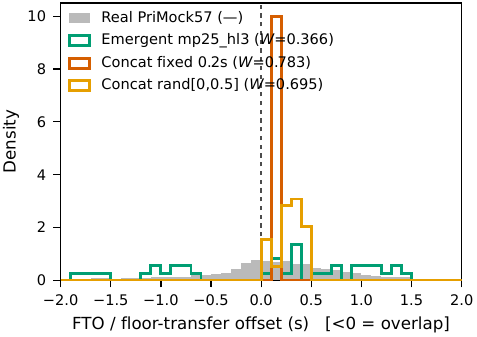
Conventional dialogue speech synthesis works by rendering each speaker's turn independently and stitching the results together — an approach that produces unnaturally clean turn boundaries and no realistic overlaps. DuplexGen from Waseda University decouples the problem into three orthogonal axes — content, timing, and acoustics — and then uses real-time full-duplex conversational models that interact with each other while realizing a scripted exchange. Interruptions and overlaps emerge organically from the interaction rather than being programmed in, resulting in far more natural-sounding synthetic dialogue corpora.
DuplexGen: Decoupling Content, Timing, and Acoustics for Synthetic Dialogue Speech
DuplexGen decouples dialogue content, timing, and acoustics to generate natural conversational speech. Unlike conventional stitching-based synthesis, it uses real-time full-duplex conversational models that interact while realizing scripted dialogue, allowing realistic overlap and interruptions to emerge organically.
Abstract
Synthetic conversational speech has become an important resource for developing and evaluating conversational speech systems. However, existing dialogue synthesis pipelines typically generate dialogue content first and then insert interruptions, overlap, and backchannels using handcrafted markers or timing rules, making conversational timing prescribed rather than interaction-driven. We present DuplexGen, a dialogue synthesis framework that explicitly decouples content, timing, and acoustics. An LLM first generates the dialogue script, and then two full-duplex conversational models perform the script while listening to each other in real time. This allows conversational timing to emerge naturally while preserving the scripted content. Finally, a high-fidelity text-to-speech model re-renders the interaction without altering its timing. As a demonstration of the proposed framework, we construct a patient--clinician conversational speech corpus with construction-time annotations, including word timestamps, speaker activity, overlap regions, and interaction events. Experimental results show that the proposed framework produces conversational dynamics closer to real dialogue than conventional stitching-based synthesis.
Trending on Hugging Face

4DAnyone: Create Anyone in 4D from a Casual Monocular Video
4DAnyone reconstructs 4D humans from monocular video by generating multiview-consistent videos and lifting them into 4D Gaussian Splatting, using reference and target context designs to overcome scaling bottlenecks.

OmniFlatten: An End-to-end GPT Model for Seamless Voice Conversation
A novel GPT-based model, OmniFlatten, enables real-time natural full-duplex spoken dialogue through a multi-stage post-training technique that integrates speech and text without altering the original model's architecture.
dots.tts Technical Report
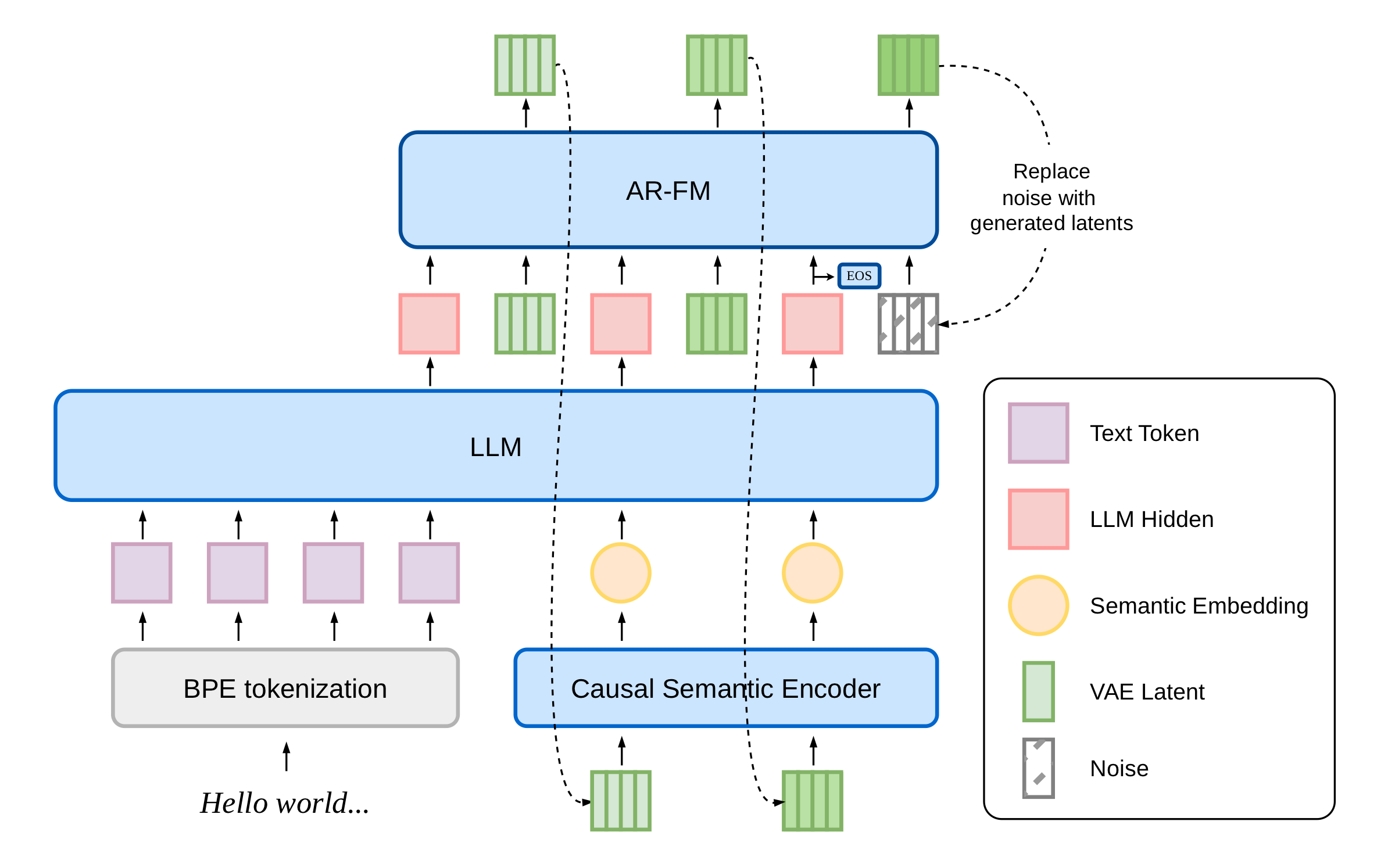
dots.tts is a 2B-parameter continuous autoregressive text-to-speech model that generates speech in a semantically structured continuous latent space. Innovations include full-history conditioning and self-corrective post-training for robust, expressive, and low-latency multilingual speech.

Qwen3-TTS Technical Report
The Qwen3-TTS series presents advanced multilingual text-to-speech models with voice cloning and controllable speech generation capabilities, utilizing dual-track LM architecture and specialized speech tokenizers for efficient streaming synthesis.

Fish Audio S2 Technical Report
Fish Audio S2 is an open-source text-to-speech system with multi-speaker capabilities, multi-turn generation, and instruction-following control through natural-language descriptions, utilizing a multi-stage training approach and production-ready inference engine.