
Singing Avatars, Rolling-Shutter Gaussians, and Empathetic Robots
Today's digest spans audio-driven avatar generation, 3D Gaussian reconstruction from real-world video, speaker-normalized speech tokenization, and emotion-aware empathetic dialogue agents — a broad sweep across embodied AI and speech research.

Qualitative paired vocal-role switching on two SingDance examples. Each Lip-on/Lip-off pair shares all role-independent inputs and inference settings; only the vocal role changes. From Kuaishou Technology.
Today's papers push across four fronts: composing singing and dancing in a single zero-shot video model, reconstructing clean avatars from rolling-shutter sensor artifacts, purifying speech tokens of speaker identity, and closing the emotional loop in social robots. Whether your focus is generative video, 3DGS, TTS, or dialogue agents, there's something sharp here.
Talking Avatars & Audio-Driven Animation
From lip sync to full-body performance — making avatars that sing and dance.
Getting a virtual performer to simultaneously sing and dance is harder than it looks: the two behaviors require different audio interpretations (vocal articulation vs. rhythmic body motion) from the same music signal. SingDance from Kuaishou Technology tackles this by introducing a role-aware audio conditioning mechanism that designates each performer as either a vocal source or a listener, allowing the model to compose separately learned speech articulation and dance modules at inference time. The result is compositional zero-shot synthesis — you can arrange novel multi-performer scenes without any paired singing-and-dancing training data.
SingDance: Compositional Zero-Shot Singing-and-Dancing Video Generation with Role-Aware Audio Conditioning
SingDance unifies music-conditioned motion with vocal articulation for singing-and-dancing generation. It enables compositional zero-shot synthesis by treating performers as vocal sources or listeners, composing separately learned speech articulation and dance through role-aware audio conditioning.
Abstract
Generating personalized dance videos from a reference image, text prompt, and audio track requires music-conditioned body motion. Singing-and-dancing adds a second requirement: the visible subject must also articulate the vocals. Existing music-conditioned methods focus primarily on choreography, while speech-driven models generally assume that the visible subject produces the input voice, leaving this combined setting largely underexplored. We introduce SingDance, a unified video diffusion framework that formulates controllable vocal articulation as a semantic role: the visible subject is either the source, who produces the vocal signal, or the listener, who receives it from an off-screen performer. Hard-compact routing selects task-relevant speech, music, and role conditions, which are composed through frame-wise joint audio injection; source and listener retain the same speech pathway. Training uses asymmetric supervision: on-screen speaking and curated off-screen conversational-response videos establish role control, while instrumental and song-based dancing-only videos establish music-conditioned body motion. The target Song/Source configuration is never observed during training. At inference, assigning the source role to a song composes separately learned articulation and song-conditioned dance capabilities, enabling compositional zero-shot singing-and-dancing. Experiments demonstrate strong motion--beat alignment and visual fidelity, reliable paired switching of vocal articulation while preserving music-aligned body motion, and highly competitive lip synchronization with substantially fewer generation-time parameters than the strongest speech-driven baseline evaluated.
Digital Humans & 3D Avatars
Reconstructing humans from the cameras we actually use.
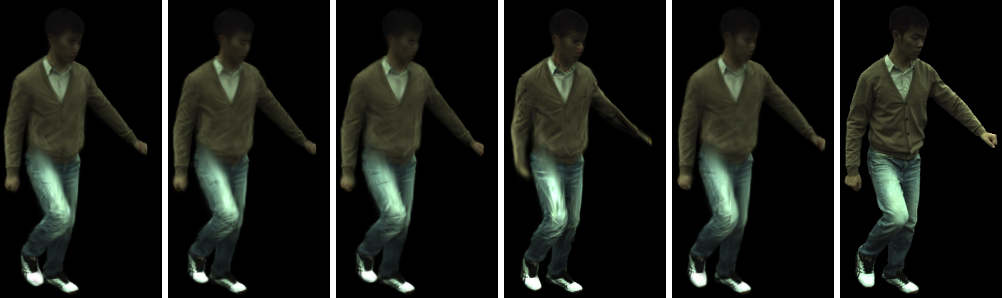
Most 3D Gaussian avatar pipelines assume global-shutter cameras, but nearly every consumer device — including most smartphones — uses a rolling shutter that exposes one scanline at a time. Fast motion during capture introduces a distinctive skew distortion that corrupts the canonical pose space reconstructed by prior methods. Zhejiang University's new approach tackles this head-on: rather than treating a frame as a single snapshot, it composites motion-aware renderings scanline-by-scanline, modeling the precise timestamp of each row. This yields sharp, undistorted animatable 3D Gaussian avatars straight from rolling-shutter video, without any pre-correction preprocessing.
Scanline-Aware Animatable Gaussian Avatars from Rolling-Shutter Videos
This work reconstructs sharp, undistorted 3D Gaussian avatars directly from rolling-shutter video, addressing a real-world sensor artifact that prior methods ignore. By compositing motion-aware renderings scanline-by-scanline rather than averaging them, it eliminates distortion that corrupts the canonical pose space.
Abstract
Animatable human avatars are routinely reconstructed from multi-view video under a silent assumption: that every pixel of a frame observes the same instant of the body's motion. Rolling-shutter (RS) sensors expose image rows sequentially, so within one frame the head and the feet of a moving person are separated by tens of milliseconds of articulated motion, and every scanline sees a different pose. Feeding such video to a state-of-the-art avatar bakes the distortion into the canonical representation, where it survives as shear and wobble under novel views and novel poses. Worse, every camera in a rig follows its own readout schedule, so the multi-view consistency that drives the reconstruction is violated even when the geometry is correct. We present RS-Avatar, which reconstructs a sharp, undistorted, animatable 3D Gaussian avatar directly from RS video. The formulation is minimal: a motion-aware avatar already renders the body at several sub-frame instants, and where a blur model averages those renderings, a rolling-shutter model composites them scanline by scanline. Changing that operator is the only modification required. On RS-ZJU, a benchmark we build from ZJU-MoCap, this improves novel-view synthesis over training as if the frames were instantaneous, on every subject. A motion-aware blur model built on the same sub-frame machinery does not transfer, and in fact falls below the shutter-oblivious baseline: the machinery is reusable, the operator is not.
Speech Tokenization, TTS & Voice Conversion
Stripping speaker identity from discrete speech representations.
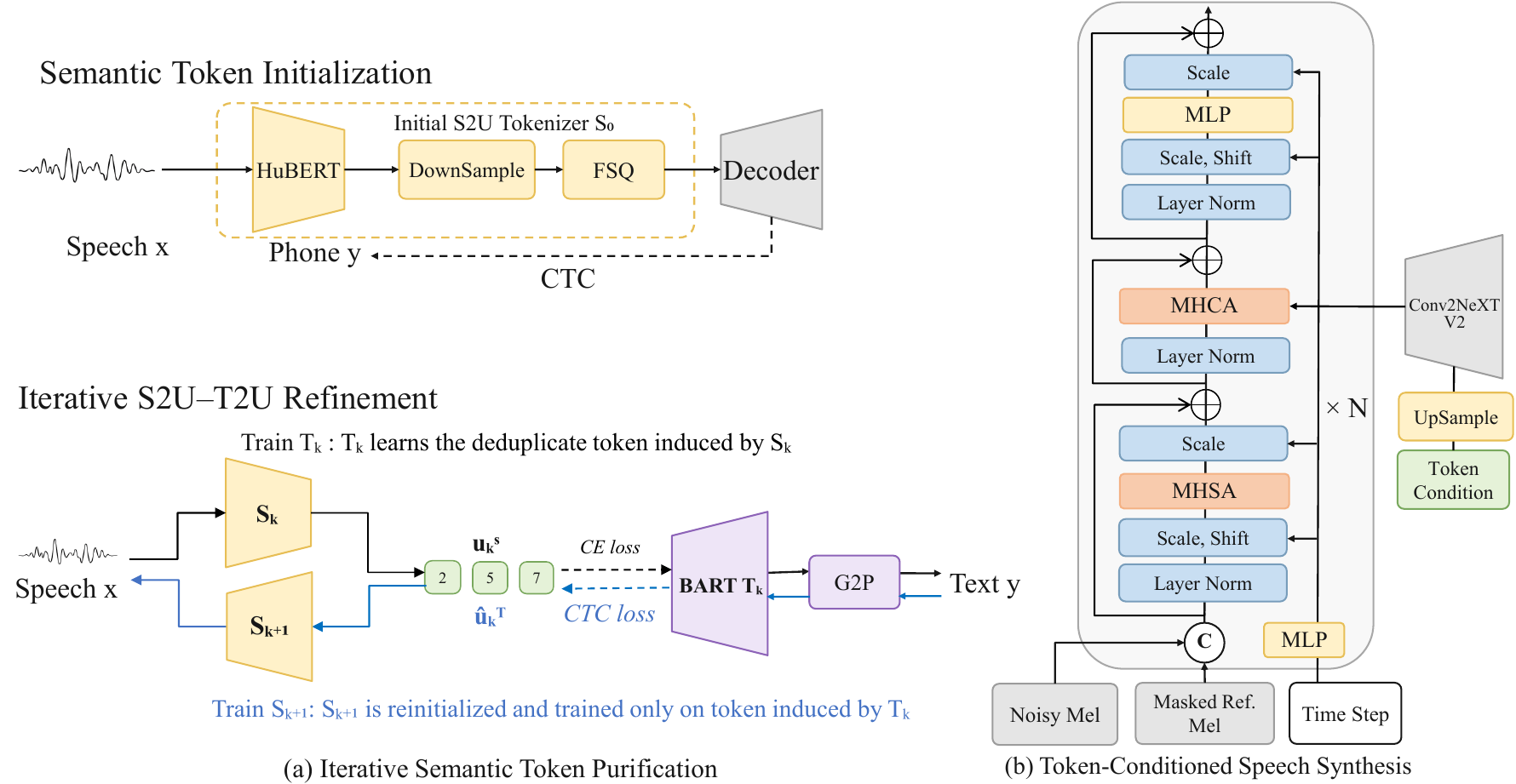
Semantic speech tokens are powerful for language-model-based TTS and voice conversion, but they tend to leak speaker characteristics into what should be purely linguistic codes. Tsinghua University's work addresses this through an iterative S2U–T2U refinement loop: by alternating between speech-to-unit and text-to-unit training — and using text predictability as the guiding signal — the procedure progressively removes speaker variation while preserving linguistic content. The cleaner tokens translate directly into improved voice conversion quality and finer-grained speaking-rate control in synthesis.
Speaker-Normalized Semantic Speech Tokens via Iterative S2U-T2U Refinement
This work refines semantic speech tokens through iterative speech-to-unit and text-to-unit training guided by text predictability. By alternating between modalities, it removes speaker variation while preserving linguistic content, enabling improved voice conversion and synthesis with better speaking-rate control.
Abstract
Semantic speech tokens should preserve linguistic content while suppressing speaker- and duration-dependent variation inherited from acoustic inputs. We propose Iterative Semantic Token Purification (ISTP), an alternating speech-to-unit (S2U) and text-to-unit (T2U) training procedure guided by text predictability. Starting from an initial S2U tokenizer, each iteration trains a T2U model on its deduplicated token sequences. The decoded T2U predictions then serve as connectionist temporal classification targets for a newly initialized S2U model, whose outputs supervise the next T2U model. This cycle progressively aligns the two token generators and biases the token space toward information recoverable from text. Experiments on Mandarin and English show substantially improved S2U--T2U agreement. Independently trained de-tokenizers further show that the refined S2U and T2U tokens retain sufficient content for high-intelligibility voice conversion and text-to-speech synthesis. In voice conversion, the generated speaking rate follows the reference more closely. The refined tokens also exhibit substantially improved cross-speaker consistency and reduced probe-recoverable speaker information.
SpeechLLMs & Spoken Dialogue Agents
Building robots that feel the emotional current of a conversation.
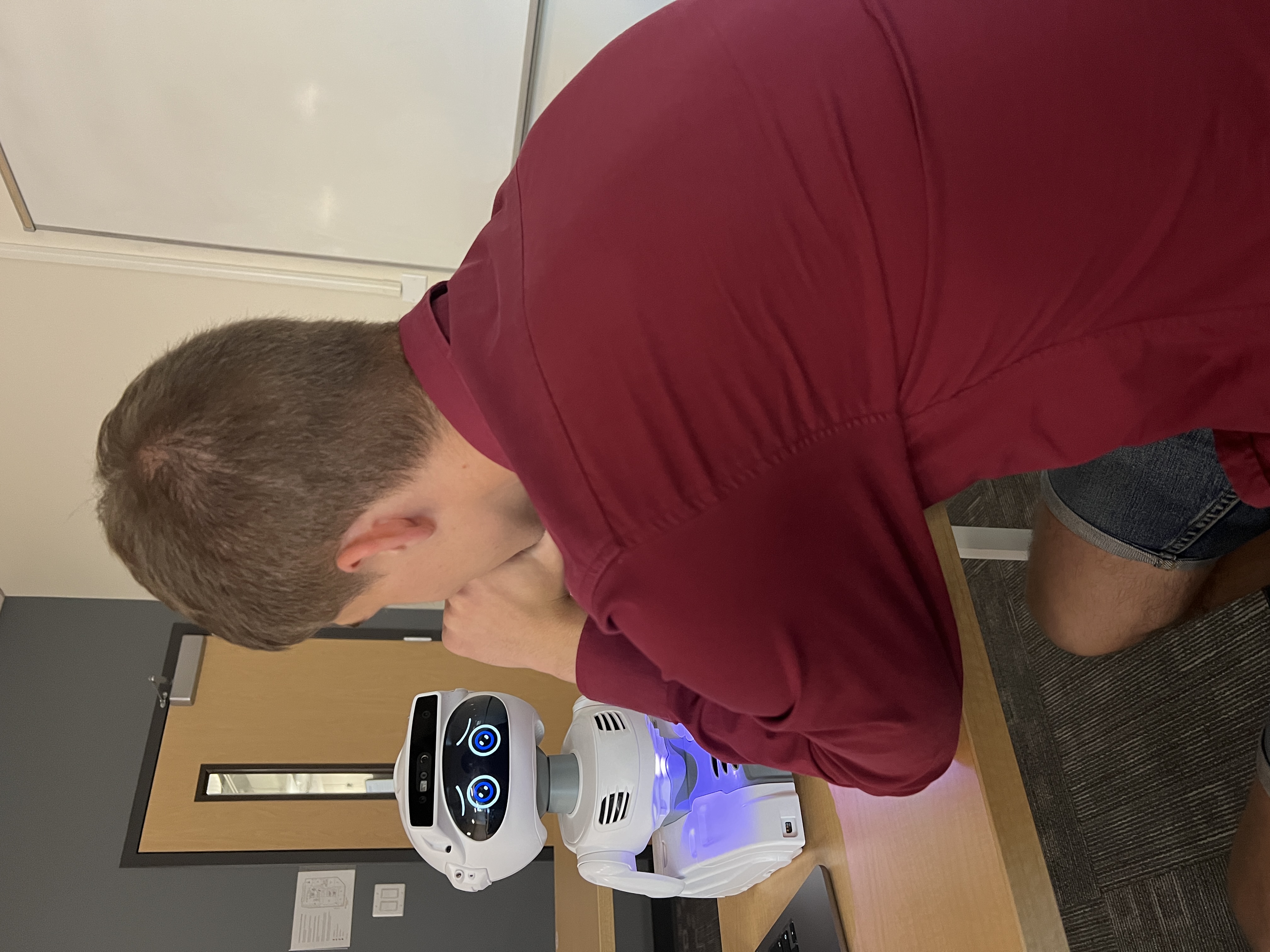
Empathy in social robots typically goes one direction: the robot detects the user's emotion and responds accordingly. The University of Tokyo's system goes further by modeling bidirectional emotional dynamics — tracking both the user's and the robot's own evolving affective states and feeding both into the LLM response generator. This creates a genuine closed affective loop, where verbal responses and physical behaviors are jointly conditioned on the full speaker–listener emotional context, improving empathetic alignment in embodied dialogue.
Closing the Affective Loop: Multimodal Speaker-Listener Emotion-Dynamics-Aware Empathetic Social Robots
An embodied empathetic dialogue system that models bidirectional emotional dynamics between speaker and listener. By conditioning LLM responses on both user and robot emotional states, the system creates a closed affective loop with matched verbal and behavioral outputs, improving empathetic alignment.
Abstract
Empathetic social robots should respond not only to what users say, but also to how their emotions dynamically evolve during interaction. However, existing empathetic dialogue systems are often text-centered and primarily model empathy as a one-way mapping from the user's emotion to the system response, limiting their ability to capture embodied speaker--listener affective exchange. We present AffectLoop, a multimodal speaker-listener emotion-dynamics-aware spoken dialogue system implemented on the Misty II robot. The system tracks the speaker's verbal and facial affective dynamics, estimates the robot listener's own verbal and behavioral affective state, and conditions LLM-based response generation on both affective streams. The robot then generates a short spoken empathetic response together with emotionally congruent embodied behavior, forming a closed speaker--listener affective loop. We evaluate the system in a pilot within-subject study with five participants, comparing it with an otherwise identical utterance-conditioned baseline that omits the speaker- and listener-affective-state inputs. The proposed system received higher overall impression ratings, especially for empathetic response and user satisfaction. Post-hoc log analysis further showed higher speaker-listener affective alignment and stronger valence-based distress recovery. These preliminary results suggest that explicitly modeling both speaker emotional dynamics and listener affective state can improve embodied empathetic interaction.
Trending on Hugging Face

4DAnyone: Create Anyone in 4D from a Casual Monocular Video
4DAnyone reconstructs 4D humans from monocular video by generating multiview-consistent videos and lifting them into 4D Gaussian Splatting, using reference and target context designs to overcome scaling bottlenecks.

OmniFlatten: An End-to-end GPT Model for Seamless Voice Conversation
A novel GPT-based model, OmniFlatten, enables real-time natural full-duplex spoken dialogue through a multi-stage post-training technique that integrates speech and text without altering the original model's architecture.

Qwen3-TTS Technical Report
The Qwen3-TTS series presents advanced multilingual text-to-speech models with voice cloning and controllable speech generation capabilities, utilizing dual-track LM architecture and specialized speech tokenizers for efficient streaming synthesis.

Fish Audio S2 Technical Report
Fish Audio S2 is an open-source text-to-speech system with multi-speaker capabilities, multi-turn generation, and instruction-following control through natural-language descriptions, utilizing a multi-stage training approach and production-ready inference engine.

VibeVoice Technical Report
VibeVoice synthesizes long-form multi-speaker speech using next-token diffusion and a highly efficient continuous speech tokenizer, achieving superior performance and fidelity.