
Real-Time Lip Sync, Streaming TTS, and Prosody-Aware Assistants
Today's digest covers real-time lip synchronization at 166 FPS, causal streaming TTS with 15.8 ms latency, backchanneling in AI clones, and a new benchmark probing whether LLMs act on prosody.
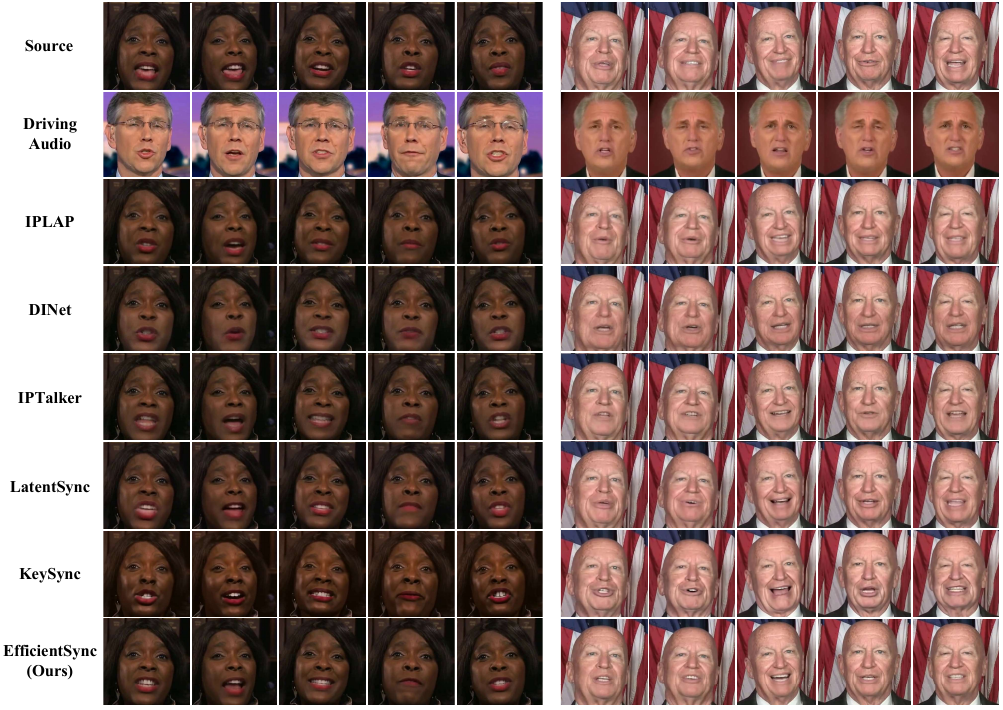
Qualitative comparisons with state-of-the-art works under the cross-audio setting. EfficientSync preserves sharp, identity-consistent intra-oral textures, whereas competing methods either blur the mouth region or hallucinate teeth that deviate from the source identity. From Sun Yat-sen University.
Today's papers push the boundaries of real-time conversational AI across four fronts: a deformation-based approach to lip sync that hits 166 FPS without hallucinating mouth textures, a causal streaming TTS system that handles asynchronous text at sub-16 ms latency, a study on how listening behaviors (nods, backchannels) make AI clones feel more present, and a benchmark from Amazon Alexa AI that exposes a stubborn gap in how LLMs handle prosodic cues.
Talking Avatars & Lip Sync
Making digital faces look and feel more alive — from pixel-perfect mouth synthesis to the subtle art of listening.
Lip sync at real-time speeds almost always involves a trade-off: regenerate the mouth region and risk hallucinating textures, or preserve too much and lose audio accuracy. EfficientSync from Sun Yat-sen University sidesteps this dilemma entirely by rethinking how reference frames are used.
EfficientSync: Real-Time Lip Synchronization via Deformation-Based Reference Texture Mixing
EfficientSync achieves real-time audio-driven lip synchronization by preserving reference textures through deformation-based mixing instead of resynthesizing. By using channel-wise texture selection and adaptive masking, it maintains identity-consistent mouth details at 166 FPS while avoiding hallucination artifacts.
Abstract
Audio-driven lip synchronization manipulates the mouth region of a talking-face video to match the driving audio while preserving head pose, identity, and background. Although the task is inherently local editing, prevailing approaches reconstruct the entire lower face with heavy GAN- or diffusion-based decoders, incurring substantial latency and, more critically, hallucinating intra-oral details such as teeth and lip wrinkles instead of preserving authentic textures. We contend that the bottleneck in identity preservation is not the scarcity of reference frames, but the lack of a mechanism that faithfully transfers the genuine textures they already contain. We therefore present EfficientSync, a real-time deformation-based framework that retains reference textures rather than resynthesizing them. First, the Dynamic Texture Mixer reformulates multi-reference fusion as channel-wise selection, evaluating each spatially aligned reference in a global context and aggregating them by channel-wise weighted summation, preserving textural integrity at low cost. Second, Spatio-Temporal Shifted Adaptive Masking decomposes the source frame into lip-generation conditions and an independent background prior, suppressing lower-face leakage while blending the synthesized mouth seamlessly into the background. Third, STAR Sampling, a zero-overhead pre-processing step, retrieves the sharpest and most topologically diverse reference frames. Experiments on HDTF and VFHQ show state-of-the-art visual quality and identity preservation at 166 FPS on a single GPU. Video demos: https://alunaticat.github.io/EfficientSync/index.html.
Instead of resynthesizing mouth pixels from scratch, EfficientSync selects and deforms textures directly from a pool of reference frames using channel-wise texture selection and adaptive masking. The result is identity-consistent mouth detail at a striking 166 FPS — fast enough for real-time deployment — while avoiding the hallucination artifacts that plague generation-based methods.
---
Authentic AI clones are more than a convincing voice and smart responses — they also need to listen. Kyoto University's study asks a deceptively simple question: does adding listening behaviors to an AI clone actually matter to users?
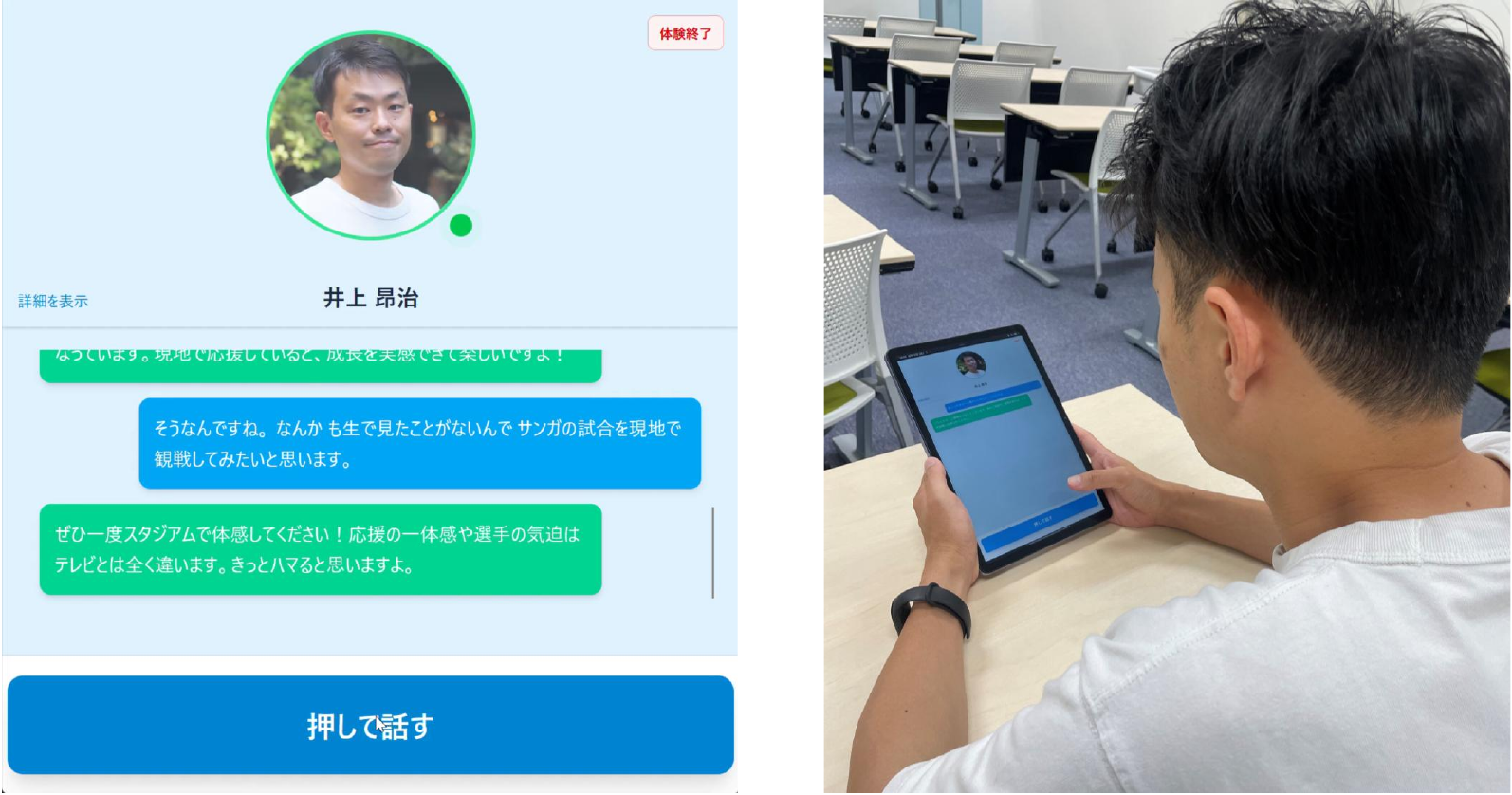
Does Listening Matter? Backchanneling and Nodding in AI Clone
This paper shows that AI clones benefit from adding listening behaviors—backchannels and head nodding—beyond voice and response content. Real-time multimodal listening feedback significantly improves perceived attentiveness and co-presence, demonstrating that interactive listening is essential for clone authenticity.
Abstract
AI clones that imitate a specific person typically reproduce what the person says and how they sound, but not how they listen. We investigate whether adding multimodal listening behaviors gives such a clone more presence and authenticity. We integrated verbal backchannels and head nodding, driven by real-time prediction models, into an AI clone equipped with voice cloning and LLM-based responses. In a within-subjects study (N=35), adding these behaviors significantly improved the perceived attentiveness of the avatar, the sense of talking with the real person, and the feeling of co-presence. These results indicate that AI clone fidelity should extend beyond voice and response content to include interactive listening behavior.
The answer is a clear yes. The paper demonstrates that equipping AI clones with real-time backchannels (verbal listening cues like "mm-hmm") and head nodding significantly improves perceived attentiveness and co-presence during conversation. The finding reinforces that interactive listening feedback is not cosmetic — it is load-bearing for clone authenticity.
TTS & Voice Synthesis
Squeezing latency out of the speech synthesis pipeline for truly responsive voice interfaces.
Streaming TTS is notoriously hard to get right: a system that peeks ahead at future tokens can feel snappy in demos but breaks down when text truly arrives asynchronously from an LLM. X2Streaming-TTS from X-Square Robot tackles this with a strictly causal design.
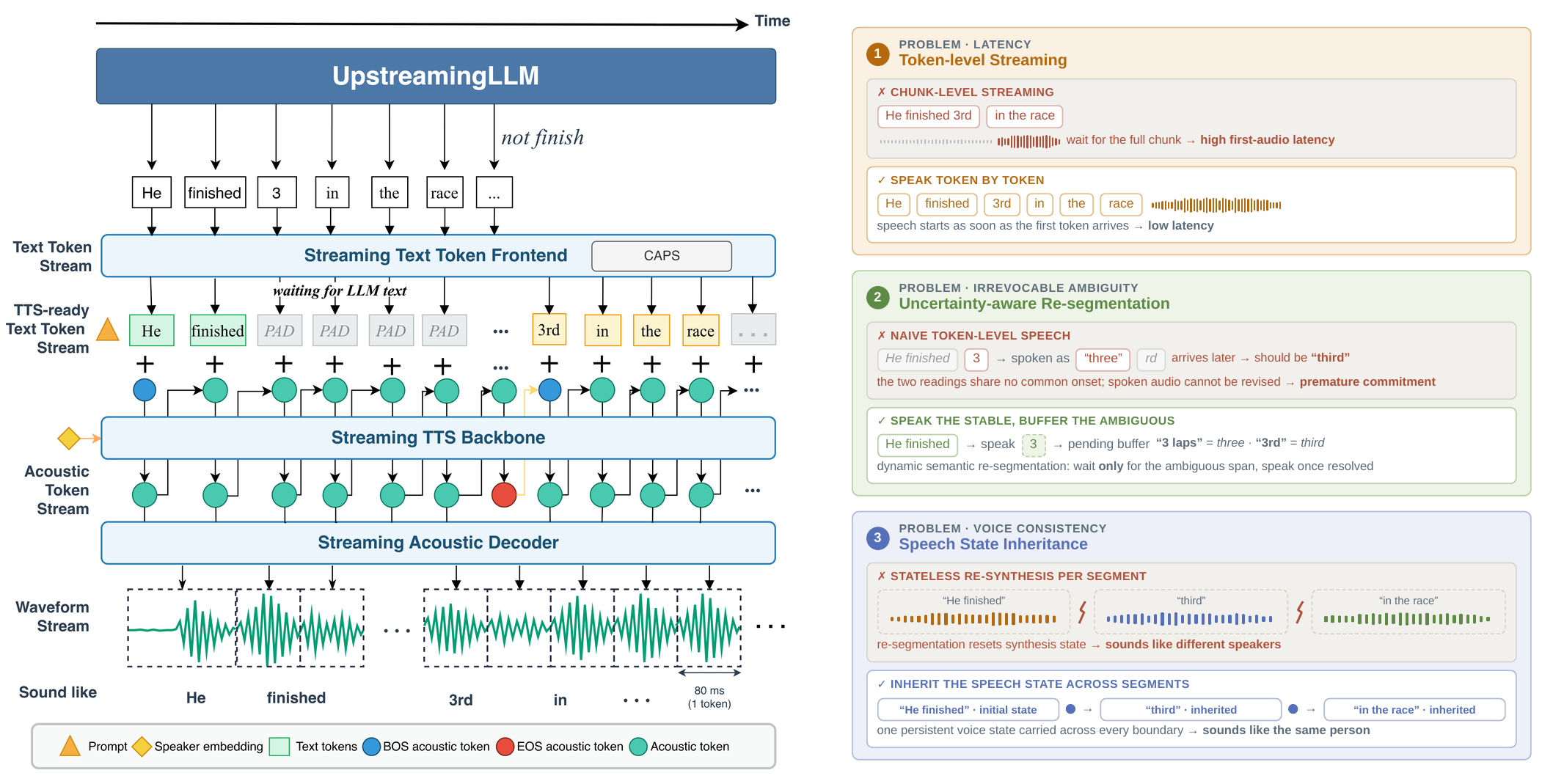
X2Streaming-TTS: Causal Token-Level Text-to-Speech from Streaming Text with Speech-State Inheritance
X2Streaming-TTS enables true token-level speech synthesis from asynchronously arriving text without accessing future input. Using causal commitment and speech-state inheritance, it maintains acoustic continuity and achieves low latency (15.8 ms) while matching offline baseline quality.
Abstract
Streaming text-to-speech is essential for low-latency spoken dialogue systems, yet many systems wait for sentence-level text and are therefore only pseudo-streaming. True token-level synthesis must generate speech from uncertain prefixes while maintaining perceptual continuity over an unbounded stream with bounded context. We present X2Streaming-TTS, a causal TTS framework that consumes asynchronously arriving text tokens and emits speech without accessing future input. To handle uncertain prefixes, we introduce causal commitment, which keeps ambiguous expressions provisional through uncertainty-aware buffering and performs capacity-adaptive, punctuation-aware segmentation. To preserve acoustic continuity, we further introduce causal speech-state inheritance, which carries the complete Code2Wav state and selected historical Talker states across segment boundaries. Together with an attention prior constraint, it blocks access to future positions while retaining bounded acoustic context. Experiments show that X2Streaming-TTS outperforms existing pseudo-streaming models on most subjective and objective metrics. Further analysis shows that causal commitment stabilizes online segmentation and reduces failures caused by insufficient context, while speech-state inheritance improves boundary continuity without degrading naturalness or speaker identity. X2Streaming-TTS thus achieves strict token-level synthesis with quality comparable to the evaluated offline baselines, a median time to first audio token (TTFT) of 15.8 ms for a single request, and a median TTFT of 260.8 ms at 128 concurrent requests. Our implementation is publicly available at https://github.com/X-Square-Robot/X2Streaming-TTS .
The key innovations are causal commitment — deciding how to pronounce each token without future context — and speech-state inheritance, which carries acoustic state across token boundaries to maintain prosodic continuity. The system achieves a first-chunk latency of just 15.8 ms while matching offline baseline quality, making it a compelling drop-in for low-latency voice agent pipelines.
SpeechLLMs & Spoken Dialogue
How well do today's voice-capable LLMs actually hear — and act on — the way something is said?
Prosody carries meaning that words alone cannot: urgency, frustration, sarcasm, emphasis. But do conversational assistants actually use that information when deciding what to do? Amazon Alexa AI's Hear2Act benchmark is designed to find out.
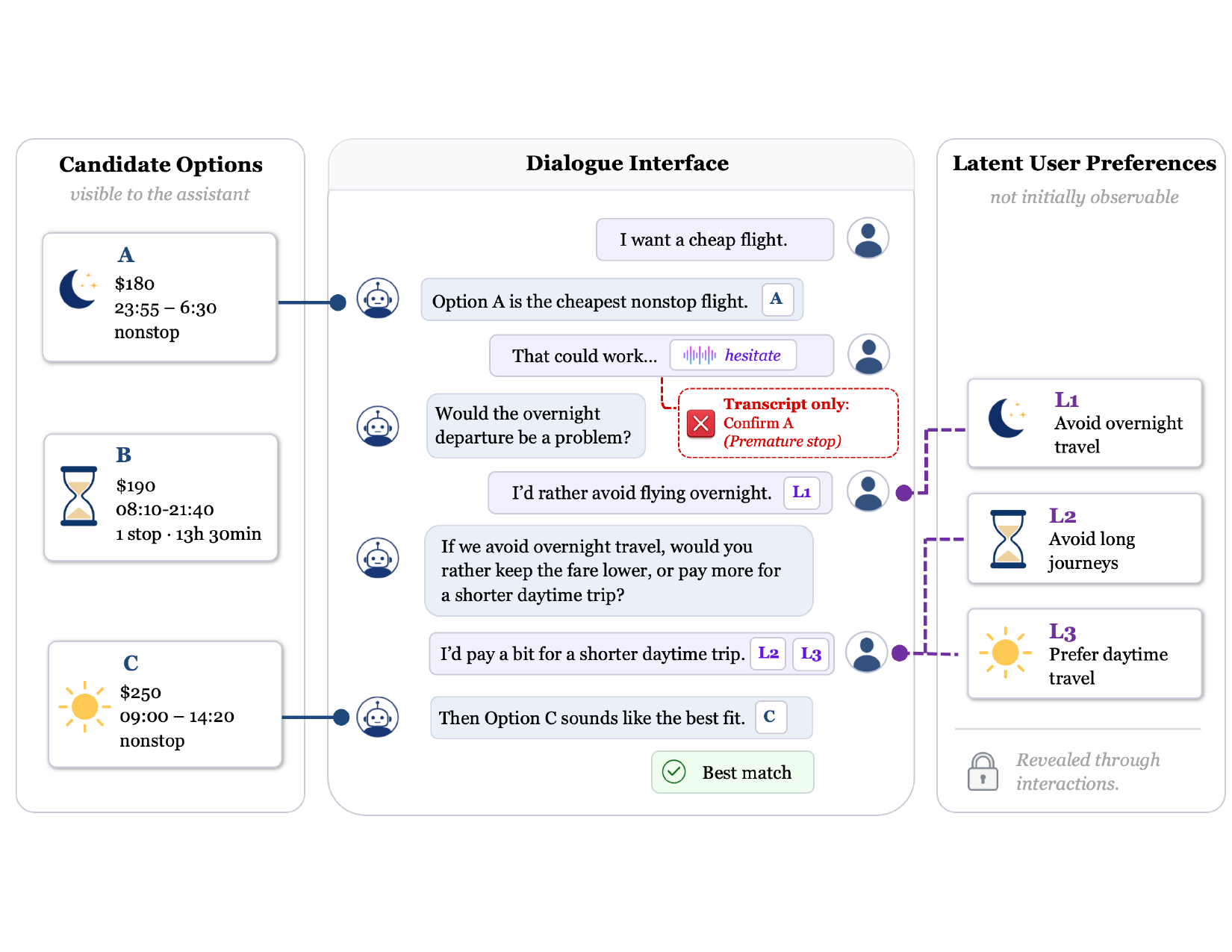
Hear2Act: Benchmarking When Prosody Should Change What an Assistant Does
Hear2Act is a benchmark testing whether conversational assistants change actions based on prosody alone. By controlling what users say while varying how they say it, the work reveals that LLMs extract prosodic information from speech but rarely use it for decisions without explicit intermediate representations.
Abstract
Prosodic cues can convey task-relevant information that alters the trajectory and outcome of a task-oriented dialogue, even when the words themselves remain unchanged. Yet existing benchmarks typically evaluate prosodic perception, response appropriateness, and task-oriented dialogue in isolation, making it difficult to test whether prosodic evidence changes downstream decisions. We introduce Hear2Act, a unified evaluation protocol for text and spoken assistants with 480 persona-grounded scenarios, hidden user concerns, and objectively verifiable outcomes. For each scenario, we keep the task and user needs fixed while varying whether the same concern is conveyed explicitly in words or primarily through prosody, and evaluate decisions under transcript, audio, and concern-state access. Using Hear2Act, we evaluate two audio-capable LLMs. Under Prosody-mediated feedback, adding audio to the transcript changes the average optimal-solution rate only from 14.6% to 15.3%. In contrast, when models infer the concern status from audio, represent it in text, and use it for next-action selection, the rate rises to 39.6%, close to 40.7% with the ground-truth state. This contrast, however, largely disappears under Explicit lexical feedback, where the concern is verbally mentioned in the utterance. Together, these results show that prosody matters when lexical evidence is insufficient, and that audio-capable LLMs can recover information from speech but do not reliably carry it into action without an explicit intermediate representation.
The benchmark holds lexical content constant while varying prosody, then measures whether assistant actions change accordingly. The verdict is sobering: current LLMs do extract prosodic signals from speech, but rarely translate them into behavioral decisions without explicit intermediate representations that surface the prosodic intent. It is a sharp diagnostic for a gap that matters enormously in real-world voice interfaces.
Trending on Hugging Face

4DAnyone: Create Anyone in 4D from a Casual Monocular Video
4DAnyone reconstructs 4D humans from monocular video by generating multiview-consistent videos and lifting them into 4D Gaussian Splatting, using reference and target context designs to overcome scaling bottlenecks.

OmniFlatten: An End-to-end GPT Model for Seamless Voice Conversation
A novel GPT-based model, OmniFlatten, enables real-time natural full-duplex spoken dialogue through a multi-stage post-training technique that integrates speech and text without altering the original model's architecture.

Qwen3-TTS Technical Report
The Qwen3-TTS series presents advanced multilingual text-to-speech models with voice cloning and controllable speech generation capabilities, utilizing dual-track LM architecture and specialized speech tokenizers for efficient streaming synthesis.

Fish Audio S2 Technical Report
Fish Audio S2 is an open-source text-to-speech system with multi-speaker capabilities, multi-turn generation, and instruction-following control through natural-language descriptions, utilizing a multi-stage training approach and production-ready inference engine.

VibeVoice Technical Report
VibeVoice synthesizes long-form multi-speaker speech using next-token diffusion and a highly efficient continuous speech tokenizer, achieving superior performance and fidelity.