
Real-Time Digital Humans: Instant Avatars, Streaming Gestures, and Memory-Augmented Voice
Today's digest focuses on real-time digital human pipelines — from sub-second animatable 3D avatar reconstruction and streaming co-speech gesture generation to a dual-brain memory architecture for emotionally aware speech language models.
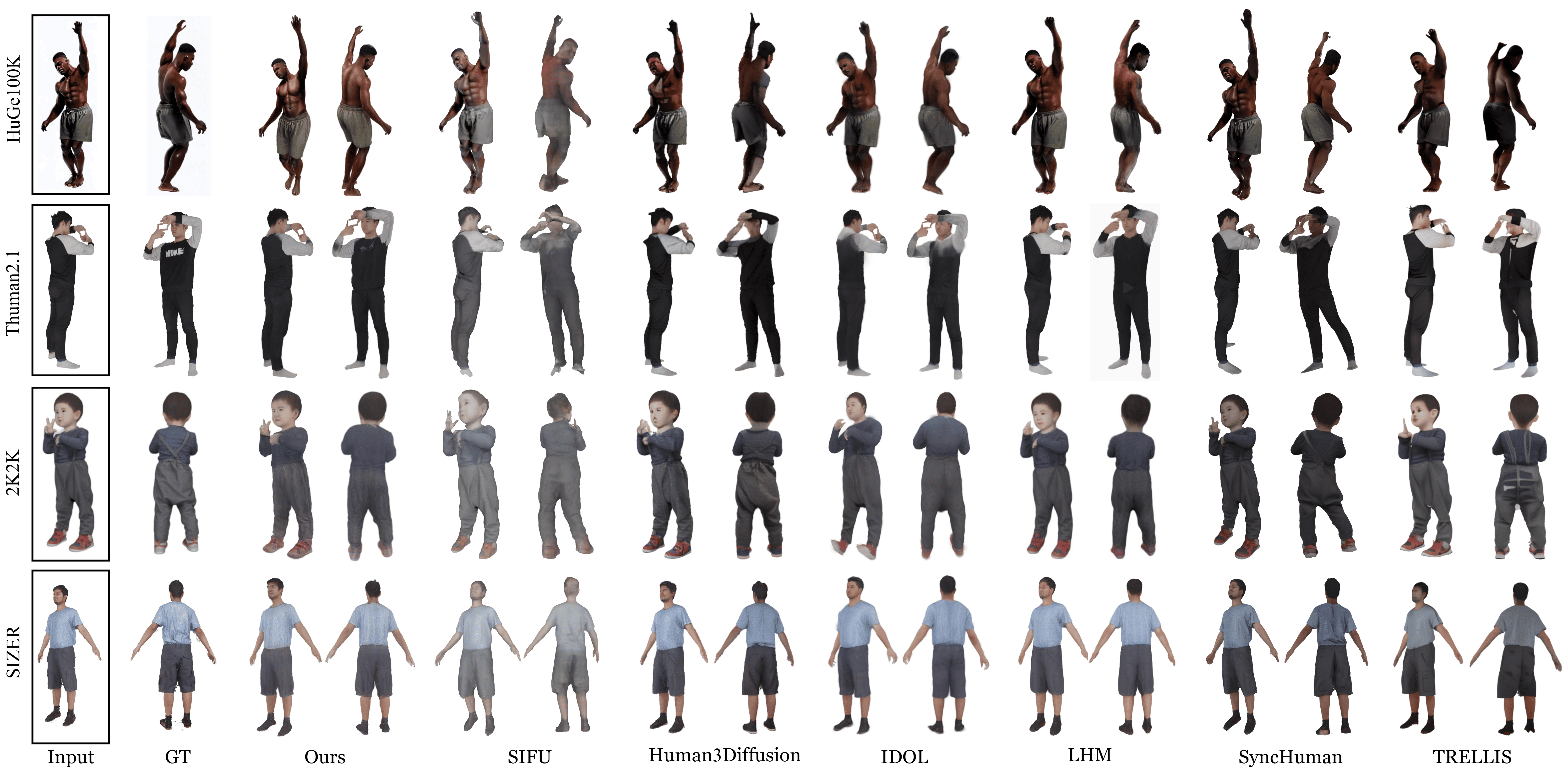
Qualitative comparison on datasets (top-down): HuGe100K, THuman 2.1, 2K2K, and SIZER. Deterministic baselines over-smooth unseen regions, while multi-view diffusion methods exhibit geometric inconsistencies. In contrast, DiGS-Avatar produces sharp, 3D-consistent details. Notably, on the out-of-distribution SIZER dataset (bottom), our method uniquely preserves the complex geometry of loose clothing. From Jilin University.
Today's papers converge on a shared ambition: making digital humans faster, smarter, and more expressive in real time. Whether it's reconstructing a fully animatable avatar from a single photo, generating co-speech gestures as words are still being spoken, or giving a voice assistant long-term emotional memory, the throughline is latency and responsiveness at human scale.
Digital Humans & 3D Avatars
From instant avatar creation to gesture-synchronized interaction — the full stack for lifelike digital presence.
Single-image 3D human reconstruction has long been bottlenecked by the cost of multi-view synthesis pipelines. DiGS-Avatar from Jilin University takes a different route entirely, reformulating the problem as UV-latent diffusion. Instead of generating multiple views and fusing them, it operates directly in UV texture space, sidestepping multi-view consistency issues by construction. A teacher-student framework handles the detail-accuracy tradeoff: the teacher recovers fine surface detail while the student maintains geometric correctness. The result is a fully animatable avatar produced in under one second — a compelling proof that consistency guarantees and speed can coexist.
DiGS-Avatar: Single-Image Animatable 3D Human Reconstruction via UV-Space Diffusion
This paper reformulates single-image 3D human reconstruction as UV-latent diffusion, bypassing expensive multi-view synthesis while guaranteeing 3D consistency. A teacher-student framework recovers fine details while maintaining geometric accuracy, producing fully animatable avatars in under one second.
Abstract
Single-image 3D human reconstruction often suffers from over-smoothed textures and geometric inconsistencies. While diffusion models improve generative quality, their reliance on multi-view synthesis prior to 3D reconstruction is computationally expensive and prone to view inconsistency. We propose DiGS-Avatar, which reformulates this task as an efficient, diffusion-based UV-latent completion task, ensuring 3D consistency by design. To capture accurate spatial structure, we introduce a teacher-student framework where a multi-view teacher provides geometrically aligned pseudo-ground-truth latents to supervise a single-view diffusion student. Treating this inferred latent as a robust structural skeleton, our method injects high-level semantic features to accurately recover fine textural details without disrupting spatial integrity. The refined representation is then decoded into 3D Gaussian primitives. Extensive experiments demonstrate that DiGS-Avatar achieves state-of-the-art or highly competitive visual fidelity and zero-shot generalization, while reconstructing a fully animatable 3D avatar in just 0.71 seconds. Code is available at https://github.com/KLMAV-CUC/DiGS-Avatar.
Animatable avatars are only half the story — they also need to move naturally during speech. Super Star, featured today from the Hugging Face Daily tab, tackles real-time co-speech gesture generation with a causal multimodal autoregressive model that consumes streaming speech and motion history simultaneously. The key practical contributions are a synthetic dialogue dataset for training and a continual user-feedback adaptation loop, so the agent's gesture style can be personalized on the fly. The streaming-first, causal design means gestures are generated as speech arrives — no lookahead buffering required.

Super Star: Towards Streaming Real-time Interactive Agents for Digital Humans
A real-time framework for online co-speech gesture generation uses a causal multimodal autoregressive model with streaming speech and motion history, supported by synthetic dialogue data and continual user-feedback adaptation.
Abstract
Existing co-speech gesture generation methods are predominantly studied in offline settings, where gestures are synthesized from complete speech segments. However, interactive digital humans in real-world scenarios are required to generate speech-synchronous gestures online, using only currently available response audio under strict latency constraints. As a result, prior methods are unsuitable for real-time interaction, as they either rely on future speech information or incur substantial inference delay. In this paper, we formulate online co-speech gesture generation for interactive digital humans and propose a real-time interactive framework that couples a streaming speech response module with an online gesture generation module. Specifically, the gesture generator is designed as a causal multimodal autoregressive model that predicts body motion from streaming response speech and motion history, enabling low-latency and speech-aligned gesture synthesis without access to future speech. To support this setting, we further propose an offline data synthesis pipeline tailored to virtual companion scenarios, which leverages topic- and emotion-aware subject corpora to construct diverse human-agent dialogues and then generates co-speech gestures conditioned on the agent responses. Moreover, to bridge the gap between offline data construction and online deployment, we establish a self-evolving training loop by incorporating user feedback collected during online interaction into the data generation process, enabling continual adaptation to user preferences. Extensive experiments demonstrate that our framework achieves superior better latency-quality trade-off, stronger speech-motion synchronization, and higher user preference than competitive existing baselines. Project Page: https://super-star-2026.github.io/
Speech Language Models & Memory
Giving voice agents the memory to remember who they're talking to.
Even the most expressive avatar falls flat if the voice behind it has no memory of past interactions. VoiceMem from Nanyang Technological University, also from today's Hugging Face Daily tab (104 upvotes), addresses this with a dual-brain streaming memory architecture for speech language models. Inspired by cognitive memory systems, the dual-brain design separates fast, short-term retrieval from slower, long-term personalization — enabling improvements in retrieval accuracy, emotional personalization, and real-time efficiency within a single unified framework. It's a timely addition to the growing literature on stateful, relationship-aware voice agents.

VoiceMem: Streaming Dual-Brain Memory for Real-Time Interaction
VoiceMem introduces a dual-brain streaming memory architecture for speech language models that improves retrieval accuracy, emotional personalization, and real-time efficiency.
Abstract
Conversational systems, such as duplex speech language models (SLMs), still lack a streaming, accurate, and empathetic memory system as their soul. We introduce VoiceMem, a simple memory architecture with a parallel informational left brain, an emotional right brain, and streaming memory I/O mechanisms. We further build a complete pipeline for memory-aware SLM training, long-horizon evaluation, and decoupled deployment with interchangeable memory backends. Experiments and real-world deployment show three advantages: i) Accuracy: under top-5 retrieval, the left brain outperforms classical systems such as Mem0 at top-200 by nearly 30 points; ii) Emotional & Personal: the right brain, with short- and long-horizon affective attribution and dual-node persona modeling, achieves state-of-the-art performance across three persona benchmarks and improves the aggregate score by 4.29 points over the previous best system; and iii) Real-Time & Cheap: VoiceMem completes retrieval in 134 ms, well within standard VAD latency, adding no extra conversational delay while maintaining high accuracy and low cost. These results show that VoiceMem provides a practical memory foundation for real-time, personalized, and emotionally aware speech interaction.
Trending on Hugging Face

OmniFlatten: An End-to-end GPT Model for Seamless Voice Conversation
A novel GPT-based model, OmniFlatten, enables real-time natural full-duplex spoken dialogue through a multi-stage post-training technique that integrates speech and text without altering the original model's architecture.

VibeVoice Technical Report
VibeVoice synthesizes long-form multi-speaker speech using next-token diffusion and a highly efficient continuous speech tokenizer, achieving superior performance and fidelity.