
Training-Free Watermarking for Flow Matching TTS
Today's digest spotlights AudioNoisePrints, a model-free watermarking technique that embeds provenance signals directly into flow matching TTS synthesis by exploiting spatial correlations in the initial noise — no training, no quality loss.
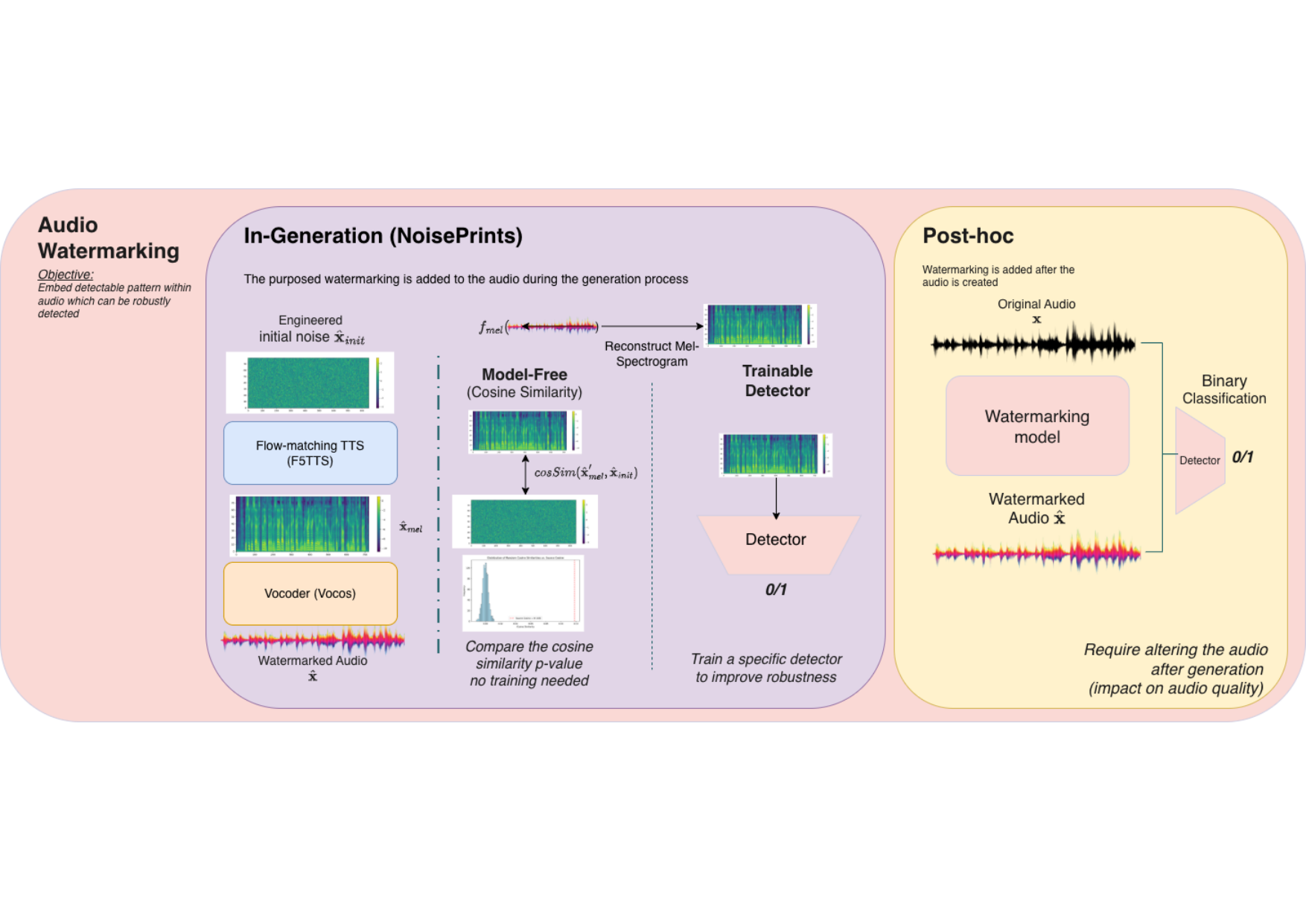
General overview of our approach ( ) comparing to the commonly used post-hoc watermarking schemes. As shown above, the post-hoc watermarking model required altering the audio after it is generated, which creates computation overhead and alters the quality of the audio. Our method simply changes the initial noise $ _init$ during generation (without altering the quality of the generated audio), and uses either the model-free option (calculating the cosine similarity of the audio-Mel-spectrogram and the initial noise) or the more robust detector option to determine if the audio is in fact watermarked. From Independent Research.
As synthetic speech becomes increasingly indistinguishable from human recordings, provenance and attribution tooling is lagging behind. Today's digest focuses on a single sharp contribution that addresses this gap head-on — embedding watermarks inside the generative process itself rather than bolting them on afterward.
TTS & Voice Synthesis
Watermarking without the overhead: exploiting flow matching internals
Post-hoc audio watermarking — slapping a signal onto already-generated audio — has always been a compromise: you risk perceptible artifacts, you add latency, and the watermark can be stripped by simple augmentations. A cleaner alternative is to encode the watermark during synthesis, but that typically means retraining or fine-tuning the model. AudioNoisePrints sidesteps both problems entirely.
The key insight is that flow matching TTS models exhibit strong spatial correlations between the initial noise sample drawn at inference time and the final generated waveform. By carefully engineering that initial noise — embedding a structured "noise print" into it — the watermark propagates deterministically through the flow and survives in the output audio without any model modification, quality degradation, or extra inference cost.
AudioNoisePrints: Model-free audio watermarking using spatial correlation in flow matching TTS
AudioNoisePrints enables training-free watermarking of TTS audio by exploiting spatial correlations between initial noise and generated output in flow matching models. Unlike post-hoc approaches, it embeds the watermark during synthesis without quality loss or overhead, offering improved robustness to augmentations.
Abstract
We present AudioNoisePrints, a training-free watermarking pipeline for flow matching and diffusion TTS models, which requires minimal extra computation during inference and does not require retraining the TTS model or reducing the generation quality. We exploited the fact that there are strong correlations between the initial Gaussian noises and the generated outputs in diffusion and flow matching models, such that a simple cosine correlation between the initial noise and the generated output can be used to perform watermaking. Moreover, we train a lightweight detector on top for more aggressive augmentations. Our method outperforms AudioSeal, a strong baseline for audio watermarking under strong augmentations. We experimented on F5TTS and other TTS and vocoder models, and concluded that they all exhibit similar spatial correlation properties, suggesting our watermarking scheme can be used for more flow-matching TTS models and even vocoders in the future.
Because the watermark lives in the noise prior rather than the output signal, it is naturally more robust to common post-processing augmentations (compression, resampling, light filtering) that would wash out a post-hoc tag. The approach is also model-free in the sense that it requires no access to model weights or gradients — only the ability to supply an initial noise tensor at inference time, which is standard in virtually all flow matching pipelines. This makes AudioNoisePrints a compelling drop-in provenance layer for any production TTS system built on flow matching, from Voicebox-style architectures to the growing family of latent diffusion speech models.
Trending on Hugging Face

4DAnyone: Create Anyone in 4D from a Casual Monocular Video
4DAnyone reconstructs 4D humans from monocular video by generating multiview-consistent videos and lifting them into 4D Gaussian Splatting, using reference and target context designs to overcome scaling bottlenecks.

VoiceMem: Streaming Dual-Brain Memory for Real-Time Interaction
VoiceMem introduces a dual-brain streaming memory architecture for speech language models that improves retrieval accuracy, emotional personalization, and real-time efficiency.

OmniFlatten: An End-to-end GPT Model for Seamless Voice Conversation
A novel GPT-based model, OmniFlatten, enables real-time natural full-duplex spoken dialogue through a multi-stage post-training technique that integrates speech and text without altering the original model's architecture.

Qwen3-TTS Technical Report
The Qwen3-TTS series presents advanced multilingual text-to-speech models with voice cloning and controllable speech generation capabilities, utilizing dual-track LM architecture and specialized speech tokenizers for efficient streaming synthesis.

VibeVoice Technical Report
VibeVoice synthesizes long-form multi-speaker speech using next-token diffusion and a highly efficient continuous speech tokenizer, achieving superior performance and fidelity.