
Compressing Avatars, Transitioning Emotions, and Peeking Inside Audio LLMs
Today's digest covers semantic-aware compression for 3D Gaussian head avatars, intra-utterance emotion transitions in TTS, and a new probe into the hidden multilingual reasoning of audio language models.
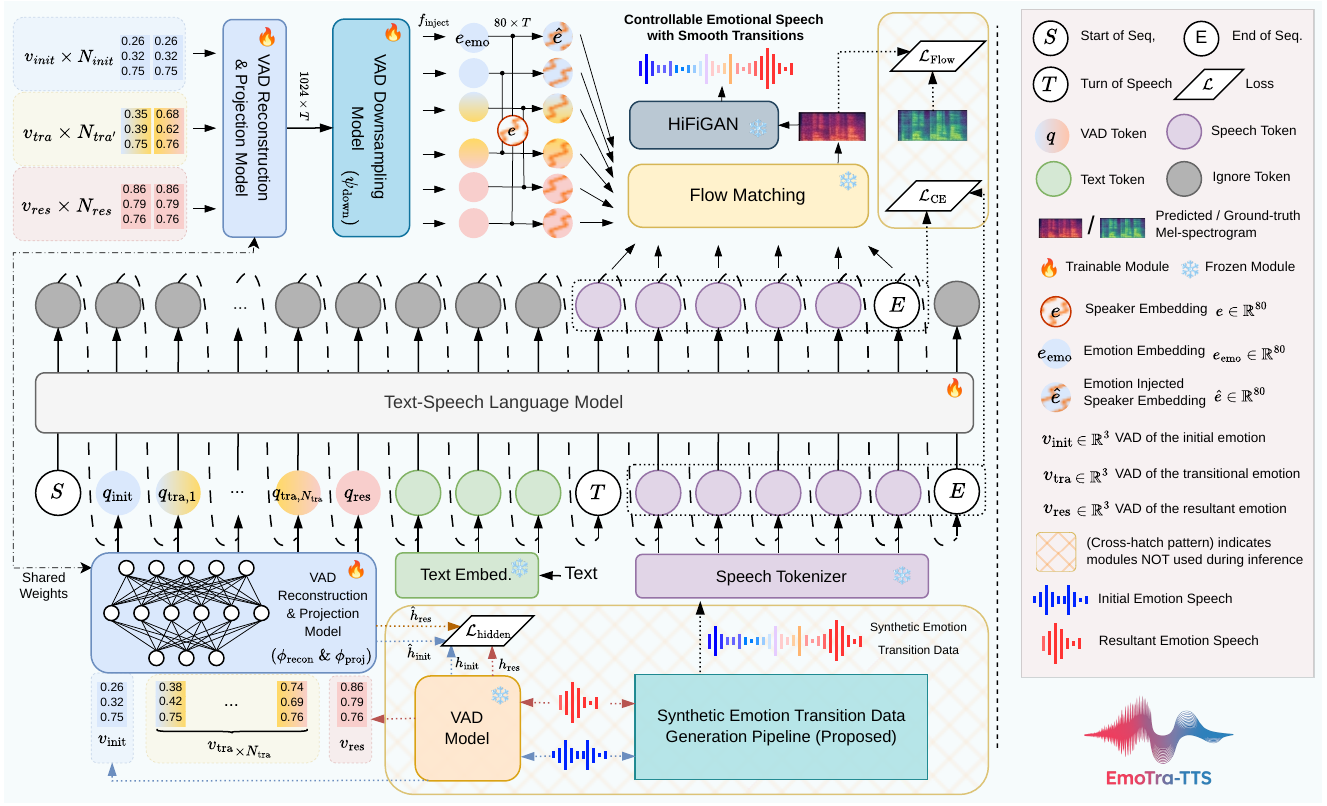
Overview of the EmoTra-TTS. Lower part: LLM stage with temporal VAD tokens ( ). Upper part: Flow decoder with frame-level emotion injection via direction--magnitude decoupled injection ( ). From Alibaba DAMO Academy.
Today's three papers span the full stack of conversational AI: from streaming dynamic face avatars efficiently over the wire, to synthesizing speech that shifts emotion mid-sentence, to interrogating what an audio LLM is actually "thinking" before it speaks. Each tackles a different layer of the pipeline — rendering, synthesis, and model interpretability — and together they paint a vivid picture of where the field is pushing next.
Digital Humans & 3D Head Avatars
Making 3DGS head avatars compact enough for real-world transmission.
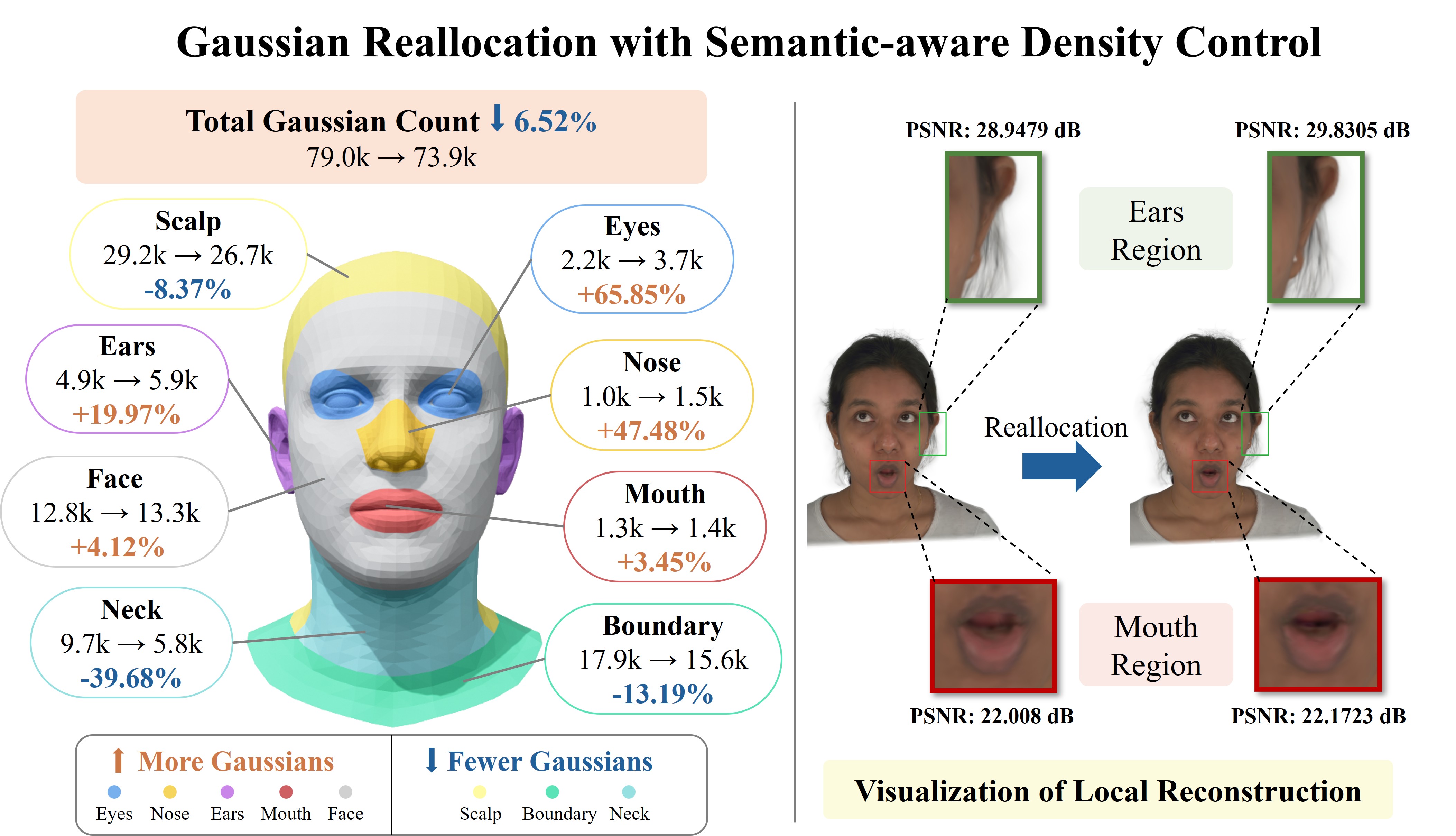
Streaming photorealistic head avatars remains a bandwidth and compute challenge, especially as 3D Gaussian Splatting (3DGS) representations balloon in primitive count. City University of Hong Kong's SACHA directly attacks this with a two-pronged compression strategy: semantic-aware density control allocates Gaussian primitives according to the saliency of each facial region (eyes and mouth get more; background skin gets fewer), while an appearance-motion decomposition strips out temporal redundancy across frames before encoding. The result is efficient transmission of dynamic avatars without sacrificing rendering quality.
SACHA: Semantic-Aware Compression for 3D Gaussian Head Avatars
SACHA compresses 3D Gaussian head avatars using semantic-aware density control that allocates primitives based on facial region saliency, combined with appearance-motion decomposition to reduce temporal redundancy. This achieves efficient transmission of dynamic avatars while preserving rendering quality.
Abstract
Animatable 3D Gaussian head avatars offer high-fidelity and flexible facial rendering, but typically require substantial storage and transmission costs for numerous Gaussian primitives. Existing Gaussian head avatar methods overlook the visual saliency of different head semantic regions for more appropriate Gaussian primitive allocation, as well as the efficient compression of trained head avatar sequences. To tackle this obstacle, we propose SACHA, a dynamic head avatar compression framework that leverages both semantic-aware density control and appearance-motion decomposition to achieve compact representation and high-quality novel-view rendering of head avatar sequences. Specifically, the semantic-aware density control guides the adaptive allocation of Gaussian primitives across different head regions with region-adaptive densification and pruning. In addition, the appearance-motion decomposed compression further reduces the temporal redundancy of the avatar sequence by transmitting only head-prior parameters for avatar movements. Together, these designs enable a compact representation for efficient transmission of dynamic Gaussian head avatars while preserving visual fidelity. Experiments demonstrate that SACHA achieves a superior rate-distortion performance over existing Gaussian head avatar representation and compression methods while maintaining high-quality novel-view and novel-expression rendering.
TTS & Voice Synthesis
Beyond the single static emotion label — letting speech feel.
Nearly every emotion-aware TTS system today stamps a single label on an entire utterance, ignoring the natural ebb and flow of feeling within a sentence. Alibaba DAMO Academy's EmoTra-TTS breaks this convention by conditioning the synthesizer at the frame level using continuous Valence-Arousal-Dominance (VAD) coordinates, enabling smooth, fine-grained emotion transitions within a single utterance. Crucially, the approach introduces no latency overhead and delivers a 30–87% relative improvement over state-of-the-art baselines — a striking gain that underscores just how much expressiveness the static-label paradigm leaves on the table.
EmoTra-TTS: Smooth Intra-Utterance Emotion Transitions for Speech Synthesis
EmoTra-TTS synthesizes speech with smooth emotion transitions within utterances using frame-level Valence-Arousal-Dominance conditioning, moving beyond the single static emotion label paradigm of current systems. The approach achieves 30-87% relative improvement over SOTA baselines with no latency overhead.
Abstract
Psychological research on emotion dynamics has established that human affect is a continuous, evolving process: emotions rise, decay, and transition within seconds. Current emotional text-to-speech (TTS) systems, however, condition on a single discrete label or static embedding per utterance, fundamentally misaligning with the temporal nature of affect. While recent LLM-based TTS systems may implicitly vary prosody through text understanding, such variation is neither explicitly controllable nor precise enough for targeted intra-utterance transitions. We address three challenges: (1) a multi-pass flow blending pipeline synthesizes frame-aligned transition audio, circumventing the scarcity of natural intra-utterance transitions; (2) dual-stage Valence-Arousal-Dominance (VAD) conditioning guides prosodic planning in the LLM and acoustic realization in the flow decoder via frame-level VAD embeddings; (3) direction-magnitude decoupled injection structurally separates emotion direction from injection magnitude, preventing content degradation. EmoTra-TTS adds only +0.43% parameters with no latency overhead, achieves 30%-87% relative improvement on emotion transition quality, corroborated by 64.4%-79.5% overall win rates in pairwise preference tests against four SOTA baselines and two commercial systems.
SpeechLLMs & Audio Language Models
Opening the black box: what is an audio LLM reasoning about before it answers?
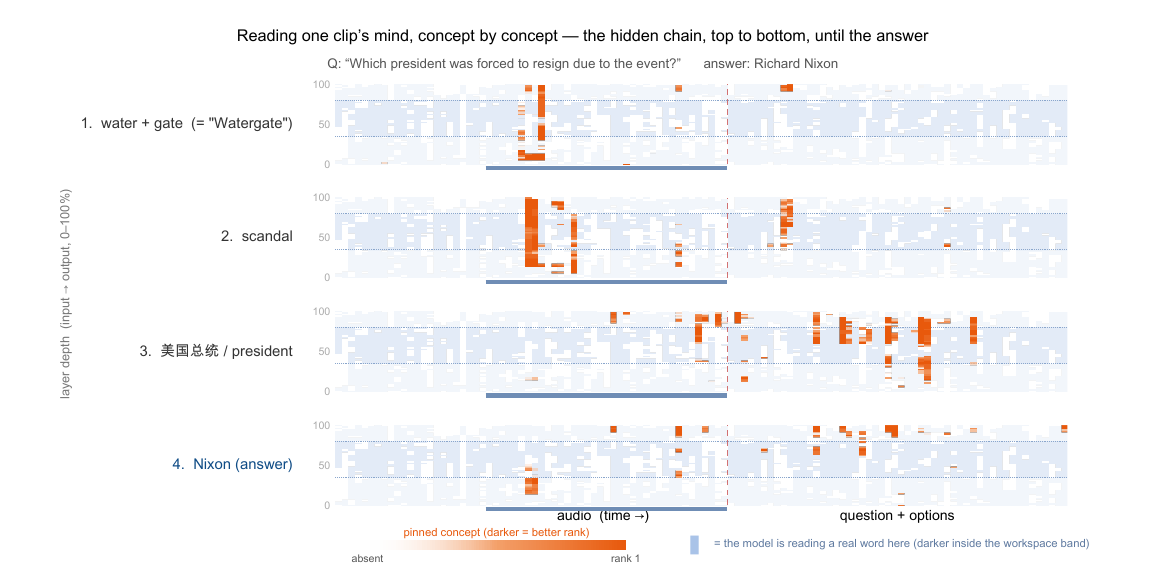
Interpretability research on audio language models is still nascent, and Amazon's work here is a genuine step forward. The paper probes the middle layers of an audio LLM to decode verbalizable concepts — effectively reading the model's intermediate "workspace" before any output is generated. What they find is striking: the model performs multi-hop inference that never surfaces in its final transcription, this internal reasoning is language-agnostic (consistent across multilingual inputs), and the middle-layer representations capture paralinguistic information — speaker affect, prosody, intent — that the output captions simply omit. It's a rare window into the hidden cognition of a speech foundation model.
Can We Read the Mind of an Audio LLM? A Verbalizable, Multilingual Middle-Layer Workspace
This work decodes verbalizable concepts from an audio LLM's middle layers to reveal reasoning before output generation. It exposes hidden multi-hop inference invisible in the model's transcription, showing this reasoning is language-agnostic and captures paralinguistic information absent from captions.
Abstract
An audio language model is a black box in a specific way: we see what it says, never what it works out on the way there, and chain-of-thought monitoring helps only if the model writes its reasoning down. Reading a base Qwen3-Omni with a logit lens at the audio-token positions, we find that the answer to a spoken question becomes legible - in words - in the model's middle layers, before it emits any token. Five findings follow. (1) The readout carries concepts in neither the question, the options, nor the model's own transcription: on a clip whose verbatim transcription is empty garbling, it reconstructs Watergate and scandal, passes through the role president, and resolves to Nixon - a hidden multi-hop chain, read with no chain-of-thought. (2) The content is language-agnostic: one audio-inferred concept surfaces in several scripts at once, and 38% of top-1 readouts are Chinese on English inputs. (3) It is paralinguistic: given the same clip as audio and as the model's own emotion-free caption, the audio mind forms the sound source, speaker role, or affect that the caption discards, and answers correctly more often. (4) The audio-driven signal is absent at the input, turns on about a tenth of the way into the network, separates most cleanly from the text prior in the middle band (35-80% of depth), and activation patching shows it is causally used and committed before the last fifth of the layers. (5) Deleting single layers maps the pipeline: reading the sound in is localized to the entry layers and answer delivery to the output layer, while retrieval is distributed across the interior. Throughout, a waveform-swap control - identical text, only the sound changed - isolates the audio-driven signal from a prior over the printed options. This is a qualitative account of what an audio model works out before it speaks: the quantities are controls, not benchmark scores.
Trending on Hugging Face

VoiceMem: Streaming Dual-Brain Memory for Real-Time Interaction
VoiceMem introduces a dual-brain streaming memory architecture for speech language models that improves retrieval accuracy, emotional personalization, and real-time efficiency.

OmniFlatten: An End-to-end GPT Model for Seamless Voice Conversation
A novel GPT-based model, OmniFlatten, enables real-time natural full-duplex spoken dialogue through a multi-stage post-training technique that integrates speech and text without altering the original model's architecture.

Qwen3-TTS Technical Report
The Qwen3-TTS series presents advanced multilingual text-to-speech models with voice cloning and controllable speech generation capabilities, utilizing dual-track LM architecture and specialized speech tokenizers for efficient streaming synthesis.

Fish Audio S2 Technical Report
Fish Audio S2 is an open-source text-to-speech system with multi-speaker capabilities, multi-turn generation, and instruction-following control through natural-language descriptions, utilizing a multi-stage training approach and production-ready inference engine.

VibeVoice Technical Report
VibeVoice synthesizes long-form multi-speaker speech using next-token diffusion and a highly efficient continuous speech tokenizer, achieving superior performance and fidelity.