
Voice Agents, Gesture Control, and Smarter ASR Augmentation
Today's digest covers reinforcement learning for audio-native voice agents, two new frontiers in co-speech gesture generation for streaming and humanoid robots, adaptive contrastive decoding for noisy audio-visual ASR, and a phoneme-guided TTS pipeline for multilingual ASR augmentation.

Figure from From Amazon.
Today's papers span the full voice stack — from training voice agents end-to-end in raw audio, to making co-speech gestures spatially controllable and robot-deployable, to sharpening ASR robustness and data augmentation pipelines. A productive Wednesday across Amazon, Google Research, Tsinghua, Yonsei, and beyond.
SpeechLLMs & Voice Agents
Closing the loop: reinforcement learning directly in the audio domain, no ASR/TTS crutches.
End-to-end voice agents have long relied on a cascade of ASR and TTS components, introducing latency and error accumulation. Amazon's SpeechGym takes a different approach, building an audio-native gym environment that lets voice agents train via RL entirely in raw audio — no external speech APIs in the loop. Crucially, the paper diagnoses where audio agents actually fail: not in reasoning, but in perceptual errors — misheard arguments in tool calls. The fix is process-reward RL, which provides denser training signals than outcome-reward alone and directly targets these perceptual shortcomings.
SpeechGym: An Audio-Native Gym for Training Voice Agents via Reinforcement Learning
SpeechGym enables end-to-end reinforcement learning for voice agents in native audio without external ASR/TTS APIs. It identifies that audio failures stem from perceptual errors (misheard arguments in tool calls) rather than reasoning, addressable through process-reward RL for denser training signals.
Abstract
Voice agents must call tools and hold multi-turn dialogue entirely through speech, yet the dominant paradigm trains them in text. Existing frameworks either cascade TTS and ASR around a proprietary voice API, where gradients cannot flow and per-call cost makes on-policy reinforcement learning prohibitive, or stay in text: they measure voice agents but cannot improve them. We present SpeechGym, an audio-native agentic environment in which two omni-modal models converse in native audio, with no external ASR or TTS and no API boundary, over the unmodified tasks, tools and success check of an established text agentic benchmark, so that the interaction modality is the only variable and the loop stays local and trainable end to end. Audio agentic capability does not follow from audio understanding. The failures speech introduces are perceptual rather than reasoning deficits: the agent picks the right tool and the right argument slot but fills it with a value misheard from the waveform, and that single error cascades into a failed call, a retry of the same call, and a wasted step budget. A second failure is behavioural: under an insistent caller the agent performs an unauthorised write and ends the episode believing it helped. Both are trainable, because the environment labels them for free: a call with a misheard argument fails against the database while a correct one succeeds. The obstacle is sparsity, not signal. Outcome-only GRPO is gradient-starved here, since almost every rollout group fails identically, while a per-turn process reward crediting each successful tool call restores variance to nearly every group. Trained this way, the agent transfers with no further tuning to an independently implemented voice benchmark, more than doubling task success and carrying an open-weights model from last place to second on that leaderboard, while using fewer turns and tokens than before training.
Co-Speech Gesture Generation
Two papers push co-speech gestures in complementary directions: one toward spatial user control in streaming, the other toward real-time humanoid deployment.
Streaming gesture generation has a fundamental tension: once a motion chunk is committed and rendered, it can't be revised — which means late-arriving spatial constraints have nowhere to go. InteractGesture from Google Research tackles this with Progressive Chunk Guidance (PCG), an inference-time diffusion guidance technique that propagates spatial constraints across chunk boundaries without retraining. Rather than freezing past motion and hoping future chunks align, PCG lets control signals flow forward and backward in the generation window, enabling genuinely interactive spatial editing of continuous gesture streams.
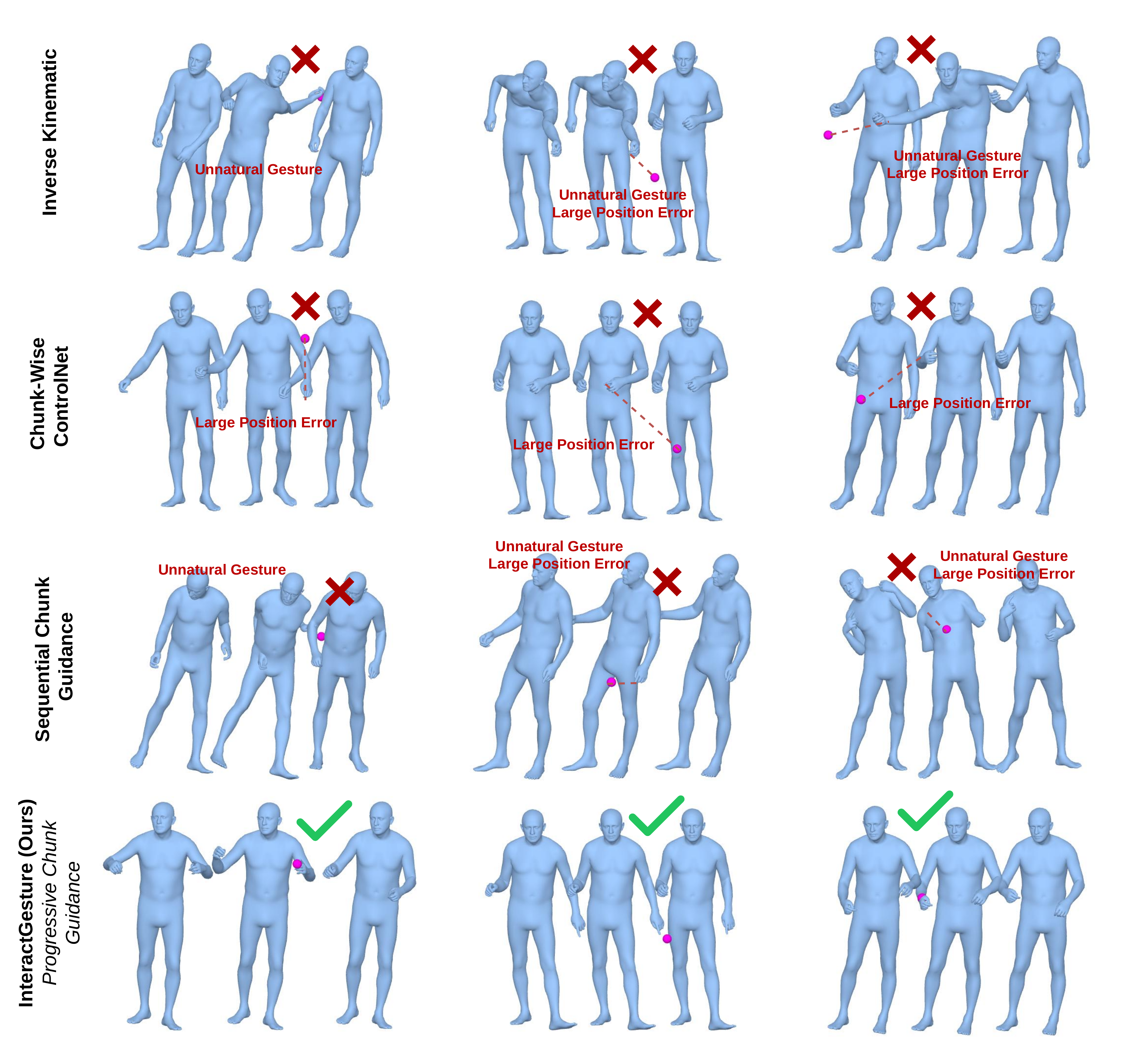
InteractGesture: Progressive Chunk Guidance for Continuous Streaming Co-Speech Gesture Control
Spatially controllable co-speech gestures via inference-time diffusion guidance. Progressive Chunk Guidance enables spatial constraints to propagate across streaming chunk boundaries, solving the problem where sequential generation freezes past motion and prevents future controls from refining earlier trajectories.
Abstract
Co-speech gesture generation has made significant progress toward realistic full-body motion from speaker audio, yet existing models lack fine-grained spatial controllability of individual joints. To address this, we introduce \emph{InteractGesture}, a model-agnostic, inference-time method for spatially controllable gesture generation. \emph{InteractGesture} guides target latent estimates of a diffusion sampler through a differentiable RVQ-VAE decoder, backpropagating spatial control gradients to adjust motion latents during sampling. A primary challenge in streaming co-speech generation is chunk-wise dependency: standard sequential inference freezes prior chunks, preventing spatial constraints in future chunks from adjusting preceding trajectories and causing boundary inconsistencies. To overcome this limitation, we propose \emph{Progressive Chunk Guidance}, a chunk-window strategy that maintains an active set of editable chunk latents with staggered delays, enabling spatial constraints to propagate gradients backward across chunk boundaries during streaming generation. Experiments on the BEAT2 dataset show that \emph{InteractGesture} improves multi-joint spatial control while preserving overall gesture quality. Furthermore, our approach supports diverse applications, including sparse joint positioning, dense joint trajectory control, and directional pointing. Our project page is available at https://exitudio.github.io/interactgesture-page .
Deploying co-speech gestures on physical humanoid robots introduces a different set of challenges: models tend to ignore audio cues entirely (the "modality eclipse" problem), real-time constraints are strict, and unsafe joint configurations can damage hardware. RoboGesture from Tsinghua University addresses all three — it generates synchronized, semantically-aligned full-body gestures from live speech in real time, backed by robot-specific datasets and safety-constrained control to guarantee collision-free execution.
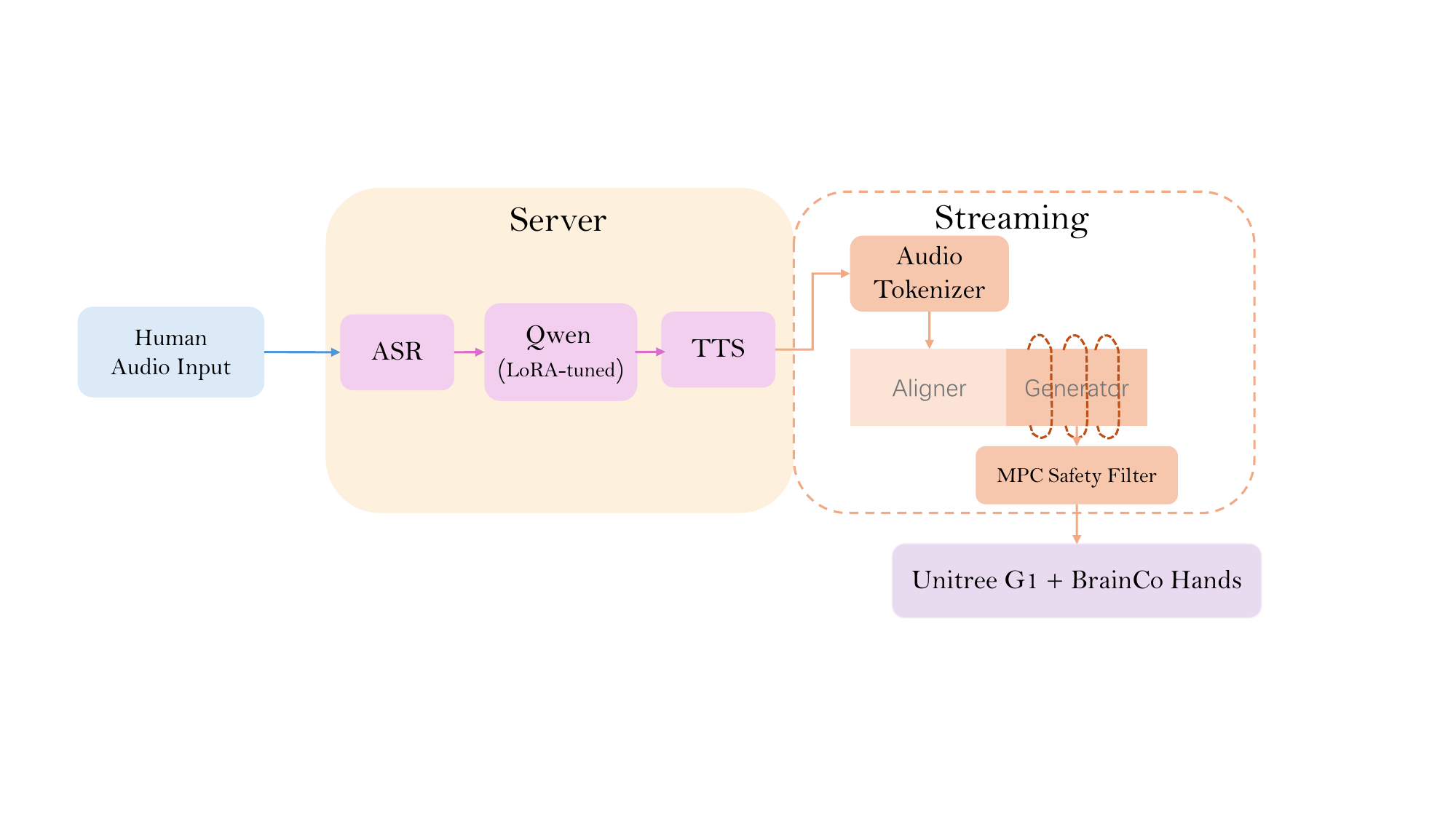
RoboGesture: Real-Time Semantic-aligned Co-Speech Gestures Generation for Humanoid Interaction
RoboGesture generates synchronized, semantically-aligned full-body gestures from speech in real time on humanoid robots. It addresses the "modality eclipse" problem where models ignore audio cues and ensures collision-free execution through robot-specific datasets and safety-constrained control.
Abstract
Enabling humanoid robots to respond to human speech with synchronized and semantically meaningful gestures is fundamental to natural human-robot interaction. However, this task faces three critical barriers: the scarcity of semantically rich datasets, the "modality eclipse" where models ignore audio cues in favor of kinematic inertia, and the sim-to-real gap regarding physical safety. We propose RoboGesture, a robot-centric framework that co-designs data, modeling, and control to power a complete interactive human-humanoid system in which the robot listens, responds, and gestures in real time. We first establish the RoboGesture dataset featuring over 300 gesture categories and develop an automated pipeline to synthesize large-scale collision-free, robot-specific audio-motion pairs. Our architecture features a Hierarchical Semantic-Acoustic Aligner that extracts multi-granular prosodic and semantic cues directly from raw audio tokens. These cues drive a Streaming Conditional Motion Generator based on a diffusion transformer with conditional flow matching. To ensure high responsiveness, we introduce Anti-Inertia CFG Masking, which prevents the model from collapsing into repetitive historical patterns by compelling it to proactively mine control signals from the audio modality. Finally, an MPC-based safety filter ensures real-time, collision-free execution on physical hardware. Experiments on a Unitree G1 humanoid demonstrate that RoboGesture generates safer, more rhythmic, and more semantically appropriate responses compared to state-of-the-art baselines.
Speech Recognition & Robustness
Dynamic, attention-aware decoding for audio-visual ASR in the wild.
Contrastive decoding for audio-visual speech recognition (AVSR) typically applies a fixed correction strength — useful in noise, but harmful in clean conditions where the audio stream already carries all the signal needed. Yonsei University's paper introduces Attention-Guided Reliability Scaling, a method that makes the intervention dynamic by measuring per-token attention reliability signals and scaling the audio/visual balance accordingly. The result: noise robustness improves where it's needed, without degrading clean-condition accuracy — a sensible calibration that fixed-strength approaches can't achieve.
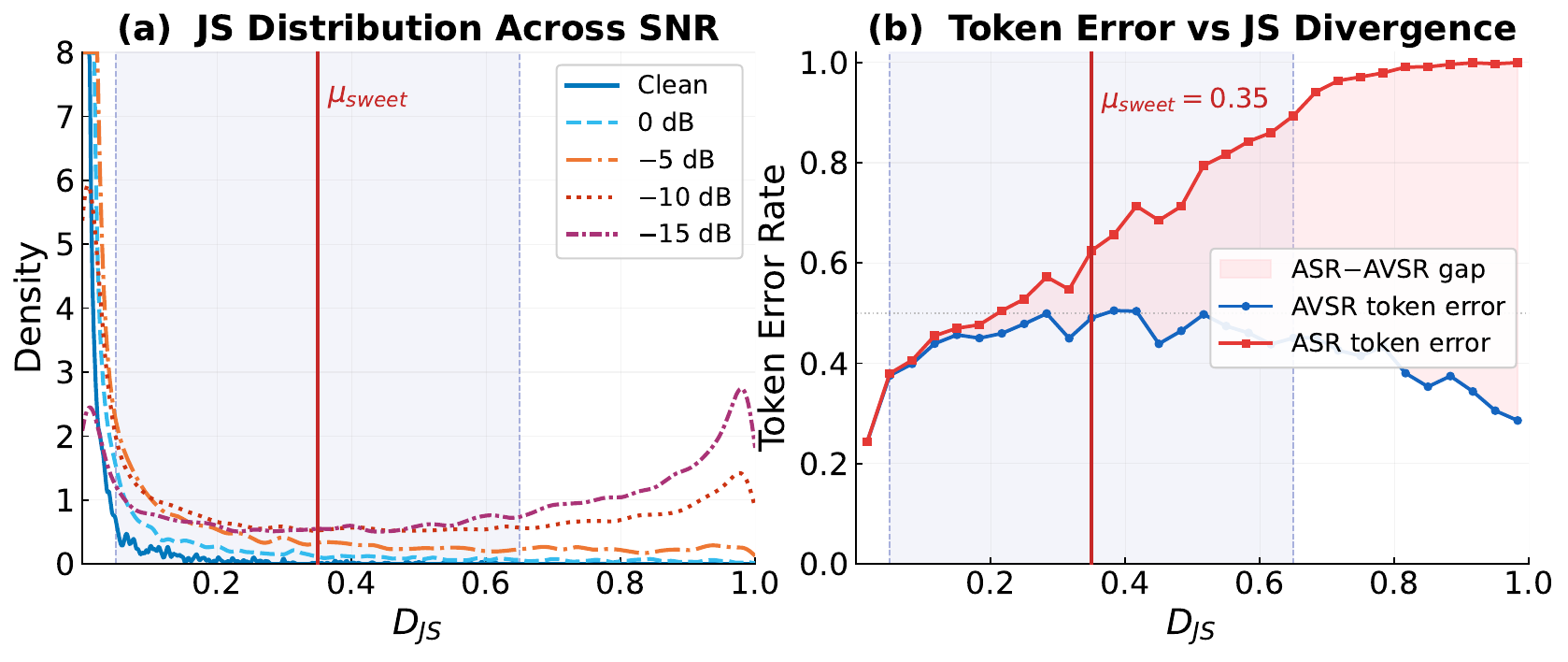
Attention-Guided Reliability Scaling for Contrastive Decoding in Robust Audio-Visual Speech Recognition
This paper applies adaptive contrastive decoding to audio-visual speech recognition, scaling token-level intervention dynamically based on attention reliability signals. It replaces fixed correction strength with dynamic audio/visual balance to maintain accuracy in clean conditions while improving noise robustness.
Abstract
Large language model (LLM)-based audio-visual speech recognition (AVSR) systems are robust under noise. Contrastive decoding (CD), originally introduced to stabilize LLM generation by contrasting a weaker model against a stronger one at inference time, adjusts predictions without additional training. In this work, we apply CD to AVSR by contrasting audio-only conditioning with full audio-visual conditioning within the same underlying model. However, using a fixed contrastive strength introduces a trade-off across noise levels: stronger intervention helps under severe noise but may over-correct reliable predictions in clean conditions. We propose reliability-aware scaling of CD for AVSR. Instead of using a fixed strength, we adaptively modulate the contrastive influence at each token based on reliability signals derived from attention dynamics and inter-model predictive divergence. Experiments on LRS3 show consistent improvements across clean and low-SNR conditions.
TTS & ASR Augmentation
Smarter text selection for TTS-based ASR data augmentation, at scale.
TTS augmentation for ASR is well-established, but most pipelines treat text selection as an afterthought — sampling arbitrarily from available corpora. This paper from Speech and Language Processing Research changes that with a phoneme-frequency-guided selection strategy: training texts are ranked by how well they cover the phoneme distribution of the target language, ensuring synthesized speech fills genuine acoustic gaps rather than duplicating already-covered patterns. The unified multilingual pipeline yields substantial WER reductions, and the controlled study carefully measures the independent contributions of synthesis scale and reference audio quality.
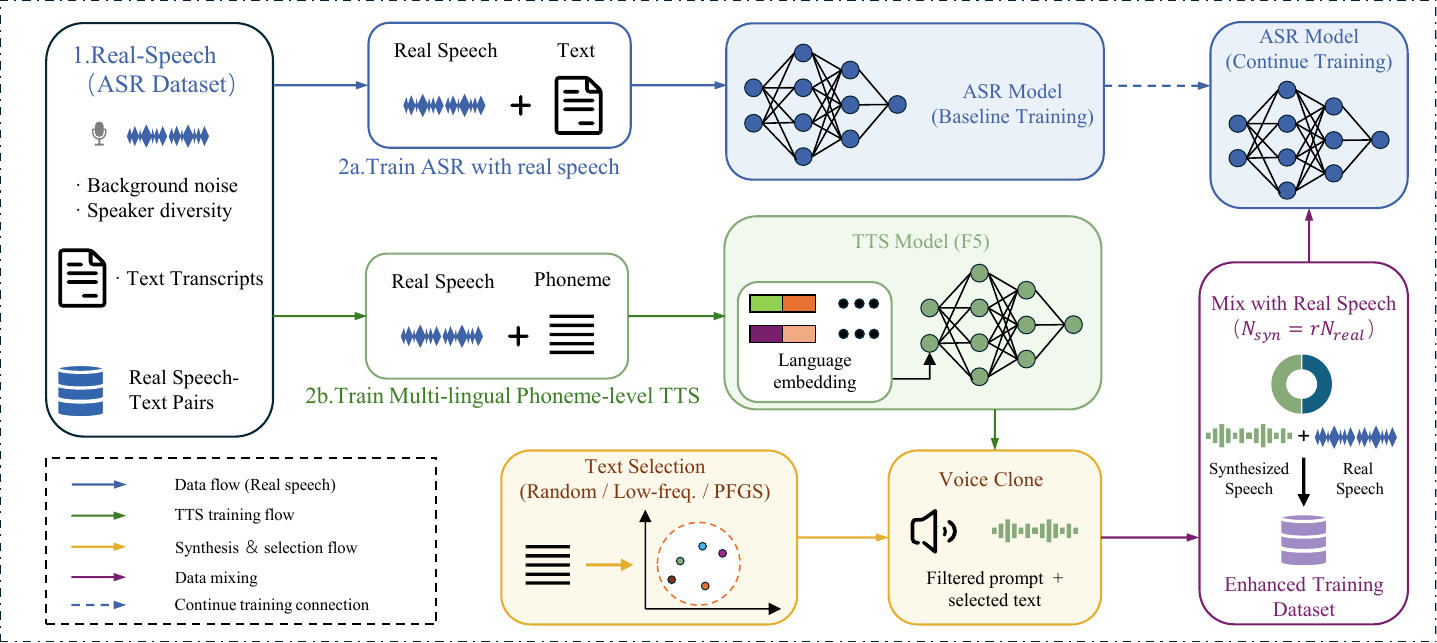
Scaling phoneme-based TTS augmentation for ASR: A unified pipeline and controlled study
This paper presents a phoneme-based TTS augmentation pipeline for multilingual ASR. It introduces phoneme-frequency-guided selection to intelligently rank training texts by phoneme coverage, achieving substantial WER reductions while measuring impacts of synthesis scale and reference quality.
Abstract
Synthetic speech provides scalable supervision for automatic speech recognition (ASR), but its benefit depends on the selected texts, reference speech, and amount of synthesized data. We present a unified phoneme-based TTS-to-ASR augmentation pipeline built around a multilingual TTS model trained from scratch using the F5-TTS architecture with language-ID conditioning. The pipeline combines language-specific grapheme-to-phoneme conversion, reference-speech filtering, candidate-text selection, synthesis, and matched ASR continuation. We further propose phoneme-frequency-guided selection (PFGS), which ranks candidate sentences using phoneme frequencies estimated from real ASR training labels. Experiments with separate monolingual ASR systems for Arabic, French, Italian, and Portuguese span 13 test sets. Across the synthesis-scale sweep, random augmentation improves over matched real-only continuation on 11 test sets. Under a nominal 60% synthesis budget, PFGS improves over real-only training on 12 test sets and over random selection on 9. Its largest relative word error rate (WER) reduction against random selection is 19.3%. With target texts and synthesis counts fixed, reference-speech filtering reduces absolute WER by 0.29 and 0.59 points on Italian and French Common Voice, respectively. These results identify synthesis scale, candidate-text content, and reference quality as important control variables in TTS-based ASR augmentation.
Trending on Hugging Face

4DAnyone: Create Anyone in 4D from a Casual Monocular Video
4DAnyone reconstructs 4D humans from monocular video by generating multiview-consistent videos and lifting them into 4D Gaussian Splatting, using reference and target context designs to overcome scaling bottlenecks.

Qwen3-TTS Technical Report
The Qwen3-TTS series presents advanced multilingual text-to-speech models with voice cloning and controllable speech generation capabilities, utilizing dual-track LM architecture and specialized speech tokenizers for efficient streaming synthesis.

Fish Audio S2 Technical Report
Fish Audio S2 is an open-source text-to-speech system with multi-speaker capabilities, multi-turn generation, and instruction-following control through natural-language descriptions, utilizing a multi-stage training approach and production-ready inference engine.

VibeVoice Technical Report
VibeVoice synthesizes long-form multi-speaker speech using next-token diffusion and a highly efficient continuous speech tokenizer, achieving superior performance and fidelity.