
Avatars, Gestures, and the Inner Life of SpeechLLMs
Today's digest spans adversarial defense for talking-face generation, environment-aware co-speech gesture synthesis, RL alignment in TTS, and mechanistic dissections of how audio-language models handle paralinguistic information — plus a trending HF paper on joint speech-and-motion dialogue.
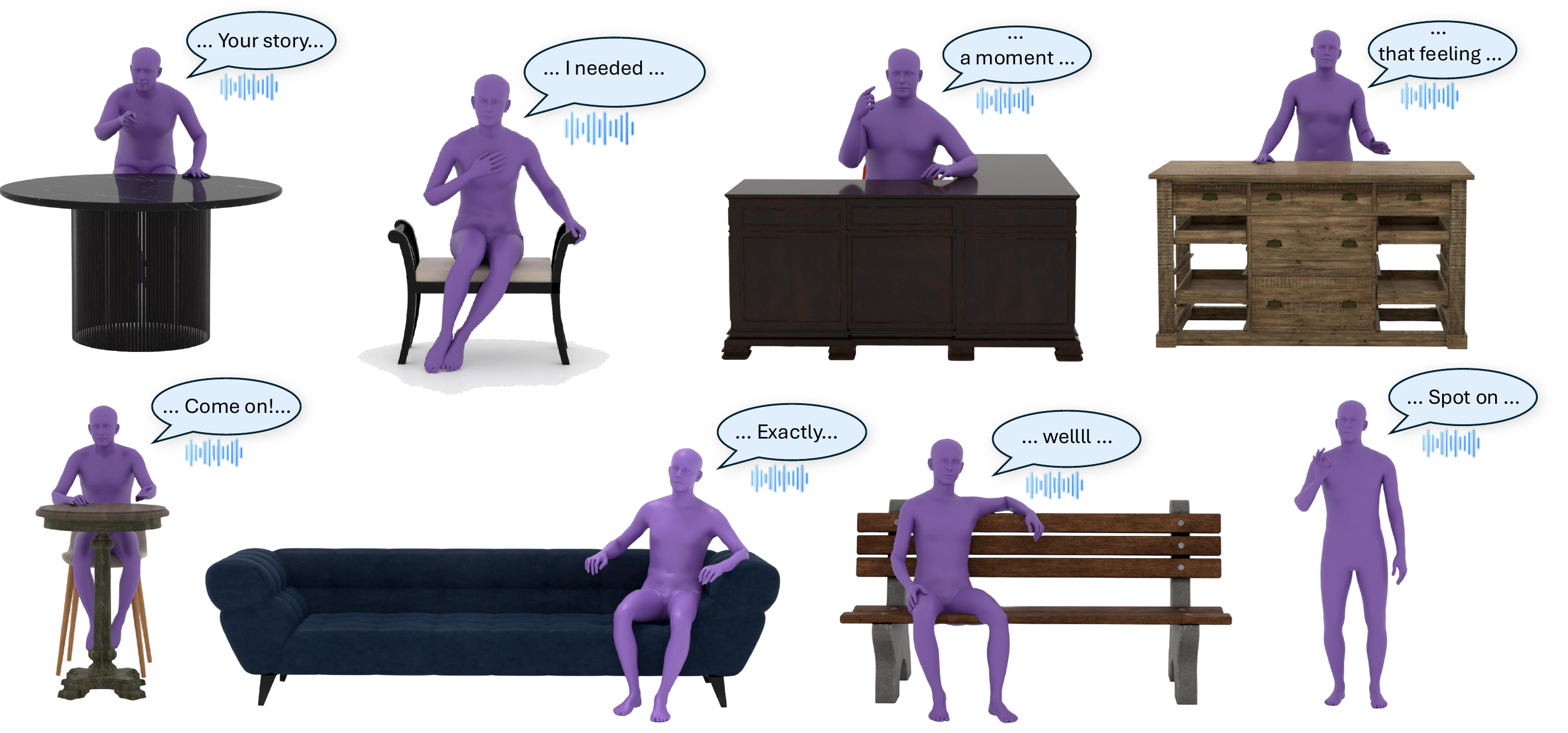
Sample frames from our dataset showing diverse conversational gestures performed in different scene contexts (tables, chairs, desks, couches, benches). The dataset captures natural speech-driven gestures with varying postures. Each sequence includes synchronized speech, full-body motion, and scene geometry. Video examples are shown in the supplementary video. From University of Toronto.
Today's papers push on several fronts at once: securing talking-face pipelines against audio-driven attacks, grounding co-speech gestures in physical scenes, interrogating whether RL actually improves perceived speech quality, and peering inside audio-language models to understand where style information goes missing. A trending paper from Hugging Face rounds things out with an end-to-end system that speaks and moves.
Talking Avatars & Audio-Driven Face Animation
Securing and generating audio-driven faces — from adversarial defenses to full-body animation.
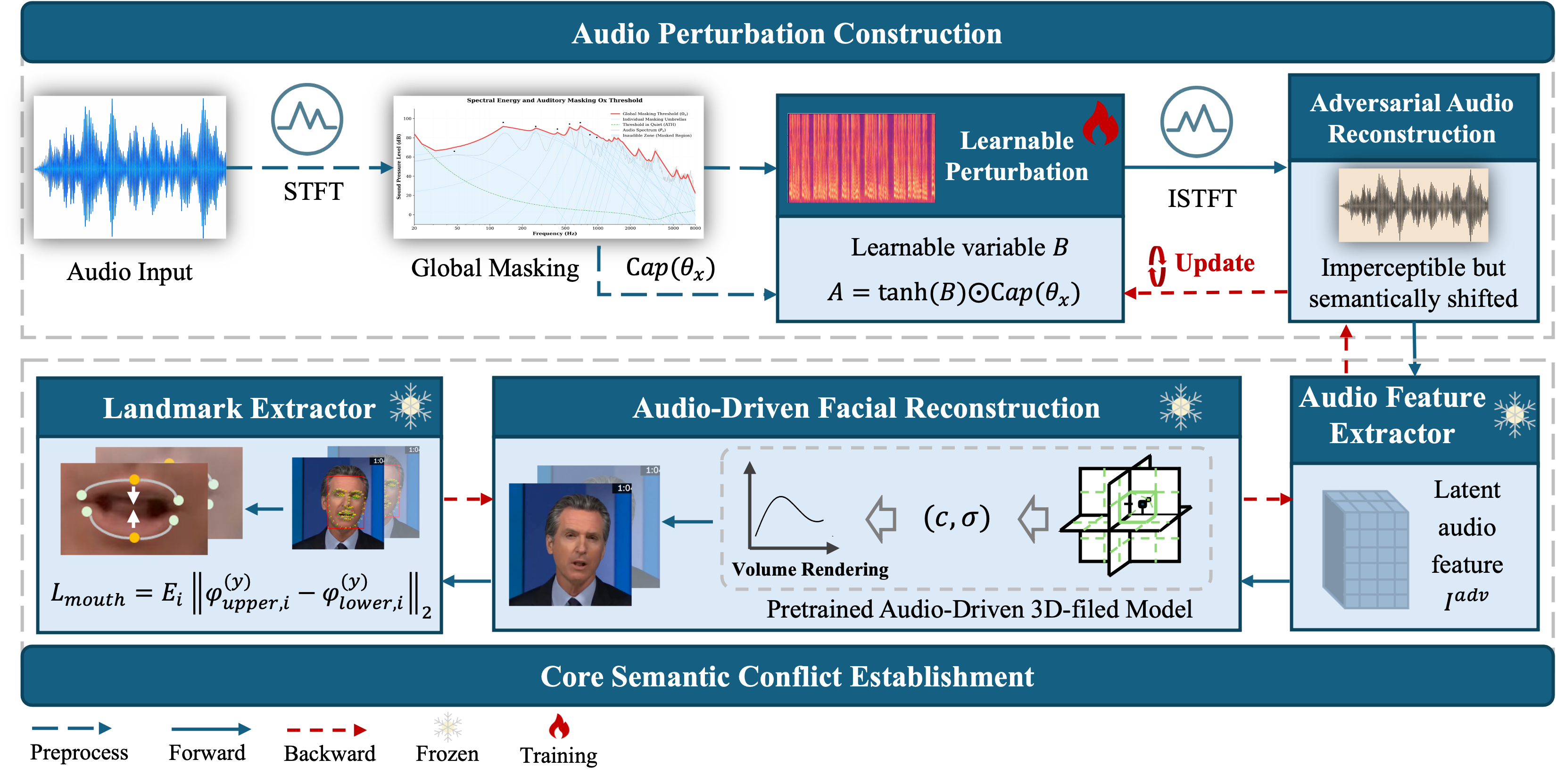
Most deepfake defenses add perturbations to video frames, which inevitably leaves visible artifacts. Fudan University takes a different tack, moving the battlefield entirely into the audio domain. By crafting psychoacoustic masking-based perturbations that are imperceptible to human listeners, the method disrupts the audio-to-geometry mapping that 3D talking-face models rely on — all without touching a single pixel.
Audio-Driven Adversarial Defense for 3D Talking Face Generation with totally Visual Fidelity Preservation
This work defends against audio-driven 3D talking-face attacks by shifting protection to the audio domain using psychoacoustic masking. Imperceptible audio perturbations disrupt audio-to-geometry mapping while preserving visual and audio fidelity—avoiding visual artifacts of prior visual-domain defenses.
Abstract
The rapid development of generative portrait models has raised growing concerns about privacy leakage and identity misuse. In particular, audio-driven 3D talking face generation can reconstruct a reusable 3D portrait of a target person from a monocular video and animate it with arbitrary speech, making realistic identity impersonation alarmingly practical. Existing proactive defenses mainly operate in the visual domain by injecting subtle perturbations into acial regions to disrupt identity acquisition. However, such perturbations often compromise visual quality due to the strong structural priors and social sensitivity of human faces, and are easily weakened by common real-world transformations such as resizing. To overcome these limitations, we propose an imperceptible audio defense for audio-driven 3D talking face generation by shifting protection from the visual modality to the audio modality. Specifically,we exploit psychoacoustic masking to hide protective perturbations within perceptually masked frequency regions of the speech signal, thereby reducing perceptual distortion while suppressing reliable facial animation. Extensive experiments demonstrate that the proposed method effectively degrades 3D talking face generation while preserving favorable perceptual quality. These findings highlight psychoacoustically guided audio perturbations as a practical and promising direction for privacy-preserving portrait protection.
Co-Speech Gesture & Full-Body Animation
From isolated gesture generation to scene-grounded, posture-aware full-body motion.
Prior co-speech gesture models treat the body in isolation, ignoring where it is and what it's holding. Puppeteer, from the University of Toronto, addresses this directly: it conditions generation on surrounding scene geometry and explicit body posture, using causal latent diffusion to produce full-body motions that are physically plausible within the environment. The result is gestures that don't just match speech rhythm — they respect the speaker's spatial context.
Puppeteer: Object-Grounded Posture-Aware Co-Speech Gesture Generation
A posture-aware, object-grounded co-speech gesture generation model that synthesizes full-body motions physically grounded in surrounding environments. Unlike prior audio-centric methods, it explicitly models body posture and scene geometry through causal latent diffusion for naturally interactive gestures.
Abstract
Generating co-speech gestures that are temporally coherent, semantically aligned with speech, and grounded with surrounding objects remains challenging. Prior speech-driven gesture models emphasize audio-gesture alignment but do not explicitly account for posture constraints or surrounding objects, failing to capture the inherent correlation between body gestures and the physical space. We present Puppeteer, a posture-aware, object-grounded co-speech gesture diffusion model operating in a causal latent space. We decompose long gestures into structured primitives and learn a causal variational autoencoder that encodes them into temporally ordered latent tokens, each depending only on the past. We then perform conditional diffusion directly in the causal latent space, conditioning on speech signals, motion history, an initial posture reference, and object geometry to synthesize physically consistent gestures. This temporally ordered latent formulation enables explicit temporal control and supports tasks such as gesture in-betweening and gesture completion. To better assess co-speech gesture synthesis beyond existing measures, we introduce new evaluation metrics tailored to this task. We also created SceneGes, the first curated synthetic 3D dataset of embodied co-speech gestures and corresponding 3D objects, enabling object-grounded gesture generation. Experiments show that Puppeteer generates more diverse and temporally synchronized gestures than prior methods, while enabling object-grounded gesture synthesis.
TTS & Voice Synthesis
Calibrating reinforcement learning rewards to human perceptual dimensions.
Reinforcement learning has become a popular lever for steering TTS quality, but how well do learned reward models actually track what humans care about? This paper from Joonyong Park and Jerry Li studies codec-based speech language models optimized with subjective rewards (naturalness, likability) and finds that different perceptual axes require axis-specific calibration. Crucially, policy optimization does not uniformly beat simpler reranking, calling into question when the added complexity of RL is worth it.
When Does Predictor-Based RL Align with Human Perception? A Study of Subjective Rewards in Codec-Based Speech Language Models
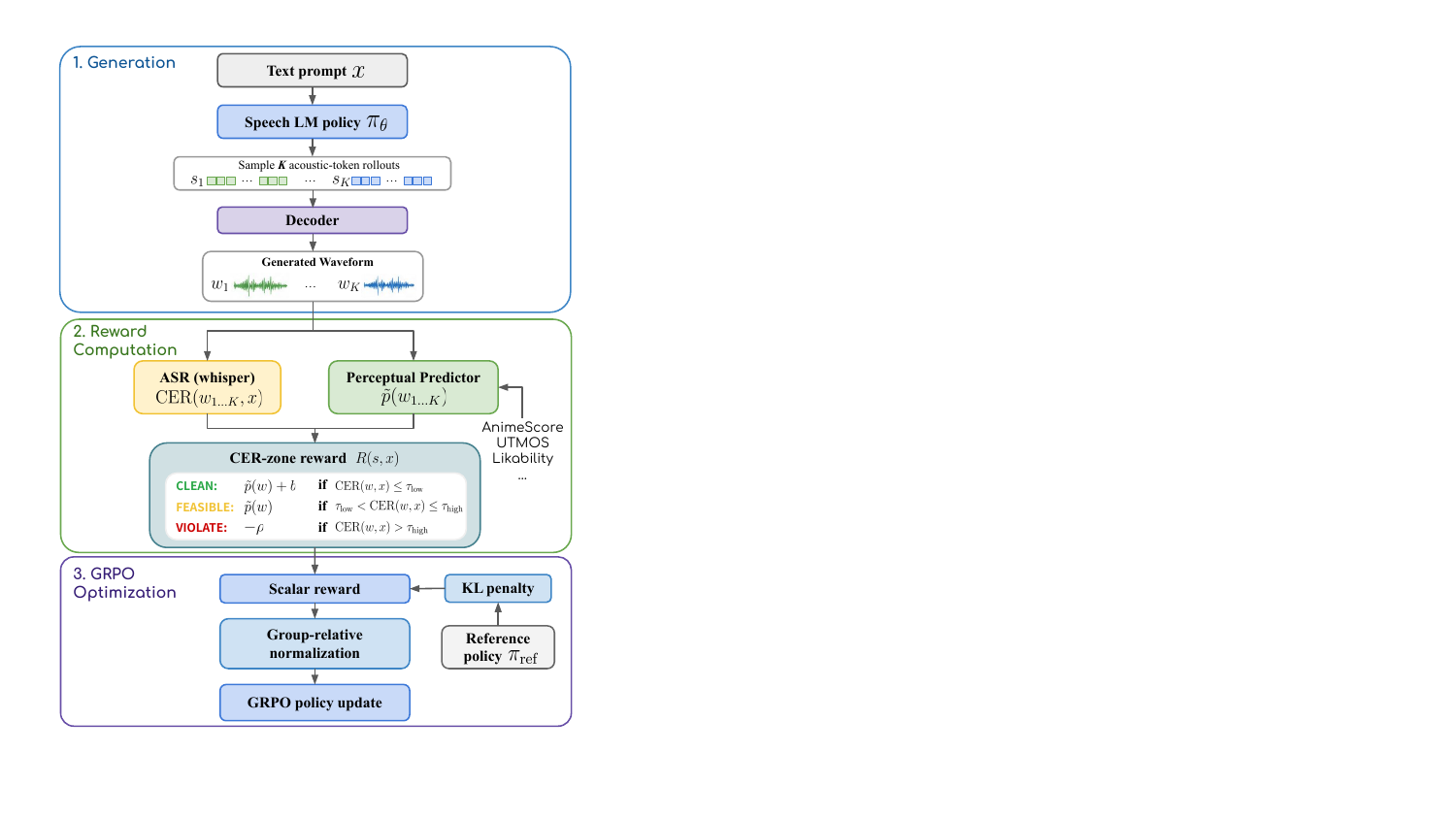
This paper studies when learned perceptual rewards can guide speech synthesis via reinforcement learning without losing human alignment. It shows that subjective dimensions like naturalness and likability require axis-specific calibration, and that policy optimization doesn't uniformly outperform simpler reranking.
Abstract
Codec-based text-to-speech (TTS) models make language-model post-training applicable to speech generation, but it remains unclear when learned perceptual predictors can serve as reinforcement learning rewards without losing alignment with human listeners. We study this question with Group Relative Policy Optimization (GRPO) using learned rewards for anime-like speaking style, naturalness, likability, and arousal. To prevent perceptual rewards from being optimized through transcript drift, we introduce a character error rate (CER) zone constraint and compare policy optimization with Best-of-$N$ reranking under the same reward gate. Across single-reward runs, each reward primarily improves its own target metric, showing that subjective predictors are not interchangeable quality surrogates. Multi-rater A/B tests further show uneven human transfer, while a reward-gap analysis separates average transfer from within-axis calibration: signed reward gaps significantly predict listener choices in the pooled analysis, whereas residual CER gaps do not, but per-axis calibration remains heterogeneous. Best-of-8 is a strong human-level baseline and is not clearly worse than GRPO perceptually, suggesting that GRPO should be viewed as amortizing reward-selected behavior into the policy rather than uniformly outperforming reranking. These results support analyzing subjective speech rewards as predictor-axis-base tuples and provide practical diagnostics for selecting rewards before multi-reward speech post-training.
SpeechLLMs & Spoken Dialogue
Mechanistic analysis of paralinguistic encoding, self-correcting ASR, and unified speech-motion dialogue.
A recurring theme this cycle is looking inside audio-language models to understand their internal representations — and finding uncomfortable gaps between what is encoded and what reaches the output.
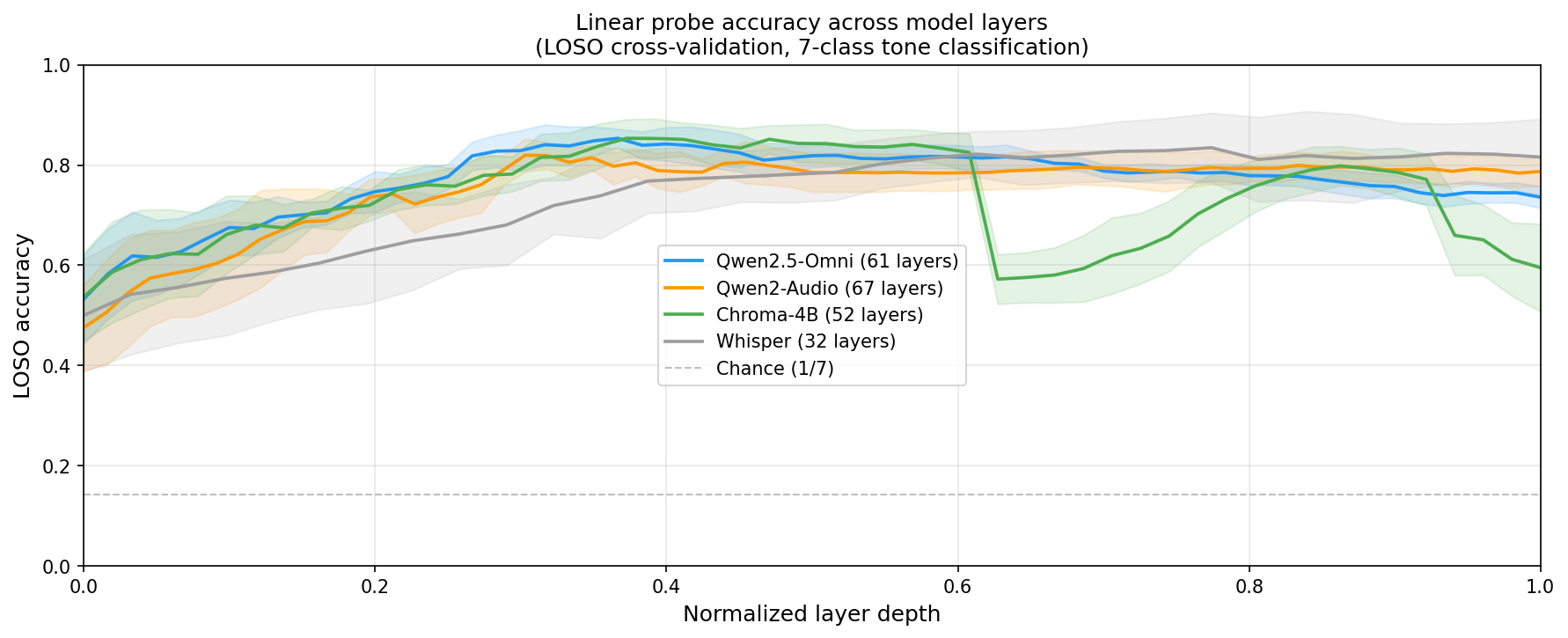
Carnegie Mellon's "Heard but Not Heeded" study probes four audio-language models and finds that paralinguistic signals like speaking style and tone are strongly present in early layers but systematically degraded as information passes through projectors and decoders. The models hear style; they just don't use it.
Heard but Not Heeded: Paralinguistic Information Encoding and Loss in Audio-Language Models
This paper reveals a critical gap in audio-language models: they encode paralinguistic information (speaking style, tone) strongly but systematically lose it before output. Using mechanistic probing across four models, the authors trace where style information degrades through projectors and decoders.
Abstract
Audio language models are designed to understand speech, yet it remains unclear whether they capture how something is said beyond what is said. We present a mechanistic analysis of paralinguistic information in four open source models, Whisper-large-v2, Qwen2-Audio-7B Instruct, Qwen2.5-Omni-7B, and Chroma-4B, using the Expresso dataset with controlled speaking styles. We combine centered kernel alignment, linear probing with leave one speaker out evaluation, open ended tone prediction, and a content prosody leakage metric to trace how style information moves from the audio encoder to the final output. All models strongly encode speaking style in the late encoder, that is, the top third of the audio encoder's layers, but this information is consistently degraded before reaching the output. The projector reshapes representation geometry without removing information, while decoders differ in how much style they preserve depending on architecture and training objective. At the output level, models fall into two behaviors. Some are content driven, where predictions depend mainly on text. Others are acoustic driven, where predictions vary with speaking style. The leakage metric quantifies this difference, and qualitative results confirm it. Overall, we identify a gap between what models encode and what they use, highlighting a key limitation in current audio language models.
On the ASR side, National Taiwan University targets a related problem: global self-correction in large audio-language models can hurt as often as it helps. Their approach analyzes hidden-state interactions to identify tokens with high semantic dependence on the base LLM, then applies selective refinement only to those tokens — yielding significantly stronger WER improvements than blanket correction strategies.
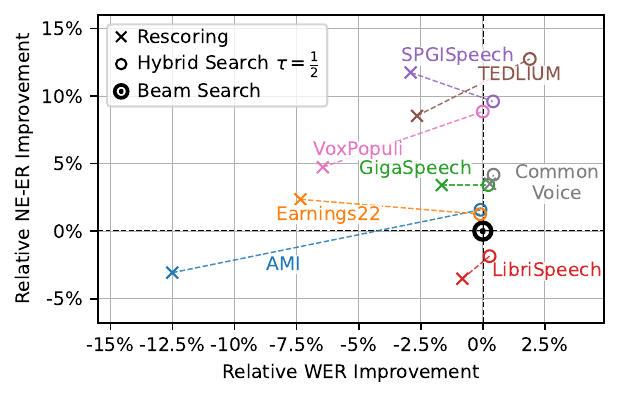
Listen to the Latents: Self-Correcting Speech Recognition in Large Audio Language Models Through Hidden-State Interactions
This paper improves LLM-based speech recognition by analyzing hidden-state interactions to identify and selectively refine tokens with high semantic dependence on the base LLM. Unlike global correction methods, targeted refinement yields significantly stronger WER improvements.
Abstract
Recent automatic speech recognition (ASR) systems increasingly integrate large language models (LLMs) to leverage their semantic knowledge, either externally through logit fusion or internally through warm initialization. However, how to effectively combine these two strategies remains underexplored. In this work, we refine warm-initialized LLM-based ASR models by leveraging their own pre-adaptation base LLMs, focusing on LoRA-adapted settings where the base LLM is preserved. To achieve this, we propose Hybrid Search, a targeted correction strategy motivated by two observations. First, interaction features that characterize the relationship between LLM-based ASR hidden states and base-LLM hidden states provide informative signals about a token's degree of semantic dependence. Second, selectively refining targeted tokens with high semantic dependence improves ASR performance far beyond naive global LLM-correction methods including rescoring and late fusion. Our analysis suggests that, even after semantic knowledge transfer through warm initialization, LLM-based ASR models can still leverage their base LLM to further improve inference-time performance.
Finally, from today's Hugging Face Daily picks, Peking University's Motion-Omni tackles the joint generation problem head-on. Rather than treating speech and gesture as separate modules, it shares hidden states across both modalities in a single end-to-end framework, using scalable pseudo-labeling to handle data scarcity and a unified evaluation protocol to benchmark the combined output. The system runs in real time, producing aligned spoken responses and full-body motion together.

Motion-Omni: End-to-End Joint Speech and Full-Body Motion for Spoken Dialogue
Motion-Omni is an end-to-end framework that jointly generates spoken dialogue and full-body co-speech motion from shared hidden states, using scalable pseudo-labeling and a unified evaluation protocol to achieve real-time, aligned responses.
Abstract
An avatar that holds a conversation should decide what to say and to move while saying it, yet these abilities live in separate model families: spoken dialogue models produce speech without motion, and co-speech motion models produce motion only from audio handed to them. The standard remedy is a cascade that first generates the spoken response and then runs a motion model over the finished audio, which requires a second full inference pass and precludes any joint optimisation between the two. We present Motion-Omni, an end-to-end framework in which a spoken dialogue model natively outputs explicit facial expression together with hand, upper-body and lower-body motion, generated directly from the hidden states that produce the speech. Joint training is not optional here: with the speech pathway frozen, motion remains misaligned with the audio, and co-adapting the LLM, Speech Generator and Motion Generator under both objectives is what recovers alignment while retaining spoken-dialogue ability. Supervision comes from a scalable, model-agnostic pipeline that pseudo-labels consistent-voice speech responses with a replaceable motion teacher, yielding 422,856 quality-ranked pairs (1,402 hours). We further release SwDA-500 and, to our knowledge, the first public evaluation protocol for stochastic open-ended full-body spoken dialogue, matching audio across motion systems while unifying rendering, automatic metrics, human evaluation, and latency measurement. Instantiated with a Qwen2.5-7B-Instruct backbone, Motion-Omni-Q7 matches the same-audio teacher cascade to within 2% on reference-free motion metrics while responding 5.4 x faster (RTF=0.78, faster than real time), surpasses all non-teacher cascades on beat correlation and diversity, and reaches a 2.62% word error rate, the lowest among the omni-modal systems compared.
Trending on Hugging Face

VoiceMem: Streaming Dual-Brain Memory for Real-Time Interaction
VoiceMem introduces a dual-brain streaming memory architecture for speech language models that improves retrieval accuracy, emotional personalization, and real-time efficiency.

OmniFlatten: An End-to-end GPT Model for Seamless Voice Conversation
A novel GPT-based model, OmniFlatten, enables real-time natural full-duplex spoken dialogue through a multi-stage post-training technique that integrates speech and text without altering the original model's architecture.

Fish Audio S2 Technical Report
Fish Audio S2 is an open-source text-to-speech system with multi-speaker capabilities, multi-turn generation, and instruction-following control through natural-language descriptions, utilizing a multi-stage training approach and production-ready inference engine.

Qwen3-TTS Technical Report
The Qwen3-TTS series presents advanced multilingual text-to-speech models with voice cloning and controllable speech generation capabilities, utilizing dual-track LM architecture and specialized speech tokenizers for efficient streaming synthesis.