
Smarter Speech Pipelines: TTS-Aligned LLMs, Audio-Grounded DST, and Multi-Talker ASR
Today's digest covers three papers tightening the full spoken-language pipeline: aligning LLMs to generate TTS-friendly text, grounding dialogue state tracking in raw audio, and softly injecting speaker posteriors into Whisper for multi-talker recognition.
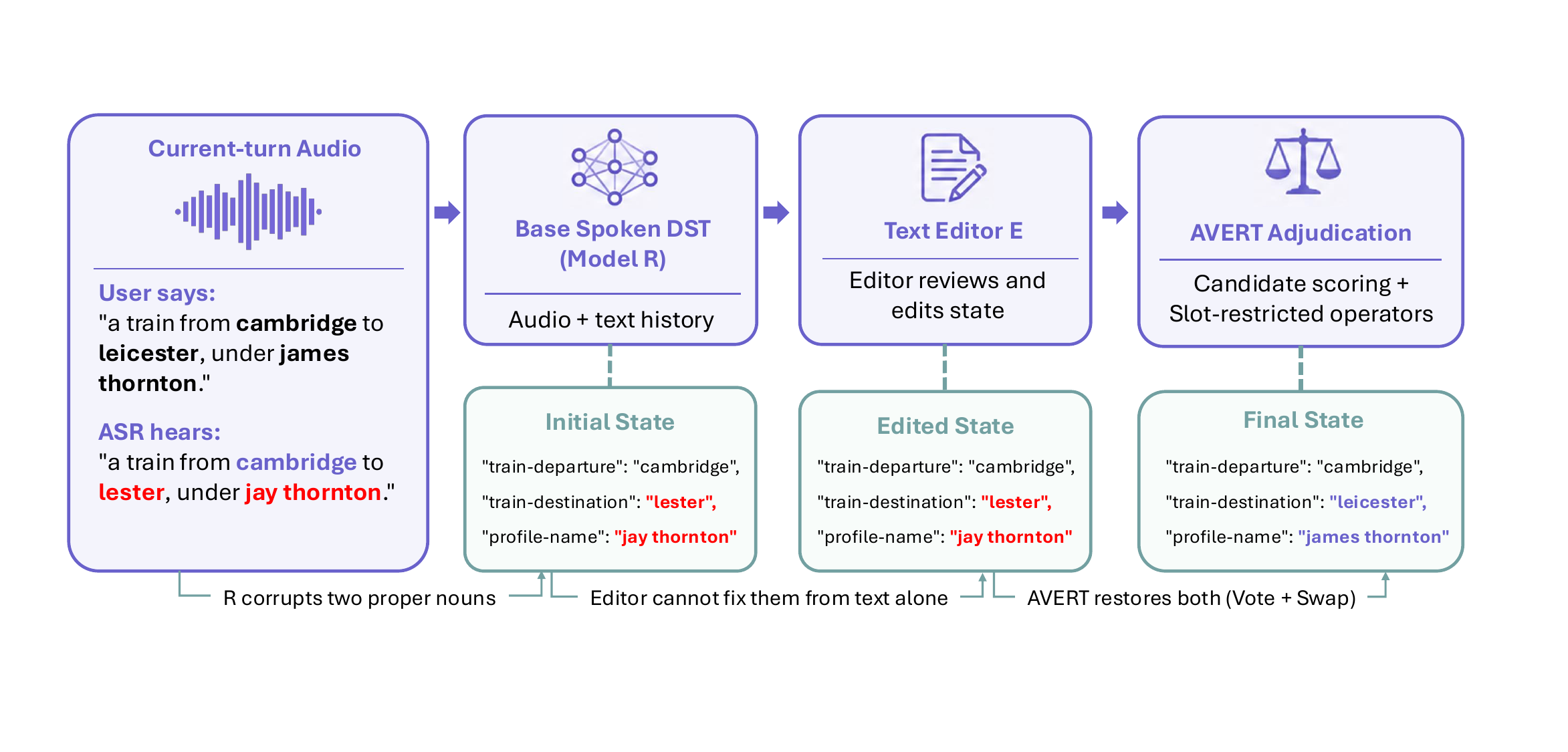
Overview of AVERT. The base spoken-DST model $R$ emits a transcript and a first-pass state, the text editor $E$ revises it, and AVERT adjudicates candidate values across turns with three slot-restricted operators. Here ASR corrupts two proper nouns (leicester to lester, james to jay), which the editor cannot fix from the transcript alone. AVERT restores both: VOTE recovers the cross-turn consensus leicester, and SWAP replaces the unattested jay thornton with an attested alternative, james thornton. From Harvard University.
Today's three papers each target a different stage of the spoken-language pipeline — from what the LLM says, to how a dialogue system tracks what was heard, to how a recognizer untangles overlapping speakers. Taken together, they push toward end-to-end spoken AI that treats audio as a first-class citizen rather than an afterthought.
TTS & Voice Synthesis
Making LLM outputs sound as good as they read.
A persistent friction point in voice assistants is that language models are optimized for text fluency, not spoken delivery — leading to responses full of parentheticals, dense lists, and symbols that trip up TTS engines. This paper from Speech & Language Research directly attacks that mismatch by training LLMs with preference learning to generate TTS-friendly text from the start, rather than cleaning up outputs after the fact.
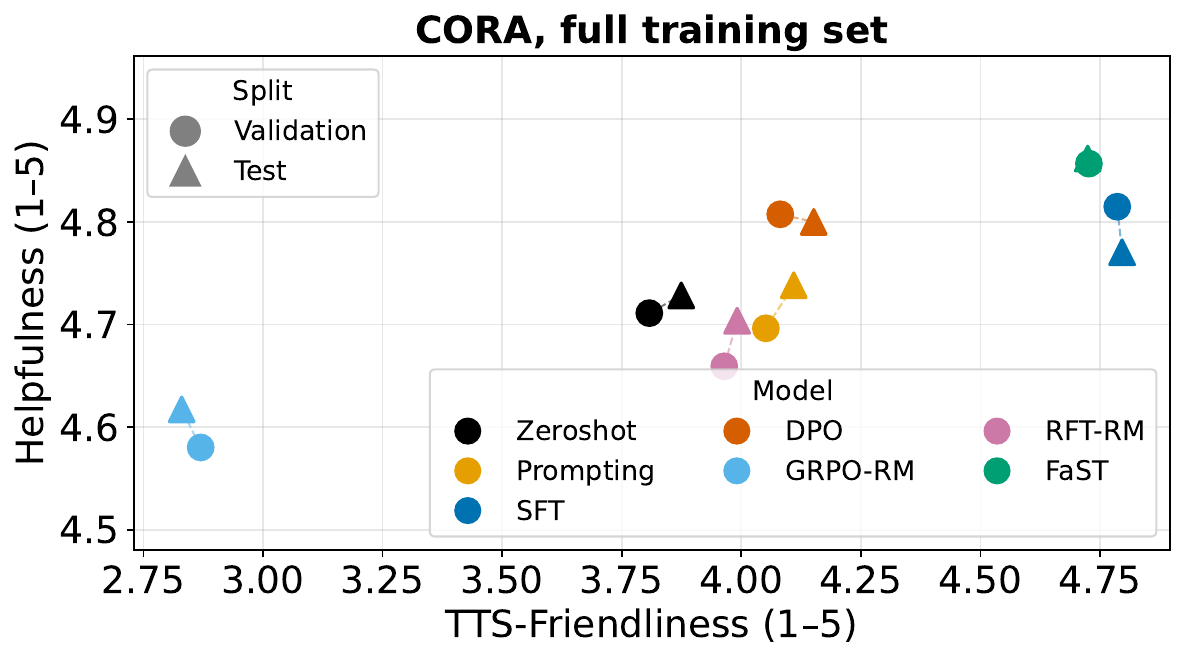
The key contribution is the FaST (Feature-aligned Spoken Text) framework, which replaces opaque, black-box reward signals with interpretable acoustic and linguistic features — things like sentence length, punctuation patterns, and prosody-unfriendly constructs. By grounding preferences in these legible features, the alignment process is both more transparent and more controllable. Listening studies confirm that FaST achieves better tradeoffs between spoken delivery quality and helpfulness than post-hoc rewriting baselines.
Ready to Speak: Aligning LLMs for TTS-Friendly Text Generation
This paper aligns LLMs to generate TTS-friendly text via preference learning, using the FaST framework with interpretable features instead of black-box rewards. It achieves better tradeoffs between spoken delivery quality and helpfulness compared to post-hoc rewriting approaches, validated through listening studies.
Abstract
Current Large Language Models (LLMs) are primarily optimized for written text, often producing outputs that are grammatically correct and helpful yet poorly suited for spoken delivery via Text-to-Speech (TTS). In this work, we study how to make LLMs natively generate TTS-friendly text, which we frame as a preference alignment problem: instead of relying on downstream rewriting modules, we directly align LLMs to generate text optimized for spoken delivery. We introduce two preference datasets spanning different target domains, CORA and Recipe, which contain paired TTS-friendly and TTS-unfriendly responses. We further propose an evaluation suite combining a pattern-based heuristic metric, a TTS$\to$ASR evaluation pipeline, and a MUSHRA listening study with human judges. Our experiments compare the recently proposed Feature-aware Sampling and Tuning (FaST) framework -- leveraging interpretable features instead of a black-box reward model -- against an array of alignment baselines on the TTS-friendly generation task. Notably, we found that FaST achieves the best overall tradeoff between TTS-friendliness and helpfulness across various settings. We also identified a strong correlation between our different metrics, highlighting the ability to reliably assess TTS-friendliness via an efficient heuristic.
SpeechLLMs & Spoken Dialogue
Grounding dialogue state tracking in the audio signal itself.
Spoken dialogue state tracking (DST) typically operates over ASR transcripts, inheriting all of their errors without any path back to the original audio for recovery. AVERT from Harvard University closes that loop by coupling a cross-turn consistency checker with an audio verifier that re-examines the acoustic signal whenever a potential error is flagged — recovering mistakes that a text-only editor would never catch.
Concretely, AVERT targets three failure modes that are invisible in transcripts alone: inconsistent slot values across turns, slots that were omitted entirely, and values that are unsupported by what was actually said. Because the audio verifier operates as a post-hoc correction module, the base DST model requires no retraining — making AVERT a practical drop-in for existing pipelines.
AVERT: Audio-Verified Adjudication for Spoken Dialogue State Tracking
AVERT improves spoken dialogue state tracking by grounding error correction in audio, not just transcripts. It combines cross-turn consistency with an audio verifier to recover errors that text-only editors miss—inconsistent values, omitted slots, and unsupported values—without retraining the base model.
Abstract
Spoken dialogue state tracking recovers slot-value pairs from speech, where ASR errors concentrate in entity values and persist across turns, making it both a generation and an editing problem. A strong per-turn text editor corrects much of this but, operating on the transcript alone, leaves three recoverable errors: a value predicted inconsistently across turns, an omitted slot, and a value the audio does not support. We present AVERT, which scores each candidate value by combining cross-turn agreement with a trained audio-conditioned verifier and resolves the three error types with three operators, vote, add, and swap, each restricted to the slots where its error is common. On SpokenWOZ, a base speech-LLM reaches 33.04 JGA, a text editor 38.34, and AVERT 40.13, without retraining either. This is in the range of a 1B end-to-end system that consumes the full spoken history (39.32), though AVERT uses two 1B decoders rather than one. The audio verifier contributes a statistically significant gain, and restricting each operator to a selected slot subset matters: removing it lets unrestricted voting overwrite correct categorical values and fall below the editor.
ASR & Speech Understanding
Speaker-aware recognition without the hard diarization bottleneck.
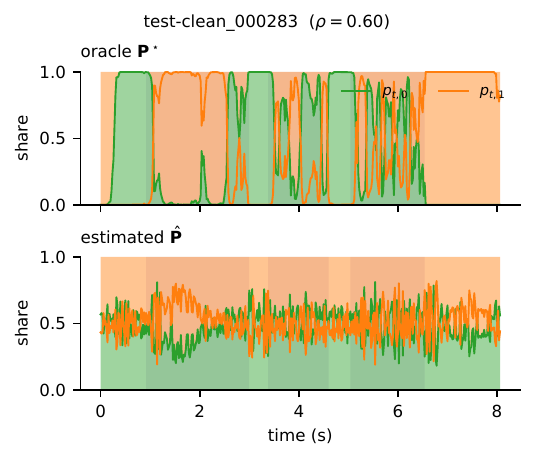
Multi-talker ASR is notoriously hard: the conventional approach of running a diarization system first and then transcribing each speaker segment propagates hard errors that downstream models cannot recover from. This paper from the Speech Recognition Research Lab proposes a softer alternative — injecting frame-level speaker posteriors directly into a pretrained Whisper model rather than committing to hard speaker boundaries.
The integration is done via feature-wise modulation of the encoder, so the model sees a continuous, probabilistic view of speaker activity at every frame, plus decoder prompts that carry speaker identity context. This keeps the benefits of speaker conditioning while sidestepping the irreversible mistakes that hard diarization introduces — a clean architectural lesson for anyone building on top of large pretrained ASR models.
Soft Posterior Speaker Injection for Multi-Talker Speech Recognition
This paper improves multi-talker speech recognition by softly injecting frame-level speaker posteriors into a pretrained Whisper model. Unlike hard diarization that introduces irreversible errors, this approach conditions the encoder on speaker activity through feature-wise modulation and decoder prompts.
Abstract
Multi-talker automatic speech recognition (MT-ASR) remains challenging under overlapping speech. Hard diarization-based segmentation introduces irreversible errors, whereas serialized output training (SOT) avoids explicit segmentation but does not condition a pretrained encoder on speaker activity. We propose Soft Posterior Speaker Injection (SPSI): a lightweight head predicts frame-level speaker posteriors $\hat{\mathbf{P}}$ and injects them into Whisper through multi-layer feature-wise linear modulation (FiLM) and decoder speaker-memory prompts. On controlled two-speaker LibriSpeech overlap, SPSI reduces utterance-mean constrained permutation word error rate (cpWER) from 50.7\% (SOT) to 49.6\% (one-sided paired bootstrap $p{\approx}0.006$), with a larger reduction in the high-overlap bin (60.4\%$\to$58.8\%). Same-backbone speaker-auxiliary objectives and voice activity detection (VAD) pipelines do not outperform SOT; zero-shot (ZS) LibriCSS is comparable. Freeze-posterior adaptation with overlap-heavy (OV-heavy) continuation reduces held-out LibriCSS cpWER (sessions 8--9) to 32.4\% (versus 37.5\% for SOT). Ablations indicate complementary encoder FiLM and decoder prompts, and that the effective signal is a \emph{soft} simplex-valued speaker share.
Trending on Hugging Face

VoiceMem: Streaming Dual-Brain Memory for Real-Time Interaction
VoiceMem introduces a dual-brain streaming memory architecture for speech language models that improves retrieval accuracy, emotional personalization, and real-time efficiency.

OmniFlatten: An End-to-end GPT Model for Seamless Voice Conversation
A novel GPT-based model, OmniFlatten, enables real-time natural full-duplex spoken dialogue through a multi-stage post-training technique that integrates speech and text without altering the original model's architecture.

Qwen3-TTS Technical Report
The Qwen3-TTS series presents advanced multilingual text-to-speech models with voice cloning and controllable speech generation capabilities, utilizing dual-track LM architecture and specialized speech tokenizers for efficient streaming synthesis.

Fish Audio S2 Technical Report
Fish Audio S2 is an open-source text-to-speech system with multi-speaker capabilities, multi-turn generation, and instruction-following control through natural-language descriptions, utilizing a multi-stage training approach and production-ready inference engine.

IndexTTS: An Industrial-Level Controllable and Efficient Zero-Shot Text-To-Speech System
IndexTTS, an enhanced text-to-speech system combining XTTS and Tortoise models, offers improved naturalness, enhanced voice cloning, and controllable usage through hybrid character-pinyin modeling and optimized vector quantization.