
Full-Duplex Dialogue, Smarter TTS, and Open Speech Foundations
Today's digest covers full-duplex spoken dialogue with decoupled turn-taking, streaming speaker-attributed ASR, direction-following TTS, grounded speech planning evaluation, and two major open-source releases from Tencent Hunyuan — an omni interaction agent and a unified speech generation model.
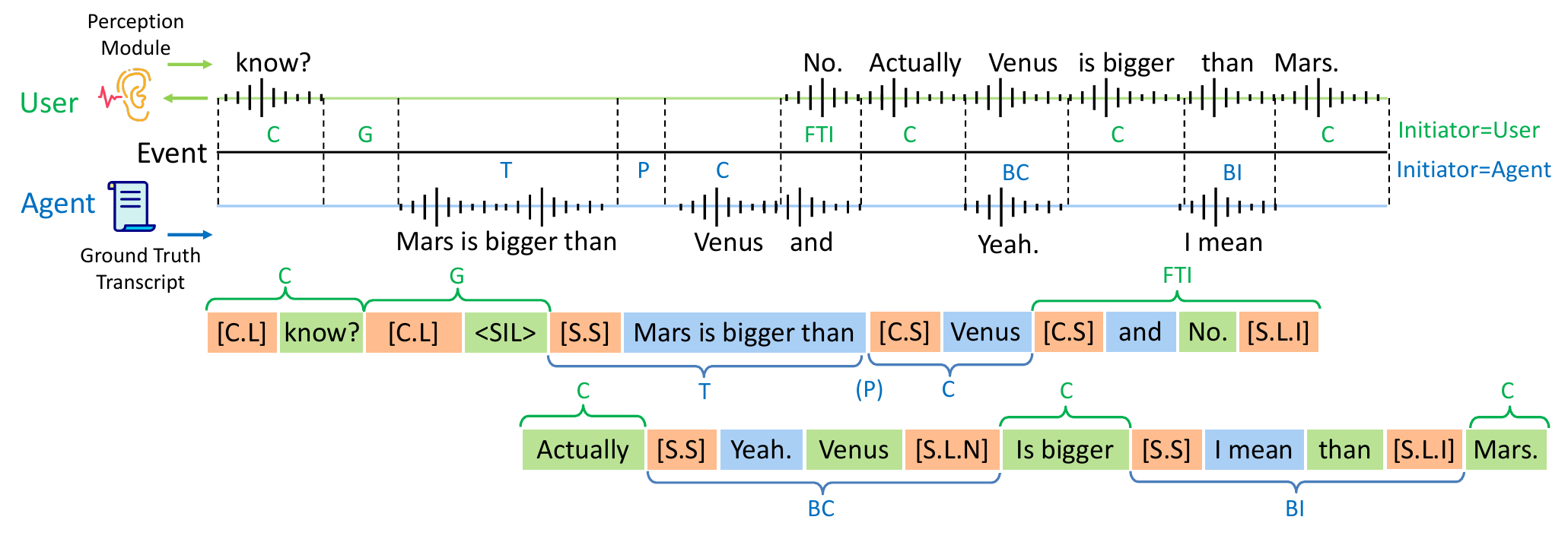
Example of turn-taking event classification and event-guided tape serialization. Green, blue, and orange blocks denote user content, agent content, and state transition tokens (shown in abbreviated form, e.g., for ), respectively. The role-prefix token preceding each user block is omitted for brevity. From Tsinghua University.
Today's papers push on two fronts simultaneously: making real-time spoken dialogue more natural and controllable, and raising the bar for what open-source speech generation models can do. From Tsinghua's FSM-based full-duplex system to Tencent Hunyuan's back-to-back open releases on HuggingFace Daily, there's a lot to unpack.
SpeechLLMs & Spoken Dialogue
Turn-taking, streaming recognition, and the plumbing that makes live voice interaction work.
A persistent problem with LLM-powered voice assistants is that LLMs are fundamentally text-trained — they have no natural sense of when to yield the floor or how acoustic overlap signals intent. Tsinghua University tackles this head-on by separating the two concerns entirely: turn-taking is learned from real spoken conversations, while semantic behavior is learned from text. A rule-based converter transforms spoken dialogues into Finite-State-Machine (FSM) tapes, giving the model a structured representation of conversational dynamics without entangling it with language modeling.
Decoupling Turn-Taking from Semantics: A Decoupled Data Approach for Finite-State-Machine-Based Full-Duplex Dialogue
This work decouples turn-taking from semantics in full-duplex dialogue, learning natural patterns from real conversations and semantic behavior from text data. A rule-based method converts spoken dialogues into FSM tapes, addressing the core limitation that LLMs cannot capture acoustic dynamics of natural conversation.
Abstract
The Neural Finite State Machine (NFSM) framework offers a pragmatic path to full-duplex dialogue by serializing turn-taking control and response generation onto a single causal tape under the standard next-token prediction objective, thereby preserving semantic prowess at a low fine-tuning cost. However, its reliance on synthetic text data fundamentally limits turn-taking naturalness, as Large Language Models (LLMs) cannot faithfully simulate the fine-grained acoustic temporal dynamics of real human dialogues. In this work, we propose a decoupled data approach that learns turn-taking from real Human-Human (HH) spoken dialogues while shaping semantic behavior through configurable Human-Agent (HA) text dialogues. To operationalize this approach, we introduce a rule-based event-guided data transformation method that serializes HH spoken dialogues into FSM tapes by classifying turn-taking events and applying deterministic mapping rules, enabling scalable supervision without LLM-generated annotations. We further propose a Source-Aware Calibrated (SAC) Loss that jointly calibrates the long-tailed distribution of state transition tokens and channels each data source toward the capability it best supervises. Experiments show that our approach substantially improves turn-taking proficiency while recovering the foundation LLM's semantic capability. Our code and model are available at https://github.com/Liyht/def-fsm.
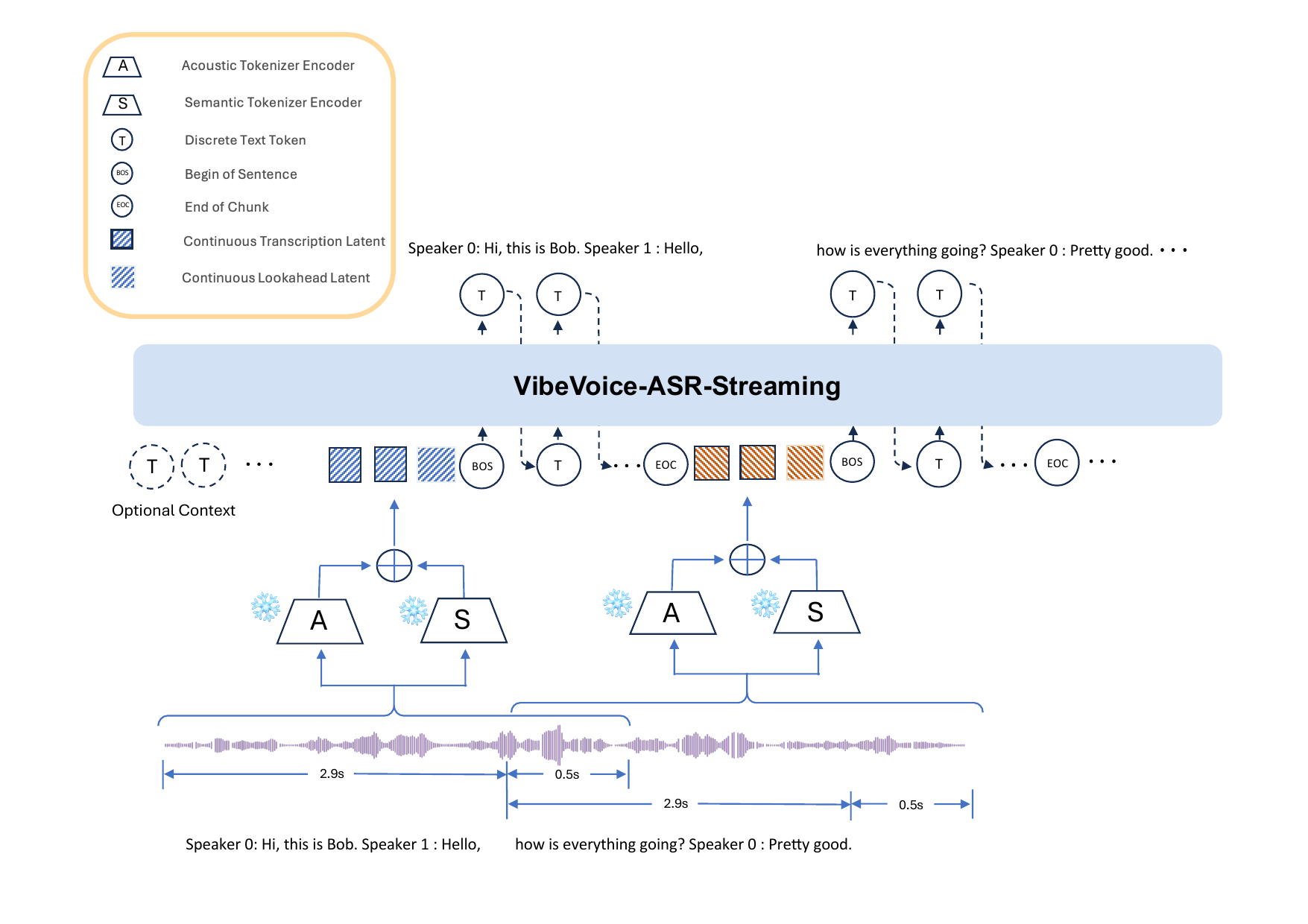
Once you have a responsive dialogue system, you need fast, accurate transcription — especially in multi-party settings. VibeVoice-ASR-Streaming from Shanghai Jiao Tong University is an LLM-based end-to-end streaming system that interleaves audio chunks with lookahead to produce real-time speaker-attributed transcriptions — "who said what" — without a separate diarization stage. The approach targets the low-latency demands of live voice assistants where offline pipeline models simply don't fit.
VibeVoice-ASR-Streaming Technical Report
An LLM-based end-to-end approach to streaming speaker-attributed ASR that interleaves audio chunks with lookahead to produce real-time "who said what" transcriptions. Unlike prior offline models, it enables low-latency recognition for voice assistants without a separate diarization stage.
Abstract
Traditional speaker-attributed ASR systems treated ASR and speaker diarization as two separate tasks. Recently, end-to-end models such as VibeVoice-ASR have unified the two tasks within a single model. However, existing unified models still mainly support offline recognition, making it difficult to meet the low-latency requirements of real-time voice assistants and agents. To tackle this issue, we present VibeVoice-ASR-Streaming, one of the first LLM-based end-to-end approaches to streaming speaker-attributed ASR. It interleaves fixed-size audio chunks, a small amount of lookahead audio and previous text. This allows the model to produce ''who said what'' as speech arrives, without a separate diarization stage. For transcription accuracy, our 7B model achieves the lowest average WER/CER across five evaluation sets. For speaker attribution, it achieves the best or tied-best on 12 of 13 evaluation settings. We release the 1.5B and 7B model weights together with inference code.
TTS & Voice Synthesis
Controllable generation, grounded evaluation, and two headline open-source releases.
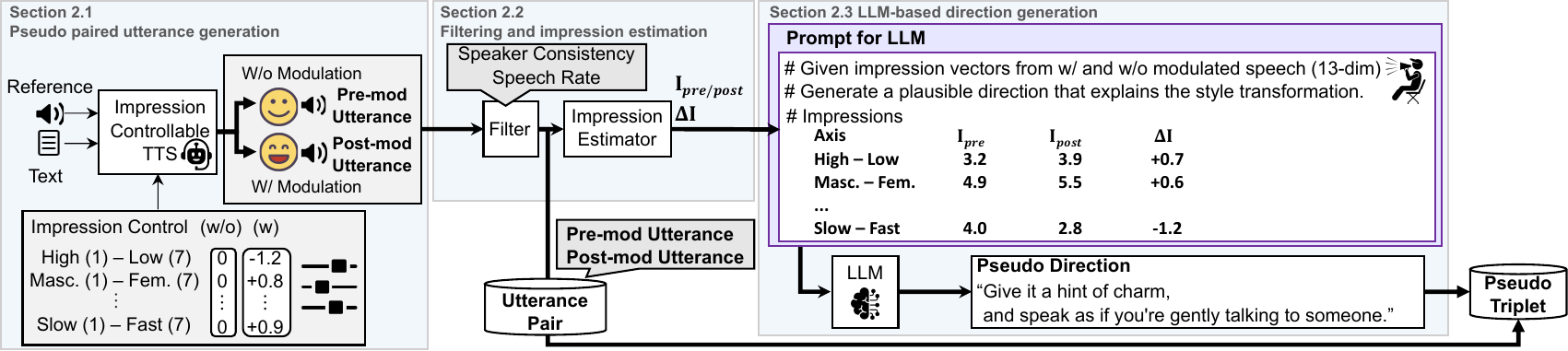
Giving TTS systems the ability to follow natural-language performance directions — "speak with more warmth," "emphasize the last word" — is valuable, but training data pairing utterances with such directions is scarce. NTT addresses this with a pseudo-triplet construction pipeline: style-modified utterances are synthesized from a voice-impression-guided process and paired with LLM-written directional descriptions, scaling up supervision without manual annotation while preserving the original speaker identity.
Scalable Direction-Following TTS via Voice Impression-Guided Pseudo Triplet Construction
This paper enables TTS systems to follow directional performance instructions while preserving speaker identity. It addresses data scarcity through a scalable pseudo-triplet construction pipeline that synthetically generates style-modified utterances paired with LLM-written directions.
Abstract
Voice actors often re-read the same script while modifying their delivery in response to performance directions. We study this setting as direction-following TTS, where a system generates a new utterance that reflects a given direction relative to a reference utterance while preserving speaker identity and linguistic content. A key challenge is the lack of training data capturing such relative modifications. To address this, we propose a scalable pseudo-triplet construction pipeline that generates~(reference utterance, direction text, modified utterance) triplets. It generates controlled style variations using an impression-controllable TTS model and uses an LLM to produce natural language directions from estimated impression differences. Experimental results demonstrate that pseudo-triplets alone enable stable speaker-preserving modification, and that combining pseudo and recorded data further improves direction alignment while maintaining speaker similarity. Audio examples are available on our demo page https://ntt-hilab-gensp.github.io/IS2026pseudo/
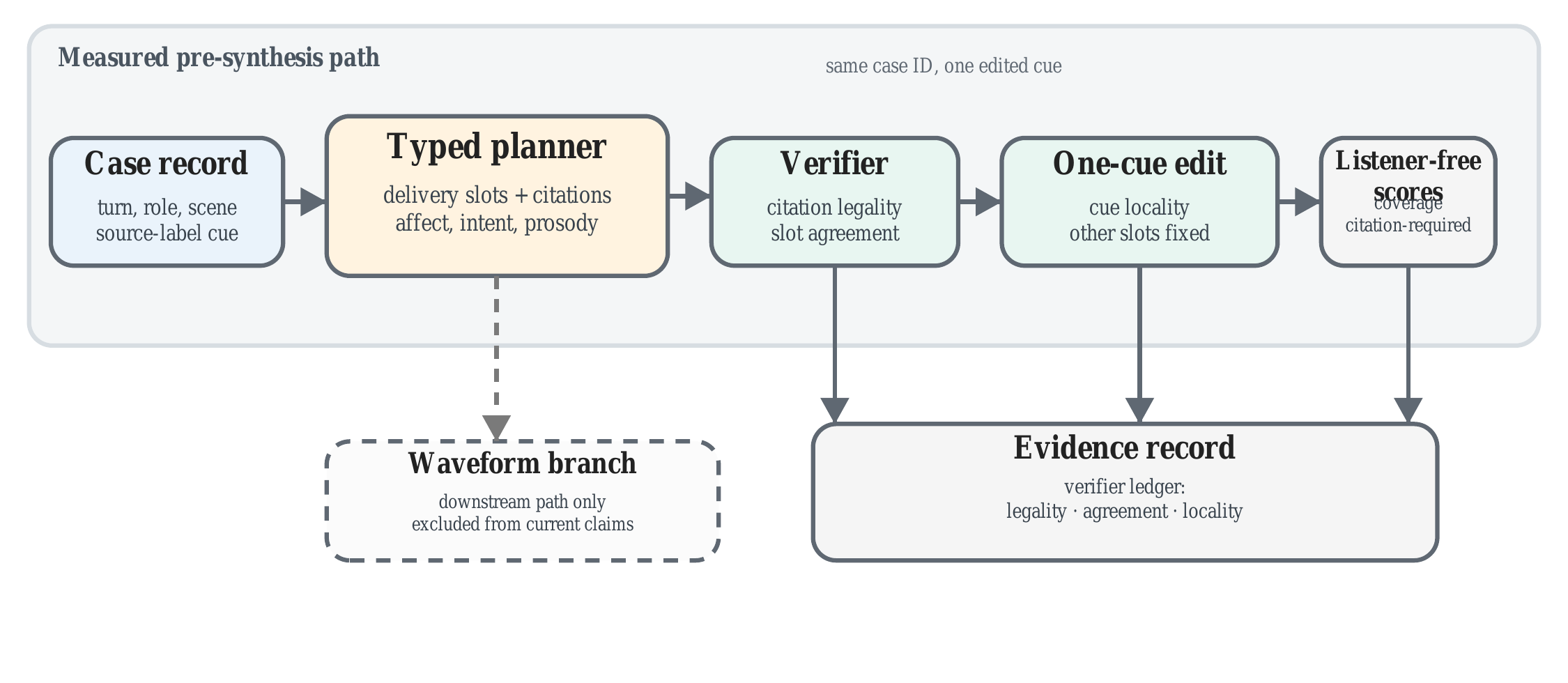
Evaluating whether a speech planning stage is actually grounded — rather than hallucinating prosodic choices — is an unsolved problem that standard audio metrics can't touch. VoxReason approaches this deterministically: it checks whether planned affect, pitch, and emphasis decisions are licensed by source records, catching planning hallucinations before synthesis ever runs. This listener-free framing is a meaningful departure from perceptual MOS-style evaluation.
VoxReason: Listener-Free Evaluation of Source-Grounded Speech Planning Before Synthesis
VoxReason evaluates speech planning by verifying prosodic choices are grounded in source material. Unlike standard audio metrics, it deterministically checks whether planned affect, pitch, and emphasis are licensed by source records rather than memorized, catching hallucination before synthesis.
Abstract
Expressive speech systems have to decide how an utterance is delivered before any waveform is rendered. In dialogue agents, narration, and role-conditioned TTS, that planning step sets affect, pitch, energy, rate, pause, emphasis, and stance, yet standard audio metrics rarely show whether those choices were actually licensed by the source record. This leaves a practical evaluation gap: a system may sound plausible while relying on a memorized script instead of the cue that governs delivery. VoxReason casts this pre-synthesis step as a listener-free task for source-grounded speech planning. Systems output a source-cited speaking plan, and a deterministic verifier checks citation legality, slot agreement, unsupported state, schema validity, and one-cue counterfactual locality. On 1,440 checked source-label cases, shortcut controls show why slot accuracy alone is unsafe: a key-lookup oracle reaches 1.000 plan-slot accuracy on seen keys, while an emotion prior still reaches 0.958 slot accuracy on source-key-disjoint cases without citing intensity or identity. In a separate 100-case learned source-key-disjoint comparison, a 7B locality SFT+CF repair improves plan-slot accuracy/locality from 0.684/0.141 to 0.919/1.000, and removing source records lowers citation-required grounded score by 0.488. The resulting benchmark isolates whether planned delivery is warranted by the record before waveform evaluation or listener studies are used.
From today's Hugging Face Daily papers, Tencent Hunyuan contributed two major releases. First, Gander (the Omni Interaction Agent) is an end-to-end framework built around a Cerebellum-Brain architecture and chunk-level token streaming. It integrates continuous multi-modal streaming, real-time full-duplex interaction, and agentic reasoning in a single system — a compelling attempt to close the loop between perception, planning, and speech output.

Omni Interaction Agent Technical Report
Gander is an end-to-end framework that integrates continuous multi-modal streaming, real-time full-duplex interaction, and agentic reasoning through a Cerebellum-Brain architecture and a chunk-level token stream design.
Abstract
In this work, we present Gander, an end-to-end model that unifies omni perception, realtime interaction, and agentic capabilities within a single framework. In contrast to turn-based conventional paradigms, Gander continuously receives streaming inputs across multiple modalities, including video, speech, and text, enabling natural full-duplex interaction in both everyday conversations and complex workflow-oriented agent scenarios. Users can interrupt the model at any time, while the model can also proactively provide intermediate feedback or ask follow up questions. To natively support these capabilities, Gander adopts two key architectural designs: 1) It employs a Cerebellum-Brain collaborative framework, in which the Cerebellum is responsible for realtime interaction and omni conversational capabilities, while the Brain handles complex reasoning and higher-level agentic tasks. The two components interact continuously through tool calling and the agent orchestration runtime. 2) The Cerebellum is built upon a streaming Thinker-Talker architecture, user inputs and model outputs are further flattened into an ordered token stream at the chunk level, providing a unified representation for low latency, continuous interaction. We conduct comprehensive evaluations of Gander across four dimensions: conversational ability, omni understanding, interactive capability, and agentic intelligence. Internal human evaluations demonstrate that Gander maintains the natural and expressive spoken dialogue capabilities of SOTA open source models while achieving competitive performance in omni interaction. Gander also demonstrates robustness in challenging real-world scenarios, including background noise interference, multi-party interactions, and backchannel communication. We release Gander together with its models, code, and data to facilitate further research and development in the community.
Also from Tencent Hunyuan and also trending heavily on HuggingFace Daily, AuK is an open-source foundational model that unifies speech generation and editing under natural-language instructions and audio context. The architecture combines a multimodal language model, a joint VAE, a hybrid rectified-flow Transformer, and efficient distillation for fast inference — making it one of the more complete open releases in the speech generation space to date.

AuK Technical Report: An Open-Source Foundational Model for Speech Generation and Editing
AuK is an open-source foundational model that unifies speech generation and editing via natural-language instructions and audio context, using a multimodal language model, joint VAE, hybrid rectified-flow Transformer, and efficient distillation for fast inference.
Abstract
We introduce AuK, an open-source foundational model that unifies speech generation and editing through a common interface of natural-language instructions and audio context. To support this broad capability set, we construct approximately 3.03 billion instruction--audio instances and 1.95 million hours of effective supervision across five task families: speech generation, content editing, enhancement and separation, paralinguistic editing, and acoustic editing. AuK combines a multimodal large language model for semantic conditioning, an VAE jointly trained on speech, general audio, and music for acoustic conditioning, and a hybrid rectified-flow Transformer that performs dual-stream MMDiT blocks followed by unified single-stream DiT blocks for generation. Training begins with generation-only warm-up and proceeds to joint generation--editing pre-training. We then apply complementary post-training strategies: human-feedback preference optimization for open-ended editing and reward-based reinforcement learning for speech generation. To reduce inference cost, we further distill the model with consistency initialization and task-routed Decoupled DMD. The resulting AuK-Flash performs 4-step inference without classifier-free guidance and achieves a 4.5 wall-clock speedup over the full model under matched conditions. Experiments demonstrate leading performance on zero-shot and instruction-controlled speech generation and general instruction-guided editing, while remaining competitive on signal-level restoration tasks. We release both the source code and model weights to support reproducibility and further research.
Trending on Hugging Face

ID-V2V: Identity-Preserving Video Restylization
ID-V2V is a video-to-video generative framework that preserves facial identity and performance during restylization by decoupling relighting-based identity preservation from keyframe-guided synthesis.

VoiceMem: Streaming Dual-Brain Memory for Real-Time Interaction
VoiceMem introduces a dual-brain streaming memory architecture for speech language models that improves retrieval accuracy, emotional personalization, and real-time efficiency.

Qwen3-TTS Technical Report
The Qwen3-TTS series presents advanced multilingual text-to-speech models with voice cloning and controllable speech generation capabilities, utilizing dual-track LM architecture and specialized speech tokenizers for efficient streaming synthesis.