
Full-Duplex Dialogue, Brain-to-Speech, and Smarter Voice LLM Serving
Today's digest spans Meta AI's 3B-parameter alignment-free dubbing and full-duplex dialogue model, real-time brain-to-speech synthesis, low-resource Thai TTS, scalable voice context orchestration for LLMs, and object-grounded co-speech gesture generation.
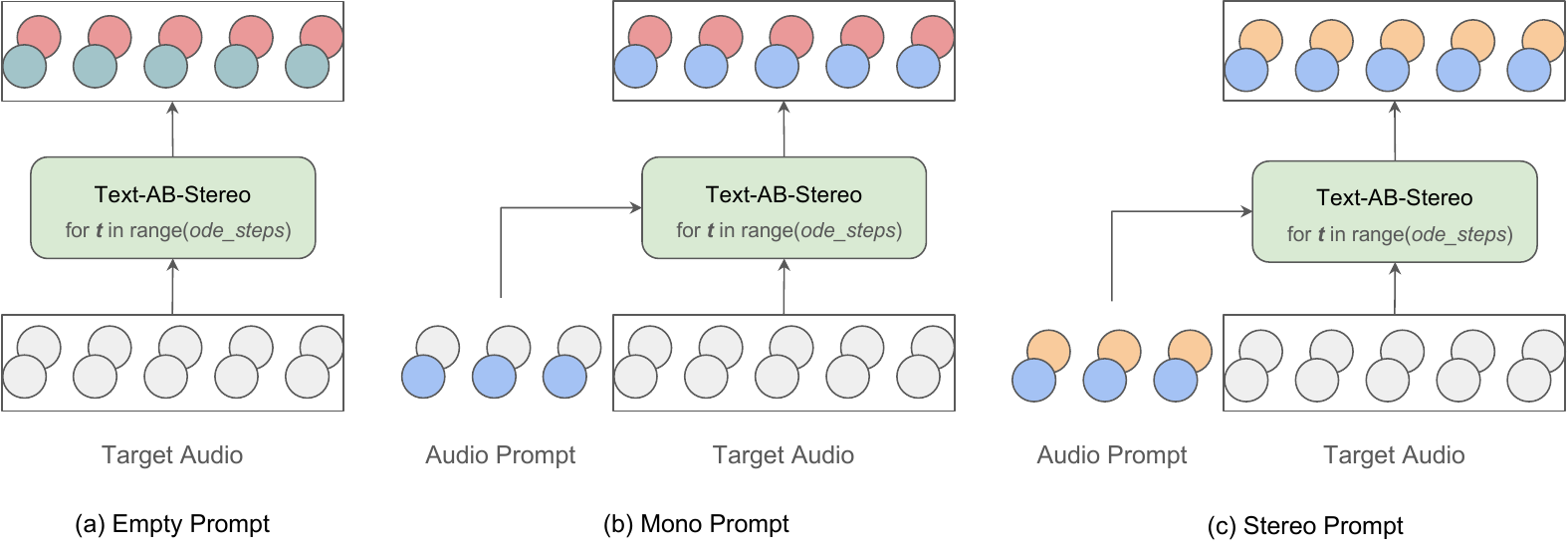
One-Shot inference with different audio prompts. From Meta AI.
Today's papers push the frontier across conversational speech synthesis, neural-interface voice output, low-resource TTS, and the infrastructure layer beneath voice AI — with a bonus from the Hugging Face Daily tab on physically grounded gesture generation.
Dubbing & Full-Duplex Dialogue Synthesis
Eliminating forced alignment and natively modeling the back-and-forth of real conversation.
Forced alignment has long been a brittle prerequisite for controllable speech synthesis. Meta AI's new work removes it entirely by learning text-speech alignment through cross-attention inside a single 3B-parameter model. Beyond dubbing, the system natively handles turn-taking and emotional dynamics, reporting substantial gains in prosody, naturalness, and conversational realism — making it one of the most complete unified frameworks for spoken dialogue generation to date.
Alignment-Free Text-Audiobox for Voice Dubbing and Full-Duplex Dialogue Synthesis
A unified framework for voice dubbing and full-duplex dialogue that learns text-speech alignment via cross-attention, eliminating forced alignment. Scaled to 3B parameters, it natively models turn-taking and emotional dynamics, achieving significant improvements in prosody, naturalness, and conversational realism.
Abstract
We present Alignment-Free Text-Audiobox (Text-AB), a unified framework for high-quality voice dubbing and full-duplex dialogue synthesis. Building on a Diffusion Transformer trained with a flow-matching objective, Text-AB departs from the Audiobox system along three dimensions. First, it operates in a latent diffusion framework using DAC-VAE features that encode 48 kHz waveforms into a 25 Hz latent sequence, giving over 10x higher compression than previous EnCodec representations while improving resynthesis quality. Second, Text-AB is alignment-free: it consumes raw text via an off-the-shelf text encoder and learns text-speech alignment through cross-attention, removing the need for forced alignment and explicit duration prediction. Third, we scale model and data substantially, pretraining a 3B-parameter model on 480k hours of monolingual speech, followed by supervised fine-tuning on three downstream tasks: cross-lingual voice dubbing, full-duplex dialogue synthesis, and emotional full-duplex dialogue synthesis. At inference, Text-AB supports one-shot generation for up to ~1 min of speech and arbitrarily long-form generation via a multi-diffusion scheme, plus a multi-stage reranking strategy that enhances quality based on automated metrics. On a real-world dubbing benchmark, Text-AB delivers a step-change improvement over the latest internal dubbing system, with large gains in prosody similarity, voice similarity, naturalness, and shareability. For full-duplex dialogue synthesis, it approaches human recordings on short-form conversations and substantially outperforms the latest internal model on long-form human-likeness and expressivity, while natively modeling turn-taking, back-channeling, and emotional dynamics. For emotional dialogue synthesis, emotion conditioning significantly improves emotion alignment and emotional interaction quality over the unconditioned baseline.
TTS & Voice Synthesis
From brain signals to on-device Thai speech — two very different frontiers of voice output.
Brain-computer interface speech synthesis has traditionally relied on cascaded pipelines — decode neural activity to text, then run TTS — which compounds errors and adds latency. Brain2Speech-Net from the University of Edinburgh sidesteps this entirely with a single end-to-end model: a phoneme bottleneck and deep-HMM alignment map neural recordings directly to intelligible speech in real time, with no text decoding step in the loop. The result is lower latency and fewer error-propagation failure modes compared to cascaded approaches.
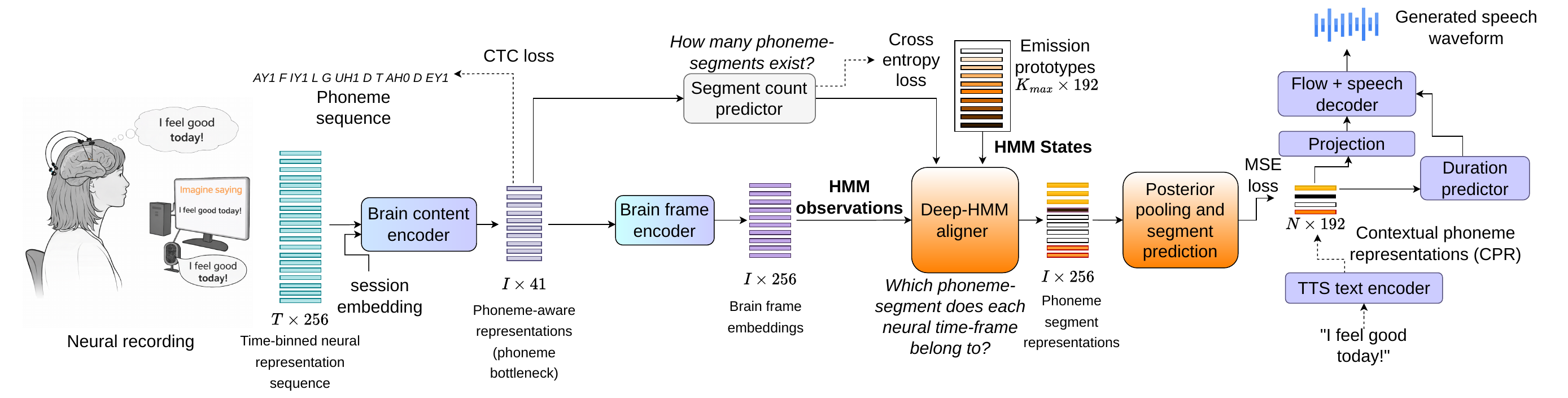
Brain2Speech-Net: Intelligible, Real-Time Brain-to-Speech Synthesis Without Text Decoding
Brain2Speech-Net synthesizes intelligible speech directly from brain recordings in real time using a single end-to-end model, avoiding latency and error propagation of cascaded neural-to-text-to-speech pipelines. A phoneme bottleneck and deep-HMM alignment map neural activity to speech without text decoding.
Abstract
The loss of speech limits communication for individuals with paralysis. Restoring speech by synthesizing it directly from neural activity is challenging: intracortical data are scarce and lack aligned targets, so most systems rely on cascaded neural-to-text-to-speech pipelines that add latency and propagate errors. We present Brain2Speech-Net, among the first single-stage frameworks to remain intelligible under limited data while removing intermediate text decoding. A differentiable phoneme bottleneck preserves linguistic structure without explicit text decoding. A lightweight deep-HMM aligner then maps this bottleneck to contextual phoneme representations in a TTS latent space. It learns monotonic alignment between neural recordings and phoneme segments without frame-level supervision, inheriting strong acoustic priors for data-efficient training. On an intracortical dataset, Brain2Speech-Net achieves strong intelligibility in objective and listening tests while running faster than real time. Unlike cascaded systems that incur high latency and direct speech-unit models that lack intelligibility, it delivers both intelligible and real-time speech.
Low-resource TTS presents a different set of challenges: tonal phonology, code-switching, and scarce natural audio. Typhoon's work on fixed-voice Thai TTS tackles all three by training a compact, on-device model from just 15 seconds of target-speaker audio using a large voice-cloning model as a synthetic-data teacher. The pipeline design carefully handles Thai tones and mixed-language utterances, and the prosody evaluation methodology itself is a useful contribution for the low-resource TTS community.
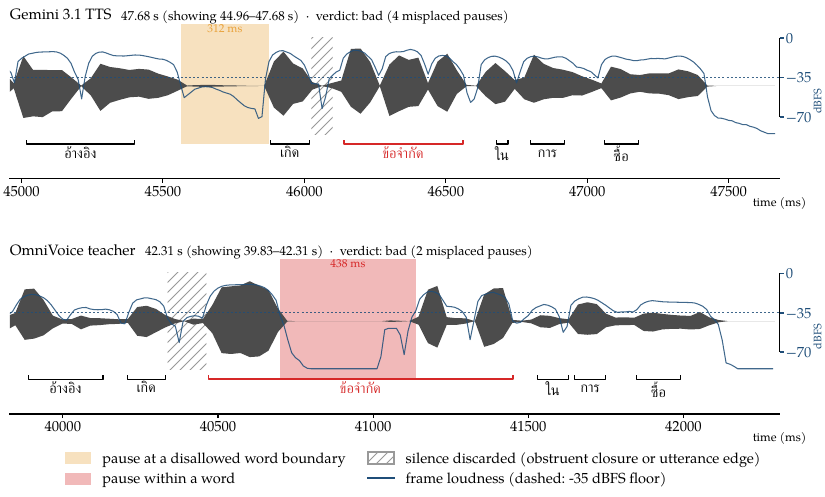
Building and Evaluating Fixed-Voice Thai TTS from Synthetic Speech
This work trains a compact fixed-voice TTS model from synthetic speech using 15 seconds of audio and a large voice-cloning teacher. It tackles low-resource language challenges (Thai tone, code-switching) through pipeline design and prosody evaluation, enabling on-device inference with state-of-the-art quality.
Abstract
In low-resource settings, deploying TTS typically requires choosing between a large voice-cloning model with costly inference or a compact fixed-voice system that requires a speaker-specific corpus. We study a third route: using a large voice-cloning model as a programmable data source to turn a short voice reference (e.g., 15 seconds) into a compact fixed-voice student trained entirely on synthetic speech. This setting makes pipeline design consequential: teacher errors become training targets, while filtering failed generations can reduce coverage of difficult texts. Thai further introduces challenges from ambiguous word boundaries, lexical tone, names and loanwords, numeric verbalization, and Thai-English code-switching. We study how text preparation, synthetic generation, quality filtering, rejection sampling, and frontend choices affect the resulting student, and where teacher limitations remain. We evaluate CER, Challenge-Set Keyword Accuracy, Prosody Pause Accuracy, speaker similarity, and speaking rate. The resulting 82M-parameter model, Wayu-Paxa-TTS-Edge, enables on-device Thai TTS without reference audio. It achieves 68.2% Challenge-Set Keyword Accuracy (85.5% of Gemini 3.1) and 91.4% pause precision, outperforming its OmniVoice teacher (89.9%) and reaching 94.8% of Gemini 3.1. It also achieves the lowest pause-placement error and intra-word pause rates among the three systems, and 3.7% and 1.1% CER on Thai and English, respectively. We open-source the model and evaluation framework for Thai TTS development.
Voice Agents & SpeechLLMs
Making voice context a first-class citizen in LLM serving, and grounding gestures in the physical world.
When an LLM serves a voice interface, critical signal — speaking rate, tone, environmental noise — is typically discarded or handled ad hoc. UC Berkeley's paper introduces middleware that surfaces structured voice context explicitly to the LLM serving stack. Rather than leaving context implicit, it orchestrates speaking rate, tone, and environmental conditions as structured inputs, improving user alignment and robustness while dramatically cutting costs for long voice sessions. It's a rare systems-level contribution to voice AI infrastructure.
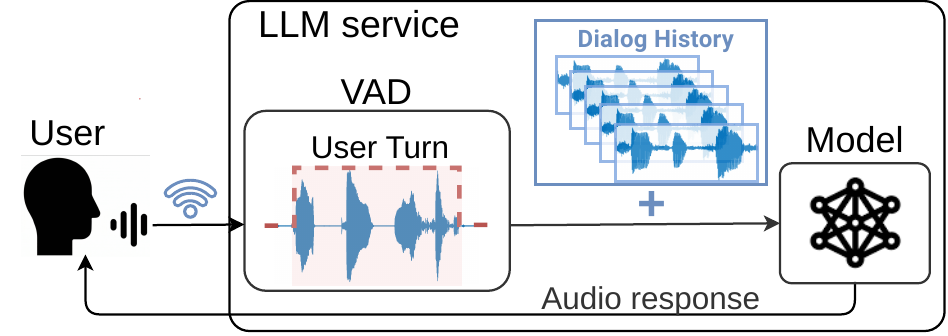
Scalable Context Orchestration for Serving LLMs Over Voice
This paper presents middleware that makes voice context—speaking rate, tone, and environmental conditions—explicit in LLM serving. Unlike existing approaches, it orchestrates structured context to improve user alignment and robustness, while dramatically reducing costs for long voice conversations.
Abstract
Voice AI applications are gaining popularity as advances in large language models (LLMs) enable more natural and accessible spoken interactions. Serving these applications requires accounting not only for what users say, but also for how they speak (e.g., speaking rate) and the conditions under which their audio is captured and transmitted (e.g., background noise and packet loss). However, existing LLM systems represent conversation context as a flat, growing sequence of messages, leaving voice-specific context implicit in the audio. As a result, they can generate responses that are poorly aligned with user preferences, degrade interaction quality under adverse environmental conditions, and incur high costs over long voice sessions. We present llmovoice, a context-management middleware that explicitly models voice context and orchestrates its use. At each turn, llmovoice constructs a bounded voice context from the current user input, relevant interaction history, and explicit paralinguistic and environmental states. It then uses the serving LLM to reason over this context and generate runtime directives that guide how the system responds. We evaluate llmovoice on real-world voice applications and benchmarks. It reduces speaking-rate alignment error by 52.4%, lowers the false-interruption rate from 46.0% to 0.9% under packet loss, and reduces model usage cost by 79.2%. For long sessions, llmovoice reduces per-turn cost by up to 24.9 times while retaining up to 98.7% of baseline answer quality.
From today's Hugging Face Daily tab: co-speech gesture generation gets a physically grounded upgrade with Puppeteer from Pickford. The diffusion-based model uses causal latent tokens alongside object geometry to produce temporally coherent gestures that respect the physical shape of objects being interacted with — a step toward avatars whose hands actually make sense in context.

Puppeteer: Object-Grounded Posture-Aware Co-Speech Gesture Generation
Puppeteer is a diffusion-based co-speech gesture model that uses causal latent tokens and object geometry to generate temporally coherent, physically grounded gestures.
Abstract
Generating co-speech gestures that are temporally coherent, semantically aligned with speech, and grounded with surrounding objects remains challenging. Prior speech-driven gesture models emphasize audio-gesture alignment but do not explicitly account for posture constraints or surrounding objects, failing to capture the inherent correlation between body gestures and the physical space. We present Puppeteer, a posture-aware, object-grounded co-speech gesture diffusion model operating in a causal latent space. We decompose long gestures into structured primitives and learn a causal variational autoencoder that encodes them into temporally ordered latent tokens, each depending only on the past. We then perform conditional diffusion directly in the causal latent space, conditioning on speech signals, motion history, an initial posture reference, and object geometry to synthesize physically consistent gestures. This temporally ordered latent formulation enables explicit temporal control and supports tasks such as gesture in-betweening and gesture completion. To better assess co-speech gesture synthesis beyond existing measures, we introduce new evaluation metrics tailored to this task. We also created SceneGes, the first curated synthetic 3D dataset of embodied co-speech gestures and corresponding 3D objects, enabling object-grounded gesture generation. Experiments show that Puppeteer generates more diverse and temporally synchronized gestures than prior methods, while enabling object-grounded gesture synthesis.
Trending on Hugging Face

ID-V2V: Identity-Preserving Video Restylization
ID-V2V is a video-to-video generative framework that preserves facial identity and performance during restylization by decoupling relighting-based identity preservation from keyframe-guided synthesis.

Omni Interaction Agent Technical Report
Gander is an end-to-end framework that integrates continuous multi-modal streaming, real-time full-duplex interaction, and agentic reasoning through a Cerebellum-Brain architecture and a chunk-level token stream design.

VoiceMem: Streaming Dual-Brain Memory for Real-Time Interaction
VoiceMem introduces a dual-brain streaming memory architecture for speech language models that improves retrieval accuracy, emotional personalization, and real-time efficiency.

AuK Technical Report: An Open-Source Foundational Model for Speech Generation and Editing
AuK is an open-source foundational model that unifies speech generation and editing via natural-language instructions and audio context, using a multimodal language model, joint VAE, hybrid rectified-flow Transformer, and efficient distillation for fast inference.