
Full-Duplex Dialogue, Hallucination-Free TTS, and Mesh-Bound Avatars
Today's digest spans the full voice-AI stack: unified audio generation with LLM backbones, smarter TTS alignment via DPO, streaming mel decoders, lightweight vocoders, speech-to-speech translation, full-duplex dialogue datasets, multiparty voice-agent benchmarking, and template-free head avatars.

Figure from From Xiamen University.
Today's papers push across the full voice-AI stack — from unified audio generation models that blur the line between TTS, music, and voice design, to smarter alignment strategies that tame hallucinations in decoder-only synthesizers, to a fresh benchmark exposing how badly current voice agents flounder the moment a third speaker joins the room. There's also a template-free head avatar system and a 2,000+ hour full-duplex dialogue corpus rounding things out.
TTS & Voice Synthesis
From unified audio LLMs to lightweight vocoders — multiple angles on making synthesis faster, more robust, and more general.
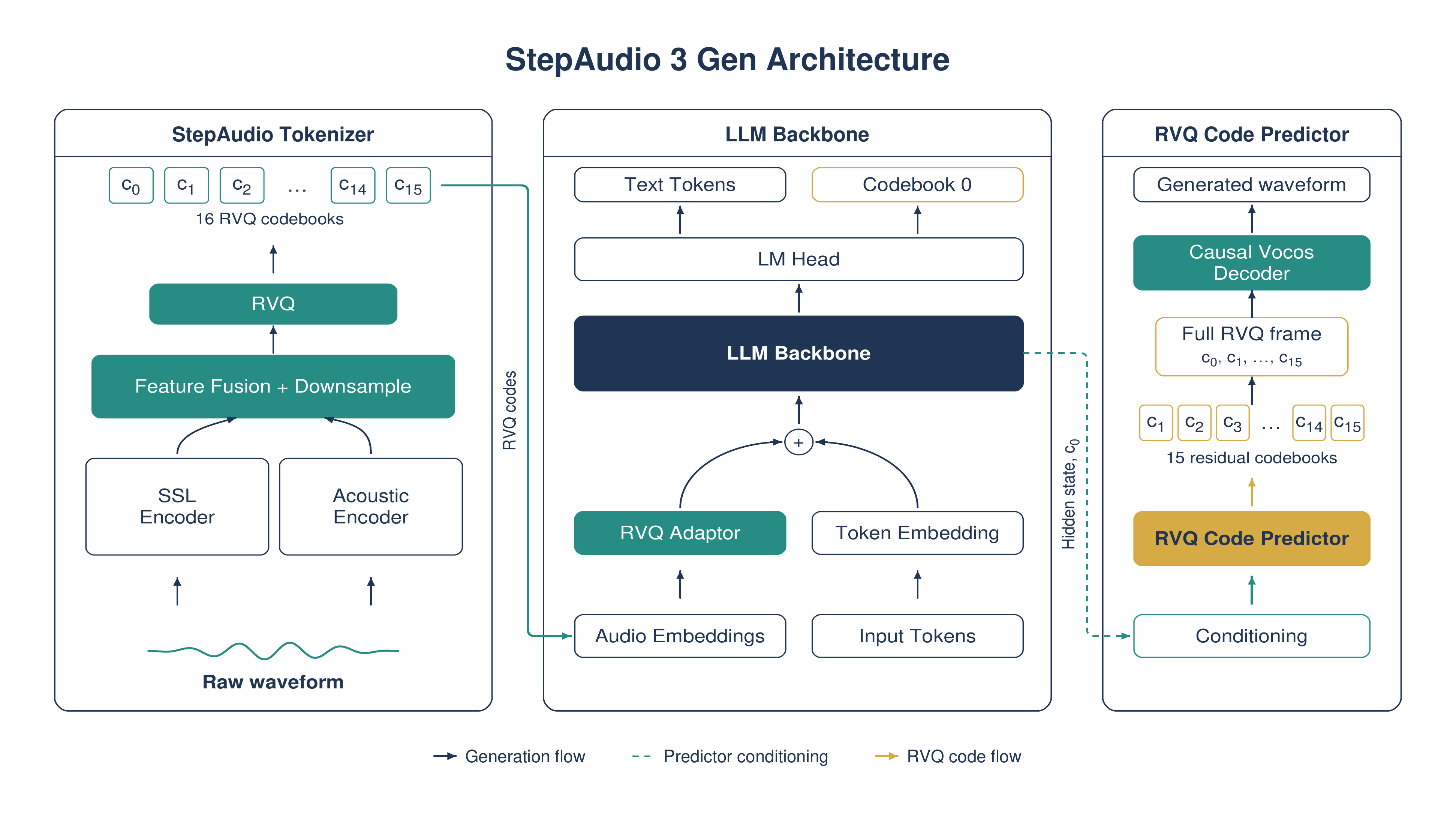
The trend toward LLM-native audio generation continues with Stepfun's latest system. StepAudio 3 Gen (featured on today's Hugging Face Daily tab) abandons diffusion in favor of discrete autoregressive modeling over RVQ tokens, unifying TTS, voice design, singing vocals, and music generation under a single LLM backbone. Progressive pretraining keeps language skills intact while the model absorbs diverse audio generation capabilities — a compelling demonstration that one architecture can span the full audio creation spectrum.
StepAudio 3 Gen Technical Report
StepAudio 3 Gen unifies TTS, voice design, vocals, and music generation via discrete autoregressive modeling over RVQ tokens instead of diffusion. It integrates an LLM backbone with progressive pretraining to preserve language skills while acquiring diverse audio generation capabilities across multiple domains.
Abstract
We introduce StepAudio 3 Gen, a general-purpose audio generation model that supports zero-shot text-to-speech (TTS), voice design, vocal generation, sound effects, music, vibe speech, and mixtures of multiple audio types within a unified framework. At its core, StepAudio 3 Gen is a discrete autoregressive generator that models audio directly over residual vector quantization (RVQ) tokens, departing from the diffusion Transformer-based continuous generation paradigm prevalent in recent general audio models. Its StepAudio Tokenizer represents general audio at 12.5 Hz in a shared $16 \times 2048$ residual code space, jointly quantizing semantic and waveform-level acoustic features so that each code layer preserves both types of information. For generation, the backbone predicts the first codebook along the time axis using autoregressive modeling, while a lightweight causal Transformer completes the remaining fifteen codebooks along the codebook axis. Our study further identifies three key design principles: (1) interference-aware progressive pretraining for acquiring audio capabilities while preserving the textual abilities of the large language model, (2) RVQ Adaptor for effectively incorporating multi-codebook acoustic representations, and (3) discrete autoregressive modeling over a shared representation across general audio domains. With progressive pretraining, multi-task instruction training, and supervised fine-tuning, StepAudio 3 Gen achieves state-of-the-art performance on both TTS and voice design, while retaining strong generation capabilities across speech, vocals, sound effects, and music. Audio samples are available at https://stepaudiollm.github.io/step-audio-3-gen/.
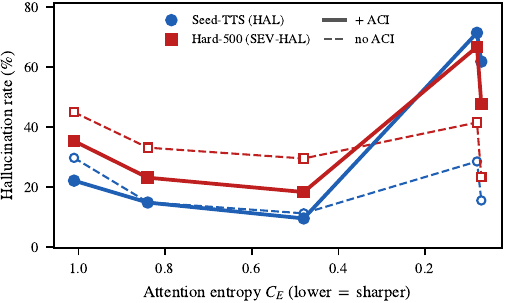
Decoder-only TTS models inherit LLM power but also LLM-style hallucinations — skipped words, repeated phrases, nonsense phonemes. The University of Edinburgh's AlignDPO surfaces a counterintuitive finding: text-speech alignment strength has a non-monotonic effect on robustness, meaning maximal alignment actually hurts. The method pairs lightweight CTC alignment with Direct Preference Optimization to land at the optimal moderate-alignment sweet spot, cutting severe hallucinations without touching the underlying architecture.
AlignDPO: Preference-Gated Alignment for Reducing Hallucination in Decoder-Only TTS
This paper reveals that text-speech alignment strength has a non-monotonic effect on TTS robustness—moderate alignment is optimal, not maximal. AlignDPO combines lightweight CTC alignment with Direct Preference Optimization to reach this sweet spot, reducing severe hallucinations without architectural changes.
Abstract
Decoder-only text-to-speech (TTS) models scale efficiently but remain prone to content hallucinations that arise from weak text-speech alignment during autoregressive generation. We find that robustness is governed by a non-monotone relation to the sharpness of the alignment-bearing attention heads: a moderate degree is best, whereas over-sharpening is no better than the unaligned backbone and even less robust. Guided by this, we present AlignDPO, a post-training method that reaches this moderate regime by folding a lightweight connectionist-temporal-classification (CTC) alignment term into Direct Preference Optimization (DPO), applied only to the chosen samples, with no architectural or inference-time change. On the Seed-TTS-Eval English set, this significantly reduces the content-hallucination and word error rates relative to a strong DPO baseline and lowers the severe content-hallucination rate to ~0.6% (from 4.4%); a listening study further finds it preferred for naturalness over both the backbone and that baseline. Alignment is thus best learned and kept moderate rather than maximized or imposed at decoding. Audio samples are available at https://align-dpo-demo.vercel.app.
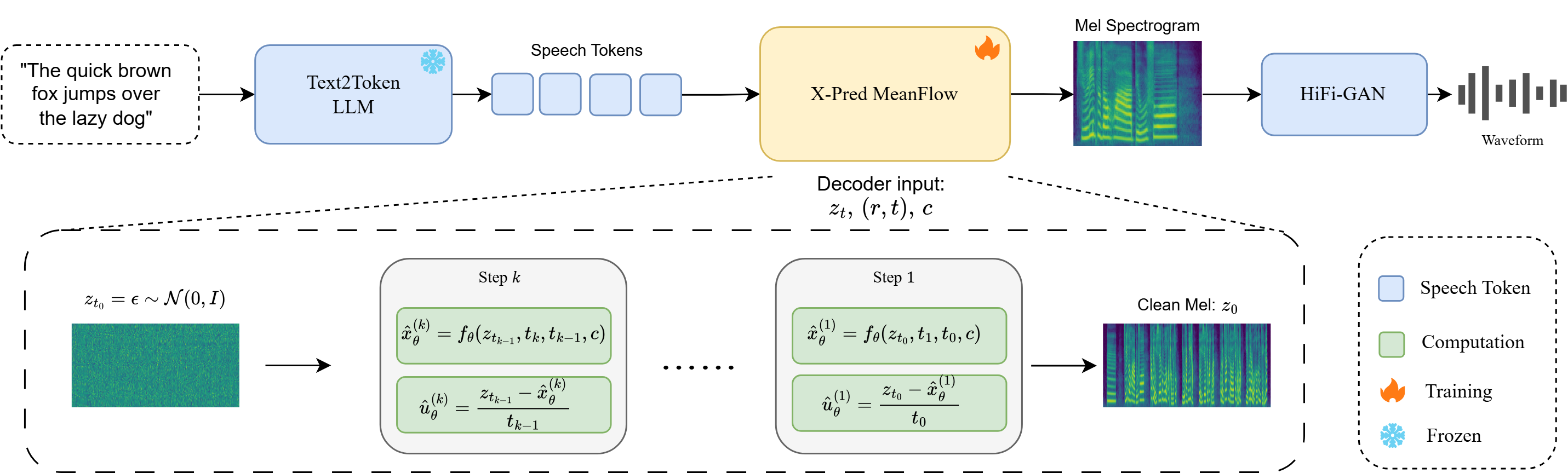
Low-latency streaming synthesis is a prerequisite for real conversational AI. Tsinghua University's X-Pred MeanFlow tackles this with a few-step token-to-mel decoder that predicts mel-spectrograms directly while analytically recovering the flow-matching velocity field — sidestepping iterative diffusion steps entirely. Layer-selective attention enables continuous chunk-wise generation with bounded context, making it well-suited for dialogue pipelines where every millisecond of latency matters.
X-Pred MeanFlow for Streaming Token-to-Mel Speech Decoding
X-Pred MeanFlow is a few-step streaming token-to-mel decoder that predicts mel-spectrograms directly while analytically recovering velocity for flow-matching, enabling efficient low-latency synthesis for dialogue. Layer-selective attention supports continuous chunk-wise generation with bounded context.
Abstract
Recent advancements in discrete token-based speech generation have highlighted the importance of efficient token-to-waveform synthesis in streaming and dialogue scenarios. Flow-matching acoustic decoders achieve high-quality token-to-mel generation, but their iterative sampling requires multiple neural function evaluations, limiting low-latency speech synthesis. MeanFlow reduces the sampling budget by modeling the average velocity over a temporal interval, yet maintaining high acoustic quality under extremely few-step token-to-mel generation remains challenging. To address this challenge, we propose X-Pred MeanFlow, a few-step streaming token-to-mel decoder that reparameterizes MeanFlow with mel-space prediction. The decoder predicts a generalized mel field and analytically derives the corresponding average velocity for sampling, thereby preserving the MeanFlow formulation while providing a direct acoustic prediction target. We further introduce layer-selective block-wise attention to enable continuous chunk-wise generation with bounded context. Experiments show that X-Pred MeanFlow improves few-step token-to-mel synthesis over Direct-$u$ MeanFlow and supports stable streaming generation. Speech samples are available.https://renxiaming.github.io/xpred-meanflow-stream-demo
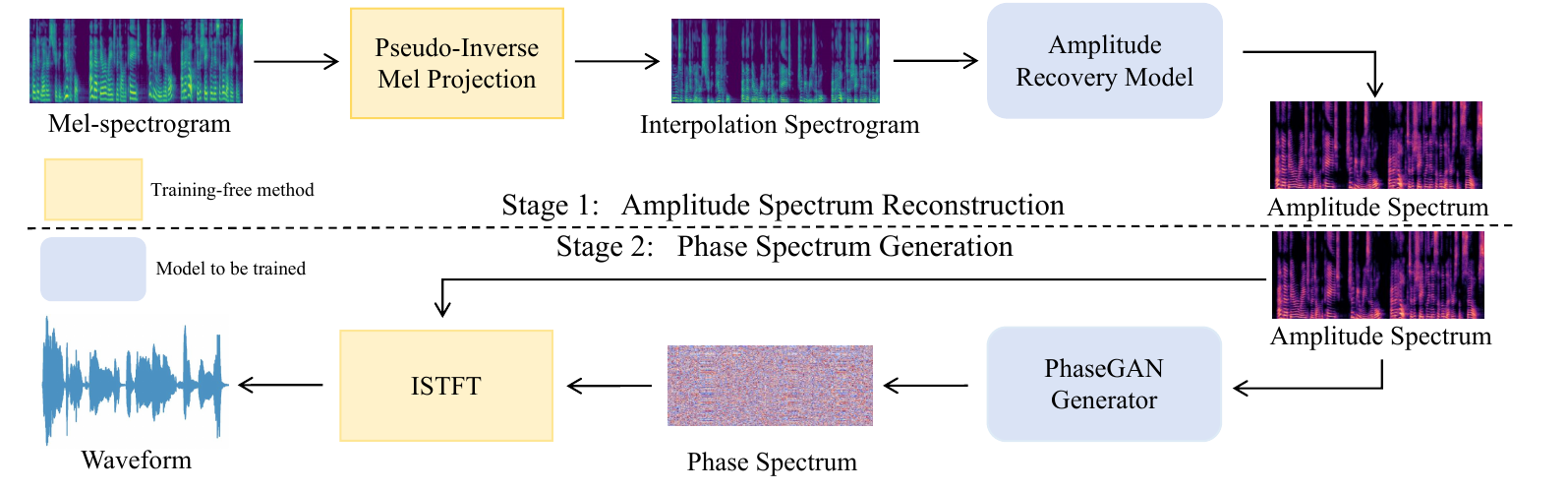
Even the best acoustic model needs a great vocoder at the end of the chain. Alibaba's PhaseGAN rethinks waveform synthesis by decoupling amplitude and phase reconstruction, using GAN-driven training specifically for the phase component. At roughly 500K parameters it runs in real time, and its GAN-driven phase approach generalizes surprisingly well to musical audio despite being trained exclusively on speech — a useful property for systems like StepAudio that span both domains.
PhaseGAN: High-Fidelity Vocoder via Decoupled Amplitude and GAN-Driven Phase Reconstruction
PhaseGAN is a lightweight vocoder that decouples amplitude and phase reconstruction for high-fidelity speech synthesis, achieving real-time performance with ~500K parameters. Its GAN-driven phase reconstruction approach uniquely enables cross-domain generalization to musical audio despite training only on speech data.
Abstract
A vocoder is a pivotal component of modern text-to-speech (TTS) systems. Despite the significant progress of neural network-based vocoders, accurate phase reconstruction remains the main challenge limiting both audio quality and modeling efficiency. We introduce PhaseGAN, a lightweight vocoder that addresses this limitation through a "mel $\rightarrow$ Amplitude $\rightarrow$ Phase" reconstruction pipeline. By reconstructing amplitude and phase spectra via distinct methodologies, the proposed PhaseGAN outperforms state-of-the-art baselines while utilizing fewer model parameters and reduced computational requirements. The compact version generates high-fidelity audio with approximately 500K parameters and 1 GMAC computational load, making it highly suitable for real-time applications on edge devices. In addition, our approach exhibits exceptional musical audio synthesis capabilities despite no training on musical data, illustrating unprecedented cross-domain generalization. See https://github.com/phasegan/phasegan-audio-demo for demos of our work.
SpeechLLMs & Spoken Dialogue
LLMs meeting speech end-to-end — for translation, full-duplex interaction, and multiparty awareness.
Speech-to-speech translation is a natural fit for LLMs, but preserving speaker identity and prosody across languages remains tricky. Sony's Kraken augments a pre-trained LLM with low-bitrate VQ tokenization and a dual-path source-conditioned vocoder — conditioning waveform generation on the original input speech so that speaker timbre and prosodic contours survive the translation process. This design also relaxes the strict alignment requirements that make multilingual training data scarce and expensive.
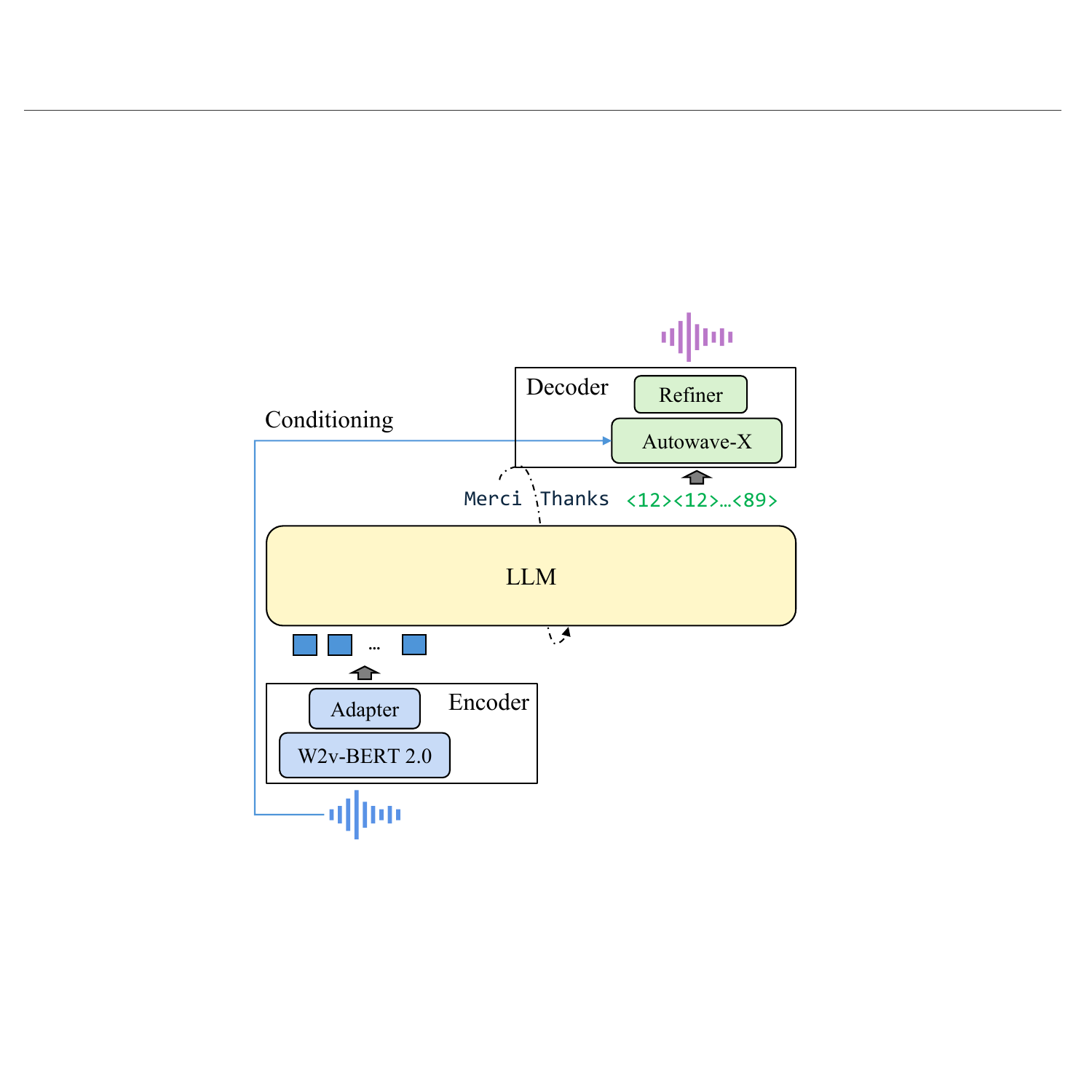
Kraken: LLM-based Speech-to-Speech Translation via Low-bitrate VQ and Dual-path Source Conditioning
Kraken augments a pre-trained LLM with low-bitrate VQ tokenization and source-conditioned vocoding for speech-to-speech translation. By conditioning waveform generation on input speech, it better preserves speaker identity and prosody while relaxing alignment constraints in multilingual training data.
Abstract
Speech-to-speech translation (S2ST) has advanced significantly with speech LLMs, offering the potential for joint optimization and preserving non-linguistic information. However, these models struggle with predicting high-bitrate speech tokens in LLMs, and face the challenge of relying on S2ST training data with ideally aligned speaker identity and prosody. We propose using low-bitrate tokens based on single-layer vector quantization, trained to reconstruct self-supervised learning (SSL) features. We also employ a separate token-to-waveform decoder named Autowave-X, which is also conditioned on the source speech to improve non-linguistic transfer, thereby relaxing the training data constraints. With the integration of these techniques, we propose an S2ST model named Kraken, which augments a pre-trained LLM with speech feature inputs and the low-bitrate token outputs, followed by Autowave-X vocoder. We built the model upon Qwen3-8B and trained it using 150k hours of multilingual and multitask speech data. We demonstrated that our model exhibited better translation quality than SeamlessM4T-Large v2 and Qwen2.5-Omni, along with improved speaker and prosody transfer capabilities.
Training full-duplex conversational models requires data that looks nothing like clean read-speech corpora. Alibaba's DuplexDrama is the first synthesized dialogue dataset explicitly built around full-duplex behaviors: interruptions, backchannels, and incomplete utterances, all paired with persona-aligned emotion, expressive prosody, and ambient sound events. Spanning 2,000+ hours of multilingual audio with scenario-level context, it fills a major gap for researchers building systems that need to handle the messy realities of real conversation.

DuplexDrama: A Synthesized Dialogue Dataset with Scenarios, Full-Duplex Behaviors, Expressive Speech, and Sound Events
The first synthesized dialogue dataset capturing full-duplex conversational behaviors—interruptions, backchannels, incomplete utterances—with persona-aligned emotion, expressive speech, and sound events. Combines scenario settings with natural dialogue dynamics across 2,000+ hours of multilingual audio data.
Abstract
We present DuplexDrama, the first synthesized spoken dialogue dataset that simultaneously covers four dimensions: (i) complete persona and scenario settings; (ii) three full-duplex behaviors (interruption, backchannel, incomplete); (iii) expressive speech with persona-aligned emotion labels; and (iv) script-aware sound events. DuplexDrama is built via a 4-stage pipeline; quality validation on both scripts and synthesized audio confirms its quality. We have produced more than 2,000 hours audio data with a 64-voice timbre pool spanning 13 personas and 5 age buckets; 3.8% of all turns carry at least one full-duplex behavior. This data has been validated through internal full-duplex model training. We will release a curated subset of 6,400 bilingual dialogues (800 h, Chinese ~500 h + English ~300 h) to advance full-duplex spoken dialogue model research. Data samples are available at our demo page and LLM-judge evaluation prompts will be released with the dataset.
Most voice-agent evaluations assume two participants. National Taiwan University's MP-Bench breaks that assumption by placing voice agents inside multiparty conversations and measuring turn-taking awareness alongside response appropriateness. The results are sobering: current real-time voice agents struggle significantly once a third (or fourth) speaker enters the room, revealing a systematic blind spot in how the field has been evaluating dialogue systems.
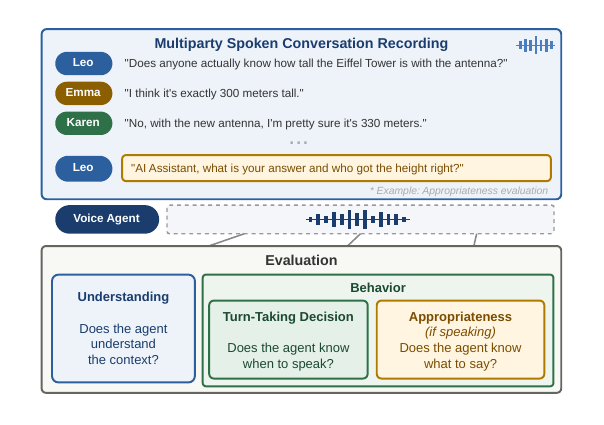
MP-Bench: Evaluating Voice Agents as a Multiparty Conversation Participant
MP-Bench is the first benchmark for evaluating voice agents as active participants in multiparty conversations, measuring turn-taking awareness and response appropriateness. It reveals that real-time voice agents struggle significantly in group settings, moving beyond dyadic interaction evaluation.
Abstract
Conversational voice agents have advanced significantly, offering increasingly natural human-machine interactions through both cascaded and end-to-end architectures. However, while recent benchmarks extensively evaluate dyadic interactions and passive audio comprehension, they largely overlook a prevalent real-world scenario: multi-party conversations. Evaluating agents in these settings is fundamentally more challenging than in dyadic interactions due to the exponentially greater conversational complexity. For voice agents to integrate seamlessly into human group dynamics, they must not only generate contextually appropriate responses but also demonstrate a nuanced understanding of open turn-taking. To address this gap, we introduce Multiparty Bench (MP-Bench), the first benchmark specifically designed to objectively evaluate conversational speech systems as active participants within multi-party contexts. MP-Bench assesses agent behavior along two primary dimensions: turn-taking awareness and response appropriateness. Additionally, we incorporate comprehension-based question-answering tasks as a complementary evaluation. By benchmarking 12 voice agents, we find that real-time voice agents stay at or below 22% on multiparty comprehension and remain near chance on multiparty turn-taking, exposing an open challenge for real-time voice agents under multiparty scenario.
Talking Avatars & Digital Humans
Geometry and appearance modeling without parametric templates.
Photorealistic head avatars typically lean on parametric face models (e.g., FLAME or BFM) as scaffolding, which limits expressiveness for unusual faces or extreme poses. Xiamen University's MGAvatar sidesteps parametric templates entirely by binding Gaussians directly to mesh geometry — vertex-bound Gaussians capture geometric detail while face-bound Gaussians handle appearance, with a view-conditioned color field ensuring consistent rendering across arbitrary poses and viewpoints. The result is a flexible avatar representation that generalizes without the topology constraints parametric models impose.
MGAvatar: Mesh-Bound Gaussians for Head Avatar Geometry and Appearance Modeling
MGAvatar combines Gaussians with mesh geometry to model expressive head avatars without parametric templates. It uses vertex-bound Gaussians for geometry and face-bound Gaussians for appearance, with view-conditioned color fields to achieve consistent rendering across poses and viewpoints.
Abstract
Accurate head modeling requires a stable yet expressive geometric representation. Existing Gaussian-based head avatars commonly rely on parametric templates (e.g., FLAME) for Gaussian initialization and deformation, but these templates lack personalized priors and struggle to represent structures such as hair and clothing. To address this issue, we propose MGAvatar, a Gaussian-mesh hybrid representation that jointly models geometry and appearance through two Gaussian-mesh binding modes. Specifically, we introduce vertex-bound Gaussians and constrain their learnable parameters, enabling progressive mesh deformation to represent complex head geometry, while a pose-dependent offset module accounts for non-rigid deformations. Once geometry is stabilized, MGAvatar switches to face-bound Gaussians for appearance modeling. To improve appearance consistency across novel poses and viewpoints, we introduce a view-conditioned neural color field that alleviates artifacts caused by independently optimized Gaussian colors. In addition, we design a Gaussian offset network to predict Gaussian offset maps in the observation space, providing greater flexibility for face-bound Gaussians to capture dynamic facial textures. Extensive experiments on multi-view and monocular videos show that MGAvatar outperforms existing methods in rendering quality, producing high-fidelity head avatars with rich texture details.
Trending on Hugging Face

PersonaLive! Expressive Portrait Image Animation for Live Streaming
PersonaLive is a diffusion-based portrait animation framework that improves real-time performance through hybrid implicit signals, appearance distillation, and autoregressive streaming generation.

Omni Interaction Agent Technical Report
Gander is an end-to-end framework that integrates continuous multi-modal streaming, real-time full-duplex interaction, and agentic reasoning through a Cerebellum-Brain architecture and a chunk-level token stream design.

VoiceMem: Streaming Dual-Brain Memory for Real-Time Interaction
VoiceMem introduces a dual-brain streaming memory architecture for speech language models that improves retrieval accuracy, emotional personalization, and real-time efficiency.

AuK Technical Report: An Open-Source Foundational Model for Speech Generation and Editing
AuK is an open-source foundational model that unifies speech generation and editing via natural-language instructions and audio context, using a multimodal language model, joint VAE, hybrid rectified-flow Transformer, and efficient distillation for fast inference.