
Full-Duplex Voice Agents, Smarter TTS, and Interactive Digital Avatars
Today's digest covers a dense wave of advances in full-duplex speech LLMs, real-time voice agents, robust long-form TTS, cross-lingual voice cloning, and interactive digital avatar simulation — plus Tsinghua's Vidu S2 from the HuggingFace Daily tab.
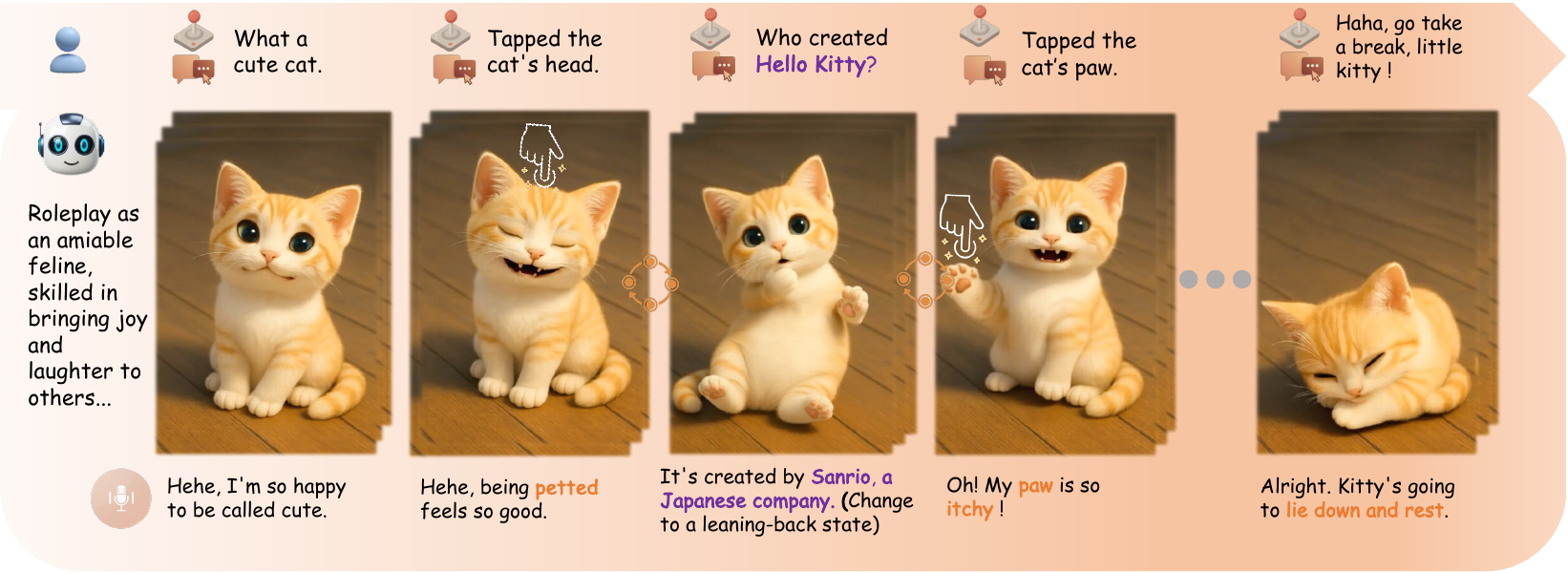
Our DiVA enables infinite, continuous interaction with undiminished quality (five rounds shown here). Users can define character personality and interact via simultaneous verbal and non-verbal (spatial click) inputs, receiving corresponding realistic actions and voice replies. DiVA demonstrates advanced state transition capabilities (3rd interaction), while also inheriting the MLLM's strong ability for factual responses (e.g., describing Hello Kitty), enabling limitless simulation within interactive digital worlds. From Nanyang Technological University.
Today's papers push hard on two fronts: making spoken AI systems genuinely real-time and full-duplex, and making speech synthesis and avatar generation robust enough for long-form, complex scenarios. From suppressing phantom speech onsets in Moshi to continuous digital-human simulation that never drifts, September 15 is a rich day across the board.
---
SpeechLLMs, Full-Duplex & Voice Agents
Simultaneous reasoning and speaking, async delegation, closing the output-mode gap, and banishing spurious onsets.
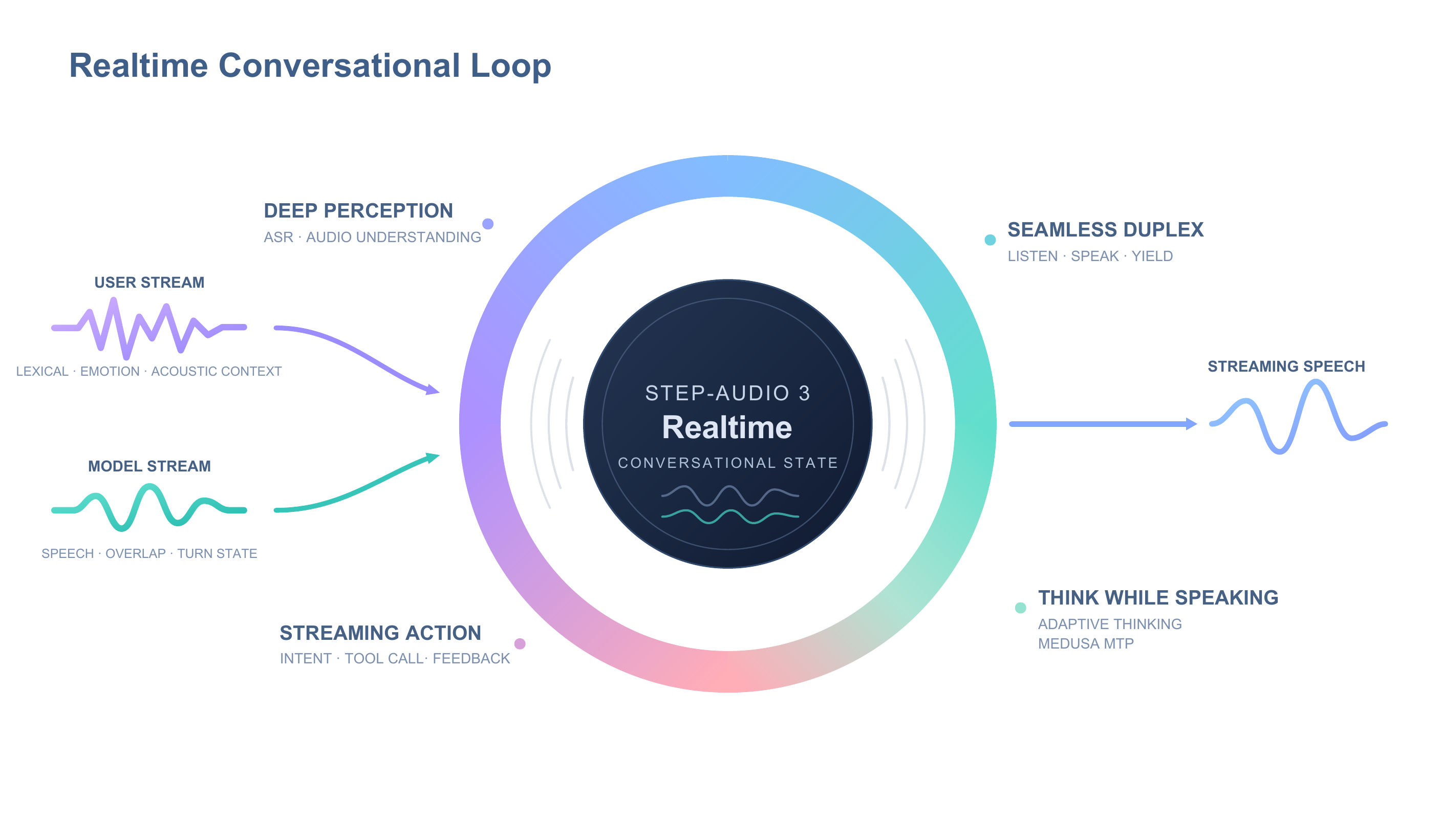
The race to eliminate perceptible latency in voice AI has produced a cluster of papers today. StepFun tackles the fundamental tension between deep chain-of-thought reasoning and low-latency delivery head-on: StepAudio 3 Realtime introduces Think-While-Speaking, where private reasoning runs in parallel with spoken output rather than blocking it. The system is organized around a continuous listen-converse-think-act loop with full-duplex audio handling for natural turn-taking, pauses, and interruptions.
StepAudio 3 Realtime Technical Report
StepAudio 3 Realtime is an audio-language foundation model for seamless spoken dialogue that resolves the tension between deep reasoning and response latency through Think-While-Speaking—executing private reasoning in parallel with spoken delivery. The system organizes interaction around a continuous listen-converse-think-act loop with full-duplex audio handling to manage natural turn-taking, pauses, and interruptions.
Abstract
Realtime spoken interaction demands deep reasoning, prompt responses, and fluid turn-taking. We present StepAudio 3 Realtime, an audio-language foundation model organized around a continuous listen-converse-think-act loop. Deep Perception captures rich acoustic cues to interpret user intent, while Seamless Duplex models synchronized audio streams to handle pauses, backchannels, and interruptions naturally. Crucially, we resolve the tension between deep deliberation and latency via Think-While-Speaking, executing private reasoning in parallel with spoken delivery. In reasoning mode, StepAudio 3 reaches a 73.0 macro average on StepAudioChat. With Think-While-Speaking, it achieves dialogue and reasoning performance comparable to dedicated reasoning models while speaking in real time. Furthermore, an integrated Voice Agent handles asynchronous tool execution without disrupting the dialogue flow. StepAudio 3 Realtime achieves top-tier performance across key dimensions: an exceptional 90.6 on the MMSU benchmark, 98.9 Overall on the Artificial Analysis Full-Duplex Bench, and a 56.0% macro task-success rate on $τ$-Voice.
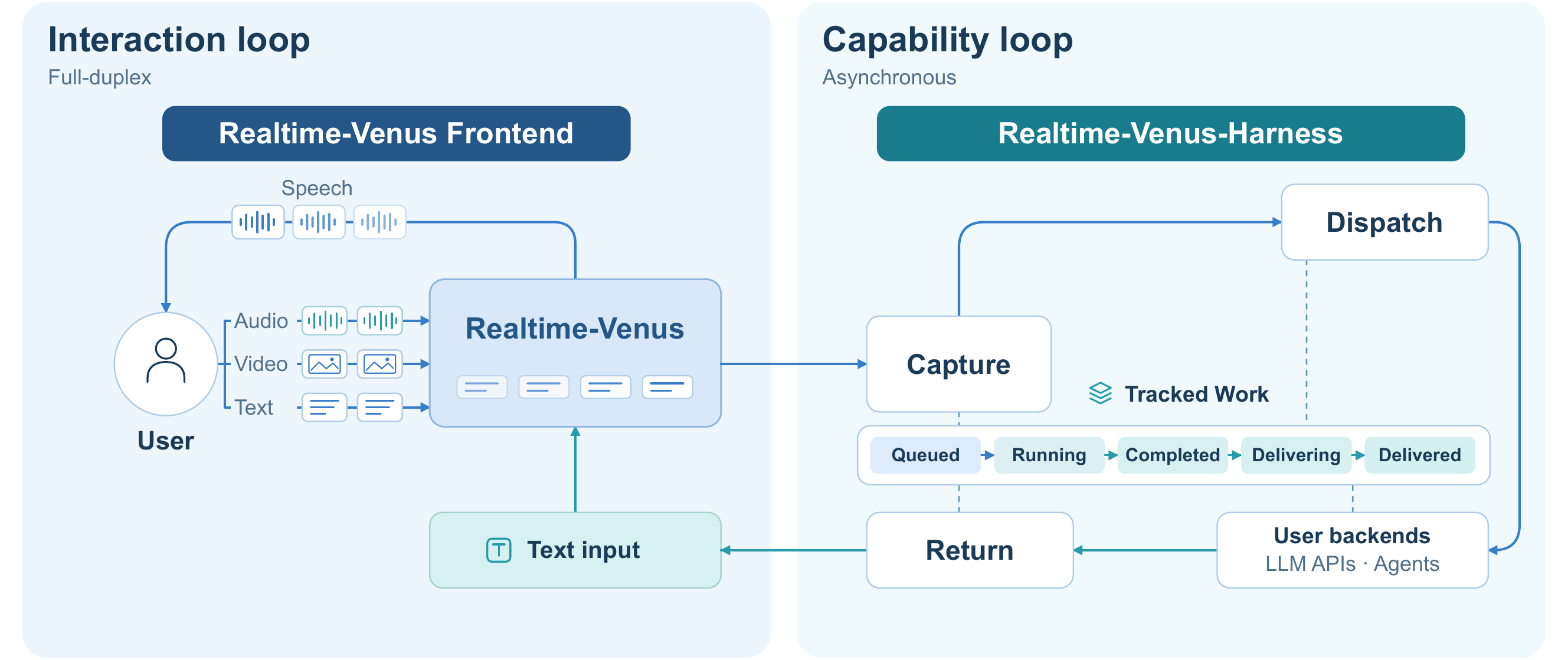
Tsinghua University's Realtime-Venus approaches full-duplex from a different angle: rather than parallelizing reasoning with speech, it introduces asynchronous delegation — background tasks (like running a tool call or doing heavy reasoning) are dispatched asynchronously while the foreground keeps the conversation alive. The system handles simultaneous perception, speech generation, and dialogue with natural interruption and multi-speaker support, coordinated through a unified temporal framework.
Realtime-Venus: A full-duplex interaction system with asynchronous delegation
Realtime-Venus is a full-duplex conversational AI system that enables simultaneous perception, speech generation, and dialogue while asynchronously executing background tasks—handling natural interruptions and multi-speaker scenarios in real-time. It uniquely coordinates foreground interaction with background reasoning through a unified temporal framework, outperforming existing systems on video and audio benchmarks including streaming and interruption-handling tasks.
Abstract
Natural interaction in digital and physical environments requires continuous perception and timely responses. Spoken dialogue relies on acoustic and linguistic cues, while video interaction also requires grounding the conversation in evolving visual context. We present Realtime-Venus, a proactive full-duplex interaction system with two separately trained 9B models: Realtime-Venus-Omni for audio-visual interaction and Realtime-Venus-Audio for spoken interaction. Each model serves as a complete conversational frontend, integrating continuous perception, conversational control, and native speech generation through a shared causal timeline for user inputs, model outputs, and delegation events. A dual-loop runtime coordinates live interaction with background reasoning and tool execution. Foreground interaction continues while Realtime-Venus-Harness executes tasks asynchronously and returns results for integration into the ongoing dialogue. Both models follow a common post-training recipe combining offline understanding, proactive full-duplex trajectories, and delegation workflows. Among the evaluated online models, Realtime-Venus-Omni achieves the highest scores on six of eight video benchmarks, including StreamingBench (70.2%), OVO-Bench (64.7%), and Daily-Omni (81.3%). Across eight audio understanding and spoken question answering benchmarks, Realtime-Venus-Audio leads the compared models on MMAU (78.0%), MMAU-Pro (63.2%), Llama Questions (83.8%), and Speech CMMLU (67.8%), while matching the best VoiceBench AlpacaEval score of 4.81. On Full-Duplex-Bench v1.5, Realtime-Venus-Audio responds to 75% of user interruptions and achieves continuation rates of 97%, 88%, and 86% under backchannels, other-directed speech, and background speech, respectively, exceeding Gemini 3.1 Live and GPT-4o on all three continuation metrics.
A subtler but important quality problem in speech LLMs is addressed by Step AI: the output-mode gap. When a model generates interleaved speech and text tokens (as required for streaming), the accuracy of internally generated text drops significantly compared to text-only mode. The paper proposes Joint-Output On-Policy Distillation to transfer the strong text-generation policy into the joint multimodal pipeline, recovering accuracy without sacrificing streaming capability.

Reducing the Output-Mode Gap in Speech Language Models via Joint-Output On-Policy Distillation
This paper identifies and addresses the "output-mode gap" in speech language models—a significant accuracy drop in internally-generated text when models produce interleaved speech and text tokens versus text-only responses. The authors propose Joint-Output On-Policy Distillation to transfer the text-generation strength of the text-only policy into the full multimodal generation pipeline, maintaining streaming capability while substantially improving answer accuracy.
Abstract
Autoregressive generation of interleaved text and acoustic tokens is a common approach to spoken-response generation in speech large language models. Although this design enables streaming generation with explicit textual guidance, generated acoustic tokens become part of the context for subsequent text predictions. Given identical speech inputs, we observe markedly lower answer accuracy for the internal text generated in speech-to-text-and-speech (S2TS) mode than for speech-to-text (S2T) responses. We term this discrepancy the \emph{output-mode gap} (OMG). To reduce OMG, we propose \emph{Joint-Output On-Policy Distillation} (JO-OPD), which distills the model's stronger S2T policy into joint generation using student-generated S2TS trajectories. At each text position, the S2T teacher provides soft targets from a text-only projection of the student's preceding outputs, while the student predicts from the corresponding full interleaved history. A preservation objective further regularizes native non-text predictions. Experiments on Step-Audio-2-mini and Baichuan-Audio-Instruct reveal OMG across two interleaved generation architectures. On Step-Audio-2-mini, JO-OPD reduces OMG from 42.87 to 16.26 percentage points on Spoken-MQA and from 29.72 to 13.04 points on speech-rendered GSM8K, with little change in S2T accuracy and substantially larger reductions than matched SFT baselines. ASR-based evaluation further shows a 7.49-point improvement in spoken-answer accuracy on Spoken-MQA.
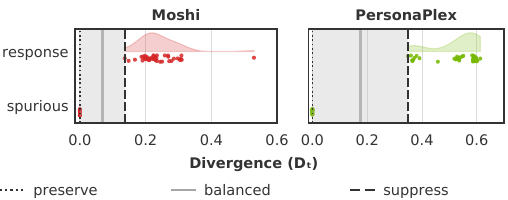
One well-known pathology of full-duplex speech LLMs like Moshi is spurious onsets — the model starts speaking during user silence due to abrupt spikes in onset probability during self-conditioned generation. This independent-researcher paper applies causal counterfactual analysis to identify the root cause and proposes a real-time fix: suppress onsets whose token distributions are minimally affected by muting the preceding user input, meaning the model was going to speak regardless of what the user said or didn't say. Crucially, no retraining is required.
Causal Analysis and Mitigation of Spurious Onsets in Full-Duplex Speech LLMs
This paper identifies why full-duplex speech LLMs like Moshi spuriously generate speech during user silence: abrupt spikes in onset probability during self-conditioned generation. The authors propose a causal counterfactual solution—suppressing onsets whose token distributions are minimally affected by muting the preceding user input—achieving real-time mitigation without retraining while preserving genuine responses.
Abstract
Speech-to-speech LLMs like Moshi, and its derivative PersonaPlex, can listen and speak concurrently through full-duplex generation. However, they can begin speaking inappropriately during prolonged user silence: under digital-zero input, Moshi and PersonaPlex initiate speech in 12/40 and 11/40 five-minute continuations, respectively. What causes this spurious speech? We investigate two hypotheses: either repeated sampling selects speech despite persistently low onset probabilities, or conditioning on the model's nonspeech outputs causes an abrupt spike in onset probability. We find that, at every observed onset, speech probability spikes by over nine orders of magnitude in one 80-ms frame, supporting the latter hypothesis. Then, to suppress these onsets without blocking genuine responses, we ask a causal counterfactual question: is the model responding to user speech, or would its next-token distribution remain similar if the preceding user input were muted? Accordingly, we suppress onsets whose distributions change little under this intervention. Across 40 held-out trials per model with realistic microphone noise, our method suppresses 13/13 Moshi and 9/9 PersonaPlex spurious onsets, while preserving 40/40 genuine responses per model. Our inference-time method requires no retraining and runs in real-time, with 95th-percentile decision time below 61 ms, within the 80-ms frame budget. Our code is available at https://github.com/KentoNishi/icassp27-spurious-onsets.
---
TTS & Voice Cloning
Stable long-form autoregressive diffusion, alignment-free cross-lingual cloning, and context-aware CoT synthesis.
Long-form TTS with autoregressive diffusion models is notoriously brittle — pronunciation errors compound and speaker identity drifts over time. DiTAR+ from Northwestern Polytechnical University tackles this with a dual-optimization strategy: dilated context sampling expands the receptive field to prevent myopic token prediction, while hierarchical acoustic masking forces the model to reconstruct missing acoustic structure rather than blindly copying recent context. Together these decouple semantic alignment from acoustic rendering and dramatically reduce error accumulation.
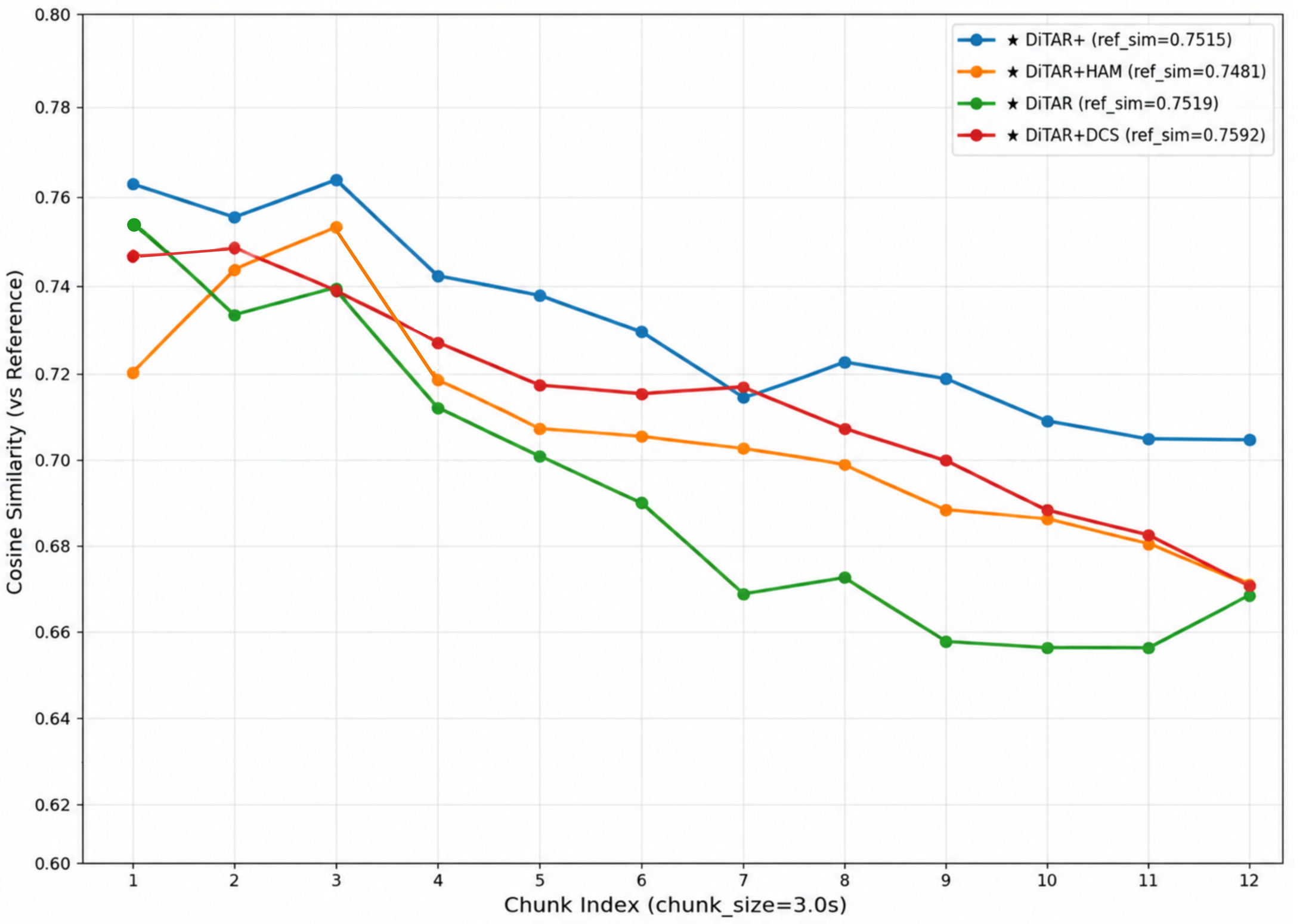
DiTAR+: Dual Optimization for Robust Autoregressive Diffusion Speech Synthesis
This paper proposes DiTAR+, a dual-optimization framework that stabilizes autoregressive diffusion models for long-form speech synthesis by decoupling semantic alignment from acoustic rendering. Key innovations include dilated context sampling to expand receptive fields and hierarchical acoustic masking to prevent error accumulation, addressing pronunciation errors and speaker drift that plague existing approaches.
Abstract
Continuous-latent Autoregressive Diffusion Transformer (AR-DiT) models have demonstrated immense potential in zero-shot speech generation. However, they still suffer from limited decoding stability when synthesizing long utterances or complex linguistic structures. This instability primarily stems from a restricted historical receptive field and an acoustic inertia dependency within the diffusion decoder, which causes the model to ignore semantic conditions. To address these challenges, we propose DiTAR+, a dual-optimization framework. First, we introduce Dilated Context Sampling to expand the macro-level historical receptive field without violating physical temporal continuity, thereby preventing cumulative error propagation. Second, we propose Hierarchical Acoustic Masking to prevent shallow layers from attending to acoustic pre-context, explicitly decoupling semantic alignment from acoustic detail reconstruction. Extensive experiments show that our framework effectively mitigates pronunciation errors and semantic hallucinations, enhances generation robustness on challenging sentences, and maintains exceptionally high speaker similarity throughout the entirety of long-form utterances. On the linguistically challenging ZH-Hard set, DiTAR+ reduces the word error rate from 12.478% to 9.893%, and on extended utterances of 25 to 35 seconds it improves speaker similarity from 0.741 to 0.759 while simultaneously lowering the word error rate from 2.778% to 2.173%, outperforming both discrete-token and pure flow-matching baselines.
Cross-lingual voice cloning typically demands forced alignment between reference audio and transcripts in the target language — a fragile and language-specific requirement. Cross-Lingual F5-TTS 2 from Shanghai Jiao Tong University sidesteps this entirely by using a pretrained TTS model to synthesize speaker-consistent training pairs, then fine-tuning on this synthetic data. No forced alignment, no audio prompt transcripts needed. Silence-aware augmentation further strengthens the speaking-rate predictor across languages.
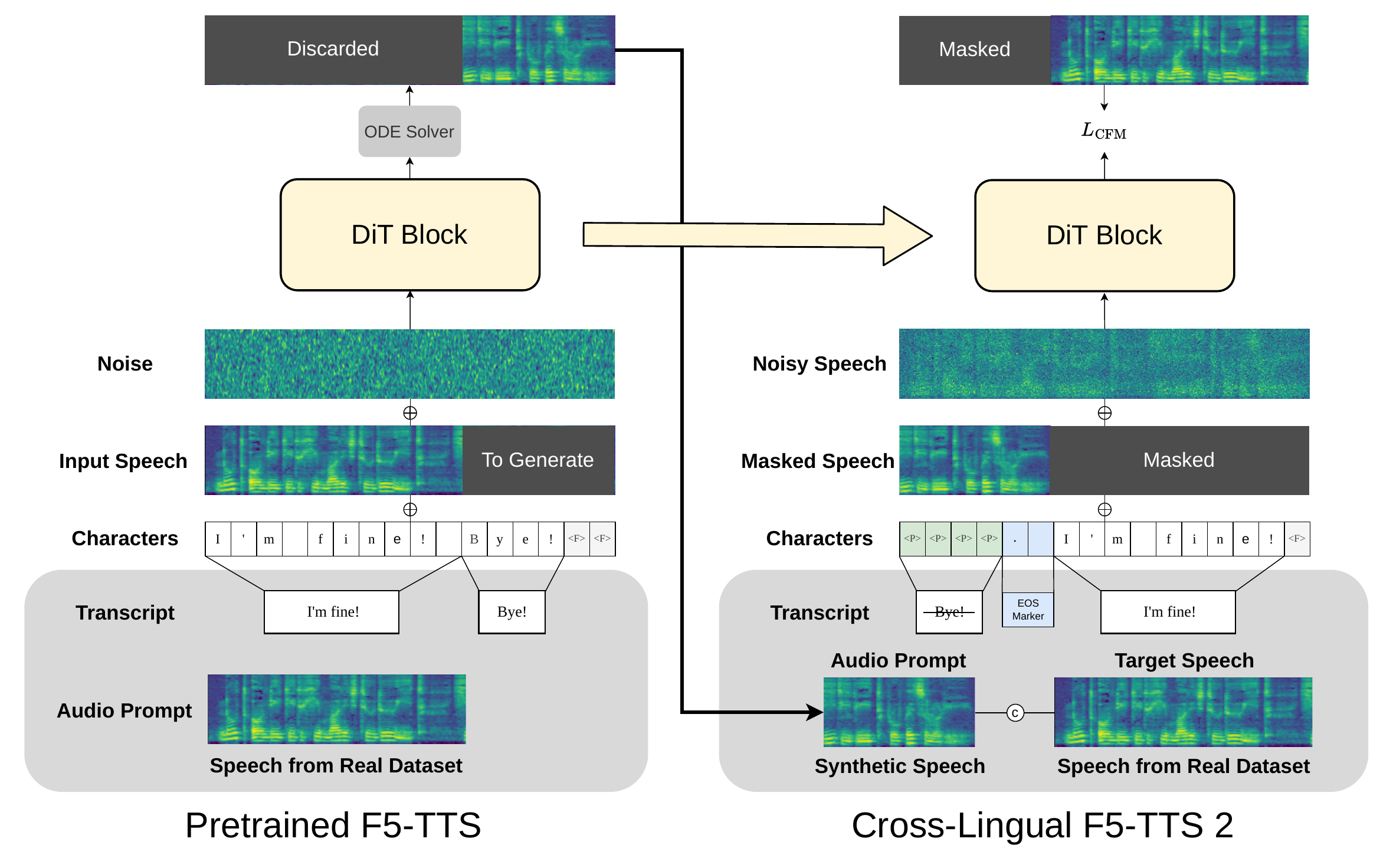
Cross-Lingual F5-TTS 2: A Simplified Framework for Language-Agnostic Voice Cloning
This work eliminates the need for forced alignment in cross-lingual voice cloning by using a pretrained TTS model to generate synthetic speaker-consistent training pairs, then fine-tunes on these constructed data without requiring audio prompt transcripts. A silence-aware augmentation further improves the speaking rate predictor's robustness across languages.
Abstract
Zero-shot text-to-speech (TTS) can clone a speaker's voice from a short audio prompt, yet most TTS systems still require the audio prompt transcript during inference. This dependency prevents cross-lingual voice cloning when the audio prompt transcript is unavailable, particularly for unseen languages. Cross-Lingual F5-TTS removes this dependency and enables transcript-free cross-lingual voice cloning, but it prepares its training data with forced alignment. Forced alignment is sensitive to boundary errors, and its cost grows as more languages are covered. Its speaking rate predictor is also unreliable at estimating duration when the audio prompt begins or ends with silence. In this paper, we present Cross-Lingual F5-TTS 2, a simplified framework for transcript-free cross-lingual voice cloning without forced alignment. Instead of using forced alignment to segment real utterances, we build same-speaker prompt and target pairs using a pretrained F5-TTS model and fine-tune the same model on these constructed pairs. This simplifies data preparation and preserves the acoustic modeling capability of the pretrained model, enabling adaptation with only a short fine-tuning stage. We further make the syllable-level speaking rate predictor robust to leading and trailing silence through silence-aware augmentation. Experiments show that Cross-Lingual F5-TTS 2 reaches higher speaker similarity than F5-TTS and Cross-Lingual F5-TTS while maintaining intelligibility. All related resources are publicly available.
Instruction-following TTS — making a model adapt prosody and style to dialogue context — is the focus of Xi'an Jiaotong University's submission to the ISCSLP 2026 CoT-TTS Challenge. Their unified pipeline generates Chain-of-Thought reasoning from dialogue history before synthesis, ensuring the model explicitly models context before committing to acoustic choices. Alignment is reinforced via Context-Aware Direct Preference Optimization, and outputs are evaluated with an LLM-based judge for consistency across context, reasoning, and speech.
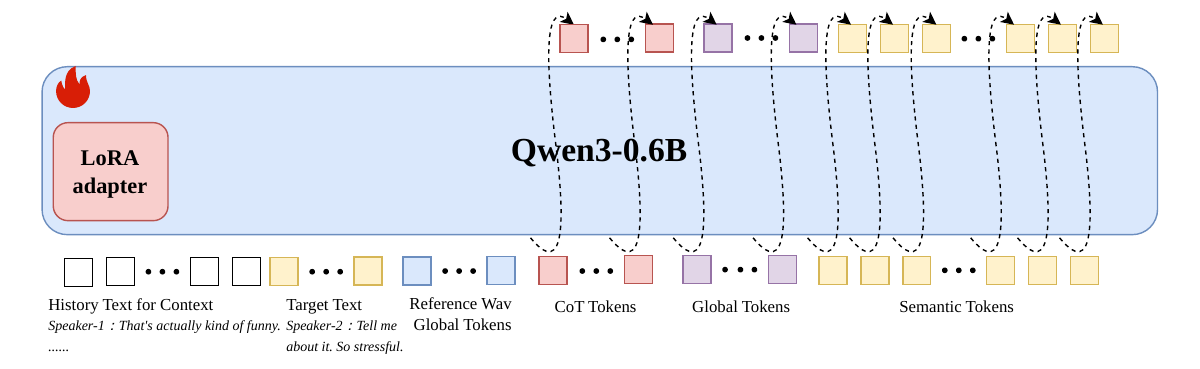
Bridging Data, Reasoning, and Alignment: A Unified Framework for Context-Aware Instruction-Following TTS
This paper tackles the ISCSLP 2026 CoT-TTS Challenge by creating a unified pipeline that generates Chain-of-Thought reasoning from dialogue history before synthesizing contextually appropriate speech. It combines rigorous data curation, Context-Aware Direct Preference Optimization, and LLM-based evaluation to achieve strong consistency across context, reasoning, and speech synthesis.
Abstract
The ISCSLP 2026 CoT-TTS Challenge requires TTS systems to generate Chain-of-Thought (CoT) reasoning from dialogue history before synthesizing contextually appropriate speech. While the official baseline establishes a unified architecture, it remains constrained by limited contextual comprehension, weak instruction fidelity, and suboptimal audio quality. We present a systematic optimization pipeline to address these limitations. First, we develop a data process framework that cleans raw data via FullSubNet denoising, Qwen3-ASR re-transcription, and Qwen3.5-35B-A3B-based history-CoT consistency analysis, while distilling 545K high-fidelity instruction samples using Qwen3-TTS and Seed-VC under strict quality filtration. Second, we propose a Context-Aware Direct Preference Optimization (CA-DPO) method. By employing a cascaded filtering strategy, ASR prescreening, LLM tournament ranking, and speaker similarity verification, we obtain high-confidence preference pairs that significantly enhance holistic ``Context$\rightarrow$CoT$\rightarrow$Speech'' consistency during DPO training. Third, we establish an evaluation method featuring a 500-sample test set and an LLM-as-Judge framework to independently assess reasoning and execution fidelity. Experiments demonstrate that our system significantly outperforms the baseline across all objective and subjective metrics, validating our data governance and alignment strategies.
From today's Hugging Face Daily tab, Tsinghua's Vidu S2 rounds out this section with real-time interactive avatar and video editing models supporting high-resolution spatial video generation and dynamic reference updates — a compelling complement to the avatar work below.

Vidu S2: Real-Time Interactive, Editable, and Spatial Video Generation
Vidu S2 introduces real-time interactive avatar and video editing models that support high-resolution spatial video generation and dynamic reference updates.
Abstract
We present Vidu S2, which comprises Vidu S2-Avatar, a real-time interactive digital-character model, and Vidu S2-Editing, a real-time video editing model. Moreover, we explore the feasibility of real-time spatial video generation for both Vidu S2-Avatar and Vidu S2-Editing. Compared with Vidu S1, Vidu S2-Avatar supports real-time 720p video generation, generation with dynamic references that can be updated at any moment, and stronger instruction following, such as dancing. Vidu S2-Editing supports editing a video stream in real time, including style rendering, clothing replacement, character replacement, and background replacement. Experiments show that Vidu S2 outperforms all baselines. A playable online demo is available at https://vidu.com/vidu-stream.
---
Talking Avatars & Interactive Digital Humans
Indefinite-length, drift-free digital character simulation.
Prior long-form avatar video systems hit a wall: visual quality drifts over time and complex pose transitions cause failure. DiVA from Nanyang Technological University addresses this with a three-part video generation pipeline centered on an Anchored Video Continuation module that re-grounds generation periodically, maintaining fidelity indefinitely. The system supports sophisticated state changes — not just talking-head loops — and spatially grounded interactions with the environment, enabling genuinely interactive digital life simulation.
DiVA: Enabling Interactive Digital Life Simulation via Video Models
DiVA enables continuous, high-fidelity interactive simulation with digital characters through a three-part video generation pipeline anchored by an Anchored Video Continuation module. Unlike prior long-form avatar systems that suffer from visual drift and fail at complex pose transitions, DiVA maintains quality indefinitely while supporting sophisticated state changes and grounded spatial interactions.
Abstract
We present DiVA, a deeply interactive digital life simulator pioneering a new paradigm for long-term, open-ended interactive experiences within digital character worlds. DiVA's architecture pairs a Multimodal Large Language Model (MLLM) as a router with a meticulously designed stacked video pipeline for seamless, multi-turn interactions with action and audio response. To maintain continuity and avoid degradation, we model generation as a three-part coupled system: waiting video, action video, and the transitions between them. These transitions are critically handled by our Anchored Video Continuation (AVC) module, which returns the character to stable states to prevent degradation. By encoding information from the preceding action video segment, AVC ensures smooth transitions, significantly reducing camera jitter and inconsistencies common in current video transition methods. This design also enables complex pose changes (e.g., sitting to standing) typically difficult for audio-driven models. These system designs together ensure high-fidelity identity, coherence, and dynamics for extended experiences. To validate our pipeline design, we comprehensively compare our system against alternatives by replacing our core generation module with mainstream long-video, continuation, and interpolation methods. We further analyze the necessity of the three-stage design, anchor-state selection, transition naturalness, spatial grounding, and the quality-latency trade-off, and we expand the comparison to additional long-form audio-driven avatar models. Results confirm DiVA is markedly superior in maintaining long-term visual quality and realism, validating its effectiveness as a sustainable, interactive simulation.
Trending on Hugging Face

PersonaLive! Expressive Portrait Image Animation for Live Streaming
PersonaLive is a diffusion-based portrait animation framework that improves real-time performance through hybrid implicit signals, appearance distillation, and autoregressive streaming generation.

Omni Interaction Agent Technical Report
Gander is an end-to-end framework that integrates continuous multi-modal streaming, real-time full-duplex interaction, and agentic reasoning through a Cerebellum-Brain architecture and a chunk-level token stream design.

VoiceMem: Streaming Dual-Brain Memory for Real-Time Interaction
VoiceMem introduces a dual-brain streaming memory architecture for speech language models that improves retrieval accuracy, emotional personalization, and real-time efficiency.

AuK Technical Report: An Open-Source Foundational Model for Speech Generation and Editing
AuK is an open-source foundational model that unifies speech generation and editing via natural-language instructions and audio context, using a multimodal language model, joint VAE, hybrid rectified-flow Transformer, and efficient distillation for fast inference.