
TTS System Design, Long-Form Reliability, and Smarter Dialogue Benchmarks
Today's digest covers principled TTS architecture retrospectives, inference-time fixes for long-form speech, self-distilled pronunciation control, layer-wise codec compression, and two new benchmarks probing the limits of spoken dialogue agents in role-playing and turn-taking.
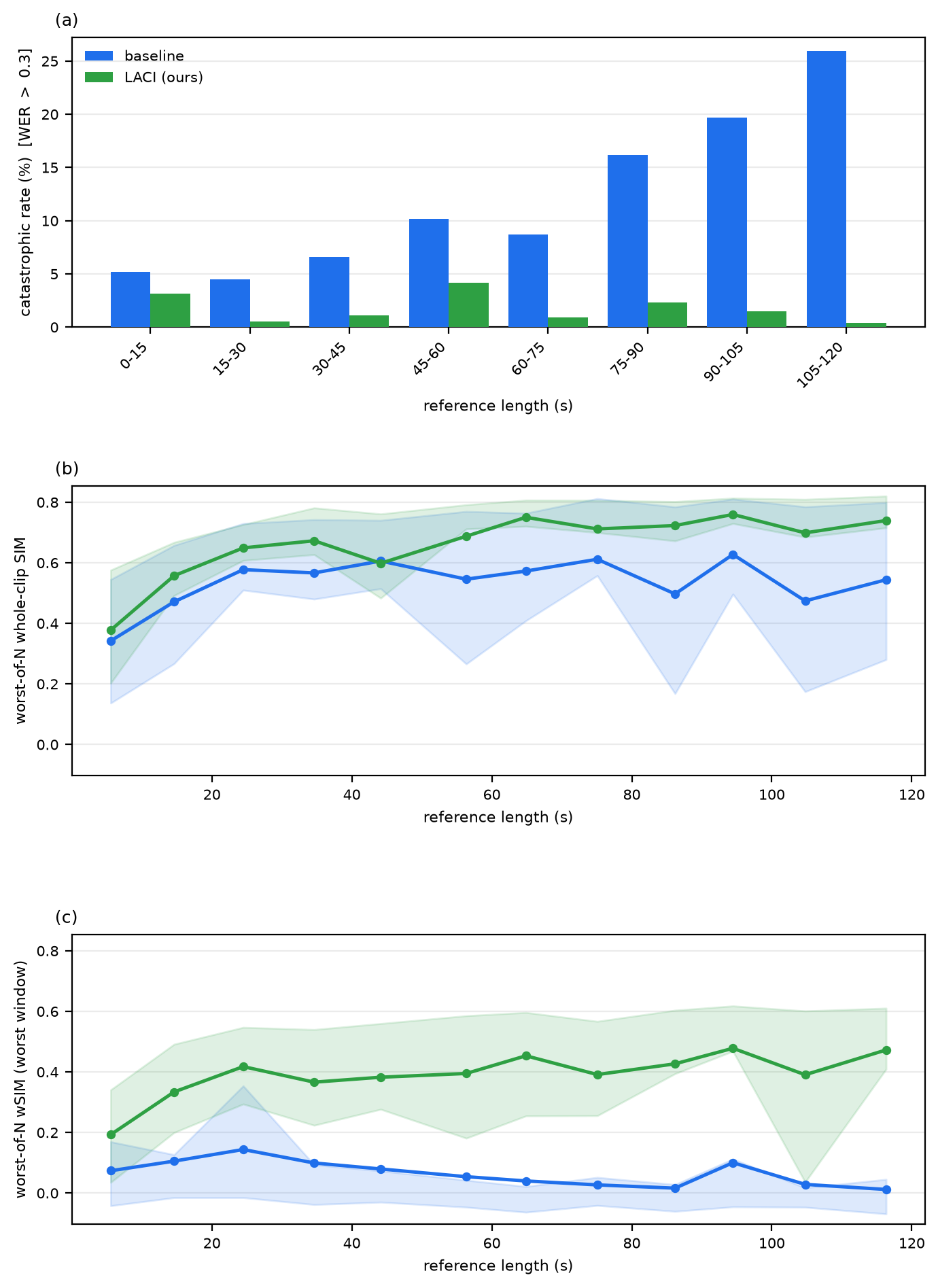
Qwen3-TTS-0.6B voice cloning reliability vs. reference audio length. (a) Catastrophic failure rate (WER above 30\%) grows from 5\% to 26\% as reference audio grows to 120 seconds, while LACI keeps it below 5\%. (b) Worst-of-$N$ SIM across 10 RNG seeds improves with LACI. (c) Worst-of-$N$ wSIM collapses for the baseline while LACI holds it high. From Alibaba DAMO Academy.
Today's papers span the full speech stack — from rethinking the AR/flow-matching interface inside TTS pipelines, to keeping long-form synthesis on the rails, to building benchmarks that expose what spoken dialogue agents still can't do. Alibaba and its DAMO Academy labs dominate the TTS side, while USTC and DAMO push the evaluation frontier for SpeechLLMs. StepFun's StepAudio 3 lands on the Hugging Face Daily tab as well, rounding out a dense day for conversational speech research.
---
TTS & Voice Synthesis
From bottleneck theory to codec efficiency — four papers that advance how we build and understand neural speech synthesis.
A useful frame for understanding TTS progress is to ask: where is the system's bottleneck today? Alibaba's retrospective on their CosyVoice and Qwen-Audio product line does exactly that, formalizing the interface between the autoregressive planner and the flow-matching renderer as the primary design surface. They identify four interface dimensions — representation, ownership, availability, and gradient reach — and show how each successive model generation (CosyVoice 1–3, Qwen-Audio-3.0-TTS) deliberately relocated the bottleneck to unlock the next wave of performance, rather than relying on brute-force scaling.

The Evolving Bottleneck in Speech Generation: Interface Co-design and Staged Alignment from CosyVoice to Qwen-Audio-3.0-TTS
A technical retrospective tracing progress in speech synthesis through systematic redesign of the interface between autoregressive planning and flow-matching rendering, rather than simply scaling models or data. The paper formalizes four interface dimensions—representation, ownership, availability, and gradient reach—showing how each generation (CosyVoice 1–3, Qwen-Audio-3.0-TTS) relocated the system's bottleneck to unlock better performance.
Abstract
Speech synthesis systems are commonly narrated as a sequence of larger models, better tokenizers, and broader data. This technical retrospective offers a different account of the CosyVoice lineage, from CosyVoice through CosyVoice 2 and CosyVoice 3 to Qwen-Audio-3.0-TTS: progress came from repeatedly relocating the system's dominant bottleneck. Across the lineage, a stable decomposition separates an autoregressive language model that plans speech from a flow-matching model that renders acoustics. What changes is the contract between them. CosyVoice establishes supervised semantic tokens as a content-aligned interface; CosyVoice 2 makes that interface causally available for streaming and removes the utterance-level speaker embedding from the language model; CosyVoice 3 improves the learnability and coverage of the interface through multitask supervision, scaling, and differentiable reward optimization; and Qwen-Audio-3.0-TTS reduces token rate, conditions its renderer on continuous language-model hidden states instead of token embeddings, and progressively aligns the coupled system. We formalize this history through four interface dimensions---representation, ownership, availability, and gradient reach---and separate within-paper evidence from cross-paper comparison. The resulting synthesis connects discrete autoregressive, continuous non-autoregressive, hybrid, and continuous autoregressive speech-generation paradigms, and yields practical principles for diagnosing and training modular speech generators.
Long-form TTS is a related reliability problem: autoregressive models degrade badly on prompts beyond ~1500 words, accumulating prosodic drift and losing speaker consistency. Alibaba DAMO Academy tackles this with LACI, an inference-only intervention that continuously monitors attention alignment during decoding and, on detecting failure, rolls back and re-synthesizes the affected segment with temporary regularization. Because it requires no retraining, LACI is directly applicable to any open-weights AR TTS model.
Taming Long-form Text-to-Speech
This paper introduces LACI, an inference-only method that detects and recovers from failures in long-form text-to-speech generation by monitoring attention alignment and rolling back to re-synthesize with temporary regularization. The approach enables open-weights autoregressive TTS models to maintain reliable prosody and speaker consistency across multi-turn conversations and long reference audio, solving a critical reliability gap that degrades performance on prompts beyond 1500 words.
Abstract
Long-form text-to-speech (TTS) enables multi-turn conversations with consistent prosody and higher quality voice cloning from longer reference audio. Recent open-weights autoregressive TTS models such as Qwen3-TTS and VoxCPM2 attain state-of-the-art word error rate (WER) and speaker similarity (SIM) on short-form prompts but significantly deteriorate when used with long-form prompts. We propose Localized Attention-Constrained Inference (LACI), an inference-only method to detect TTS errors in near real-time, roll back to the error onset and regenerate with temporary guardrails, adding negligible computational overhead. Using LACI, we improve worst-of-N WER across 10 RNG seeds for Qwen3-TTS-0.6B from 35.2% to 3.4% on prompts longer than 1500 words, even surpassing its short-form reliability of 5.4\% on prompts with fewer than 500 words. To demonstrate the efficacy of LACI on voice cloning reliability, we propose a sliding-window version of the SIM metric that we call wSIM. wSIM exposes several novel failure patterns that are not captured by SIM. LACI improves worst-of-N wSIM from 0.01 to 0.47 on 120 seconds of reference audio while reducing the rate of catastrophic generations with WER above 30% from 26% to below 1%
Pronunciation correctness and accent control are notoriously hard to supervise: rare words lack recorded references and manual phoneme editing doesn't scale. An independent researcher proposes a self-distillation loop as the solution — the model is first run on a reference sentence to produce a "teacher" output, then trained on a tagged variant of that sentence containing the target word and accent marking, using the teacher's output as the supervision signal. The result is a fully automated pipeline that requires neither human annotators nor extra recorded data.

Self-Distilled Pronunciation and Accent Control for Neural Text-to-Speech
This paper proposes a self-distillation approach for teaching neural TTS systems to correctly pronounce rare words and control accents without requiring recorded speech data or manual editing. The key insight is using the model's own output on a reference sentence as a teacher signal when training on a variant with the target word tagged and accented—a fully automated and efficient alternative to traditional supervised or exemplar-based methods.
Abstract
Text-to-speech that reads raw text has no lexicon: a rare word is read as guessed. Remedies train a reading-and-accent channel on recorded speech or edit words one at a time from exemplars. We do neither. The frozen backbone reads a sentence containing a common word it already says correctly, and its own output then serves as the teacher for the same sentence, with that word replaced by a tagged, accented reading; this training pair is the whole idea. On Sarashina2.2-TTS, screened raters at Fleiss' kappa = 0.85 hear the prescribed accent on 0.89 of unseen words against 0.57 for kana, which cannot express one; kana wins no pair; naturalness is not measurably hurt. Moved untuned to autoregressive, diffusion, and encoder-decoder backbones, it transfers reading, 0.25 to 0.47 above no edit on 319 words, and on CosyVoice 2 accent on two words in three, but not on Irodori; the paper locates why.
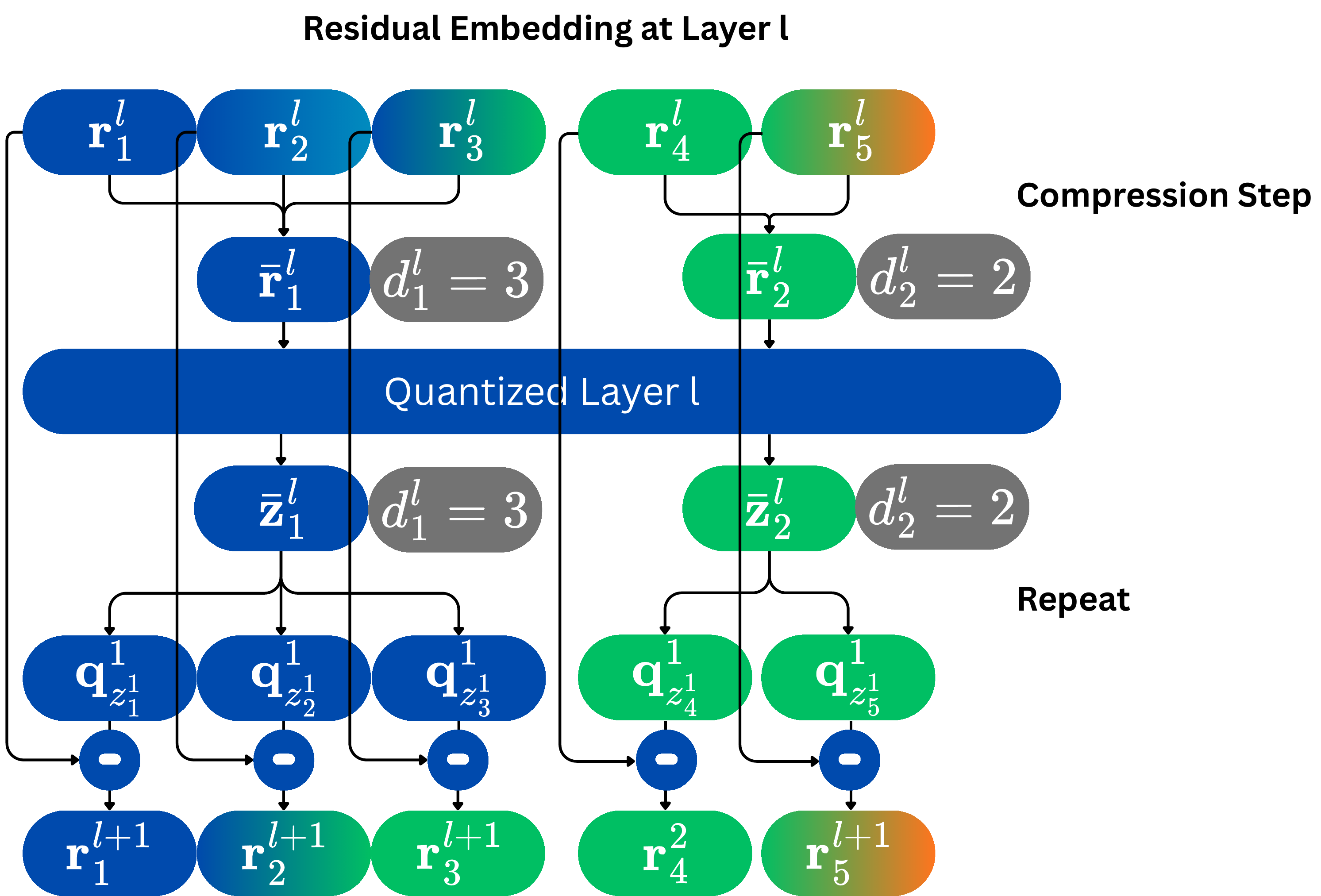
At the codec level, dynamic frame-rate codecs have been hampered by a shared-boundary constraint: all quantization layers must segment audio at the same points, limiting rate-quality flexibility. CMU's LACE (Layer-Wise Compression for Dynamic Frame Rate Codecs) breaks this constraint by allowing each quantization layer to determine its own segmentation boundaries independently. The layer-adaptive approach improves the rate-quality tradeoff for reconstruction and also accelerates TTS inference without sacrificing synthesis quality.
LACE: Layer-Wise Compression for Dynamic Frame Rate Codecs
LACE enables dynamic frame-rate neural audio codecs by applying independent compression at each quantization layer, allowing layer-specific segmentation boundaries instead of forcing all layers to share the same boundaries. This layer-adaptive approach improves the rate-quality tradeoff for speech reconstruction and improves TTS inference efficiency while maintaining synthesis quality.
Abstract
Neural audio codecs are a key component in speech language modeling. However, their high frame rates lead to long sequence lengths, increasing computational costs. Dynamic frame rate codecs mitigate this by reducing the effective frame rate using a compression step to merge multiple frames together. However, most prior methods either operate on single-codebook codecs or apply a single compression step before multi-layer quantization. This forces all quantization layers to share the same segmentation boundaries, despite the residual embeddings at different quantization layers exhibiting different rates of change over time. We propose LACE (Layer-Adaptive Codec Encoding), a dynamic frame rate codec that applies an independent compression step at each quantization layer, enabling layer-specific segmentation boundaries. To use LACE tokens in downstream text-to-speech (TTS), we further introduce union alignment and boundary anchor mechanisms to make durations consistent across layers while preserving compression benefits. Experiments on LibriTTS show that LACE offers a better rate-quality tradeoff than prior dynamic frame rate methods on the reconstruction task and improves TTS inference efficiency while maintaining competitive synthesis quality. Our code is released as part of the ESPnet3 codec recipe.
---
SpeechLLMs & Spoken Dialogue Agents
New benchmarks that go beyond short interactions — testing persona robustness, turn-taking reasoning, and real-time audio understanding.
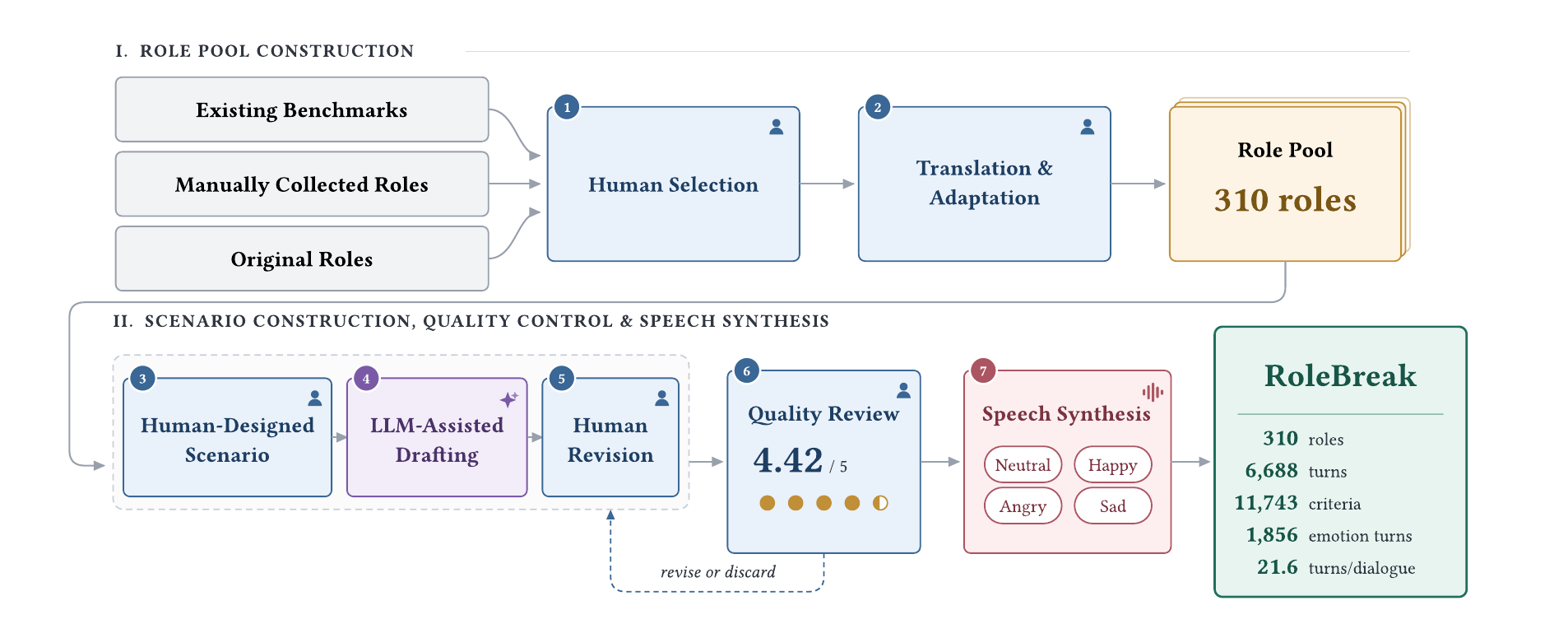
Existing role-playing benchmarks for spoken dialogue systems are limited to short exchanges or predefined characters, leaving long-horizon robustness largely unmeasured. RoleBreak from USTC fills that gap with 310 diverse roles and 6,688 multi-turn dialogues, evaluated across semantic persona adherence, safety, and vocal emotion — making it possible to test whether a speech model can sustain a character's identity and vocal style across an extended conversation, not just the first few turns.
RoleBreak: Benchmarking Long-Horizon Role-Playing Robustness in Spoken Dialogue
RoleBreak is a benchmark for evaluating long-horizon role-playing robustness in spoken dialogue systems, addressing the gap that existing benchmarks focus on short interactions or predefined characters. It introduces 310 diverse roles and 6,688 multi-turn dialogues with fine-grained evaluation of semantic persona adherence, safety, and vocal emotion to test whether speech models can sustain character consistency over extended conversations.
Abstract
Speech-to-speech dialogue models increasingly support persona control, yet existing spoken role-playing benchmarks remain largely character-centric and short-horizon. This leaves open whether spoken dialogue models can sustain diverse roles over extended interactions, especially beyond predefined fictional characters. We introduce RoleBreak, an open benchmark for long-horizon role-playing robustness in spoken dialogue. RoleBreak contains 310 character-based and user-centered roles, 6,688 human-verified dialogue turns, and 11,743 fine-grained evaluation criteria, with 1,856 turns carrying expressive emotion targets for evaluating vocal emotion. Its scenarios are designed to stress role consistency, interaction quality, safety, and affect over extended conversations. We evaluate nine configurations spanning full-duplex, omni-modal, and cascaded ASR--LLM--TTS paradigms. We find four key patterns. First, current systems are substantially stronger at semantic role adherence than at vocal emotion. Second, semantic robustness remains brittle over long interactions: even the strongest evaluated system encounters its first persona and safety failures after only 10.4 and 11.6 turns on average. Third, scaling the LLM substantially improves semantic robustness and delays failure, but yields little improvement in vocal emotion. Finally, user vocal emotion affects role-playing behavior even when linguistic content is fixed. These findings highlight persistent gaps in both long-horizon robustness and vocal expressiveness in spoken role-playing systems.
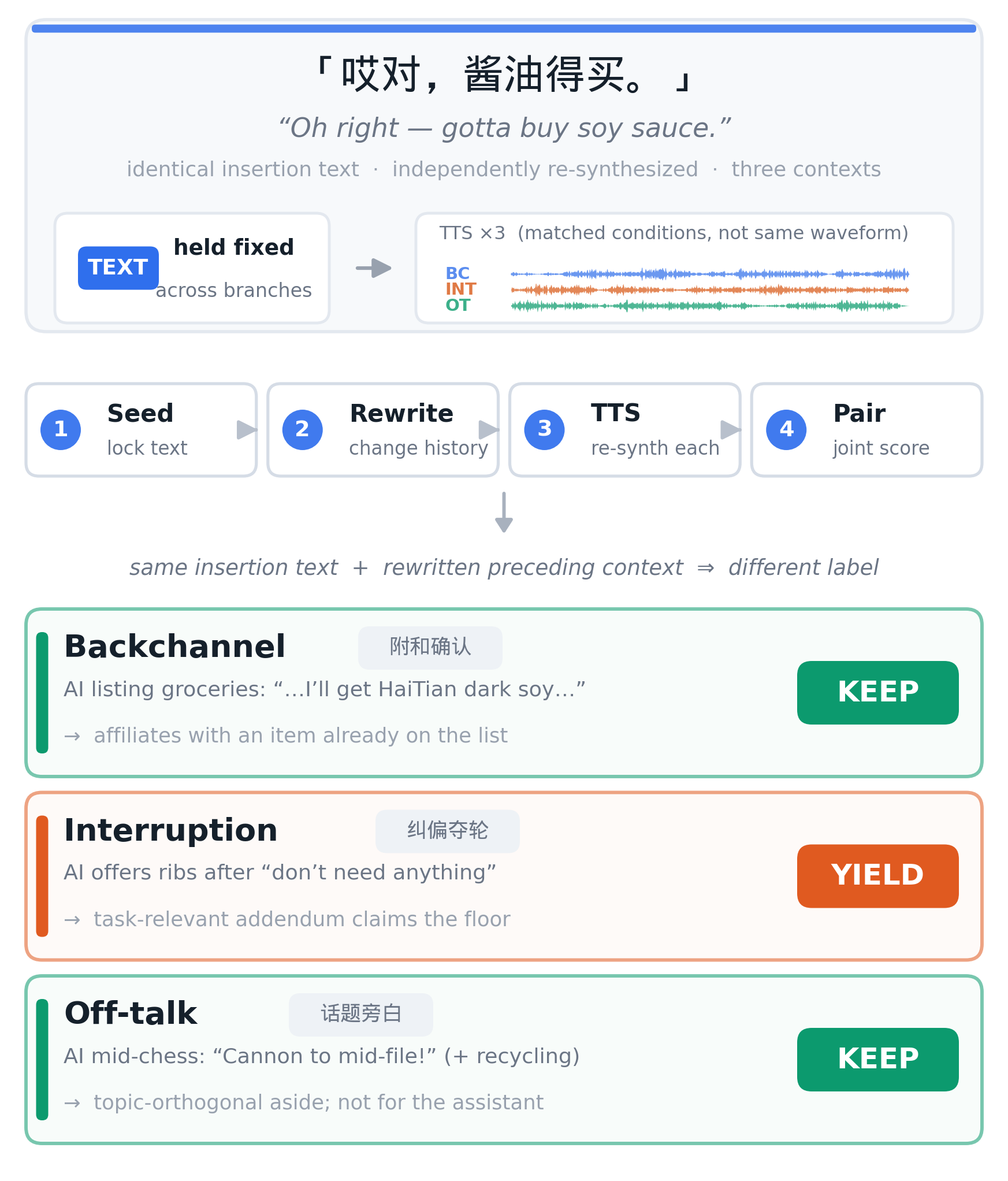
Turn-taking in full-duplex systems is similarly under-tested: most benchmarks allow models to succeed by learning fixed action biases (e.g., always yield at overlaps) rather than genuine contextual reasoning. Alibaba DAMO Academy's ECHO benchmark closes this loophole by pairing examples that share identical overlap transcripts but have contrasting preceding dialogue contexts, forcing any model that relies on surface-level cues to fail. A new pair accuracy metric quantifies contextual reasoning rather than aggregate action accuracy.
ECHO: A Matched-Contrast Benchmark for Context-Sensitive Turn-Taking in Full-Duplex Dialogue
ECHO is a paired diagnostic benchmark for evaluating context-sensitive turn-taking in full-duplex dialogue systems. It uniquely pairs examples with identical overlap transcripts but contrasting preceding dialogue contexts to prevent systems from relying on fixed action biases, and introduces pair accuracy metrics to measure genuine contextual reasoning rather than default strategies.
Abstract
Full-duplex spoken dialogue systems must distinguish interruptions that require yielding the floor from backchannels that permit continued speaking. Existing benchmarks typically evaluate events independently and may therefore reward fixed action preferences rather than context-sensitive decisions. We introduce ECHO, a paired diagnostic benchmark for Chinese full-duplex turn-taking. ECHO pairs examples with the same overlap transcript but contrasting preceding multi-turn dialogue contexts, with one requiring Yield and the other Keep. It additionally includes off-talk examples for diagnosing unnecessary yielding. We introduce pair accuracy, which requires correct decisions on both members of a pair and assigns no credit to constant-action policies. Experiments on multiple full-duplex systems show that most exhibit a pronounced bias toward \textsc{Yield}, performing substantially better on interruptions than on backchannels, while another system remains comparatively balanced. These findings demonstrate that interruption-only evaluation can overestimate practical turn-taking reliability. ECHO and its metadata will be publicly released.
From the Hugging Face Daily tab, StepFun releases the technical report for StepAudio 3 Realtime, their latest real-time audio language model. The report details the architecture and training approach behind a system designed for low-latency, full-duplex spoken interaction — a timely complement to today's benchmark papers that stress-test exactly these capabilities.
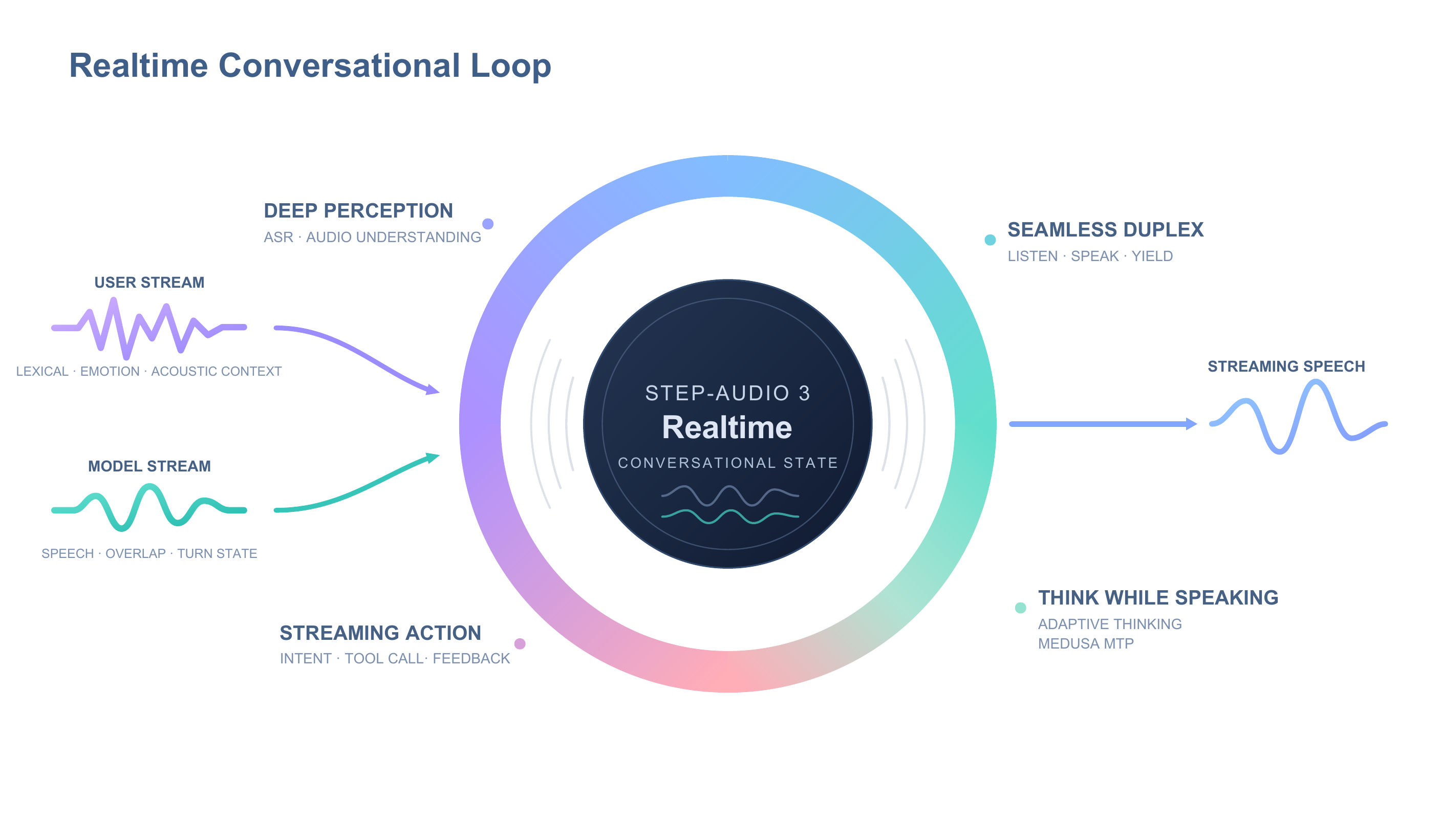
StepAudio 3 Realtime Technical Report
Abstract
Realtime spoken interaction demands deep reasoning, prompt responses, and fluid turn-taking. We present StepAudio 3 Realtime, an audio-language foundation model organized around a continuous listen-converse-think-act loop. Deep Perception captures rich acoustic cues to interpret user intent, while Seamless Duplex models synchronized audio streams to handle pauses, backchannels, and interruptions naturally. Crucially, we resolve the tension between deep deliberation and latency via Think-While-Speaking, executing private reasoning in parallel with spoken delivery. In reasoning mode, StepAudio 3 reaches a 73.0 macro average on StepAudioChat. With Think-While-Speaking, it achieves dialogue and reasoning performance comparable to dedicated reasoning models while speaking in real time. Furthermore, an integrated Voice Agent handles asynchronous tool execution without disrupting the dialogue flow. StepAudio 3 Realtime achieves top-tier performance across key dimensions: an exceptional 90.6 on the MMSU benchmark, 98.9 Overall on the Artificial Analysis Full-Duplex Bench, and a 56.0% macro task-success rate on τ-Voice.
Trending on Hugging Face

Vidu S2: Real-Time Interactive, Editable, and Spatial Video Generation
Vidu S2 introduces real-time interactive avatar and video editing models that support high-resolution spatial video generation and dynamic reference updates.

Omni Interaction Agent Technical Report
Gander is an end-to-end framework that integrates continuous multi-modal streaming, real-time full-duplex interaction, and agentic reasoning through a Cerebellum-Brain architecture and a chunk-level token stream design.

VoiceMem: Streaming Dual-Brain Memory for Real-Time Interaction
VoiceMem introduces a dual-brain streaming memory architecture for speech language models that improves retrieval accuracy, emotional personalization, and real-time efficiency.

AuK Technical Report: An Open-Source Foundational Model for Speech Generation and Editing
AuK is an open-source foundational model that unifies speech generation and editing via natural-language instructions and audio context, using a multimodal language model, joint VAE, hybrid rectified-flow Transformer, and efficient distillation for fast inference.