
Reinforcement Learning Meets Speech: Smarter Avatars, Reasoning Models, and Efficient SpeechLLMs
Today's digest covers reinforcement learning applied to talking avatars and spoken math reasoning, alongside two efficiency-focused advances for adapting language models to speech — token-level alignment and encoder-targeted fine-tuning.
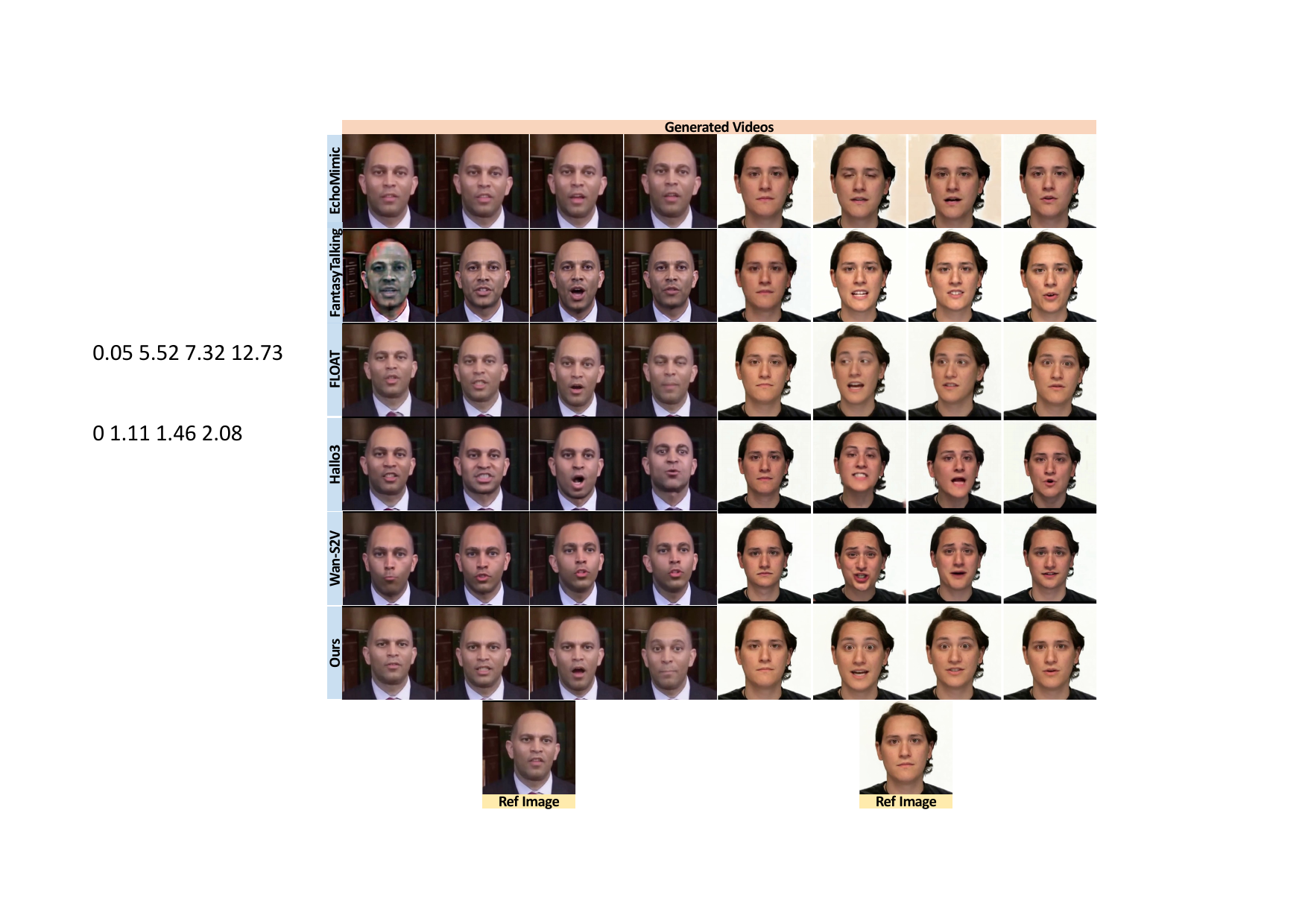
Multi-frame qualitative comparisons. % on HDTF and RAVDESS. VibeAvatar preserves more stable identity and more coherent facial motion across frames. From Tsinghua University.
A strong thread runs through today's papers: reinforcement learning is quietly becoming a first-class citizen in speech and avatar research. From optimizing talking-head motion aesthetics to closing the gap between spoken and written mathematical reasoning, RL is proving its worth beyond text. Meanwhile, two efficiency-focused papers tackle the perennial bottleneck of adapting large language models to acoustic inputs — one via smarter alignment during training, the other by finally giving the speech encoder the gradient signal it deserves.
Talking Avatars & Lip Sync
High-fidelity avatar synthesis demands both phonetic precision and natural motion — and it turns out these goals are best pursued separately.
Talking avatar systems have long struggled with a fundamental tension: optimizing for lip accuracy can produce robotic motion, while chasing naturalness often sacrifices articulatory precision. VibeAvatar from Tsinghua University attacks this directly by disentangling the two objectives into separate optimization stages. A Phonetic Kinematics Adapter handles precise lip articulation from the speech signal, while an Aesthetic Motion Policy — trained via reinforcement learning — optimizes for natural, human-pleasing movement without being constrained by the lip-sync objective. The result is state-of-the-art performance on both fronts, with efficient inference as a bonus.
VibeAvatar: Aligning Phonetic Kinematics and Human Aesthetics for High-Fidelity Talking Avatar Synthesis
This paper proposes VibeAvatar, which synthesizes high-fidelity talking avatars by disentangling phonetic accuracy and motion aesthetics into separate optimization stages rather than jointly learning them. A Phonetic Kinematics Adapter handles precise lip articulation from speech, while an Aesthetic Motion Policy optimizes natural motion through reinforcement learning, achieving state-of-the-art results in both lip sync and motion quality with efficient inference.
Abstract
Multi-modal talking avatar synthesis aims to generate realistic talking videos from a reference portrait and speech. Despite rapid progress in diffusion-based methods, existing approaches still struggle to jointly achieve accurate lip articulation, human-preferred motion aesthetics, and efficient inference. We observe that phonetic accuracy and motion aesthetics arise from fundamentally different sources and should be addressed at complementary stages rather than learned implicitly by a single generator. Based on this insight, we propose VibeAvatar, which disentangles these two objectives through a Phonetic Kinematics Adapter (PKA) that converts recognition-oriented speech features into phonetic-kinematic conditions at the conditioning stage, and an Aesthetic Motion Policy (AMP) that optimizes a flow-consistent stochastic sampling policy via Group Relative Policy Optimization (GRPO) at the post-training stage. With a lightweight flow-based motion generator operating in a compact 1D warp-based latent motion space, VibeAvatar achieves state-of-the-art results in articulation, aesthetics, and efficiency on both objective metrics and user studies, while generating a 10-second 512px video in under 10 seconds with only $\sim$3GB VRAM.
SpeechLLMs & Spoken Dialogue
Language models are increasingly expected to hear, reason, and adapt — today's papers push all three fronts.
Spoken Mathematical Reasoning via RL
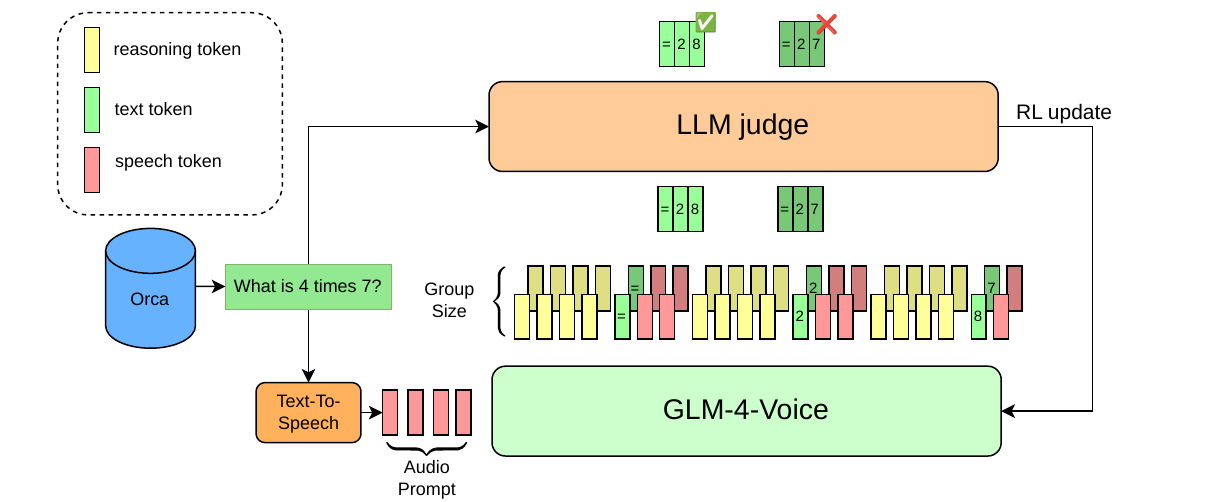
Getting speech language models to do math has been a stubborn problem: the modality gap between audio and text typically means spoken problem-solving lags well behind text-based baselines. Voice of Reason from Meta AI closes that gap by applying reinforcement learning with verifiable rewards — a strategy that has proven powerful in text-domain reasoning — directly to speech language models. Crucially, it achieves state-of-the-art math accuracy on benchmarks without requiring explicit reasoning tokens, relying instead on RL-driven training to surface correct solutions from spoken input alone.
Voice of Reason: Reinforcement Learning for Spoken Math
This work applies reinforcement learning with verifiable rewards to improve mathematical reasoning in speech language models, bridging the performance gap between spoken and text-based problem solving. Unlike prior speech-only approaches, it achieves state-of-the-art math accuracy on benchmarks through RL-driven training without requiring explicit reasoning tokens.
Abstract
Speech language models enable richer spoken interactions between humans and machines than cascaded systems, allowing access to paralinguistic information and lower latency. However, their accuracy on mathematical reasoning benchmarks has lagged behind those of text models. Reinforcement learning (RL) with verifiable rewards has been instrumental in extending text models' capabilities for solving complex problems and limiting hallucinations. In this work, we explore applying RL to the GLM-4-Voice speech model (Zeng et al., 2024) to bridge the gap between textual and spoken mathematical problem solving. We first adapt the model to the domain using supervised fine-tuning on synthesized spoken question-answering data. We then show that, even without extra reasoning tokens, RL improves the accuracy on GSM8K beyond levels previously achieved for speech models only with supplementary reasoning traces. When combined with existing streaming reasoning techniques, we show further gains to 74.8% free-form accuracy. This establishes a new state-of-the-art for mathematical spoken abilities with speech-native models.
Efficient Token-Level Alignment for Zero-Shot SpeechLLMs
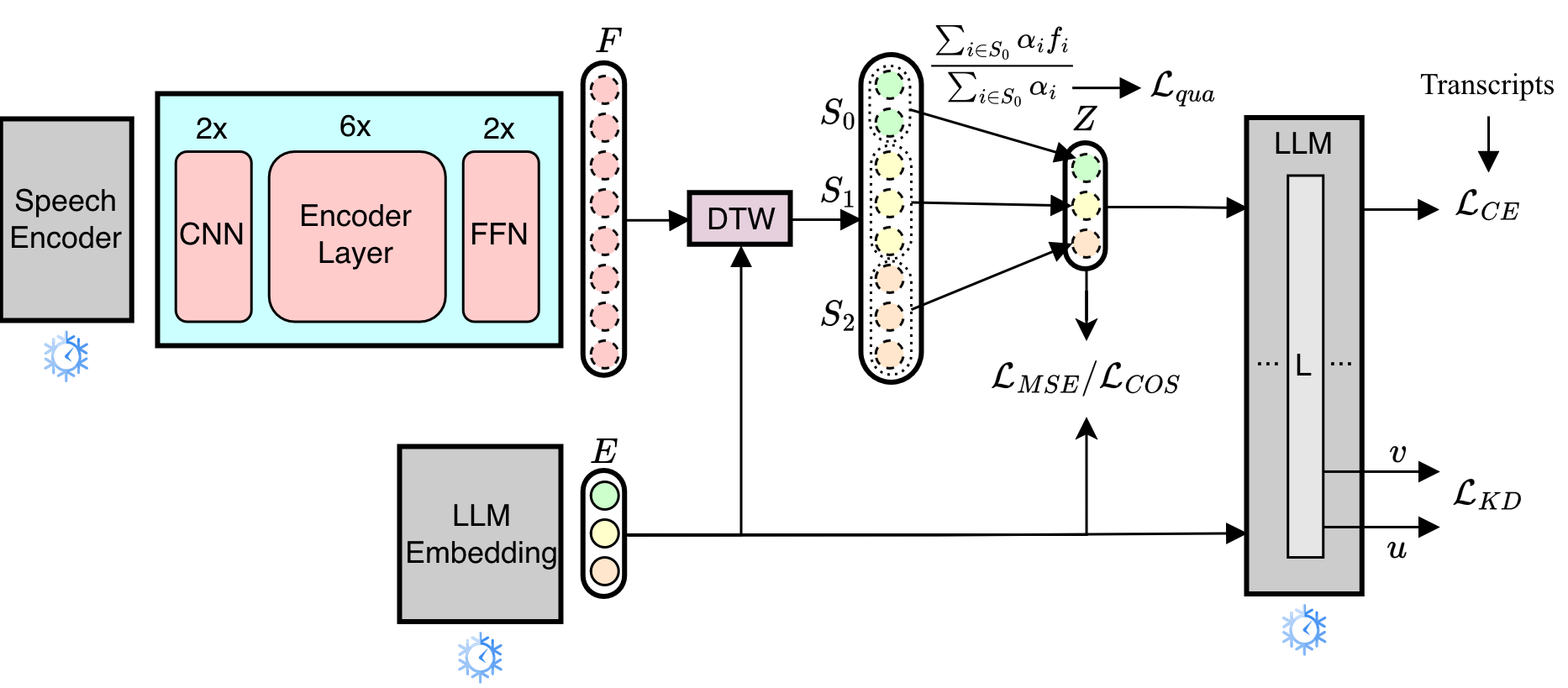
Extending a pretrained LLM to handle speech usually means running expensive LLM forward passes during training just to provide a learning signal for the acoustic front-end. The Align, Integrate, and Fire framework from the University of Groningen sidesteps this by dynamically aligning acoustic frames to text tokens — eliminating those costly passes entirely during training. It pairs this with memory-efficient knowledge distillation targeting a single LLM layer, yielding competitive performance on speech recognition and translation at a fraction of the usual computational cost.
Align, Integrate, and Fire: Efficient Token-Level Alignment for Zero-Shot SpeechLLMs
This paper presents an efficient framework for extending language models to speech by dynamically aligning acoustic frames to text tokens, eliminating expensive LLM forward passes during training. It introduces memory-efficient knowledge distillation targeting a single layer, achieving competitive performance on speech recognition and translation with significantly reduced computational overhead.
Abstract
While Large Language Models excel in natural language processing, efficiently extending their capabilities to spoken input remains a significant challenge. Existing methods for building SpeechLLMs often rely on computationally expensive full-model fine-tuning, or employ parameter-efficient projectors that suffer from inefficient token sequence lengths and costly full-model supervision. In this paper, we introduce Aligned Continuous Integrate-and-Fire, a highly efficient framework for zero-shot speech processing. Our method dynamically compresses continuous acoustic frames into the exact discrete token length of the target text utilizing explicit Dynamic Time Warping alignments. This allows our initial training stage to establish a robust acoustic-to-semantic bridge using lightweight distance metrics, entirely bypassing the computationally expensive LLM forward pass. For subsequent fine-tuning, we propose a memory-efficient knowledge distillation objective that targets a single LLM layer, performing competitively with full-model cross-entropy training at a fraction of the computational cost. Through extensive evaluations on Automatic Speech Recognition and Speech Translation, we demonstrate that our method achieves superior performance compared to prior parameter-efficient baselines.
Awakening the Frozen Speech Encoder
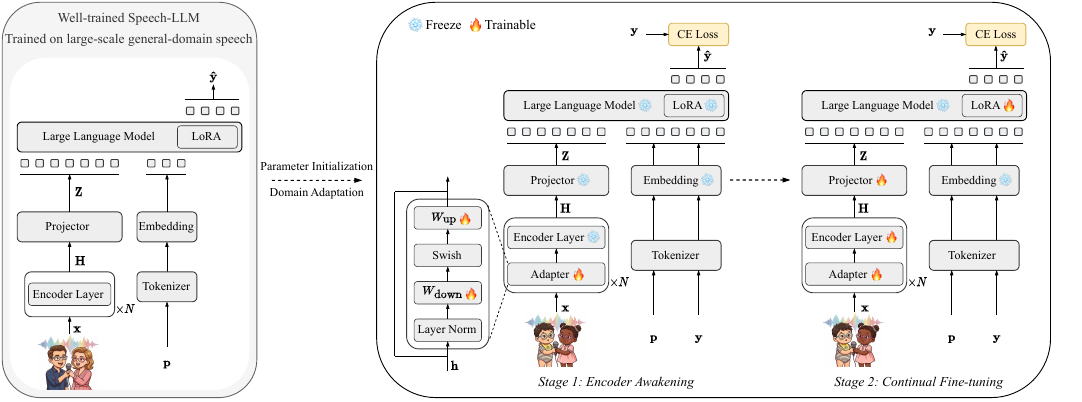
A subtle but important flaw in standard Speech-LLM fine-tuning: because the training loss is applied only at the LLM output, the speech encoder — sitting far upstream — receives a weak, indirect gradient signal and often fails to meaningfully adapt to new domains. EAVA (Encoder Awakening via Adapters) from UCLA fixes this with a two-stage approach: lightweight adapters are inserted into every encoder layer and trained in isolation first, before joint fine-tuning with the rest of the model. This targeted strategy enables effective adaptation to challenging out-of-domain speech — including child speech and dialectal varieties — under limited data, while preserving the encoder's pretrained acoustic representations.
Encoder Awakening via Adapters: Effective Domain-Adaptive Fine-tuning of Speech-LLMs
This paper proposes EAVA, a two-stage domain-adaptive fine-tuning method that explicitly targets the speech encoder in Speech-LLMs, which typically receives insufficient adaptation when loss is applied only at the LLM output. By inserting lightweight adapters into each encoder layer and training them in isolation before joint fine-tuning, the method enables effective adaptation to domain-shifted speech (child, dialectal) under limited data while preserving pre-trained acoustic knowledge.
Abstract
Speech Large Language Models (Speech-LLMs), typically built from a pre-trained speech encoder, a modality projector, and an LLM fine-tuned with Low-Rank Adapters (LoRA), have shown strong Automatic Speech Recognition (ASR) performance on general-domain speech. However, adapting them to domain-shifted speech, such as child or dialectal speech, remains challenging under limited target-domain data. Given the dominant role of the LLM in Speech-LLMs, with cross-entropy loss applied only at the LLM output, the speech encoder may receive insufficient adaptation to new acoustic conditions. In this paper, we propose Encoder Awakening via Adapters (EAVA), a simple yet effective domain-adaptive fine-tuning method for Speech-LLM-based ASR. First, lightweight adapters are inserted into each encoder layer and trained exclusively, enabling target-domain acoustic knowledge to be incorporated into the encoder while preserving its pre-trained knowledge. Second, the full model is jointly fine-tuned on the target domain with LoRA applied to the LLM. Experiments on three domain-shifted ASR datasets, covering child and dialectal speech, show that EAVA consistently outperforms vanilla fine-tuning and other baselines, achieving new state-of-the-art performance.
Trending on Hugging Face

Vidu S2: Real-Time Interactive, Editable, and Spatial Video Generation
Vidu S2 introduces real-time interactive avatar and video editing models that support high-resolution spatial video generation and dynamic reference updates.

VoiceMem: Streaming Dual-Brain Memory for Real-Time Interaction
VoiceMem introduces a dual-brain streaming memory architecture for speech language models that improves retrieval accuracy, emotional personalization, and real-time efficiency.

Omni Interaction Agent Technical Report
Gander is an end-to-end framework that integrates continuous multi-modal streaming, real-time full-duplex interaction, and agentic reasoning through a Cerebellum-Brain architecture and a chunk-level token stream design.

AuK Technical Report: An Open-Source Foundational Model for Speech Generation and Editing
AuK is an open-source foundational model that unifies speech generation and editing via natural-language instructions and audio context, using a multimodal language model, joint VAE, hybrid rectified-flow Transformer, and efficient distillation for fast inference.

VibeVoice Technical Report
VibeVoice synthesizes long-form multi-speaker speech using next-token diffusion and a highly efficient continuous speech tokenizer, achieving superior performance and fidelity.