
Agentic Voice, Faster ASR, and Multilingual Talking Faces
Today's digest spans tool-calling full-duplex speech agents from Google, streaming ASR advances from IBM and CAS, multilingual G2P and prosody evaluation from Alibaba and Tsinghua, and a new Korean-English 3D talking face benchmark from Seoul National University.
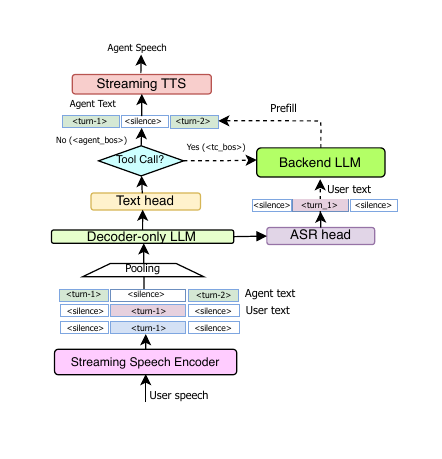
The proposed frontend-backend system for a duplex speech-to-speech model with tool-call capability. From Google.
Today's papers push on several fronts simultaneously: voice agents gain agentic tool-calling without sacrificing conversational fluidity, streaming ASR edges closer to the Pareto frontier of speed and accuracy, TTS pipelines get more principled prosody evaluation, and the talking-face field gets its first unified Korean-English 3D benchmark. Seven papers, four themes — let's dig in.
SpeechLLMs, Speech-to-Speech & Voice Agents
Making spoken dialogue models smarter and more connected to the world.
Full-duplex speech models are compelling for natural conversation, but they've historically been limited to closed-loop responses — they can't reach out to APIs or databases mid-conversation. Google's new work changes that. By inserting a speech-to-text frontend that emits lightweight delegation tokens to a text-based backend LLM, the system hands off tool-call reasoning without breaking the stream. Result injection and streaming synthesis bring the answer back into the audio channel, preserving low-latency interaction and interruption handling throughout.
A frontend-backend architecture for tool calls in full-duplex speech models
This work enables full-duplex speech-to-speech models to call external tools by introducing a frontend-backend architecture where a speech-to-text frontend emits delegation tokens to a text-based backend LLM. The key innovation is preserving the natural conversational properties (low-latency interaction, interruption handling) of duplex models while adding agentic capabilities through lightweight result injection and streaming synthesis.
Abstract
Full-duplex speech-to-speech (S2S) models provide natural, low-latency conversational interaction and would benefit from the ability to use external tools and complete voice-agent tasks. We propose a frontend-backend architecture where a duplex speech-to-text frontend learns to emit a delegation token and forwards streaming ASR transcripts to a text-based backend LLM for tool calls. Tool-call results from the backend are injected back into the frontend through a lightweight prefill-and-repeat mechanism and then synthesized using streaming TTS to the user. Our approach largely preserves regular duplex turn-taking, interruption handling, and low-latency interaction as it requires minimal modifications to the frontend model. In a single-turn tool-call evaluation, our system achieves 92-97% tool-call recall, competitive tool-call prediction performance, and 81.2% accuracy in rejecting irrelevant calls. When equipped with a larger backend (e.g., Qwen3-235B-A22B), our system achieves competitive results on Full-Duplex-Bench-V3 compared to open and closed source models, and significantly outperforms GPT-realtime-mini and Qwen3-Omni-30B-A3B-Instruct on EVA-Bench. These results demonstrate that backend delegation is an effective and modular approach for combining natural duplex speech interaction with strong agentic tool-call capabilities.
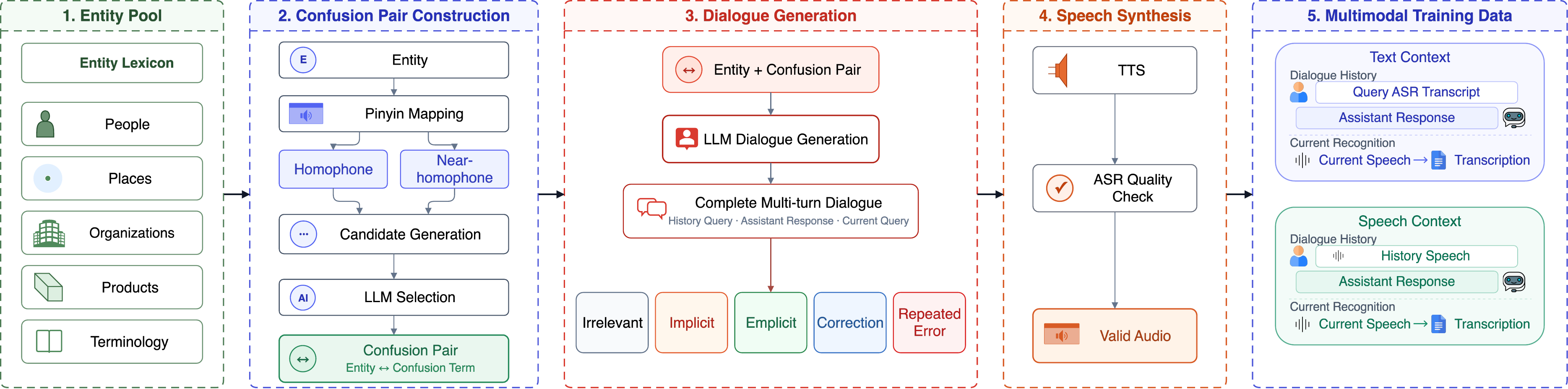
Staying in the conversational ASR space, Alibaba Damo Academy tackles a subtler problem: standard ASR treats each utterance in isolation, discarding the acoustic history of prior turns and the semantic signal in the assistant's previous responses. Their multimodal conversational ASR framework conditions recognition on both past speech and text responses, leading to better entity recognition and error correction across dialogue turns. The paper also contributes scenario-controlled data construction and a new benchmark for systematic evaluation.
Multimodal Conversational Context for LLM-Based ASR: Data Construction, Training, and Benchmark
This paper introduces a multimodal framework for conversational ASR that leverages both historical speech and assistant responses to improve entity recognition and error correction across dialogue turns. Unlike transcript-only baselines that propagate errors and discard acoustic cues, the approach combines scenario-controlled data construction, multimodal context training, and a comprehensive benchmark to systematically evaluate contextual understanding in speech recognition.
Abstract
Conversational context provides semantic and acoustic cues across turns for automatic speech recognition (ASR), but relying on historical transcripts can propagate recognition errors and discard pronunciation and speaker information. We present a multimodal conversational-context framework for LLM-based ASR that integrates a scenario-controlled data pipeline, scalable multimodal context training, and systematic evaluation. We construct dialogues around entities and their confusable forms and interleave historical user speech with assistant text responses for supervised fine-tuning. We also introduce MM-ContextASR Bench, which evaluates contextual understanding and entity error correction across five scenarios. Experiments with Qwen3-Omni and Step-Audio-2-mini reveal limitations in handling irrelevant and erroneous history and show that our data construction and training improve context utilization, with multimodal context achieving the highest overall entity recall on both models. Further experiments on accent, dialect, and target-speaker ASR demonstrate the value of historical speech. The benchmark data and evaluation code are publicly available at https://github.com/llh666521/MM-ContextASR.
Streaming ASR Architectures
Squeezing more speed and accuracy out of the encoder stack.
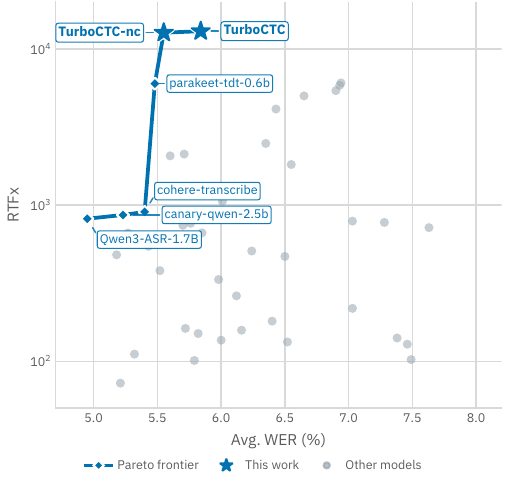
IBM Research presents Granite 5.0 TurboCTC, a 470M-parameter CTC encoder designed from the ground up for low-latency inference. The architectural recipe combines pyramidal temporal subsampling, block-diagonal attention, and careful inference optimizations — trained entirely on public data using the novel Muon optimizer. The result sits on the Pareto frontier of open ASR benchmarks and runs at roughly twice the speed of competing systems.
Design of the IBM Granite 5.0 TurboCTC ASR Model
Granite 5.0 TurboCTC is a 470M-parameter CTC encoder optimized for low-latency automatic speech recognition, achieving state-of-the-art speed-accuracy tradeoff through pyramidal temporal subsampling, block-diagonal attention, and efficient inference optimizations. Trained exclusively on public data with novel use of the Muon optimizer, the model reaches the Pareto frontier of open ASR benchmarks while being twice as fast as competing systems.
Abstract
We describe the architecture, training methodology and inference speedups of Granite 5.0 Turbo CTC, a 470 million parameter encoder-only model with an excellent speed-accuracy tradeoff. The architecture uses pyramidal temporal subsampling within Conformer blocks using strided depthwise convolutions, block-diagonal (chunk-wise) self-attention, and conditioning on intermediate predictions from the middle layer. Training highlights are the use of only publicly available data, the novel use of a Muon optimizer, and balanced data sampling. Inference speedups include replacing 1 x 1 convolutions with linear layers and optimizing the attention computation in the Conformer blocks. Collectively, these result in a model that is on the speed-accuracy Pareto frontier of the Open ASR leaderboard for English short-form ASR while being twice as fast as the fastest competitor. The model can be used under a permissive license and downloaded from https://huggingface.co/ibm-granite/granite-speech-5.0-470m-turboctc.
A complementary direction comes from the Chinese Academy of Sciences: rather than redesigning the encoder, they ask how to transfer the alignment knowledge locked inside large, non-streaming ASR-LLMs into a smaller streaming student. The key insight is to extract monotonic alignment paths from the teacher's soft attention — avoiding the mismatch that arises when forced alignments from an external aligner conflict with the student's own learned representations. Logit and hidden-state distillation round out the unified framework.

Alignment-Path Distillation from Non-streaming ASR-LLMs for Streaming Speech Recognition
This paper presents a distillation framework that transfers alignment knowledge from non-streaming ASR-LLMs to improve streaming speech recognition. Rather than relying on externally-trained forced alignments that may conflict with the student model's learning, it extracts monotonic alignment paths from the teacher's soft attention, combined with logit and hidden-state distillation for a unified approach.
Abstract
In this paper, we propose an alignment-path distillation framework for streaming automatic speech recognition (ASR) with large language models (LLMs). Interleaved streaming ASR-LLMs use forced alignments (FA) from alignment models, such as those trained with connectionist temporal classification (CTC), to construct speech-text training sequences. However, alignments obtained from a separate acoustic model may be inconsistent with those learned by LLM-based ASR. This motivates us to transfer alignment information from a non-streaming ASR-LLM to improve streaming recognition. Specifically, we extract monotonic alignment paths from a non-streaming teacher's soft text-audio attention and use them to construct interleaved training sequences. The framework also includes logit and hidden-state distillation to learn from the teacher's output distributions and internal representations. Experimental results show that, without logit or hidden-state distillation, training with teacher-derived alignment paths achieves a 5.2% relative error rate reduction compared with training using forced alignments. When both models use logit and hidden-state distillation, teacher-derived alignments yield a 3.9% relative error rate reduction, with similar mean emission latency but higher flicker. The complete framework achieves a 16.6% relative error rate reduction compared with training using forced alignments without logit or hidden-state distillation.
TTS & Prosody
Evaluating and generating expressive speech with greater precision.
Automatic prosody evaluation for TTS is notoriously hard: human preferences are multi-dimensional (emotion, intonation, energy), yet most preference-based reward models collapse them into a single verdict. Alibaba Damo Academy's Live-ProsodyJudge addresses this by distilling Gemini into Qwen3-Omni with a decoupling mechanism that keeps the per-dimension scores independent. A novel span-local GRPO training strategy further sharpens fine-grained assessment — all at a fraction of the cost of running a frontier model.

Multi-Dimensional Prosody Judgment For Live Streaming Speech Synthesis
This paper introduces Live-ProsodyJudge, a cost-effective LLM-based evaluator distilled from Gemini into Qwen3-Omni for fine-grained TTS prosody assessment (emotion, intonation, energy). It solves the "verdict coupling" problem where multi-dimensional scores collapse into single preferences through decoupling mechanisms and a novel span-local GRPO strategy.
Abstract
Evaluating live streaming speech synthesis (TTS) requires assessing fine-grained, highly expressive prosody such as emotion, intonation, and energy which traditional MOS predictors fail to capture. While proprietary Large Language Models (LLMs) like Gemini can evaluate these aspects, they are too costly for massive inference and reinforcement learning feedback. To address this, we first introduce Live-ProsodyJudge (LPJ), a cost-effective pairwise evaluator distilled from Gemini into Qwen3-Omni. However, we identify a critical flaw in standard multi-dimensional evaluation: verdict coupling. The judge tends to lazily align all individual dimension scores with its overall preference, collapsing a rich multi-dimensional rubric into a single preference bit. To resolve this, we further propose Decoupled-Live-ProsodyJudge (D-LPJ). D-LPJ eliminates the overall verdict target to prevent blind following, masks uncertain pair-dimensions during Supervised Fine-Tuning(SFT), and introduces a novel span-local GRPO strategy that applies normalized advantages strictly to their corresponding rationale spans. Evaluated on highly curated human-annotated test sets, 10 sample balanced-order LPJ achieves higher point accuracy than a single Gemini call, while D-LPJ successfully produces independent,decoupled dimension judgments. Furthermore, in a Best-of-8 TTS candidate selection tournament, the LPJ-selected utterance falls within the human top-3 in 85.29% of high-confidence cases, demonstrating its efficacy for fine-grained TTS preference optimization.
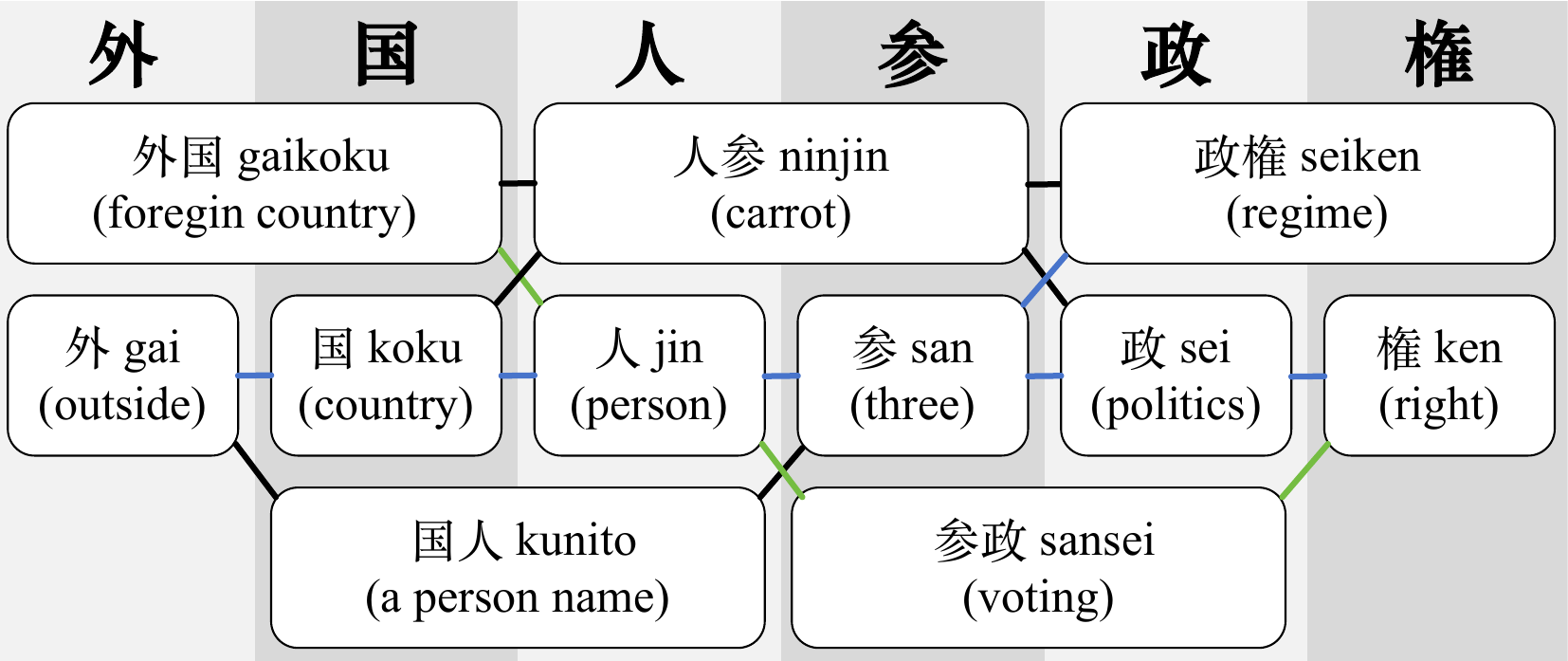
On the text-analysis side of TTS pipelines, Tsinghua University tackles grapheme-to-phoneme (G2P) conversion for unsegmented languages — a problem where word-boundary ambiguity compounds the usual data-scarcity challenge. Their solution pairs dictionary-constrained word lattices with a neural CRF scorer for context-aware disambiguation, using LLM-annotated sentences at scale to sidestep the annotation bottleneck. The approach substantially outperforms both traditional morphological analyzers and purely neural baselines.
Dictionary-Constrained Grapheme-to-Phoneme for Unsegmented Languages from LLM-Annotated Data
This paper combines dictionary-constrained word lattices with neural CRF scoring for context-aware grapheme-to-phoneme conversion in unsegmented languages. By leveraging large language models to generate millions of annotated sentences, it overcomes data scarcity and substantially outperforms traditional morphological and neural baselines.
Abstract
Grapheme-to-phoneme (G2P) conversion turns raw text into its phonemic form and is an essential part of both text-to-speech (TTS) and automatic speech recognition (ASR) systems. It is required to be fast, stable and context-aware. For unsegmented languages such as Japanese, G2P additionally couples word segmentation with highly context-dependent polyphone disambiguation, and the scarcity of accurately annotated data remains a bottleneck. In this paper, we present a context-aware neural G2P method that scores paths of a discriminative conditional random field (CRF) over a word lattice constructed from dictionaries. To tackle data scarcity, we utilize large language models (LLMs) to generate more than 2 million sentences. Experimental results demonstrate that our method strongly outperforms conventional morphological analyzer-based methods and neural sequence models. On the Joyo-Kanji-Yomi benchmark, our method reaches 99.62% target word reading accuracy, 0.32% target word phoneme error rate (PER) and 0.14% sentence PER.
Talking Avatars & 3D Talking Faces
Building the data infrastructure for cross-lingual facial animation.
Speech-driven 3D face synthesis has a silent multilingual problem: virtually all benchmark data is English-centric, making it impossible to evaluate how well models generalize across phoneme inventories and articulatory patterns. KoUniTalk from Seoul National University directly addresses this gap by retargeting both VOCASET and Korean speech-driven facial motion capture onto a shared, lightweight mesh topology. The unified articulation space preserves mouth-motion semantics while dramatically reducing mesh dimensionality, enabling apples-to-apples cross-language evaluation for the first time.
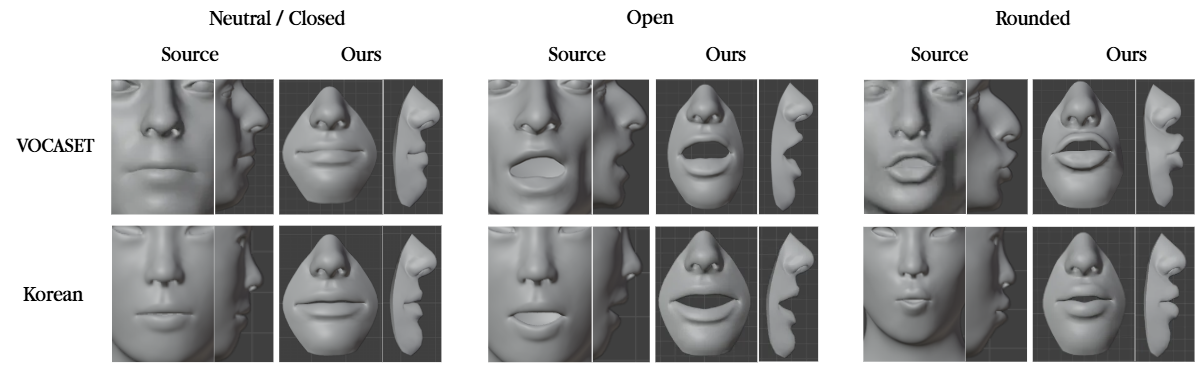
KoUniTalk: A Lightweight Articulation-Centered Korean-English 3D Talking Face Benchmark
KoUniTalk unifies English and Korean 3D talking-face datasets by retargeting VOCASET and Korean speech-driven facial data to a shared lightweight mesh topology, enabling cross-language evaluation of speech-driven facial animation models. The work addresses the multilingual data gap in speech-driven face synthesis by creating a standardized articulation space that preserves mouth motion semantics while drastically reducing dimensionality.
Abstract
High-quality 3D talking face datasets remain largely English- centric, and Korean 3D facial motion data are difficult to combine with standard English benchmarks because of differences in mesh topology, spatial scale, coordinate system, and temporal sampling. We present KoUniTalk, a lightweight articulation-centered Korean-English 3D talk- ing face benchmark that retargets VOCASET and the released Korean speech-based 3D talking face data to a shared mesh topology using de- formation transfer. Rather than proposing a new deformation-transfer algorithm or a full-head identity-preserving avatar dataset, KoUniTalk provides an identity-neutral canonical output space for controlled speech- driven facial articulation training and evaluation across English and Ko- rean. The unified template contains 1,176 vertices and focuses on the mouth and adjacent lower- and mid-face regions, reducing the output dimensionality from 15,069 and 72,147 dimensions to 3,528 dimensions, corresponding to 4.27-fold and 20.45-fold reductions compared with VO- CASET/FLAME and the original Korean mesh, respectively. To exam- ine whether retargeting preserves speech-relevant motion, we evaluate semantic mouth-landmark trajectories, including mouth opening, mouth width, aperture ratio, and mouth-opening dynamics. Since the official test set of the Korean dataset is not publicly released, we additionally define a subject-disjoint Korean benchmark split. The processed matched benchmark contains 22 speakers, 4,978 sequences, and 642,781 frames, enabling Korean-English cross-dataset evaluation of speech-driven 3D fa- cial animation models in a single compact articulation-template space. Source-reported inventory counts are listed separately from these pro- cessed counts
Trending on Hugging Face

Omni Interaction Agent Technical Report
Gander is an end-to-end framework that integrates continuous multi-modal streaming, real-time full-duplex interaction, and agentic reasoning through a Cerebellum-Brain architecture and a chunk-level token stream design.

OmniFlatten: An End-to-end GPT Model for Seamless Voice Conversation
A novel GPT-based model, OmniFlatten, enables real-time natural full-duplex spoken dialogue through a multi-stage post-training technique that integrates speech and text without altering the original model's architecture.

VoiceMem: Streaming Dual-Brain Memory for Real-Time Interaction
VoiceMem introduces a dual-brain streaming memory architecture for speech language models that improves retrieval accuracy, emotional personalization, and real-time efficiency.

AuK Technical Report: An Open-Source Foundational Model for Speech Generation and Editing
AuK is an open-source foundational model that unifies speech generation and editing via natural-language instructions and audio context, using a multimodal language model, joint VAE, hybrid rectified-flow Transformer, and efficient distillation for fast inference.

VibeVoice Technical Report
VibeVoice synthesizes long-form multi-speaker speech using next-token diffusion and a highly efficient continuous speech tokenizer, achieving superior performance and fidelity.