
Full-Duplex Voice Agents, Proactive AudioLLMs, and Streaming Gestures
Today's digest covers a wave of real-time conversational AI research: full-duplex speech agents with tool-calling and turn-taking, native audio-visual dialogue, proactive AudioLLM assistance, on-device audio models, and streaming co-speech gesture generation.
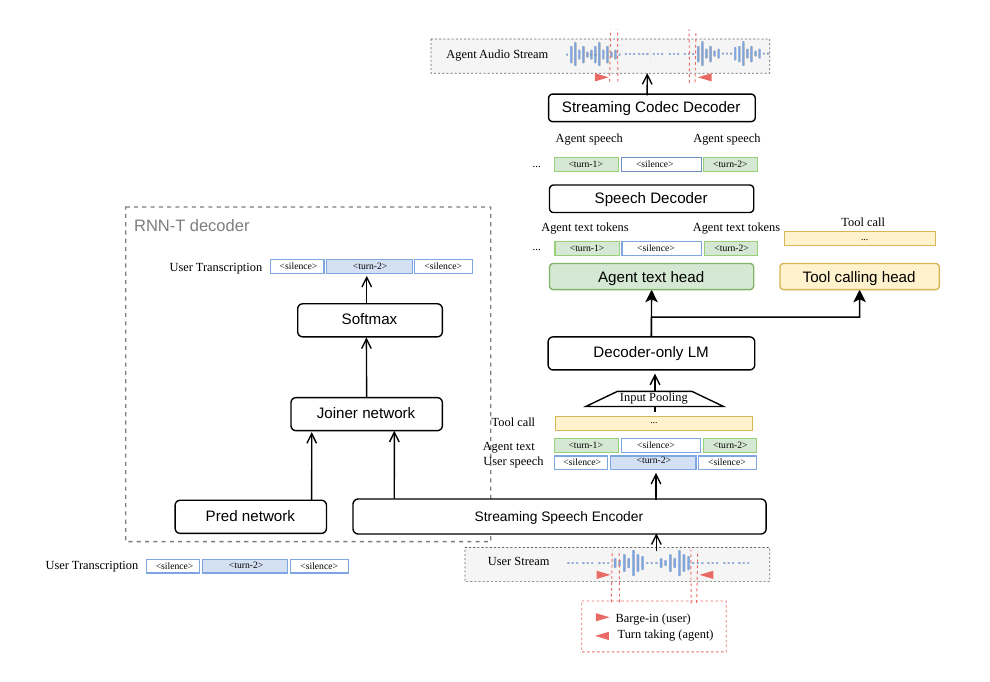
NemotronLabs VoiceChat Architecture Overview. From NVIDIA.
Today's papers push hard on the real-time frontier of conversational AI — full-duplex voice agents that handle interruptions and tool calls, audio-visual models that skip the ASR middleman, AudioLLMs that proactively monitor streams rather than wait to be asked, compact on-device audio models, and a new approach to streaming gesture synthesis for embodied agents. Across the board, the theme is closing the loop: faster, more natural, less pipeline-dependent interaction.
Speech-to-Speech & Voice Agents
From end-to-end duplex architectures to hybrid turn-taking systems and native audio-visual dialogue.
Full-duplex voice agents have become a proving ground for whether LLM-based systems can match the naturalness of human conversation. NVIDIA's NemotronLabs VoiceChat makes the strongest end-to-end statement yet: a single architecture that unifies streaming speech perception, transcription, reasoning, function invocation, and speech synthesis with parallel output streams. Critically, it retains the ability to handle user interruptions and backchannels while natively calling external tools — no pipeline glue required.
NemotronLabs VoiceChat: An Open Full-duplex Speech-to-Speech Model with Tool Calling Capabilities
NemotronLabs VoiceChat is a full-duplex speech-to-speech model that unifies streaming speech perception and generation with native tool-calling capabilities in a single end-to-end architecture. Unlike pipelined systems, it integrates transcription, reasoning, function invocation, and speech synthesis with parallel output streams while maintaining real-time conversational behavior and the ability to handle user interruptions and backchannels.
Abstract
We introduce NemotronLabs VoiceChat, an open full-duplex speech-to-speech model with native tool-calling capabilities. NemotronLabs VoiceChat combines a streaming speech encoder and decoder-only language model with parallel specialized output streams for agent text and structured function calls, an auxiliary RNN-T branch for incremental user transcription, and a streaming TTS decoder. This design enables the model to listen, transcribe, reason, invoke tools, and speak within a unified streaming architecture while preserving the temporal behavior required for natural conversation. On Full-Duplex-Bench 1.0, NemotronLabs VoiceChat achieves the lowest pause-handling takeover rates among evaluated open-weight systems, 100\% takeover following user interruptions, and a 4.33/5 post-interruption response-quality score. On Full-Duplex-Bench 1.5, it resumes its response after user backchannels in 93\% of cases. NemotronLabs VoiceChat obtains a 55.1 normalized average on VoiceBench and, on Full-Duplex-Bench 3.0 (FDB 3.0), achieves 82.5\% tool-selection F1, while argument accuracy and end-to-end tool execution remain areas for improvement. These results demonstrate that full-duplex interaction, speech recognition and generation, general language capabilities, and external tool use can be integrated in a single open speech-to-speech model without sacrificing real-time conversational behavior.
On the hybrid side, Voice-Light from Bertil Braun takes a pragmatic cascaded approach that still achieves full-duplex behavior. It combines causal ASR, speculative response generation, and reversible playback control to handle overlaps and cancellations without false cutoffs — reaching sub-800ms response latency. The key insight is that carefully engineered heuristics for turn-taking can outperform purely learned policies on real conversational data, while keeping the system highly deployable.

Voice-Light: A Full-Duplex Cascaded Voice Agent with Causal Turn-Taking and Speculative Generation
Voice-Light is a full-duplex voice agent that enables natural spoken interaction by handling overlaps, cancellations, and turn-taking without false cutoffs. By combining causal ASR, speculative response generation, and reversible playback control, it achieves sub-800ms response latency while maintaining conversation integrity—a practical hybrid system outperforming purely learned turn-taking policies on real conversations.
Abstract
Natural spoken interaction requires more than streaming ASR, language generation, and speech synthesis: a system must react to overlap without canceling on every acknowledgment, prepare a response before a turn is certain, and ensure canceled audio cannot enter conversation history. We present Voice-Light, a full-duplex cascaded voice agent that combines immediate acoustic onset, a causal adapter sharing a streaming ASR encoder, reversible playback control, and private speculative response generation. Structured tool calls execute concurrently with audible bridge speech, while browser acknowledgments make rendered audio authoritative for durable history. Locked evaluation on 1,673 real-conversation silence candidates found that an earlier learned completion checkpoint preserved a 2.70% false-cutoff rate but reached only 12.53% end-of-turn recall, compared with 95.60% for a Silero timing policy. The deployed system therefore retains a hybrid controller rather than claiming a learned-policy replacement. Across three unscripted operator-run microphone sessions, 36 measured response turns had a 758 ms median from final VAD endpoint to first server audio; 21 turns were below 800 ms. These sessions are an instrumented case study, not a controlled user evaluation. We release the synthetic data, model artifacts, evaluation code and summaries, source code, and deployment configuration supporting the result.
Alibaba's OmniVChat tackles a harder perceptual challenge: native audio-visual dialogue where the model directly processes synchronized audio and video, bypassing separate ASR or captioning modules. Data scarcity is the central obstacle here, and the paper addresses it with a multi-agent synthesis engine for dialogue generation alongside an RL-based reward design that jointly optimizes correctness, efficiency, and conversational style — validated on both synthetic and human-recorded benchmarks.

OmniVChat: Synthesizing, Benchmarking, and Training for Native Audio-Visual Dialogue
OmniVChat enables native audio-visual dialogue where models directly process synchronized audio and video without separate speech recognition or captioning. The paper addresses data scarcity and evaluation challenges through a multi-agent synthesis engine for dialogue generation and an RL-based reward design optimizing correctness, efficiency, and style—validated on both synthetic and human-recorded benchmarks.
Abstract
We define OmniVChat (Omni Video Chat) as the task of native audio-visual dialogue between a user and an omni model. In OmniVChat, omni models directly and simultaneously receive audio and video from a user and return text. The user's query is embedded in the audio and video, without a separate text question, external captioning, or speech recognition. Direct audio-visual input reduces external latency and computation while preserving perceptual cues. However, research on OmniVChat faces two constraints: data availability and evaluation. Recordings of people using their own devices are scarce. Furthermore, a good reply often needs to account for the user's surroundings, facial expressions, and nearby objects, and such responses can be expressed in many different ways, making keyword matching unreliable for evaluating reply quality. Recent progress in agent systems and video generation makes generation for comprehension viable, which means using synthesized dialogues for training and evaluation. Therefore, we present OmniVChat-Studio, a multi-agent data engine for synthesizing single- and multi-turn audio-visual dialogues. We use synthesized dialogues to build OmniVChat-Bench, an evaluation benchmark that evaluates omni models' basic dialogue abilities across five ability categories. We also present OmniVChat-RL, a reinforcement learning reward design that jointly targets reply correctness, efficiency, and style in OmniVChat. Training Qwen3-Omni-Instruct with OmniVChat-RL on synthesized dialogues improves its performance on both OmniVChat-Bench and the human-recorded OmniVChat-Bench-Human. These gains validate the reward design and show transfer to real-world dialogues in training and evaluation.
Co-Speech Gesture & Embodied Agents
Streaming gesture synthesis that preserves quality without discretization.
Co-speech gesture generation for real-time embodied agents has long suffered a quality-vs-latency tradeoff: discrete token-based methods are causally streamable but lose the natural diversity of continuous motion. GestureFAR from Tsinghua University breaks this tradeoff by autoregressing over continuous motion latents rather than discretized tokens, pairing a flow-matching head with distillation to meet the timing demands of live interaction. The result is streaming causality without the gesture quality penalty that plagued prior approaches.
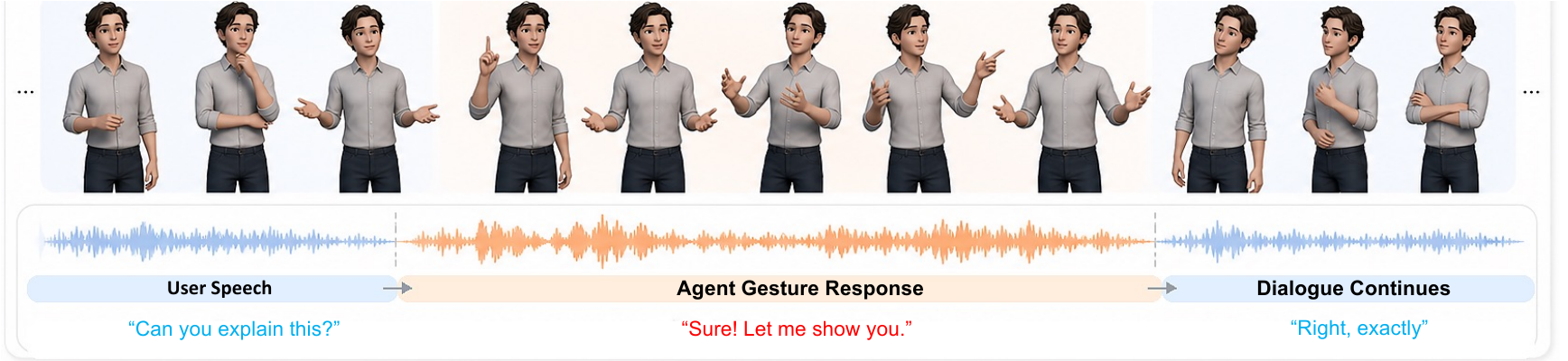
GestureFAR: Streaming Co-Speech Gesture Generation with Flow Autoregression
GestureFAR enables real-time co-speech gesture generation for embodied agents by autoregressing over continuous motion latents instead of discretized tokens, preserving natural gesture diversity while maintaining streaming causality. A novel flow-matching head combined with distillation achieves live-interaction performance without sacrificing gesture quality—a significant improvement over prior discrete token-based streaming methods.
Abstract
Generating natural co-speech gestures from streaming speech is essential for embodied conversational agents, where motion must be produced while a user is still speaking. Recent streaming gesture systems make online generation possible by autoregressing over discrete motion tokens, but this design compresses high-dimensional continuous motion into finite codebooks and can limit the realism and diversity of generated gestures. To preserve both causality and continuous expressiveness, we propose \textbf{GestureFAR}, a flow-autoregressive framework for streaming co-speech gesture generation. First, GestureFAR autoregresses over causal continuous motion latents, using a transformer to model streaming audio-motion context and a per-token flow-matching head to sample the next latent from a continuous distribution. Second, we introduce a head-only flow distillation strategy that freezes the causal backbone and distills the multi-step per-token flow head into a single network evaluation using consistency and distribution-matching objectives. This keeps the model token-causal while removing the main latency bottleneck for live interaction. Experiments on BEAT2 show that GestureFAR significantly improves the quality--latency trade-off among streaming-capable methods, preserving strong gesture quality while enabling real-time token-causal generation. Project Page: https://andypinxinliu.github.io/GestureFAR
Audio LLMs & On-Device Voice
Efficient models for the edge, and a paradigm shift from reactive to proactive listening.
Samsung Research's Samsone family pushes back against the industry's gravitational pull toward ever-larger multimodal networks. These compact audio language models are designed explicitly for real-time on-device inference — prioritizing privacy and low latency — and achieve state-of-the-art results within the small-model class through careful scaling and edge-deployment optimization. A timely reminder that not every use case belongs in the cloud.
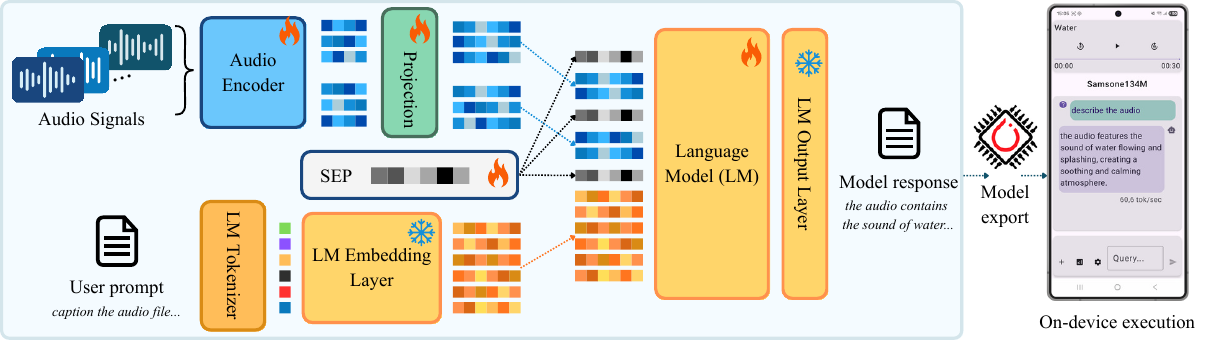
Samsone: A Family of Open Small Audio Language Models for On-Device Inference
Samsone introduces a family of compact audio language models designed for real-time on-device inference, achieving state-of-the-art performance within the small-model class while maintaining privacy and low latency. Unlike the industry trend toward massive multimodal networks, this work demonstrates that highly efficient audio models can be practical and competitive through careful scaling and optimization for edge deployment.
Abstract
The success of Large Audio Language Models has driven the development of massive multimodal networks exceeding billions of parameters. However, the demand for privacy-preserving, low-latency processing has shifted focus toward Small Audio Language Models (SALMs) capable of on-device execution. In this paper, we introduce Samsone, a family of SALMs designed for edge computing. Our core model, Samsone-134M, establishes a new state-of-the-art for its size class across multiple benchmarks. We further explore the scaling laws of SALMs by introducing Samsone-99M and Samsone-356M. Despite their compact footprint, the Samsone family delivers performance competitive with models orders of magnitude larger. To foster open research and reproducibility, we train Samsone on publicly available data. We release the training code, model weights, mobile-optimized checkpoints and provide an open-source Android application to demonstrate real-time on-device inference of Samsone.
Perhaps the most conceptually novel paper today comes from Meta AI. Rather than waiting to be queried, proactive AudioLLMs autonomously monitor a continuous audio stream and decide when to interrupt a user based on a single natural-language intent. The Interrupt and Silent Modeling (ISM) paradigm introduces special decoding tokens to handle onset detection, sustained relevance across time, and false-positive suppression — all with minimal added latency. The primary target is wearable accessibility applications, where the model acts as an always-on audio sentinel.
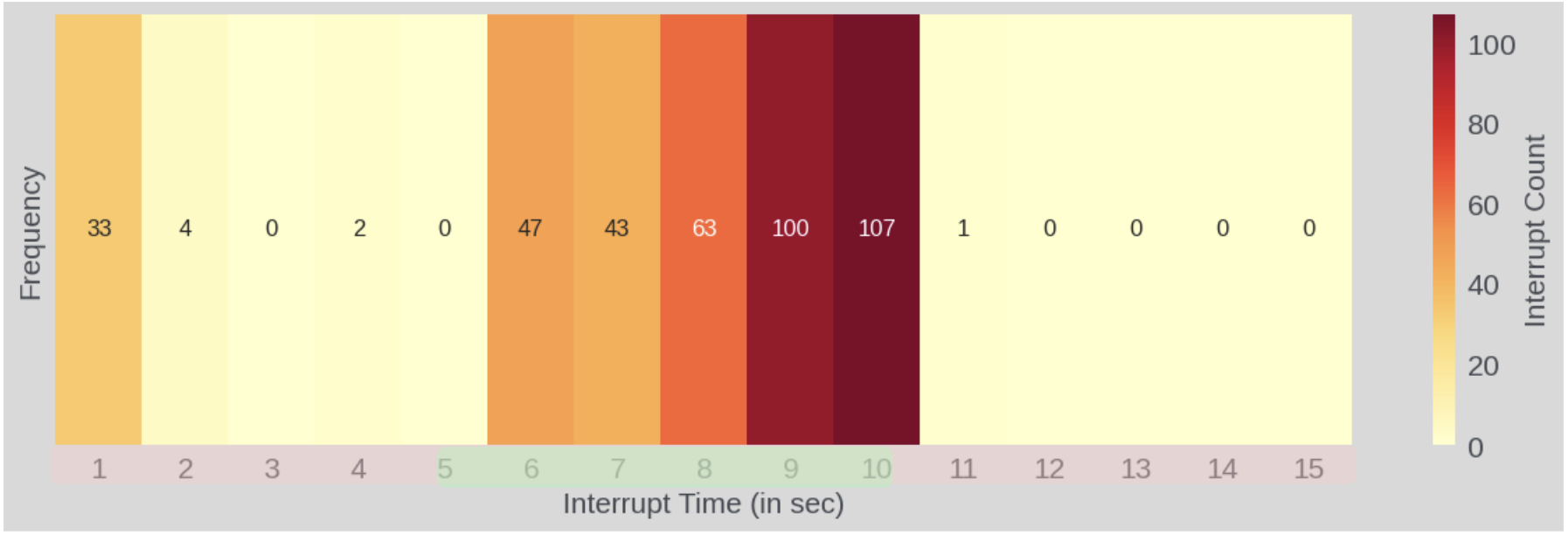
I'll Keep an Ear Out: Teaching AudioLLMs Proactive Audio Assistance
This paper shifts AudioLLMs from reactive to proactive operation, where models autonomously monitor audio streams and decide when to alert users based on a single natural-language intent—particularly valuable for wearable accessibility applications. The Interrupt and Silent Modeling (ISM) paradigm achieves this via special decoding tokens that handle onset detection, sustained relevance, and false-positive suppression with minimal latency.
Abstract
Audio large language models (AudioLLMs) operate reactively, responding only when queried. We introduce proactive audio assistance, where an AudioLLM monitors an audio stream and autonomously decides when to alert the user from a single natural-language intent, motivated by wearable applications for Deaf and Hard of Hearing users. We propose Interrupt and Silent Modeling (ISM), a model-agnostic paradigm that embeds proactive decisions into LLM decoding via two special tokens: \texttt{<interrupt>} and \texttt{<silent>}, capturing four states: onset detection, sustained-relevance triggering, irrelevance suppression, and de-duplication. Applied to Qwen2-Audio-7B, ISM achieves 99.6\% interrupt F1 and perfect de-duplication recall on ESC-50. On noisy Epic-Sounds kitchen audio, ISM achieves the highest interrupt F1 without domain-specific training, the only method maintaining strong onset detection without over-triggering or over-suppression. Streaming evaluation confirms real-time viability with 3.5-second average latency.
Trending on Hugging Face

Vidu S2: Real-Time Interactive, Editable, and Spatial Video Generation
Vidu S2 introduces real-time interactive avatar and video editing models that support high-resolution spatial video generation and dynamic reference updates.

Vidu S1: A Real-Time Interactive Video Generation Model
Vidu S1 is a real-time interactive video generation model that supports voice-controlled digital character animation with infinite-length output and high frame rate on consumer hardware.

Realtime-Venus: A full-duplex interaction system with asynchronous delegation
A proactive full-duplex system with separate audio-visual and audio models enables continuous perception, native speech generation, and asynchronous tool execution for real-time dialogue.

Qwen3-TTS Technical Report
The Qwen3-TTS series presents advanced multilingual text-to-speech models with voice cloning and controllable speech generation capabilities, utilizing dual-track LM architecture and specialized speech tokenizers for efficient streaming synthesis.

AuK Technical Report: An Open-Source Foundational Model for Speech Generation and Editing
AuK is an open-source foundational model that unifies speech generation and editing via natural-language instructions and audio context, using a multimodal language model, joint VAE, hybrid rectified-flow Transformer, and efficient distillation for fast inference.