
Real-Time Avatars, Reasoning TTS, and Voice Agent Benchmarks
Today's digest spans the full conversational AI stack: open real-time avatar systems, singing head synthesis datasets, relightable 3D faces, chain-of-thought and RL-refined TTS, speaker embedding geometry, and new benchmarks stress-testing long-context and multi-speaker voice agents.
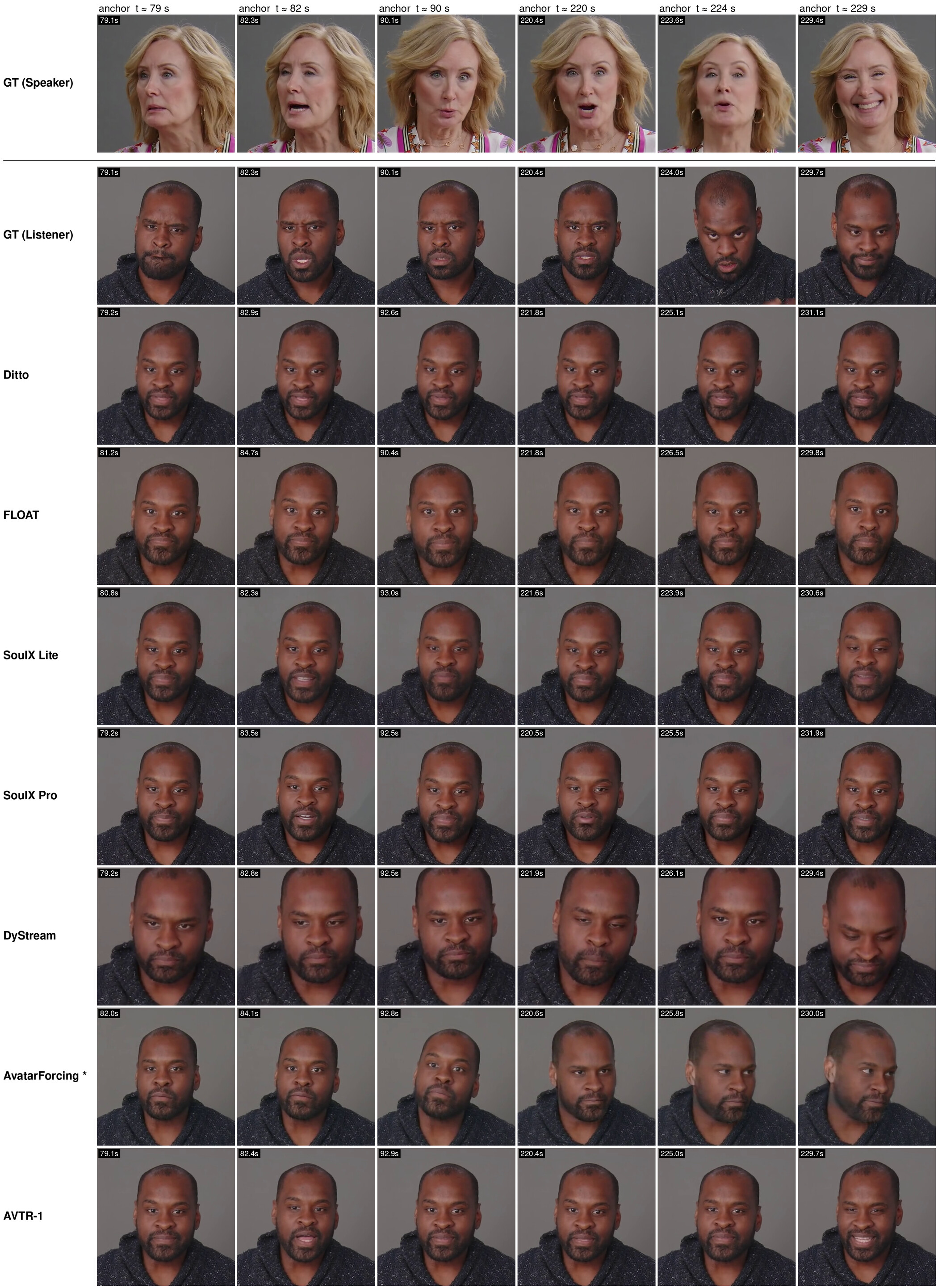
Qualitative comparison of reactive listening on the Seamless Interaction test set. The first two rows show the recorded speaker and listener, followed by frames generated for the listener by each evaluated system. Columns are anchored to the speaker times shown above the first row; inset labels report the selected timestamp for each video. From Yandex.
Today's papers cover an unusually wide range of the conversational AI pipeline — from the raw mechanics of real-time avatar playback and 3D face relighting, through chain-of-thought and RL-driven advances in speech synthesis, all the way to new benchmarks exposing the limits of spoken language models in long-context and multi-speaker scenarios. A strong day for anyone building or evaluating voice-first systems end-to-end.
Talking Avatars & Lip Sync
From open avatar stacks to the first dedicated dataset for singing heads — the talking-face field is pushing into new territory.
Real-time interactive avatar systems demand careful orchestration of audio, motion, and interruption handling — yet most research addresses only isolated components. Yandex's AVTR-1 takes on the full pipeline: a compact 153M-parameter flow-matching motion generator paired with streaming audio processing, synchronization scheduling, and graceful interruption recovery. Crucially, it also introduces R-DGG, a novel metric that measures whether a dialogue partner's speech actually improves a listener's motion generation — a question prior work left unanswered. The system is open-source, making it a practical foundation for anyone building dyadic avatar experiences.
AVTR-1: Open Stack for Real-Time Interactive Avatars
AVTR-1 is an open-source system stack for real-time interactive dyadic avatar conversations, combining a compact 153M-parameter flow-matching motion generator with streaming audio processing and synchronization scheduling. It uniquely addresses the full pipeline from synchronized audio-video playback to handling interruptions, and introduces R-DGG, a novel metric to measure whether a dialogue partner's speech actually improves listener motion generation.
Abstract
Talking-head and dyadic models now achieve real-time inference, yet fast motion generation alone does not produce an interactive conversation. A live system must synchronize the model's output with speech from an external voice agent, schedule video frames for playback, and handle interruptions. We introduce AVTR-1, an open stack for real-time interactive avatar conversations, built around a compact 153M-parameter autoregressive flow-matching motion generator conditioned on both participants' audio. We adapt its audio encoder for streaming through self-distillation. The stack turns the model's chunk-based generation into a continuous, synchronized audio-video stream driven by an external voice agent, and we analytically derive its contribution to the user-facing latencies and validate the resulting bounds with two commercial voice agents. Further experiments demonstrate that AVTR-1 leads the compared dyadic systems on all reported visual-quality metrics and most conventional listening-motion metrics while remaining competitive in lip synchronization. Its inference runtime operates in real time on data-center and consumer GPUs. However, conventional listening metrics do not establish whether the paired speaker's speech contributes to generated motion. We therefore introduce the Reference-Based Directed Granger Gain (R-DGG), which measures the additional predictive information carried by speaker speech after accounting for listener history and speaker motion. R-DGG finds statistically supported predictive dependence for recorded listeners and all evaluated dyadic systems, but not for talking-head generators without paired audio or mismatched speaker-listener pairs. We release the model weights, renderer, and serving backend under component-specific licenses.
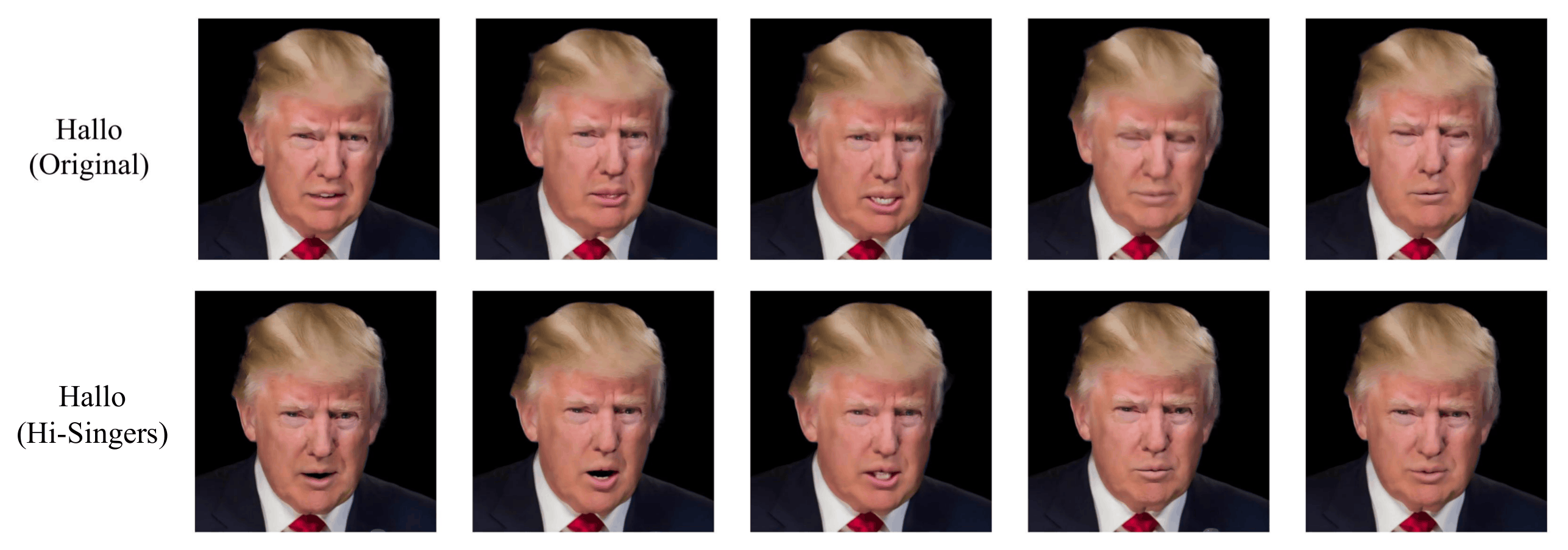
Audio-driven head synthesis models trained on speech data consistently suffer from rhythmic drift when applied to singing — misaligned lip motion, weak expression dynamics, and timing that drifts from musical rhythm. To close this domain gap, the University of Science and Technology of China introduces Hi-Singers, the first large-scale, high-quality dataset purpose-built for audio-driven singing-head synthesis. Rigorous automated and manual filtering pipelines underpin the dataset's quality, and models trained on it demonstrate superior lip-sync consistency, rhythmic accuracy, and vivid facial expressiveness compared to speech-only baselines.
Hi-Singers: A Comprehensive High-Quality Dataset for Expressive Audio-Driven Singing Head Synthesis
Hi-Singers is the first large-scale, high-quality dataset specifically designed for audio-driven singing-head synthesis, addressing the domain gap between speech and singing through rigorous automated and manual filtering. The dataset enables models to achieve superior lip-sync consistency, rhythmic dynamics, and vivid facial expressions—solving the "rhythmic drift" problem that plagues models trained only on speech data.
Abstract
State-of-the-art models for audio-driven digital human generation have achieved photo-realistic results in talking-head synthesis. However, extending these models to singing-head synthesis remains challenging due to a significant Domain Gap: singing requires more exaggerated expressions, vivid jaw openings, and precise rhythmic synchronization. Current models, primarily trained on speech datasets, often struggle with "rhythmic drift" and constrained dynamics. To address this, we introduce Hi-Singers, the first large-scale, high-quality, in-the-wild video dataset specifically tailored for singing head synthesis. Hi-Singers undergoes a rigorous automated and manual filtering pipeline, ensuring strict thematic adherence, high-resolution rendering, and stable motion, resulting in 29,608 video segments totaling approximately 170 hours. We further establish a dedicated evaluation benchmark balanced across linguistic and musical styles. Extensive experiments across diverse architectures, including 3D-coefficient and diffusion-based models, demonstrate that Hi-Singers consistently and significantly improves performance across all dimensions. Specifically, it enables models to achieve superior visual realism, enhanced lip-sync consistency, and more precise rhythmic dynamics, effectively bridging the domain gap and setting a new performance standard for the singing synthesis task. The dataset is available at https://huggingface.co/datasets/CharlesZhang-USTC/Hi-Singers
Digital Humans & 3D Face Avatars
Semantic-aware Gaussian splatting unlocks per-region motion and material modeling for realistic 3D head reconstruction.
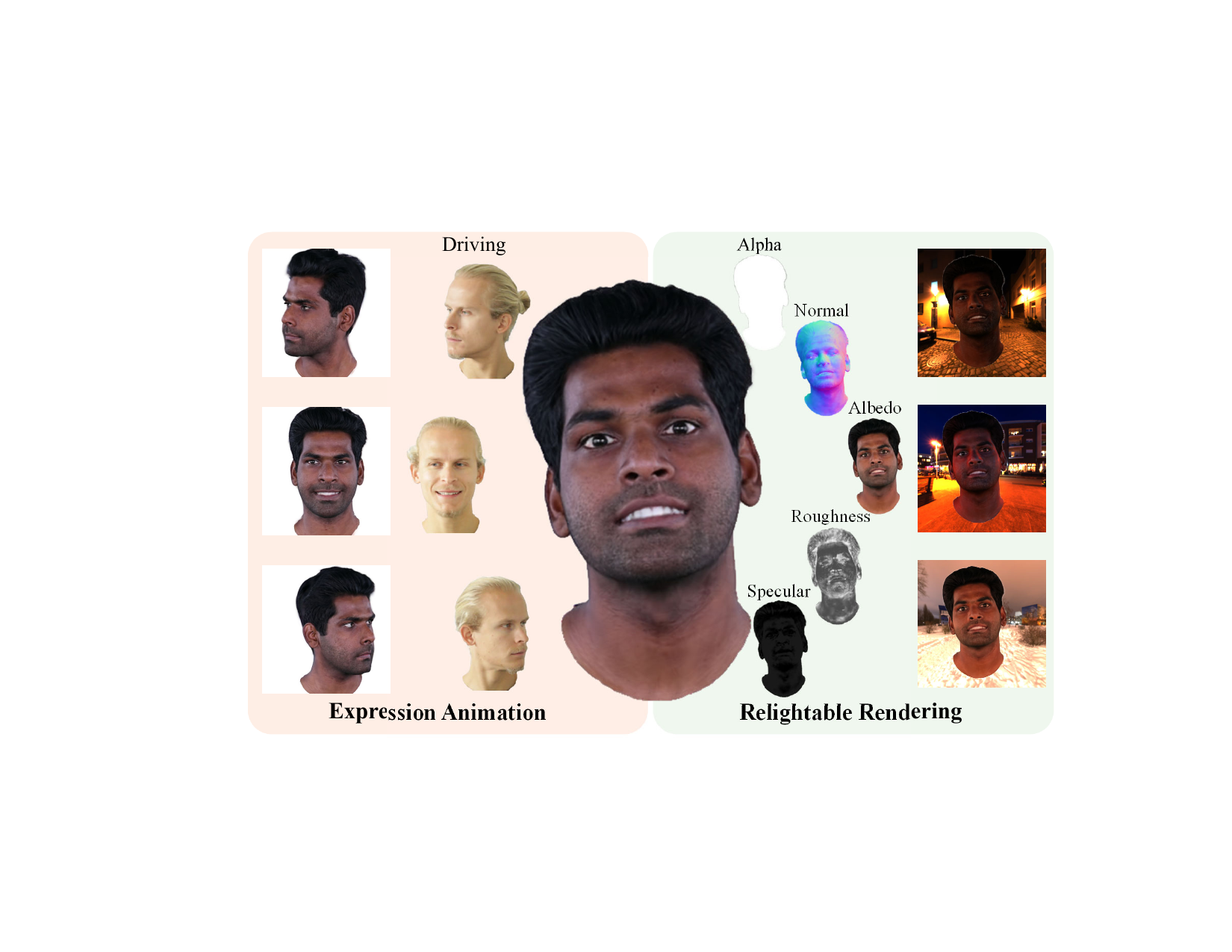
Reconstructing photorealistic, relightable 3D head avatars from casual monocular video is still an open challenge — especially at the fine-grained level of individual facial regions like eyes, mouth, and skin, which have very different material and motion properties. A team from the Institute of Automation, Chinese Academy of Sciences addresses this with a Gaussian-splatting-based framework that leverages facial semantics to assign distinct motion patterns and material properties per region. Unlike uniform-modeling approaches, their method captures fine-grained expression animation and supports realistic relighting under novel illumination conditions.
Relightable 3D Avatar Reconstruction with Semantic-Adaptive Motion-Illumination Responses
This paper presents a Gaussian-splatting-based framework for reconstructing relightable 3D head avatars from monocular video with adaptive motion and illumination responses. Unlike prior methods that apply uniform modeling across the face, it leverages facial semantics to allow different regions (eyes, mouth, skin) to have distinct motion patterns and material properties, enabling more accurate fine-grained expression animation and realistic relighting under novel lighting.
Abstract
Reconstructing expressive and relightable 3D head avatars from monocular videos remains challenging in computer vision, as it requires accurate modeling of both non-rigid facial motion and illumination-dependent appearance. Existing Gaussian avatar methods commonly rely on globally coupled representations, in which Gaussian primitives share a unified motion or illumination response model. Such uniform modeling neglects the distinct motion patterns and material/reflectance properties of different facial semantic regions, thereby limiting fine-grained animation accuracy and reducing relighting plausibility. To address this limitation, we propose SAMIRA, a 3D Gaussian avatar framework for semantic-adaptive motion-illumination response modeling. For motion response modeling, the Semantic-Adaptive Motion Response module rasterizes current-to-reference mesh displacements into a topology-consistent UV space and leverages facial semantics to route displacement features through semantic-specific modulators, predicting localized Gaussian geometric residuals beyond coarse mesh binding. For illumination response modeling, the Semantic-Adaptive Illumination Response module learns compact diffuse and specular response factors for each facial region, allowing Gaussians in different regions to adapt their illumination responses to novel environment lighting. These response factors are incorporated into deferred physically based shading, providing a lightweight approximation of semantic-dependent illumination effects. Extensive experiments on self-reenactment, cross-reenactment, and relighting demonstrate that SAMIRA improves both fine-grained expression reconstruction and relighting realism over existing methods.
TTS & Voice Synthesis
Chain-of-thought reasoning, RL-based self-critique, and hyperspherical geometry analysis push speech synthesis and voice conversion forward on three fronts.
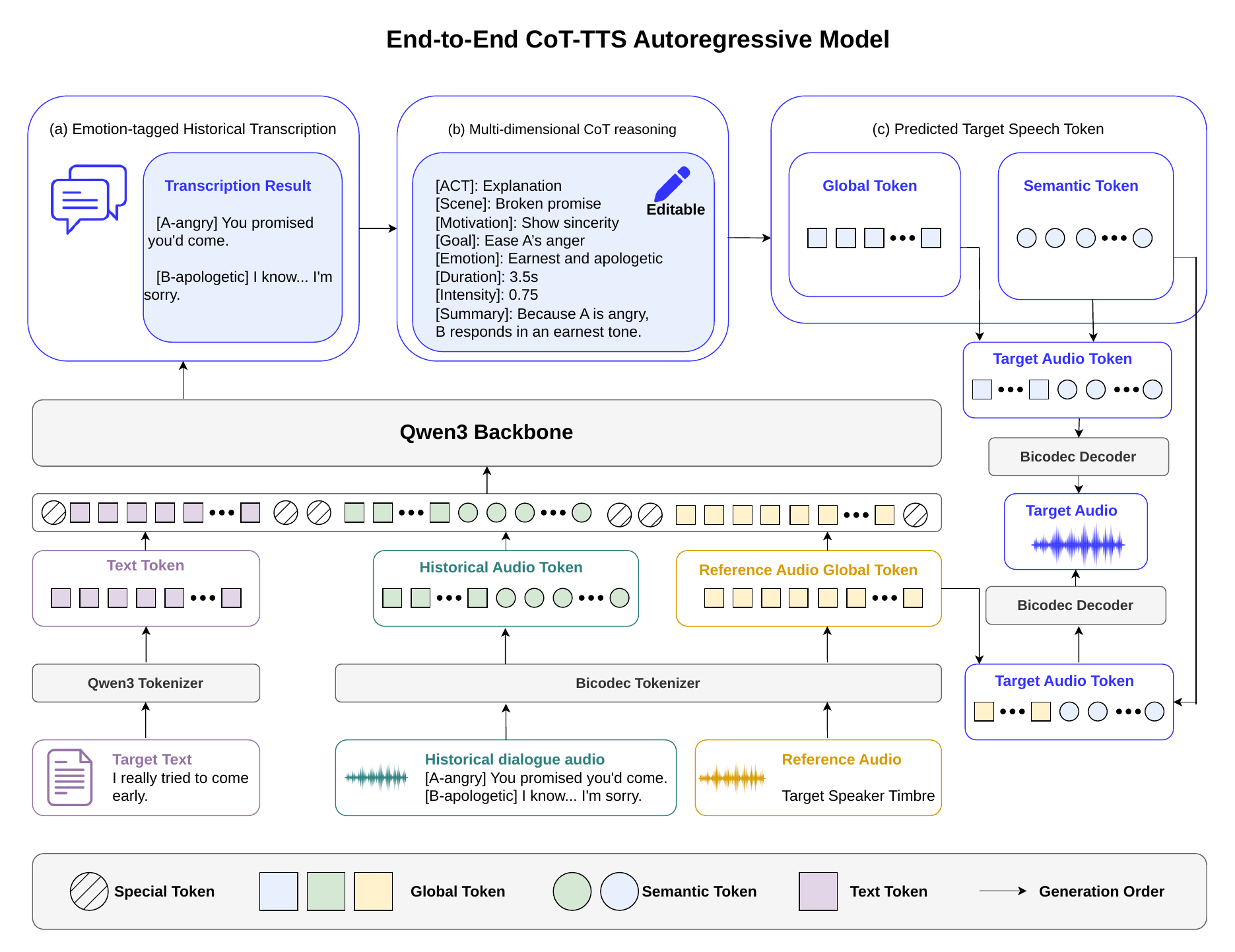
Conversational TTS has long relied on either manual style labels or reference audio to convey speaking style — neither of which scales naturally to open-ended dialogue. COT-TTS from HKUST sidesteps both by using explicit chain-of-thought reasoning over conversational history to infer the appropriate speaking style automatically. Built on end-to-end autoregressive models and a large-scale bilingual conversational dataset, it generates emotion-aware speech with prosodic variations that are grounded in — and consistent with — the preceding dialogue context, rather than user-specified instructions.
COT-TTS: Audio Context-Aware Text-to-Speech with Chain-of-Thought Reasoning
COT-TTS enables context-aware text-to-speech synthesis that naturally infers speaking style from conversational history through explicit chain-of-thought reasoning, rather than relying on user-specified instructions. The approach combines dialogue understanding with a large-scale bilingual conversational dataset and end-to-end autoregressive models that generate emotion-aware speech with natural prosodic variations grounded in conversational context.
Abstract
Recently, text-to-speech systems have made significant progress in speech expressiveness and controllability. However, the speaking style of generated speech typically relies on clear user-specified instructions. In natural conversations, speaking style should be naturally inferred from the preceding conversational context. Therefore, we propose COT-TTS, a context-aware, reasoning-based text-to-speech task. Given historical conversation audio, target text, and a reference speech, the system should comprehend the conversational context, infer an explicit intermediate reasoning, and finally synthesize the target speech with the specified timbre. To support this task, we constructed a large-scale bilingual conversational speech dataset comprising 9 million training samples, including a high-quality subset of 1 million samples. We further constructed a source-disjoint benchmark with 800 human-verified samples and established strong task-specific baselines. Additionally, we developed end-to-end autoregressive models with parameter sizes of 0.6B and 1.7B, generating emotion-labeled transcripts, editable speech style inferences, and speech tokens. Experimental results show that the proposed model achieves performance comparable to large-scale baseline systems with significantly fewer parameters. At the same time, the model performs well in terms of duration consistency and emotional consistency, and can generate appropriate emotional, stress, and rhythmic variations based on the conversational context. To facilitate future research, we will publicly release the data construction pipeline, dataset, trained models, and related resources. The demo page and additional resources are available at https://luckybian.github.io/COT-TTS
Single-pass generation struggles when instructions involve multiple interacting dimensions — pitch, speaking rate, and emotion simultaneously. National Taiwan University's Listen, Critique, and Refine framework tackles this by bringing reasoning-with-intermediate-thinking to the audio domain via reinforcement learning. The model generates a draft, produces a textual self-critique of its acoustic realization, then synthesizes a refined version conditioned on both the original instruction and the critique. This iterative loop unlocks control fidelity on complex multi-faceted instructions that single-pass audio LLMs cannot reliably achieve.
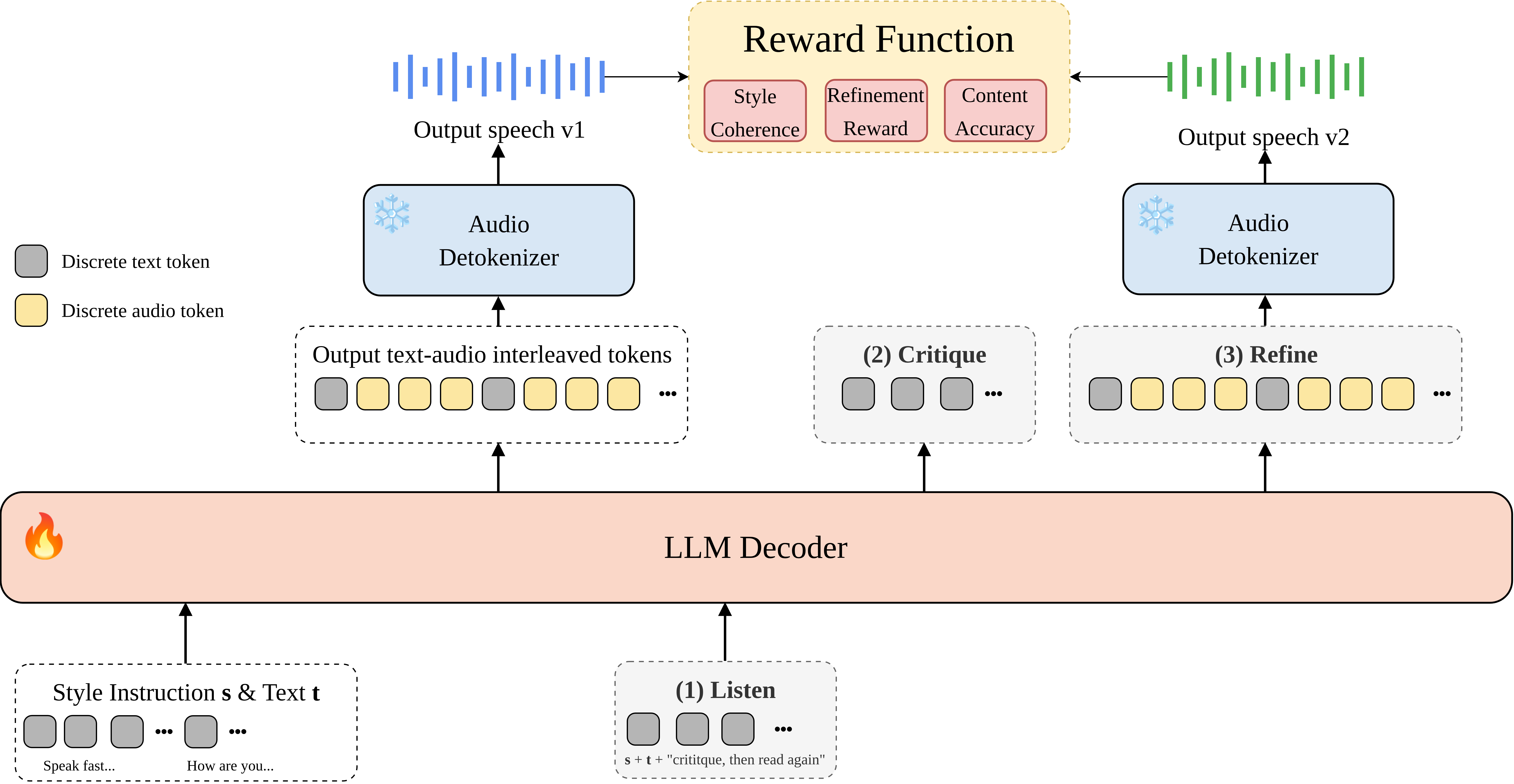
Listen, Critique, and Refine: RL-Based Self-Refinement for Instruction-Following Speech Synthesis
This paper extends reasoning-with-intermediate-thinking to the audio domain by training a large audio language model via reinforcement learning to self-critique and refine its own speech outputs. The model generates a draft, reflects on the acoustic realization in text, then produces a refined version conditioned on both—enabling better control over complex multi-faceted instructions like pitch, rate, and emotion that single-pass generation cannot achieve.
Abstract
Large Audio Language Models (LALMs) can follow diverse instructions to synthesize speech in specified styles. However, complex instructions that require simultaneous control over pitch dynamics, speaking rate, and emotional tone often exceed what a single-pass generation can faithfully realize. While recent reasoning models have shown that intermediate "thinking" tokens improve output quality, this paradigm has been confined to the text modality. In this work, we extend reasoning to the audio token space by training a LALM with reinforcement learning to reason over its own speech output. The model first generates a draft speech as a form of audio-token reasoning, critiques its own generation by reflecting on the acoustic realization in text, and then produces a refined version conditioned on both the first-pass speech and the critique, all within a single model. After RL training, the refined two-hop outputs achieve a relative improvement of 7.15\% on the InstructTTSEval benchmark, demonstrating the model's reflective ability.
Speaker embeddings are the backbone of zero-shot voice conversion, but how well do they actually cover the space of possible speakers? IRCAM investigates the hyperspherical geometry of ECAPA-TDNN embeddings, finding that standard training induces problematic angular concentration and effective dimensionality reduction on the unit hypersphere — meaning embeddings cluster rather than spread. Their proposed geometric regularization strategies push toward more uniform hyperspherical coverage, yielding gains in both speaker recognition and zero-shot voice conversion robustness, particularly for unseen speakers.
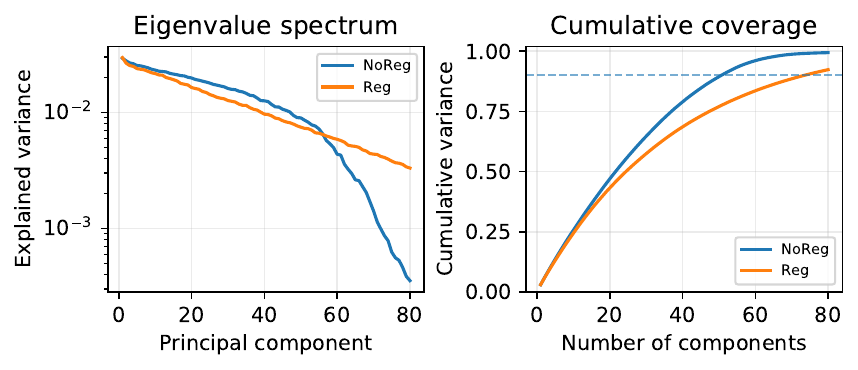
Understanding Hyperspherical Geometry of ECAPA-TDNN Embedding and Its Impact on Zero-Shot Voice Conversion
This work analyzes the hyperspherical geometry of speaker embeddings in ECAPA-TDNN models, revealing that standard training induces problematic angular concentration and dimensionality reduction. The authors propose geometric regularization strategies to encourage more uniform coverage on the unit hypersphere, improving both speaker recognition and robustness in zero-shot voice conversion—particularly for unseen speakers.
Abstract
Angular-margin speaker encoders are widely used in voice conversion, yet the geometry of their classifier prototypes remains poorly understood. We analyze ECAPA-TDNN classifier prototypes as points on the unit hypersphere and characterize their organization using rotation-invariant angular statistics together with global and local effective dimensionality measures. Our analysis shows that standard training can induce angular concentration and a substantial reduction in effective dimensionality. To address this, we investigate two geometric regularization strategies (hinged Riesz log-energy and effective-dimension maximization) applied to classifier prototypes to encourage more uniform hyperspherical coverage. The resulting prototype sets exhibit higher effective dimensionality and improved isotropy, with configuration-dependent effects on speaker-recognition performance. When the corresponding ECAPA-TDNN models are used as speaker encoders for Fast-VGAN, the regularized systems also exhibit improved robustness in zero-shot voice conversion, particularly for previously unseen speakers.
SpeechLLMs & Voice Agents
New benchmarks expose a recency bias in long-context spoken LMs and a speaker-scoping failure in multi-speaker voice agents.
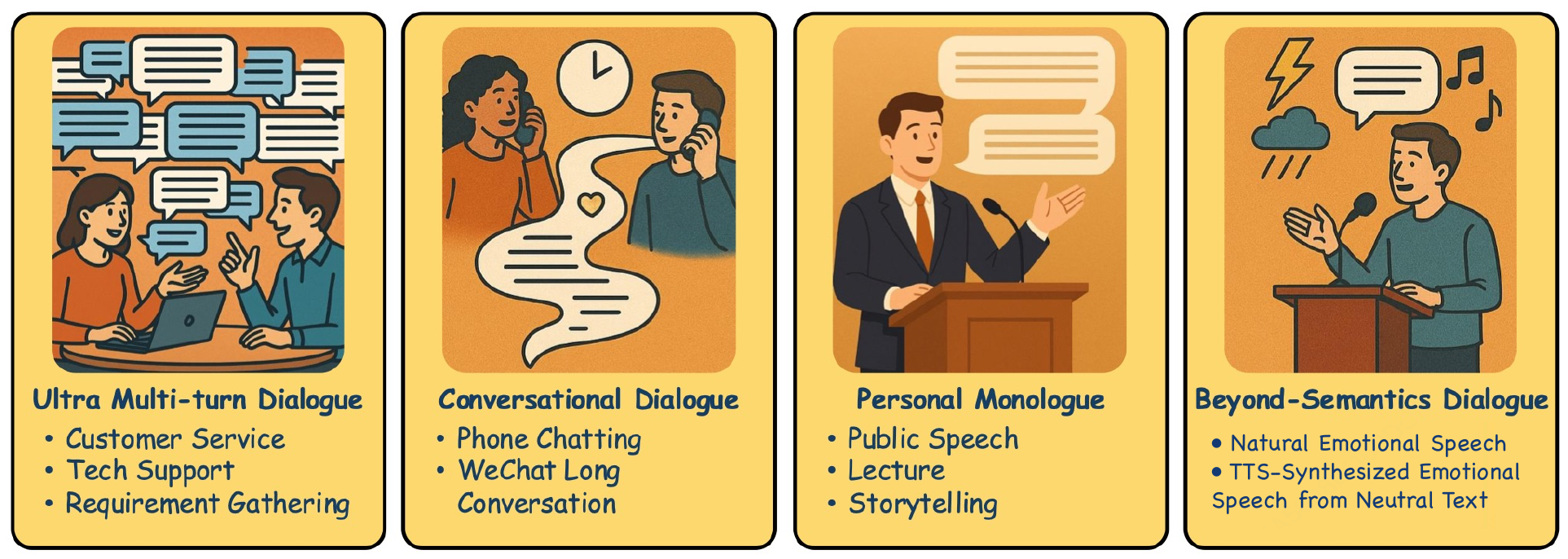
Text LLMs already exhibit a well-known recency bias in long contexts — but how severe is the problem for speech, where audio is far less information-dense than text tokens? Tsinghua University's Vox-Infinity is the first benchmark to systematically probe this, extending dialogue histories along both turn count and total duration and annotating each question with explicit answer-provenance labels. Evaluation across seven models confirms a pervasive recency effect: retrieval from distant dialogue history degrades sharply, and the challenge is measurably more severe in speech than in text LLMs — a direct consequence of audio's low-compression nature.
Vox-Infinity: Benchmarking the Limits of Long-Context Spoken Language Models
Vox-Infinity is the first benchmark to systematically evaluate long-context understanding in spoken language models, extending dialogue histories along turn count and duration with explicit answer-provenance annotations. Evaluation of seven models reveals a pervasive recency effect in speech—models struggle to retrieve information from distant dialogue history, a challenge more severe than in text LLMs due to audio's low-compression nature.
Abstract
Long-context understanding remains a fundamental challenge for large language models, as excessively long inputs often lead models to forget salient information. This issue is even more pronounced in the speech domain, where audio, as a low-compression modality, requires substantially more embeddings than text to preserve both semantic content and acoustic cues. To address this challenge, we introduce \textbf{Vox-Infinity}, the first benchmark specifically designed to evaluate long-context understanding in spoken language models. Vox-Infinity systematically extends audio history along two dimensions: turn count and turn duration. It covers a diverse range of representative scenarios with varying interaction structures and semantic complexity. Crucially, Vox-Infinity provides explicit answer-provenance annotations and organizes samples according to the amount of historical context required to resolve each query, enabling precise and length-aware evaluation. Extensive evaluations of seven representative spoken language models reveal a clear overall recency effect: models generally achieve higher accuracy when answer-supporting evidence is closer to the query, but struggle to retrieve and use evidence located farther back in the dialogue history. Cases and datasets are available at https://vox-infinity.github.io.
Most voice agent evaluations assume a single speaker; real deployments — meetings, households, collaborative work — involve multiple speakers with overlapping, sometimes conflicting instructions. MSI-Bench from Boson AI fills this gap by stress-testing agents across three capability families: memory, instruction following, and reasoning in multi-speaker scenarios. The results are revealing: open-weight models bottleneck on raw audio perception, while frontier systems fail at speaker-scoped decision-making — correctly attributing and acting on instructions from the right speaker at the right time — pointing to concrete, actionable targets for the next generation of conversational AI agents.

MSI-Bench: Evaluating Multi-Speaker Voice Interaction for Collaborative AI Agents
MSI-Bench evaluates voice agents in multi-speaker settings (meetings, households, collaborative work) across three capability families: memory, instruction following, and reasoning. The benchmark reveals that open-weight models bottleneck on audio perception while frontier systems fail at speaker-scoped decision-making, identifying concrete targets for improving conversational restraint and multi-speaker reasoning.
Abstract
Voice provides a natural and immediate interface for AI agents. Many settings in which voice agents could be useful, including meetings, households, and collaborative work, are inherently multi-speaker. Supporting these settings introduces challenges that are largely absent from one-on-one interaction. We introduce the Multi-Speaker Interaction Benchmark (MSI-Bench) for evaluating multi-speaker voice interaction. Each test case is a short multi-party multi-turn audio scene with participant context, expected tool calls, and atomic rubrics. The benchmark targets three capability families: multi-speaker memory, multi-speaker instruction following, and multi-speaker reasoning. It comprises 1,152 test cases, evenly split between Mandarin Chinese and English (576 each). The strongest configuration on each split passes all rubrics on only 66.8% of English and 54.5% of Mandarin cases, and the strongest open-weight configuration on 34.0% and 19.3%. Failure analysis separates perception from reasoning: open-weight models are bottlenecked by the multi-speaker audio front-end, while frontier systems still fail speaker-scoped decision making on clean transcripts---and models across the board often respond when no one has addressed them. These results identify speaker-grounded perception, speaker-scoped decision making, and conversational restraint as concrete targets for future voice agents.
Trending on Hugging Face

Vidu S2: Real-Time Interactive, Editable, and Spatial Video Generation
Vidu S2 introduces real-time interactive avatar and video editing models that support high-resolution spatial video generation and dynamic reference updates.

VoiceMem: Streaming Dual-Brain Memory for Real-Time Interaction
VoiceMem introduces a dual-brain streaming memory architecture for speech language models that improves retrieval accuracy, emotional personalization, and real-time efficiency.

Realtime-Venus: A full-duplex interaction system with asynchronous delegation
A proactive full-duplex system with separate audio-visual and audio models enables continuous perception, native speech generation, and asynchronous tool execution for real-time dialogue.

OmniFlatten: An End-to-end GPT Model for Seamless Voice Conversation
A novel GPT-based model, OmniFlatten, enables real-time natural full-duplex spoken dialogue through a multi-stage post-training technique that integrates speech and text without altering the original model's architecture.

AuK Technical Report: An Open-Source Foundational Model for Speech Generation and Editing
AuK is an open-source foundational model that unifies speech generation and editing via natural-language instructions and audio context, using a multimodal language model, joint VAE, hybrid rectified-flow Transformer, and efficient distillation for fast inference.