
Talking Avatars, Agentic Voice, and Smarter TTS Control
Today's digest covers unified human-centric video generation, lip-sync dubbing, full-duplex agentic voice assistants from Alibaba, spoken LLMs that reason aloud, and a trio of TTS advances spanning style adaptation, learnable CFG embeddings, and low-resource adaptation.
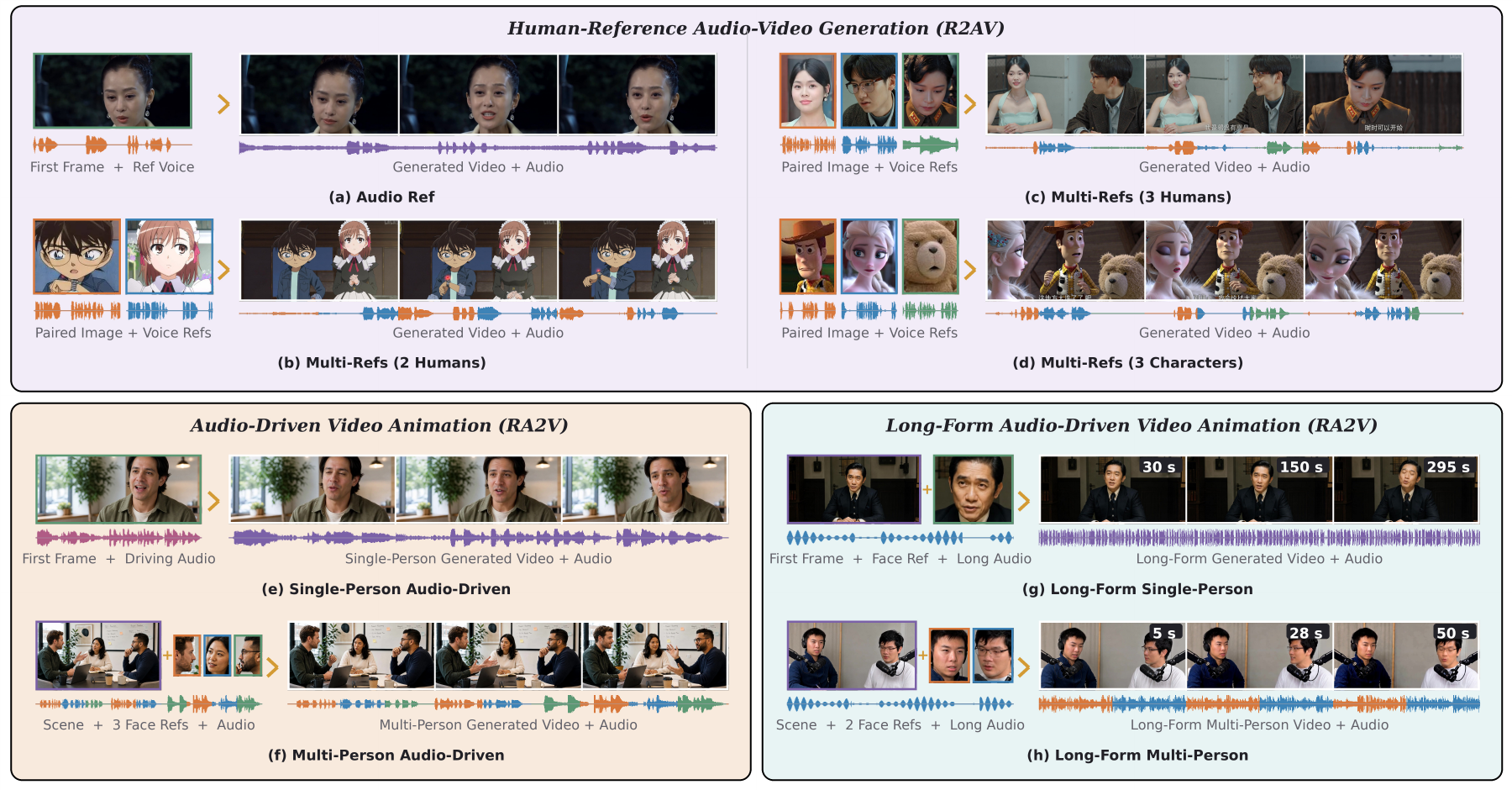
Overview of the unified human-centric audio--video generation capabilities of Vorch-Human. The examples cover single- and multi-person audio-driven animation, joint audio--video generation from appearance and voice references, multi-referenced generation, and long-horizon single- and multi-person audio driven animation. From Tsinghua University.
A strong day for the field: eight papers push the boundaries of human-centric video synthesis, real-time spoken agents, and expressive speech generation. Alibaba alone ships three papers spanning agentic voice architectures and TTS style control, while Tsinghua and Google tackle the hard problem of keeping faces and lips in sync over long-form video. Here's the full picture.
Talking Avatars & Lip-Sync Dubbing
From unified multi-task animation to voice-activity-guided dubbing — two papers rethink how we render and sync human speech on screen.
The proliferation of task-specific talking-head models has long been a pain point: one model for driving animation from speech, another for joint audio-video synthesis, yet another for multi-reference scenes. Vorch-Human from Tsinghua University collapses all three into a single dual-stream diffusion transformer, using task embeddings and condition masking to handle diverse inputs — driving speech, voice, appearance, pose — within one unified architecture. The long-horizon extension is particularly noteworthy: frozen-prefix recurrence feeds previously generated frames back as context, preserving identity and audio-visual synchronization across minutes-long outputs without fine-tuning.
Vorch-Human: Unified Multi-Task Human-Centric Generation via Long-Horizon Continuation
Vorch-Human unifies three human-centric generation tasks—speech-driven animation, joint audio-video synthesis, and multi-reference scene creation—into a single dual-stream diffusion transformer. Using task embeddings and condition masking, it handles diverse inputs (driving speech, voice, appearance, pose) within one model, and extends to long-form generation through frozen-prefix recurrence to preserve identity and synchronization over minutes-long videos.
Abstract
Human-centric audio-visual generation spans several closely related tasks: animating a person from driving speech, jointly generating speech and video from a voice reference, and synthesizing a scene from paired appearance and voice references. Existing systems commonly solve these tasks with separate models, even though they share the same target modalities and differ mainly in which observations are provided as conditions. We present Vorch-Human, a unified human-centric generation framework built on a dual-stream audio-video diffusion transformer. Vorch-Human augments the conventional noisy audio/noisy video interface with clean condition-audio and condition-video token groups. Per-token task embeddings, temporal position types, condition masks, and a shared multimodal prompt encoder allow driving speech, timbre examples, first frames, and subject images to be expressed within one model. To supply the supervision required by this interface, we develop a two-level data pipeline. Level 1 analyzes each clip with speech recognition, vocal separation, face detection and tracking, active-speaker and synchronization models, audio/visual speaker clustering, and multimodal caption correction; it produces subject-indexed speech, appearance, and timbre annotations. Level 2 links the same person across clips from a common source video and mines identity- and outfit-consistent reference images after face, body, quality, pose, and vision-language verification. Finally, we adapt Vorch-Human to long-form audio-driven generation by training with clean latent prefixes and using the same frozen-prefix recurrence at inference. Each segment contributes only its newly generated suffix, reducing boundary discontinuity and long-horizon identity drift. Experiments on short and five-minute generation demonstrate strong identity preservation, audio-visual synchronization, and temporal stability.
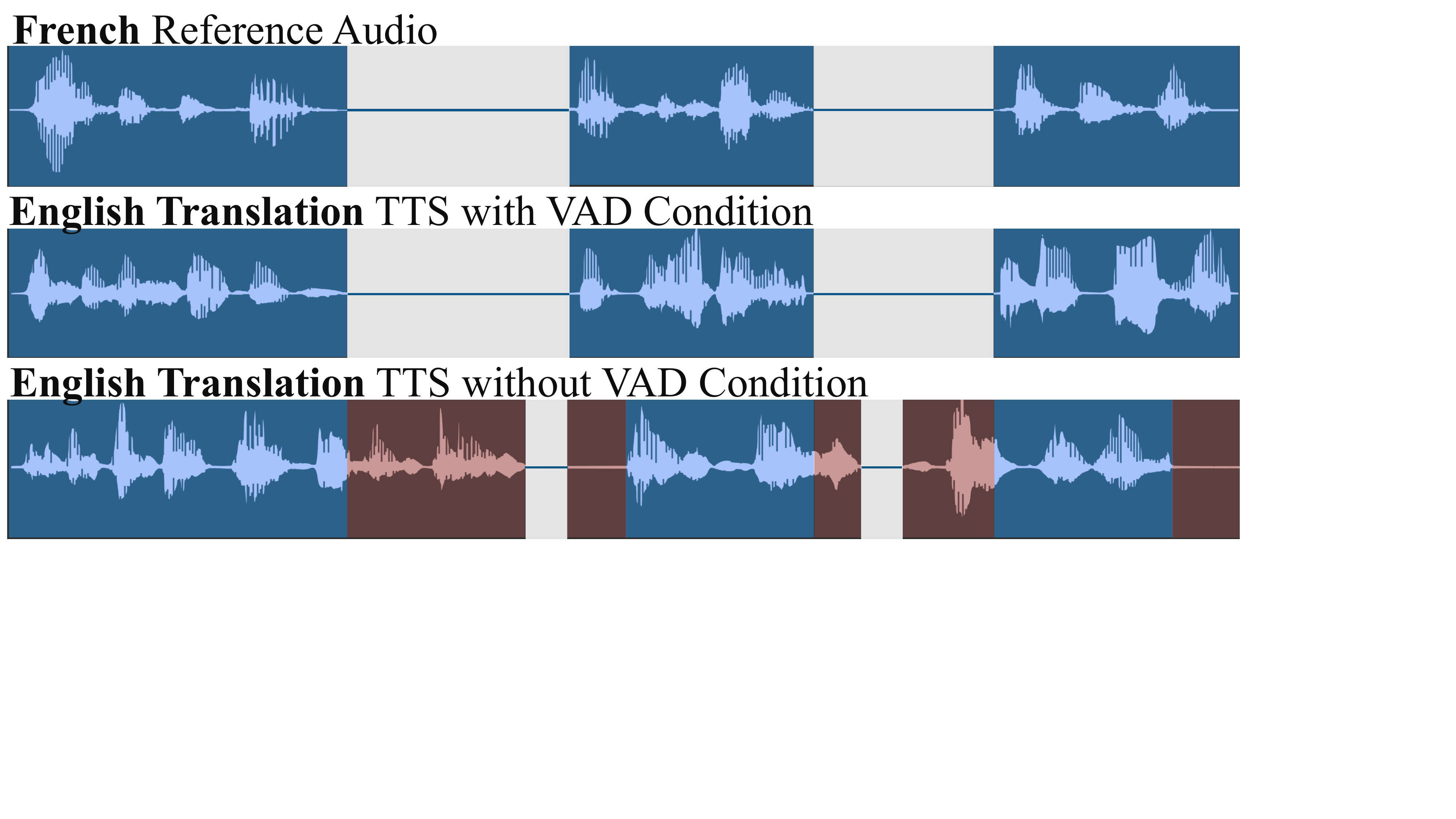
Dubbing is a different beast — you need synthesized speech to land precisely on pre-recorded lip movements, but heavy lip-feature conditioning tends to squeeze out natural prosody. Google's entry takes a disarmingly simple approach: instead of dense lip-movement features, the TTS model is conditioned on a binary voice-activity signal that encodes only when the speaker is talking. This is enough to enforce strict timing alignment while leaving the prosody model free to breathe. Crucially, the timing constraint is made optional through training-time masking, giving post-production editors a dial between strict sync and more natural-sounding delivery.
Not Quite My Tempo: Voice Activity-aware Speech Synthesis for Lip-Synchronous Dubbing
This work enables precise lip-synchronous dubbing by conditioning speech synthesis on a simple binary voice-activity signal rather than complex lip-movement features. The approach maintains natural prosody while enforcing strict timing alignment, and makes the timing constraint optional through training-time masking, giving editors flexibility over sync enforcement.
Abstract
Automatic lip-synchronous dubbing requires a speech synthesis model to generate alternating voice and silence patterns in the target language that match the timing of the source clip precisely to ensure an optimal viewing experience. Prior works address this problem by conditioning the speech synthesis process on lip movements extracted from the video signal. In this work, we condition the speech generation on a binary voice-activity signal, which has a lightweight representation and can be produced in multiple ways. We show that the model follows the voice-activity signal with high accuracy while maintaining natural prosody and semantically appropriate pause placement within sentences, as demonstrated through extensive objective and subjective evaluations. By randomly masking this condition during training, we make the feature entirely optional during inference, allowing editors to enforce or relax lip-sync constraints when desired.
SpeechLLMs & Spoken Dialogue Agents
Three papers tackle the hardest part of voice AI: staying useful, responsive, and coherent when the conversation never pauses.
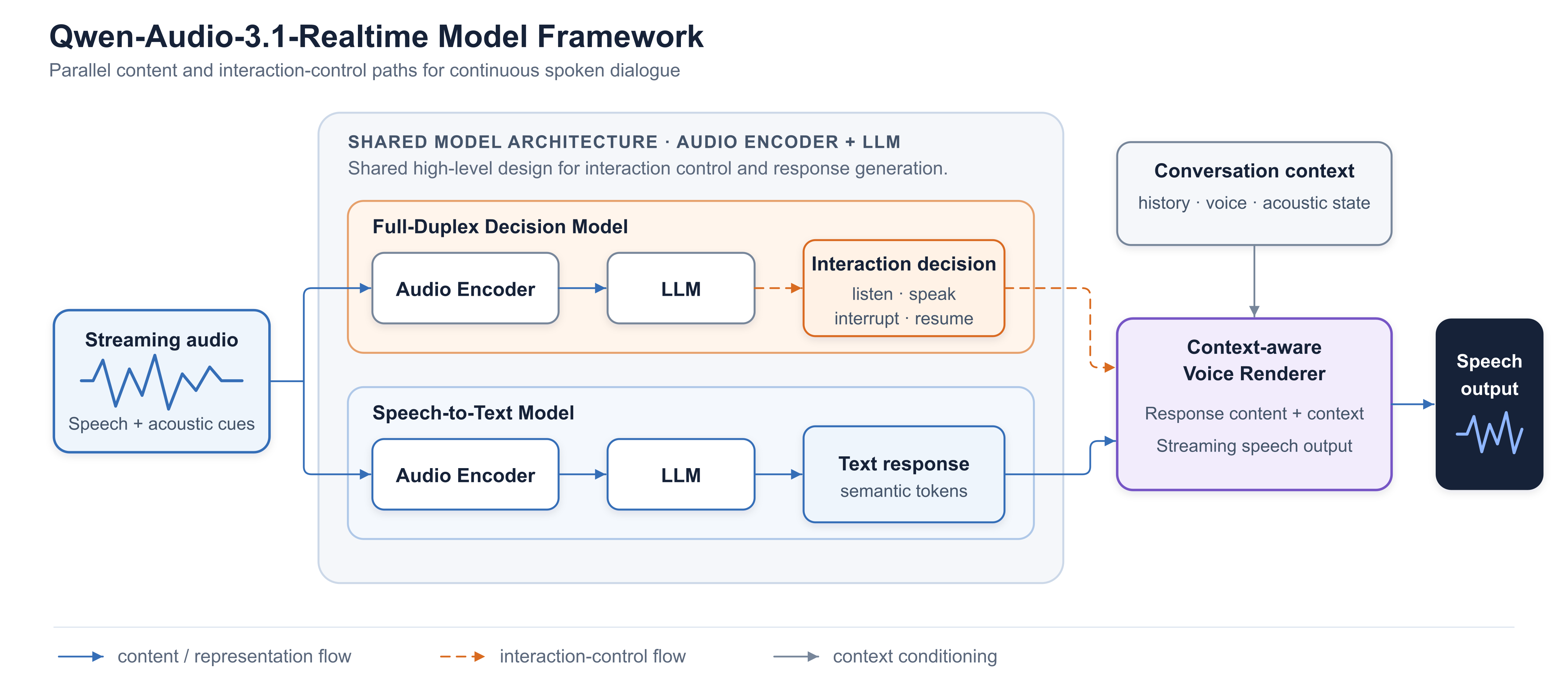
Alibaba's Qwen-Audio-3.1-Realtime positions itself squarely in the agentic voice space rather than the benchmark-chasing TTS/ASR space. It combines instruction tuning and multi-teacher distillation for reasoning with self-evolving reinforcement learning for tool execution, and wraps everything in a dual-stream architecture that handles full-duplex conversation alongside persistent background tasks — interruptions, tool coordination, and asynchronous execution included. The framing around reliability of agentic behavior rather than perceptual speech quality is a meaningful shift in how we should evaluate voice assistants.
Qwen-Audio-3.1-Realtime: Towards Reliable Agentic Voice Interaction
A real-time voice assistant that combines instruction tuning and multi-teacher distillation for reasoning with self-evolving reinforcement learning for tool execution, alongside a dual-stream architecture that manages full-duplex conversation and persistent background tasks. The work uniquely emphasizes reliable agentic behavior in spoken interaction—handling interruptions, tool coordination, and asynchronous task execution—rather than focusing solely on speech recognition or synthesis quality.
Abstract
Real-time voice assistants must reason over evolving requests, execute actions, and follow conversational rules. Qwen-Audio-3.1-Realtime brings these requirements together through Think, Act, and Speak and Coordinate. Think combines Core-Cocktail supervised fine-tuning with Multimodality and Multi-Teacher On-Policy Distillation (M$^{2}$-OPD) to transfer language capabilities and develop native audio skills. Act uses self-evolving executable environments and multi-granularity rollouts for Group Relative Policy Optimization (GRPO), teaching the model to use tools, interpret feedback, and complete tasks. Speak and Coordinate aligns how, when, and whether the assistant speaks or acts. We evaluate audio reasoning, multilingual understanding, tool use, conversational behavior, full-duplex interaction, and safety. Compared with Qwen-Audio-3.0-Realtime, 3.1 raises overall task success from 78.4% to 82.0% on our half-duplex speech-to-text adaptation of $τ$-Voice. On speech-to-speech Full-Duplex-Bench v1.5, the response rate to background speech falls from 73.0% to 13.0%. We also present a separate Voice Harness prototype, using Qwen-Audio-3.0-Realtime as its foreground, that extends spoken interaction to persistent tasks through foreground--background coordination and memory.
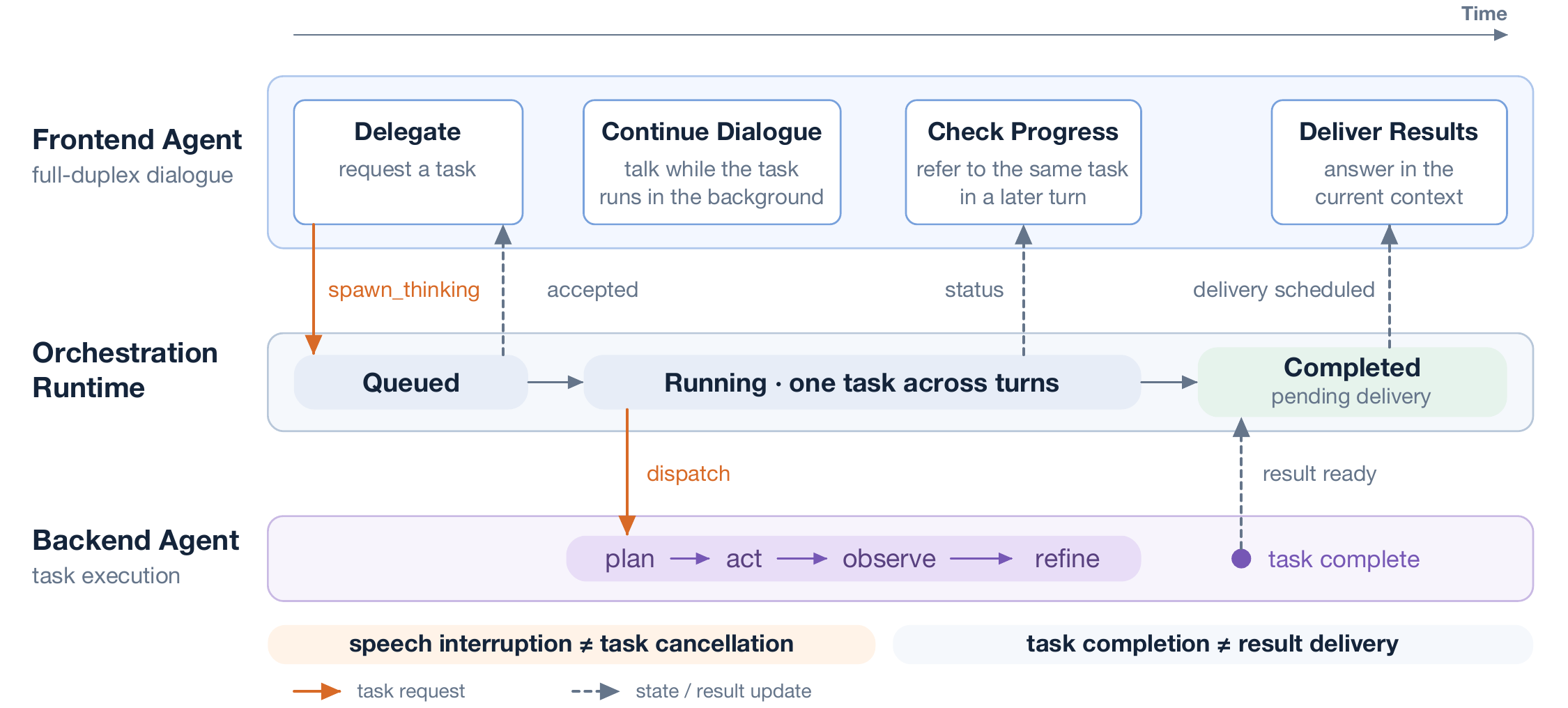
The companion Qwen-Audio-Agent Technical Report from Alibaba zooms in on the architectural decision that makes reliable full-duplex voice agents possible: a foreground-background split where a Frontend Agent manages live conversation and selectively delegates to a Backend Agent via an Orchestration Runtime for async execution. The mixed-mode strategy — keeping dialogue flowing while background tasks complete — outperforms both purely direct and purely delegated approaches on latency and task success, a result that has immediate practical implications for voice assistant design.
Qwen-Audio-Agent Technical Report
Qwen-Audio-Agent implements a foreground-background architecture for full-duplex voice interaction where a Frontend Agent manages conversation and selectively delegates tasks to a Backend Agent, while an Orchestration Runtime enables asynchronous execution. This mixed-mode strategy—allowing dialogue to continue during task completion—outperforms pure direct or delegated approaches on latency and task success.
Abstract
We present Qwen-Audio-Agent, a harness that combines full-duplex voice interaction with asynchronous task execution through a foreground-background architecture. A Frontend Agent manages dialogue and selects between direct tool use and delegation, while a Backend Agent carries out delegated tasks in a separate context. An Orchestration Runtime maintains task state, coordinates requests for user input and authorization, and schedules the return of results to the conversation. The runtime separates speech interruption from task cancellation and execution completion from result delivery, allowing conversation to continue while delegated work proceeds. Environmental events and persistent memory provide context within and across sessions. Independent adapters support integration with different frontend models, backend agents, and clients. We instantiate the architecture in desktop assistance, intelligent cockpits, and voice customer service. On an in-house cockpit benchmark of 134 cases, mixed execution achieves a task success rate of 91.04%, compared with 72.39% and 80.60% for the direct and all delegated configurations, respectively. In a separate latency evaluation on matched successful turns, mixed execution reduces mean task execution latency by 26.73% and 30.91% relative to these baselines, respectively. These results support the complementary use of direct tool calls for immediate operations and backend delegation for multi-step tasks.
Thinking takes time, and silence is awkward. NUS's paper on Spoken Language Models that Think Aloud directly confronts the latency problem in reasoning-capable spoken LLMs: rather than forcing the model to reason silently and then speak, the asynchronous Thinker-Talker architecture generates short spoken progress utterances in parallel with internal chain-of-thought. The dynamic balancing between reasoning depth and spoken updates substantially reduces user-perceived latency without sacrificing answer accuracy — a practically important result as chain-of-thought becomes standard in voice-facing models.

Spoken Language Models that Think Aloud
This work enables spoken language models to generate reasoning-aligned progress utterances in parallel with internal reasoning, rather than forcing silent thinking followed by speech. The asynchronous Thinker-Talker architecture dynamically balances reasoning with short spoken updates, substantially reducing user-perceived latency while maintaining answer accuracy.
Abstract
While Chain-of-Thought (CoT) reasoning has improved the capability of language models, directly applying it to Spoken Language Models (SLMs) may introduce long silent intervals under the serial "think-then-speak" paradigm, disrupting real-time spoken interaction. To address this issue, we propose an asynchronous think-aloud framework for reasoning-based SLMs within the Thinker-Talker architecture. The framework maintains a primary reasoning stream for logical deduction and a lightweight think-aloud stream that generates short, task-grounded progress utterances conditioned on the user input and the evolving reasoning state. A dynamic balance strategy coordinates the two streams at runtime, triggering additional think-aloud speech to avoid silent gaps and canceling pending utterances when the final response becomes ready. Experiments on spoken reasoning and question-answering benchmarks show that our approach substantially reduces user-audible silence during reasoning while maintaining answer accuracy comparable to that of a serial "think-then-speak" baseline, demonstrating the potential of asynchronous think-aloud for responsive interaction in SLMs.
TTS & Voice Synthesis
Expressive style adaptation, smarter classifier-free guidance, and trust-aware low-resource training — three complementary advances in controllable speech synthesis.
Context-aware TTS in multi-turn dialogue is harder than it looks: implicit end-to-end mappings from dialogue history to speaking style tend to suffer from timbre drift and poor instruction-following. Alibaba's Interactive TTS decouples the problem by explicitly modeling contextual style decisions as learnable style instructions, then using specialized fine-tuning to translate those instructions into synthesized speech. The decoupled design cleanly sidesteps the timbre-drift failure mode and gives the system a composable handle on style dynamics across conversation turns.
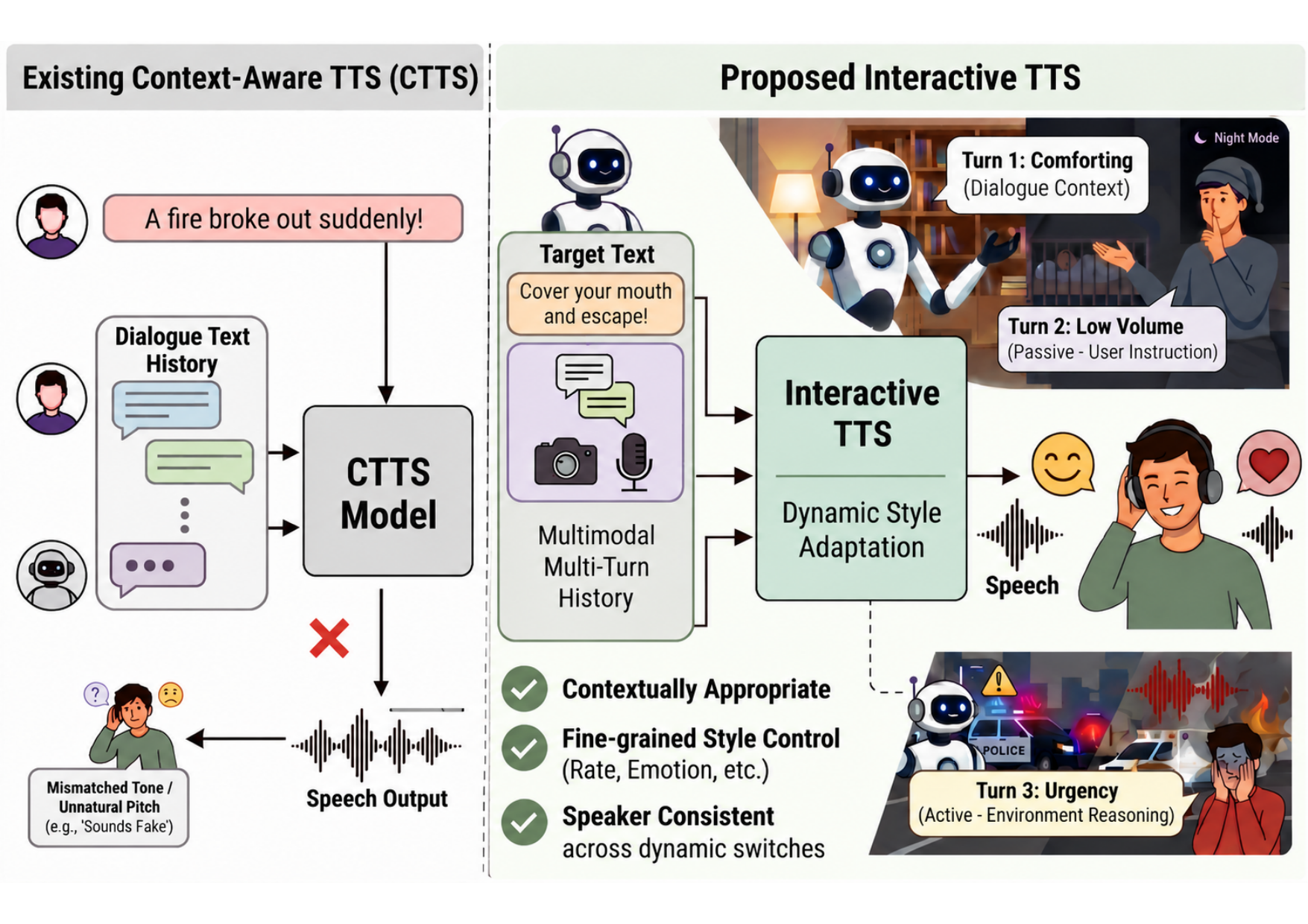
Interactive TTS: Dynamic Speaking Style Adaptation for Expressive Speech Synthesis
Interactive TTS adapts speaking style dynamically in multi-turn conversations by explicitly modeling contextual style decisions as learnable instructions, rather than implicitly mapping context end-to-end. This decoupled approach, combined with specialized fine-tuning methods, overcomes instruction-following challenges and timbre drift that plague existing context-aware TTS systems.
Abstract
Dynamic speaking style adaptation in multi-turn multimodal interaction remains a major challenge for text-to-speech (TTS) systems. Existing context-aware TTS (CTTS) methods typically map dialogue context to speech in an end-to-end manner. Such implicit modeling makes contextual style decisions difficult to supervise, while the entanglement of style, timbre, and content often leads to weak instruction-following and severe timbre drift across turns. To overcome these limitations, we propose Interactive TTS, a dynamic, style-adaptive framework for contextually appropriate and speaker-consistent speech generation. Interactive TTS decouples the process by explicitly modeling contextual style decisions as executable instructions. To bridge the gap between style decisions and speech generation, we introduce Iterative Rejection Sampling Fine-Tuning (Iterative RSFT) and Context-Aware Direct Preference Optimization (CADPO), which significantly enhance instruction-following and align the generated speech with conversational contexts. Extensive experiments demonstrate that Interactive TTS outperforms state-of-the-art models on VStyle and SpeechParaling-Bench. Demo is available at https://wjtian-wonderful.github.io/InteractiveTTS/
Classifier-free guidance is ubiquitous in diffusion-based TTS, but the fixed null (unconditional) embedding is an underexplored lever. Coqui AI's paper swaps those fixed vectors for learnable unconditional embeddings — one per conditioning modality (speaker identity and text) — letting the model independently tune the quality-similarity and stability-expressiveness trade-offs at inference time. The result is cleaner fine-grained control without any architectural overhaul, making this a practical drop-in improvement for existing CFG-based TTS systems.
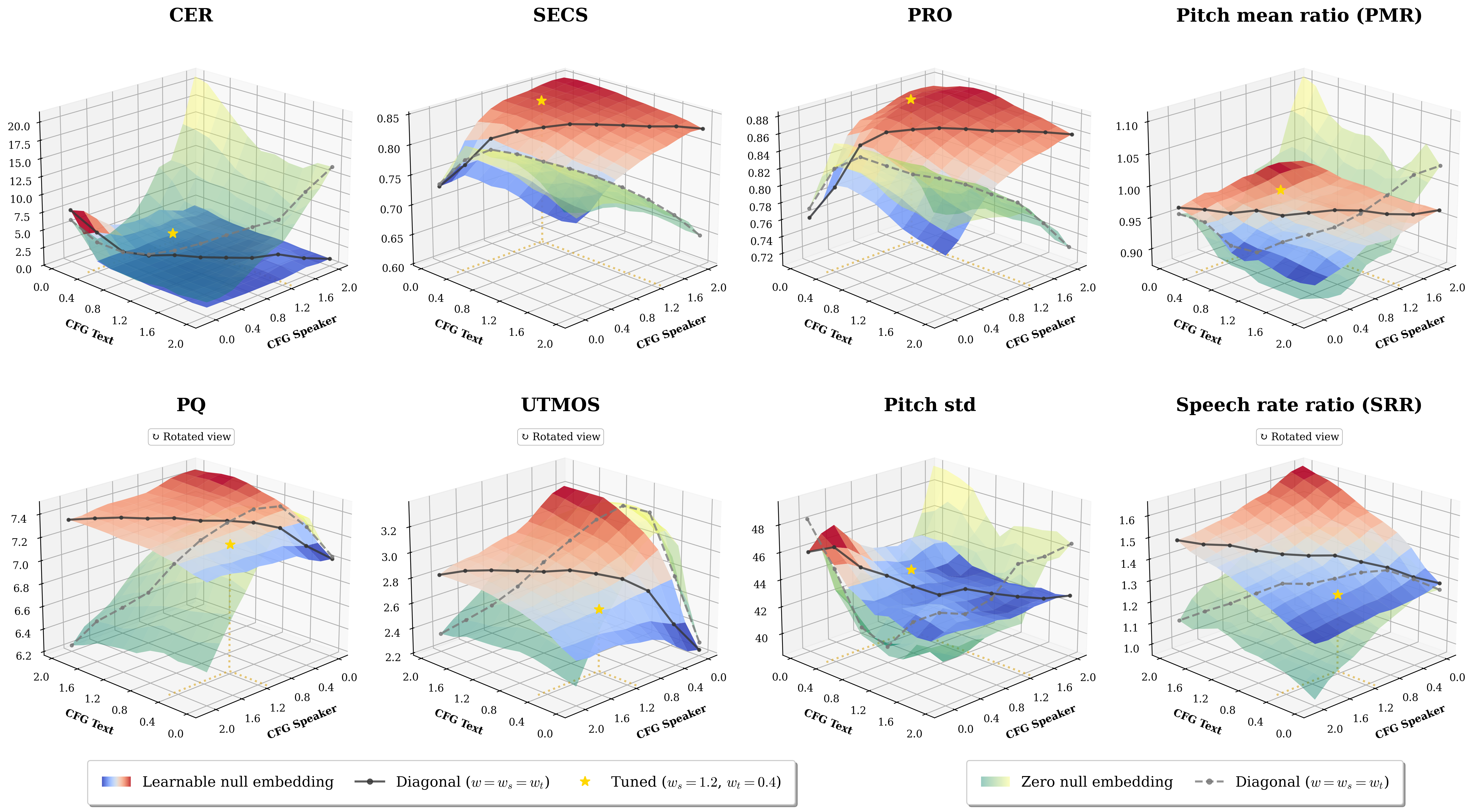
Learnable Classifier-Free Guidance Null Embeddings for Enhanced Controllable Speech Synthesis
This work replaces fixed null vectors in classifier-free guidance with learnable unconditional embeddings for text-to-speech synthesis, improving generation quality across speaker similarity and expressiveness. A key innovation is learning distinct embeddings per conditioning modality (speaker and text), enabling fine-grained control over the quality-similarity and stability-expressiveness trade-offs in synthesized speech.
Abstract
Classifier-free Guidance (CFG) is widely adopted in text-to-speech (TTS) systems to enhance generation quality and conditioning fidelity by interpolating between conditioned and unconditioned predictions. A common unconditional technique is to use an empty representation, in the form of a fixed null vector. In this work, we propose replacing this representation with a learnable unconditional embedding, optimized to represent a meaningful unconditional state. Objective and subjective evaluations demonstrate that learnable null embeddings consistently outperform fixed null embeddings across speaker similarity, speech stability, and expressiveness, while exhibiting greater robustness to larger guidance scales. We further show that learning a distinct unconditional embedding for each of the TTS conditioning modalities allows fine-grained control over speaker and text guidance, showcasing the trade-off between similarity and quality, and stability and expressiveness in the generated speech.
Low-resource TTS has always been hampered by noisy ASR pseudo-labels on real speech. Alibaba DAMO Academy's trust-aware progressive adaptation approach addresses this with a two-stage curriculum: first establish robust text-speech correspondences using clean synthetic data, then introduce real speech weighted by transcript-agreement reliability scores that filter out unreliable pseudo-labels. The ordered supervision recovers speaker diversity and natural prosody from real data while maintaining the pronunciation accuracy anchored in the synthetic stage — a principled solution to a genuinely messy practical problem.
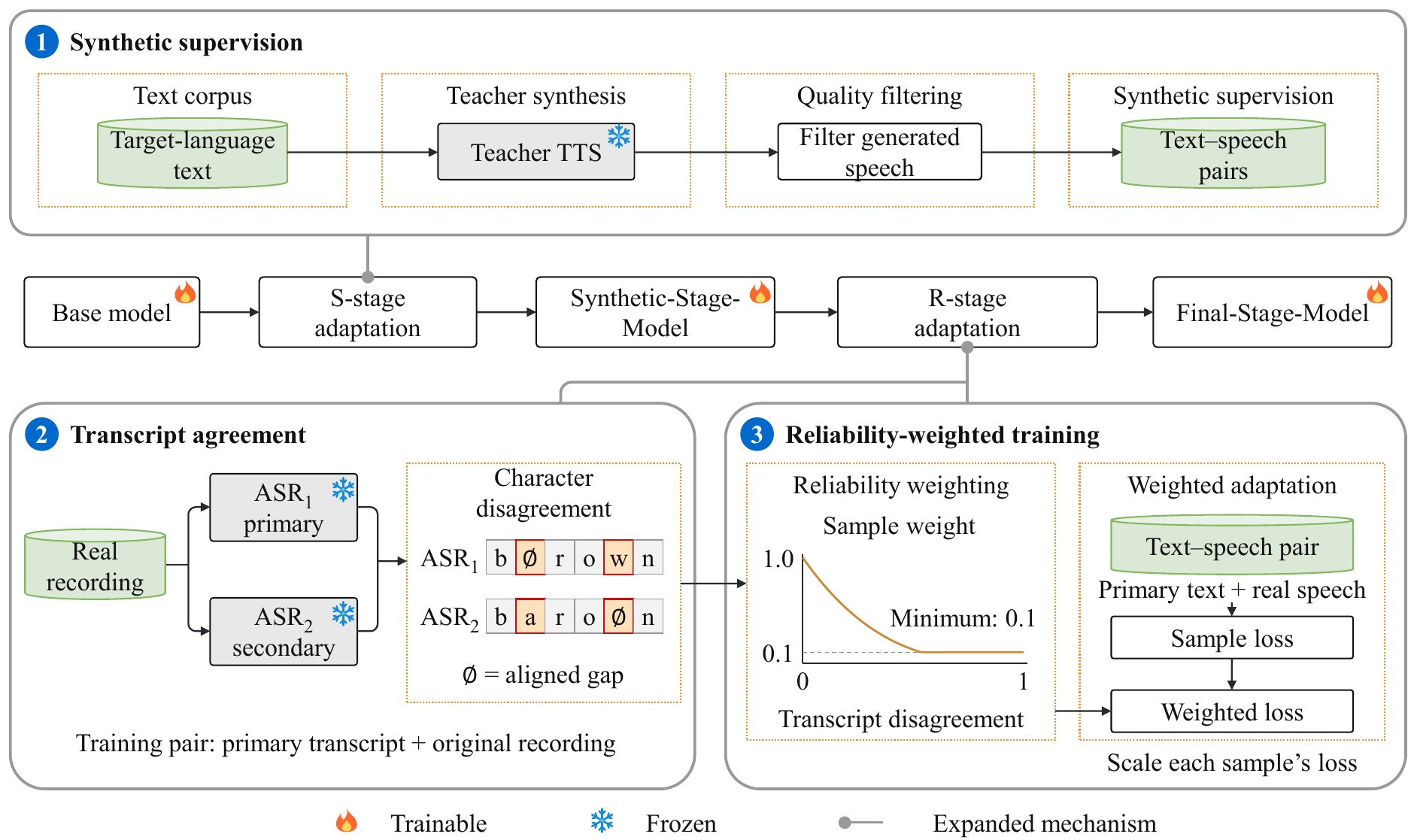
From Reliable Text to Real Voices: Trust-Aware Progressive Adaptation for Low-Resource TTS
This paper addresses low-resource TTS by progressively adapting from synthetic to real speech, where transcript-agreement weighting filters noisy ASR pseudo-labels to recover speaker diversity and natural prosody while maintaining pronunciation accuracy. The key innovation is supervising in a deliberate order—establishing text-speech correspondences first with synthetic data, then restoring speaker control with reliability-weighted real speech.
Abstract
Low-resource text-to-speech (TTS) adaptation is constrained by scarce paired data and costly manual transcription. Existing fixed-voice TTS systems can provide relatively accurate pronunciation, but their synthetic speech offers limited speaker diversity and may exhibit flat prosody. Real recordings provide natural prosody and diverse voices, yet their automatic speech recognition (ASR) pseudo-labels may contain transcription errors. We find that supervision order affects content accuracy and speaker similarity. We propose trust-aware progressive adaptation: synthetic-to-real adaptation first establishes text-speech correspondences, then restores reference-speaker control using real speech. Transcript-agreement weighting uses agreement between two fixed ASR systems as a proxy for pseudo-label reliability to limit noisy supervision. Experiments with FireRedTTS3 on Burmese and Lao and OmniVoice on Burmese show improved content accuracy with high naturalness and competitive speaker similarity. Jointly considering supervision order and pseudo-label reliability when combining synthetic and real speech offers a practical path to zero-shot voice cloning in low-resource languages with less manual transcription. Audio demos are available at https://insiderx-pro.github.io/S2R-Adaptation-TTS/
Trending on Hugging Face

VoiceMem: Streaming Dual-Brain Memory for Real-Time Interaction
VoiceMem introduces a dual-brain streaming memory architecture for speech language models that improves retrieval accuracy, emotional personalization, and real-time efficiency.

Realtime-Venus: A full-duplex interaction system with asynchronous delegation
A proactive full-duplex system with separate audio-visual and audio models enables continuous perception, native speech generation, and asynchronous tool execution for real-time dialogue.

OmniFlatten: An End-to-end GPT Model for Seamless Voice Conversation
A novel GPT-based model, OmniFlatten, enables real-time natural full-duplex spoken dialogue through a multi-stage post-training technique that integrates speech and text without altering the original model's architecture.

AuK Technical Report: An Open-Source Foundational Model for Speech Generation and Editing
AuK is an open-source foundational model that unifies speech generation and editing via natural-language instructions and audio context, using a multimodal language model, joint VAE, hybrid rectified-flow Transformer, and efficient distillation for fast inference.

Vidu S2: Real-Time Interactive, Editable, and Spatial Video Generation
Vidu S2 introduces real-time interactive avatar and video editing models that support high-resolution spatial video generation and dynamic reference updates.