
RL for Expressive TTS, Speaker Unlearning, and Smarter Dialogue Evaluation
Today's digest covers reinforcement learning for prosodic emphasis in TTS, a speaker unlearning framework for voice cloning privacy, one-step voice conversion via flow matching, adversarial robustness for full-duplex dialogue agents, and a rethinking of turn-taking evaluation grounded in speaker intent.
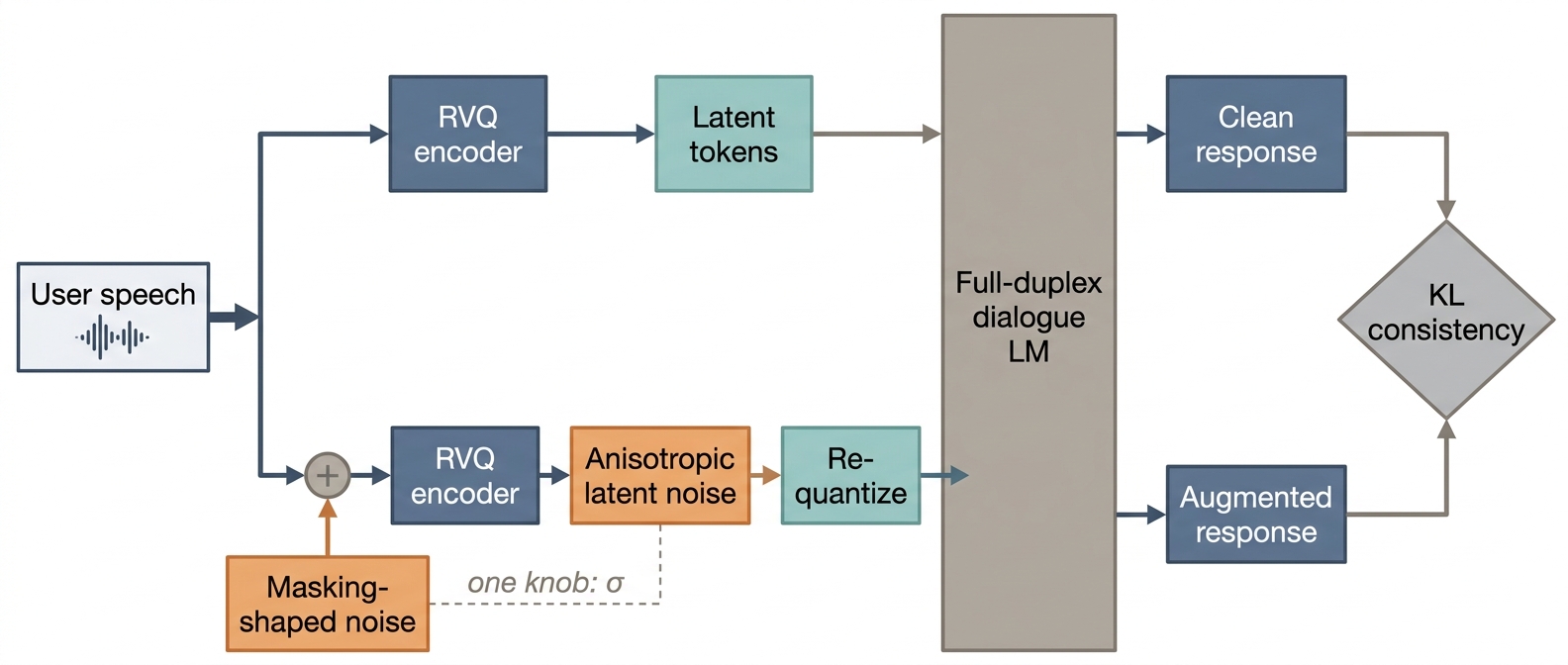
The PALS post-training pipeline. The augmented path adds masking-shaped noise in the waveform domain and anisotropic codebook-covariance noise in the latent domain, re-quantizes through a straight-through estimator, and is tied to the clean path by a KL consistency term. One scalar $ $ governs both augmentations. From Carnegie Mellon University.
Today's papers span the full stack of spoken AI: from how synthesized voices are shaped and protected, to how speech dialogue agents defend themselves and decide when to speak. Themes range from reinforcement learning applied to prosody, to psychoacoustic defenses for real-time duplex systems, to a principled critique of how we score conversational timing.
---
TTS & Voice Synthesis
From RL-driven emphasis to privacy-preserving cloning and handling the chaos of internet text.
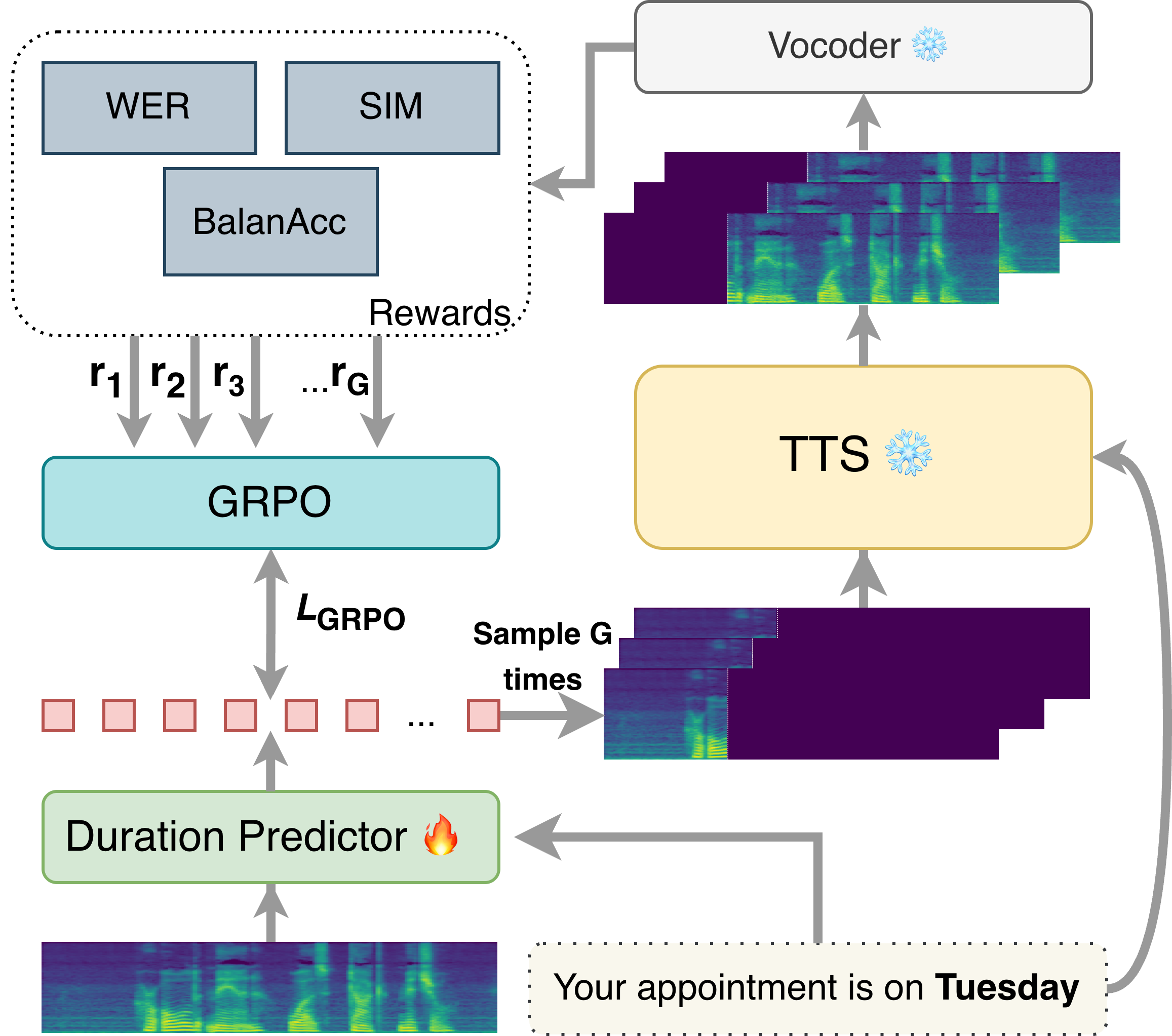
Word-level prosodic emphasis is notoriously hard to optimize with supervised losses, because the relationship between acoustic features and perceived naturalness is non-linear and preference-driven. EmphTTS from Aalto University attacks this directly by integrating Group Relative Policy Optimization (GRPO) into the duration predictor of a TTS system, replacing supervised fine-tuning with direct reward signals aligned to human preferences for expressive emphasis.
EmphTTS: an emphasis-control TTS with reinforcement learning
EmphTTS applies reinforcement learning (Group Relative Policy Optimization) to optimize word-level emphasis control in text-to-speech through direct reward signals, moving beyond supervised fine-tuning to achieve more natural and controllable prosodic emphasis. The method integrates RL into the duration predictor to better align TTS synthesis with human preferences for expressive emphasis.
Abstract
Generating controllable and human-like emphasis remains an open challenge in text-to-speech, even when explicit emphasis control signals are provided in the text input, limiting the communicative accuracy of synthetic speech in real-world applications. Reinforcement learning has recently shown promise for post-training TTS systems to align with human preference, yet existing methods have not been applied to word-level prosodic control. We present EmphTTS, a non-autoregressive TTS system that applies Group Relative Policy Optimization (GRPO) to the duration predictor with an emphasis localization reward, enabling direct optimization for word-level emphasis. Evaluations show that EmphTTS achieves the best emphasis controllability and performs the best in emphasis objective evaluation. In subjective preference tests, EmphTTS is significantly preferred over synthetic groundtruth and most baselines. Ablation studies show that GRPO improves emphasis realization beyond supervised-finetuning-based duration modeling and simple speaking-rate adjustment, while alleviating the mismatch between the independently trained duration predictor and TTS model.
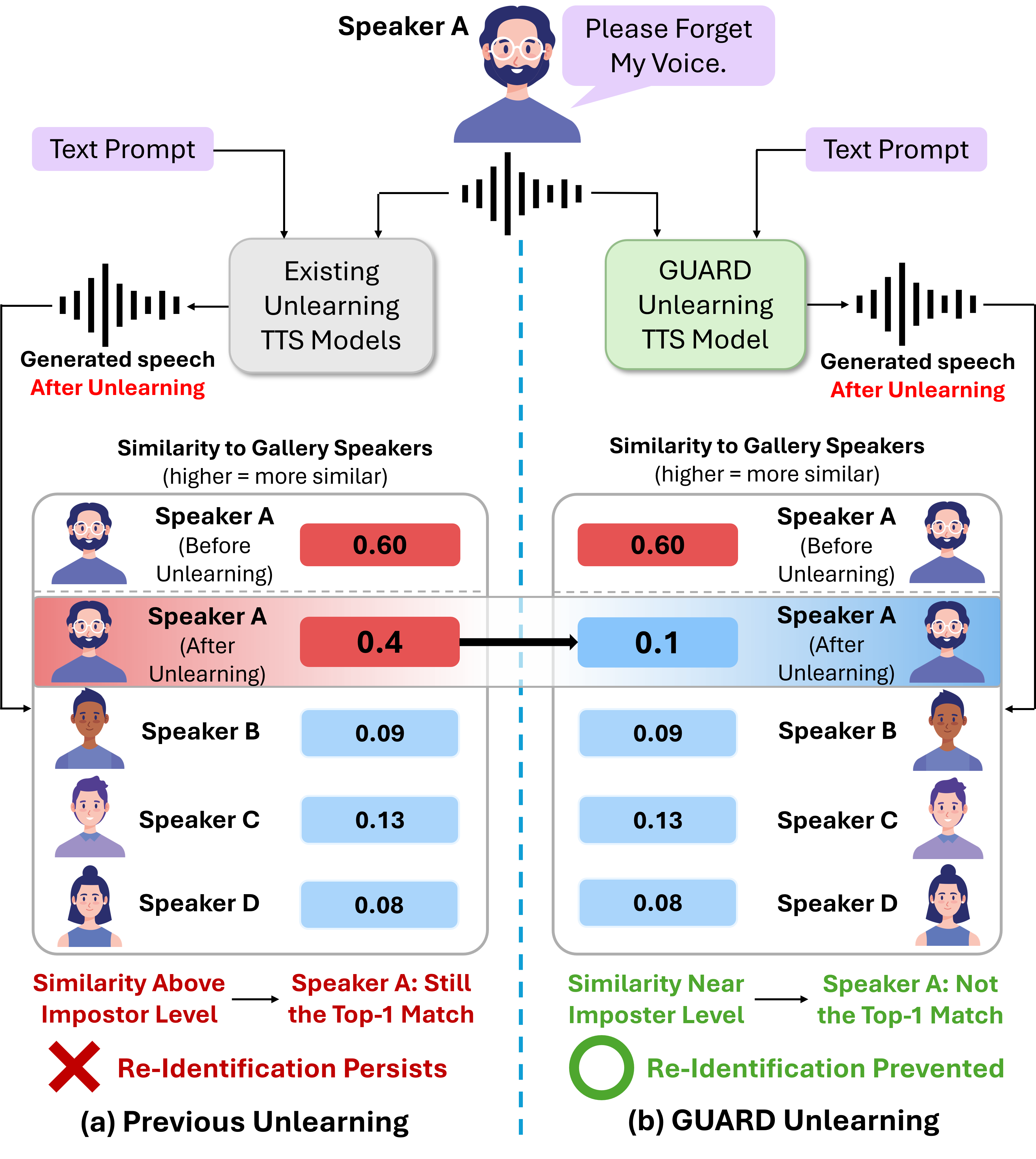
Zero-shot TTS systems that can clone arbitrary voices from a short prompt raise serious privacy concerns — and simply degrading speaker similarity isn't enough, since re-identification is still possible. Seoul National University's GUARD framework introduces speaker identity unlearning for zero-shot TTS: it uses activation steering and a learned speaker gate to push forget-speaker outputs toward population-level impostor similarity, achieving near-zero re-identification rates while leaving naturalness and intelligibility intact for retained speakers.
Forget who you Forgot: Speaker Unlearning to Prevent Re-Identification in Zero-Shot Text-to-Speech
This paper proposes GUARD, a speaker identity unlearning framework for zero-shot text-to-speech that prevents unauthorized voice cloning while preserving speech quality. Unlike prior work that only reduces speaker similarity, GUARD uses activation steering and a learned speaker gate to shift forget-speaker outputs toward population-level impostor similarity, achieving near-zero re-identification rates while maintaining naturalness and intelligibility for retained speakers.
Abstract
Recent zero-shot text-to-speech (ZS-TTS) systems can reproduce a speaker's voice with high fidelity from only a few seconds of reference speech, raising concerns over unauthorized voice cloning and impersonation. Speaker identity unlearning has recently emerged as an approach to selectively suppress this capability for speakers who opt out while preserving synthesis capability for other speakers. Although existing approaches reduce speaker similarity, preventing re-identification often faces severe degradation of speech quality. Motivated by this observation, we propose GUARD, a lightweight speaker identity unlearning framework that combines a learned speaker gate with speaker-agnostic activation steering on a frozen TTS backbone. The steering vectors are optimized using group-relative reward optimization to shift outputs from forget speakers toward population-level impostor similarity while preserving intelligibility and speech naturalness. On CosyVoice2, GUARD reduces forget-speaker similarity from 0.541 to 0.103 and re-identification accuracy in a 150-speaker gallery from 73.5% to 0.5%, while preserving retain-speaker reproduction. The results demonstrate that similarity reduction alone may not fully characterize successful speaker identity unlearning and highlight re-identification as a complementary criterion for its evaluation.
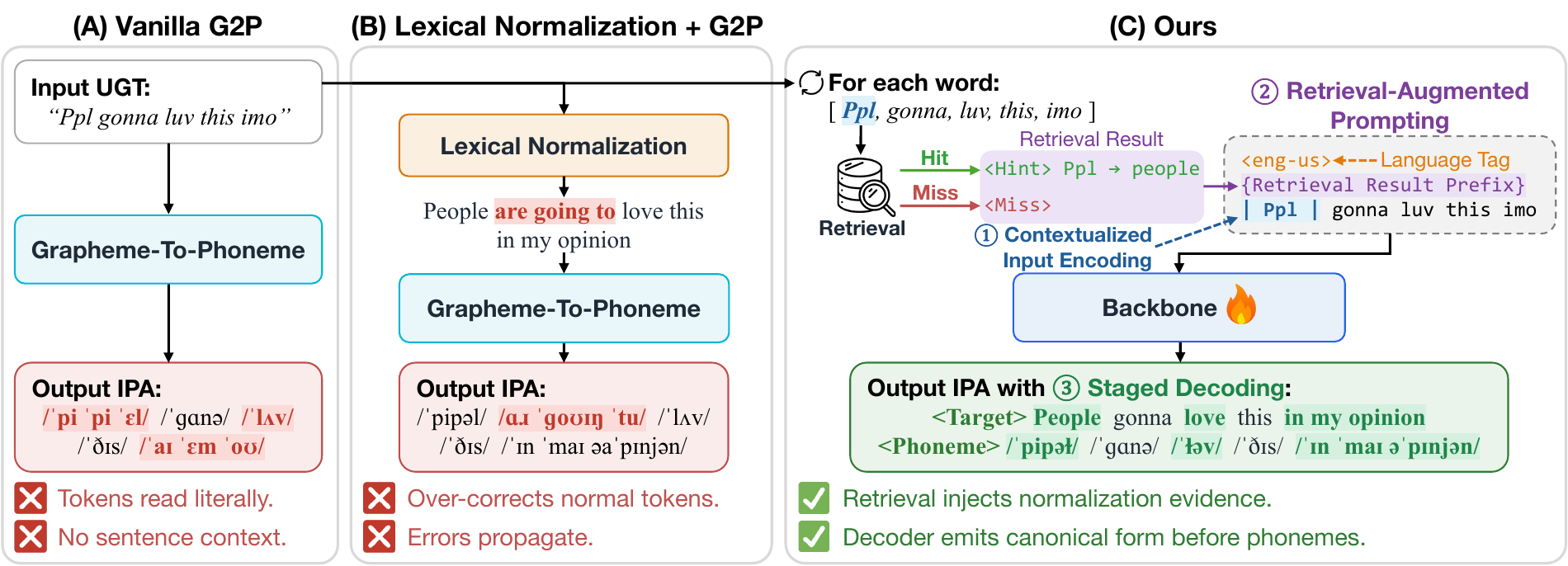
Grapheme-to-phoneme (G2P) conversion is a foundational step for TTS, but existing models quietly fail on user-generated text full of abbreviations, phonetic spellings, and internet slang. Also from Seoul National University, UGTPhon is the first G2P benchmark targeting this domain, exposing a large performance gap in current systems. The proposed compositional G2P approach explicitly models canonical-form inference as an intermediate step, matching or beating frontier LLMs with far smaller models.
Phonemizing User-Generated Text: A Benchmark, Taxonomy, and Compositional Approach
This work introduces UGTPhon, the first grapheme-to-phoneme benchmark for user-generated text (e.g., "ppl" for "people"), revealing a large performance gap in existing models that fail to recover canonical forms. The paper proposes a compositional G2P approach that explicitly models canonical-form inference, achieving competitive results with much smaller models compared to frontier LLMs.
Abstract
Text-to-speech systems increasingly process user-generated text (UGT) such as ppl and imo, whose pronunciation must be inferred from the canonical rather than surface form. We introduce UGTPhon, the first grapheme-to-phoneme (G2P) benchmark for UGT in English, Vietnamese, and Korean, together with an inference-grounded taxonomy for fine-grained diagnosis. Existing G2P models and frontier LLMs exhibit a systematic canonical-to-non-canonical performance gap, reaching up to 66.8 PER points. As a benchmark baseline, we propose a simple compositional G2P approach that incorporates canonical-form evidence through exact-match lookup and staged decoding. Across matched ByT5 and Qwen2.5-0.5B backbones, explicit canonical-form modeling consistently reduces non-canonical G2P errors. The 0.5B variant also performs competitively with much larger few-shot frontier LLMs, highlighting the benefit of explicitly modeling canonical-form inference for UGT phonemization.
---
Voice Conversion & Speaker Identity
Simplifying multi-module pipelines with learned transport in self-supervised feature space.
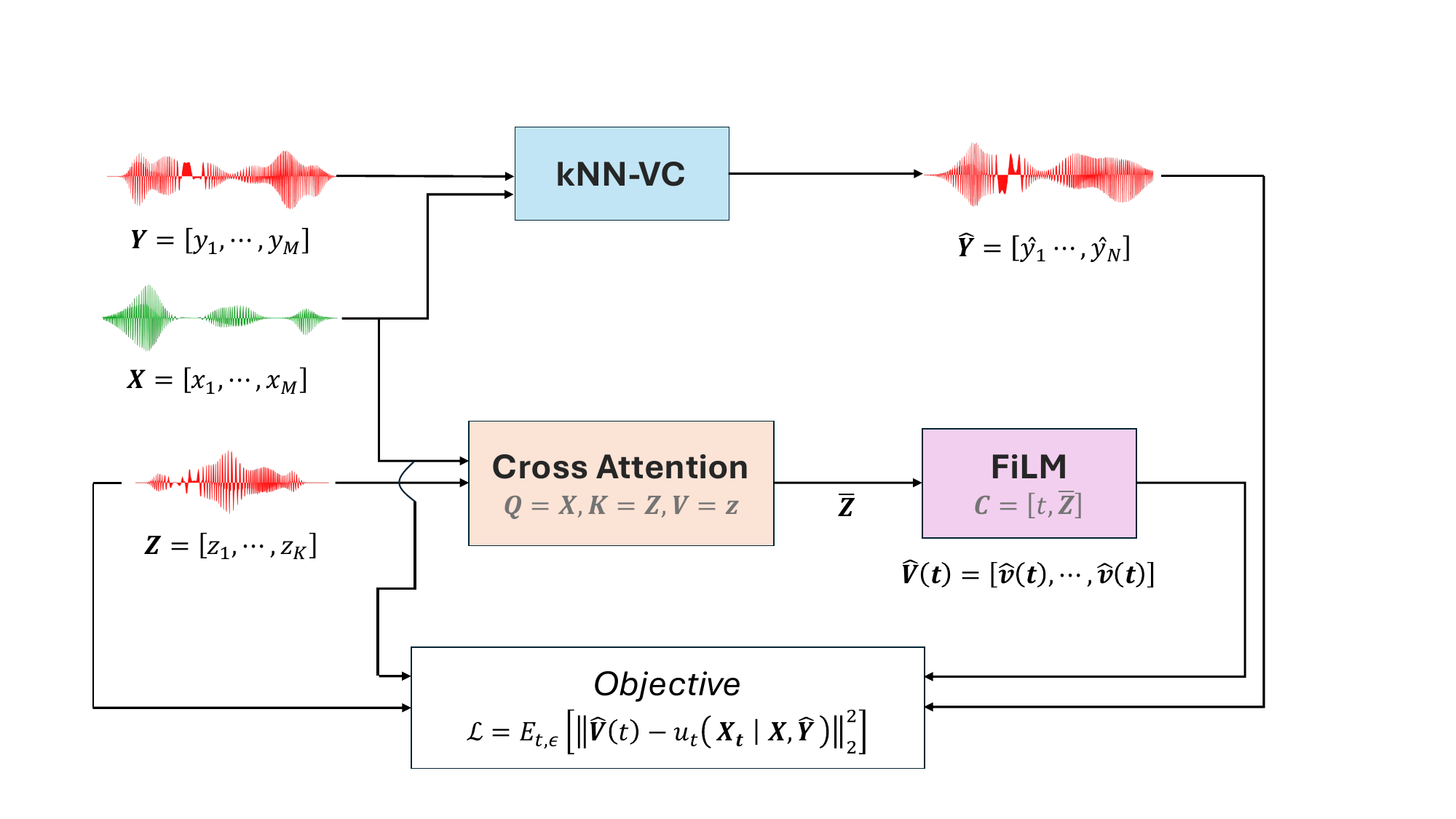
Neural voice conversion pipelines typically chain multiple modules — feature extraction, kNN lookup, vocoding — adding latency and fragility. Independent researchers propose replacing the explicit kNN lookup entirely with a lightweight conditional flow-matching network trained to approximate the kNN transport directly in WavLM embedding space. The result is true one-step inference on short utterances with competitive word-error rates and speech quality, dramatically reducing system complexity.
One-Step Voice Conversion by Learning kNN Transport in WavLM Space
This paper replaces explicit kNN-based voice conversion with a lightweight conditional flow-matching network that learns to approximate the kNN mapping directly between speaker embeddings. The approach enables one-step inference on short utterances while maintaining competitive speech quality and word-error rates, substantially simplifying the multi-module pipelines typical of neural voice conversion systems.
Abstract
Voice conversion (VC) systems fall into two families: non-parametric embedding-space methods, which need no trained model but degrade on short target utterances, and spectrogram-based neural architectures, which achieve strong quality via multi-module pipelines with tens of millions of parameters. We propose kNN-FM-VC, a single conditional flow-matching network that learns to approximate the kNN-VC mapping between WavLM embedding distributions of source and target speakers, replacing explicit pointwise kNN matching with a neural regressor trained on kNN-generated pairs. The model is conditioned on the target speaker via cross-attention and FiLM, and trained under three Gaussian conditional paths (Schrödinger bridge, straight line, and constant-variance Gaussian tube), enabling few-step sampling. Unlike Phoneme Hallucinator, which uses an upsampling stage followed by kNN matching, our 13M-parameter model performs conversion with a single learned network and supports one-step inference. On LibriSpeech, the one-step Gaussian Bridge achieves lower WER and higher estimated speech quality than FreeVC and Phoneme Hallucinator. Relative to kNN and kDOT, it substantially reduces WER.
---
Speech-to-Speech & Spoken Dialogue Agents
Adversarial robustness and intent-aware turn-taking evaluation for full-duplex systems.
Full-duplex speech dialogue agents are uniquely exposed to adversarial attack: an adversary can craft imperceptible acoustic perturbations delivered continuously over the audio channel. Carnegie Mellon's PALS (Psychoacoustically Aligned Latent Smoothing) turns this threat on its head by leveraging human perceptual masking thresholds to inject certified randomized noise at the model's latent quantization layer — a defense point where psychoacoustic masking makes the perturbation inaudible yet cryptographically certifiable. The result is strong robustness guarantees without sacrificing speech quality.
Psychoacoustically Aligned Latent Smoothing for Adversarial Robustness of Full-Duplex Speech-to-Speech Dialogue Models
This paper reveals imperceptible adversarial attacks against full-duplex speech dialogue agents that exploit continuous acoustic exposure, then proposes Psychoacoustically Aligned Latent Smoothing (PALS)—a defense that leverages human perceptual masking thresholds to inject certified noise at the model's latent quantization layer. PALS achieves strong robustness with formal certification guarantees while preserving speech quality.
Abstract
End-to-end speech-to-speech dialogue models listen and speak simultaneously, so a continuously open acoustic channel is exposed to adversarial manipulation. We formalize imperceptible attacks on full-duplex agents as optimization over additive perturbations confined beneath the psychoacoustic masking threshold of the carrier speech, under three goals: targeted semantic hijacking, response suppression, and policy jailbreaking. Against an undefended Moshi-style agent, white-box attacks succeed in up to 91.7% of trials. We then introduce psychoacoustically aligned latent smoothing (PALS), which injects anisotropic Gaussian noise shaped by local codebook covariance at the residual-vector-quantized latent interface, with input noise shaped by the masking threshold constraining the attacker and trained by a Kullback--Leibler consistency objective. Deployed with no inference-time cost, PALS reduces hijack to 8.3%, mute to 11.2%, and jailbreak to 9.1% at clean quality within 2.3%. A Monte Carlo-smoothed variant certifies an ellipsoidal latent radius up to 0.616, a guaranteed floor that the empirical robustness far exceeds.
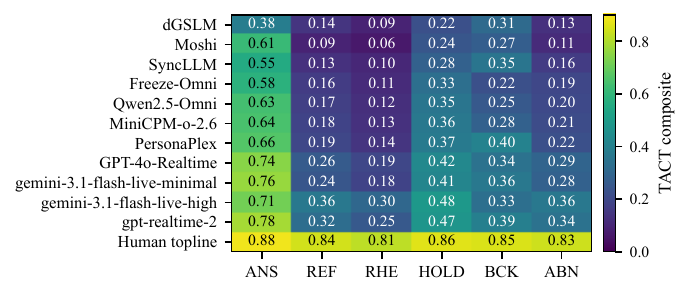
How should we score a spoken dialogue model's decision to stay silent, or to overlap a speaker? The standard fixed-window approach treats both as failures — but whether a pause or an interruption is appropriate depends on what the speaker intended. University of Illinois Urbana-Champaign's TACT benchmark introduces intent-annotated dialogue episodes and intent-conditioned scoring kernels fitted to human behavioral data, reframing silence and overlap as context-dependent dialogue choices rather than universal errors.
Neither Silence nor Overlap Is Failure: Intent-Conditioned Evaluation of Turn-Taking in Full-Duplex Spoken Dialogue Models
This work challenges fixed-window evaluation of turn-taking in spoken dialogue systems, proposing that response timing appropriateness depends on the speaker's latent intent. The paper introduces TACT, a benchmark with intent-annotated episodes and intent-conditioned scoring kernels fitted to human behavior, showing that silence and overlap are dialogue choices rather than universal failures.
Abstract
Benchmarks for full-duplex spoken dialogue models score turn-taking with binary fixed-window rules that reward immediate response or silence by completeness of the prior turn. We argue that the appropriateness of a response offset, whether delayed silence or anticipatory overlap, is conditional on the speaker's latent intent, identifiable only from that speaker's behavior. We introduce TACT, a benchmark of 9,728 episodes and 73.2 hours from five dyadic corpora; each episode carries dialogue history, a per-speaker memory profile, and an annotator-derived posterior over six intent classes. Scoring replaces binary windows with a strictly proper threshold-weighted continuous ranked probability score whose weights are intent-conditioned timing kernels fitted to human floor-transfer-offset distributions, proving boundedness, consistency, and binary reduction. Across eleven systems the best model reaches 0.47 against a human topline of 0.86, is nearly invariant to speaker profiles, and TACT agrees with human judgments at Spearman 0.81 versus 0.46 for binary metrics.
Trending on Hugging Face

Vidu S2: Real-Time Interactive, Editable, and Spatial Video Generation
Vidu S2 introduces real-time interactive avatar and video editing models that support high-resolution spatial video generation and dynamic reference updates.

Realtime-Venus: A full-duplex interaction system with asynchronous delegation
A proactive full-duplex system with separate audio-visual and audio models enables continuous perception, native speech generation, and asynchronous tool execution for real-time dialogue.

VoiceMem: Streaming Dual-Brain Memory for Real-Time Interaction
VoiceMem introduces a dual-brain streaming memory architecture for speech language models that improves retrieval accuracy, emotional personalization, and real-time efficiency.

AuK Technical Report: An Open-Source Foundational Model for Speech Generation and Editing
AuK is an open-source foundational model that unifies speech generation and editing via natural-language instructions and audio context, using a multimodal language model, joint VAE, hybrid rectified-flow Transformer, and efficient distillation for fast inference.

Qwen3-TTS Technical Report
The Qwen3-TTS series presents advanced multilingual text-to-speech models with voice cloning and controllable speech generation capabilities, utilizing dual-track LM architecture and specialized speech tokenizers for efficient streaming synthesis.