
Expressive TTS, Smarter Speech Agents, and Faster ASR
Today's digest spans emotional TTS controllability, on-device quantization, turn-taking benchmarks for speech LLMs, co-speech portrait video generation, long-form motion synthesis, and lossless ASR acceleration — eight papers pushing the boundaries of conversational AI.
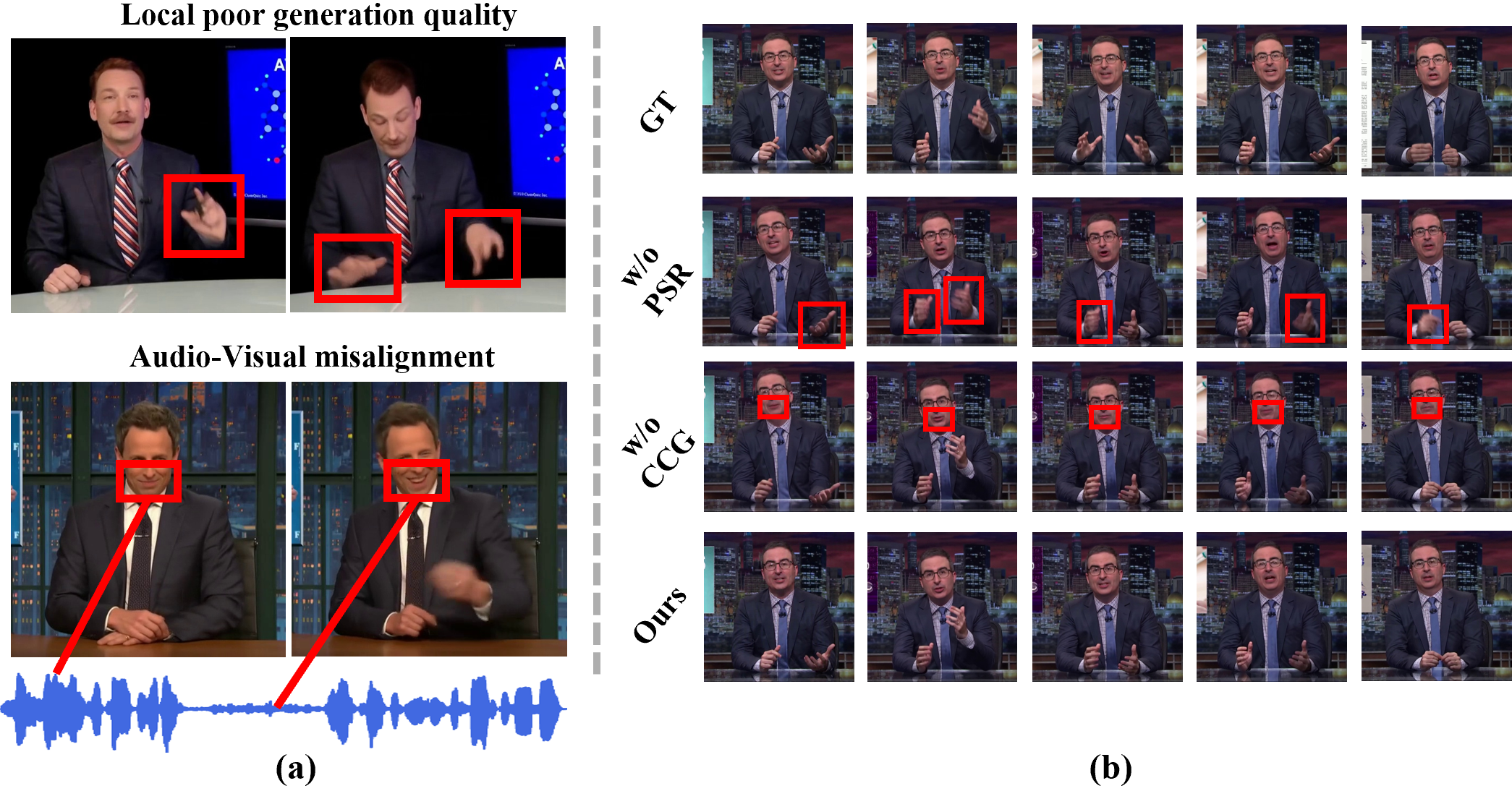
Limitations of existing methods include degraded local fidelity (e.g., hands, facial regions) and audio–visual misalignment (e.g., motion that does not match speech). Qualitative ablation. Parts-Specific Reweighting (PSR) improves local visual quality in critical regions, while Consistency Classifier Guidance (CCG) refines the generated sequence at inference time to enhance audio–visual alignment. The full PAGE framework combines both, producing high-quality and temporally consistent co-speech gesture videos. From Tencent AI Lab.
Today's digest is a broad sweep across the conversational AI stack: three papers tackle expressive and efficient TTS, two probe the conversational behaviour and fairness of speech LLMs, one accelerates ASR decoding without sacrificing accuracy, and two advance the visual side of speaking humans — from gesture-driven portrait video to long-form motion synthesis. A strong Monday showing from Tencent, CMU, Meta, NUS, and others.
Talking Avatars & Co-Speech Portrait Generation
Making synthesised speakers look and move like real ones, right down to the fingertips.
Diffusion-based portrait video generation still struggles with blurry lips, wandering eyes, and hands that lose their shape mid-gesture. Tencent AI Lab's PAGE directly attacks these failure modes: it introduces parts-specific training reweighting that concentrates spatial attention on perceptually critical regions — lips, eyes, and hands — and pairs it with an audio-conditioned classifier at inference time to enforce temporal coherence between the audio signal and the generated frames.
PAGE: Parts-Aware Guidance for Co-Speech Gesture Portrait Video Generation
PAGE enhances diffusion-based co-speech gesture portrait video generation by addressing local detail degradation and audio-visual misalignment through parts-specific training reweighting and consistency-guided inference. The approach combines spatial attention to perceptually critical regions (lips, eyes, hands) with an audio-conditioned classifier that refines generated sequences for improved temporal coherence.
Abstract
Co-speech gesture video generation aims to synthesize realistic, audio-driven portrait videos from a single reference image and a speech signal. Despite advances in visual quality, diffusion-based approaches still suffer from degraded local details and imperfect audio-visual alignment. We present PAGE (Parts-Aware GuidancE), a general, backbone-agnostic optimization framework for diffusion-based generation that enhances local spatial fidelity and global audio-visual consistency at both the training-objective and denoising-trajectory levels. During training, we propose Parts-Specific Reweighting (PSR), which adaptively increases supervision in semantically important regions such as lips, eyes, and hands, improving visual fidelity in perceptually critical areas. During inference, we introduce Consistency Classifier Guidance (CCG), an audio-conditioned latent classifier that identifies and corrects audio-visual inconsistencies in the generated video. We further design Differential Guidance (DG), an efficient inference strategy that refines facial and body motion separately while avoiding cross-region interference. To enable large-scale evaluation, we construct the Chinese Announcer Speech (CAS) dataset, the first comprehensive Chinese benchmark for co-speech gesture portrait video generation. Compared with the widely used PATS dataset, CAS includes substantially more identities, video clips, and scene diversity. Extensive experiments on both PATS and CAS demonstrate that PAGE achieves state-of-the-art performance in perceptual quality, gesture diversity, and audio-visual alignment. Project page: https://aigc-explorer.github.io/PAGE/.
Digital Humans & Motion Generation
Giving virtual characters coherent, long-horizon behaviour driven by natural language.
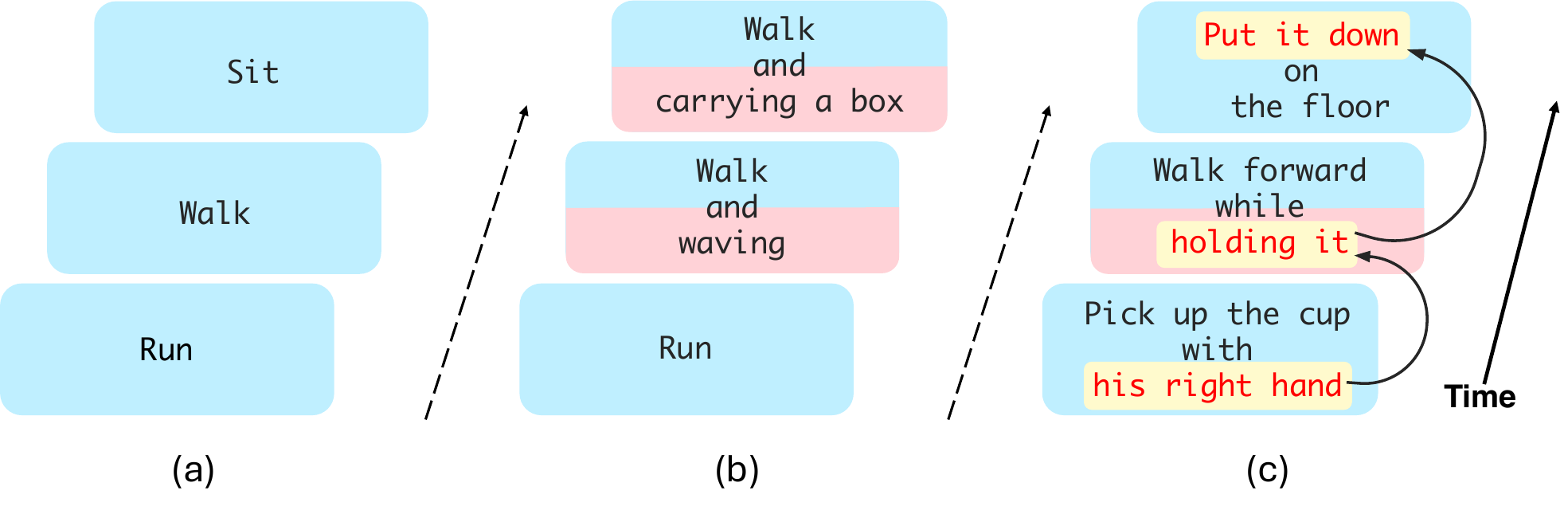
Generating human motion from text is largely a solved problem for short, self-contained clips — but real narratives span multiple instructions where earlier constraints must carry over. Sony's ELMA is the first benchmark to stress-test this: it introduces an episodic dataset with dense segment-level annotations that explicitly encode cross-segment anaphoric dependencies (e.g., "continue doing that while turning left"), forcing motion models to track context across a full sequence rather than treating each segment in isolation.
ELMA: Benchmarking Anaphoric Compositions for Long-Term Text-to-Motion Generation
This paper introduces the first benchmark for long-term human motion generation from text instructions containing anaphora—where constraints from earlier segments must be preserved across multi-step narratives. ELMA, a new episodic dataset with dense segment-level annotations capturing cross-segment dependencies, enables motion models to handle context-dependent compositions far longer than existing short-clip datasets.
Abstract
Text-guided long-term human motion generation is essential for applications such as continuously operating digital avatars. Despite recent progress on short clips, existing models struggle with multi-segment instructions that involve anaphora, where constraints established in earlier segments must be preserved over time. In this paper, we introduce a novel task of long-term motion generation from such anaphoric compositions. To mitigate this, we present ELMA, an episodic long-term motion dataset with dense segment-level annotations that preserve cross-segment dependencies. Built via a fully automated collection and filtering pipeline, ELMA extracts high-quality, continuous 30-second clips from in-the-wild videos, capturing the episodic narratives necessary for long-range state modeling. Leveraging this dataset, we fine-tune state-of-the-art motion generation models to incorporate long-range context. Extensive experiments reveal fundamental shortcomings in current models when handling context-dependent instructions. We demonstrate that ELMA enables significant improvements in both global physical realism and semantic alignment, setting a robust new baseline for long-term motion synthesis.
TTS & Voice Synthesis
From on-device quantization to fine-grained emotional control — three papers reshaping how we build and deploy TTS.
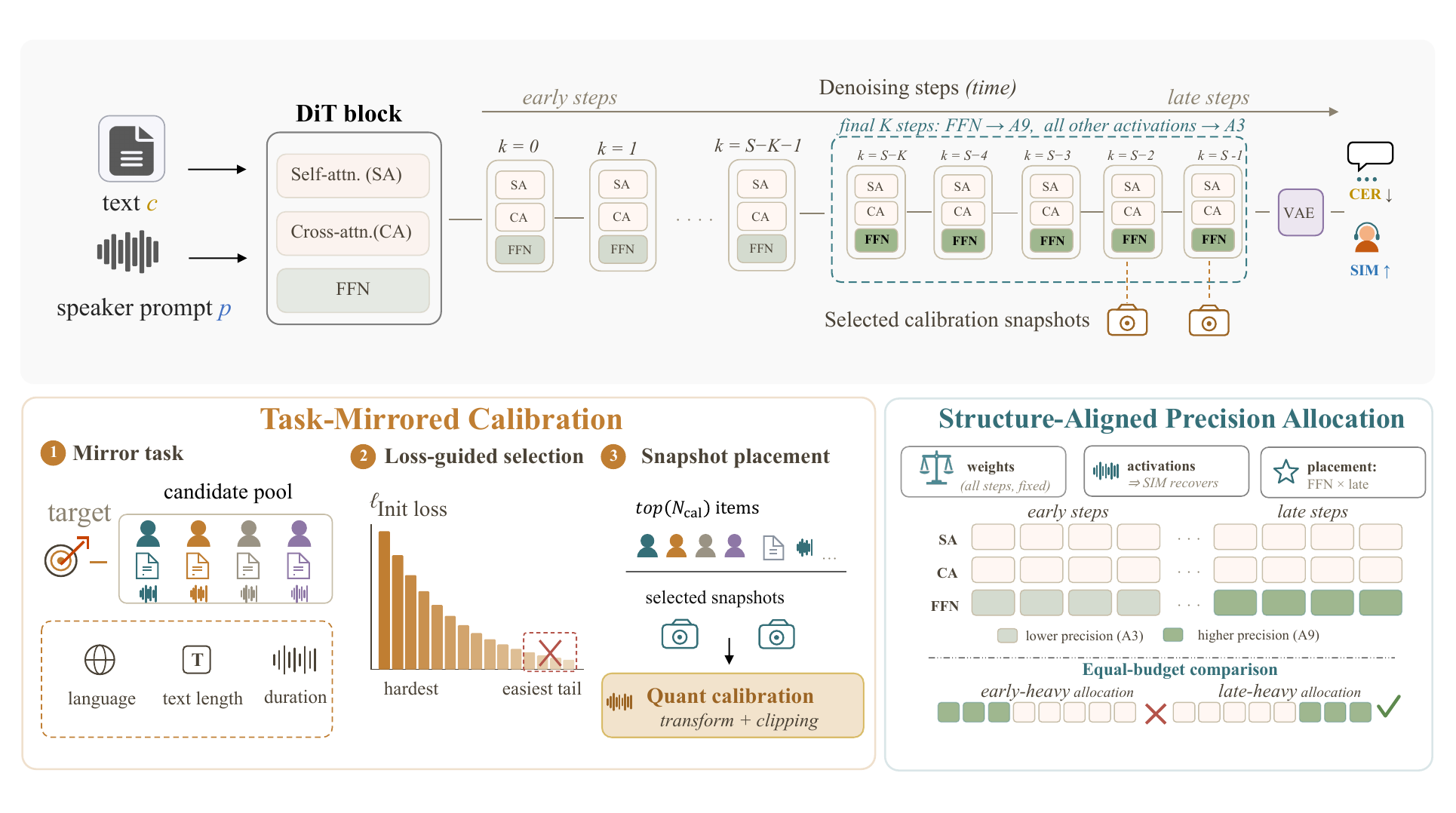
Deploying billion-parameter TTS diffusion transformers on edge devices requires aggressive compression, yet naive quantization destroys speaker timbre. Tsinghua University's TTS-Q is the first systematic study of weight-and-activation post-training quantization (PTQ) for zero-shot voice-cloning models. A key finding: at 4-bit precision it is activation quantization, not weight quantization, that degrades timbre. TTS-Q recovers quality through a task-matched calibration protocol and a timestep-aware mixed-precision schedule — all without any retraining.
TTS-Q: Perception-Guided Post-Training Quantization of Text-to-Speech Diffusion Transformers
This paper addresses quantization of billion-parameter TTS diffusion transformers for efficient on-device deployment, identifying that activation quantization—not weights—causes speaker timbre degradation at 4 bits. TTS-Q proposes a task-matched calibration protocol and timestep-aware mixed-precision schedule that recovers timbre without retraining, making it the first systematic study of weight-and-activation PTQ for zero-shot voice-cloning models.
Abstract
Zero-shot text-to-speech (TTS) can clone a voice from seconds of audio. Yet the quality comes from billion-parameter diffusion transformers whose size and multi-step sampling put them out of reach of the on-device, assistive, and real-time applications that need them most. Post-training quantization (PTQ) shrinks such models without retraining, but it has been built for language and vision, not speech. At 4 bits, a strong quantizer leaves intelligibility close to full precision but consistently erodes speaker timbre, so error rates stay low while the voice drifts from the target speaker. We ask why quantization hurts speech, where the damage lives, and whether it can be repaired without retraining. To find out, we run the first 4-bit weight-and-activation (W4A4) PTQ study of a TTS diffusion transformer at 1B and 3.5B. The timbre cost comes from both the weight and the activation quantization, but only the activation part has the timestep structure a precision schedule can exploit. We therefore introduce TTS-Q, which selects hard-to-quantize items from task-matched calibration candidates and applies a budget-balanced mixed-precision schedule that assigns higher precision to late-step feed-forward activations. TTS-Q recovers timbre best at both scales, at no cost to intelligibility. Separately, the deployed calibrated-W4A4 reference reduces peak memory on GPU, providing a practical reference for resource-constrained TTS deployment.
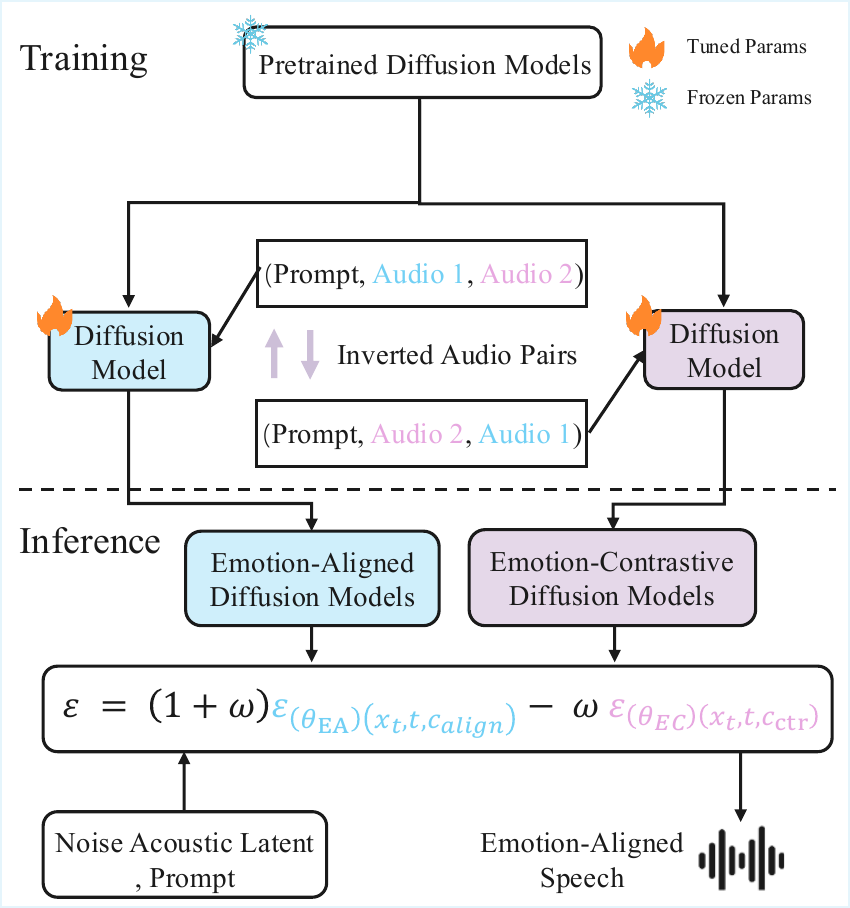
Controlling the emotional colour of synthesised speech is harder than it looks: pushing a model toward "happy" often bleeds competing emotions into the output. CMU's Emo-BPO frames this as a bidirectional preference optimisation problem — simultaneously reinforcing the target emotion and suppressing competing emotional modes via contrastive guidance. Crucially, it achieves fine-grained emotional controllability in diffusion-based TTS without auxiliary reward models or extra annotation effort.
Emo-BPO: Emotion Bidirectional Preference Optimization for Diffusion-based Emotional TTS
This paper improves emotional speech synthesis by jointly learning to reinforce target emotions while suppressing competing emotional modes through bidirectional preference optimization. Unlike prior work that focuses solely on emotion alignment, Emo-BPO uses contrastive guidance to achieve fine-grained emotional controllability in diffusion-based TTS without requiring auxiliary reward models or extra annotations.
Abstract
Diffusion-based TTS has demonstrated strong capability in emotional speech generation. However, existing emotion alignment methods primarily reinforce target emotional expressions while overlooking modeling of competing emotional modes, limiting fine-grained controllability. This issue becomes more pronounced under classifier-free guidance (CFG), which relies on contrasting conditional trajectories to shape generation. We propose Emotion Bidirectional Preference Optimization (Emo-BPO), a simple effective framework that jointly learns emotion-aligned and emotion-contrastive score functions from reordered same-text emotional pairs. Our method requires neither auxiliary reward models nor additional annotations, and can be seamlessly integrated into existing diffusion-based TTS systems to improve emotional controllability and expressiveness.
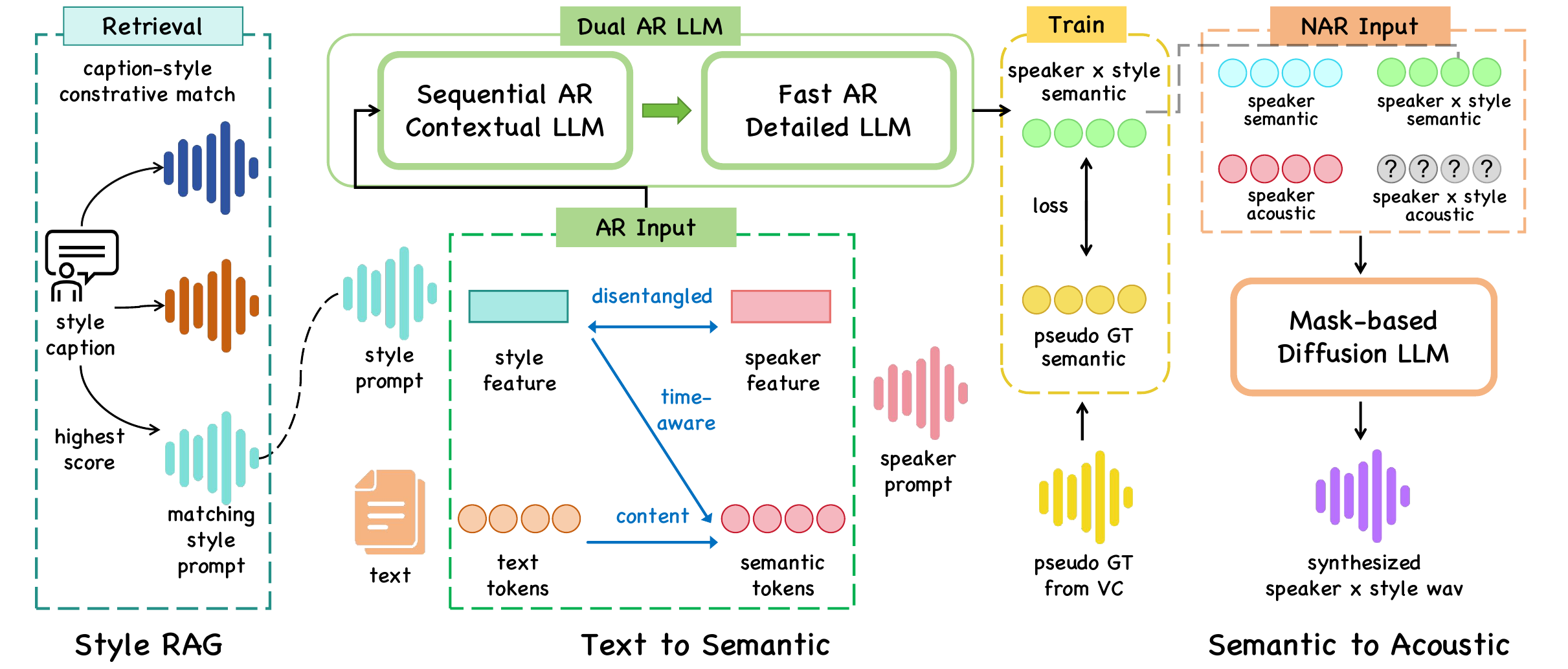
Rounding out the TTS trio, USTC's E3-System takes a holistic approach to expressive zero-shot TTS: it decouples timbre from style so users can specify emotion via either natural-language descriptions or speech prompts while the target speaker identity is preserved. The system couples a large multilingual emotional speech dataset (EmoData), style-grounding retrieval, and dual-TTS synthesis to close the loop between user intent and acoustic output.
E3-System: Expressive EmoData, Explicitly Controllable, Easy-to-Use TTS
E3-System unifies expressive zero-shot TTS by decoupling timbre from style, enabling control via natural-language descriptions or speech prompts while preserving target speaker identity. It combines a large multilingual emotional speech dataset (EmoData), style-grounding retrieval, and dual-TTS synthesis to close the full loop between user intent and acoustic realization.
Abstract
Recent zero-shot Text-to-Speech (TTS) systems can clone unseen speakers, yet controllable expressiveness remains limited by a gap between semantic intent and acoustic realization. Text descriptions offer a natural control interface but provide weak acoustic grounding, whereas speech style prompts provide concrete prosody but entangle style with the prompt speaker's timbre. To bridge this gap, we propose E3-System, a unified intent-to-speech framework for expressive zero-shot TTS that couples three requirements: Expressive style modeling, Explicit timbre-style control, and Easy-to-use natural-language interaction. Given a target speaker and either a natural-language style description or a speech style prompt, E3-System generates expressive speech while preserving the target timbre. The key idea is to close the full control loop: building a large expressive style space, grounding user intent into usable acoustic style references, and synthesizing speech with disentangled timbre and style. To realize this loop, EmoData provides a thousand-hour multilingual emotional speech dataset, Style-RAG grounds text descriptions into high-quality acoustic style prompts from these data, and Dual-TTS transfers the grounded style to arbitrary target speakers through VC-augmented timbre-style disentanglement. Experiments show that E3-System achieves strong speech quality, speaker preservation, and explicit expressive controllability.
SpeechLLMs, Voice Agents & Spoken Dialogue
How well do today's speech models actually converse — and how fairly do they treat different speakers?
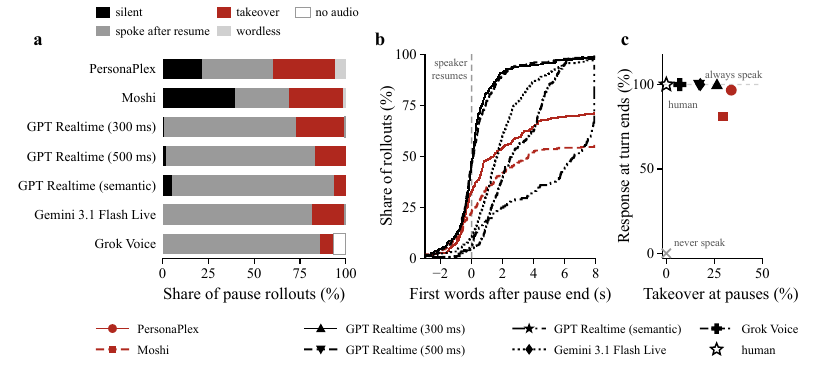
Abstract turn-taking metrics tell us little about whether a speech model will behave naturally in a real call. The University of Washington's study "People Making Conversation" takes a direct measurement approach: it plays real unscripted conversation pauses to hosted APIs (GPT Realtime, Gemini Live, Grok Voice) and full-duplex models (PersonaPlex, Moshi), measuring whether each system speaks, stays silent, or interrupts within human reaction times. The result is striking — hosted APIs almost always fill every pause, while full-duplex models achieve human-like silence and interruption timing.
People Making Conversation: Evaluating How Naturally Speech Models Converse
This paper evaluates how naturally speech-based LLMs handle turn-taking by testing them at real pauses in unscripted conversations, measuring whether and when systems actually speak rather than abstract boundary detection. It reveals that hosted APIs (GPT Realtime, Gemini Live, Grok Voice) almost always fill pauses while only full-duplex models (PersonaPlex, Moshi) consistently stay silent and interrupt within human reaction times.
Abstract
A conversational speech model has to decide, at every pause, whether to speak. Existing evaluations test boundary detection, policy adherence, or aggregate statistics, not this decision. We place real-time speech systems at 427 pauses and 482 turn ends from 176 unscripted conversations in Seamless Interaction, give each the conversation so far, and score what it generates against what the person did: whether and how soon it speaks at a pause; its latency, length, and wording at a turn end; and whether it can answer a question about the preceding 30 to 120 seconds. Across six systems, the hosted APIs (GPT Realtime, Gemini 3.1 Flash Live, Grok Voice) respond at almost every pause whichever endpointer they use; only their latency, about 1 to 4 s with silence-based endpointers and about 8 s with semantic turn detection, decides whether the words land inside the pause. The full-duplex models (PersonaPlex, Moshi) are the only systems that regularly stay silent and the only ones that interrupt within a human reaction time. Hosted systems reply longer than the person. Given the history as text, hosted systems recall 41 to 60% of conversation facts under a Claude Opus 5.5 judge and 19 to 26% under a strict word matcher; hearing it as audio, full-duplex models recall 17 to 22% and 12 to 15%. We release the labels, points, harness, and every output.
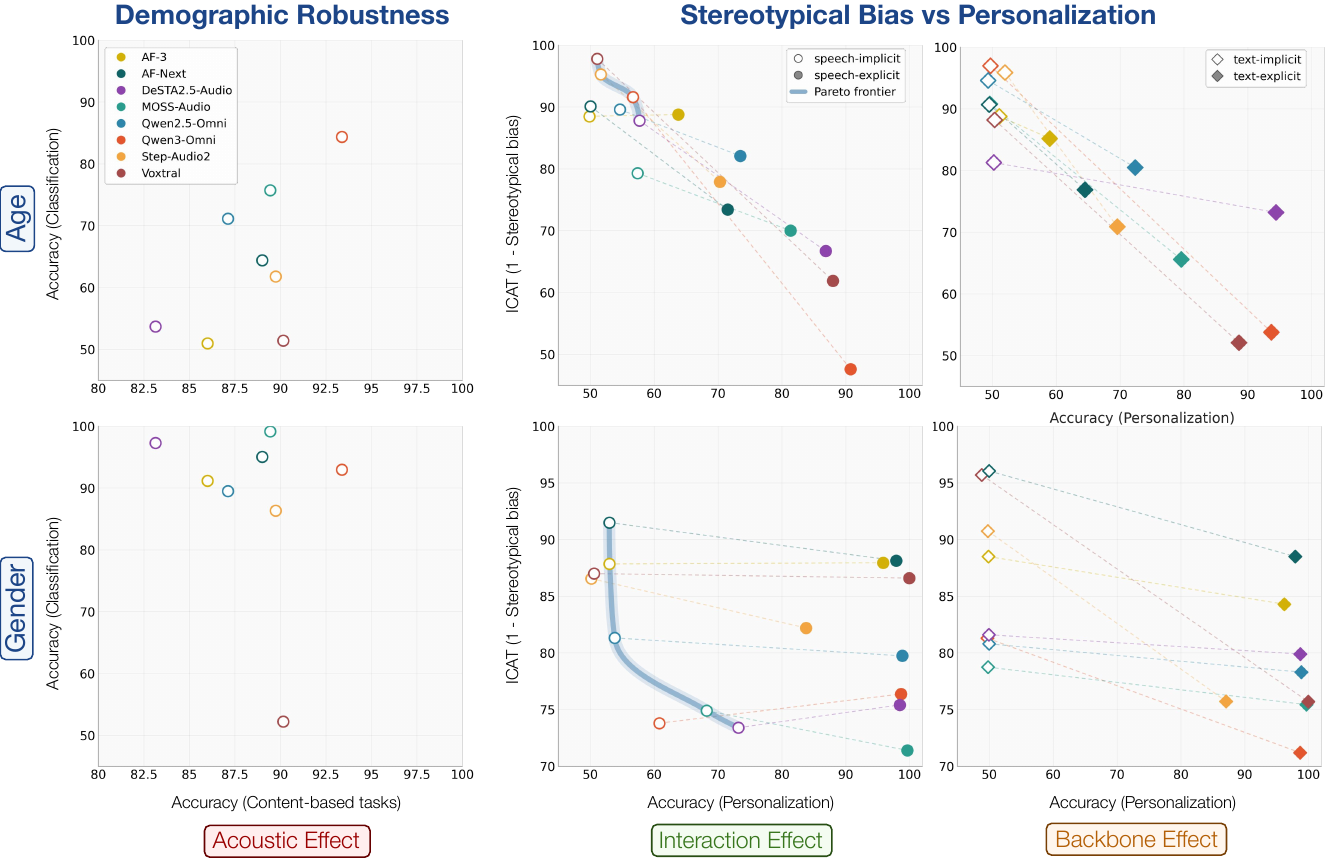
Knowing when to personalise a response based on a speaker's demographic cues is a genuinely hard problem: the same cue that enables useful adaptation in one context constitutes harmful stereotyping in another. Meta AI's BASIS-Bench disentangles these two failure modes by separately measuring demographic robustness, stereotypical bias, and appropriate personalisation across a range of speaker characteristics — going well beyond the disparity metrics that prior benchmarks relied on.
Personalization Without Stereotyping: Do Speech LLMs Know When to Turn a Deaf Ear?
This paper introduces BASIS-Bench, a benchmark that disentangles harmful stereotyping from beneficial personalization in speech LLMs by measuring demographic robustness, stereotypical bias, and appropriate personalization across speaker characteristics. Unlike prior work that only measures demographic disparities, it reveals whether models learn when demographic cues should—and should not—shape their responses.
Abstract
Recent speech LLMs can leverage rich paralinguistic cues, enabling more complex and personalized interactions. However, little work investigates how this sensitivity can lead to stereotyping, and existing evaluations largely measure demographic disparities without distinguishing beneficial personalization from stereotypical behavior. We introduce BASIS-Bench, a benchmark designed to disentangle these two aspects through three axes: (1) demographic robustness, measuring disparities in content-based tasks across speakers and demographic classification capabilities; (2) stereotypical bias, measuring whether perceived demographic cues trigger unprompted stereotypical behavior; and (3) personalization, measuring whether models can tailor responses to demographic characteristics when explicitly requested. We evaluate eight recent speech LLMs and find that, despite often recognizing demographic cues, most fail to translate them into appropriate personalization. Explicit demographic labels improve personalization but also amplify stereotypical associations already present in the textual backbones. These findings highlight the need to train speech LLMs not only to perceive demographic cues, but to learn when they should shape their responses.
ASR & Speech Model Efficiency
Speculative decoding comes to speech recognition — lossless speed-ups without external draft models.
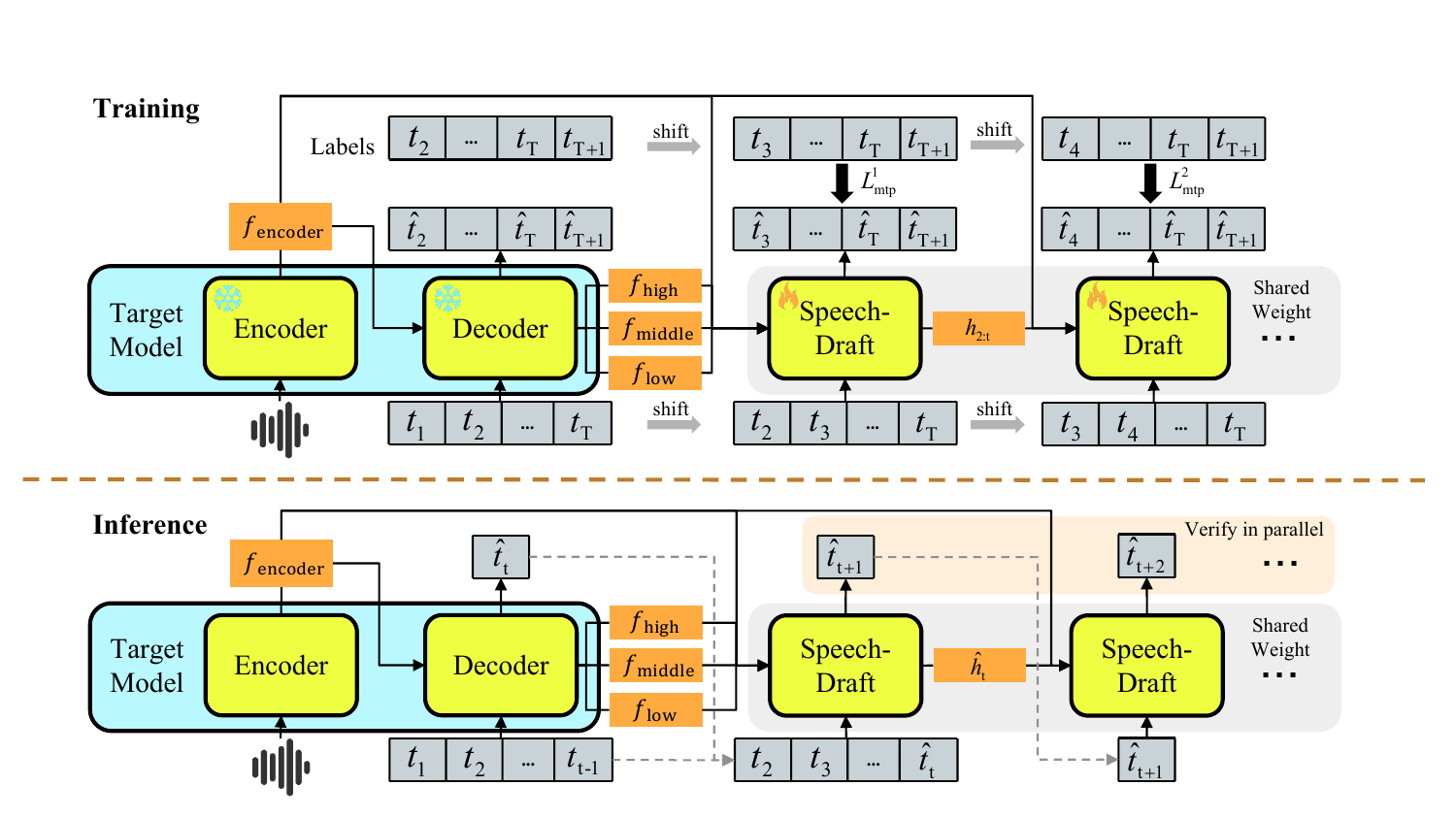
Speculative decoding has transformed LLM inference latency; bringing the same gains to autoregressive ASR is non-trivial because the draft model must respect both audio encoder outputs and decoder state. NUS's Speech-Draft solves this with an EAGLE-style draft model that jointly consumes encoder features and the target ASR decoder's own representations, trained with multi-step generation on self-distilled data. The result is high draft-token acceptance rates and lossless output quality — no external draft model required.
Lossless Inference Acceleration for ASR via EAGLE-Style Speculative Decoding
This work accelerates autoregressive ASR decoding via EAGLE-style speculative decoding while preserving output quality. It introduces Speech-Draft, a lightweight draft model that jointly leverages encoder features and decoder representations from the target ASR model itself, trained with multi-step generation and self-distilled data to achieve high draft acceptance rates without requiring external draft models.
Abstract
Autoregressive Transformer and Conformer models have achieved state-of-the-art performance in automatic speech recognition (ASR). However, their sequential token generation mechanism imposes a significant bottleneck during decoding, resulting in substantial inference latency. While speculative decoding has emerged as a promising lossless acceleration technique, existing ASR-oriented approaches either suffer from low draft acceptance rates due to suboptimal draft quality or rely on specially designed external draft models, which limit their generality and practicality. To overcome these limitations, we propose EAGLE-ASR, a novel framework that accelerates ASR inference via EAGLE-style speculative decoding while strictly preserving lossless output quality. Specifically, we introduce Speech-Draft, a lightweight autoregressive module that serves as a universal draft model by jointly leveraging encoder acoustic features and hierarchical decoder representations from the target ASR model. Furthermore, we adopt a multi-step generation strategy with self-distilled data to train the Speech-Draft, enabling it to better approximate the target model's output distribution and maintain causal consistency during multi-token generation. Extensive experiments on representative Whisper and Conformer AED models demonstrate that EAGLE-ASR achieves significant lossless speedups of up to $1.9\times$ and $2.4\times$, respectively, consistently outperforming existing speculative decoding baselines for ASR. Our proposed framework further generalizes effectively to multilingual ASR and speech translation tasks, establishing EAGLE-ASR as a practical and universally applicable solution for accelerating modern ASR systems without compromising recognition accuracy.
Trending on Hugging Face


Qwen3-TTS Technical Report
The Qwen3-TTS series presents advanced multilingual text-to-speech models with voice cloning and controllable speech generation capabilities, utilizing dual-track LM architecture and specialized speech tokenizers for efficient streaming synthesis.

VibeVoice Technical Report
VibeVoice synthesizes long-form multi-speaker speech using next-token diffusion and a highly efficient continuous speech tokenizer, achieving superior performance and fidelity.

OmniFlatten: An End-to-end GPT Model for Seamless Voice Conversation
A novel GPT-based model, OmniFlatten, enables real-time natural full-duplex spoken dialogue through a multi-stage post-training technique that integrates speech and text without altering the original model's architecture.

Omni Interaction Agent Technical Report
Gander is an end-to-end framework that integrates continuous multi-modal streaming, real-time full-duplex interaction, and agentic reasoning through a Cerebellum-Brain architecture and a chunk-level token stream design.