
Full-Duplex Dialogue, Smarter TTS, and Cross-Species Portrait Animation
Today's digest covers a wave of full-duplex spoken language model advances from NVIDIA, MIT-IBM, and UIUC, alongside fresh TTS work on realism and drama synthesis, and portrait animation that crosses species boundaries.
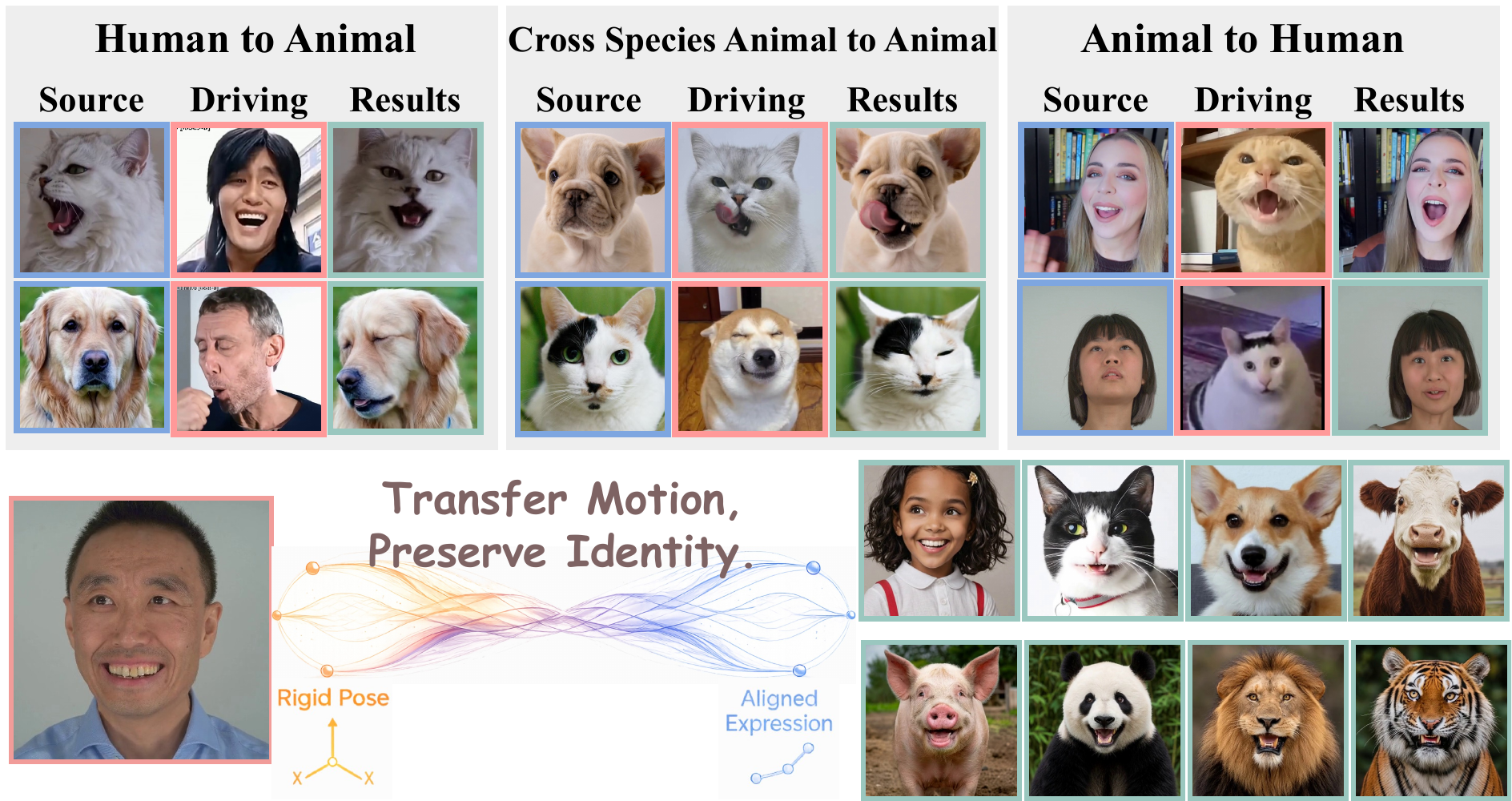
Cross-species animation by CrossPortrait. Our method transfers motion while preserving source identity in human-to-animal, animal-to-animal, and animal-to-human scenarios. Blue, red, and green borders denote source portraits, driving images, and CrossPortrait outputs, respectively. From University of Science and Technology of China.
The October 14 digest is dense with fundamental work on conversational AI: three independent teams push full-duplex spoken dialogue in different directions, two portrait animation papers tackle controllability and cross-species transfer, and the TTS front brings a drama-grade open model and a compact realism-first synthesis approach. Here's everything worth your attention today.
Full-Duplex Spoken Language Models & Voice Agents
Real-time, simultaneous listening-and-speaking remains one of the hardest open problems in conversational AI — and today three labs each take a distinct angle.
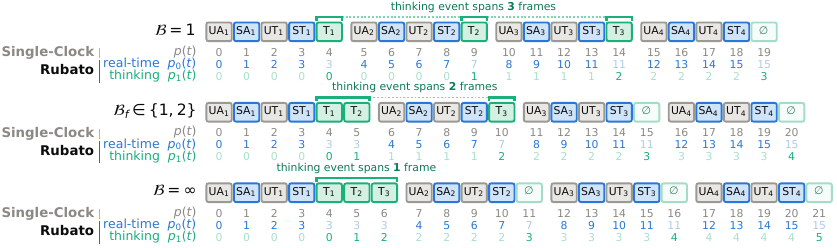
Getting a spoken language model to think as fast as the hardware allows is harder than it sounds, because standard positional encoding ties internal reasoning to the pace of audio token generation. RUBATO from UIUC breaks that coupling with a multistream positional encoding that assigns independent clocks to each stream — audio in, audio out, and internal chain-of-thought — so faster hardware directly translates to faster reasoning without destabilizing real-time dialogue output.
RUBATO: Decoupled Clocks Allow Full-Duplex Models to Think as Fast as They Can
This paper introduces RUBATO, a multistream positional encoding that assigns independent clocks to decouple audio streams and internal reasoning in full-duplex conversational models. Rather than enforcing fixed decoding rates, RUBATO enables each stream to progress at its own hardware-adaptive speed, allowing faster inference to deliver quicker reasoning while maintaining stable real-time dialogue.
Abstract
Recent Speech Full-Duplex (FDX) models are capable of engaging in naturalistic conversation by listening and speaking at the same time. Building on this foundation, recent architectures introduce internal thinking streams to enhance their intelligence. To guarantee these streams process successfully in real time, existing methods enforce a fixed decoding rate, which assumes a hardware profile capable of a specific latency. We argue this static approach is severely suboptimal. Because internal thinking is intrinsically asynchronous, an ideal FDX model should sustain real-time conversational flow while allowing each stream to decode at its own hardware-adaptive rate. Thinking streams must process as fast as the hardware allows to deliver accurate answers faster. To solve this, we propose RUBATO, a novel multistream positional encoding that assigns independent clocks to entirely decouple the streams. This structural isolation empowers the model to zero-shot interpolate across any inference decoding speed. It drastically simplifies dataset construction by requiring training on only two extreme decoding speeds while smoothly adapting to any intermediate rate during deployment. RUBATO demonstrates consistent robustness across five spoken reasoning tasks. On Spoken GSM8K, a baseline model collapses to 1.7% accuracy at interpolated speeds. Conversely, RUBATO-Full sustains 48.7% to 51.1% accuracy across all rates, leveraging faster hardware to achieve a 6.5x shorter time-to-answer with a constant time-to-first-response. This advantage holds on BIG-Bench Audio and amplifies significantly during complex full-duplex interruptions. Specifically, when a user interjects while the model is actively speaking and reasoning, RUBATO-Full achieves 40.0% to 45.1% accuracy, whereas the baseline fails completely.
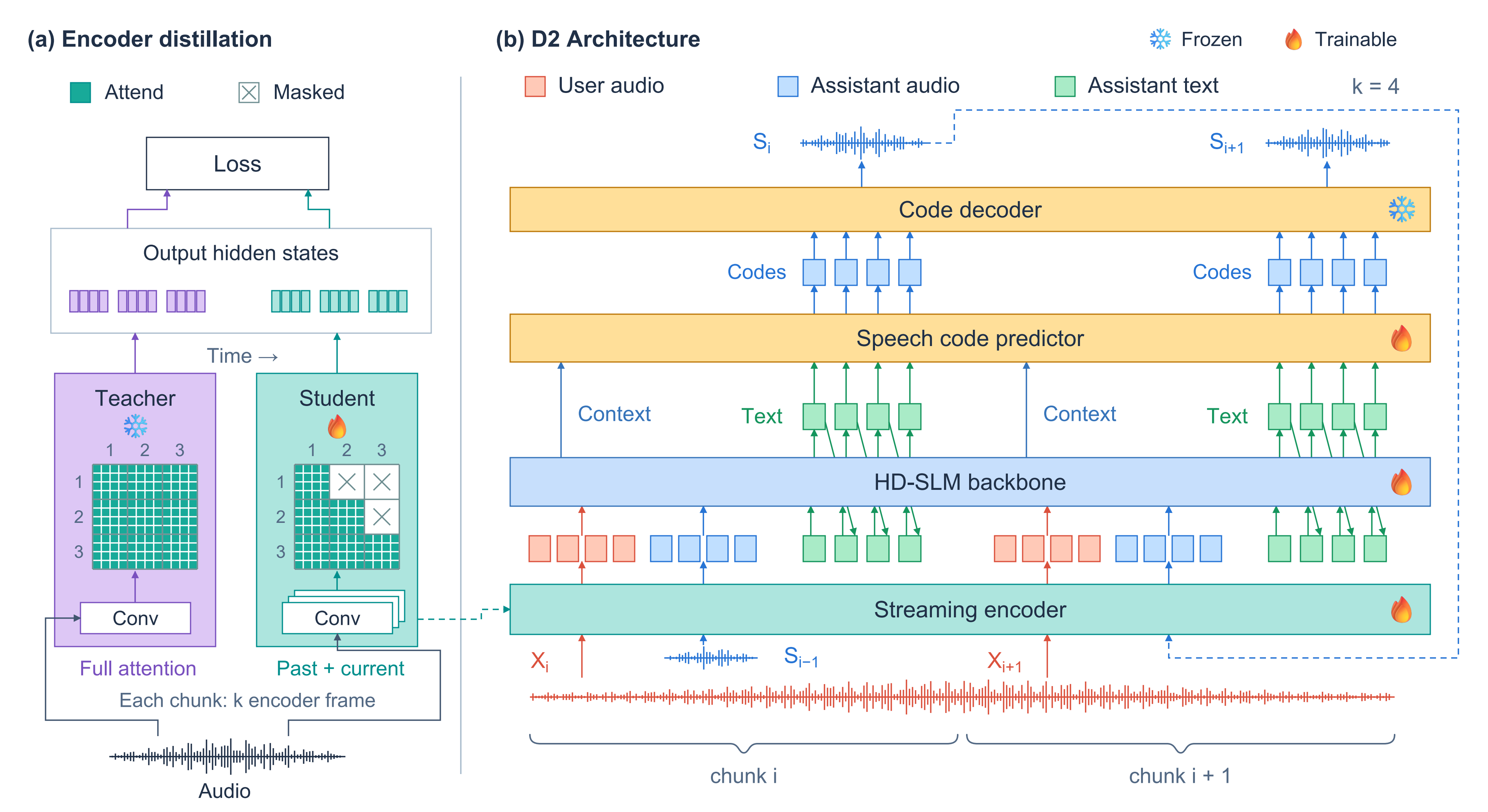
Converting a well-trained half-duplex backbone into a full-duplex system is cheaper than training from scratch, and D2 from MIT-IBM Watson AI Lab shows how to do it rigorously. The method uses decoder-free representation distillation followed by supervised fine-tuning, achieving simultaneous listening and speaking at fine temporal granularity. It sets state-of-the-art numbers on turn-taking and interruption success while keeping latency low and preserving the original model's general capabilities.
D2: High-Capability Full-Duplex Spoken Language Models from Half-Duplex Backbones
D2 converts pretrained half-duplex spoken language models into full-duplex systems through decoder-free representation distillation and supervised fine-tuning, enabling simultaneous listening and speaking at fine temporal granularity. The approach achieves state-of-the-art turn-taking and interruption success rates while preserving general model capabilities and maintaining low latency.
Abstract
Full-duplex spoken language models (FD-SLMs) support simultaneous listening and speaking, but often lag behind half-duplex spoken language models (HD-SLMs) in general capabilities. We propose Dialogue-to-Duplex (D2), a framework that converts pretrained HD-SLMs into high-capability FD-SLMs at fine temporal granularity. D2 adapts the original audio encoder to streaming through decoder-free representation distillation and learns full-duplex interaction through supervised fine-tuning. We systematically study the effects of chunk size on full-duplex interaction, general capabilities, and inference computation. We apply D2 to two distinct HD-SLM architectures, Qwen3-Omni and LLaMA-Omni 2. At a 12.5Hz update rate, Qwen3-Omni-D2 achieves 99.2% turn-taking success with 521-ms latency, 99.5% interruption success, and a state-of-the-art VoiceBench score of 70.1.
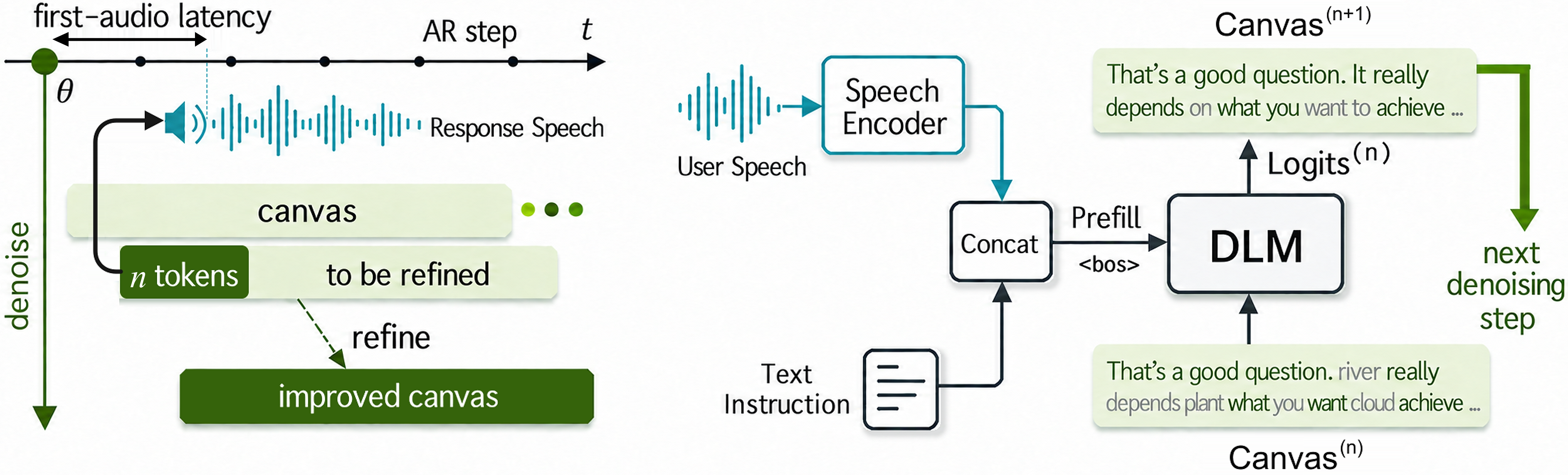
NVIDIA's entry attacks the classic latency-vs-intelligence tradeoff by decoupling timing from content: an autoregressive module decides when to speak, while a parallel discrete diffusion process refines what to say. This lets the model beat both real-time and high-quality baselines simultaneously, a result that has been elusive in prior full-duplex work.
Full-duplex Spoken Language Modeling with Discrete Diffusion
This work presents a full-duplex spoken dialogue model that decouples response timing from content generation using discrete diffusion, enabling real-time interaction while maintaining strong linguistic performance. By separating when to speak (via autoregressive interaction) from what to say (via parallel diffusion refinement), the model surpasses both real-time and high-quality baselines without requiring the typical latency-intelligence tradeoff.
Abstract
We introduce Diffuplex, a full-duplex spoken language model based on discrete diffusion that achieves an unprecedented balance between linguistic intelligence and response efficiency. With thinking mode, Diffuplex delivers 13.0 tokens per forward pass, reaching an average of 1872 tokens per second and substantially surpassing the frontier autoregressive (AR) models in decoding speed. Without thinking, Diffuplex matches the first-audio latency of existing full-duplex models while achieving markedly stronger linguistic intelligence. This capability is enabled by separating when to say from what to say at the training level, rather than compressing both into a single autoregressive timeline. During inference, Diffuplex continuously tracks the user speech through an AR interaction policy, while independently generating and refining response content through parallel diffusion. Consequently, semantic computation is no longer bounded by the perception audio frame rate, allowing intelligence and responsiveness to improve simultaneously. Taken together, these results establish a new paradigm for spoken agents that can sustain real-time dialogue while devoting parallel computation to intelligent response generation. Training code and checkpoints will be avaliable soon.
Rounding out this cluster, Toyota Technological Institute at Chicago addresses a different bottleneck: speech-to-speech models lag far behind text LMs in linguistic and factual quality. Their approach trains a speech-to-speech LM that predicts text internally as an intermediate step, enabling knowledge distillation from powerful pretrained text LMs while keeping speech-only inputs and outputs. This is the first application of text LM distillation to end-to-end speech-to-speech generation, and the factual quality gains over speech-only baselines are substantial.
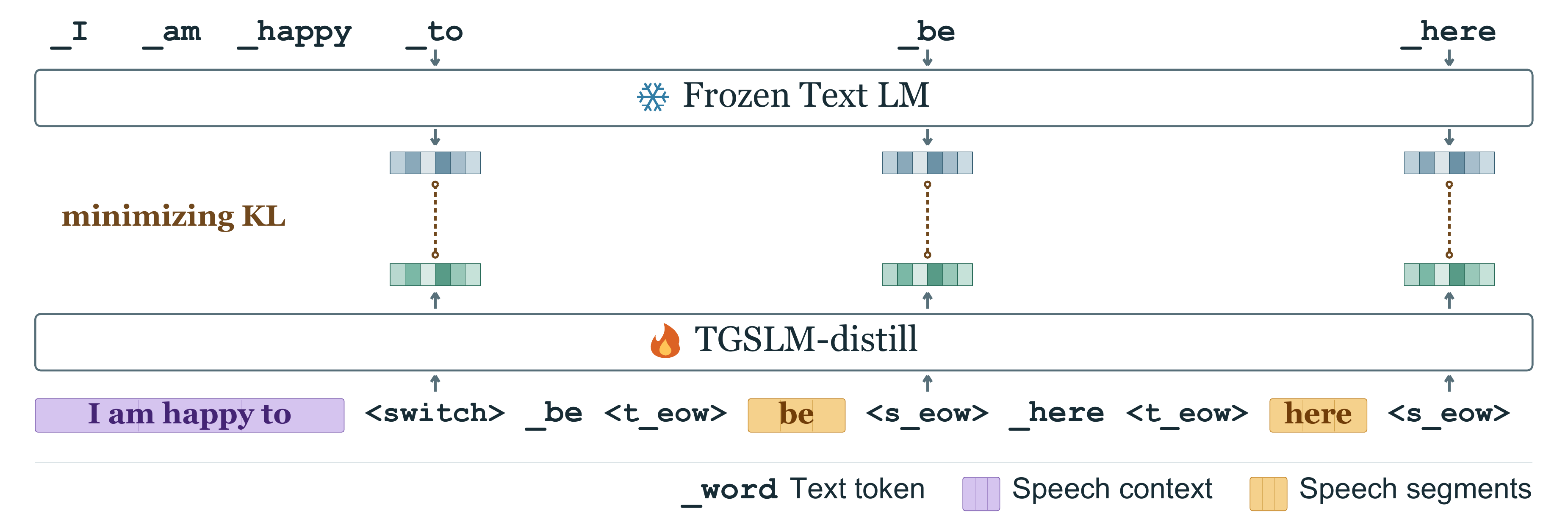
Distilling Text LMs into Speech-to-Speech LMs by Matching Internal Text Predictions
This work introduces a speech-to-speech language model that learns to predict text internally as an intermediate step, enabling knowledge distillation from pretrained text language models while maintaining speech-only input and output. This is the first application of text LM distillation to end-to-end speech-to-speech generation, substantially improving both linguistic and factual capabilities compared to speech-only baselines.
Abstract
Text language models (LMs) acquire broad linguistic and factual capabilities through large-scale pretraining, while comparable capabilities remain difficult to learn from speech alone. Recent work has shown that knowledge distillation from pretrained text LMs offers a promising way to transfer their linguistic and factual capabilities to speech models. However, existing distillation approaches have largely focused on speech-input, text-output models. This idea has yet to be explored for {\it speech-to-speech} models, which operate on both speech input and speech output. In this work we introduce a speech-to-speech pretraining method that creates an internal text interface for knowledge transfer while preserving the speech-only input and output. The model first consumes speech context without its transcription, switches to text prediction, and then uses the predicted text to lead future speech generation word by word. It also provides an interface for knowledge distillation: the internal text predictions can be directly distilled from the base text LM. To the best of our knowledge, this is the first application of text LM distillation to a speech-to-speech LM. Under matched training conditions, the proposed sequence construction substantially improves the generative perplexity of spoken continuations over speech-only and interleaved speech-text models, approaching the performance of a text-leading inner-monologue model with external ASR prompt transcription. More importantly, distillation improves factual performance under both text and speech evaluation, indicating better retention of knowledge from the base text language model.
TTS & Voice Synthesis
From drama-scale multi-character production to compact zero-shot synthesis, the TTS front is moving fast.
From today's Hugging Face Daily tab, Fish Audio's Fish Audio Drama 3 stands out as an ambitious open-source release targeting full production pipelines. A single unified model handles multi-turn script revision, scene dubbing, edit-by-infilling, and streaming inference — all with voice cloning. The architecture pairs a hybrid linear-attention backbone with a novel codebook multi-token-prediction decoder, targeting the kind of directed multi-character performance that previously required bespoke toolchains.
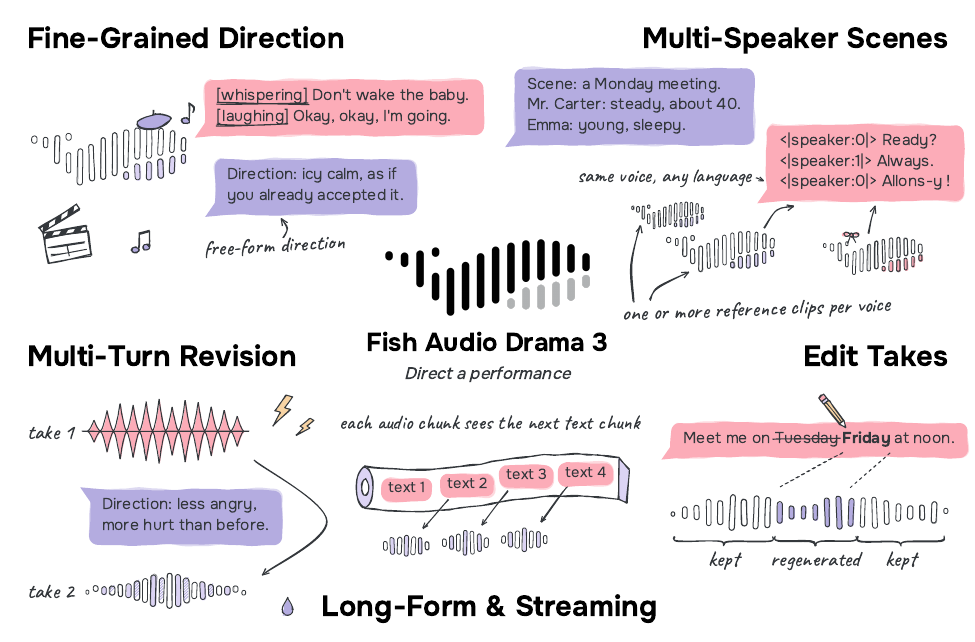
Fish Audio Drama 3 Technical Report
Fish Audio Drama 3 is an open-source speech synthesis model that converts text into directed multi-character performances with voice cloning and streaming capabilities. It uniquely combines multi-turn revision, scene dubbing, edit-by-infilling, and streaming inference in a single unified model, leveraging a hybrid linear-attention backbone and a novel codebook multi-token-prediction decoder.
Abstract
We introduce Fish Audio Drama 3, an open-source speech generation model that turns text into directed performances, built on a 35B-parameter mixture-of-experts backbone that activates 3B parameters per token. It clones voices from multiple references, follows natural-language direction, revises a take when the next turn gives a note, voices multi-character scenes, edits existing speech by infilling, and synthesizes long-form and streaming audio. Multi-turn revision, scene dubbing, editing by infilling, and streaming text input are new in Drama 3, all in one model. Drama 3 pairs the hybrid linear-attention backbone with a new codebook multi-token-prediction audio decoder that predicts the acoustic codebooks of each frame in dedicated layers that attend over the entire sequence. The model is trained with a three-stage pre-training recipe, instruction fine-tuning, and large-batch reinforcement learning whose only reward is a single learned model of human preference. Its inference engine decodes a single stream at 271 frames per second on one H200, against 177 for Fish Audio S2, although Drama 3 has more than seven times as many parameters. The model weights are available on GitHub (https://github.com/fishaudio/fish-speech) and Hugging Face (https://huggingface.co/fishaudio/drama-3), and inference is available through SGLang-Omni (https://github.com/sgl-project/sglang-omni). We highly encourage readers to visit https://fish.audio to direct their own performances.
On the compact synthesis side, Runyuan Cai et al. argue that optimizing for intelligibility metrics leaves a persistent prosodic realism gap. Their zero-shot TTS model instead trains with a learned realism critic — bootstrapped via a quality ladder of open-source TTS outputs — and uses reinforcement learning to close the gap between synthetic and human-sounding speech, all within a small model footprint.
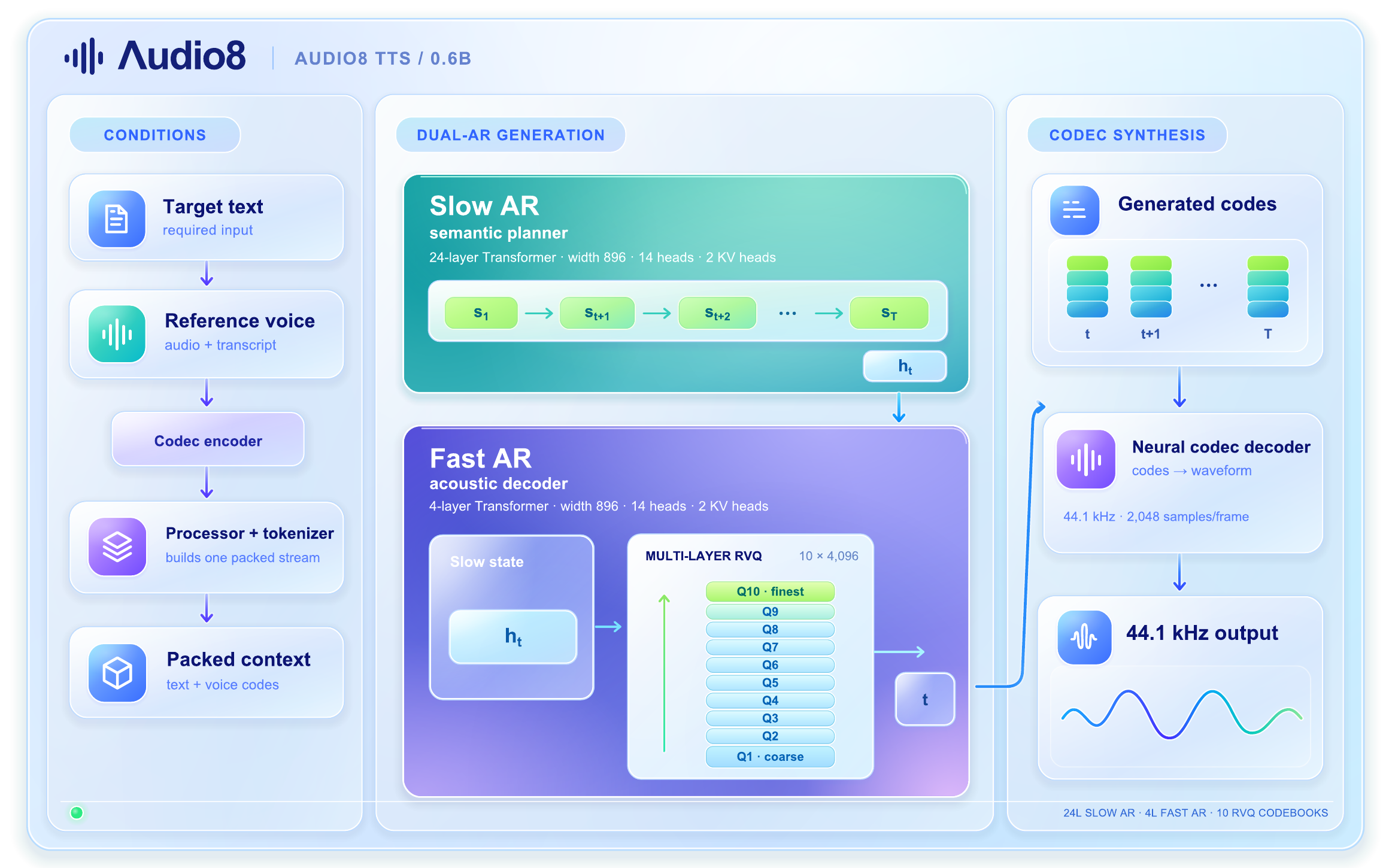
Training a Compact, Strong, and Realistic Text-to-Speech Model
A compact zero-shot TTS model that improves perceived naturalness by training with a learned realism critic instead of relying solely on intelligibility metrics. The approach uses a quality ladder from open-source TTS systems to guide reinforcement learning, specifically targeting the prosodic detail gap between synthetic and human speech.
Abstract
Text-to-speech (TTS) systems are conventionally optimized for intelligibility and speaker similarity. However, neither objective captures the prosodic detail that distinguishes human performances from synthetic speech, leaving a realism gap that larger models and higher-quality data can narrow but not close. In the absence of an objective that directly targets this gap, realism remains a persistent challenge in TTS. We present Audio8-TTS, a compact 0.6B-parameter model for zero-shot voice cloning that achieves state-of-the-art performance in intelligibility and speaker similarity, with particularly strong results in perceptual naturalness. To align the training signal with human perception rather than signal-level fidelity, we construct a quality ladder from widely used open-source TTS systems and train a realism critic to assess generated speech against matched human recordings of the same sentences. An identity-erasure objective discourages the critic from relying on generator fingerprints. We train the model in three stages: multilingual supervised fine-tuning; group relative policy optimization (GRPO) with word error rate (WER) and speaker similarity (SIM) rewards; and GRPO guided by the realism critic. The final stage improves perceived prosodic naturalness and speaker similarity while preserving WER performance.
Talking Avatars & Portrait Animation
Two papers push portrait animation in complementary directions: tighter generative model integration and cross-species identity transfer.
Tsinghua's CatPortrait sidesteps the usual dilemma of fine-tuning vs. adapter modules by injecting 3D facial geometry as in-context conditioning directly in the input space of pretrained video generative models. Because no architectural modifications are needed, the approach is drop-in compatible with existing backbones and supports both audio-driven and motion-driven animation modes while preserving the model's learned priors.
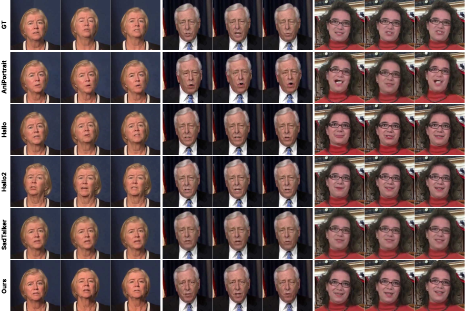
CatPortrait: Taming Video Generative Models for Portrait Animation via In-context Conditioning
CatPortrait enables controllable portrait animation by injecting 3D facial geometry as in-context conditioning directly into pretrained video generative models, avoiding architectural modifications while supporting both audio-driven and motion-driven animation. The approach preserves model priors by conditioning in the input space rather than through additional modules, making it compatible with existing pretrained backbones.
Abstract
Recent video generative models have shown strong capability in synthesizing high-quality and temporally coherent videos. Yet, adapting them for controllable portrait animation remains nontrivial, as existing methods typically rely on architectural changes or extra conditioning modules, increasing complexity and reducing compatibility with pretrained models. We present CatPortrait, a simple and effective framework that enables controllable portrait animation via 3D face guidance as in-context conditioning. CatPortrait preserves the original video generation backbone and injects structured 3D facial guidance into the input space through spatial concatenation, allowing pretrained image-to-video models to animate portraits without sacrificing their pretrained priors. CatPortrait supports both video-driven and audio-driven portrait animation within a unified framework. Extensive experiments demonstrate that CatPortrait achieves competitive or superior results across both settings.
CrossPortrait from USTC tackles a genuinely novel problem: animating a human face with an animal driving video (or vice versa) without leaking the driving species' appearance into the output. The solution decomposes motion into head poses and expressions, routes them through species-specific encoders, and applies adversarial adaptation to suppress species leakage — preserving source identity and species-specific facial structure where prior methods failed.
CrossPortrait: Cross-Species Portrait Animation via Adversarial Motion Alignment
CrossPortrait enables portrait animation across species boundaries—animating human faces with animal videos and vice versa—by decomposing motion into head poses and expressions while using species-routed encoders and adversarial adaptation to suppress species leakage. This solves the key challenge of preserving source identity and species-specific facial structure, where prior methods often transferred unwanted driving-species characteristics.
Abstract
Cross-species portrait animation, which aims to animate a source portrait of species A using a driving video of species B, is particularly challenging due to substantial anatomical differences in facial structures across species. Previous works typically fine-tune human portrait animation models on animal video datasets but often suffer from driving-species leakage. To address this, we propose CrossPortrait, a novel framework for expressive cross-species portrait animation, supporting diverse scenarios including human-to-animal, animal-to-human and cross-species animal-to-animal (e.g. cat-to-dog) animation. Specifically, we decompose the portrait motion into rigid head poses and expression keypoints. To accommodate species-specific facial structures while facilitating cross-species expression alignment, we introduce a species-routed expression encoder that incorporates species-specific LoRAs into a unified expression encoder. Furthermore, we introduce expression-level adversarial domain adaptation (Ex-ADA) to suppress driving-species-specific information in the expression latents, thereby mitigating species leakage and promoting a shared expression space across species. Extensive experiments show that our method enables expressive and identity-preserving portrait animation across diverse species and outperforms other state-of-the-art approaches.
Trending on Hugging Face

Qwen3-TTS Technical Report
The Qwen3-TTS series presents advanced multilingual text-to-speech models with voice cloning and controllable speech generation capabilities, utilizing dual-track LM architecture and specialized speech tokenizers for efficient streaming synthesis.

VibeVoice Technical Report
VibeVoice synthesizes long-form multi-speaker speech using next-token diffusion and a highly efficient continuous speech tokenizer, achieving superior performance and fidelity.
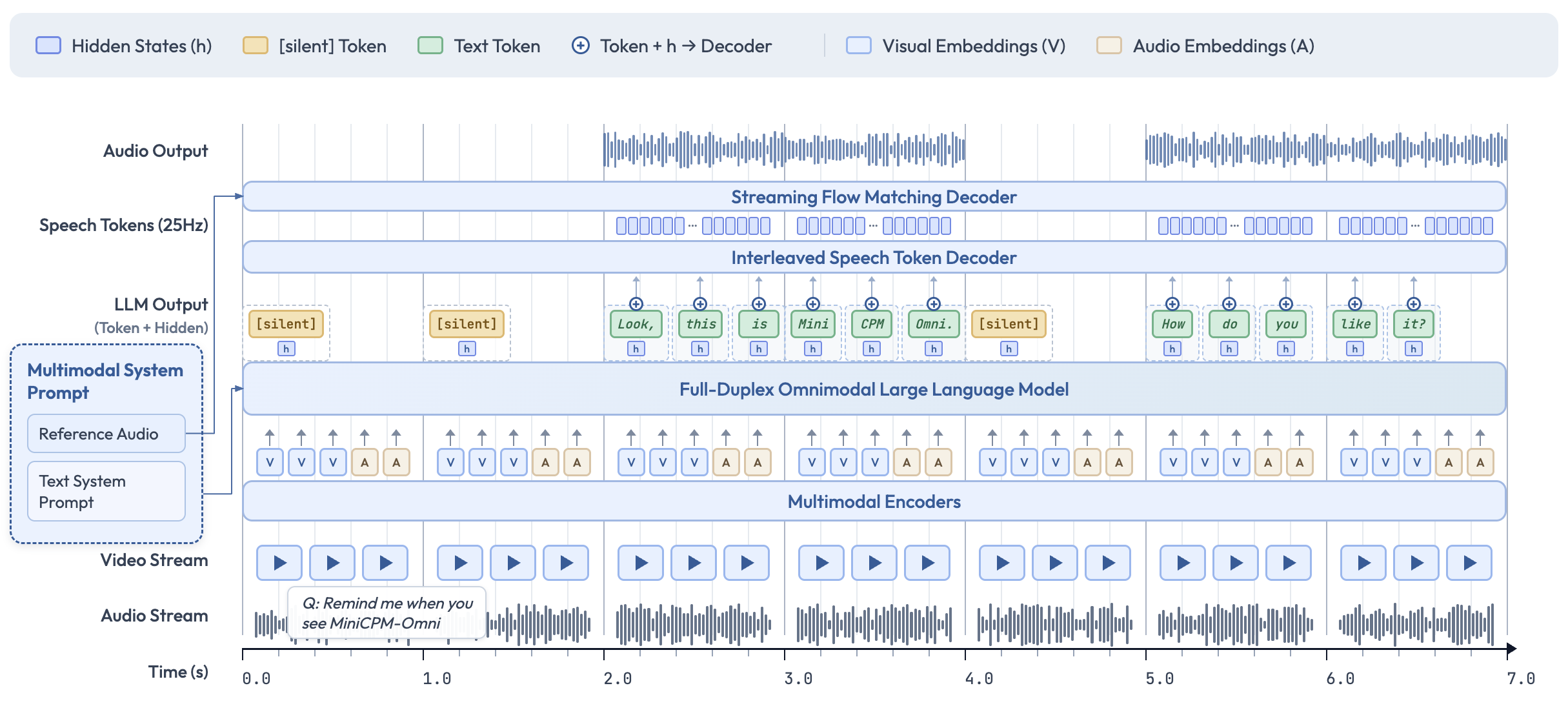
MiniCPM-o 4.5: Towards Real-Time Full-Duplex Omni-Modal Interaction
MiniCPM-o 4.5 enables real-time full-duplex interaction where perception and response happen simultaneously across vision, audio, and speech. Its Omni-Flow framework aligns multimodal signals on a shared timeline, supporting both reactive and proactive behaviors in continuous, streaming conversation.

OmniFlatten: An End-to-end GPT Model for Seamless Voice Conversation
A novel GPT-based model, OmniFlatten, enables real-time natural full-duplex spoken dialogue through a multi-stage post-training technique that integrates speech and text without altering the original model's architecture.