
Talking Avatars, Smarter TTS, and the Challenge of Multi-Party Dialogue
Today's digest covers open-source audio-driven avatar generation, a wave of TTS advances tackling long-form synthesis, prosody cloning, noise adaptation, and masked diffusion refinement, plus new benchmarks for visual speech and multi-party floor control.
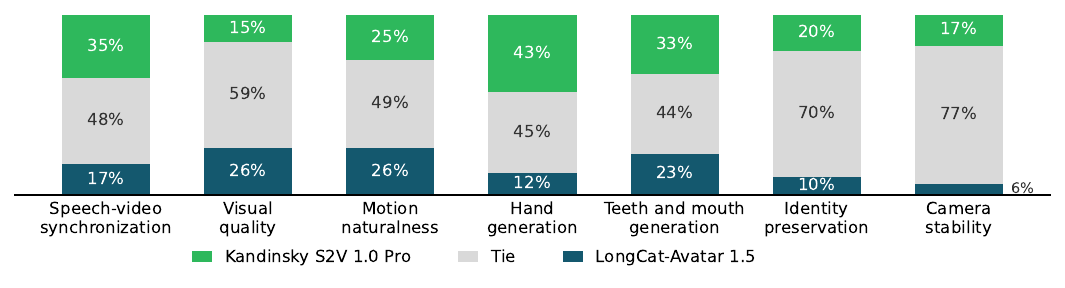
Kandinsky S2V 1.0 Pro versus LongCat 1.5, HD. From Sber AI.
A strong Thursday for the field: Sber AI ships a competitive open-source talking-head system, three Tsinghua and KAIST papers push TTS further along the length and expressiveness axes, Alibaba tackles a fundamental flaw in masked diffusion synthesis, and Maryland + Meta close things out with benchmarks and compact multilingual ASR. Here's what landed today.
Talking Avatars & Audio-Driven Animation
From open-source talking heads to phoneme-discriminative visual speech — two papers advance the audio-visual synthesis stack.
Sber AI's Kandinsky S2V 1.0 enters a competitive space by combining audio-text conditioning with a visual memory mechanism to generate expressive talking-head video from a single reference image and speech. What makes it notable is the release strategy: both lightweight and high-capacity variants are open-sourced, and distilled versions run 5.4× faster with maintained quality, putting results in the same ballpark as proprietary systems.
Kandinsky S2V 1.0: Audio-Driven Avatar Video Generation
Kandinsky S2V generates expressive talking-head videos from speech and a single reference image, combining audio-text conditioning with visual memory to achieve results competitive with proprietary systems. The approach includes distilled variants that run 5.4× faster while maintaining quality, and releases both lightweight and high-capacity models under an open-source license.
Abstract
We present Kandinsky S2V 1.0, an open family of speech-to-video models for controllable audio-driven human animation, comprising Kandinsky S2V 1.0 Lite (2B parameters) and Kandinsky S2V 1.0 Pro (21B parameters). From a single reference image, a speech waveform, and a text prompt, the models generate long-form 25 FPS video in which lip motion, expression, pose, and gesture follow the speech. The architecture draws text and audio conditioning from one Qwen2.5-Omni model and adds a reference-aware three-scale visual memory. Training starts from the Kandinsky 5.0 Video foundation models [1] and combines mixed reference-memory layouts with an area-adaptive face loss. The training corpus contains 1.17M single-speaker clips selected by active-speaker detection, with captions generated directly in English and Russian. A side-by-side human evaluation against the strongest open-source baseline and two proprietary commercial models shows that Kandinsky S2V 1.0 Pro performs comparably to or better than these models on average and is also preferred for lip synchronization. On common speech to video benchmarks, Kandinsky S2V 1.0 Lite and Kandinsky S2V 1.0 Pro rank among the top performing models according to mean rank over five reported metrics. Beyond the base models, we provide π-Flow distilled variants of both Kandinsky S2V 1.0 Lite and Kandinsky S2V 1.0 Pro. The distilled Kandinsky S2V 1.0 Pro model generates video in 16 sampling steps without classifier-free guidance, achieving a 5.4 times end-to-end speedup over the base model, while matching or exceeding it on nearly all reported benchmark metrics. To accelerate open research and deployment in speech-to-video generation, we release the code, model checkpoints, and diffusers integration under the MIT license.
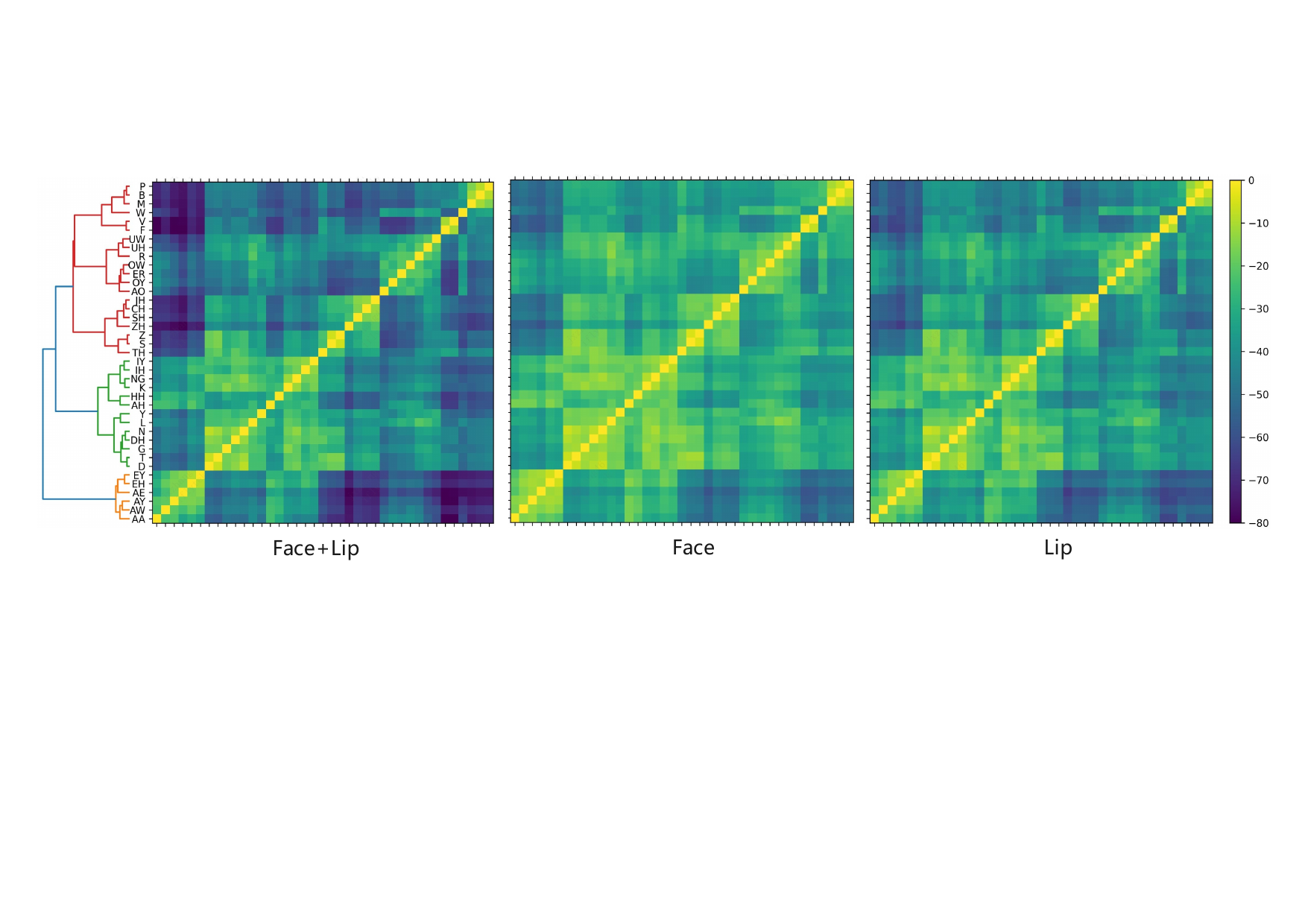
On the visual speech understanding side, FLARE from Shaanxi Normal University approaches the problem from a representation learning angle. Rather than treating the lip region in isolation, FLARE uses a dual-stream architecture that jointly processes lip crops and full-face frames, distilling supervision from Whisper via cross-modal alignment. The dual-stream design pays off particularly under video degradation and head-pose variation — conditions that routinely break single-stream lip readers — and yields more phoneme-discriminative embeddings overall.
Learning Visual Speech Representations via Cross-Modal Distillation and Joint Face-Lip Modeling
FLARE learns robust visual speech representations by combining cross-modal distillation from Whisper with a dual-stream architecture that jointly processes lip and full-face regions. This joint modeling approach explicitly improves robustness to video degradation and head pose variation while producing more phoneme-discriminative representations than single-stream methods.
Abstract
Lipreading remains challenging due to the inherent ambiguity of visual speech cues and their sensitivity to head pose and video resolution. In this work, we propose FLARE, a framework for robust visual speech representation learning via cross-modal distillation and joint face-lip modeling. FLARE leverages semantically rich Whisper representations as the acoustic teacher signal, converting them into discrete distillation targets through a random-projection quantizer and pretraining the model with a masked prediction objective. To capture complementary visual information, FLARE employs a dual-stream architecture that jointly processes lip region-of-interest (ROI) and full-face inputs, where the lip stream captures finegrained articulatory motion and the face stream encodes broader facial dynamics. During pretraining, auxiliary audio input is incorporated to facilitate cross-modal alignment, and modality dropout is applied to encourage robust visual-only representations. For downstream lipreading, FLARE serves as a visual encoder coupled with either a lightweight Transformer decoder or an LLM-based decoder. Evaluated on LRS2, LRS3, and the out-of-domain WildVSR benchmark, FLARE achieves strong lipreading performance, with word error rates of 11.7%, 13.2%, and 34.3%, respectively. A progressive design study confirms the contribution of each major component. Further analyses demonstrate that joint face-lip modeling improves robustness under degraded video resolution and large head pose variation, while yielding more phoneme-discriminative visual representations. Code and pretrained models are available at https://github.com/jxzhanggg/FLARE.
TTS & Voice Synthesis
Four papers this week collectively tackle error accumulation in discrete diffusion, prosody cloning from long prompts, length generalization in streaming models, and noise-adaptive speech.
Fixing Masked Diffusion's Commitment Problem
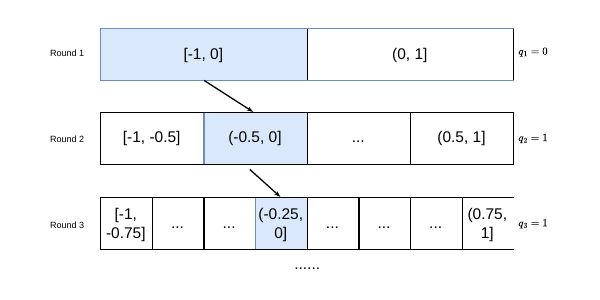
Masked diffusion TTS models suffer from a subtle but damaging flaw: once intermediate tokens are predicted, they're locked in — errors accumulate and can't be corrected. Alibaba DAMO Academy's Revise-TTS breaks this commitment by introducing hierarchical binary quantization and generative refinement networks that allow the model to revisit and self-correct token predictions iteratively during inference. The result is improved zero-shot synthesis quality without requiring changes to the upstream masked diffusion architecture.
Revise-TTS: A Non-Masking Refinement Framework for Masked Diffusion Models in Text-to-Speech
This paper introduces a non-masking refinement framework for masked diffusion TTS that addresses error accumulation by enabling iterative self-correction of predicted tokens. Unlike standard masked diffusion models that commit to intermediate predictions, the approach uses hierarchical binary quantization and generative refinement networks to allow revisable predictions during inference, improving zero-shot speech synthesis quality.
Abstract
Text-to-speech (TTS) based on masked diffusion models (MDMs) achieves competitive zero-shot speech synthesis performance. Unlike autoregressive (AR) models, MDMs define a corruption process that maps clean speech-token sequences to masked maps and learn a reverse denoising process to recover the reference tokens. However, MDMs commit to intermediate predictions that cannot be revised in subsequent inference steps. Consequently, prediction errors accumulate and propagate, degrading synthesized speech quality. We present Revise-TTS, a single-stage framework that applies hierarchical binary quantization (HBQ) and generative refinement networks (GRN) to zero-shot speech generation. First, we replace finite scalar quantization (FSQ) with HBQ to introduce a scalable binary representation for speech tokens with an explicit coarse-to-fine structure. Second, GRN is trained to reconstruct the token sequence from a mixture of ground-truth and random tokens. During inference, iterative refinement enables self-correction by randomly discarding a small proportion of previously predicted tokens with new predictions. Experiments and ablation studies demonstrate that Revise-TTS achieves competitive zero-shot speech synthesis performance using HBQ. It can further be extended to any MDM-based TTS task as an alternative training and inference method.
Going Beyond Voice Cloning with Long Prompts
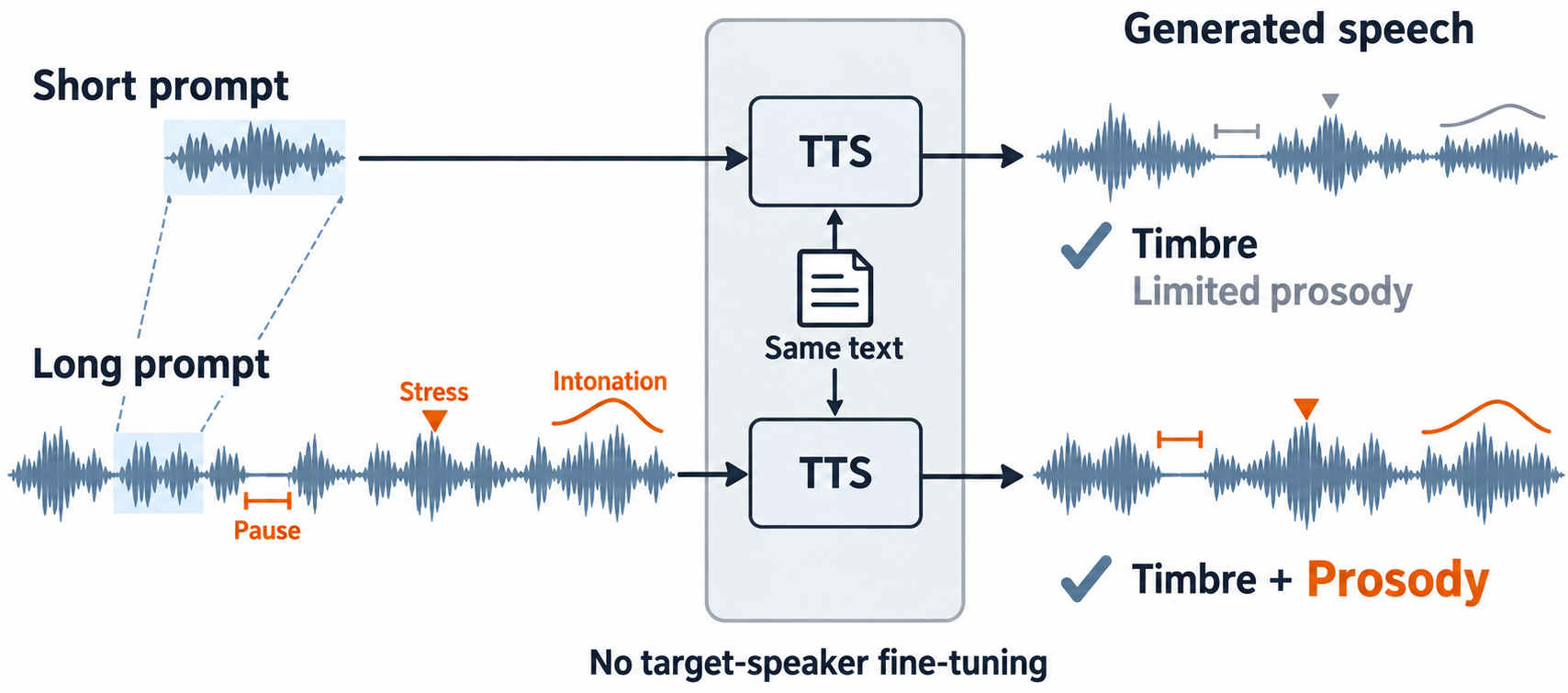
Standard zero-shot TTS captures voice timbre but often misses the finer grain of a speaker's prosody — their characteristic timing, prominence patterns, and intonation contours. Tsinghua University's LPTTS system compresses long reference speech (up to ~10 minutes) into compact prosodic vectors at inference time, and the accompanying LP-TTS-Bench provides the first bilingual benchmark with comprehensive prosody evaluation metrics. Crucially, performance scales consistently with prompt length, suggesting that speaker-specific prosody is a learnable target given enough reference signal.
Long-Prompt Zero-Shot TTS: Benchmarking Prosody Reproduction Beyond Voice Cloning
This paper extends zero-shot text-to-speech by using long speech prompts at inference time to reproduce speaker-specific prosody—including timing, prominence, and intonation—without fine-tuning. It introduces LP-TTS-Bench, a bilingual benchmark with comprehensive prosody evaluation, and LPTTS, a system that compresses long prompts into prosodic vectors, showing consistent improvements as prompt length increases up to approximately 10 minutes.
Abstract
Zero-shot text-to-speech (TTS) typically conditions on a short speech prompt, which conveys timbre but provides only limited evidence of a speaker's prosodic patterns. We formulate Long-Prompt Zero-Shot TTS, a task that uses long speech prompts at inference time to reproduce speaker-specific prosody without target-speaker fine-tuning. We introduce LP-TTS-Bench, a bilingual benchmark of 37 speakers with 63.95 prompt hours and 2,728 held-out test utterances. Beyond intelligibility and timbre similarity, LP-TTS-Bench evaluates timing, prominence, intonation, and model-based prosody metrics, enabling multidimensional evaluation of prosody reproduction. As a reference system, we develop LPTTS, whose hierarchical Long-Prompt Encoder compresses long speech prompts into a fixed number of continuous prosody vectors. Experiments show improvements in several prosodic dimensions over a short-prompt baseline, with overall gains as prompt duration increases up to approximately 10 minutes and saturation at longer durations.
Long-Form Generation Without Retraining
Streaming TTS models are typically trained on short utterances, so quality degrades when generation runs past the training length horizon. KAIST's work dissects exactly why this happens — diagnosing failure modes in attention and prompt weighting — and proposes lightweight, training-free fixes that extend generation to arbitrary lengths while preserving both pronunciation accuracy and speaker identity. No fine-tuning required.
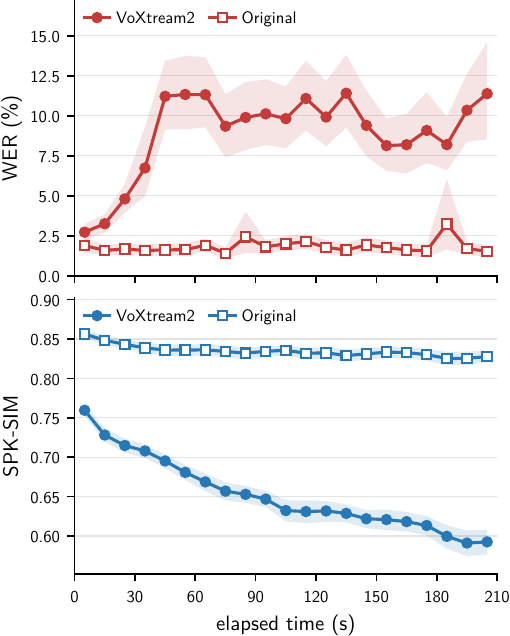
Speaking Longer Than Learned: Training-Free Long-Form Generation for Full-Stream Text-to-Speech
This work extends streaming text-to-speech models to generate speech beyond their training length without retraining by analyzing quality degradation mechanisms and proposing lightweight modifications to attention and prompt weighting. The approach preserves both pronunciation accuracy and speaker identity throughout long-form generation while maintaining naturalness.
Abstract
Recent full-stream text-to-speech (TTS) models enable low-latency personalized synthesis as input text arrives. However, sustaining generation beyond the lengths seen during training without additional training remains largely unexplored. We systematically analyze VoXtream2, which extends generation by periodically discarding past context while retaining the acoustic prompt. We find that this strategy does not prevent degradation: pronunciation accuracy deteriorates near the end of the training range due to the range of positions in which the model operates rather than the loss of past context, while speaker similarity gradually declines throughout generation. Based on these findings, we propose two training-free modifications that reduce the attention window and strengthen attention to the acoustic prompt. Experiments show that these modifications preserve pronunciation accuracy and speaker similarity throughout long-form generation while retaining the naturalness of the original model. Ablations further show complementary effects of the two modifications.
Teaching TTS to Raise Its Voice
The Lombard effect is the involuntary tendency of human speakers to increase vocal effort in noisy environments. Tsinghua University's Flow-GRPO system brings this behavior to TTS: it combines flow-matching synthesis with reinforcement learning to train a model that adaptively modulates pitch, frequency emphasis, and other prosodic features in proportion to measured environmental noise. The practical payoff is a voice agent that stays intelligible in real-world conditions without manual intervention.

Noise-Aware Lombard Speech Synthesis via Flow-GRPO for Intelligibility Optimization
This work enables voice conversational agents to automatically adjust their speech in response to environmental noise, mimicking the human Lombard effect to maintain intelligibility. By combining flow-matching synthesis with reinforcement learning optimization (Flow-GRPO), the system learns to adaptively modulate prosodic and spectral features—such as pitch and frequency emphasis—proportional to noise intensity, ensuring robust communication in real-world noisy environments.
Abstract
Voice-based conversational agents are increasingly deployed in real-world settings, where environmental noise often degrades the interactive experience. Therefore, robust acoustic adaptability is essential to maintain natural and intelligible human-computer communication. However, most existing systems remain acoustically insensitive and fail to emulate the human Lombard effect, in which speakers involuntarily adjust their vocal production to preserve intelligibility in the presence of noise. As a result, their communicative reliability degrades under adverse acoustic conditions. To remain intelligible in noisy environments, conversational agents require a mechanism to emulate noise-induced adaptive behavior during synthesis. We propose NIL-TTS, a noise-induced Lombard TTS framework. We integrate a feature-wise linear modulation (FiLM) mechanism into a flow-matching backbone for dynamic vocal adaptation. A two-stage training paradigm is utilized: initial supervised fine-tuning on paired Lombard corpora, followed by Flow-GRPO post-training to optimize for intelligibility. Evaluations confirm that NIL-TTS autonomously adjusts its output in response to varying noise conditions, exhibiting key correlates of the human Lombard effect. Driven by these adaptive modulations, the synthesized speech achieves significant intelligibility improvements that scale proportionally with noise intensity. Ultimately, this work presents a flow-matching and reinforcement learning-based advancement within the adaptive Lombard speech synthesis paradigm for challenging real-world scenarios.
SpeechLLMs, Voice Agents & Spoken Dialogue
A new benchmark exposes a blind spot in multi-party turn-taking, while Meta's CAFE solves the distillation trade-off in multilingual ASR.
Floor Control Is Harder Than It Looks
Turn-taking in two-party conversation is a largely solved engineering problem — but multi-party dialogue is another matter. MultiPartyTurnBench from the University of Maryland is the first benchmark specifically designed for floor control in group settings, with two tasks: (1) distinguishing genuine turn completions from mid-turn holds, and (2) identifying successful interruptions versus non-floor-taking backchannels. The findings are sobering: current systems score 82–92% recall on turn endings but fail badly at selective interruption handling. This paper makes the case that multi-party floor control is a distinct, unsolved challenge deserving its own research track.
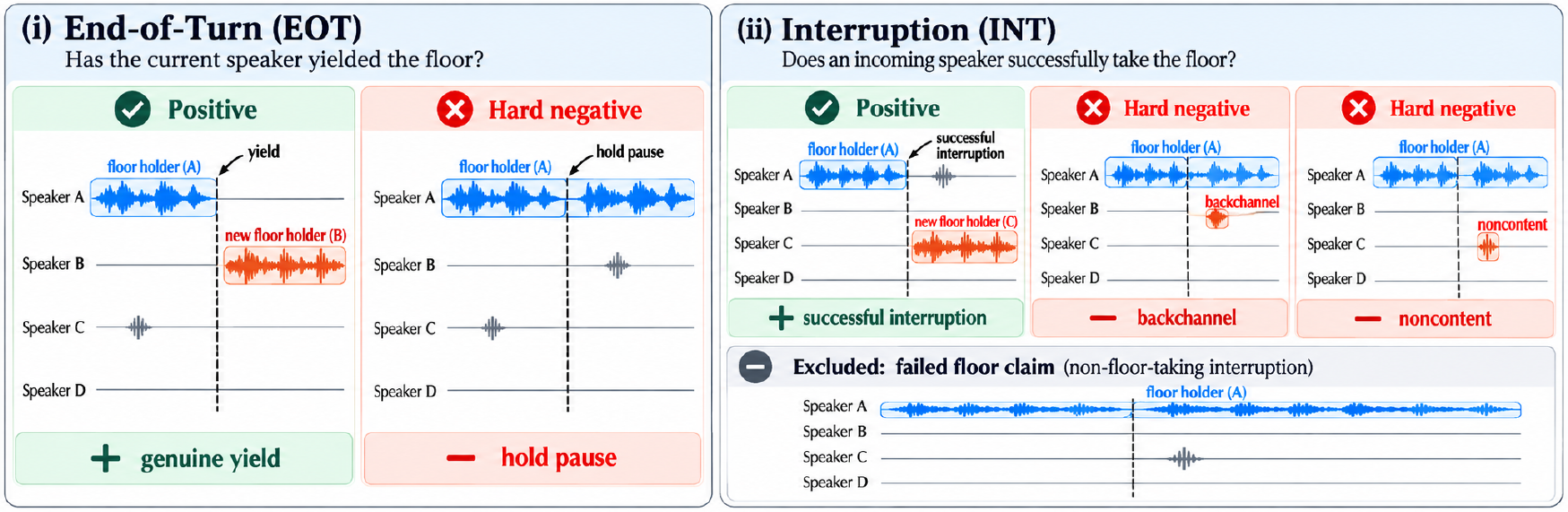
MultiPartyTurnBench: Benchmarking Floor Control in Multi-Party Spoken Dialogue
MultiPartyTurnBench is the first benchmark for evaluating floor control in multi-party conversations, with two detection tasks: distinguishing genuine turn completion from temporary holds, and successful interruptions from non-floor-taking speech. The work reveals that current systems excel at turn-ending (82–92% recall) but fail at selective interruption handling, establishing this as a distinct unsolved challenge for conversational AI.
Abstract
Full-duplex speech systems must decide when to enter, hold, or relinquish the conversational floor, even as multiple speakers overlap or backchannel without taking it. Existing evaluations study dyadic turn-taking or end-to-end agent behavior, but lack a unified, controlled evaluation of genuine floor transitions against confusable non-events in multi-party settings. We introduce MultiPartyTurnBench (MPTB), a benchmark of 240 synthetically generated, channel-separated conversations spanning two to five speakers and six interaction types. MPTB evaluates two complementary tasks: End-of-Turn (EOT) detection distinguishes genuine turn completion from temporary holds, while Interruption (INT) detection distinguishes successful floor takeovers from non-floor-taking speech. Exact event-conditioned annotations enable causal evaluation using false-positive-constrained recall and signed latency. Across acoustic, semantic, and turn-projection baselines, we find a stark asymmetry: learned systems achieve 82.5-92.6% EOT recall at 4.3-11.8% false-positive rates, while INT detection suffers from missed takeovers or excessive false activations. This asymmetry extends to five full-duplex agents which achieve 86.1-95.8% balanced accuracy on turn entry, yet perform near chance (46.9-54.7%) on selective interruption handling. Gemini-3.8-Live yields to 97.7% of backchannels, whereas MiniCPM-o-4.5 yields to only 1.4% of genuine interruptions. These findings establish selective floor control as a distinct, unresolved challenge for reliable multi-party voice interaction.
Language-Routed Distillation for Multilingual ASR
Feature distillation is a powerful compression tool for multilingual ASR, but it creates an uncomfortable trade-off: it typically hurts high-resource languages (like English) while helping low-resource ones. Meta AI's CAFE resolves this by routing distillation gradients exclusively through language-specific adapters that bypass the shared encoder entirely, rather than applying distillation uniformly. The 254M-parameter result achieves strong multilingual performance without regressing on English — a clean architectural solution to what has been an empirically frustrating balancing act.
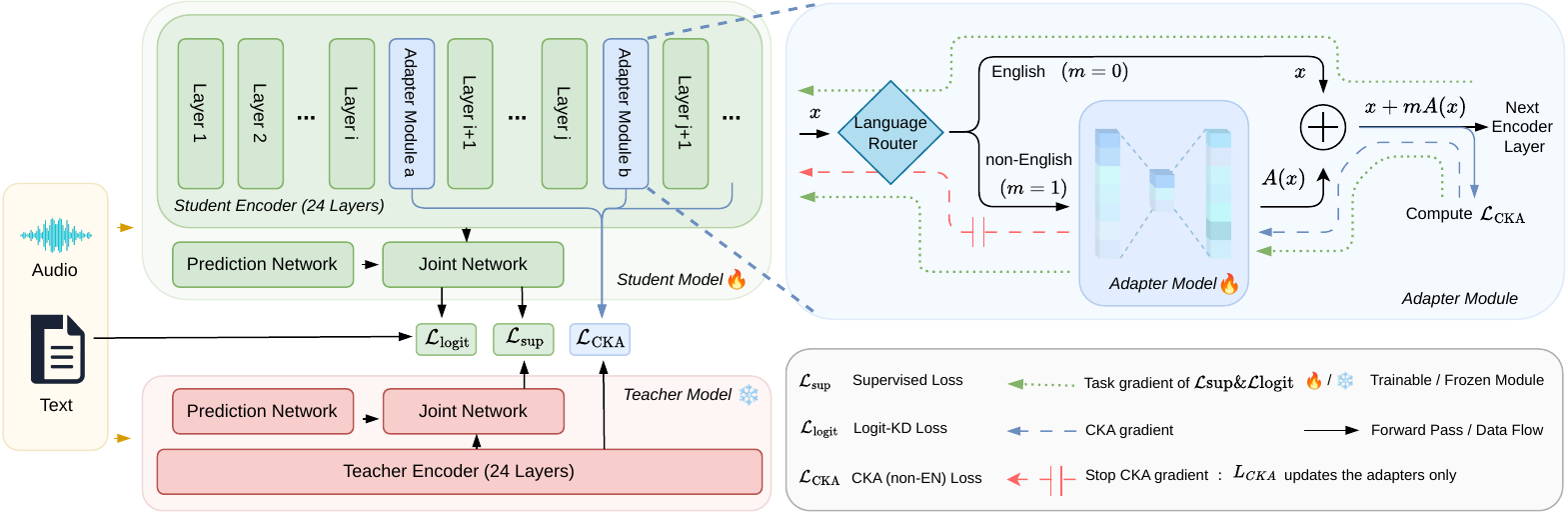
CAFE: Confining Feature Distillation to Language-Routed Adapters for Compact Multilingual Automatic Speech Recognition
This paper addresses a fundamental problem in multilingual ASR: feature distillation typically harms high-resource languages while helping low-resource ones. CAFE solves this trade-off by confining feature distillation gradients to language-specific adapters that bypass the shared encoder, rather than applying distillation uniformly across the model. The result is a compact 254M parameter system that achieves better multilingual performance while maintaining stability for English.
Abstract
Feature distillation is usually expected to add to logit distillation. We find that this expectation does not hold for two common feature losses in compact multilingual automatic speech recognition (ASR), and analyze why through their gradients. The gradient of a projection-based loss is orthogonal to the task gradient, while that of Centered Kernel Alignment (CKA), a similarity-based loss, is weakly aligned with it. CKA lowers the word error rate (WER) on non-English languages, but at the expense of data-rich English. Three loss-level remedies (one trained, two probed) all fall short, and the CKA gradient overlaps with the subspace English uses in the shared encoder by 97.5% to 99.5% (about 81% by chance). Guided by this diagnosis, we propose CAFE (Confined-Adapter Feature distillation), which confines the CKA gradient to adapters that English bypasses, addressing the trade-off in the parameters rather than in the loss. On the Open ASR Leaderboard, CAFE lowers the average WER from 8.55% to 8.02%, beats an adapter-only capacity control at 8.51%, and makes English more stable across checkpoints. At 254M parameters, it trails the 0.6B teacher by 2 WER points and is competitive with much larger models across 48 test sets in 24 languages. We use 564k hours of training data and state-of-the-art models to keep the findings relevant to practice.
Trending on Hugging Face

Kandinsky 6.0 Video: Foundation Models for Synchronized Video and Audio Generation
Kandinsky 6.0 Video is a family of diffusion models that generate synchronized audio-video clips with lip-sync via a dual-stream CrossDiT architecture and multi-stage training.

Fish Audio S2 Technical Report
Fish Audio S2 is an open-source text-to-speech system with multi-speaker capabilities, multi-turn generation, and instruction-following control through natural-language descriptions, utilizing a multi-stage training approach and production-ready inference engine.

OmniFlatten: An End-to-end GPT Model for Seamless Voice Conversation
A novel GPT-based model, OmniFlatten, enables real-time natural full-duplex spoken dialogue through a multi-stage post-training technique that integrates speech and text without altering the original model's architecture.

Qwen3-TTS Technical Report
The Qwen3-TTS series presents advanced multilingual text-to-speech models with voice cloning and controllable speech generation capabilities, utilizing dual-track LM architecture and specialized speech tokenizers for efficient streaming synthesis.
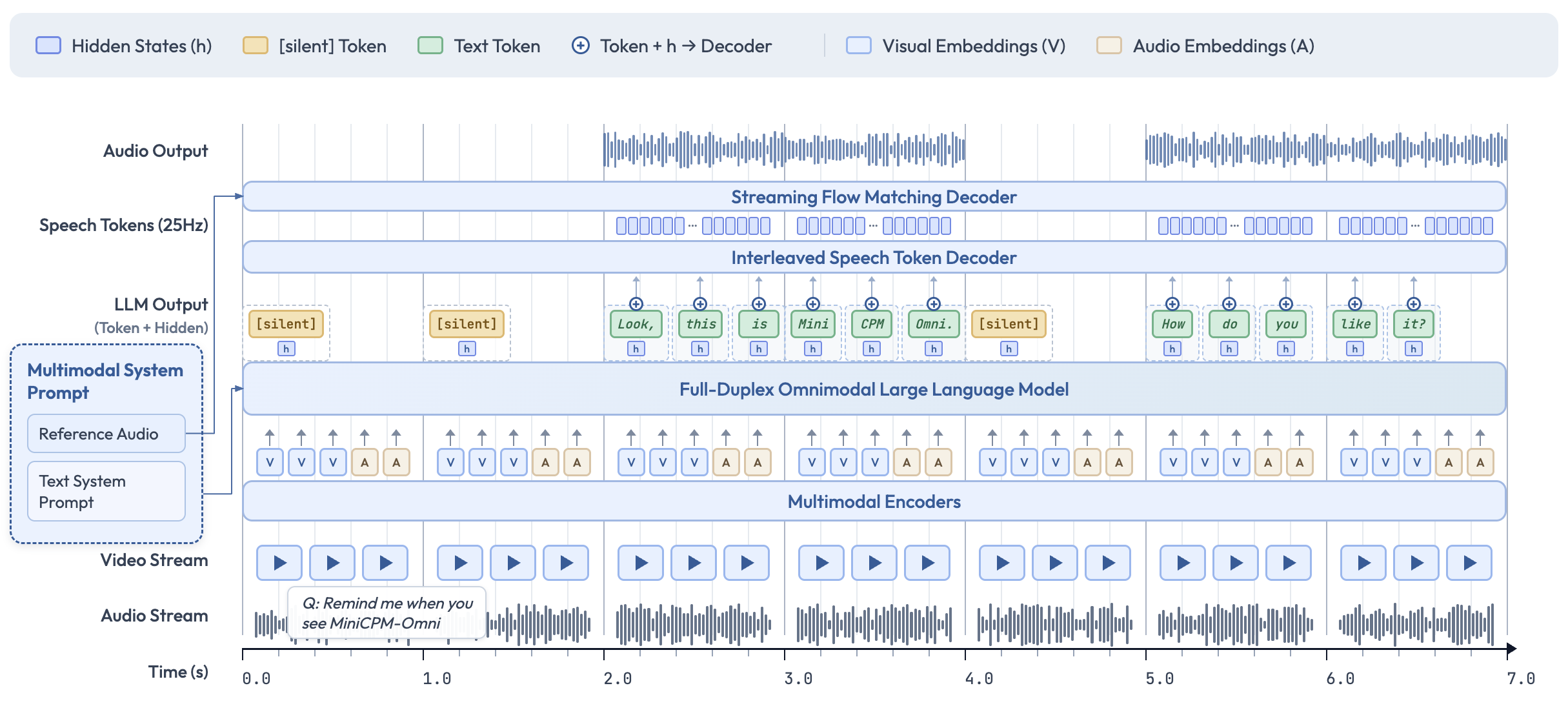
MiniCPM-o 4.5: Towards Real-Time Full-Duplex Omni-Modal Interaction
MiniCPM-o 4.5 enables real-time full-duplex interaction where perception and response happen simultaneously across vision, audio, and speech. Its Omni-Flow framework aligns multimodal signals on a shared timeline, supporting both reactive and proactive behaviors in continuous, streaming conversation.