
Making Spoken Dialogue More Human: Full-Duplex Avatars, Faster Tokens, and Smarter Turn-Taking
Today's digest covers three advances in spoken dialogue systems: a full-duplex multimodal avatar that jointly generates speech, gestures, and expressions; a post-hoc token compression method for faster speech LLM inference; and a unified turn-taking model that handles end-of-turn, backchannels, and speech validity in a single forward pass.
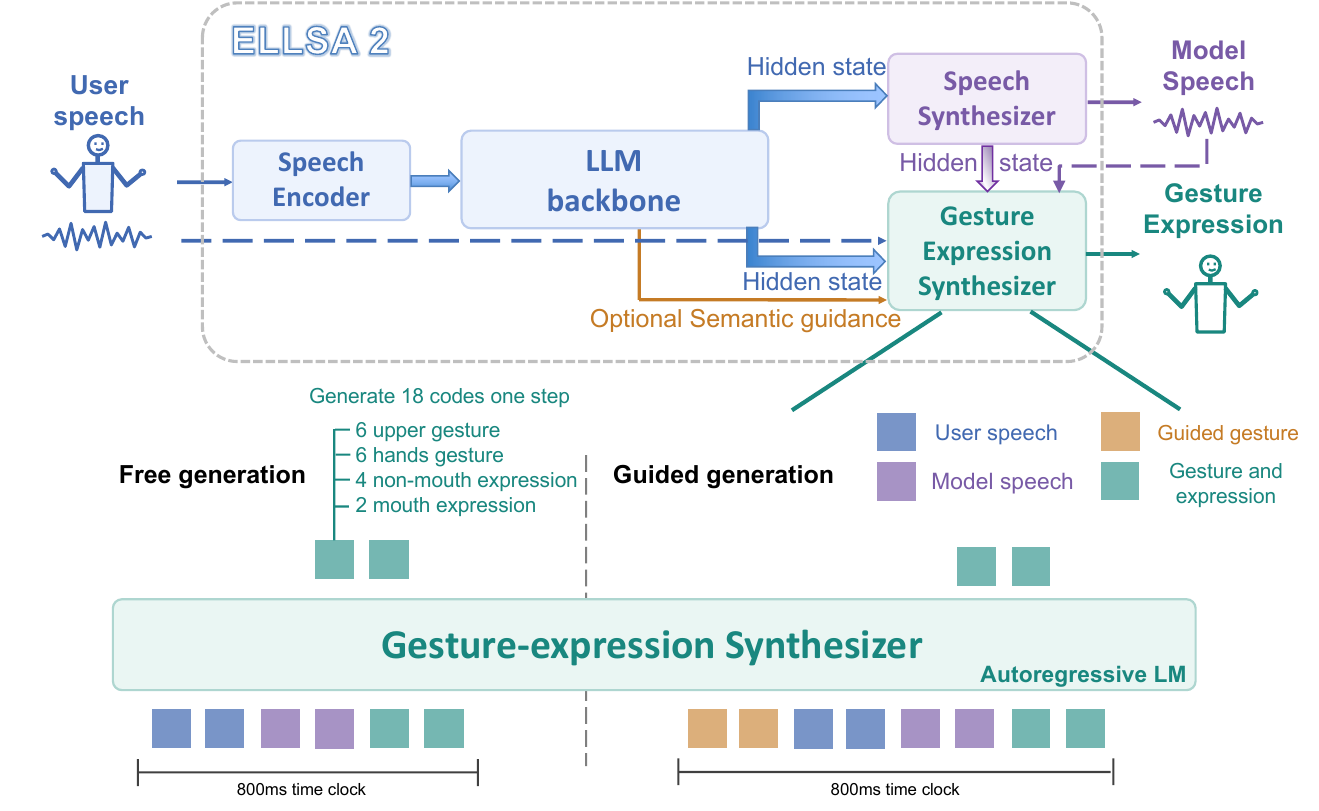
jointly models full-duplex speech, gesture, and facial expression generation. The gesture-expression synthesizer conditions on hidden states from both user and model speech and autoregressively generates discrete gesture and expression codes every 800 ms. It supports two generation modes: free generation and guided generation, which additionally incorporates optional semantic gesture guidance for more semantically grounded gesture generation. From ByteDance.
Today's papers all push toward the same goal: spoken dialogue systems that feel genuinely conversational. Whether that means coordinating gesture and expression with speech, squeezing latency out of token generation, or finally solving turn-taking without artificial segmentation — the thread running through all three is closing the gap between lab demos and real deployment.
SpeechLLMs & Spoken Dialogue
From multimodal avatars to efficient token streams and robust turn-taking, today's work addresses the full stack of real-time spoken interaction.
Full-duplex conversation demands more than just words — a natural interlocutor nods, gestures, and shifts expression whether speaking or listening. ByteDance's ELLSA 2 tackles this head-on by jointly generating coordinated speech, gestures, and facial expressions within a single real-time dialogue model. Using semantic guidance and template-based synthesis, it produces contextually grounded multimodal responses where both speaking and listening states drive non-verbal behavior — a significant departure from prior pipelines that treat speech and gesture as separate concerns.
Full-Duplex Interaction with Speech, Expressions and Gestures
ELLSA 2 is a full-duplex dialogue model that jointly generates coordinated speech, gestures, and facial expressions in real-time conversation. Unlike prior work that treats speech and non-verbal behavior separately, this approach uses semantic guidance and template-based synthesis to produce vivid, contextually grounded multimodal responses where speaking and listening states both influence gesture and expression generation.
Abstract
Human face-to-face conversation requires coordinating speech, gestures and expressions across both speaking and listening. We present ELLSA 2, an end-to-end full-duplex dialogue model that jointly optimizes speech interaction and streaming gesture-expression generation. An autoregressive, chunk-wise synthesizer combines pretrained acoustic features with distinct listening and speaking hidden states from the dialogue backbone and speech synthesizer, enabling continuous non-verbal generation even when the model is verbally silent. To translate dialogue understanding into vivid semantic gestures, we introduce contextual semantic calls and template guidance, separating whether to invoke an available semantic gesture from how to realize it. We also establish a curated data and evaluation pipeline for dialog-aware co-speech gesture generation and investigate reference-based multimodal large language models (MLLMs) as automatic judges. Experiments show that ELLSA 2 remains highly competitive with open-source full-duplex speech interaction models and outperforms cascaded baselines across dialog-aware gesture and expression metrics. Semantic template guidance further significantly improves semantic gesture quality. Strong system-level correlations with human judgments support these reference-based scores as useful preliminary metrics for full-duplex and semantic gesture assessment. Together, these results advance dialogue modeling from spoken responses toward coordinated multimodal interaction.
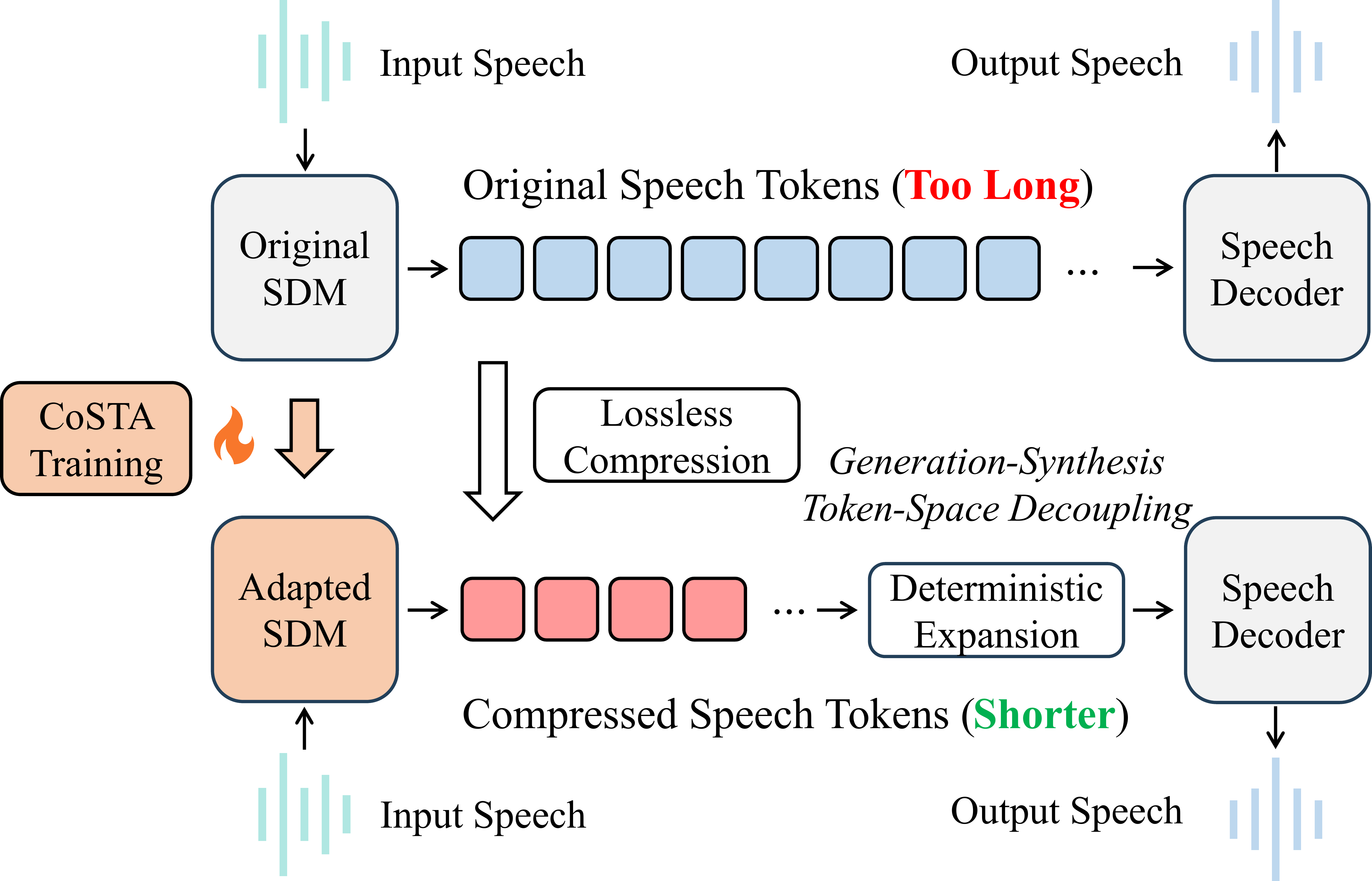
Even when a speech LLM's outputs are compelling, latency remains a hard constraint for live conversation. CoSTA (from the Institute of Automation, Chinese Academy of Sciences) attacks this without requiring a painful tokenizer replacement. It decouples the generation and synthesis token spaces: a compressed vocabulary is used during autoregressive generation, then deterministically expanded back to the original token space before the speech decoder sees it. The result is approximately 1.7× faster token generation and lower end-to-end latency while preserving the original speech decoder and maintaining response quality — a practical, post-hoc compression strategy that trades off efficiency and quality without a full retraining cycle.
CoSTA: Compressed Speech Token Adaptation for Efficient Spoken Dialogue Models
CoSTA decouples generation and synthesis token spaces in spoken dialogue models by extending the generation vocabulary with compressed tokens and deterministically expanding them back before synthesis, preserving the original speech decoder. This post-hoc approach achieves ~1.7× faster token generation and lower latency while maintaining response quality—avoiding costly tokenizer replacement while enabling practical compression-efficiency-quality trade-offs.
Abstract
Spoken Dialogue Models (SDMs) typically share a speech-token space for generation and synthesis, leading to long autoregressive sequences and costly inference. Lower-rate speech tokenizers shorten sequences but may introduce compression-quality trade-offs and costly replacement without breaking this coupling. To address this limitation, we propose CoSTA, a compatibility-preserving post-hoc framework that decouples generation and synthesis token spaces while retaining the original speech tokenizer and decoder. CoSTA extends the generation token space with compressed representations via mean-initialized vocabulary extension, pronunciation adaptation, and dialogue adaptation, followed by deterministic expansion back to the original speech-token space before synthesis. On bilingual speech-dialogue benchmarks, CoSTA achieves approximately $1.7\times$ expanded speech-token generation speed, lower full-response latency, and higher throughput while preserving response quality. Analyses show more sustained interaction under limited budgets and a practical trade-off among compression, decoding efficiency, and quality. Further experiments demonstrate cross-architecture transfer and complementarity to low-rate tokenization.
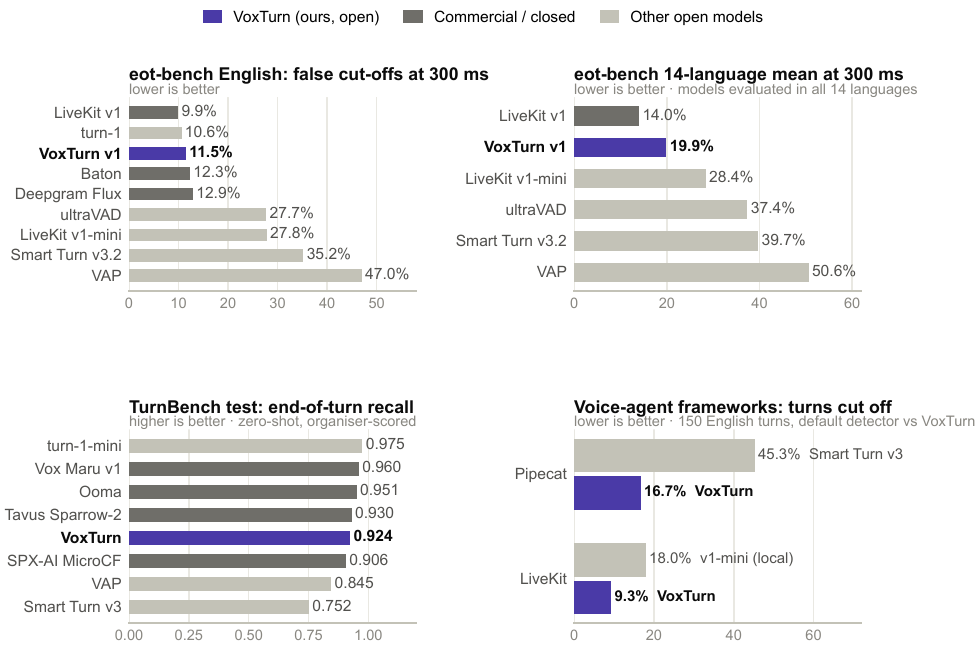
Turn-taking is one of the oldest unsolved problems in spoken dialogue, and most systems still handle it with a patchwork of specialized detectors. VoxTurn takes a unifying approach: a single speech LLM that answers end-of-turn detection, backchannel identification, and speech validity classification all in one forward pass. Crucially, it's trained on real conversational pauses rather than clean, segmented utterances — directly addressing the mismatch that causes most deployed systems to struggle. The payoff is state-of-the-art false cut-off rates across 14 languages at minimal latency.
VoxTurn: Answering Several Turn-Taking Questions in One Pass with One Model
VoxTurn unifies multiple turn-taking decisions—end-of-turn detection, backchannel identification, and speech validity—into a single speech LLM that answers them all in one forward pass. Trained on real conversational pauses rather than segmented utterances, it achieves state-of-the-art false cut-off rates across 14 languages at minimal latency, addressing the core mismatch between training data and real deployment scenarios.
Abstract
A cascaded voice agent must decide, throughout each silence of its user, whether the user has finished their turn: answering too early cuts the user off, answering too late makes the agent slow. It often needs related decisions too: will the user soon go on, is speech during its own turn an interruption or a backchannel, is a sound speech at all. With open detectors, each extra decision costs another model or another call, and on the 14-language eot-bench they cut users off in more than a quarter of mid-turn pauses. Because they are trained on segmented utterances, this mismatch is the largest single source of error. We present VoxTurn, a 0.8B speech LLM that casts these decisions as multiple-choice questions, scores the hidden state of each option, and answers any set of them in one forward pass with a block-isolating attention mask, exactly as if asked one at a time. Trained on real conversational pauses with labels derived from their timing, and re-queried while a silence lasts, VoxTurn reaches 11.5% false cut-offs in English at a 300 ms latency budget, comparable to two commercial detectors, and a 14-language mean of 19.9%, the lowest among open models, at 8.3 ms per decision. In Pipecat and LiveKit it cuts off 17% and 9% of turns, and it ranks fifth of 24 in TurnBench end-of-turn detection without any TurnBench training data. The model, code and framework plugins are released.
Trending on Hugging Face

Kandinsky 6.0 Video: Foundation Models for Synchronized Video and Audio Generation
Kandinsky 6.0 Video is a family of diffusion models that generate synchronized audio-video clips with lip-sync via a dual-stream CrossDiT architecture and multi-stage training.
MiniCPM-o 4.5: Towards Real-Time Full-Duplex Omni-Modal Interaction
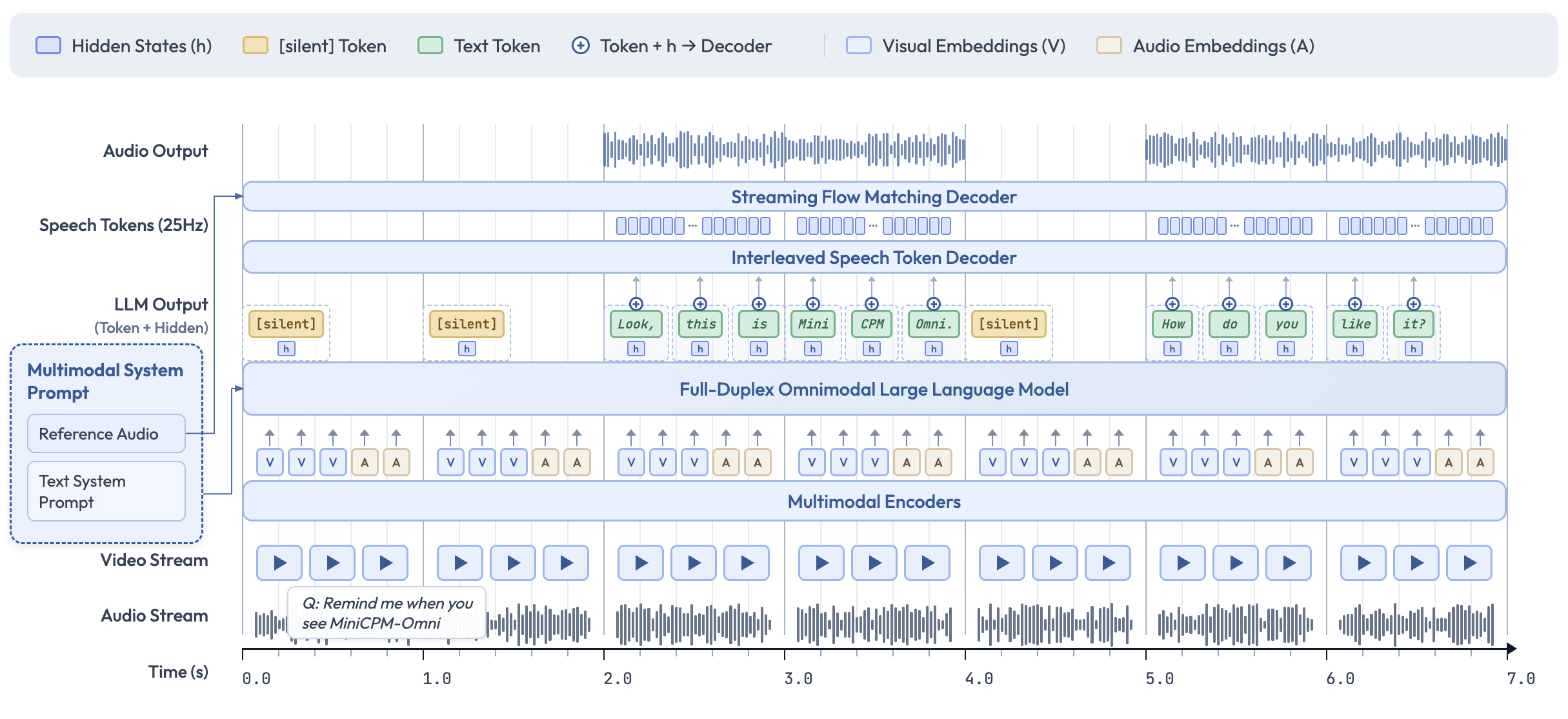
MiniCPM-o 4.5 enables real-time full-duplex interaction where perception and response happen simultaneously across vision, audio, and speech. Its Omni-Flow framework aligns multimodal signals on a shared timeline, supporting both reactive and proactive behaviors in continuous, streaming conversation.

OmniFlatten: An End-to-end GPT Model for Seamless Voice Conversation
A novel GPT-based model, OmniFlatten, enables real-time natural full-duplex spoken dialogue through a multi-stage post-training technique that integrates speech and text without altering the original model's architecture.

Qwen3-TTS Technical Report
The Qwen3-TTS series presents advanced multilingual text-to-speech models with voice cloning and controllable speech generation capabilities, utilizing dual-track LM architecture and specialized speech tokenizers for efficient streaming synthesis.

Fish Audio S2 Technical Report
Fish Audio S2 is an open-source text-to-speech system with multi-speaker capabilities, multi-turn generation, and instruction-following control through natural-language descriptions, utilizing a multi-stage training approach and production-ready inference engine.