
Lip Sync, Talking Avatars, Single-Step TTS, and Smarter Voice Agents
Today's digest spans real-time talking avatars, single-step TTS breakthroughs, deep dives into Qwen3-TTS failure modes, and novel architectures for grounding audio in LLMs — including a clinical audio model that reasons beyond transcripts.
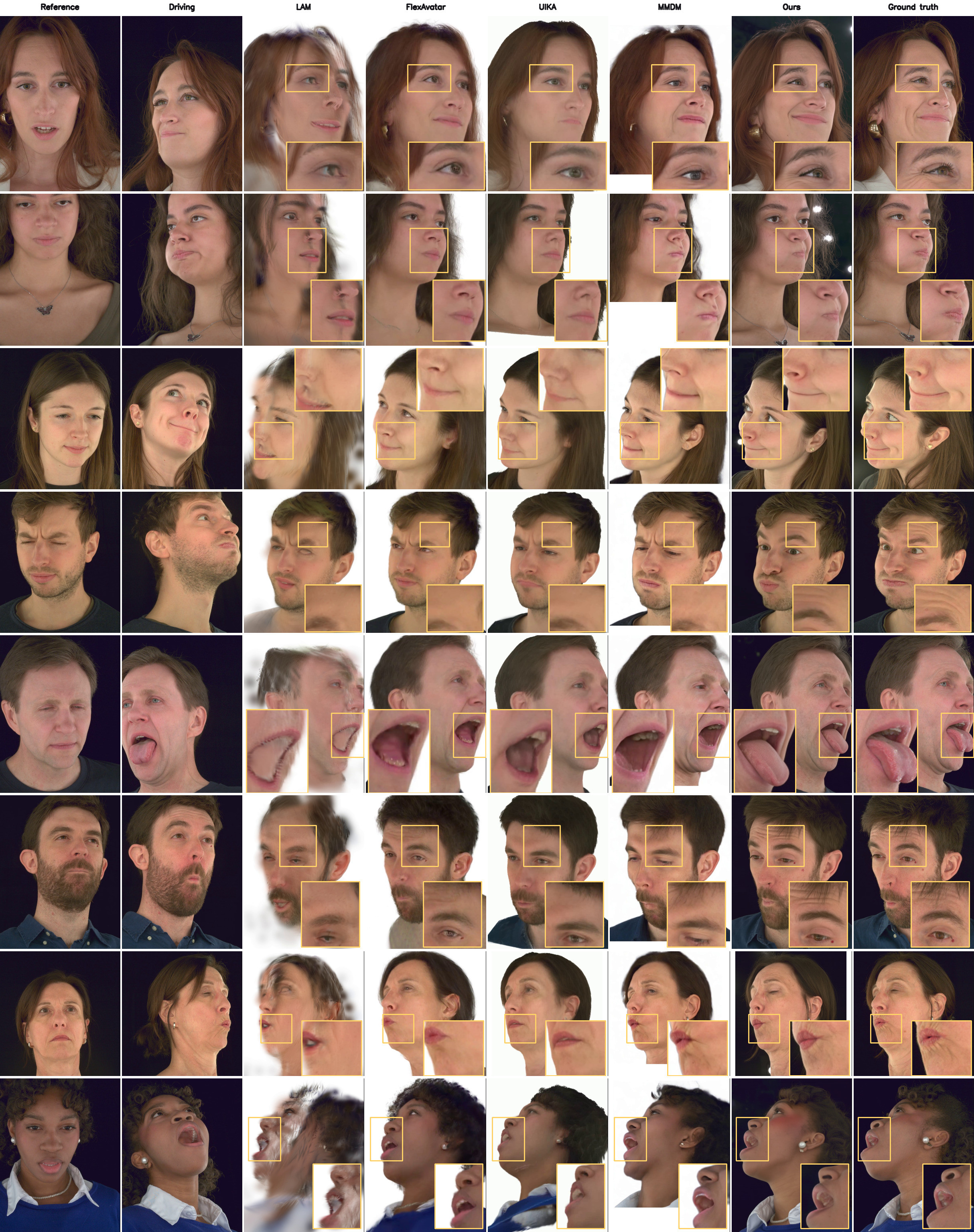
BecomingLit self-reenactment, qualitative comparison of our method against LAM~, FlexAvatar~, UIKA~, and MMDM (the morphable multi-view diffusion component of CAP4D~, rendered directly at the target camera -- not the full CAP4D avatar pipeline). One row per identity (8 of the benchmark's 13), each frame chosen to maximize expression diversity within that identity's own driving clips (farthest-point sampling over X-NeMo expression embeddings~), then narrowed from an initial per-identity diverse set down to these 8 through several rounds of manual review. From Technical University of Munich.
Today's papers push hard on two fronts: making animated faces and lip sync faster, more realistic, and easier to control; and building speech LLM pipelines that are more robust, more grounded, and more clinically aware. From single-step TTS to 3D avatars spawned from a single photo, October 19 is a dense day for audio-visual AI.
Talking Avatars, Lip Sync & Audio-Driven Faces
Photorealism, latency, and expressiveness collide as three teams tackle the hardest parts of audio-driven face generation.
Lip-sync models trained on ground-truth video suffer a subtle but painful train-test mismatch: at inference time, the reference frame is generated by the model itself, not sourced from real footage. LiveSync from Microsoft Research Asia tackles this head-on with an iterative self-training loop — a frozen checkpoint generates pseudo-pairs that mirror inference conditions, and those pairs are mixed back into training data to progressively close the gap.
LiveSync: Iterative Self-Training for Lip-Sync Generation
LiveSync introduces an iterative self-training framework that addresses the train-test mismatch in audio-driven lip-sync generation by using a frozen model checkpoint to generate pseudo-pairs that align with inference conditions. The approach refines a single mask-based model through mixing self-generated references with real training data, achieving state-of-the-art lip synchronization while maintaining low inference latency.
Abstract
Audio-driven lip synchronization aims to match target speech through localized mouth and jaw articulation while preserving subject identity, head pose, and surrounding facial context. Naturally recorded videos provide synchronized reconstruction targets but rarely offer pairs that are matched in identity and pose yet differ primarily in speech-related articulation. Mask-based training enables reconstruction from these videos, but random-reference inputs differ from the aligned self-reference used at inference. We present LiveSync, an iterative self-training framework in which a single mask-based model generates pseudo pairs and is refined for deployment. The model is first trained on a curated real-video corpus augmented with externally generated clips covering under-represented visual conditions. A frozen checkpoint then uses independently sampled audio to generate mouth-edited references from real-video frames, copying pixels outside the edit mask from each source frame. After confidence filtering, these references are paired with aligned masked inputs and original real-frame targets. The retained pseudo pairs are mixed with real training data to refine the same model from its current weights, updating training supervision without adding inference stages. Although we instantiate the framework with a single-pass GAN-based model, the self-training strategy could in principle also be adapted to diffusion-based models. Experimental results show that LiveSync achieves leading synchronization performance on HDTF and competitive performance compared with the baselines on the AIGC-LipSync subset, while maintaining low inference latency.
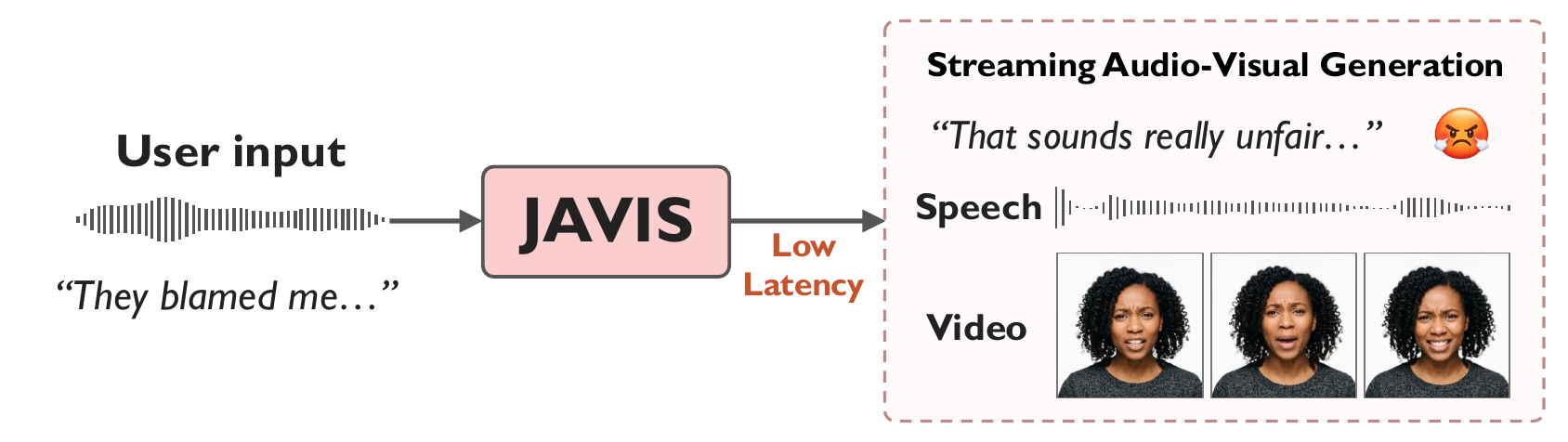
Going further than lip sync alone, KAIST's JAVIS frames real-time conversational agents as a joint audio-visual streaming problem. A single shared LLM backbone simultaneously autoregressively decodes speech tokens and facial expression tokens, hitting real-time performance at 200× lower latency than cascade baselines while keeping lip sync tight and expressions contextually appropriate.
JAVIS: Joint Audio-Visual Interaction and Streaming for Real-Time Conversational Agents
JAVIS is an end-to-end streaming framework that generates synchronized speech and facial expressions for real-time conversational agents using a unified audio-visual representation. By jointly producing voice and face outputs from a shared LLM backbone, it achieves real-time performance with 200× lower latency than baselines while maintaining tight lip-sync and appropriate facial expressions.
Abstract
Human communication is inherently multimodal, conveying intent not only through linguistic and vocal cues but also through visual signals. However, existing conversational systems have mainly focused on text or speech, leaving out the visual feedback that is essential for natural interaction. In this paper, we propose JAVIS, an end-to-end streaming framework for real-time audio-visual conversational agents. Our key idea is to let the voice and the face speak from a single representation. On top of a shared LLM, a Joint Refined Head produces a unified audio-visual representation, which is fed into dedicated streaming branches for speech and face generation. This end-to-end design avoids intermediate bottlenecks, enabling real-time generation while keeping speech and face tightly synchronized. In addition, we present JAVIS-Syn, a 334-hour synthetic corpus designed to address the lack of expressive audio-visual dialogue data, covering emotionally rich multi-turn conversations and assistant-style exchanges. Experiments show that JAVIS achieves approximately 200$\times$ lower initial latency than a strong baseline, while outperforming baselines in lip synchronization and facial expression appropriateness.
For the highest-fidelity end of the spectrum, TU Munich's Video Diffusion Avatars fine-tunes video diffusion models into controllable 3D avatars from a single input image. Camera viewpoint, facial expression, and body pose are disentangled via learned expression codes that outperform traditional 3D morphable models in expressiveness, while video diffusion priors naturally handle secondary effects — hair dynamics, specular reflections — that explicit rendering pipelines can't easily capture.
Video Diffusion Avatars: Taming Video Diffusion Models into Controllable 3D Avatars
This method creates photorealistic, controllable 3D avatars from single images by fine-tuning video diffusion models to independently control camera viewpoint, facial expression, and pose. It uniquely leverages learned, disentangled expression codes that surpass traditional morphable models in expressiveness while maintaining multi-view consistency, and exploits video priors to produce physically plausible effects like hair dynamics and reflections beyond explicit rendering.
Abstract
Video diffusion models (VDMs) trained on internet-scale data encode a rich prior on appearance, motion, and physics that is difficult to replicate with explicit 3D rendering and costly 3D data capture. We introduce Video Diffusion Avatars (VDAs), a method that creates photo-realistic, multi-view consistent avatars from a single image by fine-tuning a VDM for precise control over camera viewpoint, facial expression, and upper-body pose. Departing from 3D morphable models (3DMMs), VDAs use a learned expression space that lifts the expressiveness ceiling of 3DMMs, e.g., for the tongue and mouth interior. However, learned expression codes exhibit heavy viewpoint bias, as our DISTRACT benchmark reveals. We show that this bias can be removed through disentanglement, enabling their use as driving signals for multi-view consistent avatars. Camera and upper-body pose are controlled jointly via proxy-mesh renderings, giving independent control over expression, pose, and viewpoint. A camera-triplet training strategy makes the approach efficient: our models train for 34 hours on a single A100 using only public multi-view data. VDAs outperform state-of-the-art single-image 3D avatars on novel-view reenactment, reducing face LPIPS by 29% and improving perceptual quality (JOD) by 66% on BecomingLit. A static 3DGS reconstruction probe further confirms that our generations are the most multi-view consistent. Built on a video prior, VDAs produce effects beyond the reach of explicit renderers, including physically plausible hair dynamics, shadows, reflections, and refractions.
TTS & Voice Cloning
Speed and scrutiny: one paper collapses TTS to a single decoder step; another stress-tests a frontier system beyond its benchmark comfort zone.
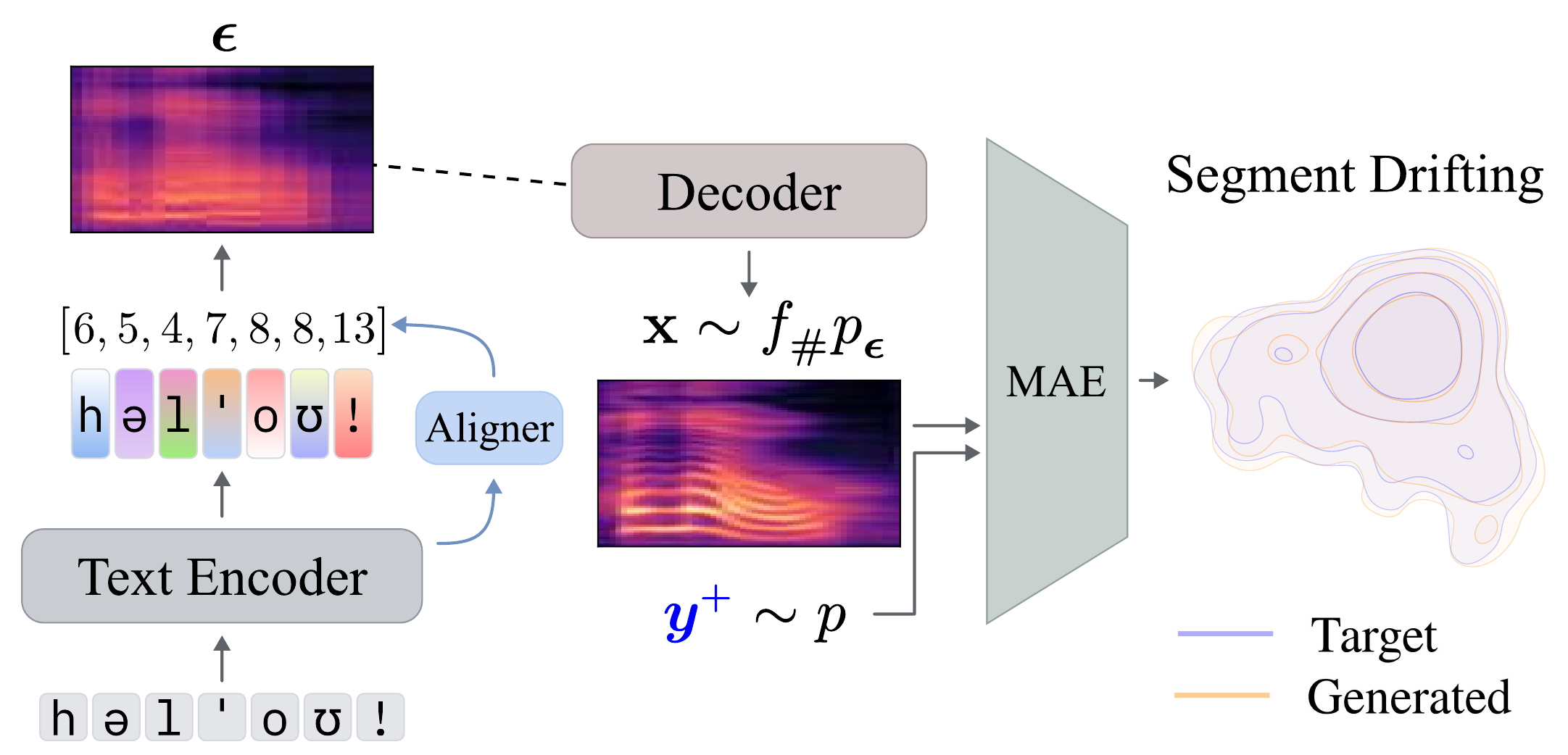
Multi-step diffusion and flow-matching TTS systems produce excellent quality but pay a hefty inference cost. DriftTTS from KAIST University reframes the problem with generative drifting — the iterative sampling process is absorbed into training rather than executed at inference, so the model synthesizes natural speech in a single decoder call. A companion technique called segment drifting handles variable-length sequences, and the results match multi-step baselines at a fraction of the compute.
DriftTTS: One-stage Single Step Text-to-Speech via Generative Drifting
DriftTTS achieves natural speech synthesis in a single decoder call by applying generative drifting, which moves iterative sampling from inference into training rather than relying on expensive multi-step decoding or pretrained models. The method introduces segment drifting to handle variable-length speech, matching multi-step TTS quality at significantly faster inference speeds.
Abstract
Text-to-speech models built on score matching and flow matching produce natural speech, but only by calling the decoder many times, which makes synthesis slow. Existing ways to cut the number of calls either distill from a multi-step teacher or add a stage on top of a pretrained model, leaving single-step TTS without a pretrained TTS model unexplored. We question whether pretraining a TTS model is necessary, and propose DriftTTS, which adopts generative drifting, an objective that moves iterative sampling from inference into training. Drifting assumes samples of fixed shape, whereas speech has variable length; we address this issue with segment drifting. On LJSpeech, DriftTTS matches the multi-step quality of Matcha-TTS and RapFlow-TTS in a single decoder call, while being faster. To our knowledge, this is the first application of generative drifting to text-to-speech.
While most TTS evaluations live and die by a handful of standardized benchmarks, Idiap Research Institute's analysis of Qwen3-TTS takes a different tack. By probing zero-shot voice cloning across varied speech domains and conditioning interfaces — text prompts, audio references, speaker metadata — the study surfaces how reference quality, domain mismatch, and speaker characteristics produce qualitatively distinct failure modes, and demonstrates that domain effects dominate system choice in ways that aggregate metrics systematically miss.
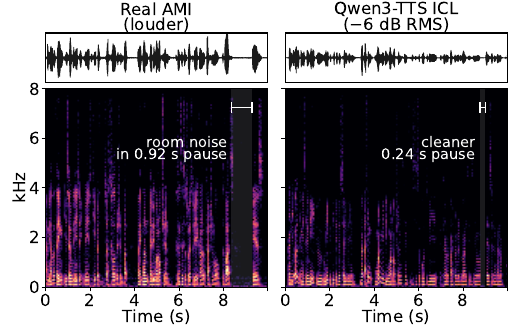
Beyond the Benchmark: Conditioning, Domains and Failure Modes of Qwen3-TTS
This paper systematically evaluates Qwen3-TTS's zero-shot voice cloning across multiple speech domains and conditioning interfaces, revealing how factors like reference quality, domain, and speaker characteristics interact to produce different failure modes. Unlike standard benchmarking, it exposes gaps between objective metrics and human perception, and shows that domain effects dominate system choice in determining output quality.
Abstract
Qwen3-TTS reports state-of-the-art zero-shot voice cloning, but its technical report leaves open how the model should be conditioned, how it behaves outside read speech, and how it fails. We characterise its two cloning interfaces, in-context learning (ICL) and X-Vector, against Chatterbox, XTTS-v2 and F5-TTS on read, meeting, emotional and air-traffic-control (ATC) speech, using eighteen objective measures, an LLM judge, a spoofing countermeasure and a listening test. Neither interface dominates: ICL clones timbre more closely from correctly transcribed references, X-Vector clones timing, and ICL degrades sharply when a short reference transcript is wrong. Domain explains four times more variance than system choice. Qwen3-TTS leads on intelligibility and pitch register but trails on prosody, and the objective measures rank systems differently from listeners. An off-the-shelf countermeasure flags its clones no more often than genuine recordings, and on ATC radio it fails for every system. Code and audio are released.
SpeechLLMs, Voice Agents & Spoken Dialogue
Three papers rethink how audio plugs into language models: better grounding, smarter coordination, and clinical-grade acoustic reasoning.
Bridging audio and text modalities usually means training a new projection layer — an MLP or Q-Former — that can corrupt the LLM's pretrained knowledge. ConvexLLM from Microsoft Research Asia sidesteps this by constraining audio representations to lie within the convex hull of the frozen text embedding space. The resulting speech tokens are valid convex combinations of existing text embeddings, preserving decoder capabilities while enabling competitive performance on transcription, audio reasoning, and knowledge-intensive tasks.
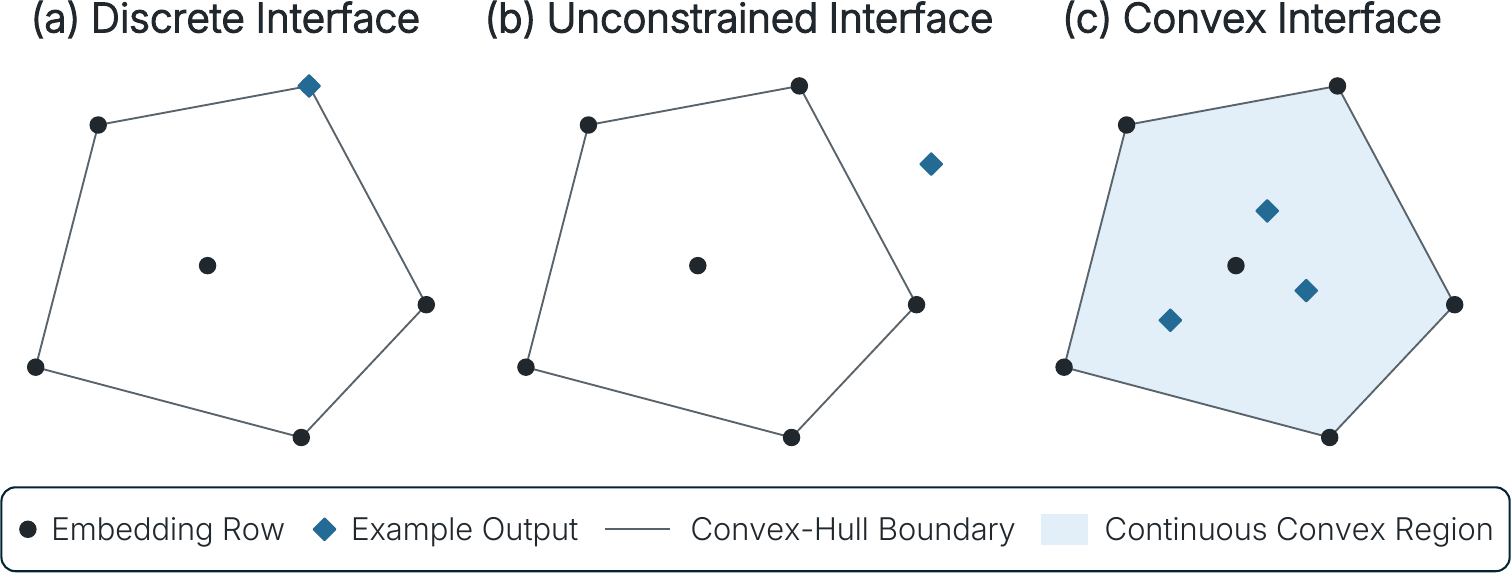
ConvexLLM: Scaling Convex-Hull Speech Interfaces to General-Purpose Audio Intelligence
ConvexLLM grounds speech and audio representations directly in a language model's frozen text embedding space using constrained convex combinations, rather than learning unconstrained projections through MLPs or Q-Formers. This approach preserves the decoder's pretrained text capabilities while enabling strong multimodal audio understanding across speech transcription, reasoning, and knowledge tasks.
Abstract
Speech and audio language models connect continuous acoustic representations to decoders pretrained primarily on text data. Most such models use MLP or Q-Former interfaces to map acoustic features into the decoder's input space, requiring the decoder to learn how to interpret the resulting representations. We investigate whether grounding these representations in the decoder's existing text embeddings can help it use acoustic information while better preserving its pretrained text capabilities. We present ConvexLLM, a general-purpose speech and audio language model whose C-Gate interface represents audio as continuous convex combinations of frozen text embeddings. ConvexLLM achieves an eleven-task VoiceBench aggregate of 75.36, the highest among the open-weight models we compare, and an MMAU Test-mini accuracy of 62.50%. Its largest margins over the baselines are on spoken knowledge and reasoning tasks, while the strongest baselines are more accurate on audio understanding and transcription. In a comparison with a 2B-parameter decoder, C-Gate achieves higher aggregate spoken-language performance than MLP and Q-Former interfaces, with text-task performance close to MLP and task-dependent tradeoffs in transcription and audio understanding. These results support convex combinations of text embeddings as a viable interface for general-purpose speech and audio language models.
Full-duplex spoken agents struggle when users interrupt, refine, or cancel requests mid-execution — a slow reasoning backend may act on stale context. Alibaba Damo Academy's Jarvis (distinct from KAIST's JAVIS above) addresses this by inserting a dedicated coordination layer that maintains versioned task state and validates every pending action against live user context before committing. Separating coordination from both the fast dialogue frontend and the slow reasoning backend yields dramatic gains in task success on full-duplex speech benchmarks.
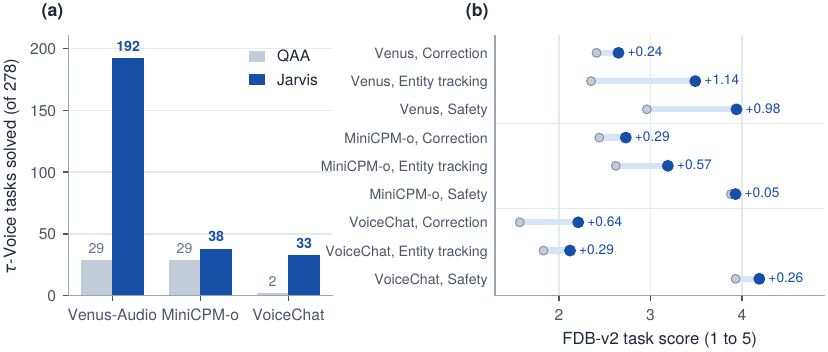
Jarvis: Coordination Deserves a Brain of Its Own in Agentic Interactive Models
Jarvis introduces a dedicated coordination layer for interactive agents that maintains versioned task state and validates every decision against live user context, preventing stale actions when users refine or cancel requests mid-execution. By separating coordination logic from the fast dialogue frontend and slow reasoning backend, the system achieves dramatically improved robustness and task success on full-duplex speech benchmarks.
Abstract
Interactive models increasingly hand complex reasoning and tool use to a slow brain in the background, leaving a realtime front model free to sustain full-duplex dialogue. Yet the user may refine, cancel or replace a request while its task runs, so a plan or result that made sense a moment ago goes stale. Each new utterance must therefore be read against the work in flight, but the front model follows only the conversation and the back end sees only its own task. Coordination deserves a brain of its own, one that sees both. We introduce Jarvis, a coordination harness where models judge and code enforces. Its typed decision model, JEV, reads each turn against the live tasks and picks among operations built from a versioned task record. Code checks every choice against the current state before applying it, so no decision can act on a task version the user has replaced. Jarvis also rechecks plans before they execute and results before they are spoken, and counts an answer as delivered only once the user has heard it in full. We build two instances of this design. Jarvis-Audio runs unchanged on three full-duplex speech models. Jarvis-Omni adds vision and rechecks the evidence behind an answer before and during playback, since a scene can change while nobody speaks. With the front model and back end held fixed, replacing Qwen Audio Agent with Jarvis raises tau-Voice task success more than sixfold, from 29 to 192 of 278 tasks, and the gains hold on every benchmark and front model. Against published systems, Jarvis-Audio reaches 69% Pass1 on Full-Duplex-Bench v3 with an open 9B front model, versus 60% for GPT-Realtime. These results suggest that how the two brains are coordinated matters as much as how strong they are.
Finally, MedSonor from USTC makes the case that clinical audio carries diagnostic signal that transcripts simply discard — a cough's timbre, a murmur's rhythm, a patient's breathing pattern. The model is trained on authentic medical audio paired with clinical dialogue contexts, then refined with rubric-guided reinforcement learning to align outputs with physician standards. Evaluated across multiple medical benchmarks with physician validation, MedSonor demonstrates that going beyond text transcription meaningfully improves clinical reasoning quality.
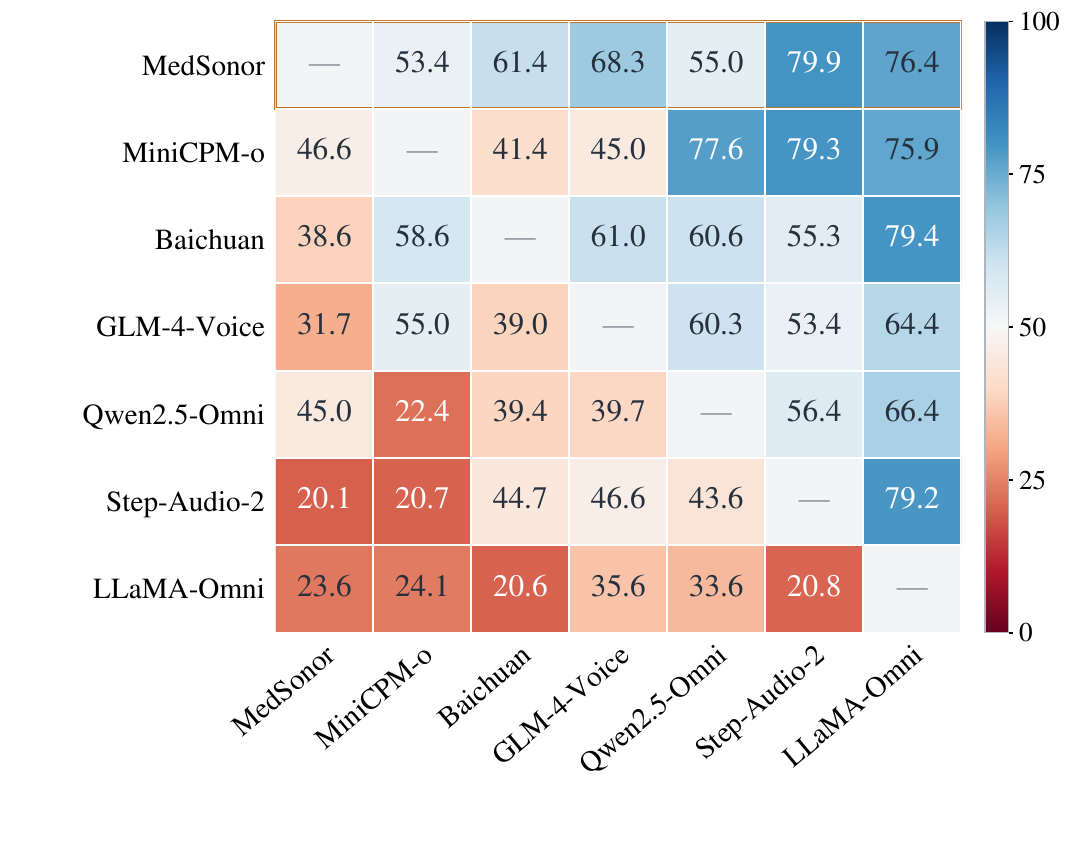
MedSonor: Learning to Use Clinical Audio in Medical LLMs
MedSonor integrates clinical audio directly into medical dialogue responses, going beyond transcripts to preserve acoustic information crucial for diagnosis. The model is trained with authentic medical audio paired to clinical contexts, followed by rubric-guided reinforcement learning, and achieves strong physician-validated performance across medical benchmarks.
Abstract
Clinical audio conveys medical information that transcripts may not preserve, but using it in medical responses requires interpreting it alongside clinical requests and dialogue context. Existing medical audio supervision largely targets classification or recognition, while general audio-language models lack specialized medical knowledge and direct feedback for open-ended responses. We present MedSonor, a medical dialogue model integrating medical knowledge, spoken dialogue, and clinical audio understanding. We pair authentic medical audio with clinical requests and combine these audio-integrated dialogues with collected medical audio and synthesized spoken dialogues for supervised fine-tuning, followed by two stages of rubric-guided reinforcement learning. We introduce MedVoice-Dial and MedVoice?AID to evaluate responses within supplied multi-turn medical contexts and to requests involving clinical audio, respectively. Across seven medical benchmarks, MedSonor outperforms the evaluated general-purpose open-weight audio-language baselines and ranks highest in aggregate physician preference evaluation, while broadly retaining general speech capabilities.
Trending on Hugging Face

Kandinsky 6.0 Video: Foundation Models for Synchronized Video and Audio Generation
Kandinsky 6.0 Video is a family of diffusion models that generate synchronized audio-video clips with lip-sync via a dual-stream CrossDiT architecture and multi-stage training.

End-to-End Video Character Replacement without Structural Guidance
MoCha enables controllable video character replacement using a single frame mask through condition-aware RoPE and a comprehensive data construction pipeline with specialized datasets.
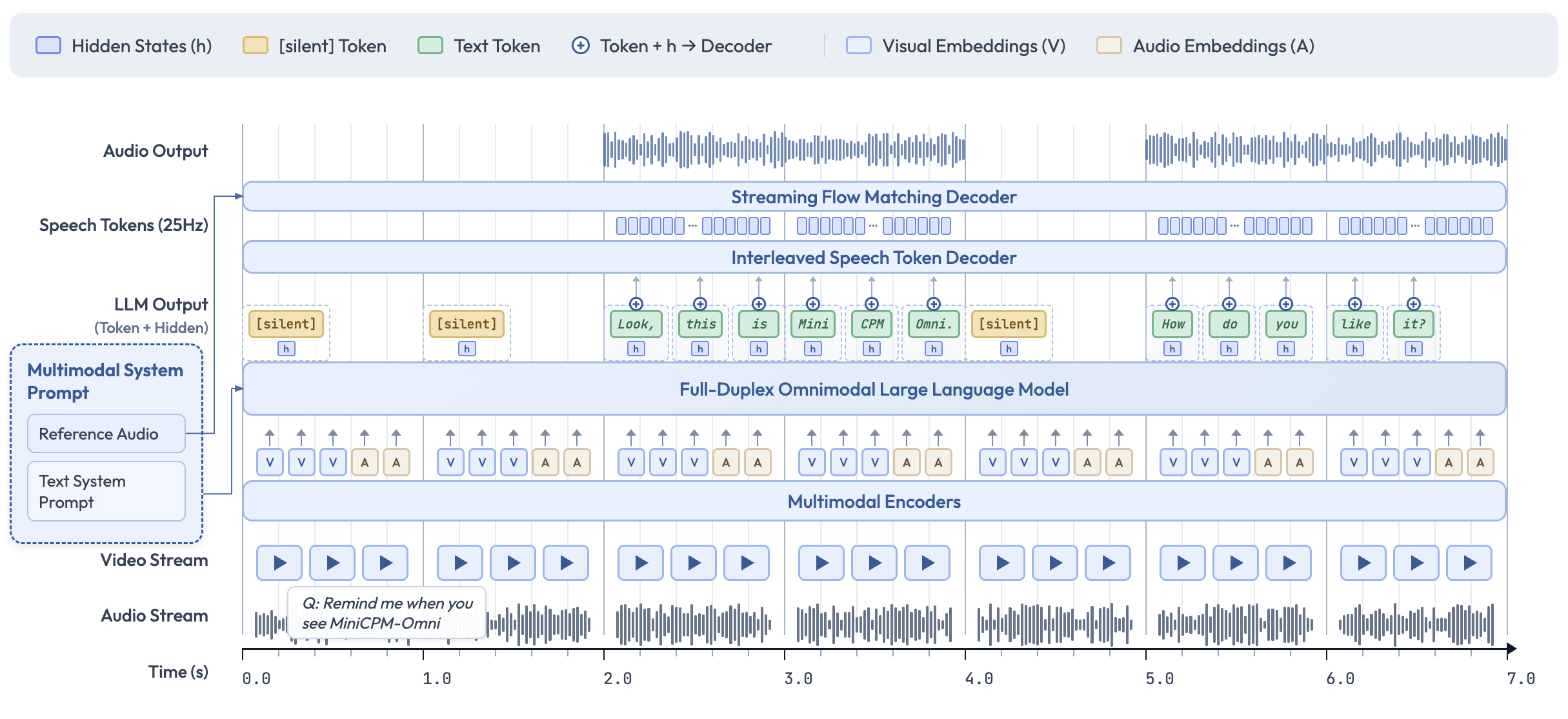
MiniCPM-o 4.5: Towards Real-Time Full-Duplex Omni-Modal Interaction
MiniCPM-o 4.5 enables real-time full-duplex interaction where perception and response happen simultaneously across vision, audio, and speech. Its Omni-Flow framework aligns multimodal signals on a shared timeline, supporting both reactive and proactive behaviors in continuous, streaming conversation.

Qwen3-TTS Technical Report
The Qwen3-TTS series presents advanced multilingual text-to-speech models with voice cloning and controllable speech generation capabilities, utilizing dual-track LM architecture and specialized speech tokenizers for efficient streaming synthesis.

Fish Audio S2 Technical Report
Fish Audio S2 is an open-source text-to-speech system with multi-speaker capabilities, multi-turn generation, and instruction-following control through natural-language descriptions, utilizing a multi-stage training approach and production-ready inference engine.