
Synced Edits, Steered Prosody, and Smarter ASR
Today's digest covers unified audio-visual editing with lip-sync, RL-driven TTS improvements, intonation steering, a Sanskrit recitation corpus, full-duplex dialogue recovery, Pareto-optimal speech LLM training, and two fresh approaches to hotword-aware contextual ASR.
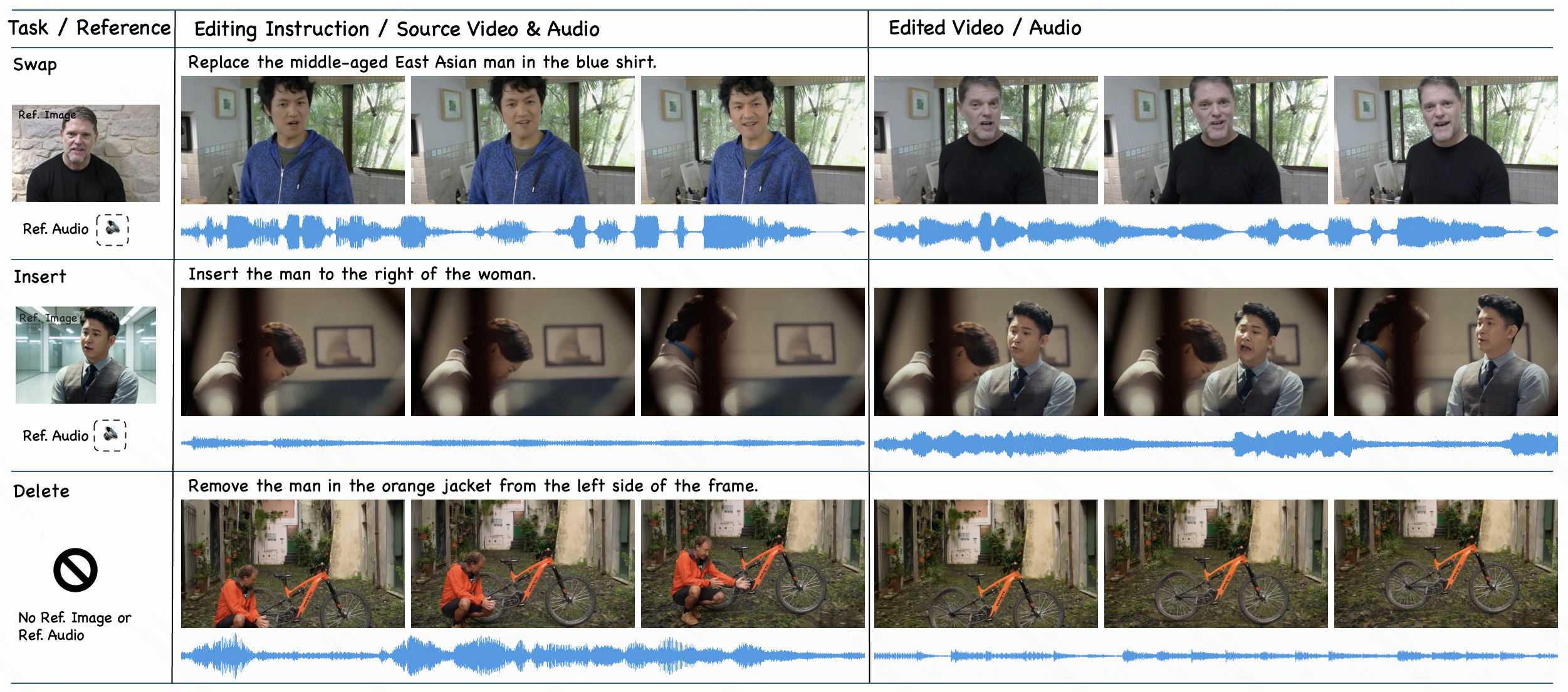
Figure from From Tsinghua University.
Today's papers span a wide arc — from end-to-end audio-visual editing that keeps lips and audio in lock-step, to reinforcement learning for flow-matching TTS, intonation steering vectors, a Sanskrit recitation corpus, full-duplex speaker anchoring, Pareto-steered speech LLMs, and two complementary takes on hotword-aware ASR. From HuggingFace Daily we also get real-time face swapping and language-queryable 4D avatars.
Talking Avatars & Audio-Visual Editing
Keeping faces, voices, and identities coherent across modalities.
Editing people in video while preserving lip-audio synchronization has historically required fragile, error-prone pipelines. Tsinghua University attacks this head-on with a single unified model.
Edit in Sync: Unified End-to-End Audio-Visual Editing for Human-Centric Videos
This work presents the first unified end-to-end framework for audio-visual editing that jointly performs person swapping, insertion, and deletion while ensuring precise lip-audio synchronization. Unlike existing separate-pipeline approaches that suffer from cumulative errors and poor alignment, it enables cross-modal interaction without spatial masks and addresses audio-video token imbalance through synthetic-to-real reconstruction.
Abstract
Human-centric audio-visual editing requires precise alignment of lip movements, gestures, and expressions with speech. Existing methods process inputs through independent video and audio pipelines, preventing cross-modal interaction between visual editing and audio dubbing. Many of these pipelines further rely on mask-based inpainting. As a result, they suffer from poor lip-audio synchronization, cumulative pipeline errors, and an inherent mask-size dilemma. We present AVE, the first unified end-to-end framework that jointly performs reference-guided person swapping, insertion, and deletion across both audio and video modalities without requiring spatial masks. To overcome data scarcity, we design a synthesis pipeline and introduce AVE-Dataset, the first audio-visual editing dataset to provide 100K pairs with appearance and voice references. By combining Synthetic-to-Real reconstruction with preliminary audio warm-up, our framework transcends synthetic pipeline limits and mitigates audio-video token imbalance. AVE outperforms modality-separate audio-visual editing pipelines in editing realism, temporal consistency, and audio-visual alignment.
Edit in Sync is the first end-to-end framework to jointly handle person swapping, insertion, and deletion in human-centric videos while enforcing tight lip-audio synchronization. It eliminates the cumulative error of chained pipelines by enabling cross-modal interaction without spatial masks and resolves the audio-video token imbalance problem through synthetic-to-real reconstruction — a neat trick that lets the model train on easier synthetic data and generalize to real footage.
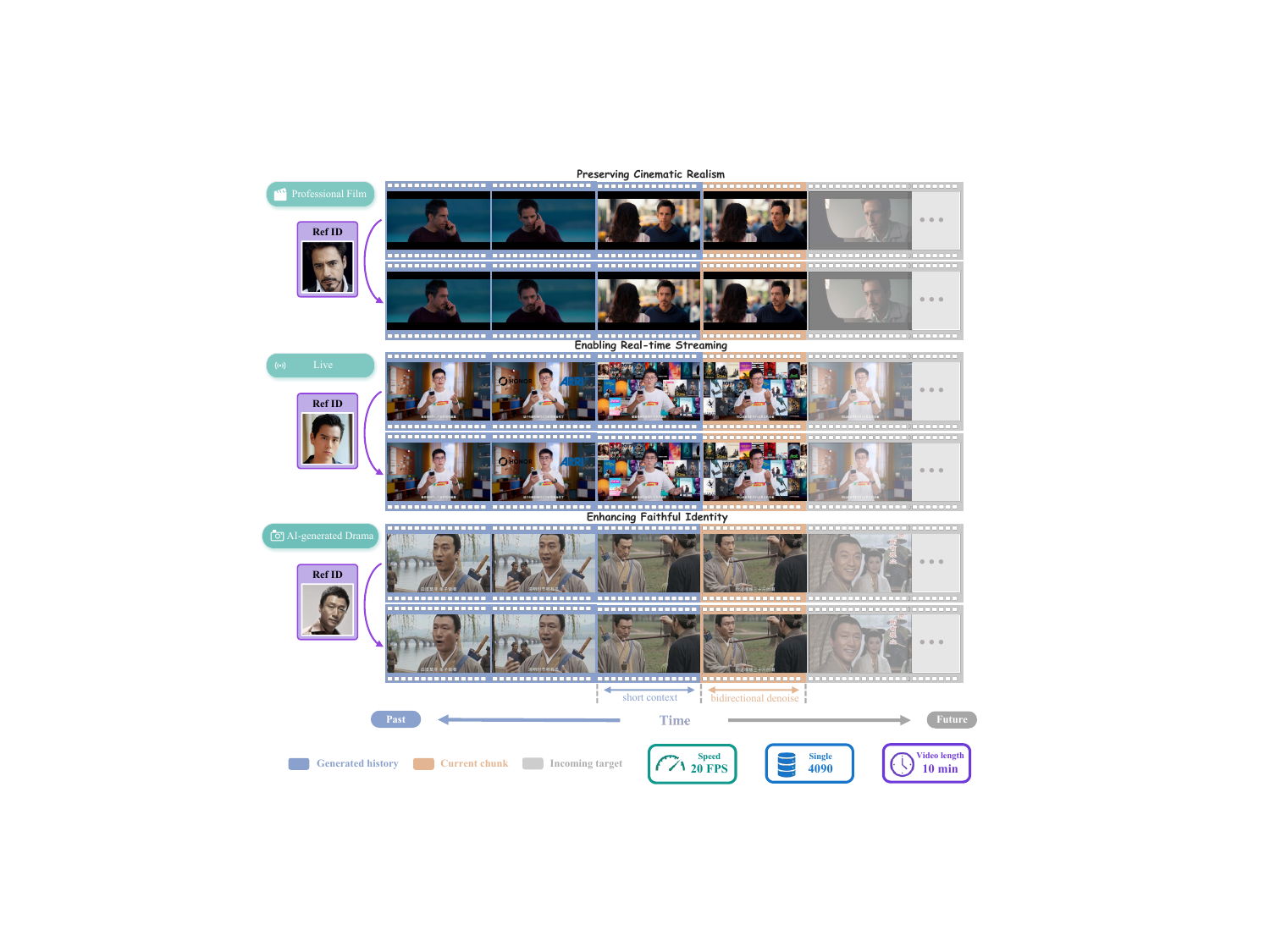
Also from HuggingFace Daily, StreamingSwap tackles the companion problem of real-time video face swapping at scale. It introduces a joint identity-reconstruction loss and reduces spatial-temporal generation overhead to hit a stable 20 FPS on long videos — making identity-faithful face swapping practical for streaming scenarios.
From Short Clips to Real-Time Streams: Identity-Aware Supervision and Context-Efficient Generation for Video Face Swapping
StreamingSwap is a real-time flow-matching framework for video face swapping that improves identity fidelity and efficiency via joint identity-reconstruction loss and reduced spatial-temporal generation, achieving stable 20 FPS performance on long videos.
Abstract
Video face swapping transfers the reference identity to a target video while preserving its other attributes and motion. Despite recent progress in reference-guided flow-based methods, jointly achieving faithful identity transfer, high fidelity, and real-time generation over long video streams remains challenging. To address this challenge, we rethink the task-specific structure of reference-guided video face swapping. First, face swapping changes only identity while preserving most visual content, yet flow-matching supervision is weakly sensitive to these changes. We therefore develop Joint Rec-ID Loss, which balances explicit identity supervision and latent reconstruction according to the noise level. Second, the target video already provides non-edited attributes and temporal dynamics, enabling generation with fewer spatial tokens and shorter temporal contexts through Face-RoI Generation and Short-Context Rollout Training. By integrating these designs, we propose StreamingSwap, a reference-guided flow-matching framework for real-time streaming video face swapping. We also introduce HumanFaceVid, comprising 1,000 hours of cinematic training data and evaluation sets of 200 short and 200 long videos. Experiments demonstrate that our method achieves competitive identity transfer and visual quality at 20 FPS on a single NVIDIA RTX 4090 GPU, with stable generation over videos up to 10 minutes long. Project webpage: https://aim-uofa.github.io/StreamingSwap/
Rounding out the avatar theme, HumanSkill-4D (also from HuggingFace Daily, from UNIST) enables natural-language queries over animatable 3D Gaussian avatars across both space and time. Crucially, it requires no additional training — shared multimodal reasoning and geometric operators handle region and interval selection directly.

HumanSkill-4D: Training-Free Language Querying of Animatable Gaussian Avatars in Space and Time
HumanSkill-4D enables language-driven selection of avatar regions and motion intervals via shared multimodal reasoning and geometric operators without training.
Abstract
We introduce avatar referring segmentation, which selects regions of animatable Gaussian avatars from language queries. A query can also specify a pose or motion to select matching intervals. This lets users interact with avatars for local editing and motion inspection. However, making these selections with existing language Gaussian splatting methods poses two challenges: adjacent parts and garments are hard to separate and may be referred to indirectly (region ambiguity), while fine-grained motions can look alike in RGB (motion ambiguity). We address these challenges with HumanSkill-4D, a training-free framework that shares a multimodal large language model (MLLM) and geometric operators across avatars. For each avatar, a semantic memory links body-part and garment categories to persistent Gaussian regions and appearance descriptions. The MLLM uses category names and descriptions to select categories by appearance, relation, or function. To find matching intervals, it composes operators into programs that check query conditions on driving joint trajectories stored in a motion memory. These category choices and operator outputs make selections traceable, while composing or adding operators supports new motion conditions. To evaluate this task, we introduce three human-annotated benchmarks and show that HumanSkill-4D outperforms the baselines in part segmentation and 3D and 4D referring segmentation, with compact memories and only minutes of setup per avatar.
TTS & Prosody Control
Finer control over what synthetic voices say and how they say it.
Getting TTS models to be both accurate and expressively controllable remains an open challenge. Three papers today push this frontier from different angles.
Flow-matching TTS systems are increasingly powerful, but optimizing them with reinforcement learning is tricky: sentence-level rewards give no signal about which frames caused an error. Tencent's LoCA fixes this.
LoCA: Local Credit Assignment for Reinforcement Learning of Autoregressive Flow-Matching TTS
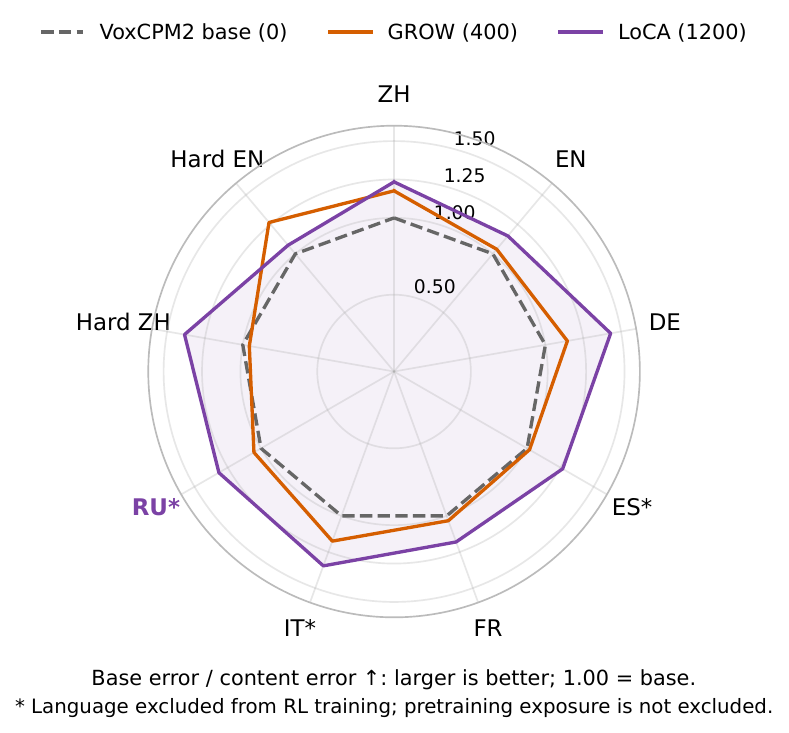
This paper proposes LoCA, a reinforcement learning framework that solves the local credit assignment problem in flow-matching text-to-speech synthesis by using ASR-based alignment to pinpoint frame-level content errors and redistribute sentence-level rewards. Novel threshold-based regression control stabilizes training and prevents overfitting, achieving 20%+ relative improvement in content accuracy across multilingual and hard evaluation sets.
Abstract
Reinforcement learning can improve text-to-speech synthesis through feedback on generated speech. However, sentence-level rewards do not identify local errors, while signed regression updates can lead to excessive fitting or repulsion of sampled outputs. We propose LoCA (Local Credit Assignment) for autoregressive flow-matching text-to-speech. LoCA uses ASR-based text alignment to locate content errors in generated speech and redistribute sentence-level advantages across acoustic frames. To improve training stability, we introduce reference-relative positive and negative thresholds that limit continued fitting and repulsion. Experiments on VoxCPM2 show that LoCA reduces sample-weighted content error on a multilingual CV3 evaluation subset by 20.5% and 14.3% relative to the pretrained backbone and GROW, respectively, while improving speaker similarity. LoCA also improves content accuracy on the Seed-TTS-Eval hard subset. Ablation results support the contributions of local credit and threshold-based regression control.
LoCA uses ASR-based alignment to localize frame-level content errors within a generated utterance, then redistributes sentence-level rewards accordingly — solving the local credit assignment problem for autoregressive flow-matching TTS. A novel threshold-based regression control prevents reward hacking and stabilizes training, yielding 20%+ relative improvement in content accuracy on multilingual and hard evaluation sets.
Beyond accuracy, how a TTS model encodes intonational tunes — rising vs. falling — has been poorly understood. Northwestern University digs into this with a mechanistic interpretability approach.
Steering intonational tunes in text-to-speech synthesis
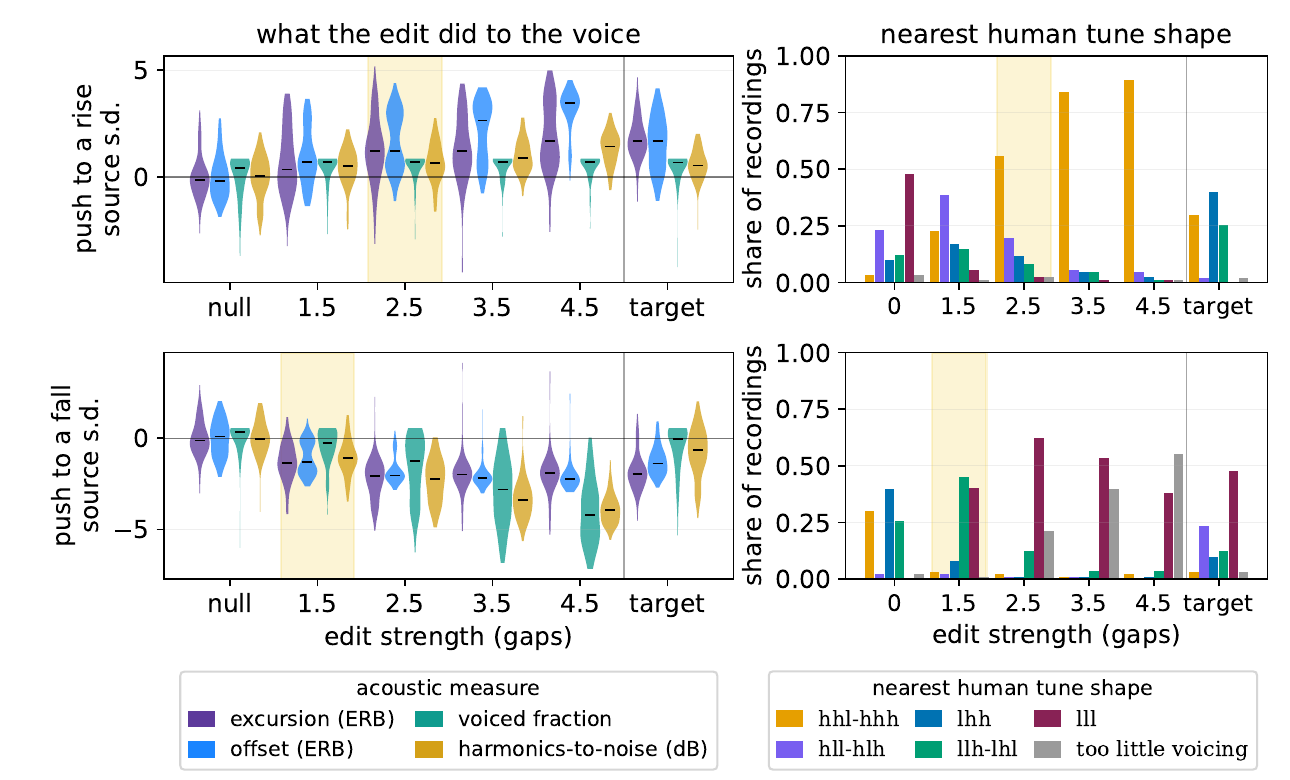
This work investigates which components of neural text-to-speech models control intonational tunes by using interchange interventions and steering vectors derived from human speech imitations. Unlike punctuation-based control, steering vectors derived from backbone hidden states of human-produced intonational variants successfully redirect the model's output between falling and rising tunes.
Abstract
Text-to-speech systems built on residual vector quantization often generate audio in two stages: a transformer backbone emits the first level of each frame's token stack, and a smaller depth model generates the rest autoregressively. We ask which components of such a model are responsible for prosodic intonation, more precisely for generating the English nuclear tune (for instance, the falling pitch melody that distinguishes an assertion from a question's rising melody), and whether interventions on those components can be used to control intonation. Prompt-based control mostly fails; only a final question mark is a reliable lever. Interchange interventions in CSM and S2 locate the tune: the backbone's hidden state carries it to the waveform through the depth model, and the first level of the stack carries little or none of it. Steering the backbone state with a difference-of-means vector computed on new material generated with a final period or question mark moves the tune, but the push toward an assertion degrades the voice. Steering vectors computed instead from the backbone states associated with human imitations of theoretically-specified tunes, whose text carries no punctuation, and applied inside the generation loop, move most recordings to the other condition in both systems (even when fitted without the speaker being steered), at a small cost in predicted naturalness. These imitation-derived vectors are aligned with the one obtained from the two punctuated conditions far beyond a shuffled-label null, so the backbone state of a punctuated prompt already represents intonation. The steered recordings broadly become falling or rising, according to the intent, but the edge tone moves more coherently than the pitch accent, and the target tune cannot be selected precisely beyond this broad tendency.
Steering intonational tunes in TTS uses interchange interventions to localize which hidden states control tune shape, then derives steering vectors from human-produced imitations of falling and rising variants. Punctuation-based prompting fails to reliably flip tunes; steering vectors derived from backbone hidden states succeed — a clean result with practical implications for expressive TTS control.
At the intersection of low-resource languages and cultural heritage, IIT introduces a dataset and task for Sanskrit verse recitation.

ShlokaDhara: A Multi-Speaker Sanskrit Speech Corpus for Learning Meter-Aware Prosody in Text-to-Recitation
This work introduces ShlokaDhara, a 43-hour multi-speaker Sanskrit corpus for meter-aware verse recitation synthesis, addressing a gap where existing datasets lack metrical fidelity. The paper proposes Text-to-Recite as a novel synthesis task and validates models using both expert assessment and objective syllable-level prosodic metrics to quantify structural metrical awareness.
Abstract
Sanskrit verse recitation is governed by $\textit{Chandas}$, a strict prosodic framework defined by rhythmic $\textit{Laghu}$ (light) and $\textit{Guru}$ (heavy) syllables. Because existing Sanskrit speech datasets prioritize ASR or conversational TTS, they lack the metrical fidelity required for authentic verse synthesis. We introduce $\textbf{\textit{ShlokaDhara}}$, a 43-hour, multi-speaker Sanskrit speech corpus capturing diverse meters, recitation styles, and melodic variations. We specifically focus on $\textit{Text-to-Recite}$, a synthesis task explicitly requiring both prosodic accuracy and metrical correctness. Benchmarking state-of-the-art TTS architectures via an automated UTMOS (neural MOS) predictor demonstrates that XTTS-v2 achieves the highest perceptual quality. We further validate the XTTS-v2 generated samples using two paradigms: subjective assessments by 16 Sanskrit experts and novel empirical metrics, specifically, syllable-level $\textit{Laghu-Guru}$ duration analysis to objectively quantify structural metrical awareness. Ultimately, this work establishes a robust dataset and evaluation benchmark for prosody-aware computational Sanskrit recitation. Generated Samples: https://shlokadhara.vercel.app/
ShlokaDhara is a 43-hour, multi-speaker Sanskrit corpus purpose-built for meter-aware synthesis. The paper formalizes Text-to-Recite as a distinct synthesis task (separate from standard TTS), where preserving metrical structure — syllable weight, rhythm, prosodic feet — is a first-class objective. Validation combines expert human assessment with objective syllable-level prosodic metrics.
SpeechLLMs & Spoken Dialogue
Making speech models smarter about who is speaking and what trade-offs to optimize.
Full-duplex conversation systems produce two speech tracks, but the identity of which track belongs to which speaker can flip unpredictably — a problem prior reconstruction methods largely ignored.

Beyond Two Tracks: Speaker-Anchored Full-Duplex Dialogue Recovery
This paper solves speaker identity drift in full-duplex conversation by introducing a lightweight routing module that anchors separated speech tracks to fixed speaker identities before reconstruction. The approach dramatically reduces track misalignment from 43.9% to 4.1%, addressing a critical gap in generative speech recovery that prior methods could not reliably handle.
Abstract
Spoken interaction is moving from alternating turns to full-duplex conversation, where an agent listens while speaking. Learning this coordination requires natural dialogue with persistent speaker-resolved tracks, a data requirement that remains difficult to satisfy at scale. Generative recovery offers a route from ordinary recordings, but recovering two voices is not enough: their track assignments can drift as the conversation unfolds. We address this missing link with speaker-anchored routing before diffusion: a 1.84M-parameter module matches the separator's coarse streams to fixed enrollment identities and orders them before a frozen generator reconstructs the speech, without retraining the generator or altering the reconstructed audio. On 25-minute remote conversations, routing cuts wrong-track time from 43.9% to 4.1%, below the 6.2% of matched-enrollment waveform re-identification, with its largest advantage when one participant holds the floor (17.8% versus 28.6%), and raises fixed-track activity F1 from 0.46 to 0.84 while per-chunk reconstruction quality is unchanged. The same router transfers to unseen face-to-face and telephone recordings, and a margin-gated verification step brings their wrong-track time to 0.9-1.7% while embedding 20-36% of the output, where full re-identification embeds all of it. Recovered voices thus become the participant-consistent tracks that full-duplex dialogue modeling needs. Audio examples: https://elpsykongloo.github.io/beyond-two-tracks/
Beyond Two Tracks introduces a lightweight speaker-anchoring routing module that locks separated tracks to fixed speaker identities before reconstruction. The impact is dramatic: track misalignment drops from 43.9% to 4.1%, making generative full-duplex dialogue recovery reliable for the first time.
Multi-task speech LLMs face a different challenge: how do you hit a specific performance trade-off across tasks at deployment time without retraining? IBM Research answers with EA-SURF.
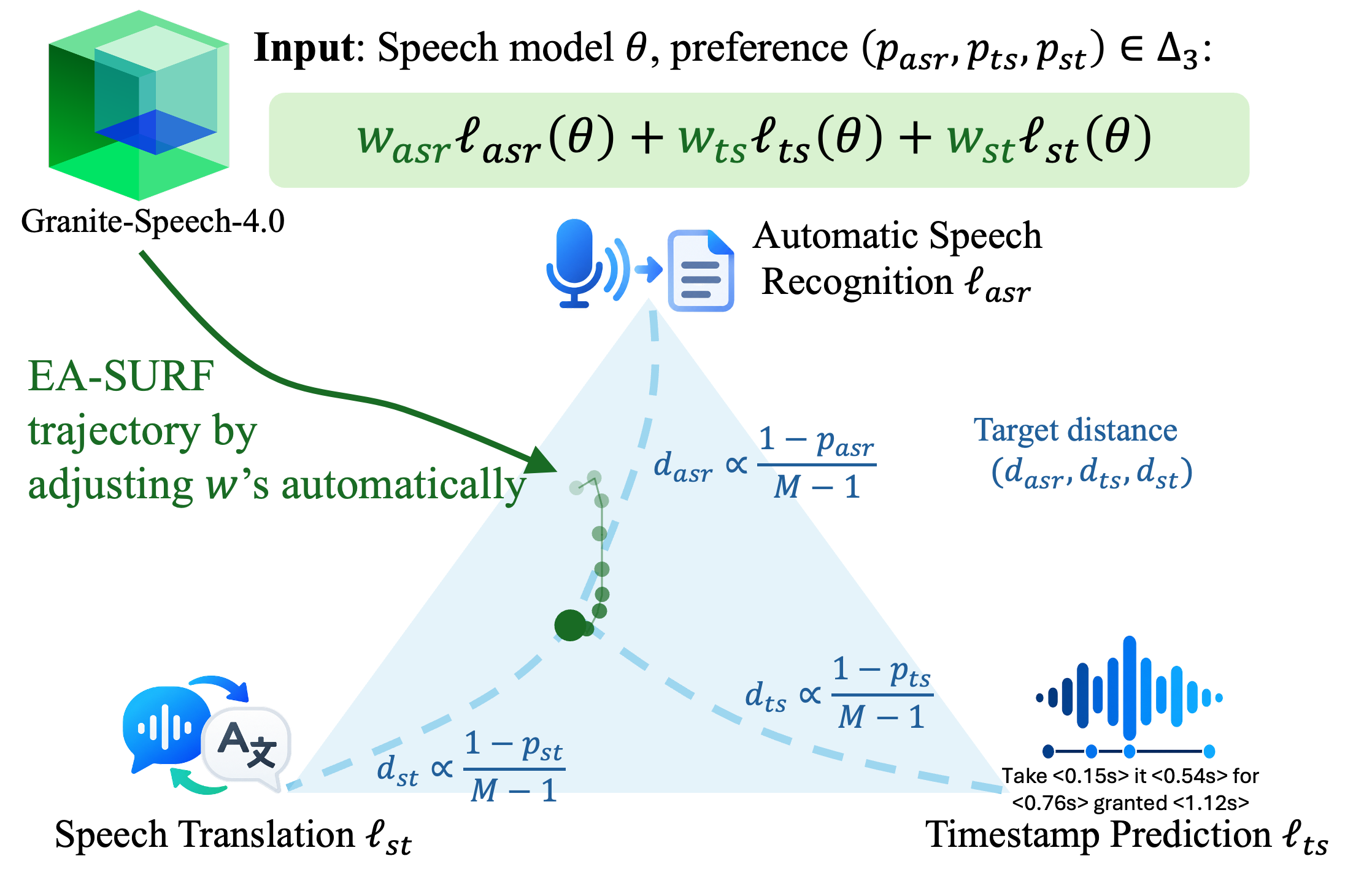
Preference-Aware Pareto Steering for Multi-Task Speech LLMs
This paper proposes EA-SURF, a method that dynamically adapts loss weights during training to steer multi-task speech LLMs toward any desired performance trade-off along the Pareto front. Unlike standard fixed-weight training, it maps deployment preferences to target task-performance shares and iteratively adjusts scalarization weights to converge toward the requested operating point, with theoretical guarantees.
Abstract
Speech large language models (LLMs) perform multiple tasks, including automatic speech recognition (ASR), timestamp prediction (TS), and speech translation (ST). Joint training of speech LLMs creates task trade-offs, yet standard training with fixed loss weights does not generally control the resulting trade-off according to deployment preferences. To address this, we propose Endpoint-Anchored Preference-Aware Sampling Uniformly along the Pareto Front (EA-SURF), an a priori method that adapts scalarization weights so that the resulting task trade-off reflects the desired preference. EA-SURF retains the standard weighted-loss training pipeline, tracking the current model's performance relative to each task-specific reference and adapting the scalarization weights as training proceeds. We theoretically show that EA-SURF can match a desired preference, with the update becoming stationary at the target under checkable regularity conditions. Across six three-objective speech LLM requests, EA-SURF empirically converges toward the requested targets and increases endpoint-inclusive normalized hypervolume by 17.8% over fixed loss weighting.
EA-SURF (Preference-Aware Pareto Steering) dynamically adapts loss weights during training to navigate the Pareto front of multi-task speech LLM performance. Given deployment preferences expressed as target task-performance shares, it iteratively adjusts scalarization weights with theoretical convergence guarantees — enabling operators to dial in exactly the trade-off they need without repeated full training runs.
Contextual ASR
Two distinct strategies for making speech recognition hotword-aware.
Hotword biasing — getting ASR to correctly recognize rare, domain-specific terms given a candidate list — is a perennial challenge. Today we have two complementary approaches: one reasoning-based, one acoustic-verification-based.
The reasoning approach from the Institute of Information Engineering, CAS, inserts a structured thinking step between audio and transcript.
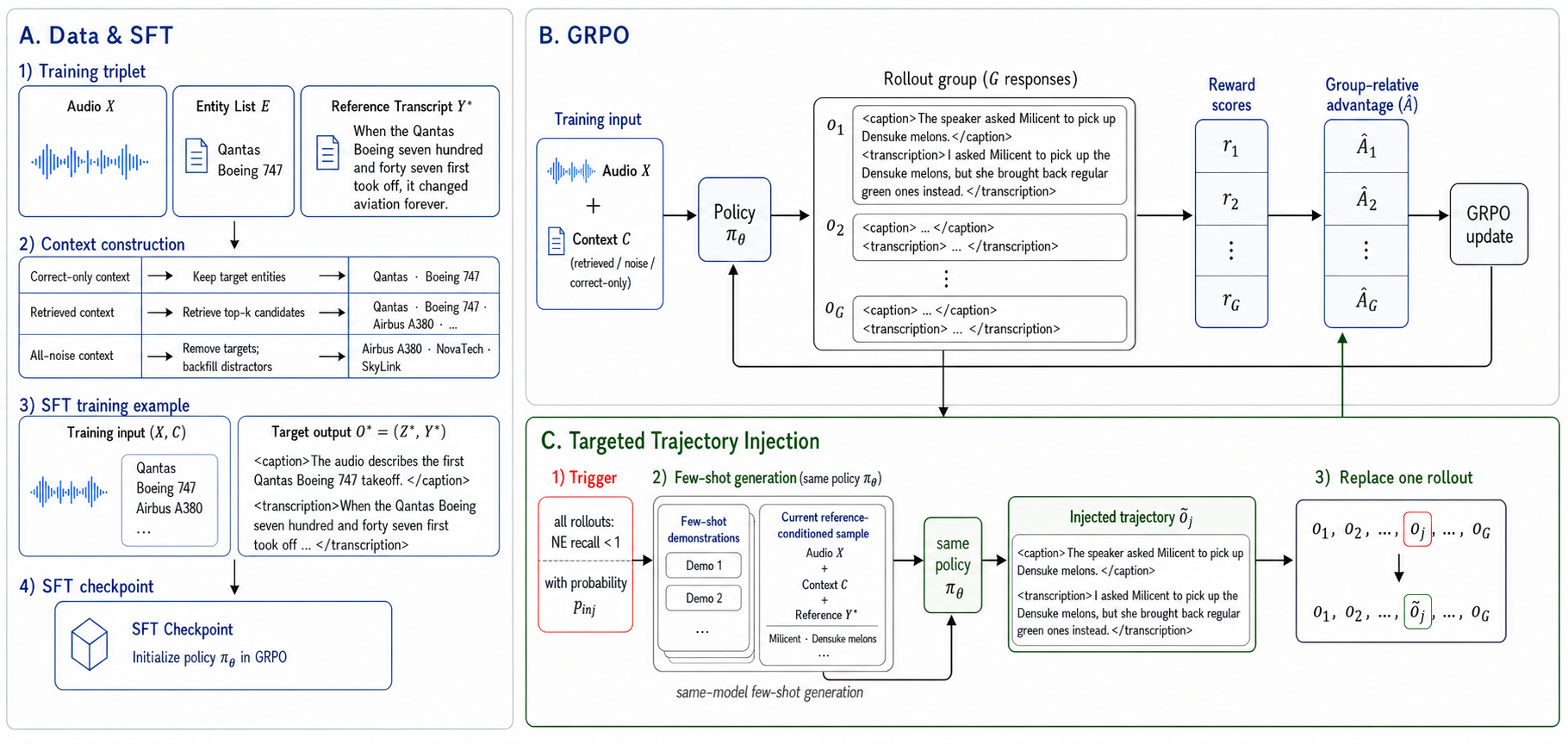
Think Before You Transcribe: Context-Steered Reasoning for Hotword-Aware Speech Recognition
This paper introduces a context-steered reasoning framework that generates an intermediate audio-grounded caption before ASR transcription, allowing the model to assess candidate hotword relevance before making lexical decisions. The approach uniquely mitigates the problem of incomplete or incorrect context candidates by adding structured reasoning between acoustic evidence and final output, strengthened with targeted trajectory injection for policy optimization.
Abstract
Contextual automatic speech recognition (ASR) improves rare-entity recognition by supplying candidate hotwords, but retrieved candidates may be incomplete or incorrect. A reliable system must therefore exploit a relevant candidate without allowing unsupported alternatives to override the acoustic evidence. We propose a context-steered reasoning framework that generates a short, audio-grounded caption before transcription. This task-specific representation lets the model assess candidate relevance before making a lexical decision. Supervised fine-tuning establishes the structured caption-to-transcription behavior, while targeted trajectory injection strengthens group relative policy optimization when difficult utterances yield only unsuccessful rollouts. Experiments across diverse context conditions show that the proposed method consistently improves both transcription quality and hotword recognition while remaining robust to irrelevant candidates.
Think Before You Transcribe generates an intermediate audio-grounded caption before committing to a transcription, allowing the model to assess which candidate hotwords are acoustically plausible before making lexical decisions. This intermediate reasoning step is especially valuable when the candidate list is noisy or incomplete. Policy optimization is sharpened with targeted trajectory injection — a form of RL fine-tuning guided by reasoning traces.
The acoustic-verification approach from Shanghai Jiao Tong University goes in a complementary direction: skip the LLM reasoning and verify candidates directly against the acoustic signal.
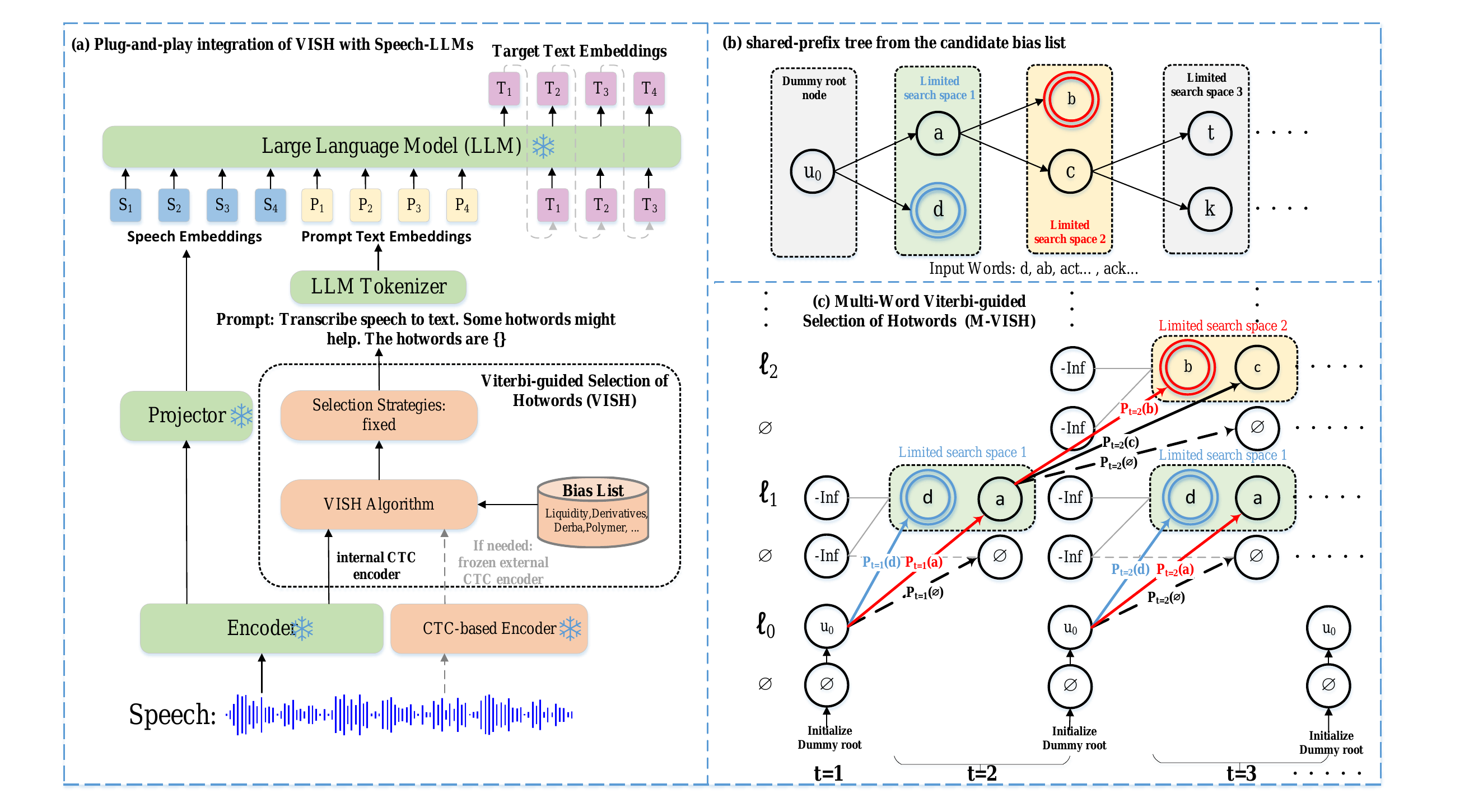
VISH-ASR: Viterbi-Guided Selection of Hotwords for Speech-LLM Contextual ASR
This paper proposes VISH, a training-free framework that selects contextual hotwords for ASR by directly verifying acoustic support using frame-level CTC posteriors, rather than relying on discrete ASR hypotheses or separately trained retrieval models. The approach scales efficiently through Viterbi-guided shared-prefix search and bidirectional evidence exploitation, achieving both higher accuracy and 75% latency reduction compared to learned baselines.
Abstract
Prompt-based contextual ASR requires selecting a compact hotword subset from large dynamic inventories, yet existing pre-selection methods rely either on discrete ASR hypotheses that may discard acoustic evidence or on separately trained retrieval models. We propose Viterbi-guided Selection of Hotwords (VISH), a training-free, plug-and-play framework that directly verifies candidate-specific acoustic support over frame-level CTC posteriors. VISH formulates pre-selection as constrained posterior search; M-VISH makes large-list verification scalable through frame-synchronous shared-prefix Viterbi search with bounded top-K pruning, while Bi-MVISH exploits complementary backward evidence for robust verification. Across five benchmarks, M-VISH achieves up to 11.7% absolute improvement in Best-F1 over a strong learned-retrieval baseline and reduces candidate-search latency by 75.2% at 2,000 candidates relative to hypothesis-based filtering. These results demonstrate the effectiveness of posterior-level verification for accurate and scalable hotword pre-selection without additional model training.
VISH-ASR selects contextual hotwords by checking acoustic support using frame-level CTC posteriors via Viterbi-guided shared-prefix search, with bidirectional evidence exploitation. Because it's training-free and operates on existing CTC outputs, it scales efficiently and achieves both higher accuracy and 75% latency reduction versus learned retrieval baselines — a compelling case for acoustic grounding over learned heuristics.
Trending on Hugging Face
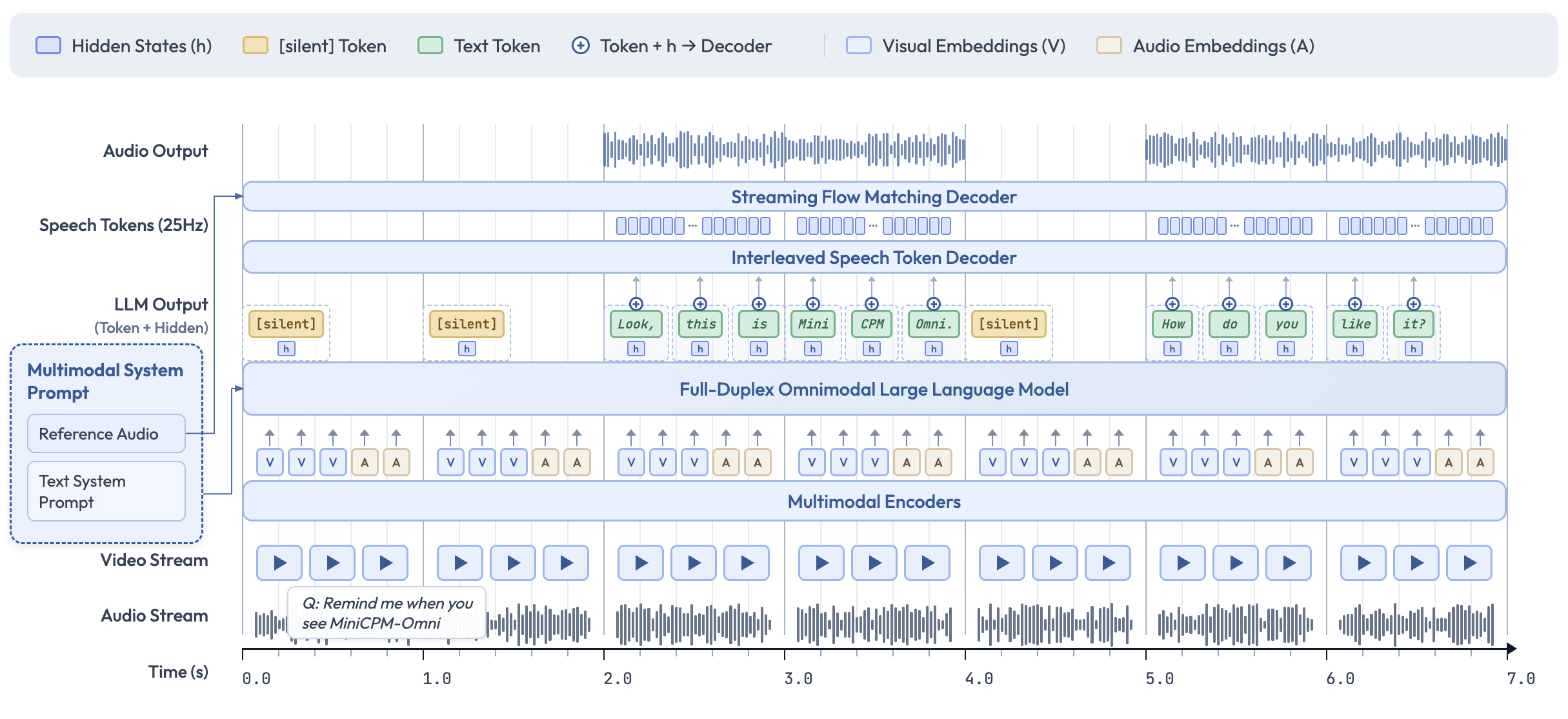
MiniCPM-o 4.5: Towards Real-Time Full-Duplex Omni-Modal Interaction
MiniCPM-o 4.5 enables real-time full-duplex interaction where perception and response happen simultaneously across vision, audio, and speech. Its Omni-Flow framework aligns multimodal signals on a shared timeline, supporting both reactive and proactive behaviors in continuous, streaming conversation.

VoiceMem: Streaming Dual-Brain Memory for Real-Time Interaction
VoiceMem introduces a dual-brain streaming memory architecture for speech language models that improves retrieval accuracy, emotional personalization, and real-time efficiency.

Fish Audio S2 Technical Report
Fish Audio S2 is an open-source text-to-speech system with multi-speaker capabilities, multi-turn generation, and instruction-following control through natural-language descriptions, utilizing a multi-stage training approach and production-ready inference engine.