
Voice Control, Timbre Localization, and Adaptive Codecs in Speech Synthesis
Today's digest digs deep into speaker controllability across TTS, voice conversion, and cross-lingual cloning — plus new findings on where timbre actually lives in speech signals and a variable-rate codec that budgets tokens intelligently.
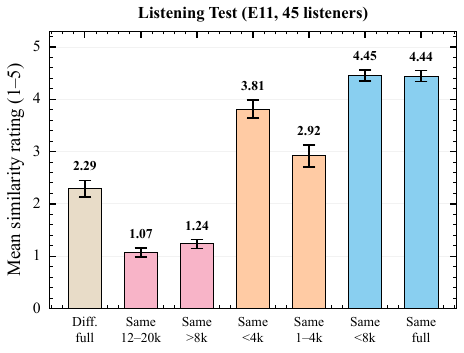
Listening test. Low/mid-frequency same-speaker pairs receive high similarity ratings; high-frequency-only pairs receive low ratings. From King Abdullah University of Science and Technology.
Today's six papers converge on a single underlying question: how do we precisely control speaker identity and prosody in generative speech systems? Answers come from multiple angles — streaming voice conversion, cross-lingual accent suppression, character-level prosody tokens, latent geometry analysis, adaptive tokenization, and a principled investigation of where timbre physically hides in the signal. Together they sketch a sharper picture of what it means to truly control a voice.
---
Voice Conversion & Streaming
Making voice style conversion fast, steerable, and accent-aware in real time.
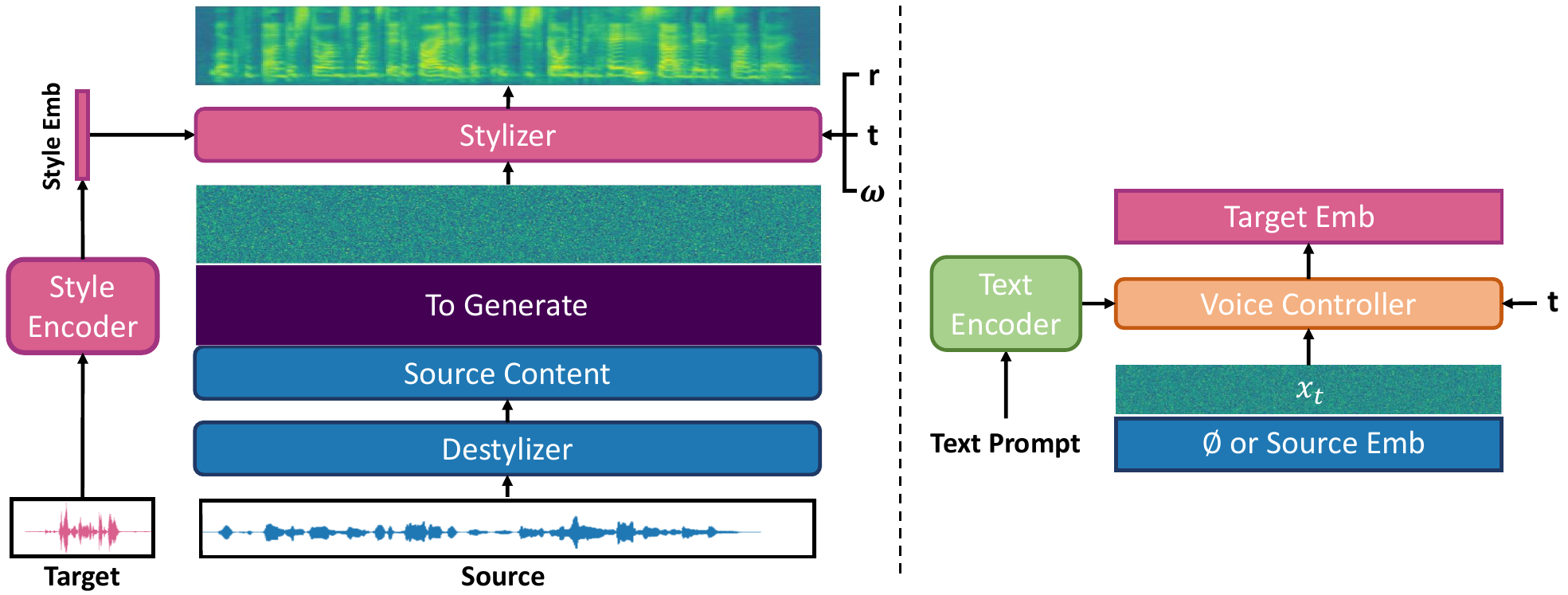
Streaming voice conversion has long struggled with latency and limited controllability. UC Berkeley's StyleStream 2.0 attacks both problems at once, cutting end-to-end latency to 520 ms on a consumer GPU — a 2× reduction over its predecessor — while adding a text-conditioned interface that lets users design voices from natural-language prompts or surgically edit specific attributes like accent or emotion. The system transforms source speech to match target timbre, accent, and emotion while preserving linguistic content, making it a strong candidate for live dubbing and real-time communication applications.
StyleStream 2.0: Fast and Controllable Streaming Voice Style Conversion
StyleStream 2.0 enables fast, streaming voice style conversion that transforms source speech to match target timbre, accent, and emotion while preserving linguistic content. Unlike its predecessor, it achieves 2× latency reduction (520ms on consumer GPU) and introduces a text-conditioned interface for both voice design from natural language prompts and precise voice editing of specific attributes.
Abstract
Voice style conversion (VSC) aims to transform a source utterance to match the timbre, accent, and emotion of a target voice while preserving linguistic content. StyleStream 1.0 introduced the first streamable zero-shot VSC system with state-of-the-art conversion quality, but remained limited in two ways: approximately 1s end-to-end latency on consumer hardware, and the lack of a text-based interface for designing or editing target voices. We present StyleStream 2.0, a fast and controllable streaming VSC framework that addresses these limitations. To reduce latency, we train a few-step pixel MeanFlow model and further fine-tune it with autoregressive feedback inspired by Self Forcing, improving robustness under streaming inference. This reduces end-to-end latency to 520~ms on a consumer GPU, a 2x speedup over StyleStream 1.0, while maintaining conversion quality. To enable controllable style manipulation, we remove the mel-spectrogram context and instead route target style information through a compact style embedding. In this embedding space, we train a unified text-conditioned flow matching model that supports both text-based voice design, which maps natural language prompts to voice styles, and instruction-based voice editing, which modifies a specific attribute of a source utterance while preserving the rest. Experiments show that StyleStream 2.0 achieves the strongest target style fidelity on VSC, voice design, and voice editing, while remaining competitive on intelligibility and non-edited attribute preservation.
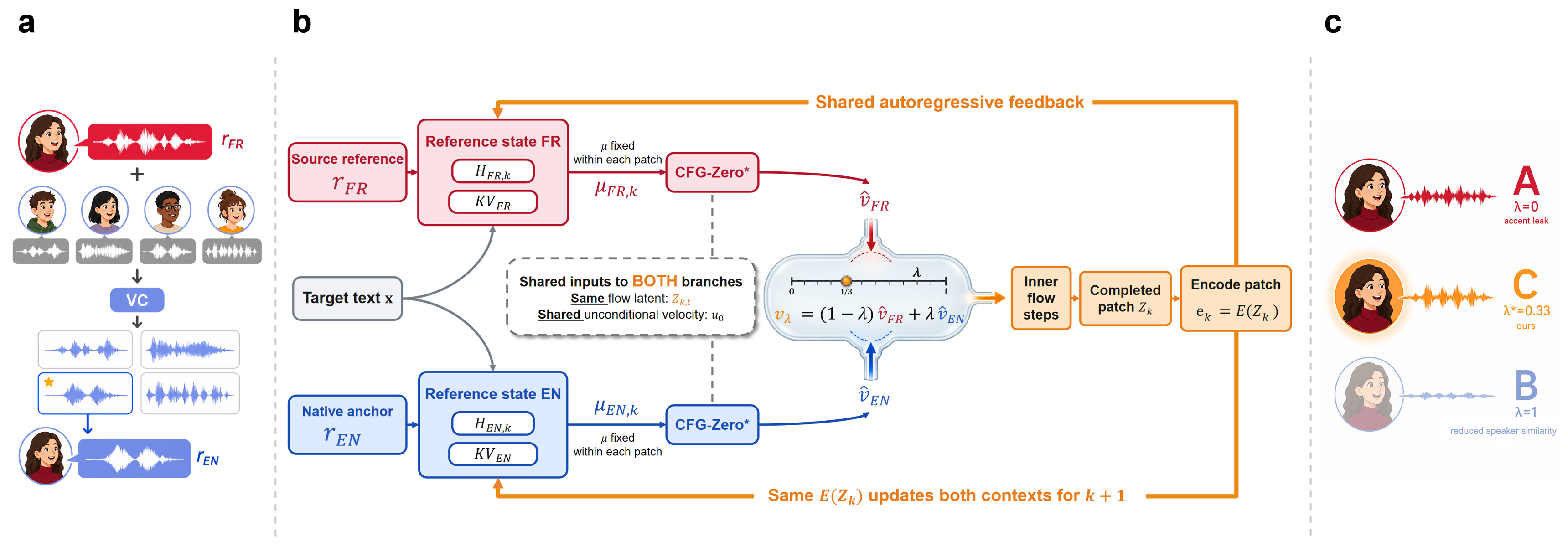
Accent leakage is one of the thorniest failure modes in zero-shot cross-lingual voice cloning: the model tends to bleed the target speaker's native accent into the synthesized output. Tsinghua University's closed-loop dual-reference guidance addresses this by pairing the original reference utterance with a reusable native-anchor speaker — constructed once via voice conversion — whose separate language-model hidden states guide synthesis while staying synchronized to emitted speech. Because the anchor is built once rather than reconstructed per utterance, the method achieves strong accent reduction without the per-utterance conversion overhead that would make it impractical.
Closed-Loop Dual-Reference Guidance for Accent Control in Cross-Lingual Voice Cloning
This paper addresses accent leakage in zero-shot cross-lingual voice cloning by proposing closed-loop dual-reference guidance. It pairs the original reference with a reusable native-anchor speaker (constructed once via voice conversion), whose separate language-model states guide synthesis while staying synchronized to emitted speech—achieving strong accent reduction without per-utterance conversion overhead.
Abstract
Zero-shot cross-lingual voice cloning often carries the reference speaker's accent into the target language. We propose closed-loop dual-reference guidance, which pairs the original reference with a reusable native anchor constructed by voice conversion (VC). The references initialize separate language-model (LM) states that guide a shared acoustic trajectory; each completed patch then updates both states, keeping their generated histories aligned with the emitted speech. Anchor construction runs once per speaker, and online synthesis uses a frozen TTS model without per-utterance VC. On 20 held-out French speakers, the fixed setting $λ^{\!*}=0.33$ reduces residual French LID mass by 73\% versus direct cloning, at an ECAPA similarity cost of only $0.042$; relative to anchor-only cloning, it recovers $0.155$. The method achieves the lowest mean WER ($0.009$) and highest mean GOP ($4.750$) among the held-out test arms. In blinded preference tests, native-English listeners favor it over direct cloning on pronunciation naturalness, and over both anchor-only cloning and a TTS$\to$VC cascade on speaker identity. Online RTF is approximately 26\% lower than the cascade's ($0.59$ vs.\ $0.80$), and the same setting reduces Spanish LID mass by 56\% without re-tuning.
---
TTS, Prosody & Speaker Control
Fine-grained controllability at the character level, a rethinking of what latent representations actually govern, and smarter token budgeting.
Utterance-level style control is a blunt instrument — for film dubbing or audiobook production, you need to sculpt prosody character by character. Alibaba DAMO Academy tackles this for Mandarin TTS by embedding fine-grained prosodic markers (pitch, duration, energy, pause) as special tokens directly in the text, then fine-tuning an LLM-based TTS backbone to interpret them. Crucially, the base model architecture is untouched, which lowers the cost of adoption and keeps the approach compatible with existing LLM-TTS pipelines.
Character-Level Prosody Control for Mandarin Speech Synthesis:An Architecture-Preserving Approach
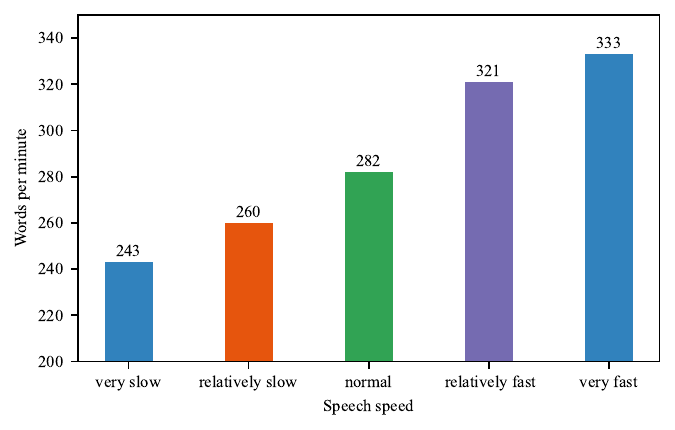
This work enables character-level prosody control for Mandarin TTS by embedding fine-grained prosodic markers (pitch, duration, energy, pause) into text as special tokens and fine-tuning an LLM-based backbone to interpret them. Unlike prior utterance-level style control, this approach delivers precise temporal adjustments at individual character positions—essential for film dubbing and audiobook production—while preserving the base model architecture.
Abstract
This paper addresses fine-grained prosody control for large-language-model (LLM) based text-to-speech (TTS) synthesis of Mandarin Chinese, motivated by multimedia content-creation scenarios---film dubbing, audiobook production, and interactive voice interfaces---in which prosodic adjustments must be placed on specific characters rather than applied uniformly to whole utterances. We present a data-driven framework in which fine-grained prosodic markers (pitch, duration, energy, and pause) are automatically extracted from raw audio at scale and embedded into the text stream as out-of-vocabulary Unicode symbols. The LLM of an existing TTS system is then fine-tuned to interpret these markers while its architecture remains unchanged, yielding character-level temporal control that complements existing utterance-level style control. An optional text-LLM front-end can translate natural-language instructions into marker sequences. Experiments on 2.15M Mandarin utterances (5,858 hours) with CosyVoice2 as the backbone demonstrate reliable control of character duration, pitch, pause duration, and global speaking rate, with perceptual quality essentially preserved. A cross-tokenizer analysis further indicates that the ASR-optimized tokenizer of the backbone attenuates prosodic variation relative to reconstruction-oriented alternatives---an observation we report as hypothesis-generating evidence for prosody-sensitive system design.
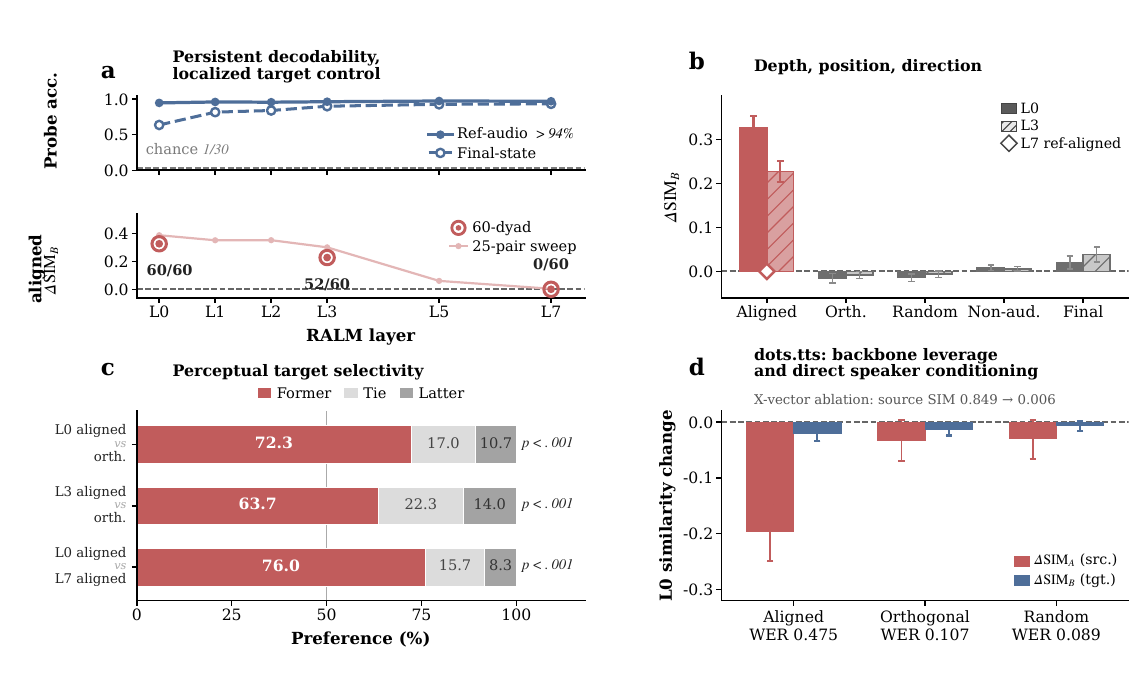
A foundational assumption in TTS representation design — that high decodability of speaker identity implies good controllability — turns out to be wrong. Baidu Research's systematic layer-wise intervention study shows that effective speaker control requires geometric specificity in the latent space and computational pathways that route speaker information directly toward acoustic synthesis. High probing accuracy in a representation doesn't mean interventions on that representation will causally steer the output, a distinction that should reshape how practitioners evaluate and design speaker conditioning modules.
Decodability Is Not Controllability: Local and Anisotropic Speaker Control in Continuous-Latent TTS
This work reveals that high decodability of speaker identity in latent representations does not guarantee causal controllability in text-to-speech. Through systematic layer-wise interventions, the authors show that effective speaker control requires geometric specificity and computational pathways that route speaker information directly to acoustic synthesis—challenging conventional assumptions about representation design for control.
Abstract
High linear decodability does not entail causal controllability in continuous-latent text-to-speech (TTS). In VoxCPM2, position-matched probes and equal-norm interventions across 30 speakers and 60 directed dyads expose this separation: reference-audio states at the final residual acoustic language model layer (RALM L7) retain 0.970 probe accuracy, yet aligned edits yield 0/60 target-dominant dyads. Edits at early reference-audio positions produce the opposite pattern. At L0, pair-aligned updates increase target similarity by 0.326 and achieve target dominance in all 60 dyads, against at most 1/60 under any equal-norm direction or position control. Independent speaker encoders, retrieval against held-out speaker prototypes, and double-blind listening confirm that the shifted voice is heard as the intended target. Cross-architecture interventions in dots.tts distinguish backbone leverage from direct acoustic control: backbone edits displace the source without target attraction, while x-vector ablation reduces source similarity from 0.849 to 0.006. These findings identify two requirements for training-free speaker control: geometric specificity and a computational route that carries the intended speaker condition into acoustic synthesis.
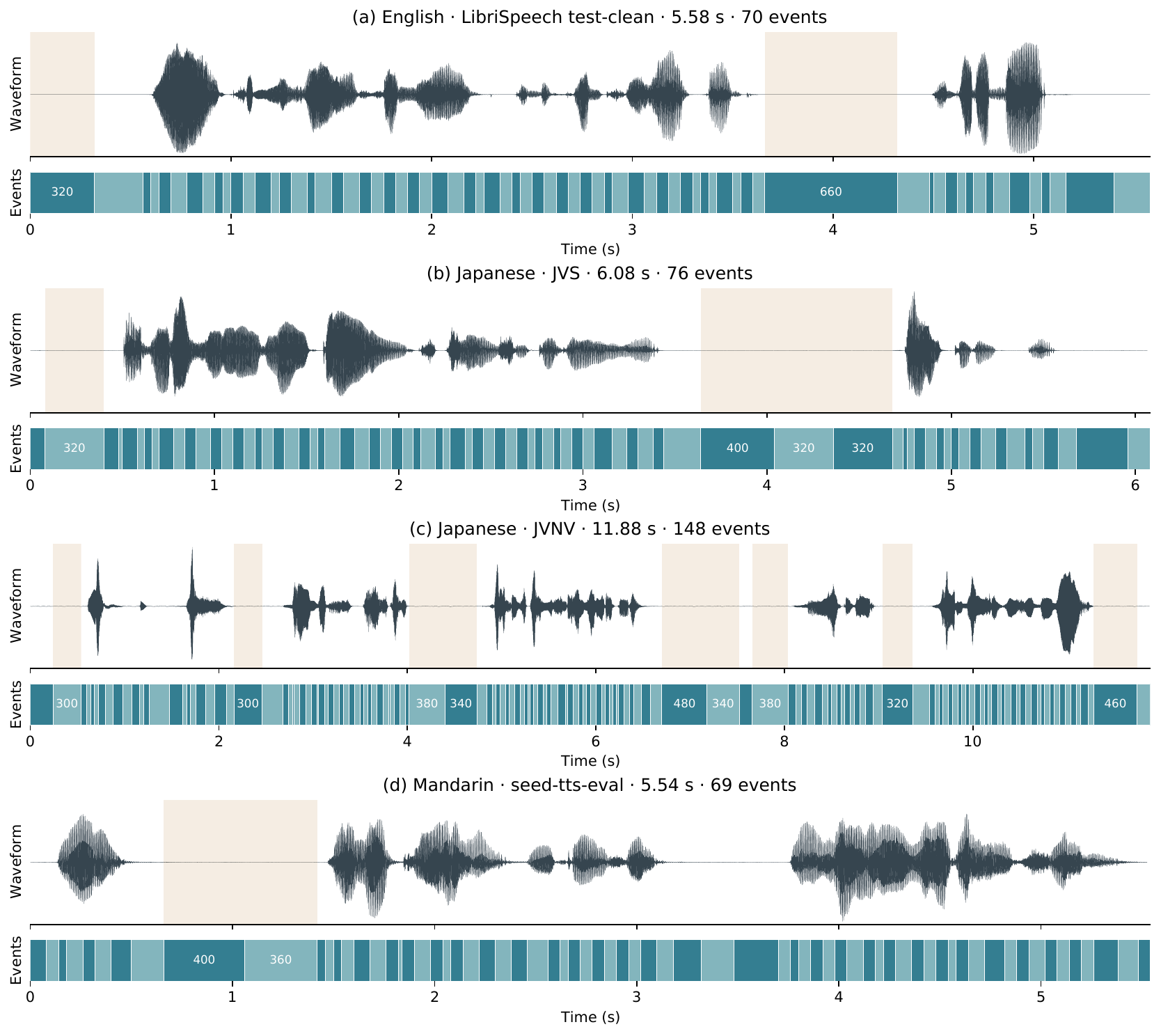
Fixed-frame-rate codecs waste tokens on silence and steady-state vowels while under-sampling complex transitions. RubatoCodec from Third Intelligence flips this by adaptively allocating tokens based on speech content, enforcing an exact utterance-level budget and supporting streaming decoding. The result is shorter sequences without quality loss — and it outperforms fixed-rate codecs in reconstruction fidelity across multiple languages, making it a practical drop-in for LLM-based TTS backends.
RubatoCodec: Budgeted Adaptive Speech Tokenization with Streaming Decoding
RubatoCodec is a variable-frame-rate speech codec that adaptively allocates tokens based on speech content, reducing sequence length without sacrificing quality. Its exact utterance-level budget and streaming decoding enable efficient text-to-speech generation while outperforming fixed-rate codecs in reconstruction fidelity across multiple languages.
Abstract
Neural speech codecs provide discrete tokens for speech generation. Lower frame rates shorten token sequences, but each token must then carry more linguistic and acoustic information. Variable-frame-rate codecs address this trade-off by adapting token allocation to speech content, but threshold-based allocation lets content determine the token count, so the sequence length a speech generator must produce varies across utterances and datasets at a fixed setting. We present RubatoCodec, a variable-frame-rate speech codec built on X-Codec-2 with an exact utterance-level event budget and streaming decoding. Its Adaptive Firing mechanism uses changes in codec features and waveform spectra to divide speech into variable-duration events without a learned boundary predictor. Discrete codes and an explicit duration represent each event, allowing a speech generator to predict and decode one event at a time. Controlled experiments show that adaptive allocation outperforms fixed-rate coding in reconstruction fidelity and intelligibility at low event rates. A model trained on large-scale multilingual speech achieves competitive reconstruction quality across English, Japanese, and Mandarin, with the best intelligibility preservation among the compared codecs on the evaluated English and Japanese benchmarks at comparable bitrates. In a matched text-to-speech comparison, the adaptive representation yields lower WER and higher UTMOS and UTMOSv2 with comparable speaker similarity. The speech generator also learns the codec's utterance-level event budget without an explicit generation-time rate constraint. These results demonstrate that budgeted adaptive speech representations support both high-quality reconstruction and streaming text-to-speech generation. Code and weights are available at https://github.com/third-intelligence/RubatoCodec and https://huggingface.co/third-intelligence/RubatoCodec.
---
Speaker & Timbre Analysis for Generative Speech
Understanding where speaker identity lives in the signal — and what that means for synthesis.
Before you can control timbre, you need to know where it lives. KAUST's analysis systematically probes speech signals across frequency bands, spectral components, SSL model layers, and codec representations using a combination of signal processing, machine probing, and human listening tests. The central finding: perceived speaker timbre concentrates in low–mid frequencies and the spectral envelope, while high-frequency components are machine-discriminative but perceptually irrelevant for speaker identity. This has direct implications for where TTS and voice conversion systems should condition or filter speaker information — and may explain why some conditioning strategies work better than their probing scores would predict.
Where Does Timbre Hide? Localizing Speaker Information in Speech Signals
This paper systematically localizes where speaker identity information resides in speech signals across frequency bands, spectral components, SSL layers, and codecs. By combining signal analysis, machine probing, and human listening tests, it reveals that perceived speaker timbre concentrates in low–mid frequencies and spectral envelope, while high frequencies remain only machine-discriminative—guiding where speech generation systems should condition or filter speaker information.
Abstract
Timbre similarity is a key evaluation target for generative speech systems, including voice conversion, speaker-cloning text-to-speech, and zero-shot speech models. When the generated voice does not match the target speaker, the problem often reflects imperfect separation of speaker-related timbre from content, making it important to identify where timbre information resides and which representations still carry it. Using speaker identity as a measurable proxy, we probe frequency bands, phase/magnitude structure, WORLD source/filter decomposition, voiced/unvoiced regions, self-supervised learning (SSL) layers, EnCodec/HuBERT tokens, and a 45-listener test across Mandarin, English, and Japanese speech/singing data. Speaker information is distributed: 1--8 kHz magnitude and vocal-tract spectral-envelope structure dominate perception, above-8 kHz bands remain machine-discriminative, shallow SSL layers expose compact speaker information, and token leakage depends on tokenizer/layer choice. These findings indicate where generation systems should condition on or transform speaker information, and where content, codec, and token pipelines should audit residual speaker leakage.
Trending on Hugging Face
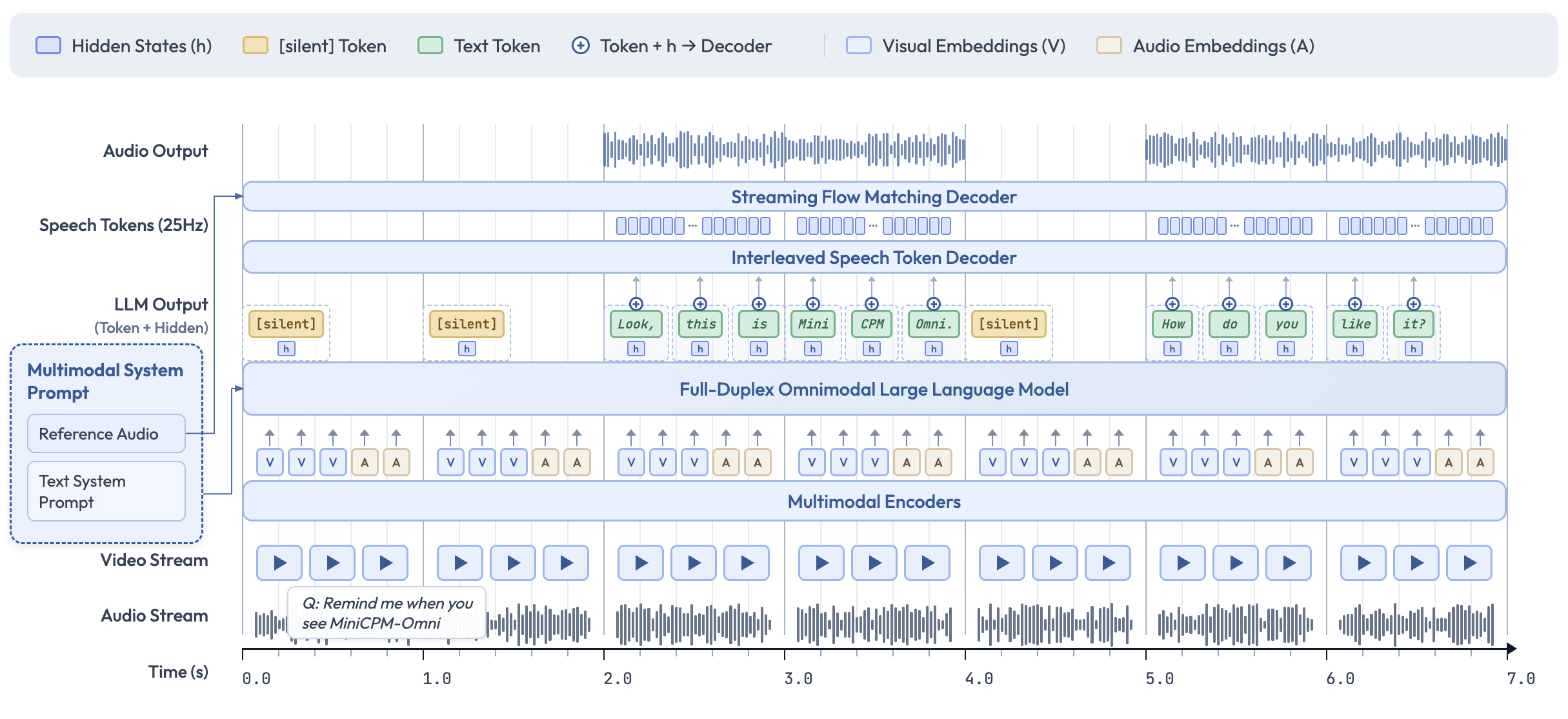
MiniCPM-o 4.5: Towards Real-Time Full-Duplex Omni-Modal Interaction
MiniCPM-o 4.5 enables real-time full-duplex interaction where perception and response happen simultaneously across vision, audio, and speech. Its Omni-Flow framework aligns multimodal signals on a shared timeline, supporting both reactive and proactive behaviors in continuous, streaming conversation.

OmniFlatten: An End-to-end GPT Model for Seamless Voice Conversation
A novel GPT-based model, OmniFlatten, enables real-time natural full-duplex spoken dialogue through a multi-stage post-training technique that integrates speech and text without altering the original model's architecture.

Qwen3-TTS Technical Report
The Qwen3-TTS series presents advanced multilingual text-to-speech models with voice cloning and controllable speech generation capabilities, utilizing dual-track LM architecture and specialized speech tokenizers for efficient streaming synthesis.

Fish Audio S2 Technical Report
Fish Audio S2 is an open-source text-to-speech system with multi-speaker capabilities, multi-turn generation, and instruction-following control through natural-language descriptions, utilizing a multi-stage training approach and production-ready inference engine.

IndexTTS: An Industrial-Level Controllable and Efficient Zero-Shot Text-To-Speech System
IndexTTS, an enhanced text-to-speech system combining XTTS and Tortoise models, offers improved naturalness, enhanced voice cloning, and controllable usage through hybrid character-pinyin modeling and optimized vector quantization.